Virginia DMV Expands Mobile ID Program to Northern Virginia

Virginia Mobile ID file photo The Virginia Department of Motor Vehicles is rolling out its Mobile ID program across Northern Virginia, allowing residents to store a state-issued driver’s license or ID on their smartphones at no cost.
The expansion follows a successful launch in the Richmond area. The digital credential can be used at DMV customer service centers, TSA checkpoints at more than 350 U.S. airports — including Reagan Washington National and Washington Dulles — 16 pilot Virginia ABC stores in Northern Virginia, and a growing number of restaurants, wineries and breweries across the state.
Virginia Secretary of Transportation Nick M. Donohue said the rollout reflects the state’s push toward modernizing how residents interact with government services. “The future of identification is now in the hands of Virginians,” Donohue said. “The more we use Virginia Mobile ID, the more businesses and organizations will see the value and convenience and will start accepting it themselves.”
To get started, residents download the Virginia Mobile ID app from the App Store or Google Play, scan their physical license or ID, complete a face verification and can begin using the mobile credential immediately. DMV officials are advising residents to continue carrying their physical ID card as a backup, particularly when driving.
The app gives users control over what personal information they share during verification. Someone purchasing alcohol, for example, can confirm they are over 21 without disclosing their name and address or handing over their phone.
Virginia DMV Commissioner Dr. Gerald Lackey said the program is designed with both convenience and security in mind. “Virginia Mobile ID is made for Virginians, and we encourage everyone to give it a try. It’s free, secure and right in the palm of your hand.”
Businesses can accept the mobile ID through a free Virginia Mobile ID Verifier app. A QR code scan transmits customer data securely between devices, and DMV says no data is stored or tracked on its end. More than 100 businesses and organizations statewide currently accept the credential.
Virginia DMV said it is working to expand acceptance locations and make the ID available through digital wallets. The Virginia ABC authority plans to bring the program to additional stores once the current pilot is complete.
More information is available at the Virginia DMV’s website.
Information from a release. Edited by Dan McDermott.
Data center tax breaks are on the chopping block in some states

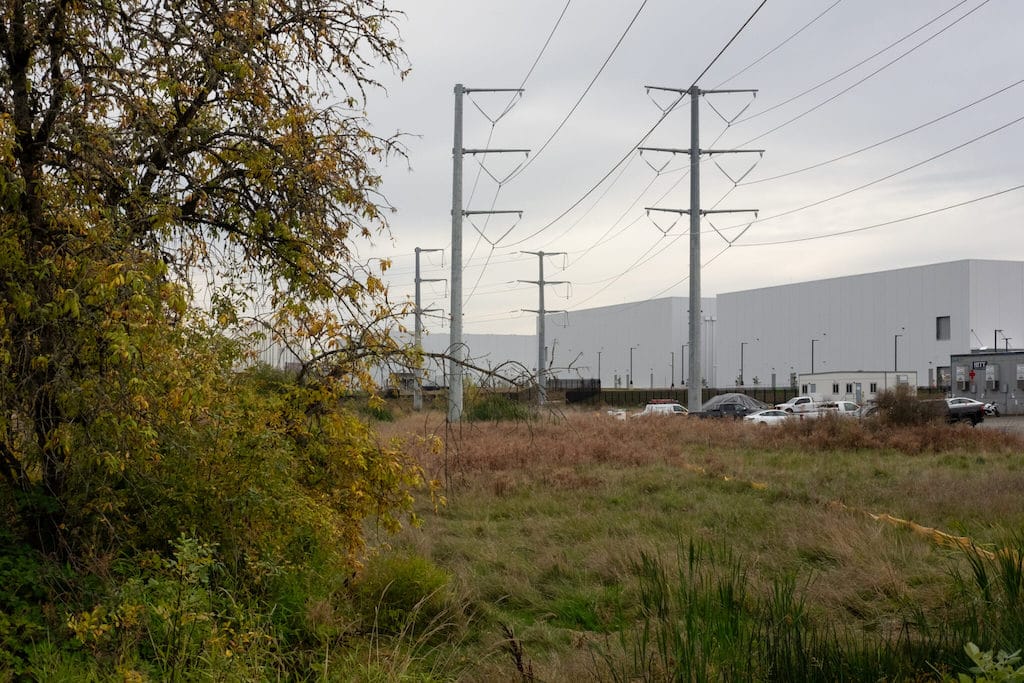
QTS Data Centers Hillsboro 3 Data Center in Hillsboro, OR, October 11, 2024. By Madyson Fitzgerald | Virginia Mercury
After years of states pushing legislation to accelerate the development of data centers and the electric grid to support them, some legislators want to limit or repeal state and local incentives that paved their way.
President Donald Trump also has changed his tone. Last year he issued an executive order and other federal initiatives meant to support accelerated data center development. Then last month, he cited rising electricity bills in saying technology companies that build data centers must “pay their own way,” in a post on Truth Social.
As the momentum shifts, lawmakers in several states have introduced or passed legislation that aims to rein in data center development by repealing tax exemptions, adding conditions to certain incentives or placing moratoriums on data center projects. Virginia lawmakers, for example, are considering ending a data center tax break that costs the state about $1.6 billion a year.
“Who is actually benefiting from these massive data centers that, in many cases, are the size of one or two shopping malls combined?” asked Michigan Democratic state Rep. Erin Byrnes, who introduced a proposal to repeal the state’s data center tax exemptions. “They have a large footprint in terms of land and energy usage. And by and large, it’s not going to be the average resident who lives near a data center who’s going to benefit.”
Over the past few years, more data centers have been built in an effort to meet the demand for digital processing power, which has rapidly increased as more artificial intelligence systems come online. Data centers house thousands of servers that are responsible for storing and transmitting data required for internet services to work.
But as local communities voice growing outrage over rising electricity prices and environmental concerns brought by data centers, such as water and energy use, lawmakers in several states are hoping to slow data center development. By limiting incentives or placing moratoriums on new projects, state legislators are hoping to give themselves more time to determine whether the massive facilities are worth losing millions or more in tax revenue each year.
Some experts also say that developers and tech companies have exaggerated some of the benefits they bring to local communities. While the promise of new jobs sounds attractive, local leaders may face other concerns, such as the effects of diverting construction resources away from other purposes and higher energy costs caused by AI, said Michael Hicks, an economics professor at Ball State University in Indiana.
“A lot of households — and the people that are elected by households — and local governments are becoming more unnerved by the public pushback to data centers,” Hicks said.
Tech developers and data center operators are concerned, however, that the changes could hurt the rapidly growing industry. And most states and localities already require developers using incentives to follow certain requirements, said Dan Diorio, the vice president of state policy for the Data Center Coalition, a lobbying group for the data center industry.
State lawmakers have to consider how changes to incentive programs could upend years of construction, which has long-term business impacts, Diorio said.
“I think data centers are very much the backbone of the 21st-century economy,” he said. “We’re generating economic activity in states, contributing to state-level GDP, contributing significantly to labor income and state and local tax revenue, and creating significant amounts of jobs. I mean, we’re just jumping into something preemptively here.”
Incentives granted
At least 37 states offer incentives that are available to data centers, including sales tax exemptions and property tax abatements, according to the National Conference of State Legislatures. Sales tax exemptions, the most common incentive, allow data center developers to buy computers and other equipment at a much lower cost.
“I think these are one of many factors that the data centers are looking at, along with the cost of electricity, the cost of construction, land and things like that,” said Nicholas Miller, a policy associate at NCSL. “These incentives are one way that states are trying to pitch themselves as competitive to this industry.”
In 2020, Maryland implemented a program that exempts data centers from sales and use taxes if they provide at least five jobs within three years of applying to the program and invest at least $2 million in data center personal property. The first four years of the program cost the state $22 million — but $11 million of that came in 2024 alone, as the costs grew, Democratic state Del. Julie Palakovich Carr said.
Concerned about this and the impact of data centers on residents’ electricity bills, Palakovich Carr introduced legislation this year that would repeal the state’s sales and use tax exemptions for personal property used at data centers. The measure, which is under consideration in the House, would also restrict localities in the state from eliminating or reducing assessments for personal property used in data centers, which drew opposition from the Maryland Association of Counties.
The amount of money states are forfeiting to provide tax breaks for data centers is increasingly concerning, Palakovich Carr said.
“Unfortunately, that’s the turn we’re seeing across many other states,” she said. “The price starts out maybe in line with what we think it’s going to be. But over time it just costs more and more.”
Similar bills that would repeal or halt state incentives for data centers have been filed in Arizona and Georgia.
“When we look at potential subsidies for businesses, I’m really looking at it from a frame of incentivizing new behavior rather than just giving away money for things that the companies were going to already do anyways,” Palakovich Carr said. “I think it’s really important that once these things get put in place, we look at the data and see what’s happening on the ground.”
In 2024, Michigan enacted sales and use tax exemptions on certain data centers through at least 2050.
Now, with developers looking at more than a dozen sites for potential data centers, public sentiment has soured, said Byrnes, who had voted against the measure. Communities across the state began organizing in an effort to stop data centers from coming to their neighborhoods because of environmental concerns and energy costs, she said.
The outcry prompted Byrnes to co-sponsor a bipartisan package of three bills that would repeal the 2024 law.
“We’re taking a stand with this legislation to say that we don’t believe data centers should be offered these exemptions,” she said. “I believe it aligns with public sentiment.”
Lawmakers in a handful of states — including New York, Oklahoma and Vermont — have filed bills that would place a temporary moratorium on all data center projects and require studies of their impacts.
Georgia Democratic state Rep. Ruwa Romman introduced a measure this session that would put a moratorium on new data center projects until March 2027. The proposal would give the legislature time to study the impact of data centers on the state’s natural resources, environment and other areas.
“We have such a beautiful state and it would be a damn shame to completely and utterly wreck it and its landscape for short-term gain,” Romman said. “These data centers aren’t bringing jobs. They’re saying they’re bringing the revenue, but there’s a ton of fine print on the revenue that’s coming in. So, I’ve been urging my colleagues from every side of the political spectrum to just take a beat.”
In 2021, the Oklahoma legislature approved a measure from current Republican House Speaker Kyle Hilbert that excludes new data centers from qualifying for an exemption program that allows certain manufacturers not to pay property taxes for their first five years in business. Any data centers that qualified for the program in the five years prior to the law, however, can continue to apply for exemptions.
This year, as more project proposals were made, Hilbert introduced legislation to ensure no data centers could “slip through the cracks.”
“These aren’t the days of being able to build a data center, cut deals with NDAs, then start turning dirt before the constituents even know what’s happened,” Hilbert said. “Those days are over, and data centers need to be proactive in their messaging and talking to people about their concerns.”
Costs vs. benefits
Last year, Virginia, home to the most data centers in the country, gave up $1.6 billion in sales and use tax revenues from data centers, state data shows. That’s a 118% increase from the previous year, according to a report from Good Jobs First, a watchdog group that focuses on economic development incentives. Another report from the group said Georgia is expected to lose at least $2.5 billion to data center sales tax exemptions this year, 664% higher than the state’s previous estimate.
Virginia state lawmakers are considering legislation that would require data centers to achieve high energy efficiency standards and decrease their use of diesel backup generators in order to be eligible for the state’s sales and use tax exemption. The measure, which passed the House, is now moving through the Senate.
Before the end of his term, former Virginia Gov. Glenn Youngkin, a Republican, suggested a provision in his proposed state budget that would extend the data center tax incentive from 2035 to 2050. The Senate’s budget bill, however, would end the incentive altogether on Jan. 1, 2027. It’s not clear if state leaders, including current Democratic Gov. Abigail Spanberger, support the measure.
While states can put a specific number on the tax losses, it’s much more difficult to determine how much data centers contribute to local communities and the state, Miller said.
Virginia brings in a significant amount of revenue from the property taxes for each facility. Local construction firms, restaurants and other small businesses also benefit from ongoing projects, he said.
“This is the big question,” Miller said. “With all economic development projects, it’s generally a lot easier to measure the cost of the incentive directly versus the benefits.”
The changing incentive landscape may cause instability within the data center industry, said Diorio, of the Data Center Coalition. Data center projects are large-scale capital investments that play out for several years, but changing policies could upend that progress.
“When states look at these policies or consider abrupt ends to programs, that creates significant market uncertainty,” Diorio said. “It will have a significant long-term impact on the viability of that market for data center development. Industries are very responsive to market signals, and any kind of uncertainty will bring up a red flag because you’re looking to invest for the long haul.”
Stateline reporter Madyson Fitzgerald can be reached at [email protected].
This story was originally produced by Stateline, which is part of States Newsroom, a nonprofit news network which includes Virginia Mercury, and is supported by grants and a coalition of donors as a 501c(3) public charity.
Lawmakers reshape Youngkin’s final budget with focus on affordability, no new taxes
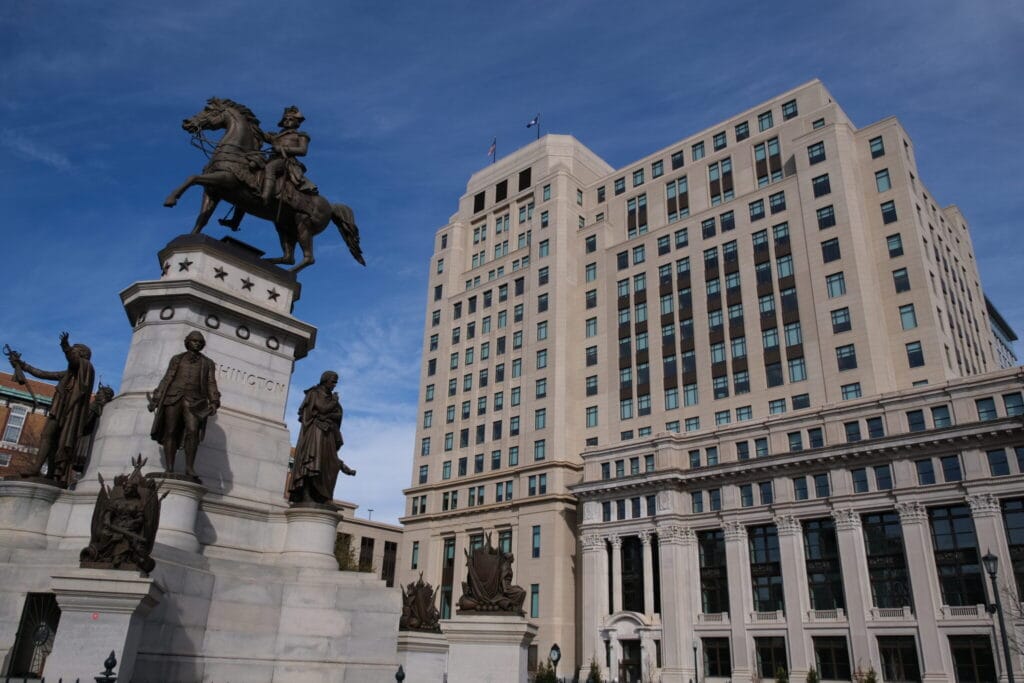
The General Assembly Office Building in Richmond’s Capitol Square. (Photo by Graham Moomaw/Virginia Mercury) By Markus Schmidt | Virginia Mercury
The Virginia General Assembly’s money committees on Sunday rolled out sweeping amendments to former Gov. Glenn Youngkin’s proposed two-year, $212 billion state budget, with both the House and Senate advancing plans that emphasize affordability, backfill federal funding gaps and avoid new taxes as they reshape the Republican’s final spending blueprint.
The Senate Finance Committee’s Senate Bill 30 would end a data center sales tax exemption and set the stage for the state to potentially reap millions in revenue from the industry.
The spending plan would also deliver $100 in tax rebates to individual filers and $200 to joint filers, raise the standard deduction, protect Medicaid, fund 3% annual teacher raises, invest $50 million in affordable housing and provide $205.7 million for Metro over the biennium.
The House Democratic plan, branded the “Affordable Virginia Budget,” similarly prioritizes housing, health care and education, but diverges in some spending details — including larger direct investments in the Virginia Housing Trust Fund and a broader package of worker protections and labor initiatives.
Both chambers are expected to pass their respective proposals next week — the House on Thursday — before negotiators reconcile differences in a conference committee in the coming weeks.
Notably, neither plan includes new taxes, which prompted Sen. Richard Stuart, R-King George, to vote for the Senate budget in committee, while three of his Republican colleagues abstained.
“I can’t tell you how much I appreciate the fact that there are no tax increases in this budget, that you’ve kept a very conservative forecast of revenues going forward, that we have not built the base budget, but we’re using one-time monies,” Stuart told Senate Finance Committee Chair Louise Lucas, D-Portsmouth.
“But more than that, I’ve been here for a long time, and you are the first Finance chair that I remember that actually took and listened to our considerations and our suggestions, and I very much appreciate that. And I just wanted to say that, Madam Chair.”
Lucas, visibly surprised, replied: “Thank you very much, I really appreciate that compliment, I didn’t see that one coming. Where are the tissues?”
Reworking Youngkin’s final budget
Youngkin on Dec. 17 unveiled his final proposed budget, pitching a plan he said built on record revenue growth and sustained his administration’s tax-relief priorities as Democrats prepared to take control of both the General Assembly and the governor’s office.
The proposal anticipated continued economic strength, with what Youngkin described as a “prudent” revenue forecast rooted in job and business growth. It preserved reserve balances while advancing nearly $730 million in new, ongoing tax cuts and maintaining income tax conformity with recent federal policy changes.
On the spending side, Youngkin targeted public safety, health care and education, including bonuses and salary increases for teachers and state employees, while projecting a balanced budget over the six-year forecast window. He acknowledged at the time that his successor and the Democratic-led legislature would ultimately reshape the plan.
Senate Democrats argued Sunday that his outgoing proposal left “significant structural deficiencies,” particularly by not planning for new federal cost shifts under HR1, including potential state matching requirements for food assistance.
Lucas said the Senate amendments were built around affordability and long-term fiscal balance.
“It’s the entire mantra of this session,” she said. “The committee has delivered a budget focused on affordability, while still maintaining structural balance.”
Data centers and tax cuts
A central change in the Senate plan would allow the data center sales and use tax exemption to end on Jan. 1, 2027. Originally projected to cost $1.54 million annually, the exemption now forgoes roughly $1.6 billion per year in revenue, according to Senate Democrats.
“In the most recent fiscal year alone, they benefited from more than $33.2 billion dollars in tax-free computer equipment purchases,” Lucas said. “We’re asking data centers to pay their fair share in sales tax to help deliver our core services — education, transportation, and social services.”
By ending the exemption, the Senate would direct nearly $300 million to transportation across all modes and make one-time investments in water infrastructure, Lucas said, while avoiding additional tolls or fees.
The Senate plan also includes a one-time tax rebate to be issued around Oct. 15 and increases the standard deduction by $450 for individuals and $900 for married filers.
“By exempting more income from taxation, Virginians get immediate relief in their paychecks. That’s affordability,” Lucas said.
Health care and federal uncertainty
Health and Human Resources Subcommittee Chair Creigh Deeds, D-Charlottesville, said the Senate confronted rising Medicaid costs projected at $3.2 billion in general fund spending through fiscal 2028.
Medicaid and the Children’s Health Insurance Program cover 1.8 million Virginians, he said. The subcommittee adopted $591.2 million in savings strategies and set aside a $90 million reserve while restoring the prenatal care program.
With enhanced federal Affordable Care Act tax credits having expired Dec. 31, Deeds warned that up to 100,000 Virginians could lose coverage. The Senate includes $200 million in the first year to subsidize premiums.
The House proposal similarly emphasizes backfilling federal reductions.
Health and Human Resources Subcommittee Chair Rodney Willett, D-Henrico, said the House recommends $79.1 million to reduce premium spikes, $45 million to restore federal reductions for core public health services and more than $211 million to cover new state cost shares for SNAP benefits.
“We feel it is a prudent and responsible decision to act now,” Willett said, to ensure uninterrupted access to food benefits.
The House plan also includes $11.1 million for a sickle cell disease package and funding to improve maternal and infant health programs.
House Appropriations Committee Chair Luke Torian, D-Prince William, said his chamber’s budget “backfills those holes, not out of politics, but out of prudence.”
“This is a balanced budget,” Torian said. “It is built on conservative revenue assumptions, maintains healthy reserves, and prepares us for continued uncertainty ahead.”
Education and housing
On education, the Senate proposes 3% raises each year for teachers and state employees, along with $50 million for a childcare pilot to match employer contributions.
Education Subcommittee Chair Mamie Locke, D-Hampton, said the Senate plan adds more than $627 million in general fund support over the biennium, including increased funding for at-risk students, special education and school construction through a 1% local option sales tax for renovation projects, pending local referendums.
In higher education, the Senate recommends $159.4 million in additional funding, including $65 million for need-based financial aid and $32.5 million for workforce credential grants.
The House budget also invests heavily in K-12 and early childhood education.
Elementary and Secondary Education Subcommittee Chair Delores McQuinn, D-Richmond, said it includes $400 million in one-time flexible funding for school divisions and $160 million in additional special education support, along with $160 million for early childhood education to clear childcare waitlists for families earning below 85% of the state median income.
On housing, the Senate wants to invest $50 million in its housing trust fund and $13 million for eviction prevention, while the House directs $187.5 million to the Virginia Housing Trust Fund, establishes a $25 million revolving loan fund for mixed-income housing and provides $17 million for eviction prevention.
Balancing new revenues
Anne Oman, staff director for the House Appropriations Committee, said the caboose budget signed by Gov. Abigail Spanberger on Friday increased current-year general fund resources by $3.1 billion, leaving $2.3 billion to carry into the new biennium.
The proposed budget assumes modest 3% to 3.5% annual revenue growth, though year-to-date collections are running at 6.9%.
Adjustments eliminate Youngkin’s proposed tax cuts, capture nearly $80 million from a business-ready site acquisition fund and recognize potential revenue from skill games legislation, projected at about $176 million annually if enacted.
After accounting for $1.8 billion in additional spending, the House plan leaves an unappropriated balance of $15.2 million at the end of the biennium, Oman said.
Despite bipartisan moments, some Republicans voiced caution.
“I want to say thank you to you,” Senate Minority Leader Ryan McDougle, R-Hanover, told Lucas. “This has been a challenging process, and I appreciate the fact that you and I can have candid conversations as we’ve worked through this.”
He added: “Today, I am going to vote to abstain, because of some of the significant physical impacts that I’m concerned about in Virginia as we continue to discuss. This budget has a significant amount of additional revenues up and above the proposed budget, and I think we need to have a serious conversation about where those revenues come from, how they impact Virginians, and continue to discuss them as we go forward.”
Va. state senator pushes for water testing after 243 million-gallon sewage spill in Potomac River
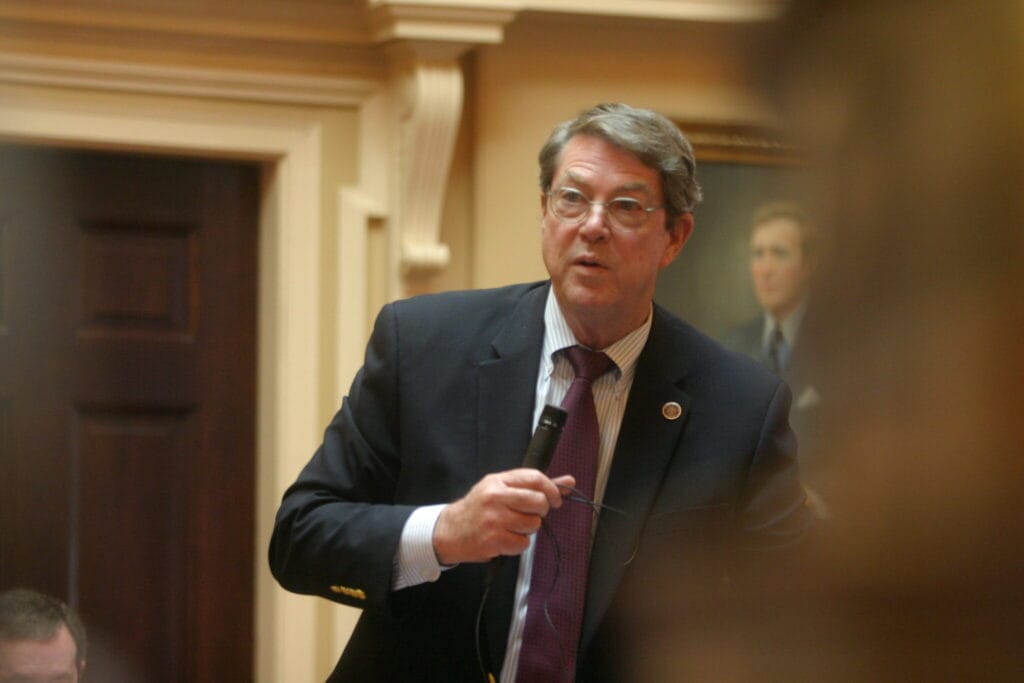
Virginia Sen. Richard Stuart, R-King George. (Photo by Shannon Heckt/Virginia Mercury) By Shannon Heckt | Virginia Mercury
After a decrepit pipe burst in Maryland last month and sent hundreds of millions of gallons of raw sewage spewing into the Potomac River, a Virginia lawmaker is now urging the state’s health department to take concrete steps to address the environmental disaster’s potential health risks to residents.
“This one will trickle down over time, and I’m very worried about the contamination as it goes,” Sen. Richard Stuart, R-King George, said in an interview Friday.
The DC Water system owns the pipe that broke in Montgomery County, Maryland on Jan. 19 and leaked over 243 million gallons of sewage into the waterway. The agency estimates it will take about six weeks for a temporary fix on the pipe – and nine months for a permanent solution.
Meanwhile, the Virginia Department of Health has issued a recreational advisory for 72.5 miles of the Virginia coast along the river, urging people to avoid touching the water and to be cautious when preparing seafood harvested from the river.
VDH has not issued any warnings for drinking water and Maryland has issued a shellfish closure only for the Port Tobacco River region down to the Harry W. Nice Bridge.
After one of his constituents asked VDH about potential contamination, Stuart said he was concerned to learn that the agency was not testing the water given the magnitude of the spill.
“VDH will not conduct water sampling. The agency does not operate a freshwater bacterial monitoring program for recreational waters, and the Potomac River falls under Maryland’s jurisdiction for water quality oversight,” VDH’s Feb. 14 letter read.
Stuart then sent his own letter to State Health Commissioner Dr. B. Cameron Webb.
“Virginians who fish, crab, boat, and recreate on the Potomac deserve proactive protection and transparency, not a declaration that no testing will occur because another state holds primary authority,” Stuart wrote to Webb on Wednesday. “Furthermore, there are miles of creeks and tributaries branching off the Potomac River that are unquestionably Virginia waters, directly impacting the health of our marine resources and shoreline communities that I represent.”

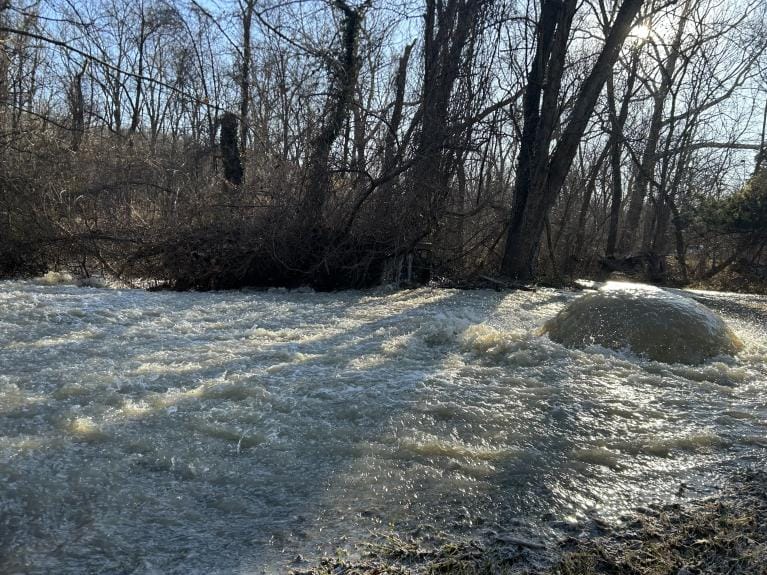
A photo of the sewage spill near Cabin John from late January, shortly after the rupture was discovered. DC Water officials expect it will take weeks to bring the problem under control. (Photo courtesy DC Water) By Friday, Stuart said, the state’s top environmental agency had taken preliminary steps to test state waters.
“I have since learned that (Department of Environmental Quality) is engaged, and they are doing sampling in various places. They were sampling on the edge,” Stuart said Friday. “I asked them if they would please go out into the channel and do various water columns to determine if it’s on the top.”
The Virginia Department of Environmental Quality said in a statement that on Tuesday, the agency collected 25 surface water samples across the recreational advisory area from above the sewer line break to Potomac Creek in Stafford County. The results of those samples are pending.
The agency also said VDH staff “conducted a routine seawater sampling run for shellfish growing areas from Colonial Beach to the 301 (Harry Nice) Bridge, collecting 36 water samples in total. Based on their laboratory analyses, there were no elevated fecal coliform bacteria concentrations, with the vast majority of the samples at or below the detection limit for the test.”
VDH replied to Stuart on Wednesday in a letter obtained by The Mercury.
“We will continue sharing information, including sample results, between VDH, DEQ, Alex Renew, DC Water, MDE and VDEM. VDH staff are also maintaining communication with seafood industry stakeholders and watermen to provide timely, accurate information,” Lance Gregory, Director of VDH’s Office of Environmental Health Services, wrote.
Gregory also said that the agency, in partnership with the Marine Advisory Board, “developed a mapping resource that illustrates the spill’s geographic scope relative to other productive waterways in the Commonwealth. This tool supports affected watermen in communicating clearly about the limited proximity of the incident to other harvesting areas and helps preserve confidence in Virginia seafood.”
The state’s chief executive also weighed in on the disaster on Friday and said the state’s drinking water is safe.
“I’m encouraged that EPA and FEMA have begun coordinating with DC Water to respond to the sewage spill in the Potomac,” Gov. Abigail Spanberger said in a statement. “Amid the response, our state agencies are conducting water quality testing and monitoring the status of repairs. Our focus is on Virginians’ health and safety. Virginians should know that the spill is not impacting our drinking water.”
Members of Virginia’s congressional delegation, along with Maryland officials, have written to DC water about their concerns over the health and environmental impacts of the spill. Still, Stuart is pushing for the state to do more.
“Maryland owns the Potomac, but a lot of people in Virginia make their (livelihood) on it, and we eat a lot of the seafood that comes out of it. It’s a very productive river, despite how badly we treated it over the years,” Stuart said.
Conservation group Potomac Riverkeepers Network agrees with the senator that this extreme of a situation calls for different approaches on how to handle it.
“The historic sewage spill and the ongoing risk of intermittent overflows demands a departure from the status quo,” said David Flores, the Vice President of the Potomac Riverkeepers Network. “Virginians deserve more, not less, water quality monitoring and long-term assessments to protect their safety and the Commonwealth’s natural resources. This responsibility should not be deferred to another state.”
Fairfax casino bill awaits House action

Slot machines are displayed inside the Horseshoe Bossier City casino. Photo: Emilee Calametti / The Center Square By Shirleen Guerra | The Center Square
(The Center Square) – A bill that would allow a casino in Fairfax County is now before the House of Delegates, reviving a debate that has repeatedly surfaced in Northern Virginia.
Senate Bill 756 would add Fairfax County to Virginia’s list of eligible casino host localities. Like the state’s other casino laws, the measure would require voter approval through a local referendum before an operator could receive a license.
The House committee substitute sets new rules for how a Fairfax referendum would work. Even if countywide voters approve a casino, the referendum would fail unless voters in the magisterial district where the casino would be built also approve it.
The substitute also limits any casino site in Fairfax to a coordinated mixed-use development that is at least 1.5 million square feet, according to the draft language. The bill does not restrict the project to Tysons.
The legislation arrives as Virginia’s casino market has moved beyond proposals and into active operations. Casino gaming is operating in Bristol, Portsmouth and Danville, and temporary facilities are operating in other localities as projects move toward permanent resort construction.
The committee substitute would set a different tax structure for Fairfax than the rates used for other cities. For Fairfax, the substitute would impose a 40% tax on adjusted gross receipts from casino gaming.
The substitute also sets a higher state licensing fee for Fairfax. It would require a $150 million, nonrefundable fee when an operator’s license is issued and again if a license is transferred, with half of that fee directed to Fairfax County and half directed to the state Gaming Regulatory Fund.
The Fairfax debate also intersects with a broader policy push to change how gambling is regulated in Virginia.
House Bill 271, which passed the House, would create a Virginia Gaming Commission and consolidated regulatory responsibilities spread across multiple entities. A fiscal impact statement from the Department of Planning and Budget has warned the transition would require administrative restructuring, staffing changes and startup costs, with some fiscal effects uncertain early in implementation.
Fairfax County leaders have also taken a formal position on casino legislation.
In December, the Fairfax County Board of Supervisors voted to add language to its legislative program opposing any casino bill for the county unless the board requests it, a statewide gaming commission is in place and the revenue split “substantially benefits Fairfax County as opposed to the commonwealth.”
Senate Bill 756 passed the Senate and now awaits House consideration.
Poll: Virginians back maps, split on gun laws
By Shirleen Guerra | The Center Square
(The Center Square) – As lawmakers continue debating redistricting and firearm legislation, new polling provides a snapshot of where Virginians stand on both issues.
The results suggest voters largely favor the commonwealth’s existing redistricting framework and support several gun policy changes, though views differ on enforcement and effectiveness.
Those views come from a Roanoke College Poll conducted by the Institute for Policy and Opinion Research.
“Virginians clearly support a variety of gun control measures, but many question their efficacy,” said Dr. Harry Wilson, interim director of the Institute for Policy and Opinion Research. “While majorities back policies such as firearm registration and owner licensing, fewer respondents believe stricter laws alone will make them safer. Many also point to factors beyond gun laws when asked about the causes of mass shootings.”
Wilson said responses on redistricting suggest voters are generally comfortable with Virginia’s current system. He noted that differences between survey wording and the language used in the proposed referendum could affect how voters ultimately view the issue.
Researchers surveyed 800 Virginia residents Feb. 9-16. The poll carries a margin of error of +/- 4.43%.
Sixty-two percent of respondents said they support Virginia’s current redistricting system.
Asked how they would vote on a proposed constitutional amendment tied to redistricting, 52% said they would keep the existing system, while 44% said they would adopt the change.
The findings arrive as redistricting remains an active issue in Richmond.
Democrats have pursued appeals connected to a proposed voter referendum that could reshape how congressional district maps are drawn, while lawmakers also advanced a revised congressional map.
Firearm policy was another major focus of the survey as the General Assembly continues considering related legislation.
Majorities of Virginians expressed support for several gun-related restrictions. Seventy-one percent said gun owners should be required to obtain a license, while 67% supported requiring firearms to be registered with the state.
Support also extended to several proposed firearm bans. Fifty-nine percent said they favor banning firearms commonly described as assault rifles. Fifty-seven percent supported banning semi-automatic rifles, while 53% backed restrictions on magazines holding more than 10 rounds. Half of respondents said they would support banning semi-automatic handguns. Nineteen percent said they support banning all firearms.
Views were more mixed on whether stricter laws would improve safety. Forty-nine percent said tougher gun laws would make them feel safer. Thirty-five percent said such laws would make no difference, while 16% said they would feel less safe.
More respondents said better enforcement of existing laws, 56%, would be more effective at reducing gun violence than passing stricter laws, 42%.
Several firearm-related measures have cleared both chambers of the General Assembly and now await action from the governor.
Beyond policy issues, the poll measured broader voter sentiment about the direction of Virginia and the nation.
Sixty-five percent of respondents said the country is on the wrong track, while 51% said Virginia is headed in the wrong direction.
Gov. Abigail Spanberger received a 53% job approval rating, while 39% disapproved.
Middletown’s Third Black History Celebration Set for February 28, 2026

Middletown’s Black History celebration will be held at Grace Methodist Church on Main Street. “We are elated to celebrate the occasion of the third Black History Celebration in Middletown, Va., on February 28, 2026, from 3:00 to 6:00 p.m. at Grace Methodist Church on Main Street,” said Pastor and Counselor Dr. Diane Newman-Shannon.
“Ms. Ellen Gant of Middletown, my assistant, has worked wholeheartedly beside me on this project each year,” she added.
Grace Methodist Church has generously provided its building, members, and refreshments for the past two years, and organizers would like to publicly thank them for their continued support. Additional sponsors have joined this year’s celebration and will be recognized during the event.
Organizers extend sincere appreciation to everyone who has contributed.
The celebration honors those who have paved the way for people of color, acknowledging what they endured and reflecting on where we are — and where we should be — today.
“Hatred should never be because of the color of one’s skin,” Newman-Shannon said.
The event is intended to educate, uplift, and foster inclusion and mutual respect. It offers a positive approach to diversity — one that dispels misconceptions, reduces prejudice, and promotes understanding.
The goal is simple: to ensure all individuals feel seen, valued, and respected for their unique and diverse backgrounds.
“Everyone is going through something,” she said. “Can’t we all just get along and help one another?”
Together we stand; divided we fall. Organizers encourage the community to show love to one another and come together in unity. As Newman-Shannon noted, “My Bible tells me that God rains on the just as well as the unjust. We all belong to Him. He is not a respecter of persons.”
Featured at the event will be speakers from various churches, step dancers from Skyline Middle School, health and craft vendors, music from gospel groups, and worship dancers.
The community is invited to attend and celebrate together.
“We will see you there,” Newman-Shannon said.
Information from a release. Edited by Dan McDermott.
Winchester Planning Commission removes Pledge of Allegiance from meetings
The Winchester, Va, Planning Commission voted Feb. 17, 2026 to remove the Pledge of Allegiance at meetings. By Dan McDermott | WarrenCountyVa.com
The Winchester, Va. Planning Commission voted 4-2 Feb. 17 to remove the Pledge of Allegiance from its business meetings.
Commissioner Leesa Mayfield brought up the issue during discussion of the commission’s by-laws.
Commissioner Sandra Bloom concurred, saying, “I would prefer that we didn’t do any pageantry or rituals before and we just dive into business.”
Mayfield added, “It seems unnecessary… I second what Commissioner Bloom said. Just jumping into business.”
The vote was 4-2 to make the change.
Vice Chair Mark Dyck: No
Leesa Mayfield: Yes
Brandon Pifer: No
Madelyn Jimenez-Torres: Yes
Sandra Bloom: Yes
Chairman Beau Correll: No
The Winchester, Va. Planning Commission voted Feb. 17, 2026 to remove the Pledge of Allegiance from its business meetings. The Winchester, Va, Planning Commission voted Feb. 17, 2026 to remove the Pledge of Allegiance at meetings. The discussion starts at 1:45:43. Potomac spill draws federal, state responses
Aerial View of Silos by Tom Fisk: https://www.pexels.com/photo/aerial-view-of-silos-12975468/ By Shirleen Guerra | The Center Square
(The Center Square) – A wastewater overflow tied to the collapse of a major sewer pipeline continues to prompt responses from officials in Virginia, Maryland and Washington as repair work advances along the Potomac River.
The incident involves the Potomac Interceptor, a large sewer line that carries wastewater for treatment in the Washington region. District of Columbia Water said a section of the interceptor failed earlier this year, contributing to wastewater discharges into the Potomac River and nearby drainage channels.
Utility monitoring data later indicated that a substantial volume of wastewater was released during the early stages of the failure. D.C. Water said much of the discharge occurred before bypass pumping systems were fully operational.
Crews have since expanded emergency bypass operations and installed additional pumping capacity designed to stabilize flows and prevent further overflows. Repair efforts have focused on gaining safe access to the damaged section of pipe.
In responses to questions from The Center Square, D.C. Water said emergency repairs are expected to take between four and six weeks. Officials said that work will be followed by long-term rehabilitation of the interceptor, a process projected to take approximately nine to 10 months.
Utility officials said the full scope and cost of repairs cannot yet be determined because crews have not been able to fully access the damaged portion of the interceptor. Engineers also said the cause of the failure cannot be determined until the damaged section is accessible.
D.C. Water said it will cover repair expenses, which will be shared among wholesale customers including WSSC Water, Loudoun County and Fairfax County based on allocated pipe capacity.
The Potomac River runs through Maryland, Virginia and Washington, making the overflow a regional concern. The river serves as a drinking water source and supports recreational and commercial activity across multiple jurisdictions.
In Virginia, the Department of Health issued a recreational water advisory covering portions of the Potomac shoreline. State health officials cited reported wastewater releases and ongoing repair work in advising residents to avoid direct contact with river water within the affected area.
Virginia health officials said they had not observed evidence of impacts to drinking water systems.
Federal and state officials have also commented on the incident.
Second-term Republican President Donald Trump said federal agencies were being directed to provide management and coordination support related to the overflow, describing the situation as a serious environmental concern.
Maryland first-term Democratic Gov. Wes Moore, in public statements, said the spill was “basically contained” and used the incident to call for federal approval of FEMA funding for Western Maryland communities still recovering from prior flooding.
Environmental Protection Agency Administrator Lee Zeldin said the agency stands ready to assist, stating that D.C. Water and Maryland officials have been managing containment, monitoring, and regulatory oversight tied to the spill.
Virginia General Assembly advances cannabis retail framework
Products in a display counter at the Cannabis Outlet in Portsmouth advertise high THC concentrations. (Photo by Ned Oliver/Virginia Mercury) By Markus Schmidt | Virginia Mercury
After years of clearing the General Assembly only to meet a veto, legislation to create a legal, adult-use cannabis market in Virginia passed both chambers Tuesday — this time with a governor ready to sign it and retail sales poised to begin as early as November.
The votes mark the clearest signal yet that Virginia is poised to move from legal possession without legal sales to a fully regulated marketplace, a transition that has eluded the commonwealth since 2021, when lawmakers first legalized simple possession.
Tuesday morning, the House passed House Bill 642, sponsored by Del. Paul Krizek, D-Fairfax, by a 65-32 vote. Hours later, the Senate approved Senate Bill 542, introduced by Sen. Lashrecse Aird, D-Petersburg, by a narrow 21-19 margin after an initial failed vote.
Similar proposals have cleared the General Assembly in recent years — often with bipartisan backing — but were repeatedly vetoed by former Gov. Glenn Youngkin. This year, the political calculus has shifted. Democratic Gov. Abigail Spanberger has vowed to sign legislation establishing a regulated retail market.
Under Krizek’s bill, the Virginia Cannabis Control Authority would administer the retail system, with no retail sales allowed prior to Nov. 1, 2026.
“It’s about fixing a status quo that is not working,” he said, noting that while adult possession of cannabis is legal, retail sales remain unregulated.
Right now, he said, the absence of a legal marketplace means “no testing, no standards and no oversight whatsoever.”
The bill, he added, would replace what he described as a $5 billion illegal market with a regulated system designed to protect public health. He pointed to requirements for testing, labeling and packaging, as well as enforcement mechanisms and penalties intended to keep products away from minors.
Krizek said the legislation takes a phased approach to give the Cannabis Control Authority time to implement the framework responsibly. It also preserves local control, granting localities full zoning authority over where and how retail stores operate.
He added that the proposal creates opportunities for small businesses and communities disproportionately harmed by past enforcement and called it “a measured, responsible step forward.”
Legal to possess, illegal to sell
Virginia first decriminalized marijuana in 2020 before lawmakers legalized simple possession.
But they failed to finalize a retail framework before Republicans regained the governor’s mansion, leaving cannabis in legal limbo — legal to possess, illegal to sell.
Over the past year, a joint legislative commission has worked to craft a new roadmap, hearing testimony from regulators, industry experts and advocates about safety, access and equity concerns.
Over the past year, the joint legislative commission held a series of hearings and work sessions to refine the framework, beginning with presentations in August on potential rollout models, followed by October discussions weighing safety, access and equity concerns.
By November, members were reviewing a draft retail blueprint, and in December they unveiled revisions aimed at setting the stage for a 2026 launch.
The Senate version, sponsored by Aird, largely mirrors the House proposal but sets a later retail start date of Jan. 1, 2027.
The measure initially failed Tuesday afternoon after Sen. Adam Ebbin, D-Alexandria, recused himself because he is about to assume a role at the Cannabis Control Authority. Moments later, Ebbin asked for reconsideration, stating he has “no financial interest” in an adult-use cannabis marketplace. On the second vote, the bill passed 21-19.
The substitute measure adopted this week, Aird said, incorporates many elements lawmakers have seen before but also introduces new approaches — starting with governance.
“This new legislation takes on the approach where the Cannabis Control Authority will manage the license and regulatory portions while the marketplace is immediately being stood up,” Aird said.
Taxes, caps and rollout timeline
The measure establishes a state tax rate of 12.875% on retail cannabis sales, along with an additional 3% local option tax. Permit applications would begin in July 2026, and seed-to-sale tracking would start Sept. 1, 2026, ahead of a Jan. 1, 2027 retail launch.
“The transaction limit for retail purchases will remain at 2.5 ounces, which has always been throughout this process,” Aird said.
The legislation outlines standards for a lottery process for impact licensees and creates a tiered cultivation licensing structure based on canopy size, ranging from tiers one through five, with the largest capped at 35,000 square feet.
A maximum of 350 retail licenses would be issued statewide. Cultivation facilities would be capped at 450 through 2028. At-home cultivation would continue to be permitted, allowing up to four plants per household, provided each plant is tagged with the grower’s name and identification.
Local governments would no longer be able to ban cannabis retail through referenda.
The bill also sets THC limits for non-pharmaceutical products at 10 milligrams per serving and 100 milligrams per package. Aird said it includes robust criminal provisions aimed at cracking down on illicit sales and the illegal marketplace.
“There are a lot of details in this legislation,” she said.
If signed by Spanberger, the measures would mark the final step in a yearslong effort to bring structure and oversight to a market that has operated without a legal retail framework.
Aird emphasized Tuesday that many lawmakers contributed to shaping the legislation — a proposal she said reflects extensive collaboration across chambers.
“There are many in this chamber that have helped shape this legislation,” she said.
Virginia’s wage hike to $15 adds more pressure, says small business advocate
By Shirleen Guerra | The Center Square
(The Center Square) – Virginia’s move toward a $15 per hour minimum wage is drawing warnings from small business advocates who say the policy could increase operating costs and place pressure on employers.
The legislation, which cleared both chambers of the General Assembly, is now before Gov. Abigail Spanberger. The governor has already indicated she intends to sign the measure.
“Our members aren’t surprised that the minimum wage increase passed, but they’re frustrated and worried about what will happen next,” said Julia Hammond, state director for the National Federation of Independent Business in Virginia.
Hammond said many small businesses already pay above the minimum wage but warned that state-mandated increases could still trigger broader cost adjustments.
“Raising the state minimum wage would put pressure on employers to pay more to stay competitive and force small businesses to raise prices to cover the costs of the mandate or else try to get by with fewer workers,” Hammond said.
She continued, “Our members already are contending with rising prices. Raising the minimum wage is going to make a bad situation even worse.”
Outside policy groups have also questioned the broader economic effects of minimum wage increases.
A recent report from the Employment Policies Institute points to research suggesting wage hikes are often associated with higher consumer prices. The group cited studies indicating a $1 minimum wage increase has been linked to price increases of up to 5.5%, particularly in industries with higher labor costs.
Under the legislation, Virginia’s adjusted minimum wage of $12.77 per hour would rise to $13.75 per hour beginning Jan. 1. A second increase to $15 per hour would take effect Jan. 1, 2028.
Beginning in 2029, future changes would be tied to inflation using the Consumer Price Index.
Spanberger endorsed the bill following its passage.
“I look forward to signing this legislation into law to give Virginia workers a pay raise,” the governor said in a statement.
State budget analysts say the wage increases will carry direct costs for the commonwealth. According to the Department of Planning and Budget’s revised fiscal impact statement, the bill is expected to increase state spending by $546,761 from the general fund and $489,371 from nongeneral funds in fiscal year 2027.
Once the $15 wage takes effect, projected costs rise substantially. The same analysis estimates general fund spending would increase by roughly $14 million in fiscal year 2028, along with an additional $14.6 million in nongeneral fund expenditures.
Separately, NFIB announced a statewide advertising campaign urging lawmakers to consider the cumulative effects of rising business costs, including labor mandates and regulatory policies.
Lawmakers debate how to regulate data centers’ diesel backup generators
Symmetrical data center aisle illuminated by LEDs. File photo. By Shannon Heckt | Virginia Mercury
There are over 9,000 backup generators that can supply emergency power to Northern Virginia data centers, some of which run on diesel and emit toxins. The use of these generators became a flashpoint in communities concerned about the health impacts of the emissions and fueled legislation in this year’s General Assembly session, as new research sheds more light on how much pollution the generators produce.
The Department of Environmental Quality limits when the diesel generators deemed Tier II can run, which is mostly in emergency situations and during regular testing. But lawmakers who represent areas where hundreds of data centers are concentrated said the emissions from the generators, even just during the testing hours each month, are harmful to the health of surrounding communities.
House Bill 507, sponsored by Del. John McAuliff, D-Fauquier, has been amended to direct the Virginia Department of Environmental Quality to not issue air permits to data centers with generators below the emissions quality of the Tier IV generators, starting with applications after July 2026.
His bill originally required data centers to utilize battery storage as the main backup source and created siting and notification requirements for the generators – but those aspects of the bill have now been removed.
“I will note it’s probably not the final step toward making sure that we have the best possible tech out there and being used, and those generators are being used in the right way for our communities, but it is a very good first step,” McAuliff said in a Feb. 11 committee.
The U.S. Department of Energy allowed data centers in PJM – the regional power grid – to run fully on generator power if they needed to during the frigid cold snap at the end of January, even if it meant going over their permitted emissions. A representative from PJM said no data centers in the Dominion Energy zone needed to kick over to backup power during the emergency order, including in Virginia.
Senate Bill 336 by Sen. Danica Roem, D-Manassas, has been reduced to requiring the State Corporation Commission conduct a study to review the impacts of prioritizing the use of Tier IV generators over Tier II ones. It instructs the commission to consider the environmental impacts as well as costs to data centers to retrofit their back power generation.
In its original version, the bill would have mandated that data centers invest more in pricier but less toxic Tier IV generators.
“We do realize that in the event that we had the 200 some odd (data centers) in Loudoun, plus all the ones in Prince William, if they were running on generators at the same time, there’s not enough hospitals in the entire state that would be even close in league with that,” Roem said in a committee hearing for SB 336. “We are talking about a very specific issue dealing with a very specific industry because of the size and scope of the industry.”
HB1502 by Del. Elizabeth Guzman, D-Prince William, has also been amended to direct DEQ to conduct a one-year study of all standby generators run by commercial entities that are currently permitted to determine which pollutants are emitted – and how much.“We all know that standby generators produce many harmful pollutants. These pollutants have been associated with cardiovascular and respiratory diseases and emergency room visits for asthma, among other health effects,” Guzman said in committee.
SB 336 is now headed to the House while HB 507 and HB 1502 are waiting for final passage on the House floor to be sent to the Senate.
A recent study conducted by the VCU Institute for Sustainable Energy and Environment by Damian Pitt, Ivan Suen, and Ellie Plisko found toxins are being released into the localities where data centers with the diesel generators are concentrated. The study used data from emissions reports in 2023 and compared what the air emissions would be if the data centers would reach their permitted cap.
“Not that anyone thinks they’re all gonna all of a sudden hit 100% of their permits, but it gives you a sense of what is currently allowed,” Pitt said. “It’s pretty shocking, the degree of total emissions exposure that would result in those clustered areas if they were to actually admit their permitted amounts.”

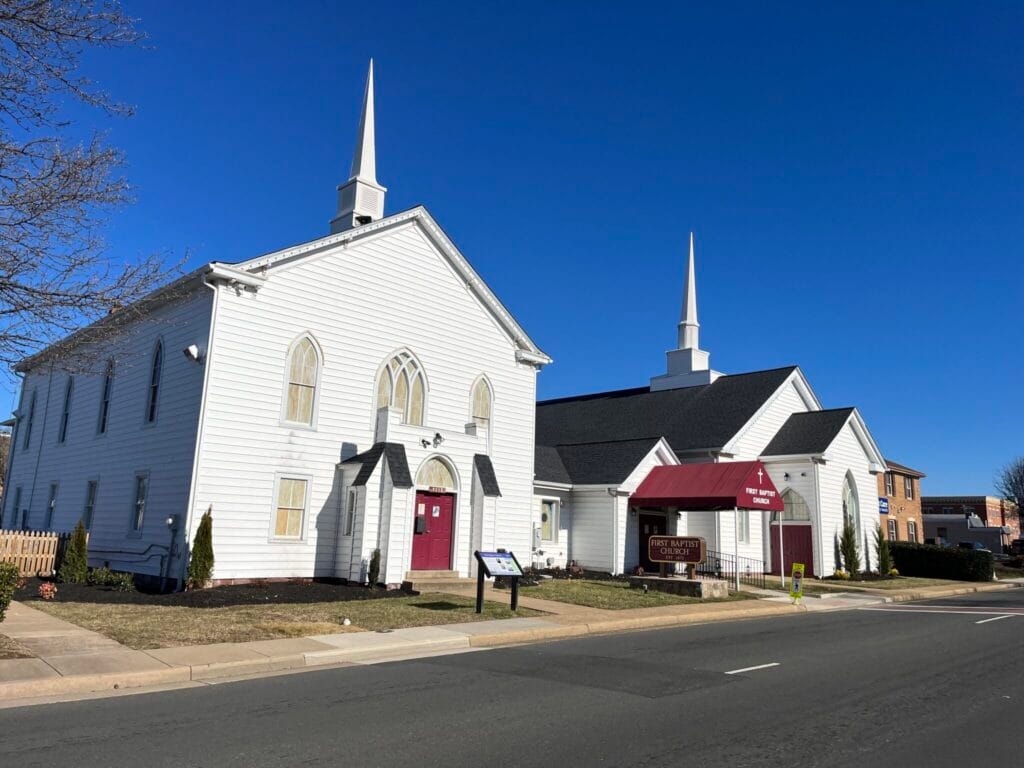
Potential carbon monoxide (CO) emission concentrations from Northern Virginia data centers (Maximum Allowed under DEQ Permits). (Source: “Modeling Localized Air Pollution Impacts from Data Centers in Northern Virginia”/VCU Institute for Sustainable Energy and Environment) Concentrations of carbon monoxide (CO) emissions (tons / sq. mi.) from Northern Virginia data centers (2023) versus select other facilities (2022). (Source: “Modeling Localized Air Pollution Impacts from Data Centers in Northern Virginia”/VCU Institute for Sustainable Energy and Environment) “Our churches are being priced out of Virginia. Lawmakers could help them survive.”

First Baptist Church in Manassas, the parish of Rev. Dr. Keith Savage. (Photo by Devry Becker Jones) By Rev. Dr. Keith Savage, Senior Servant, First Baptist Church of Manassas and Rev. Dr. Michael Sessoms, Pastor, Little Union Baptist Church (Dumfries)
For centuries, the African American church has been the backbone of our Virginia communities. Our congregations — First Baptist Church of Manassas, founded in 1872, and Little Union Baptist Church, established in 1903 — have been places of worship, organizing, refuge and leadership through Reconstruction, Jim Crow, and generations of upheaval.
Today, we face a different kind of threat. It’s quieter than the ones our grandparents faced, but it’s hollowing us out just the same.
It has become unbearably expensive to live in Northern Virginia.
It is our sincere hope that Virginia lawmakers, now debating hundreds of bills during the General Assembly session, will invest in housing solutions to meet the dire needs of our congregants and residents statewide.
We’re losing our people
We have lost count of how many faithful, longtime members have left our region for the Carolinas, Georgia, Texas and Florida. They’re not leaving because they suddenly prefer those states’ politics or because they no longer love this community.
Elders who are retiring and young families trying to raise children simply cannot afford to stay.
Over the past month alone, our two congregations have lost five longtime families to retirement moves down south, where housing is affordable and their savings actually stretch.
Increasingly, our goodbye gatherings outnumber our baptisms.
When these families go, we lose more than numbers. We lose our history. We lose our mentors, our choirs, our ushers, our Sunday school teachers — leaders who invested in our churches for decades. Communities that took generations to build are being slowly dismantled. Not by a lack of faith, but by a lack of housing people can afford.
Even when young families join our churches, many are soon priced out of Prince William County. They’re forced to move farther away or leave Virginia altogether.
It’s not just about church
Every week, people from the neighborhoods surrounding our congregations come to our doors with tears in their eyes, asking for help to make rent. Our food pantry lines grow longer as families are forced to choose: food on the table or a roof over their heads.
And as our congregations shrink, we’re left with fewer resources to help people navigate a crisis that grows more severe by the day.
Virginians across the commonwealth understand this. Polling last summer showed Virginians view housing costs as the single biggest issue facing our state — cutting across region, race, and party.
Despite that consensus, our housing system remains locked in place.
The problem is simple
In much of Virginia, local rules make it illegal or nearly impossible to build the kinds of homes working adults and families actually need. Smaller homes. Apartments. Homes near jobs, transit and existing communities.
With too few homes available, families get pushed into bidding wars. Rents climb. Homeownership slips further out of reach.
This isn’t just a Northern Virginia problem. When one region shuts the door on new housing, pressure builds in the next one, raising prices everywhere. That’s why this statewide crisis requires leadership at the state level — just as Virginia already provides for transportation, education and public safety.
There’s a path forward
This year, the General Assembly is considering several bills that would take meaningful steps forward. And this week, as bills passed by the House or Senate move to the other chamber, lawmakers have several chances to take a stand for affordability.
One promising bill would allow faith institutions like ours to build affordable housing on our own property, with clear standards. That speaks directly to our call to love our neighbors. The House and Senate have passed their own versions of this bill. This week, they must work together to send it to the governor’s desk.
Other legislation would make it easier to add modest homes in existing neighborhoods, redevelop empty strip malls, and eliminate outdated parking rules that quietly drive up housing costs.
None of these proposals are radical. Many other states — red and blue — have adopted similar reforms. They enjoy broad public support. And they would unlock desperately needed homes without costing taxpayers a dime.
Virginia’s new gubernatorial administration campaigned on making life more affordable for families. When it comes to housing — the single biggest expense most households face — this is the test.
It’s one thing to run on affordability. It’s another to summon the courage to break from a failed status quo.
We want Virginia to be a place where people can build a life, raise children, retire with dignity and remain rooted in the congregations and communities they love. But it will require elected leaders truly willing to lead — so our churches, and our people, are not priced out of the commonwealth we have all worked so hard to build.
Grant-Funded Collaboration Between REC and Linebird Shows Efficiency and Safety Potential for Drone Installation of Reliability Sensors

REC and Linebird team members watch the successful installation of a fault current indicator by drone in early January. Fredericksburg, Va. — Last month, Rappahannock Electric Cooperative (REC) collaborated with Richmond-based startup Linebird to install fault current indicators on cooperative-owned live power lines using a drone equipped with Linebird’s non-conductive payload system and new sensor-installing tool. The partnership is the result of a Virginia Power Innovation Program Award Linebird earned from the Virginia Department of Energy. The sensor placement helped prove the applicability of Linebird’s concept and technology.
Linebird has developed drone technology for electric infrastructure maintenance, the Osprey Nonconductive Payload System. The technology is designed to enhance lineworker safety during live line work. Virginia Energy backed the project to reduce the risks associated with traditional maintenance methods, and for its potential to save lives and improve efficiency of grid operations, according to the Department’s original announcement of the award.
“Fault current indicators have been used on REC’s electrical grid for a long time. What really impressed us was the ability to reach those hard-to-access lines that are typically difficult for our equipment to reach. Reducing the need for heavy equipment in challenging rights-of-way enables us to install more indicators on the grid efficiently, improving safety and controlling costs for our members. Plus, we get better visibility into faults, loading, and capacity, which matters more and more as demand continues to grow,” said Daniel Dewey, REC’s Sr. Director of Operations and Construction – Eastern Region
“Linebird is proud to share this milestone with REC,” said Michael Beiro, Linebird Founder & CEO. “The ability to install hotstick-deployable sensors on live lines with our Osprey NPS technology is one the market’s been asking for since our early days. We’re grateful to the Virginia Department of Energy and the Virginia Power Innovation Program for supporting this effort and we look forward to leveraging the results to accelerate smart grid deployments in the Commonwealth and around the world.”
About the Virginia Power Innovation Program
The VPIP is for the purposes of research and development of innovative energy technologies, including nuclear, hydrogen, carbon capture and utilization, and energy storage; and to award grants on a competitive basis from the Fund to support energy innovation in the Commonwealth of Virginia. Information about additional grant opportunities through VPIP is available online.
About Linebird
Emerging from independent student research supported by a Fortune 500 power utility, Linebird was originally developed to answer a simple question: can drones be used by utilities not just as eyes in the skies, but to perform contact testing and measurement of live infrastructure? Once the core technology was proven, the founding team of utility, drone and robotics experts extended its potential into many other areas of line work such as storm restoration, wildlife mitigation, and ground-to-tower supply transportation. Today, the company provides equipment to utilities from municipal to Fortune 500s and is conducting projects around the world. For more info, visit www.linebird.net and follow Linebird on Facebook and LinkedIn.
About Rappahannock Electric Cooperative
Serving over 184,000 connections across portions of 22 Virginia counties, REC is a pillar in its communities, with over 18,000 miles of power lines extending from the Blue Ridge Mountains to the Chesapeake Bay. For more information about REC, please visit www.myrec.coop. Follow REC on Facebook, X, Instagram, LinkedIn and YouTube.
Robert Duvall: Legendary Actor and Northern Virginia Neighbor

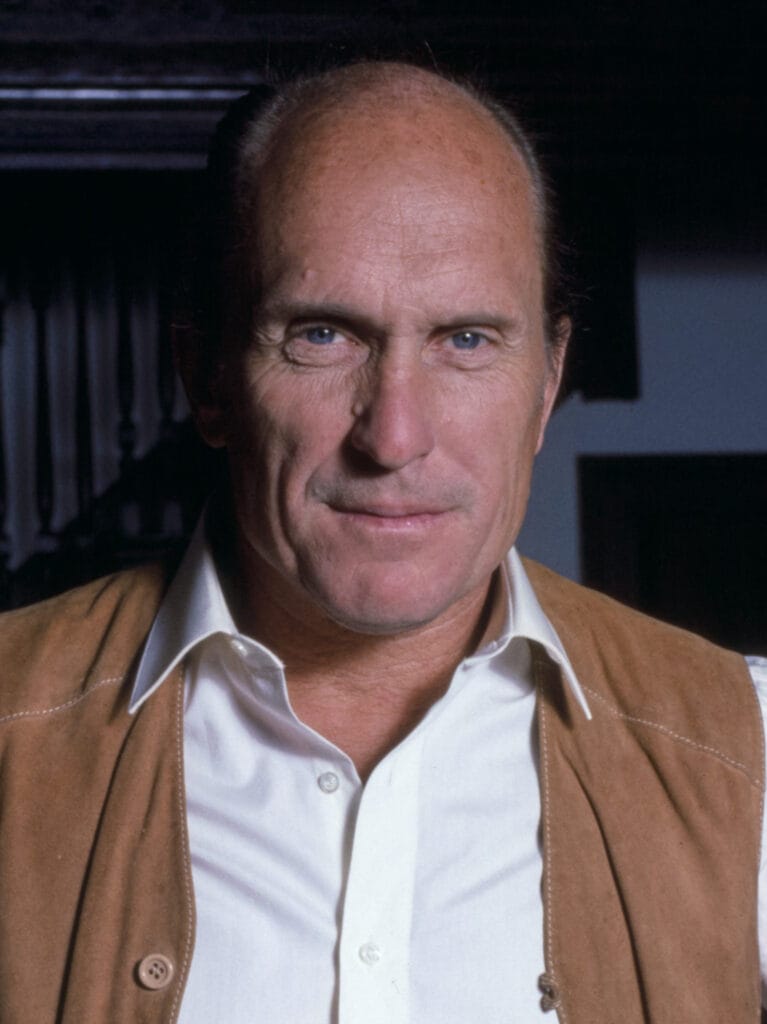
Robert Duvall [actor, at home, New York City apartment, 1984] Creator(s): Gotfryd, Bernard, photographer Date Created/Published: March 1984. Medium: 1 photograph : color transparency ; 35mm (slide format) Reproduction Number: LC-DIG-gtfy-01084 (digital file from original) Rights Advisory: No known restrictions on publication. For information see “Bernard Gotfryd,” (https://hdl.loc.gov/loc.pnp/res.592.gotf) Access Advisory: Please use digital image: original slide is kept in cold storage for preservation. Call Number: LC-GB05- 1084 [P&P] Repository: Library of Congress Prints and Photographs Division Washington, D.C. 20540 USA Notes: Title based on information from slide mount or other caption information provided by the photographer. Photo agency: Newsweek; NW/FILE. Date on slide mount: 3/84. On mount: 266D. Gift; Bernard Gotfryd; 2004; (DLC/PP-2004:032). Subjects: United States–New York (State)–New York. Actors Personalities Format: Slides–Color–1980-1990. Part of: Bernard Gotfryd photograph collection (Library of Congress) Bookmark This Record: https://www.loc.gov/pictures/item/2020730625/ 1931-2026
Robert Selden Duvall, the Oscar-winning actor whose powerful performances graced the screen for seven decades, passed away peacefully at his beloved ranch in Middleburg, Virginia, on February 15, 2026. He was 95 years old.
While the world knew him as one of cinema’s greatest talents—the steely-eyed consigliere in “The Godfather,” the surf-obsessed colonel in “Apocalypse Now,” and the redemption-seeking country singer in “Tender Mercies”—Northern Virginia knew him as a neighbor, a horseman, and a passionate advocate for the rural character of our region.
Duvall made Middleburg his home, embracing the equestrian culture and rolling hills of Fauquier County with the same intensity he brought to his craft. His deep roots in Virginia extended even further—through his mother, Mildred Virginia Hart, he was related to General Robert E. Lee and the historic Lee family of Virginia.
A Front Royal Connection
The actor’s love for the region was perhaps best exemplified in his 2010 film “Get Low.” During production, Duvall insisted on featuring a mule from his own backyard—literally. The film’s co-star was Gracie, a champion mule owned by Stevie Foster of Front Royal, just twenty miles from Duvall’s Middleburg home. In an interview, Duvall proudly noted that America’s champion mule didn’t hail from Tennessee, Texas, or Georgia as one might expect, but from right here in Warren County. Gracie, trained to perform remarkable tricks, became the on-screen companion to Duvall’s character, a Tennessee hermit seeking redemption.
A Career Without Equal
Born in San Diego in 1931 to a Navy admiral and an amateur actress, Duvall’s path to acting began after serving in the Korean War. He studied under the legendary Sanford Meisner at New York’s Neighborhood Playhouse, where his classmates included Dustin Hoffman, Gene Hackman, and James Caan—friendships that would last a lifetime.
His film debut came at age 31, playing the reclusive Boo Radley in “To Kill a Mockingbird” (1962), a role that showcased his remarkable ability to convey deep emotion without dialogue. What followed was an extraordinary career spanning roles in “MAS*H,” “The Godfather” films, “The Conversation,” “Network,” “The Great Santini,” “Lonesome Dove,” and “The Apostle,” which he also wrote and directed.
Duvall won the Academy Award for Best Actor for “Tender Mercies” (1983), performing his own songs for the role. He received seven Oscar nominations throughout his career, along with four Golden Globes, two Emmy Awards, a BAFTA, and a Screen Actors Guild Award. His final Oscar nomination came at age 84 for “The Judge” in 2014.
The Man Behind the Roles
Those who knew Duvall in Virginia remember his passion for Argentine tango, his love of fine meals, and his skill as a horseman—summers spent on his uncle’s Montana ranch as a child had made him an expert rider. He was also known for his directorial work and his devotion to authentic storytelling, often choosing projects that explored the complexities of the human spirit.
His wife of over 20 years, Argentinian actress and director Luciana Pedraza, was at his side when he died. In announcing his passing, she described him as someone whose passion for his craft was matched only by his deep love for characters, great meals, and holding court. For each role, she said, he gave everything to capture the truth of the human spirit.
A Lasting Legacy
Robert Duvall’s death marks the end of an era in American cinema. He belonged to that remarkable generation of actors—along with his old friends Hoffman and Hackman—who revolutionized film acting in the 1970s, bringing a naturalistic intensity that changed what audiences expected from the screen.
But for those of us in Northern Virginia, he was also a reminder that greatness doesn’t require distance from ordinary life. He chose to make his home here, among the horse farms and country roads, and he fought to preserve the character of this place he loved.
As his family requested, there will be no formal service. Instead, they encourage those wishing to honor his memory to do so by watching a great film, telling a good story around a table with friends, or taking a drive through the countryside to appreciate the world’s beauty—a fitting tribute to a man who found beauty in both the grand gestures of cinema and the simple pleasures of rural Virginia life.
Robert Duvall is survived by his wife, Luciana Pedraza, and by an incomparable body of work that will continue to move, challenge, and inspire audiences for generations to come.
Information for this obituary was gathered from public sources including Wikipedia, news reports, and published interviews. Warren County residents with memories of Mr. Duvall’s connections to our community are invited to share them with our editorial team. Edited by Dan McDermott.
State bill aims to designate local zoning districts for homes on small lots
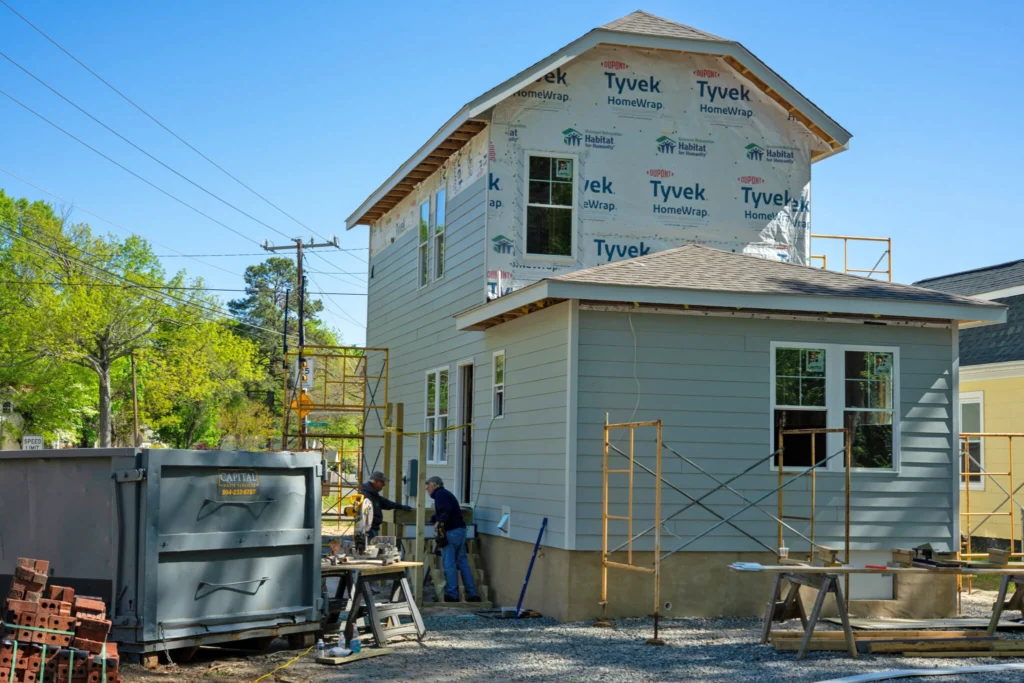
A home built by Richmond Metropolitan Habitat for Humanity volunteers. (Photo courtesy Richmond Metropolitan Habitat for Humanity) By Charlotte Rene Woods | Virginia Mercury
House Bill 1212 by Del. Briana Sewell, D-Prince William, would require localities with populations over 20,000 people to adopt at least one zoning district dedicated to homes on small lot sizes.
The idea is to encourage more housing density while still allowing single-family homes in neighborhoods, and is among a flurry of housing bills that have been advancing in this year’s legislative session.
Sewell said in an interview that her bill is “designed to empower localities to get creative with housing solutions.”
She envisions this measure being particularly helpful for making home ownership attainable for people who might otherwise struggle to make the leap from renter to owner, as well as senior citizens seeking to downsize.
However, the crux of the debate with many housing bills at the state level is whether or not state authority overrides local authority or if prescriptive measures can work widescale.
With a noted shortage of housing supply and years of rising mortgage and rent costs, state lawmakers have presented a range of bills aimed at curbing housing affordability issues. It’s the purview of local governments to approve developments or make local zoning changes, lawmakers like Sewell have proposed areas wherein the state might have more control. But not all of her colleagues agree.
“Top-down zoning mandates are not the right way to address (affordable housing),” Del. Anne Ferrell Tata, R-Virginia Beach, said on the House floor last week when speaking in opposition to Sewell’s bill.
Sewell said her bill was inspired by the actions of a Central Virginia locality that she feels can be more widely implemented.
Earlier last year Henrico County adopted design guidelines for small-lot single family home developments to incorporate into its comprehensive plan — a guiding document localities update every few years as a blueprint for land use decisions.
Sewell said her bill is a way of “making sure that we diversify housing options in every locality.”
Having cleared the House of Delegates, her bill can now journey through Virginia’s Senate in the other half of this year’s legislative session. It joins other housing bills that have cleared their chambers of origin, like proposals to encourage apartments and townhomes near certain commercial corridors, lift caps on local housing grants to government workers so they can live in the communities they serve, and various bills to bolster renters’ protections.
By spring Gov. Abigail Spanberger will sign, veto or seek amendments on all legislation that makes it to her desk.
Analysis: In redistricting case, Supreme Court of Virginia gives new meaning to ‘prompt’
The Supreme Court of Virginia in downtown Richmond. (Photo by Robert Zullo/ Virginia Mercury) By David M. Poole | Virginia Mercury
The Supreme Court of Virginia on Friday said a Republican lawsuit challenging the validity of a redistricting referendum set for April 21 is “of such imperative public importance as to … require a prompt decision.”
Then the court set the deadline for briefs on April 23, two days after the election is slated to take place.
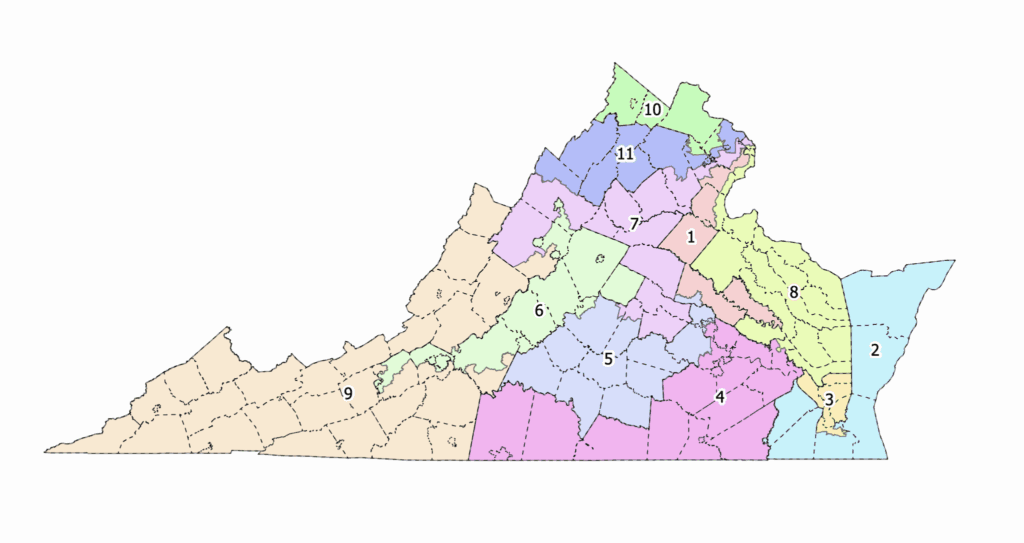
Democrats cheered the decision, as it clears the way for a statewide referendum asking voters to lift a constitutional ban on political gerrymandering so Virginia can engage in an unprecedented national redistricting battle.
Early voting begins on March 6.
The high court, which historically has avoided involving itself in legislative political disputes, appears to have given itself an out should voters defeat the redistricting play.
A majority of votes for “no” would render the lawsuit moot.
But if voters approve the measure, the high court has placed itself in an extremely difficult spot should the justices find in favor of Republicans. The Virginia GOP claims that the election is not valid because Democrats cut procedural and legal corners to rush the redistricting question to a vote in time for midterm elections this November.
With such a finding, the court would not only overrule the legislative branch, but would overturn the will of Virginia voters. Not to mention $5 million in taxpayer money wasted on a previously unplanned election.
“It makes it extraordinarily difficult for them to reject it,” noted Bob Holsworth, a longtime Virginia political analyst.
With the election set for April 21, Virginia voters will now decide if they want to shift gears after six years ago voting overwhelmingly for a constitutional amendment that bans partisan gerrymandering.
A recent Christopher Newport University poll found that nearly two-thirds of Virginia voters favor a bipartisan Redistricting Commission. But a slight majority, 51%, supported a one-time exception that would allow Virginia to counteract Trump’s call for rigging maps in Republican states like Texas and North Carolina.
The poll was released on January 28, before Virginia Democrats released plans for a maximalist partisan gerrymander designed to flip all but one of the current five congressional seats represented by Republicans.
Holsworth said early indications would appear to favor a “yes” vote.
So far, Democrats appear to be more organized and have more money. A group supportive of the redistricting effort launched a $1.3 million statewide TV buy this week, financed by $5 million from a national Democratic “dark money” group.
And Democrats’ have a message – “stop Donald Trump” – that has resonated with many Virginians for the last decade.
“The choice is voting against Trump or voting for a non-gerrymandered map,” Holsworth said.
Those early advantages explain why a cheer erupted Friday in the Democratic caucus.
The court’s timetable may not fit everyone’s idea of speedy. But the timing was just right for Democrats.
Front Royal Town Council to hold public hearings Feb. 23
FRONT ROYAL — The Front Royal Town Council will hold four public hearings Monday, Feb. 23, beginning at 7 p.m. in the Warren County Government Center Board Meeting Room, 220 N. Commerce Ave.
The council will consider two special use permit applications and receive public comment on two requests to conditionally vacate portions of public rights-of-way.
The first hearing involves a special use permit application submitted by Gary Bunch to allow an automobile garage/general repair shop at 3 W. 14th St. The property is identified as Tax Map 20A2-3-63-24A, 25, 26, 27, B 63. It is zoned C-1, Community Business District, and is located in the town’s Entrance Corridor.
The second hearing concerns a special use permit application submitted by AJM LLC Front Royal VA on behalf of The Boisseau Family LC et al. to operate a shopping center in the C-1 zoning district pursuant to Section 175-39(B) of the town’s municipal code. The property is located on South Street and identified as Tax Map 20A18-5-7.
The council will also receive public comment on a request from West Brown to conditionally vacate by ordinance an approximately 1,800-square-foot portion of an unimproved alley between West 13th and West 14th streets.
A fourth hearing will address a request from Paul Rush to conditionally vacate by ordinance a 6,211-square-foot portion of the unimproved Lowe Lane between Braxton Road and Lot 27A.
Copies of proposed plans, ordinances and amendments are available for review during normal business hours at the offices of the town manager and planning and zoning at Town Hall, 102 E. Main St.
All interested persons are invited to attend and express their views.
Information from a release. Edited by Dan McDermott.
Buddhist monks end their cross-country walk in Maryland’s capital
The Theravada Buddhist Monks begin the final leg of their Walk for Peace at the Navy Marine Corps Memorial Stadium in Annapolis, Md. on Feb. 12, 2026. (Jess Daninhirsch/Capital News Service) By RHIANNON EVANS, IRIT SKULNIK, NOLAN ROGALSKI, ANDREW MOLLENAUER | Capital News Service
ANNAPOLIS – After 110 days and nearly 2,300 miles, nearly two dozen Theravada Buddhist Monks ended their ‘’Walk for Peace’’ Thursday at the Maryland State House.
Donning bright orange robes, the group embarked on the final leg of its pilgrimage — a stretch it wasn’t expecting.
“I thought yesterday was our last day of Walk for Peace,” Venerable Bhikkhu Paññakāra, the group’s spokesperson, told hundreds gathered in front of the State House. “But after receiving the invitation from Maryland, we are happy to be here with you all.”
Paññakāra called for peace and mindfulness at a time when the nation and the world are “deeply suffering.” The journey, Paññakāra said, serves as a reminder to himself and everyone else that peace is possible.
“We always carry the key with us to share with you– to hand it to you– so you can unlock peace and love and passion yourself,” he said. “Peace is always with us, it’s been with us, never left us. … It’s just that we’ve forgotten it.”
The stop at the Maryland capital was a last- minute addition, according to Paññakāra.
Due to scheduling conflicts and Washington’s holiday schedule, Maryland and other states were removed from the route that began in Fort Worth, Texas. Maryland Lt. Gov. Aruna Miller extended the invitation to visit the State House only a few weeks ago, said Rachel Sawicki, director of communications for the office of the lieutenant governor.</span>
The monks visited Washington, D.C., earlier this week stopping by the Lincoln Memorial and the Washington National Cathedral.
The pilgrimage began at the Huong Dao Vipassana Bhavana Center in late October and serves as a reminder that peace is a practice, not a destination, according to organizers.The group has attracted a large following along the way, in person and virtually. Thousands have shown up at stops, while the official Walk for Peace page and Facebook support group have garnered nearly 3 million followers combined.
Jill Tocco, a 50-year-old small business owner, has been following the monks’ journey over the past several months. Tocco, of Arnold, Maryland, said she planned to go to Virginia to see the monks until she found out last week they were coming to Annapolis.“I felt it was kind of a blessing in a way that it came to Annapolis, it was totally unexpected,” said Tocco, who had arrived in Annapolis by 7:30 a.m. in preparation to see the monks. “We can’t change the whole world, but if we live within peace, it will.”
By 8 a.m., hundreds of people lined the streets in downtown Annapolis, bundled in coats and holding warm beverages, hoping to see the monks passing by.
The monks were scheduled to arrive at the Navy-Marine Corps Memorial Stadium at 9 a.m. and make their way to the State House by 9:45 a.m., but delays postponed their arrival by roughly an hour. When the crowd at Lawyers Mall learned the monks were not arriving until 10:30 a.m., it still cheered
After his address, Paññakāra and the other monks climbed the steps of the state capitol to applause from the crowd. Once inside, the monks were introduced in the Senate and House chambers before joining a private meeting with the Council on Interfaith Outreach.
Justin Reitz, a 35-year-old cook from Annapolis, wanted to come see the monks to celebrate their mission.
“I just hope it opens people’s eyes,” Reitz said. “The world’s a big place, but it’s still our world, and I think peace is a huge message.”
Spectators held up signs promoting peace, waved LGBTQ+ pride flags and brought brightly colored flowers.
Reitz was one of many who arrived with flowers as a way to honor the monks. Onlookers said the monks take the flowers and give them to people along the route.
“Seeing so much love and support, it warms our hearts,” Paññakāra said. “But at the same time, I feel sad. I feel sad because as human beings, why do we have to suffer? … We truly deserve better.”Leaders from local religious groups said they support the monks’ mission.
Rev. John Crestwell of the Unitarian Universalist Church of Annapolis said the monks’ visit is meaningful.
“It means that the spirit of love is emanating and calling us forward in this time of division,” Crestwell said. “In this very mindful way, they’re walking quietly and making a statement as a minority faith.”Brian Grim, founding president of Religious Freedom & Business Foundation, said the monks’ walk illustrates hope for continued healing in a divisive America.
“Anything that is going to have a lasting impact is a journey. It’s not something that happens overnight,” Grim said.
Gloria Foley had followed the monks’ journey for six weeks. When the trip was extended to Annapolis, it made seeing them doable for the 101-year-old Centreville resident. She woke up at 5 a.m. and, with the help of caregivers, waited for hours outside the Navy stadium. Wrapped in a bundle of blankets with a “Walk for Peace” T-shirt draped over her lap, Foley said it was important to show support.
“Let’s get back to a world of peace,” Foley said.Silek elected county GOP committee chairman
Local attorney David W. Silek has won a fairly close election to head Warren County’s Republican Committee Feb. 12, 2026. Whether to fund Samuels Public Library was an issue in the race.
Silek released the following letter on the organization’s facebook page.
Dear Friends:
Last night, we made history together. With a vote of 225 – 206, you didn’t just elect new leadership for the Warren County Republican Committee – you reclaimed it for the values of common sense, community, and genuine conservative principles that have always defined our party at its best.
I am deeply humbled by your support, your courage and endurance in sticking it out last night and not getting frustrated at the idiotic process the former committee erected to complicate and delay registration. Many of you have known me since I was born, watched me grow up in Front Royal, stood beside me through my working life, and have been part of the fabric of this community for generations. Others I’ve come to know more recently, but your faith in this mission means just as much. You didn’t just show up for me – you showed up for Warren County and for the future of principled Republican leadership, not to mention the shape and direction of Warren County.
This victory belongs to every single person who came out last night. In an era when extremism threatens to hijack our institutions, you stood firm. You proved that our community will not be led astray by those who value ideology over integrity, or purity tests over practical governance.
But I want to be clear-eyed with you about what lies ahead. This was the first step, not the finish line. We have a Warren County Republican Committee to rebuild from the ground up. We need committed people in every precinct. We need fresh energy, new volunteers, and sustained engagement. The work of restoring our committee to health – and restoring faith that it represents all Republicans, not just a narrow faction – will take time, dedication, and your continued involvement.
I’m asking you to stay with me in this effort. If you can give your time, please reach out – we need precinct captains, volunteers, and people willing to do the unglamorous work of rebuilding. If you can’t volunteer but want to stay informed and engaged, I promise to keep you updated on our progress. And if you simply want to offer advice or encouragement along the way, my door is always open.
This committee belongs to you now. Together, we’ll make it something Warren County can be proud of again – a place where Republicans of good faith can work together, where neighbors are welcomed rather than tested for ideological purity, and where our focus is on serving our community and advancing conservative principles that actually improve people’s lives.
Thank you for believing in this mission. Thank you for believing in me. And thank you for proving that in Warren County, common sense and community still matter more than extremism.
With deep gratitude and determination,
David W. Silek,
Chair, Warren County Republican CommitteeEdited by Dan McDermott
Virginia 4 p.m. burning law takes effect Feb. 15
Virginia’s annual 4 p.m. burning law takes effect Feb. 15, 2026 and remains in force through April 30, restricting open burning during peak wildfire season.
Under the law, no burning is allowed until after 4 p.m. if the fire is within 300 feet of woodland, brushland or a field containing dry grass or other flammable material.
Fires within 150 feet of woodland or other dry fuel leading to woodland must be attended at all times. No additional fuel may be added or a fire started after midnight.
The law applies to campfires, warming fires, brush piles, stumps, fields of dry grass and brush, or anything capable of spreading fire.
Violations carry a maximum fine of $500.
Residents planning a controlled burn in Warren County are asked to call 540-635-4128 to log the burn.
For more information, contact the Virginia Department of Forestry or visit www.dof.virginia.gov.
Information from Warren County Fire and Rescue. Edited by Dan McDermott.

2026 Burning Ban poster. Supreme Court of Virginia greenlights redistricting referendum
Supreme Court of Virginia in Richmond, Va. (Photo by Parker Michels-Boyce for The Virginia Mercury) By Samantha Willis and Charlotte Rene Woods | Virginia Mercury
The Supreme Court of Virginia on Friday agreed to allow Democratic lawmakers’ mid-decade redistricting attempt to move forward, announcing it will hear the case on an expedited basis. The court denied Republican lawmakers’ motion to pause a redistricting referendum as the high court deliberates the case.
The order means voters will be able to approve or reject the redistricting amendment in a referendum scheduled for April 21, 2026. The effort would redraw Virginia’s congressional maps, with 10 districts favoring Democrats and one tipped towards Republicans.

Virginia Democrats’ proposed 10-D, 1-R congressional districts map preserves the broad outlines of some existing districts but redistributes how the population is grouped across much of the state. (Photo courtesy Virginia Legislative Information System) Almost immediately after the order was released, Democratic leaders emphasized that the decision to redistrict or not will be in the hands of Virginians this spring.
“It’s a question of whether people want to move forward that’s responsive to the redistricting that we’ve seen in other states,” Gov. Abigail Spanberger said while walking with reporters in Capitol Square Friday. “Certainly the General Assembly was clear with the amendment process they put forward, and now it’s up to voters.”
Virginia House Speaker Don Scott, D-Portsmouth, also echoed the sentiment. Virginia’s redistricting effort is a response to President Donald Trump kicking off redistricting squabbles nationally by encouraging GOP-led states to fortify their party by redrawing their Congressional maps, Scott said.
“We have a president that’s run amok,” Scott said in a press gaggle Friday morning. “So we have no choice but to respond and try to do everything in our power to level the playing field.”
While Virginia’s redistricting amendment surfaced in recent months, the national debates first began late last summer when Trump prompted Texas to redraw its maps. Other GOP states began following suit and the Democratic states like New York and Maryland began their own processes.
House Minority Leader Terry Kilgore, R-Scott, made no reference to Trump or Republican states redistricting on Friday, but lamented other Democratic-led states’ efforts. With the redistricting process still moving forward, he noted the outreach efforts his party will need to do to counter Democratic messaging.
“We’re going to make the case to Virginians that this is unfair, this is unprecedented, and, you know, quite frankly, it’s against the law we believe, and we will ultimately win in court,” Kilgore said.
The court’s order also allows Attorney General Jay Jones to intervene in the case. All parties must file their opening briefs with the court by March 23.
Editor’s note: This story has been updated with responses from Demoratic and Republican leaders.
Va. bill gives injury lawyers, like House Speaker, new advantage
By Daniel Fisher | Legal Newsline
A bill that would shift Virginia’s legal landscape dramatically in favor of plaintiff lawyers is one step closer to a vote by the House of Delegates, which could impact sex-abuse cases brought by the firm of its Democrat speaker.
House Bill 1111 exited a key legislative committee this week with plenty of time for legislators to present a final bill to Gov. Abigail Spanberger. It sets up a test for the new Democratic governor, raising the maximum bond defendants must post to appeal civil verdicts from $25 million to $100 million.
Spanberger was elected with the help of significant business interests, but the bill would make it much riskier and more expensive for companies to fight blockbuster jury verdicts on appeal. Plaintiff lawyers, conversely, would use higher appeal bonds as leverage to negotiate bigger settlements and fees for themselves.
One case currently on appeal is a $360 million verdict against Cumberland Hospital, a unit of Universal Health Services. Those defendants needed only to put up $25 million for permission to appeal the Richmond city judgment, but if the bill passes, figures in future similar cases could reach nine figures.
Virginia Speaker of the House Don Scott controls the flow of legislation and also is a partner with Breit Biniazan Trial Lawyers, which won that trial on behalf of three alleged victims of former Cumberland Hospital medical director Daniel Davidow. He is accused of sexual abuse during medical exams.
The firm has more than 40 other clients making similar claims against the hospital and says it is seeking more than $930 million from the litigation.
UHS acknowledges in its most recent financial report if it is forced to post higher appeal bonds, its finances “would be materially adversely impacted.”
The bill was voted out of the Justice Committee 17-5 on Tuesday, with Republicans Jay Leftwich, Wren Williams, Will Davis, Madison Whittle and Justin Pence voting against. Four of the Republicans are lawyers, while Democrats voting for the bill included at least five attorneys at firms with personal injury practices.
The cases against Cumberland Hospital aren’t the only ones brought by Speaker Scott’s firm featuring claims in excess of the current bond cap. In September, Biniazan sued several companies over injuries to a gymnast that left him paralyzed for $350 million. Sexual assault suits could also be costly for the Peoria Unified School District.
Scott is listed as a lawyer in two cases over the chemicals PFAS that are currently in federal court, where his co-workers have asked a judge to send them back to state court in Virginia Beach. The firm says its clients contracted diseases from exposure to PFAS-containing foam while working as firefighters and blames deep-pockets companies like 3M and Honeywell for two deaths.
The House has until Feb. 17 to pass the bill, after which the Senate can take it up or amend. The General Assembly adjourns March 14 and reconvenes April 22 to reconsider bills Gov. Spanberger has vetoed or demanded changes to.
If the bill passes, Virginia would be the only state in recent memory to increase appeal bonds, although several states including Kansas, Hawaii and Louisiana have gone the other way and imposed caps. The American Tort Reform Association has come out strongly against HB 1111, saying it would undermine the ability of defendants to appeal outsized verdicts.
The Virginia Manufacturers Association also recently noted the state’s strongly pro-business reputation is in danger due to rising legal costs and uncertainty. After ranking No. 1 in CNBC’s “America’s Top States for Business” in 2024, Virginia fell to No. 4 in 2025. For manufacturers specifically, Virginia dropped from 7th to 9th nationally in the 9th Annual Virginia Manufacturing Competitiveness Index, the group said.
Gov. Spanberger defeated her Republican challenger last year with a broad base of support including prominent business executives. She received $14 million from Democratic Party organizations, but also drew $205,000 from Thomas J. McInerney, president of Genworth, an insurance company; $200,000 from real estate developer Christopher Clemente; and $143,000 from cigarette manufacturer Altria, according to the Virginia Public Access Project.
The appeal bond bill, and another one that would establish class actions in Virginia state courts, present Gov. Spanberger with the choice of pleasing liberal Democrats and trial lawyers or mollifying business leaders who fear the impact of higher litigation costs.
A previous version of the bill set a $200 million bond cap but was ultimately vetoed by Spanberger’s predecessor, Glenn Youngkin. The first version of the new bill also aimed at a cap of $200 million but was changed ahead of the committee meeting, during which no opposition was voiced other than the five votes against.
The Medical Society of Virginia, which also could be affected by higher appeal bonds, said it has “no position on this bill.”
This report was produced by Legal Newsline and distributed by The Center Square as part of a content-sharing agreement. Reach editor John O’Brien at [email protected].
Lawmakers call for drug price transparency, lower costs

Photo of prescription drug pills by Alan Wooten / The Center Square By Andrew Rice | The Center Square
(The Center Square) – A bipartisan group of lawmakers on Wednesday called on pharmaceutical companies to provide increased price transparency and lower costs for drugs.
Elected leaders on the U.S. House Energy and Commerce subcommittee on Health questioned pharmaceutical company leaders over their role in rising prices for prescription drugs. Several Congressional leaders accused pharmacy benefit managers of inflating drug costs beyond reasonable prices.
UnitedHealthcare, a leading insurance provider, reimburses its own providers an average of 17% more than it pays independent providers for the same services, according to a study published by Health Affairs.
The bipartisan panel offered various solutions to address rising drug costs. U.S. Rep. Morgan Griffith, R-Va., suggested pharmaceutical benefit managers operate as fiduciaries in order to leave them with greater liability in cases where certain treatment or coverage causes suffering and harm to a patient.
“There’s still going to be tough choices that are going to have to be made, but you would have more confidence that those choices are based on doing the right thing as opposed to making the most profit,” said James Gelfand, president and CEO of the ERISA industry committee.
Lawmakers argued the nation’s top insurance providers use vertical integration to take up a large share of the market and drive smaller insurance carriers out.
U.S. Rep. Nanette Barragan, D-Calif., said CVS Health, UnitedHealth Group and Cigna operate nearly 80% of the pharmaceutical benefit managers market. She accused panelists of using this large share to eliminate competition and drive out community pharmacists.
“You are part of the reason why people suffer and why it’s making it harder for people with cancer and HIV to get their drugs,” Barragan told the panelist at the hearing.
Douglas Hoey, president and CEO of the National Community Pharmacists Association, said the consolidation of insurance providers leads to higher drug prices for average Americans. He said the large pharmaceutical benefit managers can sometimes override a doctor’s prescription in favor of a more expensive drug.
“If a patient is prescribed a prescription, the doctor or the pharmacist can sometimes be overruled by the PBM because the PBM makes more money off of a different drug,” Hoey said. “When those patient choices are compromised, there’s less competition and higher prices.”
Lawmakers also highlighted figures that estimate private employer sponsored insurance premiums will rise by 6.5% in 2026, a higher hike than Affordable Care Act premiums.
Lawmakers across the aisle also called for more transparency in financial holdings among large drug manufacturing companies. U.S. Rep. Greg Landsman, D-Ohio, accused leaders of the corporations of prioritizing investments that yield larger profits rather than lowering prices.
Lori Reilly, chief operating officer at PhRMA, said 30% of the company profits are reinvested into research and development. Landsman criticized her for that figure and questioned why more of the remaining roughly 70% does not go toward lowering consumer prices.
“When individuals decide to invest with our companies, there is an expectation for a return on investment just as there is for any for-profit company,” Reilly said.
Virginia weighs joining national popular vote plan
A roll of “I Voted” stickers sits on a table at a polling place on Nov. 8, 2022. Photo: Phil Roeder / Flickr / CC BY 2.0 By Shirleen Guerra | The Center Square
(The Center Square) – Virginia lawmakers are considering whether the commonwealth should join a multistate agreement that would tie its presidential electoral votes to the national popular vote.
The proposal is known as the National Popular Vote Compact. States that join agree to award their electoral votes to the presidential candidate who wins the most votes nationwide, rather than the candidate who wins their individual state.
The agreement would not take effect until participating states control at least 270 electoral votes, the number needed to win the presidency. Until that threshold is reached, states would continue awarding electors under existing law.
Seventeen states and the District of Columbia have enacted the compact so far, representing 209 electoral votes.
Senate Bill 322 on Monday passed 21-19, with Democrats in support and Republicans opposed.
The House Privileges and Elections Committee advanced companion measure House Bill 965 on Friday 14-8. The legislation now heads to the full House of Delegates.
If Virginia were to join, its 13 electoral votes would raise the compact’s total to 222, still short of the number needed for it to take effect.
Supporters of the proposal say it would make every vote count equally across the country and reduce the focus presidential campaigns place on a small number of battleground states.
Republican leaders have raised concerns about how the proposal would shift control over Virginia’s electoral votes.
“Republicans certainly understand the impetus behind this, but the underlying facts give many of them a reason to pause,” said J. Garren Shipley, communications director for House Republican Leader Terry Kilgore.
“Virginians need to decide who wins Virginia’s 13 electoral votes,” Shipley said.
He added that if the compact had been in place during the 2024 election, Virginia’s electoral votes would have gone to President Donald Trump rather than Vice President Kamala Harris.
“I’m doubtful that would have been an acceptable outcome to many of those who have supported this legislation,” Shipley said.
Under the compact, Virginia voters would still cast ballots as they do now, and local election officials would continue counting and certifying results under state law. After certification, participating states would compare results to determine the national popular vote winner, and governors would certify electors accordingly.
The agreement also limits when a state can withdraw, barring a state from exiting within six months of the end of a presidential term.
HB965 awaits a vote in the full House. SB322 has already crossed over for further consideration.
Virginia proposals could alter taxation of data centers
By Shirleen Guerra | The Center Square
(The Center Square) – A wide range of data center-related bills are on the table this legislative session as Virginia lawmakers review potential changes to tax policy, utility oversight, environmental reporting, and local approval requirements.
The proposals span multiple policy areas, including tax exemptions, utility cost recovery, water use disclosures, environmental monitoring, and land use authority.
Most of the measures remain in the earliest stages of the legislative process and are still pending in committee or subcommittee.
Several bills would revise how data centers are taxed. The commonwealths’ 570 data centers are most of any state.
Two proposals focus on changes to existing tax exemptions for data centers. House Bill 897 and House Bill 961 would tighten eligibility for the retail sales and use tax exemption, linking it to factors such as energy sourcing, backup power systems, and certain equipment upgrades.
Separate legislation would create a new land conservation tax tied to data center development. House Bill 641 and Senate Bill 393 propose a per square foot charge on data center facilities, with proceeds directed to land preservation and conservation programs under the Great Outdoors Act.
Other proposals focus on how data centers connect to the electric grid and how related infrastructure costs are handled.
House Bill 155 would require high-load facilities with electricity demand exceeding 25 megawatts to obtain a certificate of operation from the State Corporation Commission before beginning service. The bill directs regulators to consider grid capacity and potential cost impacts.
House Bill 503 would restrict electric utilities from recovering certain costs tied to serving large data center customers from other ratepayers, instead assigning those costs to the facilities themselves under specified conditions.
Environmental monitoring and resource use are also addressed.
House Bill 507 would place new limits and monitoring requirements on certain backup generators used by data centers. The bill would require air quality monitoring in areas with concentrated facilities.
House Bill 154 would require data centers to publicly disclose when emergency generation units are operating.
House Bill 589 would require water providers serving data centers to submit monthly water usage data to the State Water Control Board.
Land use and planning requirements are included in several measures.
House Bill 496 would require site assessments and water use disclosures before local governments approve rezoning or special use permits for new data centers. The bill specifies that local zoning authority is preserved.
House Bill 323 directs the Department of Energy to study the reuse of waste heat generated by data centers and report findings to the General Assembly.
One proposal, House Bill 1515, would temporarily prohibit final local approvals for new data center projects until certain electric grid interconnection requirements are met or until July 1, 2028.
That measure has already been continued to the 2027 session.
Federal lawsuit challenges Virginia fair housing law
By Shirleen Guerra | The Center Square
(The Center Square) – A conservative nonprofit law firm has filed a federal lawsuit challenging Virginia’s fair housing law, saying the state’s ban on “source of income” discrimination effectively forces landlords to participate in the federal Housing Choice Voucher program commonly known as Section 8.
The lawsuit, filed by The Hamilton Lincoln Law Institute in the U.S. District Court for the Eastern District of Virginia, targets provisions of Virginia’s Fair Housing Law that prohibit landlords from refusing tenants based solely on how they pay rent, including through federal housing vouchers.
The plaintiffs say the law goes beyond preventing discrimination and instead compels private property owners to take part in a federal program they say carries additional administrative requirements, inspections and contractual obligations.
“Section 8 is voluntary, and Virginia cannot use housing law to coerce warrantless searches,” said Ted Frank, the institute’s cofounder and director of litigation.
Virginia added “source of income” as a protected class under its fair housing statute in 2020 This makes it illegal for landlords to reject applicants solely because they use housing assistance or other lawful payment sources.
The law is enforced by the Virginia Fair Housing Board and Fair Housing Office, which investigate discrimination complaints and may impose penalties for violations.
The lawsuit does not challenge the federal Section 8 program itself.
Rather, it focuses on how Virginia enforces its fair housing statute. It says landlords are left without a meaningful ability to opt out of voucher participation under state law.
According to U.S. Department of Housing and Urban Development data, nearly 50,000 low-income households in Virginia rely on Housing Choice Vouchers to help pay rent in the private market.
The data also shows voucher utilization in Virginia exceeding 80%, reflecting high demand and limited housing availability.
Virginia is one of at least 17 states that prohibit discrimination based on lawful sources of income, though the scope and enforcement of those laws vary.
Courts have generally upheld source-of-income protections. Legal challenges have continued in some states and cities, including New York and local jurisdictions in Ohio and Missouri, where landlords or local governments have argued the laws improperly compel participation in the federal Section 8 program.
The lawsuit asks the court to block enforcement of Virginia’s source-of-income protections and declare the law unconstitutional.
No judge has ruled on the case, and the law remains in effect.
TCS was unsuccessful prior to publication getting comment from the Virginia attorney general’s office and state housing officials.
Bill to create a Prescription Drug Affordability Board clears House of Delegates

Bottles of prescription drugs. (Photo by Angela Breck for Maryland Matters) By Charlotte Rene Woods | Virginia Mercury
Virginia’s multi-year attempt to establish a Prescription Drug Affordability Board is again advancing in the legislature, but it’s unclear if it will finally become law this time around. The measure passed the House of Delegates Friday and will be taken up by the Senate next week, once the second half of the session begins.
The bipartisan proposal would create a special board of medical and health experts tasked with analyzing data to set payment limits on drug prices. The legislature approved it for the past two years but former Gov. Glenn Youngkin vetoed it, citing concerns with stifling medical innovation and attracting pharmaceutical companies to the state.
Gov. Abigail Spanberger has not confirmed whether she would sign, amend or veto the measure if lawmakers send it to her desk.
Now often referred to by lawmakers and advocates as the “Affordable Medicine Act” — a clearcut sign of its goals — House Bill 483 sponsor Del. Karrie Delaney, D-Fairfax, told her colleagues Thursday that she is “continuing to work with stakeholders and the administration” to refine the bill.
Delaney and Sen. Creigh Deeds, D-Charlottesville, have carried the legislation several years in a row. The concept of the board aligns with Spanberger’s broad goals of addressing affordability struggles, and Deeds and Delaney said they are hopeful she’ll sign their measure into law.
In an interview Thursday, Delaney said there’s still work to be done in the coming weeks of the legislative session to ensure that Virginia’s board won’t falter as other states’ boards have.
“Our goal is to really make sure that it is effective,” Delaney said.
She said the bill is needed now more than ever, as she continues hearing anecdotes from her constituents feeling forced to choose between medicine, paying their rent or mortgages, and buying groceries.
These struggles are playing out nationally and even inspired a plotline in the latest season of HBO’s The Pitt, wherein a diabetic character’s expensive ER visit stemmed from stretching his medication thin and a lack of health insurance.
Delaney said a PDAB can explore root causes in drug supply chains that factor into higher prices.
“On a bigger scale, it’s about understanding why (drug price surges) happen and who is accountable,” Delaney said. “Somewhere along the supply chain if we can identify ‘hey, this is where we’re seeing these jumps happen’ that gives us a precision approach at addressing costs for drugs.”
In opposing her bill, Del. Keith Hodges, R-Middlesex, noted his support for the idea but called the measure “highly flawed.”
Because states fund the setup of boards, Hodges cautioned that “taxpayers will be the ones that carry these costs.
“We have learned from where (PDABs) have gone right and where they have gone wrong,” he said. He highlighted mixed results in Maryland and Colorado, which are among the few states that have already set up such boards and that have not yet achieved their goals.
Maryland became the first in the nation to set up a PDAB in 2019, but it hasn’t made much progress until recently.
The 2020 COVID-19 pandemic spurred then-Gov. Larry Hogan to pull the board’s earmarked funding and not assign board members. Current Gov. Wes Moore started to get the ball rolling again by releasing those funds, but it took the board a year and a half to set up a regulatory framework and settle on six drugs to consider for cost reduction. The matter is still not a done deal.
Colorado’s PDAB successfully established a cap on Enbrel, a drug used for various autoimmune disorders. But the cap hasn’t yet taken effect.
After staving off a previous legal challenge, Colorado’s board is now facing a fresh lawsuit from the drug’s manufacturer.
Delaney said she continues to study Maryland’s PDAB experience for helpful insights. Virginia’s board can aim to align prices with drugs that have already garnered federal limits through Congress’ 2022 Inflation Reduction Act, she added. That federal law applied to Medicare-covered drugs, while Virginia’s board could be more broad.
Amendments forecasted
As lawmakers near the midpoint of the session next week, all bills that clear one chamber must go through the opposite chamber. While floor amendments do happen, most often bills are tweaked within the various committees they filter through. Delaney expects that her and Deeds’ bills will be similarly tweaked and is open to compromise.
“At some point we’re going to have to make the decision – ‘what is the line of what we’re kind of willing to give and take for this particular year?’” Delaney said.
Addressing affordability issues has been a key goal of state lawmakers and the governor this year. Spanberger pitched proposals to reduce costs in health care, housing and energy during her campaign, but a PDAB was absent from her plans and she stopped short of endorsing the idea in a sit-down interview with the Mercury last summer.
“I want to make sure that whatever we might implement in the future will be a best practice based on the success or challenges that other states have faced,” Spanberger said then.
While governors rarely comment on pending bills during legislative sessions, Spanberger’s team confirmed that she is in talks with both Deeds and Delaney as she considers the legislation.
Trump administration completes rollback of Obama-era greenhouse gas regulations
Marathon Petroleum Company’s Salt Lake City Refinery in Salt Lake City on Wednesday, Jan. 3, 2024. (Photo by Spenser Heaps for Utah News Dispatch) By Jacob Fischler | Virginia Mercury
WASHINGTON — President Donald Trump and his top environmental policy officer finalized a move Thursday to undo an Environmental Protection Agency regulation that laid the foundation for federal rules governing emissions of the greenhouse gases that cause climate change.
At a White House event, Trump and EPA Administrator Lee Zeldin said they were officially rolling back the “endangerment finding” that labeled greenhouse gases a threat to public health and provided a framework for the EPA to regulate emissions.
The 2009 finding, established under President Barack Obama, called climate change a danger to human health and therefore gave the EPA power to regulate greenhouse gases, such as carbon dioxide from cars and trucks.
Such regulations created a challenge for automakers and other industries, which dragged down the entire economy, according to Trump, administration officials and allies in Congress.
Democrats and their allies in environmental and climate activism, though, consider the measure a crucial tool to address climate change and protect human health.
Undoing the finding will remove the economy-wide uncertainty, Trump argued.
“That is why, effective immediately, we are repealing the ridiculous endangerment finding and terminating all additional green emission standards imposed unnecessarily on vehicle models and engines between 2012 and 2027 and beyond,” he said Thursday.
Affordability argument
In its initial notice last year that it would repeal the endangerment finding, the EPA said it did not have the authority to regulate vehicle emissions.
With household costs, including transportation, expected to be a major theme in the fall’s midterm campaigns to determine control of Congress, members of both parties have framed it as an economic issue.
“This will be the largest deregulatory action in American history, and it will save the American people $1.3 trillion in crushing regulations,” White House press secretary Karoline Leavitt said at Tuesday’s press briefing.
Some Democrats and climate activists argue the rollback will hurt the country’s nascent renewable energy sector, driving up the cost of home heating, electricity and other common expenses.
Senate Minority Leader Chuck Schumer, D-N.Y., and Sen. Sheldon Whitehouse, D-R.I., issued a lengthy joint statement slamming the announcement.
“The Trump EPA has fully abandoned its duty to protect the American people from greenhouse gas pollution and climate change. This shameful abdication — an economic, moral, and political failure — will harm Americans’ health, homes, and economic well-being. It ignores scientific fact and common-sense observations to serve big political donors,” the senators said.
“This sham decision initially relied on a now thoroughly disgraced and abandoned ‘report’ by known climate deniers. Zeldin stuck to this charade anyway, undaunted by half a century of actual evidence, showing the fix was in from the beginning,” they continued.
Money and fossil fuels
The move outraged Democrats and climate activists when Zeldin first proposed it last summer. Climate activists say undoing the finding undercuts the federal government’s ability to address an issue critical to the United States and the entire world.
In a Tuesday floor speech, Schumer blasted the rollback as a giveaway to fossil fuel companies, leaders of which contributed to Trump’s 2024 campaign.
“Remember: In the spring of 2024, Donald Trump invited top oil executives to Mar-a-Lago and told them, if you raise me a billion dollars to get me elected, I will cut regulations so you can make more money,” Schumer said. “That devil’s bargain is now coming true. I never thought it would be this way in America, in this bald disgusting way that so hurts people’s health, but there it is.”
Democratic attorneys general and environmental groups are likely to sue over the rollback.
At least one lawsuit, from the Environmental Defense Fund, was promised Thursday afternoon.
“EDF will challenge this decision in court, where evidence matters, and keep working with everyone who wants to build a better, safer and more prosperous future,” Fred Krupp, EDF president, said in a statement Thursday.
Washington state Attorney General Nick Brown, a Democrat, said last year he would “consider all options if EPA continues down this cynical path.”
Ashley Murray contributed to this report.
Warren County Sheriff’s Office PAL to host Jr. Deputy Camp in Front Royal
FRONT ROYAL — The Warren County Sheriff’s Office Police Athletic League (PAL) will host its Jr. Deputy Camp March 31 through April 1 for children ages 9 to 12, offering a hands-on introduction to law enforcement and team-building activities.
The two-day camp will run from 8 a.m. to 4 p.m. each day at the Warren County Emergency Services complex, 200 Skyline Vista Drive in Front Royal. Organizers say the program is designed to give young participants an educational and engaging look at the work of local law enforcement.
Campers will take part in a variety of activities, including K-9 demonstrations, a tactical team demo, law enforcement basics, an obstacle course, and crafts and other activities. Lunch and snacks will be provided.
The cost is $20 per child. Space is limited, and applications and fees must be submitted by March 12.
Applications can be submitted through the Warren County Sheriff’s Office. For more information, contact Krista Beahm at 540-635-4128, ext. 211, or by email at [email protected].
Edited by Dan McDermott.

The Warren County Sheriff’s Office will host a two-day Jr. Deputy Camp for children ages 9–12 at its Skyline Vista Drive facility, offering hands-on activities and demonstrations focused on law enforcement.
BLACK FRIDAY MEMBERSHIP SPECIAL: Two Websites. One Price.
Join WarrenCountyVA.com and we’ll also feature your membership listing and any banner advertising on Route11DJ.com at no additional charge through May 2027.