Brown water, dust and loud noises: Louisa homeowner sues Amazon over data center construction

Austin Newsom explains how construction of a new Amazon data center campus across the street from his home has disrupted his life, July 2026. (Photo by Shannon Heckt/Virginia Mercury)
From the driveway of his Louisa home and business, Austin Newsome sees dozens of dump trucks barrel down Route 33 most days, hauling dirt and other debris. The road is stained rusty red from the soil displaced by the construction of Amazon’s latest data center campus in the county.
One day, Newsom said, his neighbor across the street up and left.
“I was like, oh no, he’s picked up and gone. And then I looked up who owned the property, and it was Amazon,” Newsom said in the garage of Central VA Marine, the business he co-owns and runs near his home.
Newsom’s home rests on the border of the Northeast Creek technology overlay district, a portion of the county zoned to attract specific businesses, including data centers.
It is the site of Amazon’s second data center campus in the county, with plans for this project detailing ten buildings, three substations, stormwater structures, logistic and administrative buildings and associated infrastructures. Construction is slated to be completed in 2031.
When the project started in March 2025, Newsom reported to county officials several disturbances — loud noises, trucks kicking up big clouds of dust — and his tap water turned a muddy brown color.
The water discoloration persisted off and on for months as the data center buildout continued.
“(My well has) made it through four major droughts we’ve had since the ’50s and never had an issue with it,” Newsom said. “I’ve lived here for 11-12 years. Never had an issue with it ever until they started doing things over there.”
Newsom and his spouse also experienced loud sounds emitting from the construction site in the late hours of the night. They said light pollution from the site floods their children’s bedroom.
One of his chief concerns is that dust from the project is covering the roadway. Amazon responded by deploying street sweepers and spraying water to keep the dust down. But Newsom said it isn’t enough.
“They got this truck out there that just pretty much just dumps water on the road. The roads are covered with mud, Newsom said. “Now all the mud just washes into my driveway.”
In August 2025, Newsom filed a lawsuit against the company seeking relief from the negative impacts the construction levied on his home and boat detailing and repair business.
In the private nuisance suit, Newsom alleged that vibrations from the construction are cracking the foundation of his house. The project is devaluing his home, disrupting natural drainage and impacting his mental health, Newsom said in the filing.
Newsom operates his business in a workshop near his home. He said in his filing that his customers, who are often towing boats, have had many “near accidents” with the trucks.
The closest school is just one mile away from the construction site. A Louisa Public Schools representative said the trucks have not yet posed any issues.
Amazon is already constructing another data center in the county near the Lake Anna Power Station within the county and was planning for a third project but withdrew it in July 2025 due to public backlash.
Many problems, few solutions
Newsom has aired his complaints to county leaders and Amazon many times. He said he was met with promises that the issues would be looked into, but they remain unresolved
Board of Supervisors Chair Duane Adams said he had been in contact with Newsom and his wife multiple times about their concerns and worked to help get some of them addressed.
“I’ve treated Mr. and Mrs. Newsom as I do with all my constituents. I try to be very responsive and help address issues that may be impacting them and help mitigate the circumstances,” Adams said.
When work began to build the data center, it pushed Newsom to start building his family a new home.
He has put his current home up for sale, but he said there haven’t been any bites because when potential buyers find out what’s under construction across the street, they lose interest.

A sign advertises a home for sale n Louisa County across the street from Amazon data center construction site. (Photo by Shannon Heckt/Virginia Mercury) Transmission line presents another obstacle
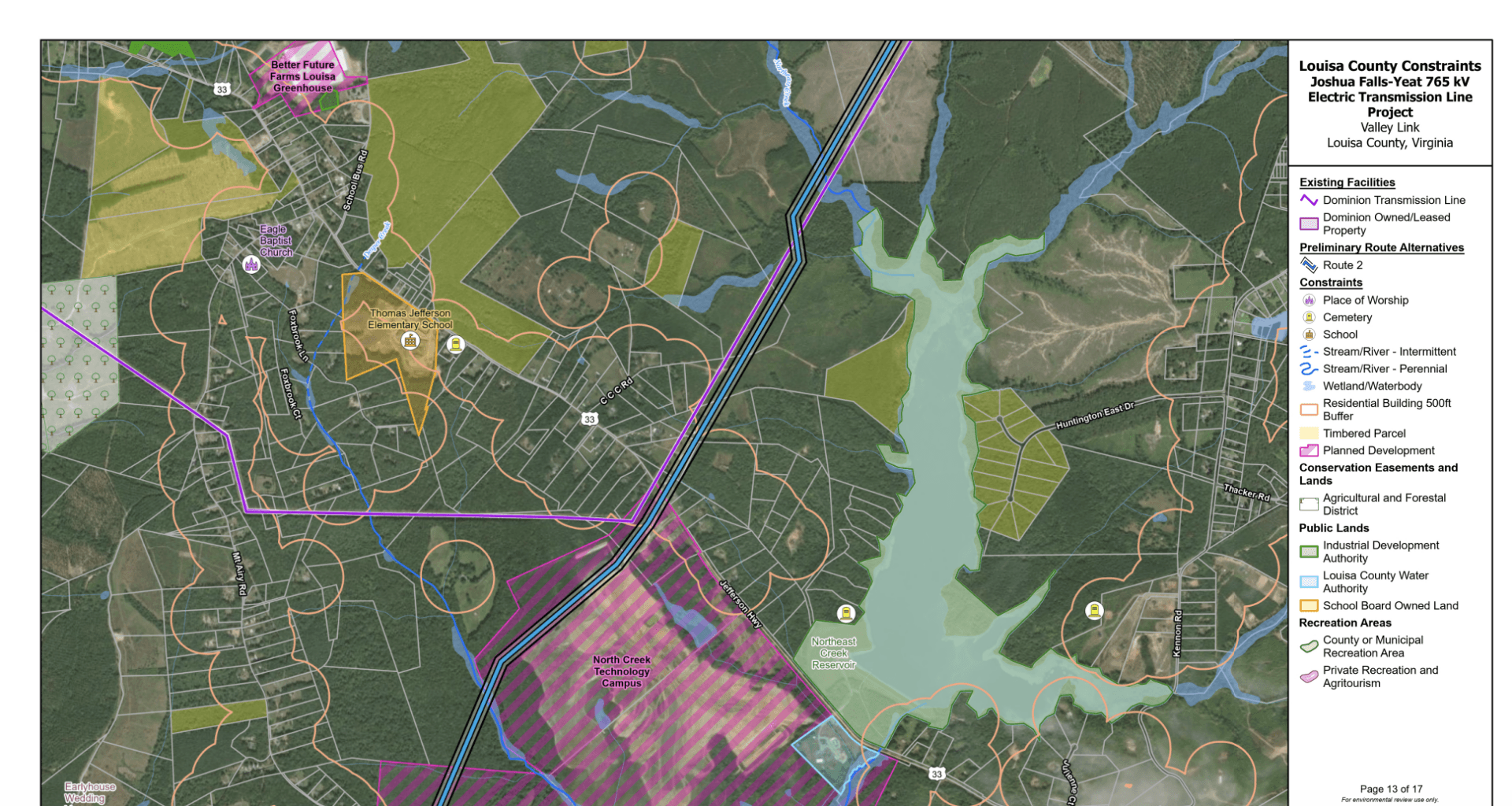
Another challenge is that the preliminary route options for the high-voltage Valley Link transmission line could run through Newsom’s property. The line will feed power to energy-intensive data centers in Northern Virginia, and may force Newsom to tear down the workshop that houses his business.

Map of potential Valley Link transmission routes through Louisa County. (Valley Link Transmission) “So I’m getting out of here, but I’m just going to be stuck with this property,” Newsom said. “(I’m) going to be stuck with two mortgages.”
The final preferred route has not been selected for the 115-mile 765 kilovolt transmission line that will stretch from Lynchburg to Culpeper County.
What’s ahead
Newsom’s lawsuit continues playing out in court, with a preliminary hearing set in the case for Aug. 19, according to U.S. District Court for the Western District of Virginia (Charlottesville) records.
Amazon tried to persuade the court to throw out the nuisance claim lawsuit, arguing in its court filing that “the brown water, noise, diminished air quality, and light pollution, are each insubstantial and thus require dismissal of the entire nuisance claim.”
U.S. District Judge Jasmine H. Yoon allowed the nuisance claim to move forward, but dismissed Newsom’s claim of injunctive relief, stating it could still be done as part of the nuisance claim but not as a separate claim.
The Louisa man’s story has captured the attention of prominent environmental advocate and paralegal Erin Brockovich, who led a successful lawsuit against a major oil and gas company for groundwater contamination in 1993.
Brockovich’s latest campaign raises awareness about the environmental impacts of data centers nationwide. Brockovich has posted multiple videos on her social media with Newsom, describing his experiences and walking through his lawsuit.
Newsom said he plans to keep pushing back against the disturbances created by the forthcoming data center campus.
“You know, one person can make a difference,” Newsom said. “So if one person like myself can get as far as I have and make the differences that I have with everything, everybody else can, too.”
This post was originally published on Virginia Mercury.
Does extreme heat cause train derailments? A Virginia railroad expert weighs in.
CSX Transportation is working to repair the damage near the intersection of Dock and 20th Streets in Richmond that contributed to three train cars derailing from a 200-car train and crashing into the Riverfront Canal on July 3, 2026. (Photo by Nathaniel Cline/Virginia Mercury)
After a freight train derailed in Richmond earlier this month, questions have emerged about what caused the crash and whether the extreme heat played a role.
Excluding the July train accident in Richmond, Virginia has recorded four derailments, all at speeds under 9 mph, since January, Federal Railroad Administration data shows. The incidents reflect the broader challenge of preventing derailments, which can stem from track defects, equipment failures, human error, or adverse weather conditions.
J.B. Jones Chair of Mechanical Engineering at Virginia Tech and director of the Center for Vehicle Systems & Safety Mehdi Ahmadian is an expert in how extreme weather affects rail tracks, the role of steel in rail infrastructure and how rail operators respond to extreme weather events.
“I can tell you confidently that the railroads do an exceptional job of maintaining the general condition of the track,” Ahmadian said. “There are thousands of trains and rail cars that operate on this complex railroad network that we have around the country, and by and large, they will travel on those tracks safely and without any incidents.”
Ahmadian, also the founder of the Railroad Transportation Laboratory, designed to help improve rail and truck safety through research and to educate students who will enter the transportation industry and advance public safety, said the U.S. rail network is “extremely complex,” carrying mostly heavy freight and sharing passenger trains in some corridors.
With over 35 years in the industry, Ahmadian said he believes railroads do an exceptional job maintaining track conditions. High-profile derailments can distort public perception, he added.
Ahmadian said one misconception is that all derailments result from extreme heat.
Impact to rail tracks in extreme weather
Regardless of the weather, Ahmadian said railroad tracks can be affected by both extreme heat and cold temperatures. This is one of the biggest challenges for railroad operators when moving passengers and cargo.
Even though train wheels look large, Ahmadian said the actual spot where each wheel touches the rail is only about the size of a quarter, roughly one-inch across.
Under extreme heat, Ahmadian said rail tracks can expand and buckle, resembling a large S-shaped curve. Even the slightest deviation in the track can cause a wheel to drop between the rail tracks, triggering derailment, with each railcar carrying thousands of pounds over eight wheels.
In extreme cold conditions, rail tracks can contract as tension increases, like tightening a guitar string, Ahmadian said. If the force exceeds the rail’s strength, it will break, creating a gap in the track and possible derailment.
Steel remains the best ‘practical material’ for rail tracks
Since the 19th century, steel has been the preferred material for railroad tracks and Ahmadian said it’s still the best choice for rail construction and maintenance.
“There is no better practical material that we can use for the extreme demands of running heavy trains,” Ahmadian said.
Steel has evolved over 150 years and is now specifically engineered to withstand extreme mechanical loads from heavy trains and resist wear.
Rail tracks can last between 20 and 40 years, depending on traffic volume and other conditions, Ahmadian said, which is amazing considering the continuous heavy loads, thermal cycling between heat and cold and constant environmental exposure.
Ahmadian said rail steel is a cost-effective engineering achievement that can’t be easily replaced.
Rail operators’ response to extreme weather
Passenger rail operators regularly adjust travel schedules that can trigger train delays if weather conditions impact rail tracks. Ahmadian says this is common for maintaining safe travel for passengers.
On hot days, Ahmadian said operators may implement “slow orders,” which require trains to run at reduced speeds on affected segments of the rail track and help reduce the risk of a heat-weakened track causing a derailment.
Ahmadian said rail operators could also temporarily suspend traffic if conditions are deemed particularly risky, typically on the hottest parts of the day. He said services typically resume once conditions are considered safe.
Maintenance crews inspect tracks for cracks or breaks caused by cold-induced contraction on extremely cold days.
Crews also investigate rail tracks ahead of trains, often using pickup trucks fitted with rail wheels to move efficiently along the tracks. Ahmadian said these patrols monitor for lateral rail shifting, signs of track panel shifting or potential buckling. They then recommend slow orders, repairs, or other interventions, if needed.

Richmond derailment still under investigation
CSX is still working on repairing the damage near the intersection of Dock and 20th Streets in Richmond that contributed to three train cars derailing from a 200-car train into the Riverfront Canal on July 3.
No injuries and no HAZMAT issues resulted from the accident. Crews continue to remove the grain from the three cars submerged in the canal. A spokesperson said the case is still under investigation.
This post was originally published on Virginia Mercury.
Loudoun supervisors mull data center moratorium and more Virginia headlines
• “Have thoughts about data centers and power bills? Share your input for the Virginia Energy Plan.” — WHRO
• “(Department of Environmental Quality) study finds growing pressure on Eastern Virginia groundwater.” — Shore Daily News
• “Lawmakers move forward with plans for childcare center for state employees.” — VPM News
• “Loudoun supervisors mull data center moratorium.” — Virginia Business
• “Chiefs assistant Eric Bieniemy’s son charged in shooting of his mother in Virginia, authorities say.” — WTOP News
This post was originally published on Virginia Mercury.
Browntown Community Center Unveils Renovated Kitchen

A fresh coat of paint is applied to the walls of the kitchen by Jim Sylvester, Steve Merz, Lisa Merz, and Roxanne Campbell (l. to r.). (Photo provided by Jim Sylvester BROWNTOWN, VA — July 27, 2026 — The Browntown Community Center Association (BCCA) is excited to announce that its kitchen renovation project, dubbed Project Kitchen Sink, is nearing completion. Browntown residents and members of neighboring communities are invited to a special Grand Reopening Celebration on August 15, 2026, from 2:00 p.m. to 4:00 p.m.
After months of renovation, the Community Center’s kitchen has been transformed into a more modern and functional space. The redesigned kitchen makes better use of the available area and provides increased storage capacity, additional countertop space, and expanded cooking capabilities.
Structural and safety improvements include new electrical wiring and plumbing, enclosed HVAC ducts, new ceiling tiles, refinished flooring, and a new commercial stove with appropriate ventilation. Much of the work was completed by a team of dedicated volunteers, with licensed contractors handling specialized portions of the project.
Damon Sutton, a member of the kitchen team, said, “It has been incredibly rewarding to collaborate with such a driven group of volunteers to repair, update, and secure a vibrant future for this special place.”
Martha Buracker, president of the BCCA and a member of the kitchen team, described the financial generosity that made the project possible.
“[This] is a shining example of what we can do with generous estate donations and a grant. While we used contractors for the license-required portions, our volunteer crew probably saved us another $20K. And the families of the donors will know that their loved ones’ legacy made a difference to the people of Browntown and to our Community Center.”
The public is invited to visit the Community Center at 96 Browntown Road in Browntown on Saturday, August 15, 2026, from 2:00 p.m. to 4:00 p.m. Attendees can see the improvements firsthand, enjoy light refreshments, and meet the volunteers and contractors who brought the project together.
The renovation was made possible by estate donations from the families of Doodle Campbell and Sam Updike and a grant from Rappahannock Electric Cooperative (REC).
To learn more about Project Kitchen Sink, see the most recent editions of the On the Gooney newsletter at browntowncommunity.com/bcca-newsletter.
About the Browntown Community Center Association
The Browntown Community Center Association is a 501(c)(3) nonprofit organization dedicated to strengthening community fellowship and providing a gathering space for residents of the Gooney Valley.

Damon Sutton, Roxanne Campbell, and Bill Lacy work together to ensure that every nook has a fresh glow. (Photo provided by Jim Sylvester.) Trump administration sustains defeat on vote-by-mail order in federal appeals court
A federal appeals court over the weekend denied the Trump administration’s request to resume a controversial plan forcing significant restrictions on vote-by-mail.
A three-judge panel of the 1st U.S. Circuit Court of Appeals agreed with a lower court ruling last month that blocked President Donald Trump’s March 31 executive order restricting mail-in voting because the U.S. Constitution grants states — not the president — authority to administer elections.
The executive order “directs unprecedented levels of involvement by federal officials in how states administer elections,” two appeals judges, Gustavo A. Gelpí and Julie Rikelman, wrote in a Saturday order. Both were appointed by President Joe Biden.
The panel’s third judge, Joshua D. Dunlap, concurred in part and dissented in part, noting that the Postal Service rule mandated by the executive order had not been finalized. The timeline suggested by the order, though, would have required states to take immediate action related to mail ballots, he added.
In a statement Monday, a Justice Department spokesperson seemed to indicate the administration would appeal the case further, likely to the U.S. Supreme Court.
“We disagree with the First Circuit’s ruling and are reviewing all options,” the spokesperson wrote. “The Department remains confident that President Trump’s order to secure federal elections will ultimately be upheld.”
Midterms in 99 days
Time is running out for Trump’s administration to successfully place the restrictions on vote-by-mail before November’s midterm elections 99 days from Monday.
The 1st Circuit panel pointed to the approaching midterms as a reason to block the order for now. A full analysis of the executive order could be considered on a longer timeline, but state election officials faced imminent consequences if they did not begin preparing for the order’s requirements in time for the November general election and September primaries, the judges found.
The order directed the U.S. Postal Service to require states to notify the agency 90 days before an election if they plan to use mail-in ballots and, if so, to send the federal government a list of eligible voters at least two months before the election and before sending ballots to those voters.
Democratic officials in 23 states — California, Massachusetts, Nevada, Washington, Arizona, Colorado, Connecticut, Delaware, Illinois, Maine, Maryland, Michigan, Minnesota, New Jersey, New Mexico, New York, North Carolina, Oregon, Rhode Island, Vermont, Virginia, Wisconsin and Pennsylvania — and the District of Columbia brought the suit challenging the executive order.
Twelve states with Republican attorneys general — Alabama, Missouri, Florida, Indiana, Kansas, Louisiana, Montana, Nebraska, Oklahoma, South Carolina, South Dakota and Texas — joined the appeal on the federal government’s side.
Citizenship lists
The executive order also required the Department of Homeland Security, with help from the Social Security Administration, to compile lists of voting-age citizens living in each state, and then provide that information to state officials at least 60 days before each federal election.
The list of citizens would be drawn from naturalization and Social Security records, according to the order. It would also include data from SAVE, a powerful computer program maintained by Homeland Security that verifies citizenship by checking names against information in federal databases.
The district court judge, Indira Talwani, said the executive order did not cite relevant constitutional or legal authority to support the creation of the lists.
Trump erodes faith in mail ballots
Trump has consistently raised unfounded concerns about mail-in voting, which nearly every state allows and some use exclusively.
The practice, especially common in Western states, enjoyed strong bipartisan support until Trump sought to undermine its credibility during the 2020 election cycle.
In 2018, the Pew Research Center found 71% of voters, including 57% of Republicans, supported vote-by-mail.
By the time of an April 2026 poll, Democrats’ favorable opinion of vote-by-mail remained high, but Republican support cratered to 34%.
In the executive order, Trump said restricting mail-in voting would limit voting by noncitizens, another voting issue Trump has often raised without offering evidence it has created a significant integrity problem in any election.
This post was originally published on Virginia Mercury.
Virginia joins Democrat-led lawsuit against FEMA, Homeland Security
(The Center Square) – Virginia is a participant in litigation seeking relief from FEMA and the Department of Homeland Security as the federal departments withhold money states use to fund counterterrorism and disaster response efforts.
Virginia in 2023 received $8.7 million through the Homeland Security Grant Program and the Emergency Management Performance Grant. The federal taxpayer money is used for purchases such as equipment for bomb squads, active shooter exercises, cyberattacks, natural disaster response, assessment of flood risks, management of wildfires, and search and rescue.
Filed Thursday in the U.S. District Court for the District of Rhode Island, first-term Democratic state Attorney General Jay Jones affixed Virginia to the list of plaintiffs led by California Attorney General Rob Bonta, Illinois Attorney General Kwame Raoul, New Jersey Attorney General Jennifer Davenport and Rhode Island Attorney General Peter Neronha. Defendants are FEMA, Robert Fenton as senior official and administrator with FEMA, and Homeland Security Secretary Markwayne Mullin.
The states are asking the court to rule that imposing election conditions, immigration conditions and termination conditions are contrary to the Constitution and federal law and in violation of the Administrative Procedure Act.
Jones says FEMA and Homeland Security have attached conditions to the financial resource, including the ability to “terminate any federal grant at any time, for any reason” and to “withhold the money unless states change how they administer elections.”
“Critical funding for emergencies and counterterrorism efforts is not a bargaining chip, and Virginia will not be threatened or bullied into sharing sensitive voter data with the federal government,” Jones said. “Donald Trump knows that the People will hold him accountable at the ballot box less than four months from now, so he is doing everything in his power to undermine voters before they get to the ballot box. With these funding conditions, he’s prioritizing his partisan agenda over the health and safety of those he serves. We will not let this stand.”
Twenty-four other states and the District of Columbia are plaintiffs. Twenty-two have Democratic attorneys general, and two states use the name of their Democratic governor rather than their Republican attorney general, respectively. Hawaii is part of the lawsuit; its attorney general’s office is nonpartisan.
This post was originally published on The Center Square.
Virginia’s new pay transparency law changes the rules for job postings
Virginia job seekers now have a right to know what a position pays before applying online under a new state law aimed at giving workers more leverage in hiring and salary negotiations.
The new law, which took effect July 1, requires employers to include a good-faith wage or salary range in public and internal job postings for openings, promotions, transfers and other employment opportunities.
It also bars employers from asking applicants about their salary history or using prior pay when making hiring and compensation decisions. Employers may also not retaliate against applicants or employees who decline to provide their salary history or ask how much a position pays.
Gov. Abigail Spanberger said the ban on salary-history questions could prove just as significant as requiring pay ranges because it prevents a candidate’s previous salary from becoming the starting point for negotiations.
“Where it becomes impactful is that if I apply for a job with a certain salary range, and my salary history is $40,000, it is not legal anymore to ask what I made,” Spanberger told The Mercury in an interview earlier this month.
An applicant could instead base a salary request on the employer’s posted range without having to explain or defend what a previous employer paid, she said.
The law, sponsored as Senate Bill 215 by state Sen. Jennifer Boysko, D-Fairfax, and House Bill 636 by Del. Michelle Maldonado, D-Manassas, places Virginia among a growing number of states requiring employers to disclose pay information in job postings.
Many multistate employers were already posting salary ranges in the commonwealth because they operate in states with similar requirements. Others have had to update job postings, compensation policies and interview practices since the law took effect.
“We’re still in the very new stages of this,” Spanberger said.
Defining a good-faith range
One question the new law leaves unanswered is how broad a salary range an employer may advertise. It requires employers to establish a range in “good faith,” allowing for differences based on experience, education, credentials and other qualifications.
Spanberger acknowledged an employer could post a broad range — for example, $35,000 to $95,000 — and still comply with the law, even if it gives applicants only a rough idea of what the employer expects to pay.
“It doesn’t necessarily serve the benefit, which is intended to provide a bit of clarity for a potential employee related to what the salary range would legitimately be,” Spanberger said.
“You can then walk in and say, ‘OK, the top end of the range is $95,000, I’m here asking for this job, I’m asking for $95,000,” she said. “They can always play games with the lower limit, but the upper limit is a piece of it that does matter.”
Julie Schweber, lead specialist in the Knowledge Center at the Virginia SHRM State Council, said many employers — particularly multistate companies — were already familiar with similar laws in other states.
“From my HR opinion, it’s not all that difficult to add a salary range on a job posting and to not ask applicants about their previous salary,” Schweber said. “It’s not a big stretch to comply with that.”
Because the law also applies to internal job postings, Schweber said employees may begin asking why similar positions carry different salary ranges or why a new hire could earn more than someone already on staff.
“A lot of organizations are asking, ‘How is this going to impact our current staff? Will they potentially get upset when they see other jobs may have a higher pay range than their job?’” she said.
That means employers may have to explain how they established posted salary ranges and why workers in similar positions may earn different amounts.
“What exactly are we looking at when we develop a pay range?” Schweber said. “It’s not so simple to just say, ‘Hey, this is our pay range.’ We also want to explain how we get to that.”
The Virginia Chamber of Commerce said employers have already been updating hiring practices, compensation policies and job postings while seeking additional guidance on compliance.
“The Chamber is focused on helping employers understand the new requirements, and as implementation continues, we will evaluate whether any legislative or regulatory changes are needed to provide additional clarity, reduce unintended consequences, and ensure Virginia remains a competitive place to do business,” said spokeswoman Hannah Emerson.
Outreach and enforcement
Spanberger said the administration’s initial focus is educating employers, particularly small businesses that may advertise a position only occasionally.
“We want to make sure that we’re getting information out and doing educational efforts before we really start aggressively holding people accountable on this front,” she said.
The administration plans to work with business associations and local chambers of commerce to explain the new requirements. The Virginia Department of Labor and Industry also published guidance when the law took effect.
Spanberger said it’s still too soon to judge how consistently employers are complying.
“Some are already being compliant, because some know about it and have taken action quickly. But in terms of us sending out any sort of formal engagement to say, ‘You’re not being compliant, fix it,’ that is too early,” she said.
The law gives the office of attorney general authority to investigate violations and bring civil actions against employers. A first violation carries a penalty of up to $1,000, with subsequent violations subject to penalties of up to $5,000 each.
Prospective and current employees also may sue within one year of an alleged violation and seek actual damages or other legal and equitable relief.
“Attorney General (Jay) Jones was proud to support stronger protections for Virginia workers during the most recent General Assembly session,” spokeswoman Rae Pickett said. “This office will stand firmly with workers and ensure that Virginia’s pay transparency laws are fully enforced.”
Schweber encouraged employers to review the state’s guidance, train managers and evaluate their overall compensation policies rather than viewing the law as simply a requirement to add salary ranges to job postings.
Employees may ask why they fall at a certain point within a pay range or why another position pays more, she said. Those conversations could include factors beyond salary, such as health benefits, flexible work arrangements, professional development and or opportunities for advancement.
“It’s not a one-and-done type of communication,” Schweber said.
She said the law could also prompt employers to identify pay differences that developed over time without a clear compensation strategy and ensure salaries remain fair and competitive.
Lessons from other states
Virginia joins a total of 13 states, including California, Colorado, New York, which require pay transparency in job postings, though details vary. Washington, D.C. also has pay transparency standards.
Some of those laws only apply to employers above a certain size, while others also require companies to disclose benefits and other forms of compensation.
Research suggests the laws have significantly increased the amount of salary information available to job seekers. A 2025 study by the National Bureau of Economic Research found that disclosure requirements increased the share of job postings containing pay information by about 30%.
The researchers also found wage increases ranging from 1.3% to 3.6% across three data sets, but no measurable effect on employment, pay differences among workers or the education and skill requirements employers listed.
Colorado began requiring compensation information in job postings in 2021 and has since established a formal process for investigating complaints. New York’s statewide law took effect in 2023 and generally applies to employers with at least four workers, while Virginia’s new law has no minimum employee threshold.
But those laws have not eliminated job postings without salary information. A 2025 review by the New York City Council found thousands of listings on Indeed and Google for Jobs that lacked pay ranges, which the council attributed in part to the way those platforms pull postings from other websites.
Among 100 employers the council reviewed directly, 87 included salary information in every posting, 12 complied in some but not all listings and one included no salary information. The review also found that some employers posted wide salary ranges, underscoring that requiring a range does not always provide applicants with a precise estimate of what a job will pay.
But advocates argue salary-history bans can help reduce long-standing wage gaps because workers who were underpaid in one job no longer have to carry that salary into negotiations for the next.
Schweber pointed to federal labor statistics showing women, on average, earn less than men and that wage disparities also persist among women of different racial and ethnic backgrounds.
“The theory behind these regulations is not to give companies more work to do,” she said. “But it’s so that job applicants and employees will have more information that will enable them to negotiate their compensation more fairly, and ideally close those pay gaps.”
She said that job seekers increasingly expect to disclose pay before they apply. Citing a 2023 SHRM survey, Schweber said 82% of U.S. workers were more likely to consider applying for a job if the salary range was listed.
A separate 2024 survey of human resources professionals found that 60% of organizations were publishing salary ranges in job advertisements, up from 45% the previous year.
Schweber said many employers now see pay transparency as a recruiting and retention tool, even when the law does not require it.
“Companies are seeing the value of doing this as part of their recruitment and even retention strategy,” she said, “and it’s better for an organization when we are transparent with our job applicants and employees.”
This post was originally published on Virginia Mercury.
Va. co-owner’s donation of White’s Ferry paves way for Potomac River crossing’s reopening
A Virginia-based ferry owner has donated his dormant transportation service that connects the commonwealth to Maryland, ending Virginia’s era of ownership in hopes of lifting the ferry suspension after six years.
White’s Ferry is one of a few that remain nationally. At the time of its closure in December 2020, it allowed 600 to 800 vehicles per day to cross the Potomac River from Montgomery County, Maryland, to Loudoun County, Virginia. The closure has resulted in longer drive times for travelers and a negative impact on businesses near both sides of the ferry’s ports.
On Friday, on the Maryland side of the Potomac River, longtime Virginia business owner and ferry co-owner Chuck Kuhn announced plans to turn over the service, property and assets to Maryland’s Montgomery County, to continue the process of restarting the ferry service.
Kuhn was joined by Maryland state lawmakers and leaders from Montgomery County and neighboring jurisdictions of White’s Ferry.
In 2021, Kuhn and his wife Stacey purchased the ferry in hopes of reviving service. But they couldn’t reach an agreement on operations and the structure of revenue with Rockwell Farms, the owner of the landing in Virginia, leaving the ferry docked.
The couple doesn’t care about owning the ferry, Kuhn said Friday. What’s important to them is keeping the ferry open.
“We acquired the ferry so the barge wouldn’t be removed and cut up for scrap,” Khun said in an interview after the announcement. “We were afraid that once it was gone, we’d never get a boat back on the river.”
He added, “What we needed to do was get the ferry out of private ownership and into county and state ownership, and (now) you’ll see action. This ferry will ride.”
As part of the tentative deal, Montgomery County Executive Marc Elrich said the locality will pay the Kuhns $1.5 million for 2.5 acres of ferry landing property. The boat, store lease and related equipment are being donated by the Kuhns.
“The most logical and simple thing is just go to that (Virginia) landing that we can all see in plain sight, and just get the job done and get the state and the owner to agree that we can resume services,” Elrich said of how the plan developed.
Elrich explained that reopening White’s Ferry will significantly reduce commute times by restoring a direct crossing, helping drivers avoid long detours to distant bridges.
A study estimates that this time savings was worth about $1 million per year in 2022 dollars and will grow to roughly $1.77 million annually by 2040, with the overall economic impact of the crossing projected to be between $9 million and $13 million each year.
He added that the county plans to hire operators, rather than run the ferry itself, and is open to different fee structures including per-car charges, but no specific per-car cost has been set yet.
Montgomery County Department of Transportation Director Chris Conklin said the agency explored multiple ways to restart the ferry, adding that “this is the most likely path for success, and we hope that it happens.”
Conklin said the county has several tasks to complete before service can resume, including assessing the condition of the vessel. In the meantime, the county will wait until representatives of Loudoun County government and Rockwell Farms can reach an agreement on the future of the landing, which has been an ongoing process.
Loudoun County spokesman Glen Barbour said in a statement that Montgomery County officials informed his county on Thursday about the agreement to assume ownership of the property and the ferry.
Barbour said Loudoun views the purchase as a “positive development” and remains interested in a “commercially reasonable price for the land in Virginia that would enable the two counties to resume operation of the ferry in the future.”
Loudoun Economic Development Executive Director Buddy Rizer added, “This is an important milestone toward improving regional connectivity. Working together on projects like this creates stronger local economies and better opportunities on both sides of the river.”
Barbour did not detail any of Loudoun’s plans. However, Loudoun County does have the authority to exercise eminent domain, or to take private property for a public use. The authority comes from both the Fifth Amendment to the U.S. Constitution and Article I, Section 11 of the Virginia Constitution.
The Mercury contacted Rockland Farms for comment but didn’t receive a response by press time.
With the sale of the service, Virginia’s list of ferry operations is trimmed down to at least three, including Jamestown-Scotland Ferry, the largest of a trio of state-operated ferry systems. The free ferry service runs between Jamestown in James City County and Surry County.
Virginia saw an increase in ferry demand since the pandemic, reaching an average of 2,185 vehicles per day in 2023, up from 1,922 in 2020, according to the Virginia Department of Transportation.
This post was originally published on Virginia Mercury.
Goochland residents rebuff data center developer Tract ahead of permit application
Cynthia Haas speaks against data center development in Goochland County, July 2026. (Photo by Shannon Heckt/Virginia Mercury)
On Thursday evening, dozens of Goochland residents donned red t-shirts and held signs that spelled out their displeasure with the idea of multiple data centers being built in the county’s technology overlay district that butts up against Mosaic, a 55+ neighborhood that hosts over 500 homes.
“We want to make sure that everyone understands that we don’t want data centers in Goochland,” resident Cynthia Haas said outside Goochland High School, where data center developer Tract presented its plan to construct several data centers on 870 acres in the rural central Virginia county.
Tract specializes in land acquisition and getting sites “shovel ready” for data center construction. The group secures permits for companies to either purchase land to build or lease out data centers built by Tract’s sister company.
The company is proposing a 900 megawatt, multi-facility development in the Tuckahoe Technology Park, a controversial plot that was rezoned for this kind of development last year and is at the center of a lawsuit.
At the meeting, Tract representatives did not present a definitive number of data centers that could be developed on the site if their permits are approved and the land is prepared.
When discussing the project’s potential environmental impacts and the construction process, Tract’s director of entitlements Kara Bowyer provided an example of 12 potential data centers.
Among their chief concerns, residents questioned how the company would handle noise pollution, diesel generators near homes, transmission line placements, and water use.
Tract also works with the utilities to add data center sites to the power grid connection queue, a process that Dominion Energy said can take up to seven years.
Bowyer told meeting attendees that most data center companies won’t be interested in the land until about 18 months out from the power connection. Construction on the campus itself would begin as soon as final approvals are given.
The project would require the zoning of some parcels within the technology district to be changed from agricultural to industrial, another pain point residents voiced. Many attendees said maintaining the area’s rural character is a priority for them.
In defense of those points, Bowyer pointed to the county’s comprehensive plan, which they said earmarked the area “for economic development for nearly 50 years.”
“So this is the place in the county that your government has decided is the best place for this type of growth,” Bowyer said.
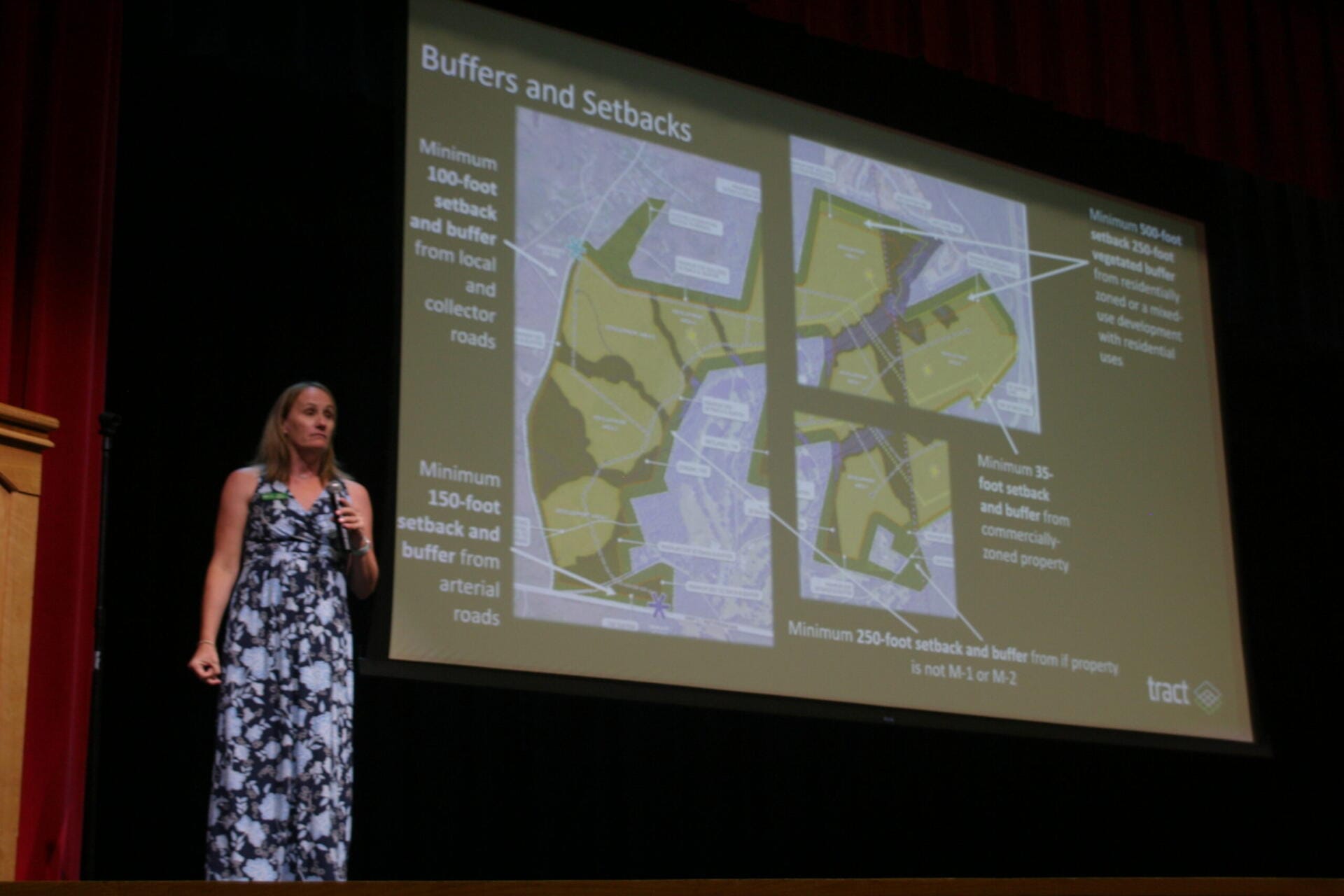
Tract representative presents to Goochland residents plans for data center development. (Photo by Shannon Heckt/Virginia Mercury) Goochland’s government also requires a pre-application meeting to allow the company to engage with the public before the application review process begins, which is the origin of Thursday’s meeting.
Tract is still tweaking the full development plan before it submits the application for a conditional use permit to the county.
In response to some of the community concerns, the company has committed to using air cooling, rather than evaporative cooling, for the computer systems. This would significantly reduce the water usage for the data centers, but air cooling requires far more power, which would be a further strain on the state’s electrical grid.
At the meeting, Bowyer said the company would ensure backup generators would be 1000 feet away from the Mosaic residences and 500 feet from residential structures in other parts of the technology district.
Those promises were met by boos and angry murmurs from the crowd inside the high school’s gym.
Bowyer suggested that Tract’s data centers would be able to rely on power infrastructure supporting another major development nearby. The data center complex would be just as beneficial to the county’s tax revenue and local employment rate as the forthcoming Eli Lilly pharmaceutical manufacturing plant, Bowyer said.
But residents are not sold on the two projects being comparable when it comes to permanent jobs for the area. The drug maker’s project is slated to create 650 permanent jobs, developers said last year, equaling $5 billion in investment in the state’s economy.
“Eli Lilly is bringing an extraordinary number of people to work in their plant,” Haas said. “It’s going to be a really good business. Data centers, on the other hand, the negativity surrounding them is huge.”
Tract was dealt a blow recently in Hanover County, where a similar proposed data center campus was rejected by county supervisors after fierce local opposition, according to WTVR. That result has emboldened Goochland residents to fight back against Tract’s latest venture in Virginia, some attendees said.
“When someone tells you that these data centers are inevitable, I want you to remember something: We were told the exact same thing. We were told the decisions had already been made, and it was a done deal,” said Holly Manke, a member of the anti-data center group Friends of Hanover.
Sign at public meeting in Goochland, VA shows anti-data center development sentiment. (Photo by Shannon Heckt/Virginia Mercury) The Mosaic Home Owners Association passed out a list of questions they want Tract to answer before the formal conditional use permit is filed. The list includes queries about impact studies on the years-long construction expected, public health impact studies on sound and pollution and the number of back up generators.
There is no timeline yet of when the formal application will be filed or when county supervisors will begin their official review of the proposal. Residents can learn more about the proposal on the county website.
This post was originally published on Virginia Mercury.
Emails show how Virginia regulators downplayed data center health concerns, more headlines
• “Emails show how Virginia regulators downplayed data center health concerns.” — Politico
• “Nexstar Tegna merger: Virginia AG alleges court order violation.” — Roanoke Star
• “Virginia needs months of steady rain to recover from one of its worst droughts in decades.” — WSET
• “Span of control: What your Virginia local government can (and cannot) do.” — Augusta Free Press
• “First-ever leatherback turtle nesting in Va. discovered in Virginia Beach.” — WAVY
This post was originally published on Virginia Mercury.
Federal judge in Virginia says certain abortion drug restrictions are unlawful
A federal judge in Virginia ruled Thursday that the U.S. Food and Drug Administration did not sufficiently justify restrictions imposed in 2023 on a drug used to terminate early pregnancies, adding another layer of complexity to a string of legal cases with opposing goals that could affect future abortion access.
The lawsuit was filed in 2023 by abortion providers in Kansas, Montana and Virginia to challenge the restrictions as excessive, unwarranted and inconsistent with other legal requirements. A similar case in Hawaii was already decided in October, with a federal judge also finding that the restrictions were arbitrary.
In Virginia, U.S. District Court Judge Robert Ballou, an appointee of former President Joe Biden, said the FDA failed to conduct an appropriate review of the 2023 restrictions on mifepristone, which include rules that prescribing pharmacies and clinicians must be specially certified and prescribers and patients must sign a form acknowledging the medication’s risks.
“The 2023 REMS modification is unlawful and must be remanded to the FDA for review,” Ballou wrote, using the acronym for the FDA’s Risk Evaluation and Mitigation Strategies protocols.
Amy Hagstrom Miller, president and CEO of lead plaintiff Whole Woman’s Health Alliance, based in Virginia, said in a statement Friday that eliminating those three restrictions would help clinic staff focus on patient needs instead of “excessive paperwork.”
“I have worked in abortion care for over 30 years, and I can attest that these regulations serve no medical purpose, nor do they add value to our patients’ experience of abortion,” Hagstrom Miller said in the statement.
The FDA did not immediately respond to a request for comment from Stateline on Friday.
Ballou did not give a timeline for a review of the restrictions, but the FDA has said it is conducting a broader safety review and has sought to dismiss cases related to mifepristone regulation until it completes that review. Trump administration officials told the Wall Street Journal in June that the review was expected to take about six months, meaning it would conclude after the national midterm elections.
Katie Keith, founding director of the Center for Health Policy and the Law at the Georgetown University Law Center, said the Virginia and Hawaii decisions mean the FDA has been ordered by two courts to reconsider its restrictions and more thoroughly explain why they are necessary.
“They’re going to have to look at everything these various courts are telling them to look at,” Keith said.
But the two rulings come at the same time the administration is receiving pressure from anti-abortion groups to further restrict access to mifepristone, even in states where abortion is legal.
The 2023 rules, which were decided under the Biden administration, also eased restrictions to allow mifepristone to be dispensed without an in-person provider for the first time. That helped expand national access to the medication, which is one of two drugs typically used to end a pregnancy before 10 weeks and to treat miscarriages, and allowed people who live in one of the 13 states with near-total abortion bans to continue to receive it by mail.
That expanded access prompted three other lawsuits from attorneys general in states with abortion bans that are still pending in federal courts. In Louisiana, the 5th U.S. Circuit Court of Appeals is considering whether to strike down the provision allowing telehealth prescriptions, and will hear oral arguments in the case in September.
The 5th Circuit initially granted an emergency request from Louisiana to block telehealth access to the medication, but after drug manufacturers appealed the decision to the U.S. Supreme Court, the justices reversed the circuit court ruling. That stay from the high court will remain in place as the case continues.
Two other cases with different implications for the future of mifepristone are ongoing. One is in Missouri, joined by attorneys general from Idaho and Kansas, where they have asked the court to return all of the restrictions to what they were in 2016. The other is in Texas, joined by Florida’s attorney general, asking the federal court to revoke the drug’s approval entirely.
Stateline reporter Kelcie Moseley-Morris can be reached at [email protected].
This story was originally produced by Stateline, which is part of States Newsroom, a nonprofit news network which includes Virginia Mercury, and is supported by grants and a coalition of donors as a 501c(3) public charity.
This post was originally published on Virginia Mercury.
Loudon County considers pause before final data center regulations are ready
(The Center Square) – Loudon County could be added to the list of jurisdictions in data center-rich Virginia that is creating a pause on their creation.
In Wednesday’s meeting of the nine-member governing body of the county, Democratic Supervisor Juli Briskman requested a way to enact a moratorium on applications. The Board of Supervisors in the spring is expected to have its new regulations for the industry.
Other jurisdictions known to have paused activity in some manner are Fluvanna County and Front Royals, with Suffolk City in consideration.
According to DataCenterMap, a respected tracker of data centers, Virginia has 653 – most of any state in the country. The map has tracked 4,619.
Data centers are tied to the explosion of artificial intelligence. Debate most often revolves around the strain of local resources inclusive of water depletion and grid reliability; passed-on costs by utility companies scaling capacity; pollution by noise, air, industrial, and destruction of land; corporate tax breaks to lure companies; jobs promises; and lack of transparency in deals bringing them into communities.
Leo Rogers, lawyer for the county, told the supervisors it would be illegal for the county enact a moratorium. He said he would look at actions by other jurisdictions.
This post was originally published on The Center Square.
‘E pluribus unum’ is not a slogan. It’s a choice.
Like two sides of a coin imprinted with the nation’s motto, “e pluribus unum” — out of many, one — America’s political factions are cast in opposition, but they are intrinsically bound together as parts of a larger whole.
From the beginning, the United States has aspired to build a more perfect union. When our founders convened the Constitutional Convention in 1787, they disagreed about the structure of government, the balance of power and the protection of individual versus collective rights. But when they debated — and they often did, with great conviction and intensity — they honed their arguments on what they thought was best for the entire country, guided by the shared vision of a new nation established on the ideals of individual freedom, equality and opportunity.
Today, that shared commitment to America’s founding creed is under strain.
Most Americans feel exhausted by politics, and a growing number are unhappy with the way the political system is working. Worse, this unhappiness is showing up in unhealthy ways, with low trust in government and each other — a sense that the other side is the problem.
We are painfully aware that partisanship and distrust have grown. We see this too often, when people are reduced to disparaging labels, states are cast as simply red or blue, and the hostility in our politics produces no progress, leaving us all no better off, or worse than before. Our political parties appear deadlocked in a struggle for power, forgetting that they are inseparable sides of the nation’s democratic system, which depends not on who wins but on a shared commitment to the common good. Central to that commitment is a willingness to listen to opposing views, not simply to respond but to understand.
Disagreeing is one thing — it is rooted in our pluralist republic. But when we cannot find ways to work together, it becomes impossible to solve our problems. The founders understood this. They argued passionately, but they shared a deeper allegiance to the nation’s success and its posterity, and they were partners in creating and safeguarding a system that we all continue to rely on.
Whether we choose to engage in political warfare or civil debate is up to each of us. That’s as true in statehouses and city councils as it is at the family dinner table, in the community center, on the debate stage, or standing on opposite sides of a free speech zone. In each of these venues, we can choose to practice democracy by engaging in debate that is spirited, healthy and rooted in strong arguments rather than name calling — or worse, heeding the impulse to withdraw from political engagement altogether.
There are glimmers of hope.
Here in Chicago, as part of the nation’s largest public policy gathering of state legislators and staff from all 50 states and U.S. territories, our organizations, the National Conference of State Legislatures and The Pew Charitable Trusts, are working together to build connections across the political spectrum and share policy ideas and best practices that strengthen legislatures and serve communities nationwide. This follows a series of events held around the country, including a February “America at 250 Forum,” to bring people with opposing views together to discuss issues that matter to everyone. All of the events demonstrate a serious commitment to strengthening our democratic muscles at this historic moment for the country.
Legislators from different parties sitting together to discuss not only their politics but also their human connection and shared belief in the country demonstrates that, despite the spotlight on our divisions, the time is ripe to unite for a common cause. We need to see more unity from our leaders — and be willing to try it ourselves.
Today, Americans must recognize that our political differences are not inevitably divisive, because our futures are fundamentally connected. Politics are difficult, yes, but they do not need to be ugly. Finding common ground is welcome, but at a minimum, Americans need to find the space to connect with one another and the courage to engage in healthy and substantive discussion. We can do that by building up state and local institutions where individuals get to know each other personally and by overcoming the silos and sides we’ve allowed to define us. A far better approach is to deal with people face-to-face and with respect, even when we profoundly disagree.
In a time when polarization and mistrust are treated as inevitable, we encourage all Americans to recommit to the principles and institutions that bind us together: a common belief in individual rights and equality, the rule of law, the legitimacy of representative democracy and our shared pursuit of national prosperity.
As America honors its 250th anniversary, it’s important to say, unequivocally and collectively, that we’re grateful to our country’s founders for starting this great experiment. We care about each other, and we want our fellow citizens to be successful. And we are proud to be part of this diverse, complicated and hopeful country.
Shared beliefs like these are central to the American experiment. E pluribus unum — out of many, one — if we so choose.
Tim Storey is the CEO of the National Conference of State Legislatures. Sue K. Urahn is the president and CEO of The Pew Charitable Trusts.
This story was originally produced by News From The States, which is part of States Newsroom, a nonprofit news network which includes Virginia Mercury, and is supported by grants and a coalition of donors as a 501c(3) public charity.
This post was originally published on Virginia Mercury.
National landlord with property in Virginia accused of housing discrimination
Civil rights complaints filed in Virginia and other states allege that Greystar, a national apartment management company, has violated fair housing laws by rejecting prospective tenants that use housing vouchers to help pay their rent.
An investigation by nonprofit watchdog Housing Rights Initiative found over 100 instances where properties managed by Greystar in Virginia, Maryland, Hawaii, New Jersey, Michigan, California and Washington D.C. appear to have violated state or local housing laws.
Housing vouchers support low-income families or people with disabilities who otherwise would struggle to afford rent.
Though federal law allows acceptance of vouchers to be optional, many states set acceptance requirements. Virginia law, for instance, generally requires landlords accept vouchers unless a landlord owns fewer than four properties.
Housing Rights Initiative executive director Aaron Carr said his organization “trained an army of undercover investigators” to conduct cold calls to Greystar properties and pose as housing voucher users inquiring about renting apartments.
They asked typical questions prospective renters pose: “How much are utilities?” and “What’s included in the rent?”
But towards the end of conversations, Carr said “they would ask the million-dollar question, which is, ‘do you accept rental assistance?’ And over and over again the answer was ‘no.’”
As part of the investigation, the group created a spreadsheet with recordings of the calls. A staff member at a Greystar property in McLean in Northern Virginia told multiple callers that the company was “not set up” for receiving vouchers.
“Greystar markets itself as a provider of higher end rental housing, and my theory is that they may view voucher holders as a threat to that brand,” Carr explained.
But Thomas Okuda Fitzpatrick, director of Housing Opportunities Made Equal of Virginia, previously noted that voucher holders can represent stability for landlords, because those tenants are guaranteed to be able to pay some or all of their rent each month.
HOME of Virginia has represented Virginians in housing discrimination cases, like a Richmond couple who settled out of court after struggling to find a home due to rejected housing applications.
The organization also settled cases against Sylvan Homes LLC and College Square Apartments last year for refusing to rent to voucher users. In a joint statement announcing the settlement, College Square Apartments noted that its employees have since undergone training to ensure they understand state housing laws and prevent discrimination.
“Source of funds bias is deeply harmful,” said HOME deputy director of advocacy Brenda Castañeda. “The vast majority of voucher holders in Virginia are women, frequently mothers, and voucher households often include individuals with disabilities — vulnerable neighbors facing major obstacles.”
While the calls made in the Housing Rights Initiative investigation were feigned, Carr emphasizes they represent what would happen as actual voucher holders seek a place to live.
Cohen Milstein teamed up with the Housing Rights Initiative to bring the cases to each state’s key housing enforcement agency or attorney general.
“We look forward to this process where we will be providing any and all information that these states may request of us,” Cohen Milstein lawyer Brian Corman said.
Greystar has come under fire in the past.
Last December, the company settled a $24 million lawsuit with the Federal Trade Commission and the state of Colorado for deceptive pricing on tenants’ rents.
Last November, it reached a $7 million settlement with nine states over participation in a scheme to drive up rental prices using shared rent-setting algorithms in a property management software.
The Mercury reached out to Greystar for comment but did not receive a response by the time of this publication.
Carr said that landlords who reject voucher holders harm not only those who use that type of housing assistance but also all taxpayers, eventually.
“Homelessness is extraordinarily expensive,” he said. “It increases law enforcement costs, hospital costs, shelter costs. Housing discrimination doesn’t just screw over low-income families, but ultimately screws over everyone. We all have a stake in this.”
This post was originally published on Virginia Mercury.
Va. transportation board OKs stricter oversight for economic development fund
The Commonwealth Transportation Board on Wednesday accepted regulation changes outlining how funds from the state’s Transportation Partnership Opportunity Fund will be allocated, giving state lawmakers additional time to review the proposals.
Since 2005, the fund, a flexible economic development tool, has invested over $644 million as of Jan. 31 to support major projects, including transportation improvements for the LEGO manufacturing plant in Chesterfield County and enhanced access near Wallops Island for the state’s aerospace and research facilities.
Overall, the changes increase oversight by lowering the funding thresholds that trigger review by the Virginia Major Employment & Investment (MEI) Commission, lengthening the review period, adding more formal notification procedures and requiring updates to program guidelines.
Lawmakers directed the guideline changes in the biennium budget passed in late June in response to lawmakers’ concerns about awareness and oversight, according to Secretary of Transportation Nick Donohue. He did not expand on lawmakers’ directions to the board at its business meeting on Wednesday.
“The authority of this board and of the administration to allocate funds is the same,” Donohue said.
“What has changed is the amount of time that we must provide an opportunity for review of awards of a certain amount. That amount has been lowered. The number of people we must provide the notice to has been expanded, and the method of delivery has been changed.”
Under the fund’s guidelines, the governor can award money from the fund as grants up to $5 million, revolving loans up to $30 million and other financing tools to an agency or political subdivision in Virginia.
In light of the concerns, additional notification requirements are being considered, including:
If a single project is funded over $10 million or $25 million over two years, it must be reviewed by MEI within 30 days; if no response is received, the funds can move forward. Additionally, the governor’s notification must be hand-delivered to MEI, House Appropriations and Senate Finance and Appropriations committee staff.
The secretary of transportation will continue to notify legislative leaders of funds directed to projects in excess of $5 million within 35 days.
The revised guidelines will be posted on the Virginia Regulatory Town Hall, the state’s online bulletin board for government rule changes, for 30 days of review and public comment.
Before making any new awards, the governor must provide copies of the revised changes to the chairs of the House Committees on Appropriations, Finance, and Transportation, and Senate Committees on Finance and Appropriations.
This post was originally published on Virginia Mercury.
Virginia dental offices face ongoing staffing strains and more state headlines
• “Virginia dental offices face ongoing staffing strains, new report finds.” — WWBT
• “In the data center capital of the world, residents ask who the AI boom is helping.” — NBC News
• “Study: Virginia has the sixth-best school system in the U.S..” — WAVY
• “Department of Defense picks Virginia Tech for Fellowship Program.” — WDBJ7
• “Virginia pastor charged after allegedly sending explicit images to teen he met at church, police say.” — Fox 5 DC
This post was originally published on Virginia Mercury.
Future regional power supply down, but not out
(The Center Square) – Shrinking power supply remains a challenge according to the grid operator’s most recent capacity auction, signaling that regional utility bills could still climb, albeit more slowly, as demand for electricity grows faster than can be provided.
PJM, the organization tasked with managing the flow of power for 67 million people across 13 states and Washington, D.C., collects annual bids from generators that commit them to providing energy supply over the following 12 months. In this case, it’s for the 2028-29 operating year.
By doing so, the organization can better hedge against blackouts and soaring prices that could happen if there’s not enough power to turn on furnaces in the dead of winter or air conditioning at the height of summer.
“These auction results show that demand for electricity continues to grow faster than electricity supply,” said David Mills, PJM president and CEO. “At the same time, PJM recognizes how this supply-and-demand imbalance impacts the reliability of the system and costs for consumers. We are working with government and industry leaders on multiple fronts to restore that balance by bringing on new generation as fast as possible and managing the growth of new load on the grid.”
But a better solution, according to energy producers, state officials, and PJM alike, would be to plug more supply into the grid, which can help limit the stress fractures anticipated from the data center boom.
Auction Price
Results of PJM’s 2028-2029 Base Residual Auction show the price reached the federally approved cap of $325 per MW-day throughout the PJM region – 2.5% below the $333.44 price in the previous auction.
The auction’s cleared capacity totaled $16.4 billion. PJM notes that figure does not represent the total cost to customers because some utilities and other load-serving entities secure capacity through self-supply arrangements or bilateral contracts and are not subject to the auction clearing price.
Katie Blume, coalition chair of Clean Power PA, said the results amounted to “more of the same: high prices driven by surging data center demand, and a grid that’s getting less reliable, not more.”
Blume credited the price cap negotiated by Gov. Josh Shapiro with preventing steeper increases, saying it has saved consumers nearly $13 billion over two auctions. However, she said a cap does not add new power supplies or resolve PJM’s underlying problems.
She called for making data centers pay their “fair share” of grid costs and accelerating the connection of wind, solar, and battery-storage projects.
Reliability Shortfall
For the second consecutive auction, PJM secured less capacity than required to meet its reliability target. The 2028-2029 auction fell short by 6,831 MW, leaving the grid below the reserve cushion required to meet a one-in-10-year reliability standard.
A rough estimate puts the total number of homes powered by that many megawatts around 5.5 million. This figure assumes PJM’s standard of 1 MW is equal to supplying an average of 800 homes.
The organization, however, said that the shortfall does not necessarily mean the system will be unable to meet demand. It means the grid will operate with slimmer reserves and greater risk during extreme conditions. It continues to hold a reserve margin of 14.7%.
The shortfall was not unexpected given the trend. The previous auction fell approximately 6,500 MW short, and large load projects continue to be added to the demand forecast.
Forecast peak demand for 2028-2029 is approximately 2,000 MW higher than in the previous delivery year.
Supply and Proposed Solutions
The auction secured 138,318 MW of capacity, an increase of 3,733 MW from the previous auction. That included 525 MW from new generation and upgrades to existing plants.
That’s enough supply to power 69 million and 138 million homes, dependent upon the season.
The committed resources include: 46% natural gas, 20% nuclear, 18% coal, 5% demand response, 4% hydro, 2% wind, 2% oil, and 1% solar.
PJM said it is working to increase supply and manage demand by clearing its project queue, creating a faster pathway for certain high-priority generation proposals, improving the performance of existing plants, and developing “Connect and Manage” frameworks that would allow data centers and other large users to connect under flexible operating conditions.
The grid operator also plans to seek federal approval for a Reliability Backstop Procurement intended to address near-term supply needs.
“All of these initiatives are critical to keeping the lights on while allowing states to protect their everyday electricity customers,” Mills said.
Electric Power Supply Association President and CEO Todd Snitchler said historically low capacity prices had discouraged investment in generation, while the higher prices that began with PJM’s July 2024 auction prompted companies to announce, restart, expand, or advance tens of gigawatts of projects.
Snitchler said the immediate challenge is turning that investment into additional electricity supply by accelerating permitting, siting, and grid interconnection. He also cautioned against allowing utilities to finance new generation through mandatory customer charges, arguing that competitive suppliers and investors should continue to bear construction risks.
Claire Lang-Ree, advocate for climate and energy for the Natural Resources Defense Council said, the results confirm that data center growth is outpacing new electricity supply, weakening reliability, and keeping prices at the cap.
She called on PJM and state officials to ensure data centers pay for generation and transmission built to serve them and to accelerate the interconnection of lower-cost clean energy projects.
“The 67 million PJM residents literally can’t afford to suffer any more record-breaking auctions or near-blackout events,” Lang-Ree said.
PJM expects to submit its Reliability Backstop and Connect and Manage proposals to the Federal Energy Regulatory Commission in the coming weeks.
The next Base Residual Auction, for the 2029-2030 delivery year, is scheduled for December as PJM works to restore its three-year-ahead auction cycle.
This post was originally published on The Center Square.
Carolina, Virginia Tech chosen for fellowship program by War Department
(The Center Square) – Carolina and Virginia Tech have succeeded Ivy League institutions War Department Secretary Pete Hegseth says are “woke breeding grounds of toxic indoctrination” in being chosen for a fellowship program for senior military officers.
The 10-month professional military education program, known as the Senior Service College Fellowship, is an alternative to education at traditional war colleges.
Lee Roberts, chancellor of the University of North Carolina at Chapel Hill, said in a statement, “The program fits well within the context of our mission of service, and we take tremendous pride in our deep, long-lasting relationship with the United States military.”
Virginia Tech, in Blacksburg, is in the midst of a presidential search. U.S. Rep. Morgan Griffith, R-Va., said the school’s tradition of service to country has existed since its founding in 1872.
“I commend DoD for developing closer ties with Virginia Tech through this fellowship program,” he said.
Hegseth, a graduate of Princeton and the Harvard Kennedy School, said, “We demand that senior service colleges work to sharpen our war fighters on genuine national security issues, not social justice activism.”
Hegseth has prohibited military officers from attending graduate programs at a number of universities, a list that includes the Ivy League’s Harvard, Princeton, Brown and Yale.
This post was originally published on The Center Square.
States move to limit classroom screen time
After school cellphone bans passed many statehouses with bipartisan support in recent legislative sessions, state lawmakers are turning to legislation governing how long students should spend looking at screens.
This year, four states passed laws restricting or regulating screen time for students from childcare through fifth grade.
Iowa capped digital instruction at 60 minutes per day for students in kindergarten through fifth grade, with exceptions for special education, assessments and computer science.
Utah lawmakers this year directed the state education board to develop grade-specific technology rules, including restrictions on screen time in kindergarten through third grade and prohibiting one-device-per-student ratios in elementary school.
A new Tennessee law requires every district and charter school serving K-5 students to adopt an age-appropriate digital device policy to minimize unnecessary screen time. And Alabama this year adopted a law requiring the establishment of screen time standards and teacher training for childcare facilities, prekindergarten and kindergarten.
But a Missouri bill to require school districts and charter schools to adopt screen time policies for kindergarten through fifth grade and an Oklahoma proposal to cap screen time at 60 minutes per day for students in prekindergarten through fifth grade both failed.
The Missouri bill easily cleared the House but stalled in the Senate. Despite passing the Oklahoma House unanimously, that bill stalled in the Senate and faced pushback from a technology industry trade group. The Software and Information Industry Association referred to the bill as an “unfunded mandate” and said it would increase administrative burdens and undermine workforce readiness.
Some school districts also are adopting screen time policies for the upcoming school year. The Los Angeles Unified School District, the nation’s second-largest school district, is the one of the first to impose systemwide, grade-by-grade instructional screen limits.
Los Angeles has barred instructional screen time before second grade. The district also set limits that increase incrementally to 60 minutes per subject each week for middle school students and 90 minutes per subject each week for high school students.
Inanna Balkin, a rising high school senior at Amherst Regional High School in Massachusetts, told Stateline that “it’s really important for students to learn how to manage their screen time,” and that schools should help students develop habits for managing screen time rather than simply removing access to technology.
“Automatically not having access to your phone or a screen during the day kind of doesn’t allow for students to be responsible for their own management when school is over,” said Balkin, who uses an app called Opal to block distractions while doing homework.There are no clear national statistics measuring how many minutes students spend using screens for classroom instruction, yet screen time has become a focus of the U.S. Department of Health and Human Services under Secretary Robert F. Kennedy Jr., including a warning from the surgeon general’s office.
Tracy Weeks, senior director of education policy and strategy at education technology company Instructure, told Stateline that states should consider metrics other than minutes when proposing screen time policies.
“The policy focus has been on minutes, and that’s the wrong conversation to be having, because not all minutes are created equal,” Weeks said. “Scrolling for 10 minutes is not the same as actually interacting with a tool for learning.”
Virginia now requires public schools to provide instruction about time spent using electronic devices and their addictive potential. Maine is directing the Maine Education Policy Research Institute to study classroom technology use, including average instructional time on school-issued devices and existing safeguards.
Stateline reporter Robbie Sequeira can be reached at [email protected].
This story was originally produced by Stateline, which is part of States Newsroom, a nonprofit news network which includes Virginia Mercury, and is supported by grants and a coalition of donors as a 501c(3) public charity.
This post was originally published on Virginia Mercury.
Va. hospitals predict $31B reduction in state’s Medicaid funding if proposed CMS rule passes
A bed in Lee County Community Hospital. (Photo by Charlotte Rene Woods/Virginia Mercury)
A proposed federal rule stemming from the reconciliation bill Congress passed last summer includes additional policy changes that would reduce Medicaid payments to healthcare facilities, a step hospital chains warn exceeds the provision Congress approved and President Donald Trump signed.
Public comment closed this week on a rule proposed by the Centers for Medicare and Medicaid Services that the Virginia Hospital and Healthcare Association calls “deeply troubling” because it could trigger a $31 billion reduction in Medicaid spending in the state over the next decade.
“As written, it goes well beyond the statutory language of H.R. 1 by imposing deeper funding cuts and more restrictive policy provisions than what Congress established in the law,” VHHA spokesman Julian Walker said.
What the proposed rule would do
Adjustments to Medicaid and how providers are reimbursed for it are set to take effect in 2027, 2028 and 2029. These changes were approved in H.R. 1, first dubbed the One Big Beautiful Bill Act and later rebranded as the Working Families and Tax Cuts Act.
The law prescribes caps to what are called state-directed payments but the proposed CMS rule includes additional policy changes to align Medicaid payment rates more closely with Medicare rates.
The proposed rule would also limit supplemental payment arrangements outside of typical Medicaid managed care organizations.
Georgetown University professor Edwin Park said regulatory matters like the proposed rule often attract less attention than legislative debates. It’s why he believes “CMS has taken this as an opportunity to make the cuts harsher.”
The suggestions in the rule stem from a June 2025 presidential memo wherein Trump directed federal agencies to curb Medicaid payments that exceed Medicare rates where possible.
Trump wrote that growth in state-directed payments “threatens the Federal Treasury and Medicaid’s long-term stability.”
CMS administrator Dr. Mehmet Oz emphasized in a press release announcing the proposed rule that the changes are about “ensuring taxpayer dollars support patients, not payment schemes.”
The sentiment echoes Trump’s statements that social service programs like Medicaid are rampant with “waste, fraud and abuse.”
The administration has also withheld Medicaid funding from California and Minnesota over allegations of abuse and revoked money meant for Hawaii’s Medicaid fraud unit due to its lack of prosecutions in recent years.
Virginia’s Medicaid Fraud Control Unit, housed under the Office of the Attorney General, investigates and prosecutes allegations and instances of abuse each year.
Of nearly 7,000 fraud investigations last year, 11% were substantiated, according to a Department of Social Services report.
To cut money that supports catching and correcting abuse, Park said, is “counterintuitive.”
Healthcare professionals, members of the public say rule risks cuts to essential services
By targeting state directed payments, hospital associations suggest the federal government may negatively affect the people programs like Medicaid are designed to protect.
Walker called state directed payments a “well-established tool” that helps hospitals bridge the gap between “often inadequate Medicaid reimbursement rates and the actual cost of delivering care.”
Walker said if the rule takes effect, Virginia could see more than $31 billion in Medicaid funding reductions over a decade.
ER visits by uninsured patients in Virginia hospitals spiked by 8% last year
“Essential hospital services including emergency care, behavioral health treatment, and labor and delivery, among others, would be more difficult to maintain under the level of cuts contemplated in the proposed rule,” he said.
Hospitals and clinics have already been trimming services over the past year, some partially due to longstanding rural healthcare challenges, while several others statewide specified H.R. 1 as a contributing factor.
CMS rule proposals undergo public comment periods, and this one has fielded about 5,500 comments from around the country. Several hundred have been posted in a public online portal that closed Tuesday.
Some people asked logistics questions about how the rule would apply, while many expressed opposition to the proposal.
Most commenters did not identify themselves on the public portal but New Mexico resident and clinical social worker Ann Schlabach emphasized how Medicaid helps people stay on top of their health with preventative care that ultimately saves taxpayers money.
“The cost of early treatment is less than emergency treatment later,” she wrote. “Medicaid is the smarter choice.”
Another commenter urged CMS to not adopt the change “unless you acknowledge your intent is to make Americans unhealthy or cause massive preventable deaths.”
Virginia leaders address federal healthcare shifts, proposed rule
While Virginia officials monitor the pending CMS rule, they are already at work implementing H.R. 1 compliance and addressing the impact of other federal healthcare funding shifts.
State lawmakers earmarked $135 million in the latest state budget to support administrative work to help keep eligible Medicaid beneficiaries on the rolls and approved about $150 million for a state-level version of federal Affordable Care Act subsidies that Congress let expire earlier this year.
Social service departments have also inherited former Gov. Glenn Youngkin’s blueprint for reducing the state’s SNAP error rate — which is when recipients are over or underpaid due to paperwork mistakes or outdated information.
The state was also awarded a $189 million Rural Health Transformation Fund grant, secured by Youngkin’s administration.
Even with these investments, Health and Human Resources Secretary Marvin Figueroa still cautioned thatH.R.1 and the proposed CMS rule could “make it harder” for providers to maintain services and patients to keep coverage.
“I hope that CMS will work with us to avoid unnecessary complexities within this already complicated process and preserve the flexibility needed to protect Virginians’ access to healthcare,” Figueroa said.
For states or other entities that might seek to delay or block the CMS rule, Park said litigation could be a path or members of Congress could seek action. A regulatory shift in a federal drug pricing program proposed by Trump was blocked by courts.
Figueroa and Gov. Abigail Spanberger have been participating in roundtable discussions with representatives of hospitals, free clinics, health centers, insurance companies, and philanthropic groups to hear more about hurdles and brainstorm solutions.
“We are trying to take every action possible, a laundry list of actions,” Spanberger said in an interview last week.
With public comment closed, Park said the CMS rule is not official just yet.
“Even on a sort of fast track, it’s still several months usually before a rule gets finalized,” he said.
This post was originally published on Virginia Mercury.
Virginia Beach doctor pushes hospitals to establish protocols for dealing with Parkinson’s patients
By Yiqing Wang/WHRO
Howard Weinberg keeps his Parkinson’s medication in a small container attached to his keychain, so he always has it wherever he goes.
The retired doctor from Virginia Beach has to take the medication every six hours, at 1 o’clock and 7 o’clock, day and night.
For him, that schedule is not optional.
“It should be within 15 minutes of when it’s due. And if you don’t, then you lose mobility, you get so many complications,” Weinberg said.
Those complications can include falls, swallowing problems and urinary tract infections.
But Weinberg said maintaining that routine to prevent those complications can be tough when Parkinson’s patients end up in the hospital – something that’s not uncommon.
National data shows about 1.1 million Americans are living with Parkinson’s disease.
One in three are hospitalized each year, and one in six have avoidable complications during the stay because they do not receive their medications on time.
During the day, he said, hospital medication rounds often happen every four hours at standard times, which often doesn’t line up with a Parkinson’s patient regimen.
Weinberg has seen Parkinson’s disease from several sides. He spent decades as a physician. His mother was diagnosed with Parkinson’s in the early 90’s. His sister was diagnosed with the disease eight years ago.
Then, after his wife died in 2024, Weinberg was diagnosed with Parkinson’s himself.
“I’ve known about Parkinson’s for 55 years, but it’s only in the last year when I become worse that I’m understanding what it’s like to be patient with Parkinson’s,” Weinberg said. “It’s a whole new world until you experience it yourself.”

Howard Weinberg’s Parkinson’s medications, which he keeps with him to stay on schedule throughout the day. (Photo by Yiqing Wang/WHRO) Weinberg now volunteers as an ambassador for the Parkinson’s Foundation, a national organization that supports people living with the disease and advocates for better care.
He gives presentations on hospital safety and encourages patients to prepare medication lists before a hospital stay.
Because hospital medication rounds often do not match patients’ individual dosing schedules, Weinberg is pushing hospitals to establish clearer protocols to make sure Parkinson’s patients receive their medication on time.
“I would love them to [have] at least a partnership, so maybe the nurse knows they’re in the room and in a place, and it was 1am and the nurse hasn’t come in to give you, you take the pills that are in the room, and then they see that you took them,” Weinberg said.
Annie Brooks, who works on hospital care for the foundation, said Parkinson’s medications should ideally be given within 15 minutes before or after a patient’s specific scheduled time.
“The time sensitivity of Parkinson’s medications is similar to the time sensitivity of diabetes medications for people with diabetes,” Brooks said.
Brooks said federal rules allow hospitals to let some patients or caregivers administer their own medication, as long as the hospital has a written policy and confirms they can do it safely. But she said many hospitals are still hesitant.
“It means you have to have some processes set, some expectations set,” Brooks said. “It’s not something that a lot of hospitals do, but it is absolutely something that we hear from the Parkinson’s community is a desired protocol.”
The Parkinson’s Foundation is working with about 50 health systems nationwide through its Hospital Care Learning Collaborative.
The effort focuses on medication timing, avoiding drugs that can worsen Parkinson’s symptoms, helping patients move during hospital stays and screening for swallowing problems.
Howard Weinberg goes upstairs at his Virginia Beach home, using both hands on the banisters he installed to help prevent falls. (Photo by Yiqing Wang/WHRO) Virginia Commonwealth University Health is one of the participating systems.
Leslie Cloud is a professor of neurology in the VCU School of Medicine and the medical director of the Parkinson’s Foundation Center of Excellence at VCU.
She said the collaboration’s priorities start with making sure hospitalized Parkinson’s patients get the exact medications they take at home, without substitutions, and get them on time.
“No substitutions, like the exact same ones, and exactly on time — not plus or minus two hours, but on time, plus or minus 15 minutes,” Cloud said.
Cloud said getting medication within that 15-minute window is one of the biggest challenges for hospitals because medication delivery depends on staffing and nursing workflow.
She said VCU is looking at a 30-minute medication window as a more realistic first step toward the 15-minute goal.
The health system is also working on changes to its electronic medical record system to flag Parkinson’s patients and warn providers about drugs that can worsen their symptoms.
Cloud said allowing some patients to use their own medication can help, especially because newer Parkinson’s drugs are not always available in hospital pharmacies.
“Our patients are really good about taking their medications on time because they know what happens when they don’t,” Cloud said. “They’re more likely to get the medicine in that plus or minus 15-minute window if they have control over it themselves.”
But Cloud said self-administration is not possible for every patient, including people with dementia or those who do not have a caregiver who can help manage medication safely.
For Weinberg, the goal is to make those steps part of routine hospital care before a Parkinson’s patient arrives.
He said he has been advocating for local health care systems in Hampton Roads to adopt similar protocols, but he says he’s gotten nowhere.
Sentara, one of Virginia’s largest health systems, declined an interview request for this story.
Riverside Health, which operates a Parkinson’s Disease & Movement Disorders Program, had not responded to an interview request by publication time.
Weinberg said hospitals already have protocols for conditions such as chest pain or stroke symptoms. He wants Parkinson’s care to be treated with the same urgency.
“I’d like to see every hospital in the United States and the world put in a patient’s protocol for Parkinson’s,” Weinberg said.
This post was originally published on Virginia Mercury.
Virginia explores 3-year bachelor’s degrees and more state headlines
• “Virginia explores 3-year bachelor’s degrees.” — Axios
• “Hegseth turns to University of North Carolina, Virginia Tech after cutting Ivy League ties.” — The Hill
• “Virginia honors Richmond soldier who gave his life trying to save fellow soldier.” — WAVY
• “VDH monitoring cyclosporiasis cases in Virginia.” — CBS 19 News
• “Amazon returns reseller Wizard Bins & Auctions opening in eastern Henrico.” — Richmond BizSense
This post was originally published on Virginia Mercury.
Onetime acting FEMA chief fired by Trump now on track to be confirmed to head agency
WASHINGTON — The U.S. Senate on Wednesday moved one step closer to confirming the first administrator for the Federal Emergency Management Agency since President Donald Trump took office last year.
The Homeland Security and Governmental Affairs Committee voted 8-4 to send Cameron Hamilton’s nomination to the floor, though it wasn’t immediately clear whether the full Senate would vote before it breaks for its August recess.
Hamilton led FEMA in an acting role at the beginning of 2025 but was fired that May after testifying before Congress that he personally did “not believe it is in the best interest of the American people to eliminate the Federal Emergency Management Agency.”
Trump has said repeatedly during his second administration he would like to reduce the size and scope of the federal government’s disaster management role, shifting more responsibility to state and local governments.
Trump created a FEMA Review Council last year to propose substantial changes to the agency, which is housed within the Department of Homeland Security. That group released its recommendations in early May, though neither the administration nor Congress has taken steps to implement those proposals.
Hamilton said during his confirmation hearing in June that if confirmed by the Senate he would ensure FEMA is “objective” and “fair.”
He said he believes the agency’s “disaster declaration process and also the federal mentorship that goes into it needs to be improved.”
“I believe states need to receive better customer service. I have full faith and confidence in the FEMA workforce, but we can do better,” Hamilton said. “And there’s a significant amount of areas where that process should be simplified, better understood and we owe you answers, I think, much faster.”
Hamilton wrote in the ethics paperwork that is a required part of the confirmation process after being fired from FEMA in May 2025 he worked as a senior adviser in the Education Department until August.
After that he was hired as the senior vice president of response and recovery at LTS, Inc. in Virginia, where he worked from August until April, when he became a senior adviser/senior counselor at the Department of Homeland Security.
Hamilton reported a salary of $247,916 and a bonus of $350,000 during the roughly eight months he worked at LTS, Inc. He expects to receive another bonus from the company valued between $250,001 and $500,000 at some point in the future.
LTS, Inc. writes on its website that it is “an award-winning enterprise consulting” firm that focuses on emergency response, automated healthcare solutions and occupational health services.
In the ethics agreement filed with the government, Hamilton wrote that he transferred ownership of his consultant business, Onward Operations, LLC, to his spouse in March. He transferred ownership of his retail coffee business, Onward Valor, LLC, to his spouse in January.
This post was originally published on Virginia Mercury.
UVA study shows how housing affordability policy, civic engagement and voter turnout connect
A University of Virginia professor’s research aims to illuminate how federal policy that supports affordable homeownership intersects with civic engagement via the ballot box, as housing affordability and access remain top concerns for voters in Virginia and across America.
A new study titled “Mortgage Refinancing and Political Participation” explored how remedies in the aftermath of 2008’s recession correlate to surges in people heading to the polls.
A joint analysis by UVA professor W. Ben McCartney along with co-authors from the University of Southern California, University of Oregon and the Federal Reserve Bank of Dallas found that homeowners who refinanced their mortgages during the recession were more likely to vote in the 2012 presidential election than otherwise similar homeowners who didn’t.
In the fallout of a banking and housing crisis that erupted in 2008, many American homeowners struggled financially. One remedy was a government program called the Home Affordable Refinance Program, or HARP, which allowed certain borrowers to get new deals with lower interest rates on their mortgages.
By linking mortgage data with voter records for millions of Americans, McCartney and co-authors tracked who showed up to vote in 2012.
He said a key takeaway from his analysis was that voter motivation spanned party affiliations or lack thereof.
“The effect was especially strong among independent and unaffiliated voters,” he added.
“That matters because this is not a case of a policy clearly helping one party and hurting the other,” he said. “The main effect is simply greater engagement. When people receive meaningful financial relief, they become more likely to participate in the political process.”
Enhanced financial security not only eases stress, McCartney argued, but can help free up peoples’ time. A voter who can feel positive effects of public policy may also become more motivated to vote.
“Policies that relieve financial distress may not only improve household finances,” he said. “They may also change whether people feel able and willing to engage with democracy.”
In the 18 years since the Great Recession, housing affordability and supply issues have surged nationwide.
A 2021 state report found that Virginia had a housing shortage of at least 200,000 affordable rental units and that fewer Virginians could afford to purchase a home.
State lawmakers have since passed a series of laws aimed at addressing supply and affordability for renters and homeowners. Congress also recently passed an overwhelmingly bipartisan housing package to tackle matters at the federal level. The federal legislation entailed numerous proposals that were first introduced or piloted in states like Virginia.
Though McCartney’s recent study was retrospective and more narrowly focused on mortgages post-recession, he believes that in the current sense, whether people still find housing costs a motivation to vote or not “could go either way.”
Some people will see it as a reason to vote, while others may feel like the government failed them and “become disenchanted with politics altogether,” he added.
Economic analysts and media companies are conducting surveys about how much housing may factor into this fall’s congressional midterm elections.
A recent CNBC poll found that young voters — between 18 and 34 years old — view housing affordability as a top issue.
Candidates across political spectrums are talking about housing affordability on campaign trails this summer, too.
McCartney is continuing work exploring housing policies’ effects on political engagement through his role at UVa’s Household and Urban Finance Lab.
His team will soon study how Opportunity Zones may or may not shape the political behavior of people living in those communities. These zones provide federal incentives to invest in distressed areas.
They’ll also research how locked-in mortgage rates from 2020 and 2021 influence engagement.
Following the early stages of the COVID 19 pandemic, homebuyers were able to secure very low interest rates on mortgages. While it was a boon for some homebuyers, it could also mean families feel compelled to stay in a home or community they may have outgrown personally or professionally.
“They are essentially golden-handcuffed to their current homes. That may create frustration, especially for people whose homes no longer fit their families or jobs. But it could also make them more invested in local politics,” he said.
“Someone who originally expected to move may instead realize that they are likely to remain in the same community for a long time and become more involved in what happens there.”
This post was originally published on Virginia Mercury.
Power line legal battle heads to Virginia Supreme Court and more state headlines
• “Power line legal battle heads to Virginia Supreme Court.” — Fox 5 DC
• “Early voting deadline approaches for Virginia primary election.” — WSET
• “Study: Virginia has the sixth-best school system in the U.S.” — WAVY
• “Adoptees in Virginia can now access birth records without court order.” — WRIC
• “Report finds Virginia’s housing market still growing.” — CBS 19 News
This post was originally published on Virginia Mercury.
Canadian hockey sticks, wine and cement subject to new Trump tariffs
WASHINGTON — President Donald Trump ordered 50% tariffs on several Canadian products Monday in response to what his administration describes as retaliatory restrictions on imports of American goods, including alcohol, dairy and automotives.
Trump’s three separate proclamations to impose steep tariffs on items like hockey sticks, wine and cement, came just days after he threatened to slap more tariffs on Canada as smoke from raging wildfires in Ontario blanketed much of the northeastern U.S. through the weekend. But a senior administration official denied the new tariffs were in response to the smoke.
“These are not the so-called wildfire tariffs. The president has asked for options on that, and options are being shared with him. These tariffs are in response to discriminatory treatment by Canada against U.S. products,” the senior administration official said on a call with reporters Monday afternoon.
The tariffs will go into effect Aug. 19.
Trump appeared alongside Canadian Prime Minister Mark Carney Sunday at the FIFA World Cup trophy ceremony in East Rutherford, New Jersey, but the two leaders did not discuss White House plans for the new tariffs, according to the senior administration official.
Trump triggered the new tariffs under Section 338 of the Tariff Act of 1930, a Depression-era provision that authorizes the president to impose duties up to 50% of a product’s value in response to discrimination against U.S. commerce. The provision has been long forgotten since the 1940s and has never been enforced, experts say.
“To our knowledge, Section 338 has not been used for this purpose before,” the senior administration official told reporters. “It’s been on the books for a long time. In our view, the terms are clear: It gives the president this authority in situations where a country discriminates against the United States relative to the treatment given (to) a third country.”
Trump’s unprecedented sweeping tariffs on global goods, including from Canada, imposed in April 2025 under the 1977 International Economic Emergency Powers Act, or IEEPA, were found illegal and overturned by the U.S. Supreme Court in February.
The administration was ordered by the U.S. Court of International Trade to refund roughly $166 billion in duties paid by importers under the IEEPA tariffs.
Since the Supreme Court’s major blow to Trump’s trade agenda, the White House has sought other routes to impose tariffs. Almost immediately after the court’s decision, Trump announced a temporary base 10% tariff on all imports under section 122 of the Trade Act of 1974. Those tariffs are now being litigated in trade court.
This post was originally published on Virginia Mercury.
Lawmakers call for special session to debate Dominion-NextEra merger
As the State Corporation Commission prepares to begin a months-long review of the potential merger of Virginia’s largest electric utility company Dominion Energy and the Florida-based NextEra Energy, two Republican state lawmakers on Tuesday urged Gov. Abigail Spanberger to host a special legislative session that would allow a vote to extend the review period.
Clock starts for state regulators to review proposed Dominion-NextEra merger
The estimated $67 billion deal would form the largest utility in the country, combining 10 million customers and 110 gigawatts of power generation, plus a connection queue of 130 GW.
On Tuesday, Sen. David Suetterlein, R-Roanoke County, and Del. Joe McNamara, R-Roanoke County, sent a letter to the governor asking her to call the session so the General Assembly can vote on extending the statutory limit for the SCC to act on an application, which is currently capped at six months.
“By forcing Virginia to be the first state to approve, Virginians lose negotiating strength, and our ratepayers will suffer the economic consequences, Virginia has more Dominion Energy ratepayers than either North Carolina or South Carolina,” the lawmakers stated in a release.
The letter broached the $2.25 billion in bill credits for ratepayers across the three states as part of the merger deal. The lawmakers said, “If Virginia acts first, later concessions secured elsewhere may never reach Virginia customers. The Commonwealth should not spend its leverage before we know its value.”
The merger must also be approved by North Carolina and South Carolina’s utility regulators as well as the Federal Energy Regulatory Commission and Nuclear Regulatory Commission.
“Their records may expose risks, produce concessions, or supply conditions unavailable to the SCC before the Commonwealth’s clock runs out,” the legislators stated.
Lieutenant Gov. Ghazala Hashmi has criticized the merger and released a list of 64 questions she asked the applicants answer before the clock started on the case. Those questions have so far gone unanswered, with a Dominion executive stating they would likely be brought up in the formal case proceedings.
The legislators explained that under state code, legislation passed during a special session is enacted four months later. A special session in August would therefore be early enough to extend the deadline before the six month window closes. Waiting to host a session in October or until the regular legislation session in January would not be enough time, they said.
Advocacy groups have raised concerns about NextEra’s political lobbying efforts and the company’s previous failed attempts to merge with other utilities around the country.
Dominion representatives have pledged to keep the lines of communication open concerning the deal, and said the utility would continue to fulfill its duties to Virginia customers.
“The person responsible for the Dominion footprint today, in terms of public policy, government affairs, is me,” Dominion’s senior vice president of corporate affairs and communications Bill Murray said in a previous interview. “After this closes it’s me, because we’ve been very clear of current leadership teams of the utilities. So nothing’s changing how we do it.”
When asked about the merger in a July 16 interview, Spanberger said she is seeking a deeper understanding of the full impact the merger could levy in terms of jobs and renewable energy investments in the state.
“How will this merger potentially really ensure that Virginia is working towards our renewable energy goals, but also that as we are continuing to expand our generation that we are doing so in a way that is sustainable and affordable?” Spanberger said.
State regulators are slated to release a schedule for the merger case in the coming weeks.
This post was originally published on Virginia Mercury.
Push increased for Dalilah’s Law to get a floor vote
(The Center Square) – More than four months later, federal legislation from a North Carolina congressman addressing nondomiciled commercial drivers remains stuck in the U.S. House of Representatives.
A trucking industry group tells Speaker Mike Johnson, R-La., it’s time for a vote on the House floor.
Transportation Secretary Sean Duffy and the Federal Motor Carrier Safety Administration have restricted issuance by states of nondomiciled CDLs. Todd Spender, president and CEO of the Owner-Operator Independent Drivers Association, wrote to Johnson last Wednesday urging permanent protection that can only be done through Congress.
“This legislation is essential to closing dangerous gaps in the issuance of nondomiciled commercial driver’s licenses that continue to put lives at risk on our nation’s highways,” Spencer wrote. “OOIDA is the largest national trade association representing small-business truckers and professional drivers, and this legislation is necessary to help protect their safety and the safety of other highway users.”
Nondomiciled commercial driver’s licenses, under the new rule, are limited to those with lawful immigration status and the employment-based nonimmigrant categories of H-2A, H-2B and E-2 visas. Others can come from U.S. territories or states with decertified CDL programs.
House Resolution 5688, known also as Non-Domiciled CDL Integrity Act as well as Dalilah’s Law, was authored and filed Oct. 3 by U.S. Rep. David Rouzer, R-N.C. It taps into Ohio Republican Rep. Dave Taylor’s bill known as Connor’s Law.
English language proficiency is required for holders of commercial driver’s licenses, inclusive of road signs and ability to communicate with lawmen.
Other aspects include requirements for states to verify they are not issuing CDLs to people illegally in the country; stronger penalties up to and including withholding of federal funds; and a focus on ending “CDL mills.”
“Ensuring each truck driver is qualified and legally operating will protect the public from these tragic, yet preventable accidents,” said Rouzer, chairman of the panel’s Subcommittee on Highways and Transit. “I want to thank Chairman Graves, Secretary Duffy, and my colleagues for their support and swift action in advancing this critical legislation. I look forward to working to get this bill through the House and Senate to answer President Trump’s call to restore public trust on our roadways.”
Missouri Republican Rep. Sam Graves is chairman of the committee.
Forty-eight state trucking associations (all but California, Delaware), the American Trucking Associations, Truckload Carriers Association and National Tank Truck Carriers signed a statement in support.
The proposal’s namesake is Dalilah Coleman, in June 2024 a 5-year-old passenger in a vehicle struck by a semi-truck driven by a person illegally in America. The vehicle she was in was stopped, the truck driven by Partap Singh was traveling at 60 mph in California. Singh got the CDL in California.
Coleman’s injuries included a fractured skull, broken femur, and traumatic brain injury. She emerged from a three-week coma, and diagnosis of diplegic cerebral palsy and global development delay, to go with her family as a State of the Union guest of second-term Republican President Donald Trump this year.
People in the country illegally and driving big rigs has brought tragedy – and awareness – from coast to coast.
Prosecutors say on Aug. 12 that Harjinder Singh was driving an 18-wheeler and tried to U-turn on the Florida Turnpike through a point in the divided highway marked “official use only.” The speed limit at mile marker 171 is 70 mph. Three people in a van behind them, with a tractor-trailer suddenly blocking the lane, perished.
In Ontario, Calif., on Oct. 21, the California Highway Patrol says 21-year-old Jashanpreet Singh of India was behind the wheel of an 18-wheeler on the 10 Freeway that didn’t brake starting a rear-end crash involving eight vehicles. Three people died.
In February, a quadruple fatal in Indiana was tied to Bekzhan Beishekeev of Kyrgyzstan failing to brake for a slowed semi-truck and swerving into the westbound traffic on a two-lane highway. His 18-wheeler crashed head-on into a 15-passenger van on State Road 67.
Homeland Security said Beishekeev came to America using the CBP One app offered by the Biden administration. Published reports say he entered through Nogales, Ariz., on Dec. 19, 2023, and was released via parole.
More recently, Spencer said a tragedy this month in Pennsylvania might have been averted. A truck driver with a nondomiciled CDL from Massachusetts and his immigration parole status terminated struck and killed Pennsylvania Trooper Michael Pahira Jr. on Interstate 81 while Pahira was inspecting a tractor-trailer on the shoulder of the road.
“Trooper Pahira’s death is a devastating reminder that our current CDL system lacks the safeguards needed to keep unqualified and unvetted drivers off the road,” Spencer wrote to Johnson. “Had this legislation been previously signed into law, the driver responsible for Trooper Pahira’s death would not have been eligible to receive a CDL in the first place.”
Jing Dong, driver of a bus involved in a quintuple fatal in Virginia on May 29, is an example of a U.S. citizen – he immigrated from China and naturalized during the Obama administration – who doesn’t speak English. Prosecutors say he was intoxicated and without a license at all.
Rouzer’s Committee on Transportation and Infrastructure passed the bill 35-26 on March 18. Its languished since.
“We respectfully ask,” Spencer wrote to Johnson, “that you bring Dalilah’s Law to the floor for a vote without further delay. The safety of America’s truckers, law enforcement officers and the motoring public should not be a partisan issue, and it should not wait any longer.”
This post was originally published on The Center Square.
Governor, economic leaders in Europe
(The Center Square) – Strengthening relationships with international employers, attracting new business investment and expanding economic opportunity in Virginia is the goal of a European trip this week by Gov. Abigail Spanberger.
The first-year Democrat is journeying to the United Kingdom, Italy and France. Footprints are already in Virginia for BAE Systems and Rolls-Royce from the United Kingdom, Selex Galileo from Italy and Airbus Group from France.
“Virginia’s economic future depends on our ability to compete in the global marketplace while expanding economic opportunity at home,” said Spanberger in a release. “When global companies are considering where to invest in the United States, I always want Virginia to be their first choice. Every meeting is an opportunity to showcase Virginia’s exceptional workforce, world-class infrastructure, and collaborative approach to economic development as we work to create jobs and opportunity across every region of our commonwealth.”
Also on the trip representing the state are Secretary of Commerce and Trade Carrie Chenery, Secretary of Agriculture and Forestry Katie Frazier, and senior officials from the Virginia Economic Development Partnership, Virginia Tourism Corporation and the Virginia Department of Agriculture & Consumer Services.
While in Europe, the group is expected to attend the Farnborough International Airshow. This is an internationally known aerospace and defense industry event that began Monday and includes more than 1,400 exhibitors from 41 countries.
The group is scheduled to return home this weekend.
This post was originally published on The Center Square.
VA-01 Democrats escalate dispute with state party over primary neutrality
Six Democrats seeking their party’s nomination in Virginia’s 1st congressional district have escalated their dispute with the Democratic Party of Virginia, arguing newly disclosed federal campaign finance records undercut party leaders’ claims that they have remained neutral in the crowded primary field.
In a new letter sent Monday to DPVA Chair Lamont Bagby, members of the party’s Steering Committee and other top Virginia Democrats, the candidates point to Federal Election Commission filings showing the state party participating in the Shannon Taylor Victory Fund, a joint fundraising committee created while early voting was still underway in the Aug. 4 primary election.
“The notion that this is free and fair looks differently based on the documentation,” said candidate Jason Knapp, who spearheaded the effort, in a phone interview Monday.
The candidates also question DPVA Treasurer Abbi Easter’s paid consulting work for Taylor’s campaign and ask party leaders to address what they describe as governance and conflict-of-interest concerns before voters choose a nominee.
The letter builds on complaints first raised last week after the Democratic Congressional Campaign Committee promoted Taylor in a coordinated Instagram post during early voting. Since then, Democratic candidates Tim Cywinski and Ericka Kopp have joined the effort.
The latest letter is signed by Elizabeth Beggs, Cywinski, Salaam Bhatti, Knapp, Kopp and Mel Tull. Taylor’s campaign declined to comment Monday.
FEC filing fuels new dispute
At the center of the escalation is a July 14 FEC filing establishing the Shannon Taylor Victory Fund, which lists Taylor’s campaign and the DPVA as participating committees. The candidates argue the arrangement is “difficult to reconcile with the repeated public assurances of neutrality” made by party leaders.
The letter also points to records showing DPVA Treasurer Abbi Easter, a 33-year veteran of the party’s Steering Committee, received $22,000 from Taylor’s campaign for consulting during the primary while serving as a party officer.
Calling it, “at minimum, an appearance of conflict,” the candidates asked who approved the Victory Fund arrangement and whether party officers should disclose consulting relationships or recuse themselves from campaign matters.
Bagby rejected the criticism Monday, saying that the Victory Fund is part of the Democrats’ coordinated campaign and is intended to benefit whichever Democrat wins the nomination.
“If either one of them wins, guess what they get to do? They get to spend the money that Shannon Taylor raised into the Victory Fund,” Bagby said in a phone interview, referring to the Democrats who signed the letter.
The coordinated campaign is the party’s joint general election effort, which pools fundraising to pay for shared mailers, advertising and voter outreach benefiting nominees from the top of the ticket down to congressional and legislative candidates.
“A lot of candidates raise money into the coordinated campaign, even before the primary is over,” Bagby said. “That’s been a common practice, that’s an effort that if they win, they hit the ground running. The gamble is if they lose, they raise money for the Democratic Party to set the other person up.”
Bagby also said Taylor has no control over the money in the coordinated campaign fund. He emphasized that the same fundraising mechanism is available to every Democratic candidate.
The candidates maintain that the issue is not the existence of the coordinated campaigns, but whether the state party should formally participate in a fundraising committee tied to one candidate while the nomination contest is still underway.

DPVA Chair Lamont Bagby says the party has remained neutral in Virginia’s 1st congressional District Democratic primary and defended the party’s participation in a coordinated fundraising effort challenged by several candidates. (Photo by Shannon Heckt/Virginia Mercury) Last week, Bagby dismissed suggestions the party was backing Taylor in an interview with The Mercury, likening the DPVA to legendary boxing promoter Don King.
“We will continue to be like Don King in a boxing match,” Bagby said at the time.
The comment came one day after the July 14 FEC filing listed the DPVA as a participating committee in the Shannon Taylor Victory Fund.
Bhatti, one of the Democrats who signed both letters, rejected that comparison.
“The state party is acting like Don King by putting its weight behind a candidate at a time when neighbors across the district can’t afford groceries, gas, and healthcare,” Bhatti said in a text message Monday. “If it’s one thing voters in America’s birthplace know, it’s that we don’t bow down to kingmakers.”
The dispute over the party’s neutrality has also spilled over into another Democratic congressional primary.
In Northern Virginia’s 8th District, Democratic challenger Mo Seifeldein said his campaign recently asked the DPVA to correct what it described as a coordinated campaign text message asking voters whether U.S. Rep. Don Beyer, the Democratic incumbent, could count on their support in the Aug. 4 primary.
According to Seifeldein’s campaign, party officials acknowledged the text message resulted from a mistake by a junior staff member working with Democratic U.S. Sen. Mark Warner’s team.
The campaign said DPVA officials told them the message was not intended as an endorsement. It also said it later learned the coordinated campaign had organized a canvass launch for Beyer’s campaign during the contested primary.
While accepting that missteps happen, Seifeldein’s campaign said the party declined requests to send a corrective text or clarify that the original message was sent in error.
“Everyone makes mistakes,” Seifeldein said in a statement Monday. “The issue isn’t that an error occurred — it’s that DPVA did not correct it. Democratic voters deserve confidence that their state party is administering a contested primary fairly and impartially.”
Questions over Easter’s role
Monday’s letter also questions Easter’s dual role as DPVA treasurer and a paid political consultant working for Taylor’s campaign, arguing the arrangement creates at least the appearance of a conflict of interest because she simultaneously serves as a state party officer.
They also alleged Easter, in her DPVA role, directed a local committee to remove a social media post concerning Taylor’s campaign.
Easter declined to comment for this story.
Bagby rejected the suggestion that Easter’s consulting work created a conflict.
“We don’t tell consultants of different campaigns that they can’t participate in the Democratic Party,” he said. “There’s a number of individuals that are members of the Central or Steering Committee that are engaged in campaigns. I mean, that’s what she does for a living.”
He also said Easter’s position as DPVA’s treasurer does not give her authority over party spending decisions.
“She’s a Democrat, so I certainly don’t see a conflict with a consultant being a member of the Central or Steering committees, and the treasurer certainly doesn’t make decisions on money,” Bagby said.
Knapp said campaign finance filings raise questions the party should answer before Democrats cast their ballots.
“The fact that the DPVA has in the statement claimed neutrality, and an officer within a DPVA is a paid consultant for a singular campaign, flies in the face of that neutrality,” Knapp. “It is clearly and undeniably a conflict of interest with an officer of the DPVA monetarily benefiting from one candidate.”
Knapp said he has not heard from Bagby since The Mercury first reported the dispute last week, and while he has no evidence the chairman personally knew about the arrangements reflected in the FEC filings, he said responsibility ultimately rests with the party’s leader.
“The decision lands with the person who is ultimately responsible, and as the chair, that is where it lands,” Knapp said. “The buck stops here, and as the chair, he is ultimately responsible for the actions and the decisions of the people that serve him and work under him.”
Knapp said he and the other four candidates want party leaders to publicly answer the questions raised in the letter and reassure candidates that the nomination process remains impartial.
“I would like DPVA leadership to reaffirm a fair and neutral election and ensure that they are not putting their thumb on the scale, and do so in a truly meaningful way to correct the perception that is now grown increasingly large that the party is pushing on one candidate to win in this primary over six others.”

Democratic congressional candidate Jason Knapp and five other candidates in Virginia’s 1st congressional District have questioned the Democratic Party of Virginia’s neutrality following newly disclosed federal campaign finance filings. (Photo courtesy campaign) Debate over neutrality
The debate also reached local Democratic Party leaders in the district.
David Dustin, chairman of the Northumberland Democratic Committee, said DPVA officials recently reminded local party chairs they were expected to remain neutral until the primary and that he believed the same standard should apply statewide.
“In a meeting just last Monday night, they said they maintain their neutrality, because us chairs are told that we have to be neutral and can’t support a candidate until after the primary,” Dustin said. “So we try as very hard as we can to be neutral.”
The DPVA Party Plan does not expressly prohibit party officers from working for campaigns during contested primaries or bar the party from participating in a joint fundraising committee before a nominee is chosen.
It does prohibit the party from formally endorsing candidates before they are nominated and says its role during contested primaries is to remain neutral and administer a fair election process.
“It’s very disappointing that they speak out of two sides of their mouth, telling us one thing, and then, behind the scenes, doing something else,” Dustin added.
“It may not explicitly violate the bylaws, but it seems that it does violate the spirit of the bylaws. And if we have our treasurer working for her campaign, that seems out of line.”
This post was originally published on Virginia Mercury.