Five Virginia localities awarded opioid settlement funds for new programs
By Markus Schmidt | Virginia Mercury
A committee of the Virginia Opioid Abatement Authority approved more than half a million dollars in new grants this month, directing settlement funds to five localities for programs aimed at reducing opioid use, expanding access to treatment and strengthening community-based responses to addiction and overdoses.
At a Jan. 20 meeting, the committee approved $545,429 in awards to Clarke, Franklin, Henrico and Patrick counties and the city of Fairfax. The grants will support a mix of new initiatives and expansions of existing programs, funded through Virginia’s share of national opioid settlements with manufacturers, distributors and retailers.
“These awards provide support to Virginia cities and counties to implement and expand opioid abatement programs that meet the current and future needs of their communities,” said Sen. Todd Pillion, R-Washington, chair of the OAA Board of Directors.
“Virginia continues to lead the way in awarding opioid settlement funds for diverse, evidence-based projects at the community level.”
The authority has emphasized local decision-making as it distributes settlement funds, with projects designed to respond to needs identified by communities themselves.
“Awarding community-level projects really allows those on the front lines to steer the solutions and respond to what they are seeing,” said Del. Brianna Sewell, D-Prince William, treasurer of the OAA Board of Directors.
Clarke County received $14,700 to fund a substance use disorder intensive case manager who will work with families and children affected by addiction.
The position will provide case management services aimed at reducing substance use in families, decreasing substance-related child abuse and neglect, and strengthening coordination among local and regional service providers.
The county committed an additional $31,514 of its opioid settlement funds to support the effort.
Franklin County received two awards totaling $184,580, making it the largest overall recipient in this funding round.
One award increases funding for the Grace House PEARL Program, a six- to 12-month recovery housing program for pregnant and postpartum women.
The $99,575 increase will be used to purchase an additional home rather than renovate part of the existing facility, allowing the program to add three living units and expand capacity by about 60%.
Franklin pledged an additional $138,920 in settlement funds to support the expansion.
The locality’s second award, totaling $73,500, will support a new Community Paramedicine Program administered by the Franklin County Public Safety Department.
The program is designed to bridge gaps in health care access, reduce avoidable emergency department visits and improve long-term outcomes for vulnerable populations. While focused on opioid use disorder services, it will also address broader community risk reduction priorities.
Officials estimate the program will directly benefit residents connected to roughly 150 opioid-related 911 calls received annually, while also providing prevention services, treatment referrals and education for people experiencing non-opioid substance use emergencies.
Franklin County committed an additional $23,750 in settlement funds, and only 50% of the personnel costs are covered by the OAA grant to ensure non-abatement activities are funded separately.
Henrico County received $275,000 to contract with an organization that will provide substance use education and training for up to 20 faith-based leaders representing a range of religions.
Over the course of up to a year, participants will receive training on substance use, prevention, recovery and harm reduction, and be connected with local treatment and support. The program is expected to reach more than 5,000 people through participating congregations.
Patrick County was awarded $18,945 to enhance services for the Piedmont Adult Recovery Court and expand mental health and substance use disorder treatment within the county jail.
The funding will support a peer support specialist, a psychiatric mental health nurse practitioner, a licensed therapist, a justice support supervisor and the purchase of an SUV.
The county pledged an additional $145,211 in settlement funds following a needs assessment that identified gaps in services.
The city of Fairfax received $63,709 to launch the first phase of a proof-of-concept project using artificial intelligence-enabled virtual reality training for multidisciplinary crisis response teams.
In partnership with George Mason University’s College of Public Health and Immersion Technology Lab, the city will develop immersive, scenario-based training focused on opioid-related crisis and post-crisis response, with an emphasis on strengthening the role of certified peer recovery specialists.
As the authority continues awarding grants, officials say early investments are beginning to show results.
“We are beginning to see the results of the early rounds of OAA grants come to fruition, and it is wonderful to see more cities and counties applying these funds to help save lives in their communities,” said Dr. Sarah Thomason, vice chair of the OAA Board of Directors.
To date, the Opioid Abatement Authority has funded more than 171 active projects across the commonwealth. Established by the General Assembly in 2021, the authority oversees 55% of Virginia’s opioid settlement funds. Another 30% is distributed directly to cities and counties, with the remaining 15% allocated to the state.
Virginia’s settlement payments began in 2022 and are expected to exceed $1.1 billion by the time they end in 2041. Court orders and state law restrict the use of the funds to opioid abatement and remediation efforts.
Shenandoah National Park to conduct aerial limestone applications to improve stream health

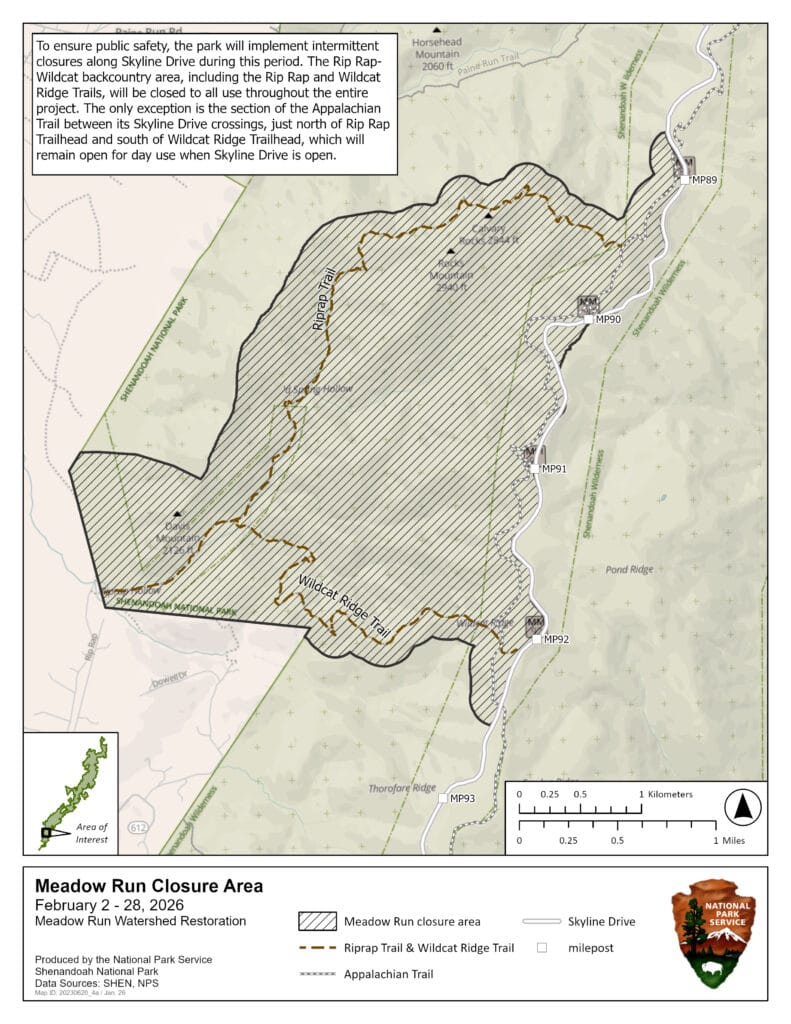
A map provided by the National Park Service shows the Meadow Run closure area near mile 90 of Skyline Drive, where helicopters will apply limestone sand to reduce stream acidity between Feb. 2 and Feb. 28, 2026. LURAY, VA – Shenandoah National Park will conduct an aerial limestone application to reduce the acidity of Meadow Run, a stream near mile 90 on Skyline Drive, between February 2, 2026, and February 28, 2026. The contract will be awarded to Helicopter Applicators, Inc., of Gettysburg, Pa., with Summit Helicopters, Inc. of Salem, Va., as a subcontractor. The restoration project is funded through settlements for Clean Air Act violations.
To ensure safety for the public, the park will implement intermittent closures along Skyline Drive during this period. The Rip Rap-Wildcat backcountry area, including the Rip Rap and Wildcat Ridge Trails, will be closed to all use for the entire project period. The only exception is the section of the Appalachian Trail between its Skyline Drive crossings just north of Rip Rap Trailhead and south of Wildcat Ridge Trailhead, which will remain open for day use on days when Skyline Drive is open.
Park officials will notify the public through signage, the park website, the park alert system, and social media. Visitors planning a trip during the application window should check the website for information and a map depicting the closure area: Meadow Run Watershed Restoration – Shenandoah National Park (U.S. National Park Service).
Contractors will use helicopters to apply 1,150 tons of locally sourced limestone sand across approximately 450 acres, most of which Congress has designated as wilderness. This method avoids ground disturbance and protects sensitive habitats.
Excessive acidity in both the water and soil harms healthy ecosystems. Declines in brook trout, songbirds, native plants, and overall forest resilience have reduced both resource condition and the visitor experience. Under the Clean Water Act, the Virginia Department of Environmental Quality has listed the stream as impaired due to acidity.
After the application of limestone, soil and stream pH are expected to improve within a year. The ecological benefits will last for up to a century. Once stream pH reaches an acceptable level, the park will request that Meadow Run be removed from Virginia’s list of impaired waters under the Clean Water Act.
Information from a release. Posted by Dan McDermott.

A view from the Rip Rap Trail area near mile 90 of Skyline Drive in Shenandoah National Park. Portions of the Rip Rap–Wildcat backcountry will be closed during February 2026 as the park conducts an aerial limestone application to restore the Meadow Run watershed. Warren Heritage Society program to explore birth of Civil War ambulances

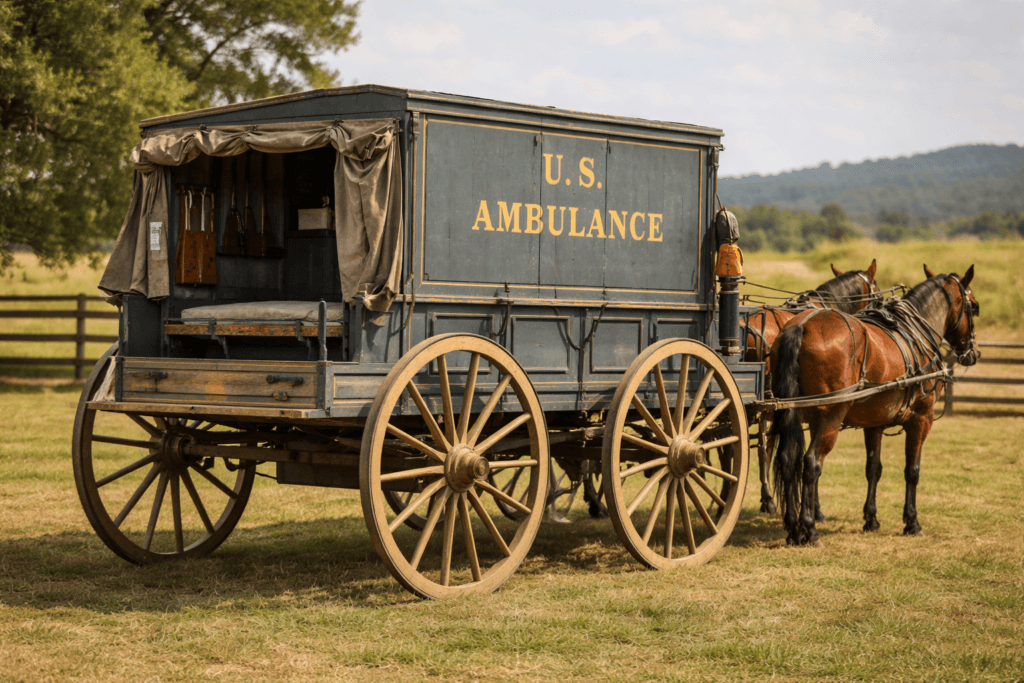
Visual approximation of a Civil War ambulance The Warren Heritage Society will host a presentation examining how organized battlefield medical transport began in the United States.
Dana Shoaf, Director of Interpretation at the National Museum of Civil War Medicine, will present “Gutbusters: The Development of Civil War Ambulances” during the group’s Third Thursday program.
Before the Civil War, the U.S. Army did not operate a formal ambulance system, and such vehicles were virtually unknown in civilian life. As the war unfolded, however, both Union and Confederate forces adapted ideas from European armies and rapidly developed organized ambulance corps to move wounded soldiers from the battlefield. By the end of the conflict, ambulances had become an established part of American medical response, shaping emergency transport for decades to come.
Shoaf’s talk will trace how these early ambulances were designed, built, and used between 1861 and 1865. He will also examine the wide range of ambulance models created during the war — including designs that proved effective and others that failed under battlefield conditions.
The program is free and open to the public.
Event details:
What: Third Thursday Program — “Gutbusters: The Development of Civil War Ambulances”
Speaker: Dana Shoaf, National Museum of Civil War Medicine
When: Thursday, February 19, 2026 5:30–7:00 p.m.
Where: Stone Branch Center for the Arts, 114 E. Main St., Front Royal
Information from a release. Edited by Dan McDermott.
Northwest regional drug and gang task forces execute search warrants at vape stores
Law enforcement agencies seized suspected illegal drugs, firearms and more than $100,000 in cash after executing search warrants at multiple tobacco and vape shops across the region.
On Jan. 20, 2026, the Virginia State Police Bureau of Criminal Investigation Culpeper Field Office Drug Enforcement Section and members of the Northwest Regional Drug and Gang Task Force, with assistance from the Woodstock Police Department, the Drug Enforcement Administration and Homeland Security Investigations, served five search warrants at Tobacco and Vape Novelty stores in Edinburg, Strasburg and Woodstock.
According to authorities, officers seized 39,403 grams of THC-based products valued at $117,092, 430 grams of psilocybin valued at $16,340 and 500 grams of khat valued at $2,550. Investigators also recovered two firearms and $103,371.50 in U.S. currency.
The investigation remains ongoing, and additional details were not immediately released.
The Northwest Virginia Drug and Gang Task Force includes personnel from the sheriff’s departments in Clarke, Frederick, Page, Warren and Shenandoah counties, as well as the police departments in Front Royal, Luray, Strasburg and Winchester, and the Virginia State Police. The task force operates as a High Intensity Drug Trafficking Area (HIDTA)–funded initiative.
Information from a release. Edited by Dan McDermott.
Engle’s Angle: Taming Dragons
The author got a call from the zoo. They want him to tame a lion. by Kevin S. Engle
“Deep breaths … relax … you can do this.”
Positive self-talk.
It’s supposed to keep you calm and focused.
I was neither.
I could feel the knot in my stomach. The one I couldn’t untie. This was going to be a disaster.
I’d been avoiding ‘this’ for a month.
But I’d put it off long enough. The time had come to slay the dragon, or at least try to.
There really wasn’t a dragon. It was a router. The device that gives us WiFi throughout the house. And I needed to replace it.
I didn’t want to replace it. Ours was working fine. But the email from the manufacturer said they weren’t going to support it anymore. It should still work, but there’d be no updates and it might be more vulnerable to security threats.
It was time to buy a new one they said. One of theirs.
Of course.
Great.
I thought about it, and forgot about it, but knew I had to do something.
I’d wait until their Black Friday sale. I bought it on Cyber Monday and it arrived a few days later.
And it’s been sitting in my office, in the box, ever since.
Every so often I’d hear the dragon in the box hiss and I’d get that knot in my stomach.
When faced with swapping out any kind of technology, I always expect the worst.
Because that’s what usually happens.
I didn’t realize how many devices in our house run on WiFi until I made a list.
The TVs. Our phones. The printer. A thermostat. And more.
I just knew when I did this, there’d be no TV for weeks. Or months.
I can’t live without television for that long. Yeah, I’m pitiful.
The little card in the box said to download an app to my phone and follow the setup instructions.
I did as I was told.
I read and reread each step at least five times to make sure I was doing it correctly.
My old router had 3 connections. One that plugged into the electric outlet, another that went to the modem and one to the computer. This one only has two wires. One for electric and one to the modem.
I plugged stuff in, closed my eyes and pressed continue.
Nothing.
“Deep breaths … relax … you can do this.”
I knew one cord had to be plugged into the wall outlet. Maybe the other one was in the wrong slot?
I changed it and pressed continue again.
And then I heard a purring sound.
I’m not sure if it was the dragon or the router, but something was working.
A few minutes later, after the router had done all it needed to, I turned on the TV.
It worked!
Everything worked. I only had to reset one TV.
Piece of cake.
I’m not sure how it happened, but I’ll take it.
I love technology.
And taming dragons.
#######################################
The author got a call from the zoo. They want him to tame a lion.

The Best of Engle’s Angle: A Humorous Slant on Life and our Wacky World (Book Cover) The Best of Engle’s Angle is available online or pick up a signed copy at a local bookstore.
Limits on courthouse arrests, identity concealment, ICE cooperation proposed

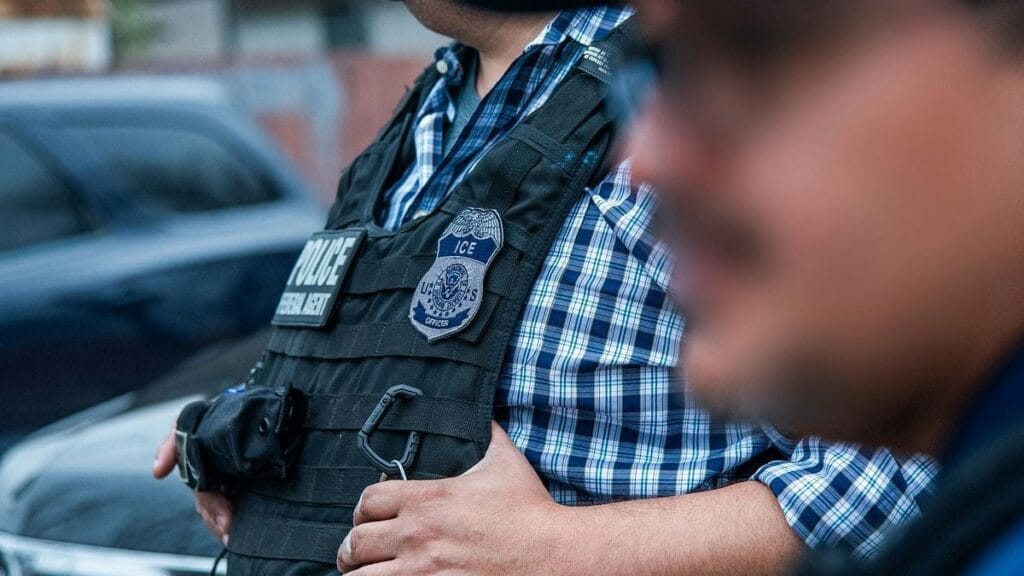
An ICE officer coordinates with officials during an enforcement operation in San Antonio on Feb. 5, 2025. Photo: U.S. Immigration and Customs Enforcement via Flickr / PDM 1.0 By Shirleen Guerra | The Center Square
(The Center Square) – Proposals to restrict civil arrests at courthouses, limit when law enforcement officers may conceal their identities, and narrow state and local cooperation with federal immigration authorities have been proposed by a Democrat in the Virginia Senate.
Sen. Saddam Salim, D-Fairfax, is yet to have a hearing for his three bills. Each has been referred to the Courts of Justice Committee.
One proposal, Senate Bill 351, would prohibit most civil arrests in and around courthouses.
The bill would protect individuals required to attend court, including parties, witnesses, and certain family or household members, from civil arrest while attending, traveling to, or leaving court proceedings.
Civil arrests would be allowed only if authorized by a judicial warrant or order that has been reviewed by a designated judicial officer.
Violations could be punished as contempt of court.
Another measure, Senate Bill 352, would restrict state and federal law enforcement officers from wearing facial coverings while performing official duties.
The bill includes exceptions for protective purposes, such as guarding against disease, infection, or exposure to toxic substances, as well as for officers assigned to special weapons and tactics teams during operations.
The bill would create a Class 1 misdemeanor for officers who knowingly violate the restriction.
It would also allow individuals to bring civil lawsuits for injuries resulting from such violations. Sovereign immunity would not be a defense in those cases.
The Department of Criminal Justice Services would be directed to develop a model policy governing the use of facial coverings by law enforcement officers.
A fiscal impact statement prepared by the Department of Planning and Budget found the proposal is not expected to have a material fiscal impact on state agencies.
The statement noted that potential indirect costs related to jail populations could vary by locality.
The third proposal, Senate Bill 783, would limit agreements between Virginia law enforcement agencies and federal authorities for certain immigration enforcement functions.
The bill would prohibit state and local agencies from entering agreements that authorize officers to perform federal immigration enforcement duties unless specific conditions are met and the agreement is in writing.
Any such agreements would expire June 30, 2028.
The measure would also expand data collection requirements under the Virginia Community Policing Act.
Agencies would be required to track whether federal immigration officers were present during certain law enforcement actions, including traffic stops and other investigations.
In a statement announcing the bills, Salim said the legislation is intended to address concerns related to immigration enforcement, law enforcement accountability, and civil liberties.
Virginia court strikes down redistricting amendment headed for April ballot
By Markus Schmidt | Virginia Mercury
A Virginia circuit court on Tuesday struck down a proposed constitutional amendment aimed at giving lawmakers the option to redraw congressional districts mid-decade, dealing a major setback to Democratic legislative leaders who say the change is needed to respond to partisan gerrymandering in some Republican-led states and had hoped to put the measure before voters in an April referendum.
In a 22-page ruling issued by the Tazewell County Circuit Court, Judge Jack C. Hurley found that the legislature acted unlawfully when it approved the redistricting amendment during a special legislative session days before the Nov. 4 election, concluding that lawmakers exceeded the scope of that session, violated their own procedural rules and failed to comply with constitutional and statutory requirements governing amendments to the Virginia Constitution.
As a result, the court declared the amendment process “void ab initio,” meaning legally invalid from the outset.
Ruling blocks April vote on redistricting amendment
Democrats had planned to ask voters on April 21 whether the General Assembly should be allowed, under limited circumstances, to redraw congressional and legislative districts between censuses.
Instead, the court ruled that the amendment was improperly adopted and cannot advance to the ballot as scheduled. The judge also barred state election officials from taking further steps to submit the measure to voters unless and until the constitutional requirements are met.
Democratic leaders said they intend to appeal the decision, which they argue improperly blocks voters from weighing in on the proposal.
A new poll released Wednesday by Christopher Newport University’s Wason Center for Civic Leadership suggests Virginians hold mixed views on redistricting.
While 63% of respondents said they support the state’s current redistricting system, a narrower majority — 51% — said they support or strongly support the proposed constitutional amendment.
The lawsuit was brought by Senate Minority Leader Ryan McDougle, R-Hanover, who also serves as a legislative commissioner on the Virginia Redistricting Commission.
McDougle and other plaintiffs argued that Democrats unlawfully expanded the scope of a 2024 special session that had been convened by then-Gov. Glenn Youngkin primarily to address budget matters, and that they did so after voting for the amendment process had already begun.
In siding with the plaintiffs, the court agreed that while the special session itself was valid, the General Assembly overstepped when it adopted House Joint Resolution 6007 — the resolution proposing the constitutional amendment — because redistricting was not among the matters permitted to be considered during that session under existing House rules and resolutions.
“The special session was allowed to continue, but it did not allow the majority to unilaterally expand the scope of business,” the judge wrote, concluding that lawmakers failed to follow the procedural safeguards they themselves had adopted for calling and conducting a special session.
Court cites timing, notice failures under state Constitution
The ruling also focused on the timing of the amendment’s passage.
Under the Virginia Constitution, proposed amendments must be approved by two separately elected General Assemblies, with an intervening general election for the House of Delegates.
The court found that the amendment was improperly advanced during the 2024 special session and that actions taken during the 2026 regular session could not retroactively cure those defects or satisfy the “next ensuing general election” requirement set out in the constitution.
In addition, the court held that state officials failed to comply with a Virginia statute requiring public posting of proposed constitutional amendments at courthouses and other public locations at least three months before the next general election.
Because that posting did not occur, the court said election officials are prohibited from submitting the amendment to voters.
Taken together, the court concluded that “any and all matters, motions, actions or votes regarding House Joint Resolution 6007” violated the General Assembly’s own rules and were therefore illegal.
GOP, allies call decision a victory for rule of law
Republicans and allied advocacy groups hailed the decision as a rebuke of what they described as a partisan end-run around constitutional safeguards.
In a joint statement, McDougle and former U.S. House Speaker Eric Cantor, the honorary co-chair of Virginians for Fair Maps, said the ruling vindicated their argument that Democrats ignored clear legal limits.
“Today’s ruling is a decisive victory for the rule of law and Virginia voters,” the statement said.
“The court confirmed that Democrat legislative leaders unlawfully expanded a special session, violated their own rules, and attempted to force through a redistricting constitutional amendment while Virginians were already voting.”
The judge, they added, “rightly declared those actions void” from the start. “If they continue to move forward with the unconstitutional amendment process, the Democrats would be defying the order of the court.”
The statement emphasized the GOP’s position that the case was “never about partisanship,” but rather about process and constitutional compliance. “The court made clear that elections matter, notice matters, and the rules apply to everyone — even those in power,” McDougle and Cantor said.
Democrats blast ruling, promise to appeal
Democratic leaders, however, sharply criticized the ruling and signaled they would fight it.
House Speaker Don Scott, D-Portsmouth, who called lawmakers back to Richmond for the special session in October, accused Republicans of using the courts to block a policy they could not defeat politically and said the General Assembly would appeal immediately.
“Nothing that happened today will dissuade us from continuing to move forward and put this matter directly to the voters,” Scott said in a statement. “Republicans who can’t win at the ballot box are abusing the legal process in an attempt to sow confusion and block Virginians from voting.”
Scott called the lawsuit “court-shopping, plain and simple,” and said Democrats are “prepared for the next step.” “Voters — not politicians — will have the final say,” he said.
Judge Hurley was appointed to the court by former Gov. Bob McDonnell, a Republican.
Advocacy groups aligned with Democrats echoed that message, framing the ruling as a temporary obstacle rather than a final outcome.
Keren Charles Dongo, campaign manager for Virginians for Fair Elections, said she expected the decision to be appealed and warned that the ruling could mislead voters.
“This is a clear attempt to confuse voters and block them from having a say,” Dongo said. “Republicans court-shopped for a ruling because litigation and misinformation are the only tools they have left.”
Dongo added: “We’re prepared for what comes next, and Virginians deserve both the right to vote and the chance to level the playing field.”
The amendment at the center of the dispute grew out of Democratic concerns about efforts in some Republican-led states to redraw congressional maps ahead of the 2026 midterm elections, moves that party leaders have linked to pressure from former President Donald Trump and warned could reshape the national political landscape.
In 2020, Virginia voters approved a constitutional amendment creating a bipartisan redistricting commission to draw legislative and congressional maps. When that commission deadlocked in 2021, the task fell to the Virginia Supreme Court, which adopted maps that Republicans have largely defended and Democrats have criticized as more favorable to the GOP.
Earlier this month, Democrats in the newly organized legislature for a second time advanced the proposed constitutional amendment that would allow the General Assembly, under narrow conditions, to revisit district lines between censuses — for example, if a court invalidates a map or if federal law changes.
Supporters argued the amendment would give Virginia a tool to respond more quickly to legal or demographic shifts, rather than locking in maps for a full decade.
Republicans countered that the proposal would reopen the door to partisan gerrymandering and undermine the intent of the voter-approved redistricting commission. They also warned that Democrats were rushing the amendment through an unusual procedural pathway to get it before voters as soon as possible.
Those procedural concerns formed the backbone of McDougle’s lawsuit.
The court ultimately agreed, finding that while the General Assembly has broad authority to propose constitutional amendments, it must do so in strict compliance with the Virginia Constitution, state law and its own internal rules.
The ruling does not permanently bar lawmakers from pursuing a redistricting amendment in the future, but it does require them to restart the process in a manner consistent with constitutional timelines and procedural requirements.
Samuels Public Library Youth Events – February, 2026
Children in library. File photo. More information about Samuels Library and the programs and services available can be found at www.samuelslibrary.net or by calling (540) 635-3153. These are the events being presented by the Youth Services Department at Samuels Public Library during the month of February 2026. More information about Samuels Library and the programs and services available can be found at www.samuelslibrary.net or by calling (540) 635-3153.
Monday, February 2
10:15 AM – Music & Movement for Babies (ages 0-23 months).
11:15 AM – Music & Movement for Toddlers (ages 2-5). Join our fun and joyful time with your little ones as we listen to music while learning some basic movements and multisensory activities designed to delight your baby or toddler.
Tuesday, February 3
4:00 PM – Silhouettes: 250th American Celebration. For ages 6-11. George Washington and Abraham Lincoln have very distinct silhouettes. As we celebrate our 250th Anniversary, we will learn about shadows and silhouettes and then make our own. Sponsored by FRUMC. Registration is required.
Wednesday, February 4
10:15AM – Toddler Story Time.
11:00AM – Preschool Story Time.
Come in for an enjoyable hour filled with Groundhog Shadow stories, exciting sing-alongs, finger plays, and a craft.
Thursday, February 5
10:30 AM – Grand Story Time. For ages 0-6. Come hear a grandparent read a few stories, say some nursery rhymes, and do a craft.
Saturday, February 7
11:00 AM – Groundhog: Tales & Trails. For ages 6-11. Come to the library to do some crafts and hear stories about groundhogs with the Shenandoah River State Park rangers. Did he see his shadow? Registration is required.
2:30 PM – Colonial Cooking: Teens Connect. For ages 12-18. Come learn what types of food people ate 250 years ago and why. Then learn some recipes they used and taste your creation. Sponsored by FRUMC. Registration is required.
Monday, February 9
10:15 AM – Music & Movement for Babies (ages 0-23 months).
11:15 AM – Music & Movement for Toddlers (ages 2-5). Join our fun and joyful time with your little ones as we listen to music while learning some basic movements and multisensory activities designed to delight your baby or toddler.
Tuesday, February 10
10:30 AM – Cupid’s Arrow: Homeschool Hub. For ages 6-11. We will design and test a bow and arrow(Q-tips), as we talk about variables that could “challenge” the shot. Registration is required.
Wednesday February 11
10:15AM – Toddler Story Time.
11:00AM – Preschool Story Time.
Come in for an enjoyable hour filled with Friendship stories, exciting sing-alongs, finger plays, and a craft.
Thursday, February 12
10:30 AM – Grand Story Time. For ages 0-6. Come hear a grandparent read a few stories, say some nursery rhymes, and do a craft.
Saturday, February 14
10:00 AM, 10:20 AM,
10:50 AM, 11:10 AM Paws for Reading. For ages 6-18+. Paw for Reading is a program where people read aloud to trained therapy dogs, which helps improve their reading skills, confidence, and attitudes toward reading. This program provides a non-judgmental and stress-free environment, as the dogs are calm, attentive listeners who don’t correct mistakes, making it less intimidating for children. Bring your own book or use one of ours! Teens and adults can come for the calming influence and doggie kisses. Registration is required.
2:30 PM – Chocolate Fever. For ages 8-14. Learn where chocolate comes from and how to make lollipops and clusters. Registration is required.
Monday, February 16
Library is closed for the holiday
Tuesday, February 17
4:00 PM – Chinese New Year. For ages 6-11. Hear stories about the New Year Dragon, the zodiac signs and find out your sign! Registration is required.
Wednesday, February 18
10:15AM – Toddler Story Time.
11:00AM –Preschool Story Time
Come in for an enjoyable hour filled with 5 Senses stories, exciting sing-alongs, finger plays, and a craft.
Thursday, February 19
10:30 AM – Grand Story Time. For ages 0-6. Come hear a grandparent read a few stories, say some nursery rhymes, and do a craft.
Saturday, February 21
2:30 PM – Teen Scents. For ages 12-18. We are thrilled to invite teens to come experiment and make their own perfume or cologne! Registration is required.
Monday, February 23
10:15 AM – Music & Movement for Babies (ages 0-23 months).
11:15 AM – Music & Movement for Toddlers & Preschoolers (ages 2-5). Join our fun and joyful time with your little ones as we listen to music while learning some basic movements and multisensory activities designed to delight your baby or toddler.
Tuesday, February 24
10:30 AM – Frozen Yogurt: Homeschool Hub. For ages 6-11. Come learn about freezing points and acidity in yogurt. Registration is required.
Wednesday, February 25
10:15AM – Toddler Story Time.
11:00AM – Read with the Sheriff: Preschool Story Time
Come in for an enjoyable hour filled with Arctic Animal stories, exciting sing-alongs, finger plays, and a craft.
Thursday, February 26
10:30 AM – Grand Story Time. For ages 0-6. Come hear a grandparent read a few stories, nursery rhymes, and do a craft.
Saturday, February 28
2:00 PM – Hard Act to Follow. Come see 5 skits on individuals and friendship. Bring the family!
Eyes on Spanberger as pro-plaintiff legislation revived in Va.
By Daniel Fisher | Legal Newsline
New Virginia Gov. Abigail Spanberger faces a test as the Democrat-controlled legislature has teed up two plaintiff-friendly bills that her Republican predecessor Glenn Youngkin vetoed as dangerous to the state’s business climate.
One bill would establish the class action procedure in Virginia state courts for the first time, while another would hike the bonds defendants must post to appeal civil judgments. Combined, they would reshape Virginia’s litigation landscape by dramatically increasing the pressure on businesses to settle cases rather than fighting them out in court – leading the Wall Street Journal to wonder about the future of the state.
“We are concerned,” said Tiger Joyce, president of the American Tort Reform Association, who testified against the bond bill when it was before the Virginia legislature last year. “It undermines the ability of defendants to look for justice. If a bond is unavailable or beyond financial reach, that becomes the deciding factor.”
House Bill 1111, pending in committee, would raise the appeal bond from $25 million to $200 million, adjusted for inflation after 2029. The sponsor is Rep. Phil M. Hernandez, a lawyer and former Obama administration official. He sponsored a similar bill last year, initially featuring an unlimited cap, which Youngkin vetoed in 2025.
Senate Bill 229, sponsored by Majority Leader Scott Surovell, would establish class actions and allow lawyers to seek statutory damages under the Virginia Consumer Protection Act. Youngkin vetoed a similar bill in 2024 amid concerns plaintiff lawyers could leverage statutory damages of $500 per violation to force businesses into huge settlements to avoid bankruptcy.
The bill must be amended to eliminate statutory damages or Virginia’s business climate could deteriorate, said Thomas Waskom, co-head of product liability and mass tort litigation at Hunton. If it remains in some form, the state could become like New York, where federal courts have interpreted New York class action law to allow statutory damages even though state courts themselves do not.
“Class actions in Virginia state courts today are totally unnecessary,” Waskom said.
Gov. Spanberger, a Democrat and former Central Intelligence Agency officer, won the governor’s race last year with a broad base of support including some prominent business executives. She received $14 million from Democratic Party organizations, but also drew $205,000 from Thomas J. McInerney, president of Genworth, an insurance company; $200,000 from real estate developer Christopher Clemente; and $143,000 from cigarette manufacturer Altria, according to the Virginia Public Access Project.
“The real question will be ‘how does new Gov. Spanberger approach this?’” said Joyce. “Does she seek compromise on these measures, or go along with Democratic Party priorities?”
Unlike some “hellhole” jurisdictions like South Carolina, where trial lawyers from both parties dominate the legislature and elected judiciary, Virginia has a reputation for a more balanced court system. Increasing the appeal bond would change that dramatically, forcing businesses to balance the cost of paying a large judgment with the risk of bankruptcy if they appeal.
Virginia Speaker of the House Don Scott controls the flow of legislation and may have his own interest in seeing the bond increase. Scott also is a partner with Breit Biniazan Trial Lawyers, which won a $360 million sex-abuse lawsuit against Cumberland Hospital, a unit of Universal Health Services.
That verdict is on appeal, and UHS acknowledges in its most recent financial report it faces suits by at least 40 more plaintiffs and if it is forced to post higher appeal bonds its finances “would be materially adversely impacted.”
The class action bill has what looks like a partial concession to business, allowing defendants to appeal class certification to the Court of Appeals, although plaintiffs could also appeal denial of certification. Bill sponsor Sen. Scott Surovell is a founding partner of a 10-lawyer firm in Fairfax.
When the appeal bond bill came to a vote last year, ATRA provided statistics suggesting appeal bonds are generally capped at $25-50 million.
“To go to $200 million would place it way on the outside of the mainstream,” Joyce said. Gov. Spanberger, who may have higher political aspirations than governor, would also be putting a major precedent on her resume, he said: While states have placed caps on appeal bonds in recent years, none has gone the other way.
This report was produced by Legal Newsline and distributed by The Center Square as part of a content-sharing agreement. Reach editor John O’Brien at [email protected]. Reach editor John O’Brien at [email protected].
Middletown receives state tourism grant for July 4 celebration
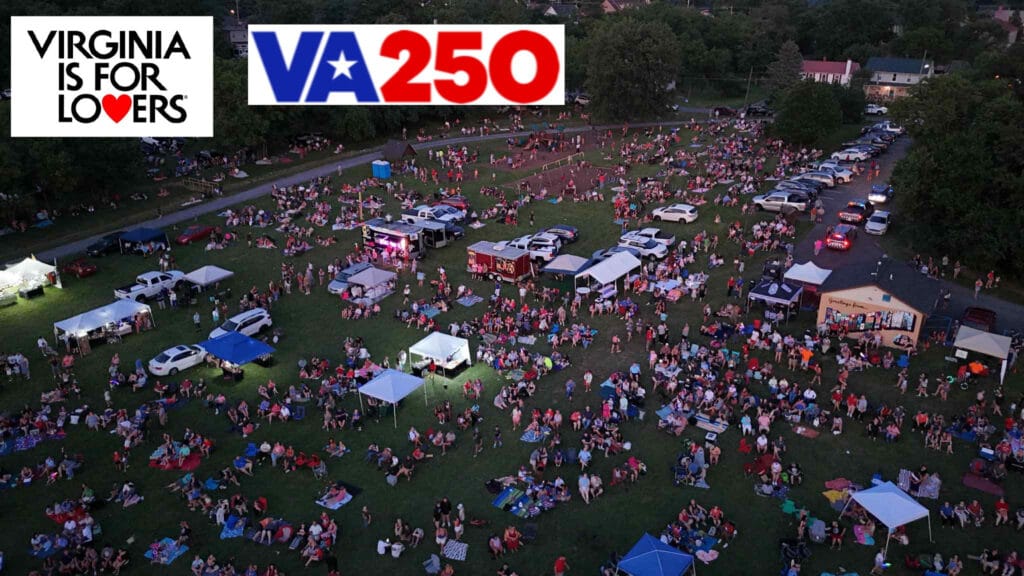
Promo photo of Middletown, Va 4th of July Celebration MIDDLETOWN — The Town of Middletown has received a $3,200 grant from the Virginia Tourism Corporation to support its annual July 4 Celebration, town officials announced.
The funding comes through the Virginia Tourism Corporation’s Special Events & Festivals Sponsorship Program, which awarded nearly $886,000 to 88 special events and festivals across the Commonwealth for 2026. The grants are intended to encourage overnight visitation and increased traveler spending.
Middletown’s July 4 Celebration was among the events selected statewide.
Town officials said the grant will help enhance the celebration as Middletown prepares for upcoming milestone anniversaries, including the nation’s 250th anniversary in 2026.
“We are proud to receive this grant for the second time in our celebration’s history, and it comes at the perfect moment,” Mayor Charles Harbaugh IV and the July 4 Celebration director said in a joint statement. “This support will not only help us enhance the festivities, but also promote our town and the wonderful local businesses that make Middletown special.”
According to the Virginia Tourism Corporation, local partners across the state will contribute more than $4.8 million in matching public-private funds alongside the grants, generating more than $5.6 million in new marketing and event production activity focused on tourism in 2026.
The program uses a “hub-and-spoke” model that encourages visitors to attend a featured event while also exploring nearby Main Streets, restaurants, shops, historic sites, and attractions.
Gov. Glenn Youngkin said the funding helps strengthen Virginia’s visitor economy while supporting local communities.
“Special events and festivals play a vital role in Virginia’s long-term growth by strengthening our visitor economy, celebrating our communities, and bringing people together across the Commonwealth,” Youngkin said in a statement.
Virginia Tourism Corporation President and CEO Rita McClenny said the program helps inspire travel and extend visitor stays throughout the state.
A full list of grant recipients is available through the Virginia Tourism Corporation.
Edited by Dan McDermott. Information from a release.
VDOT Preparing For Additional Snow While Continuing To Tackle Persistent Icy Roads Across The Commonwealth

VDOT crew in snow file photo RICHMOND — Virginians greatly assisted the Virginia Department of Transportation (VDOT) during last weekend’s major winter storm by remaining at home, allowing snow removal crews to make significant progress on plowing and treating major roads. VDOT needs your help again ahead of another forecasted winter storm this weekend and predicted low temperatures again next week.
A snowstorm expected to arrive Friday and continue into Sunday could bring moderate snow in areas southwest to more significant snowfall in Hampton Roads. Residents will not see pretreatment on most roads ahead of this storm due to residual salt remaining from last week’s storm.
Those traveling in Virginia should be weather aware and check the forecast along their entire route. Stay off the roads in regions expecting substantial snow during and after the storm as much as possible. If you need to be somewhere, reach your destination before the snowfall begins or delay travel. Visit 511.vdot.virginia.gov, check the 511 Virginia mobile app or call 511 in Virginia for road condition updates.
As with every winter weather event, crews focus on plowing and treating interstates and major primary roads carrying the most traffic first before moving to secondary roads and subdivisions. Work begins as soon as there is enough snow on the roads to plow, which means plow drivers are focused on making multiple passes throughout the storm. When those major routes have been adequately addressed, they are then able to move onto the less traveled routes.
Crews can work more effectively when they have room on the roadways, so VDOT reminds motorists not to crowd the snowplows. Don’t pass a snowplow or spreader unless it is absolutely necessary, and do not tailgate them.
VDOT crews continue to work in 12-hour shifts across most of the commonwealth battling persistent ice on roads from last weekend’s winter storm. Consistent freezing temperatures all week caused refreezing and created thick layers of ice on the roads, posing an obstacle for crews as they worked to plow and treat roads. Virginia’s interstate and primary roads are clear, but some secondary and subdivision roads still have snow and ice packed on them.
This week, heavy equipment is being used to help break apart ice pack on those less traveled roads. Sand has also been used in many of those areas to provide traction for drivers to navigate the remaining icy roads. Because crews will shift into tackling the impacts of the upcoming storm, they will need to pause efforts and then return to work on those lingering patches.
Contact VDOT’s Customer Service Center 24 hours a day with questions or to report hazardous road conditions by visiting my.vdot.virginia.gov or calling 800-FOR-ROAD (367-7623). The Customer Service Center has been experiencing historically high call volumes and online requests. If you have an emergency, call 911.
Information from a release. Posted by Dan McDermott.
Restore the Wild Artwork Competition

A DWR Biologist examines a Rafinesqeue’s eastern big-eared bat. J.D. Kleopfer/DWR RICHMOND, VA – Due to recent statewide inclement weather, the Virginia Department of Wildlife Resources (DWR) has extended the submission deadline for the Restore the Wild Artwork Competition. All artwork must be physically received by 4:30 p.m. on Monday, Feb. 9 or postmarked by Saturday, Feb. 7.
The DWR annual Restore the Wild Artwork Competition is open for submissions. This year artists are asked to create original pieces depicting the Rafinesque’s big-eared bat (Corynorhinus rafinesquii), a medium-sized bat that lives in Virginia’s Coastal Plain and is designated as a state endangered species. The Rafinesque’s big-eared bat, as per its name, has enormous ears and large, protruding facial glands that give them an oddly charming face and roosts in hollow trees and abandoned buildings.
Artists may submit their work in two different categories including Artistic Expression and Natural History Illustration. There are also two age-based youth categories, Ages 11-17 and Ages 10 and under. A submission form must accompany every piece. For rules and submission details, visit the DWR webpage.
Artwork will be displayed in The Gallery at Main Street Station in Richmond, Va. beginning March 6 and continuing through March 29. There will be an opening reception on March 6 where the category winners as well as the art selected for the Restore the Wild fine art print and sticker will be announced.
This is the sixth year of the competition and previous species include the Atlantic sturgeon, spotted skunk, eastern hellbender, loggerhead shrike, and wood turtle.
To view the winning artwork from previous contests, follow the links below.
2025 – Atlantic sturgeon
2024 – Spotted skunk
2023 – Eastern hellbender
2022 – Loggerhead shrike
2021 – Wood turtleInformation from a release. Posted by Dan McDermott.
Ask Stewart – What’s going on in 2026?
Hey Stewart,
What’s going on with the Tree Stewards in 2026?
David
2026 looks like it will be a TREE-mendous year for the Warren County/Front Royal Tree Stewards!
Work sessions happen every month (Log on to the Tree Stewards web site). April has Arbor Day and Lone Pine festivities. And, mark your calendar, the All About Trees class will be conducted again this year starting the first week in September.
If you have trees on your property, the All About Trees class with teach you how to care for them.
If you don’t have trees on your property, you can enjoy planting and pruning trees around Warren County.
If you are new to the area, you can meet people who are interested in making Front Royal a better place to live and work.
If you are a long-time resident, you can give your time and talents to sustaining the natural beauty of Warren County for future generations.
The best time to plant a tree was 20 years ago, The second best time is now.
Make 2026 the year that you plant a tree in Warren County.
Your Pal in the Trees,
Stewart
The Front Royal/Warren County Tree Steward program began in 1997 with volunteers dedicated to improving the health of trees by providing educational programs, tree planting and care demonstrations, and tree maintenance throughout the community. The group now consists of over 30 active members with several interns working toward becoming certified tree stewards from our annual “All About Trees Class”. Each month Stewart will answer a question from our readers. Please forward it to “Stewart” in care of: [email protected] and we may publish it in a future issue. Please visit our website at: www.treesfrontroyal.org
Stewart answers reader’s questions about trees! Please forward your question to “Stewart” in care of: [email protected] and we may publish it! Please visit our website at: www.treesfrontroyal.org Heart Surgeon Becomes Valley Health’s New Medical Director of Cardiovascular Surgery
Cardiothoracic surgeon Lindsey M. Prescher, DO Winchester, V.A. January 28, 2026 – Valley Health announces the addition of cardiothoracic surgeon Lindsey M. Prescher, DO, who will lead the health system’s Cardiovascular Surgery team as its new medical director.
Dr. Prescher, who joined Valley Health this week, will help advance Valley Health’s heart surgery program by providing clinical leadership and expertise in the full scope of cardiovascular surgical care for our community.
“We are excited to welcome Dr. Lindsey Prescher to Valley Health,” said Iyad Sabbagh, MD, Valley Health Chief Physician Executive. “Dr. Prescher brings a wealth of clinical and academic leadership experience, as well as deep expertise in advanced minimally invasive surgical techniques for treating conditions of the heart.”
A board-certified cardiothoracic surgeon, Dr. Prescher is a retired Commander in the United States Navy and former Chief of Cardiothoracic Surgery at Walter Reed National Military Medical Center. She completed her Cardiothoracic Surgery Fellowship at the Yale University School of Medicine, followed by an additional year of advanced training as a Fellow in Structural Heart Disease at Yale.
Dr. Prescher specializes in the full spectrum of adult cardiac disease, with particular expertise in complex and minimally invasive heart valve repair and replacement procedures (aortic, mitral tricuspid valve), transcatheter therapies (including TAVR and TMVR) and aortic pathology. She also performs advanced procedures for aortic aneurysm and dissection management, coronary artery bypass grafting (CABG) for patients with coronary artery disease, and offers treatments for cardiac tumors and adult congenital cardiac conditions.
“I’m honored to join the team and look forward to providing high-quality, compassionate cardiac care for the community,” said Dr. Prescher.
Dr. Prescher will serve patients at Valley Health Cardiothoracic Surgery, within the Clyde A. Smith Heart & Vascular Center at Winchester Medical Center. The Heart & Vascular Center serves as a regional referral center for advanced cardiac care across an 18-county service area.
“Dr. Prescher’s arrival at Valley Health marks a pivotal moment for the heart health of our community,” said Tonya Smith, Valley Health Chief Operating Officer and President of Winchester Medical Center. “By bringing a cardiothoracic surgeon and clinical leader of this caliber to our region, we are ensuring that patients can receive the most advanced cardiac care close to home. Dr. Prescher is deeply committed to clinical excellence, patient-centered care and improving quality of life for patients in our community.”
A dual fellow of the American College of Surgeons and American College of Cardiology, Dr. Prescher is a passionate educator and researcher with multiple national and international speaking engagements as well as peer-reviewed publications. She has served as a Clinical Instructor in Surgery (cardiac surgery) at Yale University School of Medicine and Assistant Professor in Surgery at Uniformed Services University of the Health Sciences.
About Valley Health
Valley Health is a nationally recognized not-for-profit health system serving a population of more than 500,000 in the Northern Shenandoah Valley of Virginia and the Eastern Panhandle of West Virginia. As a healthcare provider, employer, and community partner, Valley Health is committed to improving the health of the region. The system includes six hospitals, more than 75 medical practices and Urgent Care centers, outpatient rehabilitation, medical transport, long-term care, and home health. www.valleyhealthlink.com.
Information from a release. Posted by Dan McDermott.
Who’s responsible for a dishwasher disaster that almost burned down my home?

Illustration by Christopher Elliott By Christopher Elliott
Imagine this: You buy a new dishwasher, but two days later, your kitchen fills with smoke. The stench of burnt plastic hangs thick in the air, and water pools across your floor. Turns out the heating element failed on the new dishwasher and burned a hole straight through the machine.
For Sharon Hornbaker and her husband, Raymond, they didn’t have to imagine. It happened with the brand-new GE dishwasher they’d purchased from Home Depot.
Their quest for a simple resolution – feeling safe in their own home again – spiraled into a maddening odyssey of corporate buck-passing, broken promises, and a baffling argument over $160. The case raises critical questions every consumer should know the answers to before they plug in their new appliance:
- Who is responsible when a new appliance fails catastrophically within days – the retailer or the manufacturer?
- What recourse do consumers have when a defective product poses a significant safety hazard?
- How should companies handle requests for product replacements when the original model is discontinued?
We’ll have all the answers in a moment. But first, let’s return to that combustible dishwasher.
“I felt insulted and unheard”
Hornbaker paid $418 plus installation for her GE dishwasher. It seemed like a good deal from two brands they trusted for her and her husband, who are on a fixed income.
Maybe too good of a deal. Two days later, during only its second use, the nightmare began.
“My home became filled with smoke and a burned metal and plastic smell permeated the air,” Hornbaker recounted. “We also found our kitchen floor flooded with water.”
They immediately turned off the power and contacted Home Depot.
Home Depot sent the same technicians who had installed the appliance. Their verdict was troubling: The dishwasher had malfunctioned and the heating element burned a hole through the interior shell. Water had gushed out, and the plastic shell had melted and ignited.
The installers contacted their supervisor, and the Hornbakers were assured Home Depot would contact them directly with a resolution.
But that assurance evaporated quickly.
“Shortly thereafter, Home Depot contacted us and said that since it had been more than 48 hours since the installation, it was no longer Home Depot’s responsibility and that we would need to contact GE Appliances to get the matter resolved,” Hornbaker says.
She was shunted to GE and the frustration ratcheted up.
“I spent hours and hours trying to make contact with the proper person at GE,” she recalls. “I honestly got the runaround. I felt insulted and unheard.”
As far as Hornbaker was concerned, this was not just a simple broken appliance. It was a matter of life and death. The faulty appliance could have burned down the house and even killed them.
Initially, GE seemed responsive. An agent agreed to replace the faulty unit, even though the original model was discontinued. Crucially, the agent verbally agreed Hornbaker could choose a replacement model that made them feel safe, stipulating only that it shouldn’t cost “like twice as much” as the original $418 unit.
GE: Talk to our lawyers!
Relieved, the Hornbakers chose a slightly upgraded model priced at $578 – a $160 increase, but well within the implied limit. They sent GE the details.
“GE would not replace our defective dishwasher,” Hornbaker says.
Why? The model they’d selected was too expensive.
This contradicted the agent’s clear phone instructions. Their follow-up email stressed their frustration and the reasonableness of their request: “We were not asking for an excessively priced model. We were feeling very frustrated, agitated and irritated by the whole process.”
Instead of resolution, they were handed off to the legal department.
“After six days, GE then responded, stating that all of our future correspondence should be directed to their legal team.”
Faced with a dangerous defective product, a broken promise, and a legal blockade, the Hornbakers felt “completely at a loss.” That’s when they turned to our team for help.
Who is responsible when a new appliance fails catastrophically within days – the retailer or the manufacturer?
The moment smoke poured from Hornbaker’s new dishwasher, a fundamental question arose: Who should clean up this mess?
Home Depot took the money and arranged the installation. GE built the machine.
But Home Depot’s rigid “48-hour responsibility” claim after a catastrophic failure is problematic. When you buy a product from a retailer, especially if you also buy installation, the retailer is your primary point of contact.
The Magnuson-Moss Warranty Act, which governs product warranties, doesn’t let retailers off the hook simply because of a store policy. They sold the product; they have a responsibility to the customer, especially when the product fails immediately and dangerously.
Retailers often have direct relationships with manufacturers and processes for handling defective goods. Dumping the customer onto the manufacturer, particularly after confirming the defect was a life-threatening manufacturing flaw (as Home Depot’s installers did), is a failure of customer service and, arguably, of responsibility.
GE, as the manufacturer, undeniably bears core responsibility under its warranty for a product that catastrophically failed within days.
Still, the retailer can’t simply wash its hands of the situation. The strongest consumer position is to hold the retailer accountable first. It took your money. It facilitated the installation. It should take the lead on the resolution.
So Hornbaker’s initial instinct to contact Home Depot was correct. Its refusal, based on an arbitrary time window and ignoring the severity of the defect, was where the process derailed.
What recourse do consumers have when a defective product poses a significant safety hazard?
Not all product failures are created equal. A leaking door seal is annoying. But a heating element burning through the tub and spewing water while melting plastic is a potential house fire and severe safety hazard.
Hornbaker wasn’t dealing with more than a lemon. This product failure was downright dangerous. And this elevates the situation beyond standard warranty replacement.
Consumers have significant leverage in these situations, though they often don’t realize it.
Document everything immediately. Keep photos, videos, and technician reports (like the installer’s confirmation of the defect). Report the incident to the Consumer Product Safety Commission (CPSC). Manufacturers take CPSC reports seriously because they can trigger recalls. Mentioning you have filed, or intend to file, a report with the CPSC can dramatically shift a manufacturer’s posture from dismissive to cooperative.
Make a reasonable request for a replacement. When a specific model line demonstrates a catastrophic failure pattern (the installers noted this model was discontinued, suggesting there may be a known issue), expecting a consumer to accept a direct a similar appliance from the same suspect line is unreasonable. Asking for a different, perhaps slightly upgraded model within the same brand is a minimal concession for the trauma and risk endured. GE’s initial agent understood this, agreeing verbally to the $578 model. The subsequent reversal over $160 felt like a betrayal.
Remind companies of the potential legal liability. Had the Hornbakers not been home, the result could have been a total loss of their home. While pursuing major damages without significant actual loss (like a fire) is complex, the risk created by the defect is a powerful point. No wonder GE referred this to its legal department. Communicating this liability is essential. Companies have a legal duty to provide products that are not unreasonably dangerous. A heating element burning through the unit on its second use strongly suggests a breach of that duty.
How should companies handle requests for product replacements when the original model is discontinued?
GE’s handling of the replacement request showcases a critical failure, not only to replace the defective unit, but to understand the consumer mindset after a traumatic appliance failure.
The Hornbakers needed reassurance that there wouldn’t be an exploding dishwasher sequel in their kitchen. The original unit, a budget model, had proven to be dangerously defective. The agent’s verbal promise that they could choose a model that restored their feeling of safety, capped at roughly double the price (around $836), seemed like a reasonable resolution. Selecting a $578 model – just $160 over the original price, nowhere near the implied cap – was an act of good faith on the part of the Hornbakers.
GE’s abrupt rejection, claiming a $500 limit, felt petty. It signaled that GE valued minimizing its immediate cost over restoring customer trust and addressing the genuine safety fear its product created.
Eventually, GE offered Hornbaker a lesser unit, but by then her trust in GE had been shattered. Knowing that its predecessor, which she had just purchased, had gone up in flames made her reluctant to accept GE’s new downgraded offer.
Here’s where corporate policy clashes with human experience. Strict adherence to internal price-matching formulas ignores the context: a terrifying, near-catastrophic failure caused by a manufacturing defect.
Drawing the line over $160 after such an event, then directing the customers to its legal department, is a textbook case of how not to handle a serious product safety failure. It also turns a manageable warranty claim into a PR disaster.
Advocacy cuts through the smoke
Facing GE’s legal department brick wall, the Hornbakers found us. My advocacy team contacted Home Depot’s executive office, presenting the facts: a life-threatening defect confirmed by their own installers, a rejected reasonable replacement request over $160, and GE’s unhelpful escalation to legal.
The response from Home Depot was swift and decisive.
“We’re taking care of Mrs. Hornbaker,” a Home Depot representative told me. “She is receiving a new dishwasher at no cost, plus our extended warranty. We apologize for the inconvenience and are grateful for the opportunity to make this right for her.”
Home Depot stepped up, rectifying its initial mistake of hiding behind the arbitrary 48-hour rule. It provided the Hornbakers the specific $578 model they had requested – the one that finally offered them a measure of safety and peace of mind. And it added an extended warranty, a tangible acknowledgment of the trauma endured and an investment in rebuilding trust. The Hornbakers were relieved and grateful.
“They were very cooperative at Home Depot and remedied the situation with quickness and certainty,” Hornbaker reported. “We truly appreciate the solution provided and believe you played an integral part in it.”
P.S.: You don’t negotiate safety
This case screams a warning: When an appliance fails in a way that threatens property and lives, the response must prioritize safety and restoring trust, not minimizing costs or hiding behind rigid policies. Companies that forget this, like GE did here, risk far more than losing a single customer. They risk their reputation and invite the very legal actions they try to avoid.
For consumers, the lesson is threefold: Document meticulously, negotiate, and don’t be afraid to escalate when a company fails to recognize that a smoking appliance isn’t just a broken product – it’s a potential tragedy narrowly avoided.
And sometimes, you need an advocate to cut through the smoke and make them see the fire.Christopher Elliott is an author, consumer advocate, and journalist. He founded Elliott Advocacy, a nonprofit organization that helps solve consumer problems. He publishes Elliott Confidential, a travel newsletter, and the Elliott Report, a news site about customer service. If you need help with a consumer problem, you can reach him here or email him at [email protected].
Commonwealth Transportation Board Awards $219 Million Contract for I-81 Widening at Harrisonburg
STAUNTON – The Commonwealth Transportation Board at its Jan. 6 meeting in Richmond awarded a $218.9 million contract to Triton Construction Inc. of St. Albans, W.Va., to widen about six miles of Interstate 81 in Harrisonburg and Rockingham County. Construction is expected to begin this spring and take about six years to complete.
The project adds a third lane northbound and southbound from about one mile south of exit 243 (Route 11/South Main Street) to about one mile north of exit 247 (Route 33/East Market Street). Eight bridges along the interstate main line will be replaced, as will the Pleasant Valley Road overpass bridge.
The Harrisonburg-area widening has a contract completion date of June 2032, but the new travel lanes are expected to open to traffic by late 2031. The project is funded by the I-81 Corridor Improvement Program (CIP) which enhances safety, reduces congestion and unlocks the region for further economic growth.
“This is one of the largest and most ambitious projects along the corridor,” said Dave Covington, I-81 Program Delivery Director for the Virginia Department of Transportation (VDOT). “Triton Construction is in the final stages of exit 247 improvements, and will be able to move seamlessly into the widening project.”
The first several months of construction will include strengthening of right shoulders and installation of temporary concrete barrier walls to protect the work zone. Both of these operations will take place during nighttime and overnight hours.
I-81 widening will take place toward the median, within the existing VDOT right of way. A concrete barrier will separate northbound and southbound traffic. The project also constructs about four miles of noise-barrier wall, upgrades stormwater management systems, and replaces the signalized intersection of Early Road and Pleasant Valley Road with a roundabout.
“This is a long-awaited project for I-81 drivers and for Harrisonburg,” said Joel DeNunzio, VDOT Staunton District Engineer. “We will engage with the community every step of the way so they know what’s happening and how it will affect them.”
VDOT plans extensive public outreach before the start of construction and at various stages of the project. This will include in-person meetings, news releases, and online updates through the VDOT project page and social media channels.
Other major I-81 CIP projects in the VDOT Staunton District include:
- Staunton-area widening (scheduled for completion in summer 2027)
- Weyers Cave truck-climbing lanes (scheduled for completion in late 2027)
- Strasburg-area southbound widening (scheduled for completion in fall 2028)
- Winchester-area widening (construction starts in 2028)
The nearly $4 billion CIP includes 65 construction projects plus operational improvements along I-81 in Virginia. Find out more at Improve81.org. The website includes interactive maps, videos and podcasts, and details about upcoming and current projects.
The VDOT Customer Service Center operates 24/7 to help roadway users report potential hazards, make service requests or get information related to Virginia’s transportation network. Use its mobile friendly website or call 800-367-7623.
Find the VDOT Staunton District on Facebook and X and follow VDOT statewide social media accounts. News releases, travel tips and project updates are on the VDOT website.
The VDOT Staunton District serves Frederick, Shenandoah, Clarke, Warren, Page, Rockingham, Augusta, Highland, Rockbridge, Alleghany and Bath counties.
REC Clears Winter Storm Fern With Limited Impacts; Urges Continued Cold-Weather Preparedness
Fredericksburg, Va. — Winter Storm Fern has moved through Rappahannock Electric Cooperative’s service territory with limited impacts. However, extreme cold expected over the next few days could still lead to outages and other disruptions.
“We were very fortunate that conditions were not nearly as bad as we had prepared for, and we appreciate that our member-owners prepared as well,” said Casey Hollins, REC’s managing director of communications and public relations. “But we also want to urge our member-owners not to let their guard down and to remain prepared for the cold days ahead.”
REC will continue monitoring conditions and is prepared to respond if members experience power outages.
As part of its preparation for Winter Storm Fern, REC pre-staged response crews and equipment and requested additional crews from across the country. Crews came from electric cooperatives as far away as Minnesota.
“The rural electric cooperative community really pulled together for Winter Storm Fern,” said Hollins. “Although this storm didn’t bring disastrous effects, we were confident, with the help of our fellow cooperatives, that we were ready. We really appreciate the linemen and all personnel who took time away from their families and homes to be here for us.”
REC offers a number of informational resources on its website to help member-owners prepare for outages safely:
- REC’s winter outage-preparation and safety resources: https://www.myrec.coop/stormprep
- Storm safety tips: https://www.myrec.coop/storm-safety
- Generator safety: https://www.myrec.coop/generatorsafety
If an outage occurs, members can report it in several ways:
- Text OUT to 63273
- Report online at https://www.myrec.coop/out or through the MyREC SmartHub mobile app
- Call 800-552-3904
Members can also track outages, report outages, and find additional updates by visiting REC’s Outage Center: https://www.myrec.coop/outagecenter
About Rappahannock Electric Cooperative
Serving over 184,000 connections across portions of 22 Virginia counties, REC is a pillar in its communities, with over 18,000 miles of power lines extending from the Blue Ridge Mountains to the Chesapeake Bay. For more information about REC, please visit www.myrec.coop. Follow REC on Facebook, X, Instagram, LinkedIn and YouTube.
Rappahannock Electric Cooperative Prepares for Multi-Day Power Outages
Rappahannock Electric Cooperative (REC) is actively monitoring the significant winter weather system projected to result in wet snow and ice accumulations across its service territory. Joining REC’s workforce are a large number of electric cooperative crews from other states and contractors. REC’s full team and restoration materials will be pre-staged by Saturday.
“Based on weather predictions, REC is preparing for a multi-day outage event,” said Casey Hollins, managing director – Communications and Public Relations for REC. “Wet snow and ice add weight to power lines, causing them to break, and weigh down trees and limbs, which can lead to power outages.”
For context, a quarter-inch (0.25”) to a half-inch (0.5”) of ice adds anywhere from 100-500 pounds per span of power lines, which can cause widespread issues. Repairing broken poles and power lines and removing downed trees are time-consuming jobs.
“We’re asking our member-owners to take steps now to assemble a storm preparedness kit that will ensure you have the essentials, as well as items to provide peace of mind during an outage,” added Hollins. “Due to the extended forecast of extreme cold temperatures, we also urge you to make alternate arrangements now if you don’t have a backup power or heating source.”
What to do before the storm:- Plan for a secondary, non-electric heating source.
- Prepare your generator to provide safe backup power if one is available to you (see important safety tips below).
- Gather any extra blankets, bedding, sleeping bags, sweaters and other warm clothing items.
- Find a complete list of items REC recommends you assemble into a storm preparedness kit: myrec.coop/stormprep.
- Before the storm hits, ensure electronics and battery-powered chargers are fully charged so you can stay connected in the event of an emergency.
Stay informed during the weather event:
- Bookmark REC’s outage center: myrec.coop/outagecenter where you can track outages on the Outage Map, find information on the Cooperative’s Outage Restoration process, and more important safety information
- REC offers multiple ways to report power outages:
- Text OUT to 63273
- Online at myrec.coop/out or in MyREC SmartHub
- By calling 1-800-552-3904
- If someone in your home requires electricity for a serious medical condition, review your backup plan for an alternate location with power that you can rely on should power outages occur.
Important safety reminders:
- Always assume downed power lines are energized and dangerous. If you see a downed power line, stay away from it and anything that might be in contact with it. Call 911 and contact REC at 800-552-3904 to report downed power lines.
- If your backup power plan includes using a portable generator, be sure to follow all safety guidelines including:
- Isolate your generator from REC’s power lines using a generator transfer switch which requires installation.
- Connect appliances or other devices directly to the generator with the appropriate cords. Never connect your generator directly to your home wiring unless you are using a generator transfer switch to operate safely.
- Never refuel your generator while it’s operating.
- Provide adequate ventilation and air cooling for the generator to prevent overheating and the accumulation of toxic fumes. Do not place a portable generator in a closed area. Exhaust gases contain carbon monoxide, which is poisonous.
About Rappahannock Electric Cooperative
Serving over 184,000 connections across portions of 22 Virginia counties, REC is a pillar in its communities, with over 18,000 miles of power lines extending from the Blue Ridge Mountains to the Chesapeake Bay. For more information about REC, please visit www.myrec.coop. Follow REC on Facebook, X, Instagram, LinkedIn and YouTube.
Information from a release. Posted by Dan McDermott.
Public notice: Fraudulent email impersonates Town of Front Royal department
FRONT ROYAL, Va. — The Town of Front Royal is warning residents and businesses about a fraudulent email scam that falsely claims to originate from the town’s Planning & Zoning Department.
According to town officials, emails sent from the address [email protected], which uses the usa.comdomain, are attempting to impersonate the Town of Front Royal Planning & Zoning Department. The town has reported the email address to the domain registrar for abuse.
Officials emphasized that the emails are not legitimate. The Town of Front Royal does not send invoices by email, and the messages did not originate from the Planning & Zoning Department.
Recipients are advised not to open attachments, make payments, or provide any personal, financial, or sensitive information in response to the emails.
Anyone who has received one of the fraudulent messages is encouraged to contact the Front Royal Police Department at 540-635-2111.
Questions about legitimate invoices should be directed to the Town of Front Royal Finance Department at 540-635-7799.
2026 January Indictments-January Term
Jordan James Hall
The Warren County Va. Circuit Court Grand Jury charges that: on or about August 29, 2025, in theCounty of Warren, Jordan James Hall, 21, of the 500 block of Virginia Ave., Front Royal, VA 22630, did unlawfully, feloniously, and maliciously shoot, stab, cut, orwound Devin Owens with the intent to maim, disfigure, disable or kill, and thereby caused the said victim to be severely injured and to suffer permanent and significant physical impairment.
Dwight Eric Maynard II
The Warren County Va. Circuit Court Grand Jury charges that: on or about May 27, 2025, in the County of Warren, Dwight Eric Maynard II, 42, of the 600 block of S. Royal Ave., Front Royal, VA 22630,did unlawfully, and feloniously, knowingly or intentionally possess a controlled substance listed in Schedule I or Schedule II of the Drug Control Act.
Jay Daniel Vanduser
The Warren County Va. Circuit Court Grand Jury charges that: on or about August 15, 2025, in the County of Warren, Jay Daniel Vanduser, 52, of the 3400 block of Blue Mountain Rd., Front Royal, VA 22630, did unlawfully and feloniously, knowingly or intentionally possess a controlled substance listed in Schedule I or Schedule II of the Drug Control Act.
Tonya Michon James
The Warren County Va. Circuit Court Grand Jury charges that: on or about August 10, 2025, in the County of Warren, Tonya Michon James, 49, of the 100 block of W. Jackson St., Front Royal, VA 22630,did unlawfully and feloniously, knowingly or intentionally possess a controlled substance listed in Schedule I orSchedule II of the Drug Control Act.
Aurelio Louis Lopez
The Warren County Va. Circuit Court Grand Jury charges Aurelio Louis Lopez, 43, of the 300 block of W. 9th St., Front Royal, VA 22630, with three counts. COUNT ONE: In the County of Warren, Aurelio Louis Lopez did unlawfully and feloniously, knowingly or intentionally possess a controlled substance listed in Schedule I or Schedule II of the Drug Control Act. COUNT TWO:did unlawfully and feloniously commit an assault or an assault and battery against Mary Feuerborn, knowing or having reason to know that such person was a law enforcement officer engaged in the performance of her public duties. COUNT THREE: did unlawfully and feloniously, commit an assault or an assault and battery against, David Miller knowing or having reason to know that such person was a law enforcement officer engaged in the performance of his public duties. Dates of the offenses were on or about September 30, and October 15, 2025.
Joshua George Leslie Grady
The Warren County Va. Circuit Court Grand Jury charges Joshua George Leslie Grady, 20, of the 100 block of N. Kent St., Winchester VA 22601, with two counts. COUNT ONE: In the County of Warren, Joshua George Leslie Grady did unlawfully and feloniously steal merchandise, having a value of $1,000 or more, belonging to Target. COUNT TWO: did unlawfully and feloniously, conspire with another to steal merchandise, having a value of $1,000 or more, belonging to Target. Date of the offenses was on or about November 4, 2024.
Amanda Christine Knave
The Warren County Va. Circuit Court Grand Jury charges that: on or about September 19, 2025, in the County of Warren, Amanda Christine Knave, 30, address unknown, did unlawfully and feloniously, knowingly or intentionally possess a controlled substance listed in Schedule I or Schedule II of the Drug Control Act.
Da’shawn Lee Edwards
The Warren County Va. Circuit Court Grand Jury charges that: on or about August 19, 2025, in the County of Warren, Da’shawn Lee Edwards, 30, of the 1400 block of Cedar Dr., Front Royal, VA 22630, did unlawfully and feloniously, having received a visible or audible signal from a law-enforcement officer to bring his/her motor vehicle to a stop, drive such motor vehicle in a willful or wanton disregard of such signal, so as to interfere with or endanger the operation of the law-enforcement vehicle or endanger a person, and the speed of the accused exceeded the maximum allowed by twenty miles per hour.
Julian Matthew Flint
The Warren County Va. Circuit Court Grand Jury charges that: on or about October 11, 2025, in the County of Warren, Julian Matthew Flint, 23, of the 100 block of Pacific St., Paw Paw WV 25434,did unlawfully and feloniously, knowingly or intentionally possess a controlled substance listed in Schedule I or Schedule II of the Drug Control Act.
Rebecca Ann Ellifritz
The Warren County Va. Circuit Court Grand Jury charges that: on or about May 22, 2025, in the County of Warren, Rebecca Ann Ellifritz, 52, of the 300 block of Amherst St., Front Royal, VA 22630, did unlawfully and feloniously, knowingly or intentionally possess a controlled substance listed in Schedule I or Schedule II of the Drug Control Act.
Tabitha Dawn Maxey
The Warren County Va. Circuit Court Grand Jury charges that: on or about March 27, 2025, in the County of Warren, Tabitha Dawn Maxey, 35, of the 16000 block of Old Valley Pike, Edinburg VA 22824,did unlawfully and feloniously, possess 28 grams or more of methamphetamine, its salts, isomers, or salts of its isomers with intent to manufacture, sell, give, or distribute it.
Jenna Michelle Kees
The Warren County Va. Circuit Court Grand Jury charges that: on or about May 13, 2022, in the County of Warren, Jenna Michelle Kees, 37, of the 1700 block of Henry St. Winchester VA 22601,did unlawfully and feloniously, being a parent of, guardian for, or person responsible for the care of a child under the age of eighteen years, who by willful act or omission or by a refusal to provide any care necessary for the life or health of said child, caused or permitted serious injury to the life or health of such child.
Kristine Nicole Keene
The Warren County Va. Circuit Court Grand Jury charges Kristine Nicole Keene, age and address unknown, with THREE counts. COUNT ONE: In the County of Warren, Kristine Nicole Keene did unlawfully and feloniously, knowingly or intentionally possess a controlled substance to wit: Cocaine as listed in Schedule I or Schedule II of the Drug Control Act. COUNT TWO: did unlawfully and feloniously knowingly or intentionally possess a controlled substance to wit: Methamphetamine Hydrochloride listed in Schedule I or Schedule II of the Drug Control Act. COUNT THREE: did unlawfully, and knowingly or intentionally possess a controlled substance listed in Schedule III of the Drug Control Act. Date of the offenses was on or about August 28, 2025.
Takita Ines-Rycine Johnson
The Warren County Va. Circuit Court Grand Jury charges Takita Ines-Rycine Johnson, 33, of the 100 block of Division Ave., NE Washington DC 20019, with TWO counts. COUNT ONE: In the County of Warren, Takita Ines-Rycine Johnsondid unlawfully and feloniously, manufacture, sell, give, distribute or possess with the intent to manufacture, sell, give, or distribute, a controlled substance classified in Schedule I or Schedule II of the Drug Control Act, namely, Cocaine. COUNT TWO: did unlawfully and feloniously, while being a prisoner in a state, local, or community correctional facility or in the custody of an employee thereof, procure, sell secrete or possess a chemical compound which the accused had not lawfully received. Dates of the offenses were on or about October 25 and 26, 2025.
Robert Anthony Wooddell
The Warren County Va. Circuit Court Grand Jury charges Robert Anthony Wooddell, 53, of the 100 block of Heishman’s Park, Toms Brook VA 22660, with THREE counts. COUNT ONE: In the County of Warren, Robert Anthony Wooddell did unlawfully and feloniously, maliciously wound or by any means cause bodily injury to Elizabeth Rogers, with the intent to maim, disfigure, disable, or kill. COUNT TWO: did unlawfully and feloniously impede the blood circulation or respiration of Elizabeth Rogers without such person’s consent by knowingly, intentionally, and unlawfully applying pressure to the neck of such person resulting in wounding or bodily injury. COUNT THREE: did unlawfully and feloniously, assault and batter Elizabeth Rogers, who is a family or household member. The accused has been convicted twice previously of a combination of assault and battery, malicious or unlawful wounding, aggravated malicious wounding, malicious bodily injury by means of substance, or an offense under the law of another jurisdiction which has the same elements of preceding offenses. The accused committed prior offenses against a family or household member within the past 20 years, with the offenses having occurred on different dates. Date of the offenses was on or about April 19, 2025.
Devin Cenard Samuel
The Warren County Va. Circuit Court Grand Jury charges that: on or about February 24, 2025, in the County of Warren, Devin Cenard Samuel, 45, of the 100 block of S. Royal Ave., Front Royal, VA 22630, did unlawfully and feloniously, knowingly or intentionally possess a controlled substance listed in Schedule I or Schedule II of the Drug Control Act.
Anthony Wade Ritenour II
The Warren County Va. Circuit Court Grand Jury charges Anthony Wade Ritenour II, of the 100 block of Spicewood Lane, Front Royal, VA 22630, with TWO counts. COUNTS ONE and TWO: In the County of Warren, Anthony Wade Ritenour II did unlawfully and feloniously, being a person 18 years of age or older, use a communications system, or other electronic means, for the purpose of soliciting, with lascivious intent, a person the accused knew or had reason to believe was a child less than 15 years of age to knowingly and intentionally expose his sexual or genital parts to a child to whom he was not legally married or propose that the child expose her sexual or genital parts to the accused. The accused is seven or more years older than the child the accused knew or had reason to believe was a child less than 15 years of age who was the subject of solicitation. The accused previously has committed one or more offenses in violation of the Code of Virginia. Date of the offenses was from September 6 to September 12, 2025.
Staff report.
Virginia lawmakers weigh AI oversight bills
By Shirleen Guerra
The Center Square(The Center Square) – Virginia lawmakers are considering two artificial intelligence bills during the General Assembly session that would set new limits on how AI tools are used in schools and establish broader oversight standards for certain chatbot technologies.
The proposals, House Bill 1186 and House Bill 635, build on AI-related laws Virginia has passed in recent years. Those laws already cover areas such as AI-generated child sexual abuse material, the creation of nonconsensual AI-altered intimate images, limits on how automated systems can be used in parts of the criminal justice system, and consumer data protections enforced under the Virginia Consumer Data Protection Act.
House Bill 1186 would require every local school board in Virginia to adopt a policy restricting how artificial intelligence chatbots may be used for certain instructional purposes. Under the bill, students could not be required, encouraged, or permitted to use AI chatbots for schoolwork.
A fiscal impact statement prepared by the Department of Planning and Budget states that the bill is not expected to have a state fiscal impact. The analysis notes, however, that the measure places new requirements on local school boards and that any costs at the local level are unknown at this time.
House Bill 635 takes a broader approach. The bill would create the Artificial Intelligence Chatbots Act and set statewide rules for companies that operate AI chatbots in Virginia. Among other requirements, the proposal would require chatbots to clearly disclose that they are not human, set standards for how they interact with users, and establish penalties for prohibited practices.
The legislation is being considered as federal officials continue to shape a national approach to artificial intelligence policy.
In a December executive order, President Donald Trump directed agencies to work toward a more uniform federal approach to artificial intelligence and warned that differing state regulations could create burdens for companies and users. The order also instructs federal agencies to review state AI laws to identify those that could conflict with federal priorities, including how they relate to programs such as broadband deployment.
Virginia lawmakers debated similar issues last year, when then-Gov. Glenn Youngkin vetoed a broader artificial intelligence bill that would have created a regulatory framework for high-risk AI systems enforced by the attorney general’s office.
In his veto message, Youngkin said the role of government in safeguarding AI practices “should be one that enables and empowers innovators to create and grow, not one that stifles progress and places onerous burdens on our Commonwealth’s many business owners.”
Posted by Dan McDermott
Virginia lawmakers weigh fixed in-state tuition
By Shirleen Guerra
The Center Square(The Center Square) – Virginia lawmakers are considering legislation that would change how in-state tuition is set at public colleges.
House Bill 502, introduced by Del. John McAuliff, would require public colleges to set fixed in-state tuition rates for incoming first-year and transfer students. Under the bill, a first-year student’s in-state tuition rate would remain unchanged for four academic years, while a transfer student’s rate would be locked in for the remainder of the student’s degree program, provided the student maintains continuous enrollment.
The measure allows limited exceptions, including for students whose enrollment is substantially disrupted or for degree programs that require more than four years to complete.
The proposal comes as tuition costs continue to rise statewide. According to the State Council of Higher Education for Virginia’s most recent Tuition and Fees Report, tuition and mandatory education and general fees for in-state undergraduate students increased 2.6% this academic year, an average increase of $243 per student.
The council’s data shows average tuition and mandatory fees for in-state undergraduates now total $14,460 per year. When room and board are included, average total charges reach $28,640, a 3.4% increase from the prior year.
The report also shows students pay about 42% of the cost of their education, while the remaining 58% is covered through state funding, which is largely supported by taxpayer dollars. The State Council of Higher Education for Virginia estimates tuition could be as much as $1,900 lower per student if the state met its long-standing cost-share policy level of 67%.
Lawmakers are also considering House Bill 287 to expand eligibility for in-state tuition. The bill would allow non-Virginia students who are members or citizens of federally recognized Virginia tribes to qualify for in-state tuition if enrolled in an undergraduate degree program.
A preliminary fiscal impact statement from the Department of Planning and Budget says HB287 could reduce tuition revenue for public colleges, though the total impact cannot yet be calculated. Colleges would be expected to absorb the impact.
The tuition measures come as Attorney General Jay Jones moves to defend Virginia’s existing in-state tuition law in federal court. Jones said he filed a motion earlier this month to withdraw the commonwealth’s prior consent to a consent decree that could invalidate the law.
“On Day 1, I promised Virginians I would fight back against the Trump administration’s attacks on our commonwealth, our institutions of higher education, and most importantly, our students,” Jones said in a statement.
Spanberger rescinds EO 47; sheriffs say ICE cooperation unchanged
By Shirleen Guerra
The Center Square(The Center Square) – Virginia Gov. Abigail Spanberger’s decision to rescind former Gov. Glenn Youngkin’s Executive Order 47 does not immediately end state or local law enforcement cooperation with U.S. Immigration and Customs Enforcement, according to law enforcement officials and the order itself.
Executive Order 47, issued by Youngkin in February 2025, required the Virginia State Police and the Virginia Department of Corrections to enter into 287(g) agreements with ICE. The order also encouraged local law enforcement agencies to participate in the federal immigration enforcement program.
Spanberger rescinded the order as part of her first round of executive actions after taking office.
The rescission removes the directive for state agencies to participate going forward, but it does not automatically terminate existing 287(g) agreements. Under federal law, those agreements remain in effect unless they are suspended or ended by the participating agency or ICE.
ICE also maintains a physical detention presence in Virginia. The agency operates two detention facilities in the commonwealth, the Caroline Detention Facility in Bowling Green and the Farmville Detention Center, according to ICE records. Those facilities operate independently of whether state or local law enforcement agencies participate in 287(g) agreements.
Several Virginia sheriffs contacted by The Center Square said the change has not altered their current practices.
The Hanover County Sheriff’s Office said it has not conducted operations with ICE and has not signed a 287(g) agreement, either before or after the rescission.
“To date, the Hanover County Sheriff’s Office has not conducted any operations with U.S. Immigration and Customs Enforcement, nor have we altered our policies as a result of Executive Order 47 or its rescission,” the department told The Center Square.
“During the normal course of our law enforcement duties, if we encounter an individual who has committed a crime and is determined to be unlawfully present in the United States, we may notify the appropriate federal authorities, including ICE. Any decision regarding response or assumption of custody rests solely with those federal agencies.”
Virginia State Police acknowledged a request for comment and said a response would be provided later in the week.
According to ICE data, there are currently 32 active 287(g) agreements in Virginia, involving local governments, state agencies, and correctional facilities.
Spanberger has said the policy change is intended to refocus state and local law enforcement resources on core public safety responsibilities. In a television interview this month, she criticized federal immigration enforcement tactics, saying they undermine trust between law enforcement and communities.
Republican leaders have criticized the decision. House Republican Leader Terry Kilgore has previously said ending the state’s participation in 287(g) agreements would make Virginia less safe. Former Attorney General Jason Miyares called the move “a disaster for public safety” in a post on X.
The policy shift comes as immigration enforcement has returned to the national spotlight. President Donald Trump has threatened to withhold federal funding from states and localities that limit cooperation with federal immigration authorities, though courts have previously blocked similar efforts.
Federal judge allows Va. inmates rights’ lawsuits to move forward

Red Onion State Prison in Wise County (Photo courtesy of Virginia Department of Corrections.) By Charlotte Rene Woods
Virginia MercuryA class action lawsuit alleging that the Virginia Department of Corrections has violated its “Step Down” program by arbitrarily keeping people confined solitarily for long periods of time will be allowed to move forward, a federal district judge ruled this week.
While Virginia does not have what is colloquially referred to as “solitary confinement,” Virginia law does have “restorative housing.” This is when incarcerated people are placed in restrictive or isolated housing, typically for safety or punishment reasons due to behavior issues.
The Step Down program is a special type of programming for people placed in solitary housing, meant as an incentive to help them transition back into general population quarters. ACLU’s Thorpe v. VADOC case alleges that in practice, the program lacks transparency.
“Because the committee of prison staff that reviews their conduct meets in secret and does not document the rationale for its decisions, people in the program are not given the opportunity to know why they are kept in the Step-Down Program, much less respond or adjust their behavior,” an ACLU press release explained.
After Del. Holly Seibold, D- Fairfax, and Sen. Mike Jones, D-Chesterfield, each visited Red Onion last year, they said they saw people in restorative housing unable to participate in legally-required out-of-cell time. Seibold worried that this sort of treatment could further exacerbate someone’s behavioral issues or lead to poor mental health.
“Solitary confinement will damage even the most resilient of minds,” Seibold said in 2025. “I can’t even imagine myself being in there for more than a few days and being able to remain stable.”
With the recent ruling, the litigation that was filed in 2019 can finally proceed to trial.
In recent years, incarcerated people and their families have been outspoken about concerns of racism, abuse, retaliation and misuse of restorative housing.
A state watchdog report found several of the claims “unsubstantiated,” but did not rule out racism or retaliation from among inmates’ experiences. The probe, however, was narrow in scope, as it focused on allegations stemming from a handful of inmates who’d burned themselves in late 2024.
The investigation, conducted by Virignia’s Corrections Ombudsman, was made possible after state lawmakers created the position in 2024 to focus on oversight of prisons. The reports of inmates burning themselves either in protest or seeking transfer to another facility prompted the ombudsman to prioritize the investigation shortly after taking the job. She then spent a few months hiring additional staff before the team could conduct it.
Published this month, the probe was “limited to relevant circumstances as specified in the complaints,” the report stated.
But due to the information ACLU has gathered in its seven-year case against VADOC, attorney Vishal Agraharkar said that the ombudsman “will have to conduct a thorough, transparent, and far more sweeping investigation than this.”
In the meantime, with their case deemed merited, its details could emerge through the trial process before judgement is made.
New lawsuit alleges withholding of earned sentence-trimming credits for inmates
Virginia has not had parole since the mid-1990’s, and a relatively new law called Enhanced Earned Sentence Credits is a way that people who meet certain good behavior benchmarks can trim time behind bars off their sentences. In two new lawsuits ACLU Virginia filed in federal court, the group alleges that VADOC has unlawfully withheld credits that people have earned.
It’s not the first time VADOC has been taken to court over the matter. The Virginia Supreme Court previously found the department kept people behind bars unlawfully.
“Just because VDOC doesn’t like the law as it’s written doesn’t mean it can go rogue and make its own,” Agraharkar said.
State statute dictates that people can begin earning the credits as soon as they start their incarceration and have a final conviction order. However, the suit points to a VADOC policy wherein people do not begin earning the credits until the department calculates their projected release date.
This process can take months, meaning a person’s incarceration can take longer, and the ACLU argues it is “wasting taxpayer dollars” when people are incarcerated when they should not be.
Despite becoming law in 2020 under previous Gov. Ralph Northam, Enhanced Earned Sentence Credits had a delayed enactment that later was stalled for another few years by former Gov. Glenn Youngkin.
The credits were not fully implemented until 2024, before facing fresh scrutiny from both Youngkin and former Attorney General Jason Miyares.
VDOC has faced three previous, successful challenges concerning its application of the credits.
Posted by Dan McDermott
Price-gouging law activates in Virginia after state of emergency declared
By Nathaniel Cline
Virginia MercuryAs Virginians prepare for this weekend’s winter storm that is forecast to blanket the region with inches of snow, freezing rain and sleet, consumers are asked to report suspected cases of price gouging to state authorities.
Gov. Abigail Spanberger’s Thursday afternoon declaration of a state of emergency due to the anticipated severe winter weather triggered Virginia’s anti-gouging statutes, which protect consumers from paying “outrageously high prices” for essential goods during an emergency.
Protected items and services include water, ice, food, generators, batteries, home repair materials and services, and tree removal services.
The office of Attorney General Jay Jones said shoppers who suspect they are victims of price gouging can call the Consumer Protection Hotline at (800)-552-9963, email [email protected], or download a complaint form.
Federal agencies have warned that price gouging increases in the wake of natural disasters and Jones’ office gave guidance on spotting unfairly inflated costs.
“The basic test for determining if a price is unconscionable is whether the post-disaster price grossly exceeds the price charged for the same good or services during the 10 days immediately prior to the disaster,” the office stated in a release.
The Attorney General will investigate complaints, except those concerning gasoline or motor fuel prices. Those are handled by the Virginia Department of Agriculture and Consumer Services.
Virginia officials are projecting snowfall to begin Saturday evening and end Monday morning, with freezing temperatures expected to continue through Thursday.
Posted by Dan McDermott
Warren Coalition’s Warren County Unplugged encourages residents to reconnect beyond screens

Warren County Unplugged encourages community members to step away from screens and reconnect. FRONT ROYAL, VA— Misunderstandings increase when people hide behind keyboards instead of gathering and talking face-to-face. The market has introduced toys with AI (artificial intelligence) toys that seek to provide children with emotional connections that should be coming from other human beings. Social media continues to feed us with divisive feeds, using algorithms that don’t care about truth, but only how long you stay on the platform. Teens on social media excessively are exposed to more bullying and experience higher levels of anxiety and depression.
Technology itself isn’t the enemy, but our dependence upon it and how it is used certainly can be. Warren County Unplugged, organized by Warren Coalition as part of the Global Day of Unplugging, is a chance for us all to take stock of where we are in relation to social media, AI, and screens in general. Now in its third year, Warren County Unplugged will take place from Friday, March 6th through Saturday, March 7th, sundown to sundown. Participants are encouraged to sign up to pledge a reduction in social media and/or screen use during the 24-hour period, in exchange for being entered into prize drawings. This year’s prizes already include gift cards from Downriver Canoe Company and Hibachi Fresh, the latter of which were donated by Our Community Co-op Marketing.
“Our dependence on screens, social media, and AI has a negative impact on our ability to relate to each other, our mental health, and overall wellbeing,” explained organizer Celeste Brooks, Community Outreach Coordinator of the Warren Coalition. “We encourage folks to completely unplug for the 24 hours of Warren County Unplugged, but each person sets their own goal, which can include a smaller timeframe or partial unplugging. For example, you might choose to turn off your phone and focus on your family during meals or get off of Facebook for the day.”
From Friday evening to Saturday evening, local organizations and businesses are offering in-person activities, sales, and workshops to provide a distraction from the screens and make it easy to spend time with family, friends, and neighbors. Warren Coalition, Warren County Parks & Recreation, Scouting America, and Young Life will host the “Youth Unplugged Party” for youth of all ages at the Health and Human Services Complex at 465 W 15th St on Friday evening, March 6th. There will be a 3-on-3 volleyball tournament, backyard games, crafts, bingo, archery, and more! Additional information will be released in the coming weeks. That same evening, Samuels Public Library is hosting a Scottish Céilidh, which is a Scottish dance fundraiser that would make a great “phone-free” date night.
Various activities are already lined up for Saturday, March 7th. For the third year, Phoenix Project will encourage students to submit artwork during the week leading up to Warren County Unplugged, with an art show scheduled on the 7th. Jig ‘n’ Jive Dance Studio will kick off their annual Pot o’ Gold Scavenger Hunt that weekend. Habitat for Humanity plans to host a block party at the gazebo, weather permitting. Shenandoah River State Park will provide day passes that will be given away randomly at events throughout the weekend and also host two vernal pool explorations. Play Favorites, Explore Art & Clay, C & C Frozen Treats, and Down Home Comfort Bakery have all committed to hosting activities or sales, with details to be released soon. New to the events this year is On Cue’s Viva Unplugged, a fun, casino-style raffle fundraiser that will help support Warren County Unplugged!
Additional activities are being added every week. An online schedule will be released in mid-February.
Warren Coalition is thankful to the businesses that have stepped up to sponsor this event: On Cue, Downriver Canoe Company, Angels Korner Daycare and Learning Center, Mountain Laurel Montessori School, and Bret Hrbek of Edward Jones. A few additional sponsors are still needed, to help offset the costs of promoting the 24-hour challenge, printing educational materials, and providing prizes for various contests and games. Sponsorships levels are $500, $250, or $100. Gift cards of $10 to $25 and kid-friendly prize items are also welcome!
Businesses and organizations that would like to be a part of this effort in any way can contact Celeste Brooks at [email protected] or 540-660-3367.
Warren Coalition is a nonprofit agency established in 1994 to help fill the gaps in health care and substance abuse awareness to the community. The Coalition began under the guidance of Warren Memorial Hospital as an outreach project, but it has since grown and was incorporated in 2001. The office is currently located in the Warren County Community Center. Their mission is to make Warren County a safe, healthy, and drug free community through many programs and in collaboration with 15+ member agencies.
Va. state trooper injured in crash on I-81
ROCKINGHAM COUNTY, Va. — A Virginia State Police trooper and her K9 were taken for medical evaluation after a crash early Wednesday morning on Interstate 81 in Rockingham County.
Police said the crash occurred at about 5:47 a.m. Jan. 21 near the 250-mile marker on northbound I-81. The trooper was checking on two tractor-trailers parked on the right shoulder when her patrol vehicle was struck by a third tractor-trailer traveling northbound.
The trooper suffered non-life-threatening injuries and was taken to an area hospital to be checked out, police said. The trooper’s K9 was also transported to an area veterinarian for examination.
The driver of the tractor-trailer that struck the trooper’s vehicle was charged with reckless driving.
Update 12:48pm: The tractor trailer driver charged has been identified as Nakia J. Bedward, 51, of Charlotte, N.C.
The crash remains under investigation.
Information from a release. Edited by Dan McDermott.
Early Democratic bills draw scrutiny over affordability
By Shirleen Guerra | The Center Square
(The Center Square) – With Democrats now controlling Virginia state government, several bills introduced early in the legislative session are drawing Republican criticism over taxes, firearms policy and criminal justice changes tied to affordability.
The proposals touch on taxes, firearms, and criminal justice policy, areas House Democrats are addressing early in the session as the General Assembly begins work under unified Democratic control.
One measure drawing attention is House Bill 900, which deals with sales taxes and transportation funding. According to the Virginia Legislative Information System, the bill would expand the sales and use tax to some services and digital products beginning Jan. 1, 2027. It also includes new regional transportation-related taxes and a retail delivery fee that would apply in parts of Northern Virginia and the Potomac and Rappahannock region.
Another tax proposal, House Bill 979, would increase Virginia’s standard deduction beginning in tax year 2027 and adjust it over time to keep pace with inflation. The bill would also establish two new higher-income tax brackets, applying an 8% rate on income over $600,000 and a 10% rate on income over $1 million. Bill language states that 50% of the revenue generated by the new brackets would be distributed to localities to support public school costs.
A separate measure, House Bill 978, would expand the application of sales and use taxes to certain services and digital personal property. The bill would also exempt food for human consumption and essential personal hygiene products from state, local and regional sales taxes beginning July 1, 2026, according to the Legislative Information System.
Firearm legislation has also emerged as an early focus this session. House Bill 1359 would require individuals purchasing a firearm from a dealer to obtain a firearm purchaser license issued by the Department of State Police.
Under the bill, applicants would be required to complete an approved firearms safety or training course and receive verification from state police that they are not prohibited from purchasing or possessing a firearm under state or federal law. The license would be valid for five years, according to bill language.
In a statement to The Center Square, House Republican Leader Terry Kilgore criticized the proposal, saying the existing background check system already works.
“The system we have now works well. The State Police can do instant checks using a computer system that in most cases only takes moments,” Kilgore said. “The only reason to make the changes in this bill would be to create a registry of firearm owners. State government has no business keeping lists of people who are exercising their constitutional rights.”
Another firearms-related proposal, House Bill 1094, would impose an additional sales and use tax on firearms and ammunition manufacturers, with proceeds directed to the Virginia Gun Violence Intervention and Prevention Fund, according to bill language.
Criminal justice legislation has also drawn attention early in the session. House Bill 863 would eliminate mandatory minimum sentences for certain offenses, expanding judicial discretion during sentencing.
In her address to a joint session of the General Assembly, Gov. Abigail Spanberger said her administration is prioritizing affordability for Virginia families as lawmakers consider legislation during the session.
Lobby Day draws larger pro-gun crowd as Virginia Democrats revive gun-safety agenda

Gun rights advocates rally outside of Richmond’s Capitol Square Monday. (Photo by Markus Schmidt/Virginia Mercury) By Markus Schmidt and Charlotte Rene Woods
The Virginia MercuryStanding just outside the iron fencing surrounding Virginia’s Capitol in downtown Richmond on Monday, Alexandria resident Gerald Vandendries hoisted a semi-automatic rifle and scanned the crowd gathering for Lobby Day — an annual ritual for gun rights supporters that carried renewed urgency this year.
“We’re hoping to just kind of give Democrats a friendly reminder that this is our right,” Vandendries said. “Our Constitution very specifically says our rights shall not be infringed. They do not have the right in any way, shape or form to dictate to us, the civilian population, what we can or cannot own.”
Monday’s pro-Second Amendment rally, organized by the Virginia Citizens Defense League, drew nearly 1,000 people to the Bell Tower in Capitol Square.
Attendance was noticeably higher than in recent years, reflecting concerns among gun owners as Democrats once again control both chambers of the General Assembly and the governor’s office — a political alignment many supporters said felt familiar.
In early 2020, when Democrats gained unified control of state government for the first time in more than two decades, lawmakers enacted sweeping changes to Virginia’s gun laws, including universal background checks, a one-handgun-a-month purchasing limit and a red-flag law allowing courts to temporarily remove firearms from people deemed a danger.
The legislation, signed into law by then-Gov. Ralph Northam, triggered fierce opposition and drew tens of thousands of gun rights supporters to Capitol Square for Lobby Day that January, though the demonstration remained peaceful.
That history framed much of the message Monday, as speakers and attendees warned that a similar legislative push is again taking shape — and urged supporters to respond not only through rallies but by engaging in elections, local government and the courts.
Several speakers emphasized that even if new restrictions are enacted, gun rights advocates still have avenues to fight back.
Longtime VCDL coordinator Brendan Mooney, who now lives in Idaho, returned to Richmond to address the crowd. He urged attendees to run for or seek appointment to local offices, including school boards and planning commissions.
“There’s a lot of offices in your county that are probably filled with people that got there because they showed up,” Mooney said.
U.S. Rep. John McGuire, R-Goochland, also took the stage, urging supporters to mobilize ahead of this year’s congressional elections.
“We need all hands on deck. We’ve got the midterms coming up,” McGuire said. “I need 10 people to get 10 people to get 10 people to vote. We need your prayers. We need your dollars. We need you out there knocking on the doors now.”
Later Monday afternoon, a counter-protest gathered at the Bell Tower for an annual gun violence prevention rally that doubles as a day of remembrance for Rev. Dr. Martin Luther King Jr.
Friends and family members of gun violence victims joined advocates from the Johns Hopkins Center for Gun Violence Solutions, forming a crowd of a few hundred.
About 100 attendees wore blue Superman-themed beanie hats honoring Adam Turck, a Richmond-based actor who was shot and killed last summer after intervening in a domestic dispute while walking his dog.
“While we understand and even admire what Adam did, we’re also angry it wasn’t Adam’s job to protect the vulnerable from an act of violence,” said CJ Bergen, a friend of Turck’s who spoke at the rally. “That was the commonwealth’s job.”
The contrast between the two events was stark. While the VCDL rally centered on frustration and resistance to anticipated legislation, the gun safety gathering emphasized remembrance, gratitude and persistence.
According to data from the Centers for Disease Control and Prevention, 1,237 Virginians died from gun violence in 2023. Nationwide, the agency reported roughly 48,000 firearm-related deaths in the same period.
Del. Nadarius Clark, D-Suffolk, who chairs a House Public Safety subcommittee, said at the later rally that addressing gun violence is personal for him after losing a family member.
Sen. Jennifer Boysko, D-Fairfax, also attended the afternoon rally and expressed hope that legislation previously vetoed under Youngkin — including a safe storage proposal — could now advance under Gov. Abigail Spanberger.
Virginia lawmakers set to debate these gun bills this session
Democrats have already filed a broad package of firearm-related legislation this session, signaling that gun policy will again dominate debate.
One proposal would impose an 11% excise tax on retail firearm and ammunition sales, directing the revenue to a state gun violence intervention and prevention fund.
Other measures would establish standards of responsible conduct for gun manufacturers and dealers, allowing enforcement actions by the attorney general, local prosecutors or individuals harmed by violations.
Several bills focus on domestic violence, tightening firearm relinquishment requirements for people convicted of assault or subject to protective orders by adding age, residency and reporting standards designed to ensure guns are surrendered.
Lawmakers are also revisiting so-called ghost gun legislation, strengthening penalties for manufacturing, selling or possessing undetectable plastic firearms, unserialized guns and unfinished frames or receivers, with updated language reflecting modern security screening technology and delayed effective dates beginning in 2027.
Another proposal would narrow exemptions allowing firearms in Capitol Square and other government buildings, particularly on public college campuses, limiting them to approved academic or institutional activities.
Democrats have also revived an assault weapons ban, introduced by Del. Dan Helmer, D-Fairfax, a measure supporters argue would reduce mass shootings but which gun rights advocates say would outlaw commonly owned firearms.
Republicans have countered with more limited proposals, including a bill that would exempt women with active protective orders from restrictions on carrying firearms in certain locations and another that would lower fees charged by local law enforcement for processing concealed handgun permit applications.
But their prospects may be limited after losing all three statewide offices and seeing Democrats expand their majority in the House.
Valley Health releases 2025 community health needs assessment, opens 2026 grant program to address priorities
WINCHESTER, Va. — Valley Health has released the findings of its 2025 Community Health Needs Assessment and announced the launch of its 2026 Community Partnership Grant Program, a $200,000 initiative designed to help community organizations address the most pressing health challenges identified across the region the health system serves.
The nonprofit health system completes a Community Health Needs Assessment (CHNA) every three years. The assessment serves as a comprehensive review of the health status of the community, identifying both key health challenges and the resources available to address them. Valley Health said the 2025 assessment was conducted in partnership with the Virginia Department of Health’s Lord Fairfax Health District and community stakeholders throughout the region.
Based on survey data and community input collected through the CHNA process, Valley Health identified four priority health needs that will guide strategy and community investment for the current three-year assessment period:
- Access to health and wellness services
- Nutrition and physical well-being
- Mental health
- Housing
Valley Health said the health system will work collaboratively with the health department and regional partners to develop strategies intended to make progress in each priority area.
“Working collaboratively with community partners, the health system and health department will develop strategies to address these priorities for the current three-year CHNA period,” Valley Health said in its announcement.
Community partnership grants open through Feb. 27
As part of its efforts to respond to the CHNA findings, Valley Health announced it is opening the 2026 Community Partnership Grant program, which provides direct funding to local organizations working on projects tied to the assessment’s priority areas.
Valley Health is inviting eligible local organizations to apply for one of 13 one-year grants. Applicants must submit proposals describing how they plan to collaborate with Valley Health to advance solutions related to the identified health priorities.
The 2026 grant application period is open now through Feb. 27, Valley Health said.
The total funding available through the program is $200,000, structured across several award levels:
- One grant of $50,000
- Four grants of $25,000 each
- Four grants of $10,000 each
- Four mini-grants of $2,500 each
Valley Health said grant recipients will be announced in April 2026.
Focus on partnerships to strengthen community health
Jason Craig, senior director of community health for Valley Health, said the grant program is intended to strengthen community partnerships and extend the health system’s mission by supporting organizations addressing urgent needs.
“We are proud to support and partner with community agencies to address the area’s critical needs,” Craig said. “Through this program, our hope is that our community partners can collaborate with the health system to alleviate the challenges many individuals face when it comes to accessing health care, housing, mental health care and more.”
Valley Health said it “proudly supports community impact partners” whose work aligns with efforts to improve health outcomes locally, particularly in areas where barriers such as cost, transportation, housing instability, and limited services can prevent residents from obtaining needed care.
How to apply
Organizations interested in applying can find grant information, eligibility requirements, and application materials at valleyhealthlink.com/grants. Questions may also be directed to Craig by email at [email protected].
Valley Health said the Community Partnership Grant program will serve as one of the strategies used to address the CHNA priorities over the next three years, while additional planning and collaborative work continues with public health and regional community partners.
About Valley Health
Valley Health is a not-for-profit health system serving a population of more than 500,000 in the Northern Shenandoah Valley of Virginia, the Eastern Panhandle and Potomac Highlands of West Virginia, and western Maryland. As a healthcare provider, employer, and community partner, Valley Health is committed to improving the health of the region. The system includes six hospitals, more than 70 medical practices and Urgent Care centers, outpatient rehabilitation, medical transport, long-term care, and home health. www.valleyhealthlink.com.
Edited by Dan McDermott