Virginia’s $15 minimum wage bill moves to Senate committee

Multiple U.S. one-dollar bills featuring President George Washington. Photo: Emilee Calametti / The Center Square By Shirleen Guerra | The Center Square
(The Center Square) – Virginia lawmakers are moving closer to raising the state’s minimum wage to $15 an hour, but the proposal is not final yet.
House Bill 1, which would gradually increase Virginia’s minimum wage to $15 by Jan. 1, 2028, has cleared the House of Delegates and is now advancing through the Senate. The bill passed the House 64-34 Tuesday and was formally sent to the Senate the following day.
As of Thursday, the Senate has not voted on the measure. Instead, the bill has been referred to the Senate Commerce and Labor Committee.
Under HB1, the state’s minimum wage would rise from its adjusted level of $12.77 an hour to $13.75 beginning Jan. 1, 2027, followed by an increase to $15 an hour on Jan. 1, 2028. Starting in 2029, the wage would be adjusted annually based on changes in the Consumer Price Index.
A companion measure, Senate Bill 1, mirrors the House proposal. That bill was reported out of the Senate Commerce and Labor Committee earlier this week and referred to the Senate Finance and Appropriations Committee, where it remains under review.
Both bills include fiscal impacts for the commonwealth. According to fiscal impact statements prepared by the Department of Planning and Budget, higher minimum wages would increase payroll costs across multiple state agencies.
Analysts estimate the bill would add about $547,000 in general fund costs and $489,000 in nongeneral fund costs in fiscal year 2027. Once the minimum wage reaches $15 an hour in fiscal year 2028, annual costs rise to about $14 million from the general fund and $14.6 million from nongeneral funds, with higher costs projected in later years as wages continue to adjust.
Virginia ended the most recent fiscal year with about $2.7 billion in general fund surplus, according to state budget officials.
The proposals come as lawmakers debate how best to address rising costs for workers while also weighing long-term budget impacts on the state. Even if both chambers ultimately approve identical versions of the bill, it would still require action by the governor before becoming law.
Trump admin moves to more easily fire federal workers
By Andrew Rice | The Center Square
(The Center Square) – The Trump administration finalized a rule on Thursday that would make it easier to fire an estimated 50,000 federal employees.
The Office of Personnel Management published its final rule Thursday to authorize that policy influencing positions be moved to Schedule Policy/Career designations, which makes them easier to eliminate.
The federal government maintains 2,252162 employees across its various agencies, according to the Department of Government Efficiency. It costs more than $211 billion in wages for these employees across the government.
“This will allow agencies to quickly remove employees from critical positions who engage in misconduct, perform poorly, or obstruct the democratic process by intentionally subverting Presidential directives,” the Office of Personnel Management wrote.
The Office of Personnel Management, the federal government’s human resources agency, said the changes were due to “longstanding performance management challenges” in the federal workforce.
Trump first instituted a similar policy in October 2020 through the creation of “Schedule F,” which would have reduced certain workforce protections for federal workers. Trump’s directive was later canceled by the Biden administration and never went into effect.
The Biden administration also established rules to make it more difficult to fire federal workers. Trump’s rule will take effect in 30 days.
Democrat lawmakers and federal union leaders have sharply criticized the Trump administration’s move and vowed legal action in response. U.S. Sens. Mark Warner, D-Va., and Tim Kaine, D-Va., slammed the administration’s actions.
“The Trump Administration’s move to reclassify federal employees to make it easier to fire them for political reasons will hurt these workers and their families, threaten our national security, and make it harder for Americans to access the services they need,” Kaine and Warner said in a joint statement.
Federal employee unions sued the administration in January before the policy was fully developed. Democracy Forward, one of the groups behind the lawsuit, said it would resume litigation after a federal judge paused the order.
“This rule is a direct assault on a professional, nonpartisan, merit-based civil service and the government services the American people rely on every day,” said Everett Kelly, national president of the American Federation of Government Employees.
White House Press Secretary Karoline Leavitt praised the Office of Personnel Management’s rule and called for scrutiny in the federal workforce.
“This administration has been very much focused on ensuring that we have an efficient and productive workforce for the American taxpayer,” Leavitt said. “If people aren’t doing their jobs, if they aren’t showing up for work, if they’re not working hard on behalf of this president, they’re not welcome to work for him at all.”
Four charged in multi-jurisdictional vandalism incidents in Front Royal area
FRONT ROYAL — Four people have been arrested and charged following a multi-jurisdictional investigation into a series of vandalism incidents that struck businesses, residences and vehicles in the Front Royal area, authorities said.
The investigation began after officers with the Front Royal Police Department responded around 9:30 p.m. Jan. 31 to a report of vandalism at Vibrissa Beer, 122 E. Main St., where a projectile was fired through a window while the business was occupied, according to a police press release.
During the investigation, officers reviewed surveillance footage and observed a suspect vehicle driving past the business at the time of the incident. The vehicle description was entered into an Automated License Plate Reader database, which led to the identification of the registered owner of a black 2016 Ford pickup truck registered to Brayden Eckert of Frederick County, police said.
Authorities learned the Frederick County Sheriff’s Office was investigating a similar incident. Deputies contacted Eckert at his residence, where evidence indicating possible involvement was located in his vehicle, and he provided information confirming his involvement, according to the release.
To date, Front Royal police have received six reports of vandalism, including incidents involving two businesses, two residences and two vehicles. During the investigation, three additional suspects were identified and charged in connection with the incidents.
Those arrested and charged are:
- Brayden Eckert, 20, of Frederick County
- Nevin Jenkins, 20, of Front Royal
- Mason Lewis, 20, of Front Royal
- Madison Vickers, 19, of Stephens City
All four individuals were charged under Virginia law with three counts each of throwing a missile against an occupied dwelling, four counts each of destruction of property less than $1,000, and two counts each of destruction of property greater than $1,000, police said.
The Front Royal Police Department thanked the Frederick County Sheriff’s Office and the Warren County Sheriff’s Office for their assistance in the investigation.
Information from a release.
Virginia DMV urges fans to plan a sober ride ahead of Super Bowl Sunday
RICHMOND — Ahead of football’s biggest night, the Virginia Department of Motor Vehicles is encouraging fans to plan like a pro by lining up a sober ride home and making safety part of their game plan.
On Super Bowl Sunday 2025, between noon Feb. 9 and 3 a.m. Feb. 10, preliminary Virginia data shows there were 18 crashes involving alcohol. Two people who did not expect to experience a life-changing day were seriously injured. For the four Super Bowl Sundays prior, from 2021 through 2024, at least one life was lost in an alcohol-related crash the night of the Super Bowl.
“The cost of a sober ride is nothing compared to a DUI, or the risk of losing a life,” said DMV Commissioner Gerald Lackey, the governor’s highway safety representative. “There are always options available; rideshare services, public transit, taxis, or a sober friend willing to help.”
Motorists caught driving under the influence can face jail time, lose their driver’s license and use of their vehicle, and incur significant financial costs, including attorney’s fees, fines, towing, increased insurance rates and lost wages. Those costs can average $11,000. Planning ahead and choosing not to drink and drive can help prevent these consequences.
DMV offers several tips to help fans “plan like a pro”:
Designate a driver — Make arrangements with friends ahead of time to identify a designated driver who will remain sober and ensure everyone gets home safely.
Call a car service — Save the number of a local taxi service or download a rideshare app, such as Uber or Lyft, before heading out.
Buckle up — Seat belts remain the best defense in a crash and are required for all passengers under Virginia’s seat belt law.
Host responsibly — Hosts should provide non-alcoholic beverage options and food for guests, and step in to help guests find a safe ride home if they have been drinking.
Super Bowl Sunday 2026 falls on Feb. 8.
Information from a release.
Spanberger orders state agencies to end ICE agreements

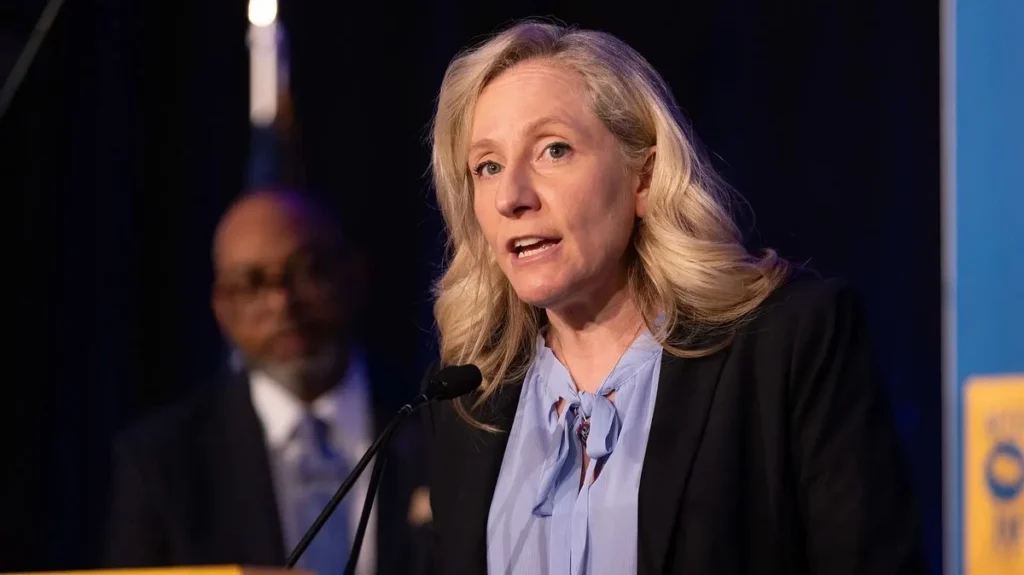
U.S. Rep. Abigail Spanberger speaks during the American Federation of Government Employees legislative conference in Washington, D.C., February 13, 2023. Photo: AFGE / Flickr / CC BY 2.0 / Cropped from Original By Shirleen Guerra | The Center Square
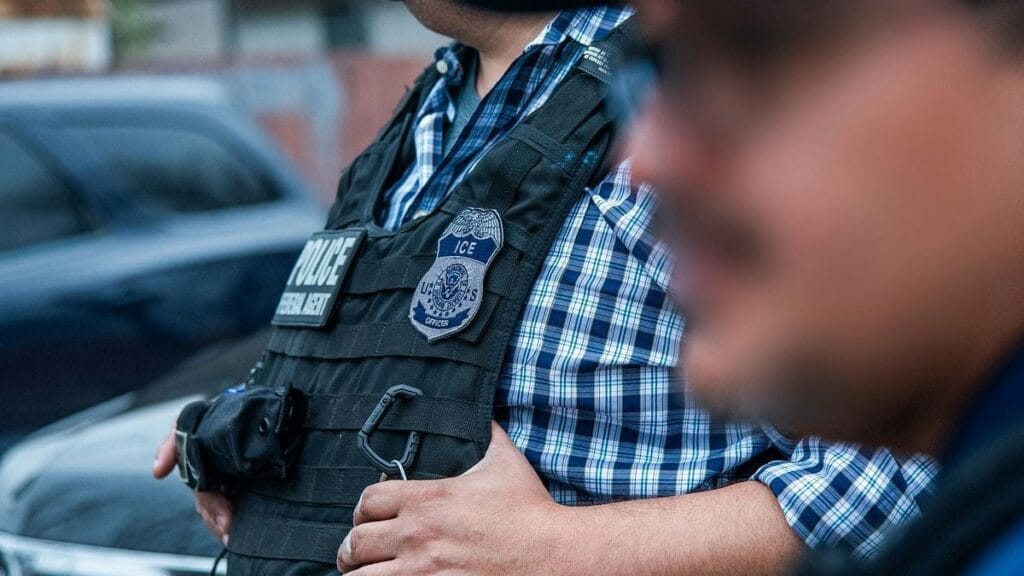
(The Center Square) – First-term Democratic Gov. Abigail Spanberger has ordered Virginia’s state law enforcement agencies to end any remaining agreements that allow state officers to take part in federal civil immigration enforcement.
The directive, issued Wednesday, requires state agencies to withdraw from all Section 287(g) agreements with U.S. Immigration and Customs Enforcement. Those agreements allow state and local officers to perform certain immigration enforcement functions under federal supervision.
The order applies to the Virginia State Police, the Virginia Department of Corrections, the Virginia Conservation Police and the Virginia Marine Police.
The move follows Spanberger’s decision on her first day in office to rescind a previous executive order that had required state participation in the 287(g) program. At the time, state and local officials said that action removed the mandate but did not automatically cancel agreements already in place.
This new directive goes further. It tells state agencies to formally terminate any existing 287(g) agreements and report back within five business days confirming they have done so.
House Republican Leader Terry Kilgore said the directive weakens public safety and cuts off cooperation with federal immigration authorities, adding, “Just days ago, Democrats insisted the governor’s order didn’t do anything. Today, Governor Spanberger ended all of Virginia’s 287(g) agreements with ICE. This decision weakens public safety and cuts off cooperation that helped law enforcement remove dangerous criminals from our communities. Virginians deserve honesty, not spin.”
Spanberger said the goal is to keep Virginia law enforcement focused on investigating crimes and protecting public safety, rather than carrying out federal civil immigration enforcement.
The governor also issued a separate executive order outlining statewide policing principles. That order emphasizes training, professionalism and public trust, and directs agencies to review their policies to make sure they align with constitutional standards.
Spanberger said trust between law enforcement and the communities they serve is essential to public safety and officer safety, and can be damaged when officers are pulled away from their core responsibilities.
The directive does not apply to local sheriffs’ offices, which are not under the governor’s authority. It also does not affect cooperation with federal law enforcement when a valid judicial warrant is involved, or participation in joint task forces unrelated to 287(g).
Spanberger said the change is meant to clarify the role of Virginia law enforcement and draw a clear line between state policing and federal civil immigration enforcement.
Engle’s Angle: Do You Want That With Or Without?

Was that our next door neighbor? It was. And her kids too. And one of their friends was with them. They were jumping up and down, breaking the ice and making the occasional snow angel. And I was laughing, watching the show. Engle’s Angle 2/4/2026 by Kevin S. Engle
I’m not allowed to shovel snow or run the snowblower for a few weeks.
Doctor’s orders.
I had minor surgery recently. I’m not sure why it’s called minor when my pain seems major. Ok, I’m a wimp but still.
The procedure was Wednesday.
The snow and sleet began Saturday night. When it was over 24 hours later, there was more than a foot of it on the ground.
Not the best time to be laid up inside.
My wife wasn’t deterred. She could take care of it.
No doubt, but I thought we should hire someone to do it this time.
Our driveway is long and this was a lot of snow.
She still went out Sunday morning to shovel a bit. Take care of the sidewalk and steps and in front of the garage doors.
I felt guilty. I was warm and toasty inside while she was out in the cold working hard.
Plow guy would be here later.
When he didn’t show up by 5PM the next day, I called.
“I can’t do it,” he said. “I broke the axle on my truck.”
Oh boy, now what?
I texted the neighbors. Did they know anyone I could call? I got some names and numbers, plus offers to help.
“Brad and I can do it” Judy said. “I’ll be over at 10 in the morning,” he told her.
And he was, along with his snowblower and wife Tracey. They met Judy at the bottom of our driveway.
While they were working, I was sitting in a rocking chair in our bedroom peering through binoculars, watching their progress as best I could.
A short time later, someone else appeared but I couldn’t tell who it was. She was helping, figuring out where the edges of our driveway were and breaking the ice on top.
Was that our next door neighbor?
It was. And her kids too. And one of their friends was with them. They were jumping up and down, breaking the ice and making the occasional snow angel.
And I was laughing, watching the show.
To the kids, it wasn’t work. It was fun. And I was enjoying it along with them.
And then I saw Rambo from across the street, armed with her snowblower. That beast can throw snow into the next county. She’s serious about snow removal.
What started out looking like it was going to take the better part of the day didn’t. Two hours later, the job was almost done.
The kids even brought water and tissues for the adults. Judy doesn’t do that for me! Maybe because I don’t act like an adult.
Five adults, three kids, two snowblowers and one very grateful laid up neighbor.
Operation Snow Angels melted my heart.
Thanks everyone.
I’ll bring the hot chocolate next time.
Do you prefer yours with or without marshmallows?
The author likes his without.

The Best of Engle’s Angle: A Humorous Slant on Life and our Wacky World (Book Cover) The Best of Engle’s Angle is available online or pick up a signed copy at a local bookstore.
REC named Front Royal-Warren County Chamber of Commerce Large Business of the Year
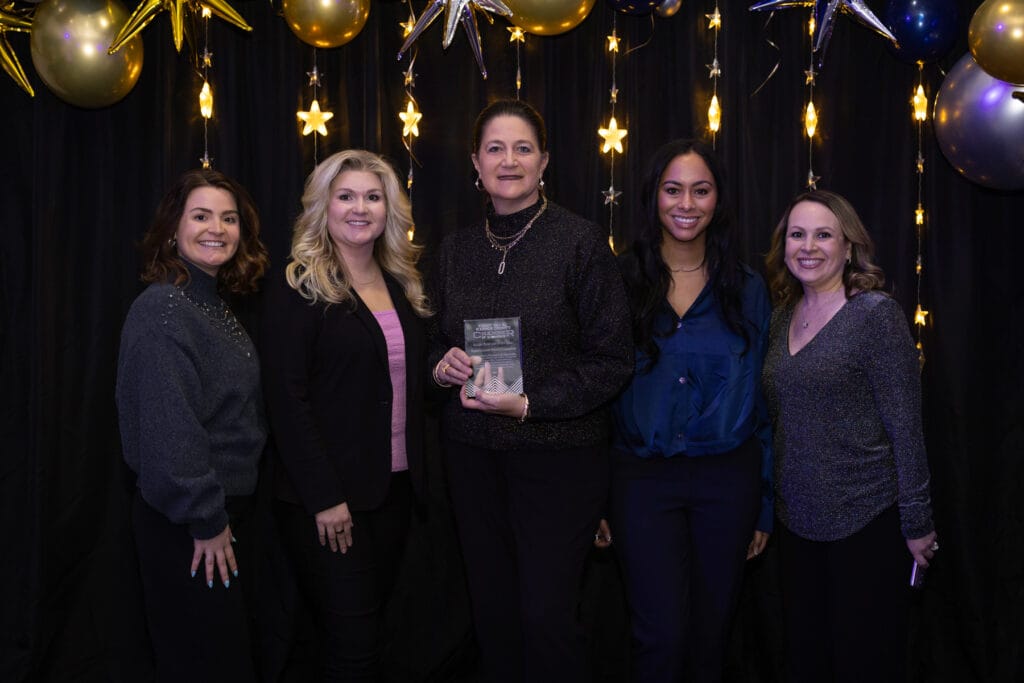
(From L to R) Brianna Murden, Casey Brill, Kristin Kula, Gigi Staubs, and Niki Shingleton, with REC’s Blue Ridge office, accepted the Front Royal-Warren County Chamber of Commerce award for Large Business of the Year on behalf of the cooperative. (Photo courtesy of Front Royal-Warren County Chamber of Commerce) Front Royal, Va. — The Front Royal-Warren County Chamber of Commerce honored Rappahannock Electric Cooperative (REC) as its Large Business of the Year during the chamber’s Annual Stargazer Gala Jan. 22. This annual event recognizes outstanding individuals and organizations, and this year’s gala marked the chamber’s 85th year of service.
The Large Business of the Year award recognizes a business that demonstrates excellence in both commerce and community, including positive contributions to the local economy and a strong record of community support.
Brianna Murden, member services team lead at REC’s Blue Ridge office, accepted the award on behalf of the cooperative alongside several REC team members.
“We’re honored to receive this award,” Murden said. “This recognition reflects the dedication of our team and our commitment to serving our members and community every day. We’re grateful for the support of this community.”
In the award citation read during the program, the chamber highlighted REC’s involvement across the region it serves — including Front Royal and Warren County — and noted the cooperative’s community support includes both financial contributions and volunteerism.
REC programs such as The Power of Change, which provides funding opportunities for nonprofits serving the region, and education and workforce efforts including Girl Power Camp, which introduces teen girls to careers in the energy industry, were also noted by the chamber, as was REC’s annual scholarship program, which will award $20,000 in scholarships in 2026 for students pursuing college or career and technical educational paths.
REC also supports regional food banks, including more than $19,000 donated in 2025 to help address food insecurity across the cooperative’s service territory.
The Stargazer Gala also recognized recipients in several other categories, including Small Business of the Year, Citizen of the Year, Nonprofit of the Year, Education Contributor of the Year, Entrepreneur of the Year and the Community Sparkplug Award.
The chamber’s recognition adds to a growing list of honors reflecting REC’s focus on service and community partnership.
“We’re grateful for this recognition from the Front Royal–Warren County Chamber, but the real reward is the work itself — showing up for our members and investing in the communities we serve,” said Casey Hollins, REC’s managing director of communications and public relations. “The efforts highlighted in this recognition reflect what matters most to us: service, partnership and making a meaningful difference close to home.”
About Rappahannock Electric Cooperative
Serving over 184,000 connections across portions of 22 Virginia counties, REC is a pillar in its communities, with over 18,000 miles of power lines extending from the Blue Ridge Mountains to the Chesapeake Bay. For more information about REC, please visit www.myrec.coop. Follow REC on Facebook, X, Instagram, LinkedIn and YouTube.
Information from a release. Posted by Dan McDermott.
Samuels Library launches February fundraiser
Send some love to Samuels Library this February!
“Love Your Library Month,” celebrated every February, is a nationwide observance to recognize the vital role libraries play as community hubs offering free access to books, technology, educational programs, and essential resources – encouraging people to visit, use services, and show support. To celebrate, a generous donor has committed to matching all donations made to Samuels Public Library throughout the month of February – up to $10,000. Your gift – no matter what size – along with this incredible match, helps ensure that Samuels Library remains the heart of our community today and for generations to come.
Taking inspiration from our theme – ‘Love Letters, Stitched Together’ – we invite patrons to stop by our Library Love Letter Station to write a note about why they love the Library. With each fundraising milestone reached, we’ll unveil a new row of Love Letters on our Community “Quilt” display.
“We continue to feel the warmth of our community through messages of support and donations that are keeping the doors open,” said Melody Hotek, President of the Samuels Public Library Board of Trustees. “The quilt reminds us that we are all part of the whole, bound together by the threads of our common experiences and joy. Our Samuels quilt gets bigger every day, and we are extremely grateful to be serving you, our friends and neighbors.”
Samuels Library’s Director, Erin Rooney, emphasized the impact donations to this campaign can make. “Love Your Library Month is a fun way to support your local library! We have an amazing team that strives to provide free and easy access to a wide range of information and ideas for the residents of Front Royal and Warren County. This is a wonderful opportunity to enhance and expand on these services to better support our entire community.”
To date since July 2025, Samuels Library has raised enough funds to continue uninterrupted operations through mid-April 2026. The donations given throughout February will be used to bridge the gap for the Library’s emergency funding needs.
Much of the success of the Love Your Library Month campaign over the years has been driven by the incredible commitment made by matching donors. “We are beyond grateful to our current anonymous donor for recognizing the importance of the services the library provides with their generous Love Your Library Month Matching Grant. Every dollar donated in February will go twice as far in bringing new services and exciting improvements to what the library already provides,” Rooney explained.
Make your donation by the end of February to DOUBLE your impact! DONATE NOW.
Join us on social media for Love Your Library Month updates (https://www.facebook.com/samuelspubliclibrary), and help us spread the news to family and friends.
About Samuels Public Library:
Originally founded in 1799 and renamed Samuels Public Library in 1952, it became the second library in the state to receive a charter and has served the citizens of Front Royal and Warren County for more than two centuries. In the past fiscal year, the library has added 2,014 new cardholders and held 925 in-person and virtual programs hosting 20,894 attendees. Attracting nearly 133,000 visitors annually, the library logged 400,002 total checkouts last year. For more information on Samuels Public Library, go to: www.samuelslibrary.net.
Samuels Public Library Adult Programming – February, 2026
You can find and register for all library events on our website, www.samuelslibrary.net.
One-Time Events
*Important: February Craft Swap Collections – Our second annual craft swap is underway, drop off your excess craft donations in Studio 330 during our Walk-In hours throughout the month of February. Those who donate get a ticket to be the first to pick through the excess stash which will open up for grabs on Saturday March 7th. Early access 10-12pm and 12-2pm all access (to participate in all access you do not need to have donated materials, all are welcome).
Sewing 201: Valentine Treat Bags
Wednesday, February 4th from 5:00 PM to 6:30 PM
In person. Registration Required. Wrap your valentine’s treats in a handmade treat bag. In this sewing 201 class, you’ll create a basic Valentine treat bag using your machine sewing skills. Perfect for those who have taken our Sewing 101 class or have basic machine sewing experience. Supplies and materials provided.
*Must have completed Sewing 101 or have a basic working knowledge of using a sewing machine. No food allowed in the studio and patrons between 13-17 must be accompanied by an adult. Registration required.
Valentine Card Making Walk-In Hours
Thursday, February 5th from 12:00 PM to 4:00 PM
In person. Drop in during our Studio walk-in hours to make a special Valentine’s Card. No experience is necessary.
Resume Workshop with Virginia Career Works
Thursday, February 5th from 1:00 PM to 2:30 PM
In person. Registration Required. Welcome to the Resume Workshop, presented by Virginia Career Works! Join us on Thu Nov 6, 2025 at 1:00 PM for an informative session on crafting the perfect resume. Whether you’re a job seeker looking to polish your resume or a student preparing for future opportunities, this workshop is for you. Our experienced professionals will provide tips and tricks to make your resume stand out. Don’t miss this chance to enhance your job prospects!
Job Fair
Thursday, February 5th from 1:00 PM to 4:00 PM
In person. Come prepared to meet employers looking for people to hire! Need help reviewing your resume beforehand? Email [email protected]! Any questions? Contact 540-678-7079 Option 8
Cricut 101
Friday, February 6th from 12:00 PM to 2:00 PM
Registration Required. In person. Have a Cricut, want a Cricut, what’s a Cricut? Come get the basics of starting your free account, accessing design space, and exploring the ins and outs of all things Cricut during our Cricut 101 program. Supplies and materials provided. 13+ with adult.
Seniors First Workshop: Medicare Fraud: Protect, Detect, Report
Thursday, February 12th from 2:00 pm to 3:00 PM
Get information about common scams involving Medicare, what to do if you suspect fraud, some “spot the scam” examples, and reading your Medicare Summary Notice.
Questions? Call VICAP at 540-635-7141 or visit seniorsfirst.info
Registration for this event is in regard to attending the hour long informational program.
One-on-one 20 minute counseling sessions can be booked beginning at 3:00 p.m. by contacting Samuels Public Library staff at 540-635-3135 ext. 105.
Seniors First Counselling
Thursday, February 12th from 3:00 PM to 4:00 PM (20-minute sessions)
In person. Sign up to meet with Seniors First for one-on-one assistance to navigate Medicare, review coverage options, and identify programs that can help lower healthcare costs. Contact the Adult Reference Department at 540-635-3153 ext. 105 to sign up for an available timeslot for one-on-one counselling.
Trivia Night: Winter Olympics
Thursday February 10th from 6:00 PM to 7:45 PM
In person. Registration Required.
Test your knowledge about the Winter Olympics at Trivia Night!
Build your teams of up to 6 people and compete for bragging rights and fabulous prizes.
AIDS Response Effort, Inc. (ARE) Free STI Testing
Wednesday, February 18th from 1:00 PM to 4:00 PM
In Person. Winchester’s AIDS Response Effort, Inc. (ARE) will be at the library on February 18, May 20, August 19, and November 18 of 2026 to provide free STI testing for the community.
1 in 5 people in the U.S.A. has an STI
Testing includes:
HIV
Hepatitis B & C
Chlamydia
Gonorrhea
Syphilis
Sewing 101: The Basics
Wednesday, February 18th 5:00 PM to 6:30 PM
In Person. Registration Required.
New to sewing? Sewing 101 is the perfect introduction for beginners to get comfortable with a sewing machine using our SINGER® Heavy Duty 4411 Sewing Machine. Learn how to thread, wind a bobbin, use an owner’s manual, and identify key machine components. We will create a simple project using basic stitches that you can take home with you.
*No food allowed in the studio and patrons between 13-17 must be accompanied by an adult. Registration required.
Elimination Tournament
Saturday, February 21st from 11:00 AM to 1:00 PM
In Person. Registration Required. Come to the library and participate in competitive matches; be some of the first to use materials soon available to borrow from the Library of Things! Prizes will be awarded to the last person standing from each of the competitive sets.
Competitive games:
- Cornhole
- Giant Jenga
- Giant Connect Four
- Giant Checkers
Due to the limited number of available spaces patrons must call, email, or speak with the Adult Reference desk in person to sign up for a slot. Patrons may choose which game they would like to compete in, unless all slots for that game are filled.
Contact Adult Reference at 540-635-3153 ext. 105 or [email protected]
Sewing 102: Beyond the Basics
Wednesday, February 25th 5:00 PM to 6:30 PM
In Person. Registration Required.
Sewing 102 will expand upon the basics with button holes and zippers. If you have attended sewing 101 or if you have a basic knowledge of machine sewing, come renew your basic sewing skills and get some advanced practice.
*No food allowed in the studio and patrons between 13-17 must be accompanied by an adult. Registration required.
Cricut 101
Thursday, February 26th from 5:00 PM to 7:00 PM
Registration Required. In person. Have a Cricut, want a Cricut, what’s a Cricut? Come get the basics of starting your free account, accessing design space, and exploring the ins and outs of all things Cricut during our Cricut 101 program. Supplies and materials provided. 13+ with adult.
Ongoing Programs
Love and Logic: Parenting with Empathy Session 1
Every Thursday, February 5th to March 12th from 5:00 PM to 7:00 PM
In Person. Registration Required. Sessions run for 6 weeks at a time.
Warren County Social Services partners with Samuels Public Library to present Love and Logic, equipping young people with character, compassion and problem solving skills.
Parents will gain practical and proven tools for raising respectful, responsible and happy kids.
To register for this session of class (or the next available session), or ask questions contact:
Lillian Johns at [email protected] or by calling 540-635-3430 ext. 3386
Scary Words Book Club
Saturday, February 7th from 2:30 to 4:30 PM
First Saturday of every month.
In person. A horror book club for people who should be afraid of the dark. This month’s titles are: Cultish by Amanda Montell.
What the Tech!
Every Tuesday from 2:00 PM to 3:30 PM
In person. Need help with technology? Come by the library’s Studio 330 where we will be going over computers and other technology basics. Having trouble with your phone, tablet, laptop, or other device? Bring it in, and we’ll help!
Bad Romance
Wednesday, February 4th from 6:00 PM to 8:00 PM
First Wednesday of every month.
In person. Do you consider yourself a hopeless romantic? Are bad romances a guilty pleasure of yours? Then you should join us for Bad Romance, where Samuels Public Library will have a themed discussion for the romance genre every month. February’s theme is Workplace Romances!
Indulge us with your favorite romance books, movies, music or other media related to the topic, and possibly discover a new treat in this awesome informal discussion! New members are always welcome!
Studio 330: Embroidery Club
Every Thursday from 10:00 PM to 12:00 PM
In person. Join us for Hand Embroidery Stitchers every Thursday morning! Bring your own needlework project to work on for a morning of crafting and socializing.
*No food allowed in the studio and patrons between 13-17 must be accompanied by an adult.
Studio 330 Walk-in Hours
Every Thursday from 12:00 PM to 4:00 PM
In person. Come tour Studio 330 or bring your project to work on. Walk-In hours are provided on a first come, first serve basis.
*Glowforge is not available during walk-in hours. No food allowed in the studio and patrons between 13-17 must be accompanied by an adult.
Studio 330: String Theory- A Fiber Arts Club
Every Saturday from 2:00 PM to 4:00 PM
In person. Welcome to a fiber arts community for experienced, novice, or first-time artists 13 and up looking to meet other artists, relax, and/or share their expertise! Bring your own knitting, crochet, weaving, or other project to Studio 330 on Saturdays 2pm to 4pm
*No food allowed in the studio and patrons between 13-17 must be accompanied by an adult.
Books & Beyond Book Club
Thursday, February 12th from 6:00 PM to 7:45 PM
Second Thursday of every month.
In person. Do you love books and sharing them as much as we do? Join us to delve into new worlds of conversation about new books at your community’s public library! The theme this month is: Older Main Characters.
Studio 330: Personal Archiving Series
Saturday, February 14th from 12:00 to 1:30 PM
Second Saturday of every month.
In Person: Discover practical, beginner-friendly ways to organize, preserve, and make accessible your photos, documents, videos, and memorabilia during our monthly Personal Archiving Series. Each month will feature a stand-alone topic including organizing photos, scanning and digitizing your media, and sharing your collections with family. Make sure to check our calendar for monthly features.
February’s Topic: Nobody Wants My Stuff. What really happens to our photos, papers, and keepsakes and how do we make sure what matters is passed on? This session explores why legacy is about meaning, not volume, and includes a guided brainstorming discussion on creative ways to share and preserve personal history beyond the “stuff.”
Registration Required.
*No food allowed in the studio and patrons between 13-17 must be accompanied by an adult.
Studio 330: Genealogy Club
Monday, February 9th from 2:00 to 4:00 PM
Second Monday of every month.
In Person: Interested in your family’s history? Already done extensive research and want to be able to share your finds? Join our genealogy club where both novices and experts alike can come together and talk about different genealogy topics.
February’s Topic: Researching African American Ancestors: This month’s Genealogy Group will focus on research specific to African American ancestry starting with a one-hour recorded viewing of Ancestry’s “Beginning African American Research” followed by discussions and time for individual research. Come to learn basic research and explore African American History.
Phoenix Project- Hope For New Beginnings
Tuesday, February 17th from 2:00 PM to 4:00 PM
Serving all members of the Front Royal/Warren County community who have experienced or are currently experiencing domestic violence or sexual assault, Phoenix Project Advocates are available to provide crisis intervention, supportive counseling, safety planning, information, education, and more. Their services are free, confidential, and trauma-informed. Hope. Help. Healing.
Information from a release. Posted by Dan McDermott.
Virginia Senate passes courthouse arrest bill
(The Center Square) – A bill aimed at limiting certain civil arrests inside Virginia courthouses has cleared the Senate and now moves to the House of Delegates.
Senate Bill 351, sponsored by Sen. Saddam Salim, D-Fairfax, would restrict most civil arrests in and around courthouses unless officers present a valid judicial warrant or order. The measure passed the Senate 21-18.
Under the bill, individuals required to attend court, including parties, witnesses and certain family or household members, would be protected from civil arrest while attending, traveling to or leaving court proceedings.
Civil arrests would still be allowed if authorized by a judicial warrant or court order that has been reviewed and confirmed by a judicial officer. Anyone who conducts or assists with a prohibited civil arrest could be held in contempt of court.
The bill applies only to civil arrests and does not change criminal arrest authority. It also does not limit the authority of judges to issue warrants or orders when required by law.
The legislation comes amid renewed debate in Virginia over the role of federal immigration enforcement inside state courthouses.
Salim said the legislation is intended to ensure people feel safe attending court proceedings without fear of arrest for civil immigration matters.
“Criminals are escaping prosecution because victims and witnesses are afraid if they go to court to press charges, they’ll be deported,” Salim wrote in a post following the vote. “SB351 simply requires that ICE present a warrant to arrest a person in a courthouse.”
Last week, Republican leaders said immigration enforcement is a federal responsibility and questioned whether legislation limiting cooperation with federal authorities addresses issues they say Virginians are most concerned about.
Virginia, Maryland have modest population growth
Photo: Alan Wooten / The Center Square By Shirleen Guerra | The Center Square
(The Center Square) – Virginia and Maryland both added a modest number of residents over the past year, according to new estimates from the U.S. Census Bureau.
In Virginia, the state’s population reached 8,880,107 residents as of July 1, 2025, up from 8,819,642 a year earlier. That is an increase of 60,465 people, or about 0.69%, over the past year.
The new figures also show Virginia has moved past its pandemic-era slowdown. Since 2020, the state’s population has grown by roughly 2.81%, reflecting a gradual recovery after several years of slower growth early in the decade.
Those gains came from a mix of new births and people moving into the state. Over the past year, Virginia recorded 92,070 births and 78,253 deaths, resulting in a natural change of 13,817 people.
Migration played an even larger role. Census data show Virginia added 46,704 people through migration, with most of that growth coming from international migration. Domestic migration also contributed, though to a lesser extent.
Maryland’s growth followed a different path, with migration playing a larger role than births.
Census estimates show Maryland added 20,033 residents between July 1, 2024, and July 1, 2025, a much smaller increase than Virginia. Census data show the state recorded 65,090 births and 53,646 deaths, resulting in a natural change of 11,444 people.
Maryland still grew because more people moved in than moved out. Census data show the state added 8,376 residents through migration, largely driven by international arrivals, even as domestic migration resulted in a net loss of residents to other states.
Taken together, the numbers show both states continuing to add residents, but in different ways.
Virginia’s population growth reflects a rebound from pandemic-era stagnation, supported by both births and migration, while Maryland’s gains were driven more heavily by migration.
Virginia on track to reform probation following bipartisan bills
File image: Empty jail cell in daylight By Charlotte Rene Woods | Virginia Mercury
Unlikely allies worked to pass probation reform bills last year that created a workgroup to refine the proposal this year.
The group, as well as a coalition of criminal justice reform organizations, probation officers, prosecutors, defense attorneys and victims’ advocates, helped develop the new proposal, which would allow formerly incarcerated people to be released from probation after a year if they demonstrate their rehabilitation by meeting certain benchmarks laid out by their probation officer.
A version by Sen. Christine New Craig, R-Chesapeake, already passed the Senate and on Tuesday, House Bill 149 by Del. Wren Williams, R-Patrick, cleared the House of Delegates.
The benchmarks could include maintaining stable housing and employment, obtaining health insurance, earning vocational certifications or participating in mental health or substance use treatment programs as needed.
Last year’s bill was more prescriptive in the criteria while this year’s bill will allow a case-by- case process for people and their probation officers, who can then send a letter to courts to end the probation status.
The proposal is backed by Reform Alliance, a national criminal justice organization that was founded by rappers Jay Z, Meek Mill and others.
“This is a common sense improvement to the Commonwealth’s probation system that applies best practices that reduce crime, lighten heavy probation caseloads, and increase reentry success,” Reform Alliance said in a statement on Tuesday.
Virginia-based criminal justice organizations including Nolef Turns and The Humanization Project have supported the bill. The Virginia Interfaith Center For Public Policy has backed the measure, as well as conservative-leaning Americans For Prosperity.
When carrying the bill last year Williams emphasized that the bipartisan drive for reform is “recognition that the punitive approach has not worked.”
He added that he believes earned probation reductions can help formerly incarcerated people “rebuild their lives out of the American Dream” and contribute to safer communities.
Kenneth Hunter, an organizer with Virginia Interfaith, also noted how probation status can sometimes hinder people that are trying to get their life back on track.
The travel restrictions that probation terms typically come with can hamper employment, Hunter said. He said he hears that commercial truck drivers run into this problem, particularly around the North Carolina state border depending on their routes. The limitations can prevent truckers from obtaining certain jobs or stunt their growth within their jobs.
Some people have also told The Mercury they believe their probation status has been a factor in the rejection of their voter rights restoration requests.
Unlike other states, in Virginia, governors decide if formerly incarcerated people’s voting rights will be restored. Former Gov. Glenn Youngkin had lower restorations than previous governors and his administration offered little clarity on factors that contributed to the success or rejection of requests.
A pending constitutional amendment could make restorations automatic so long as someone has finished their prison sentences, if a majority of Virginians approve a ballot referendum later this year.
No bills have made their way to Gov. Abigail Spanberger’s desk yet, so the jury is still out on whether the parole reform bill stands a chance to become law this year. She could approve the bill as-is, seek adjustments to it, or veto it outright.
Va. watermen push back against terrapin protections on crab pots

Thirty diamondback terrapins drowned in a crab cage in the Chesapeake Bay region. (Photo courtesy of Randy Chambers) By Shannon Heckt | Virginia Mercury
The northern diamondback terrapin is one of Virginia’s species in greatest need of protection, conservation groups say. But a bill that’s working through the state legislature to reduce the number of the terrapins that drown in Chesapeake Bay crab pots met pushback this week from fishermen who say it could impede their trade.
Dozens of Virginia watermen traveled to Richmond Monday to voice their concerns about House Bill 1013, which would have required bycatch reduction devices on crab pots in designated areas of the Bay. The devices are meant to prevent the terrapin from getting inside while still allowing crabs to enter the pots.
“They’re not targeted by crabbers by any means. They just frequently get trapped in crab pots and cannot escape. They will drown in about 50 minutes,” bill sponsor Del. Kathy Tran, D-Fairfax, said.
Bycatch devices — plastic borders on the opening of crab pots to make them smaller — preventing the turtles from entering the pots. However, the watermen said it also blocks larger crabs from getting into the pots.
Some bill opponents stated that pots with these devices see as much as a 50% cut to their catch. Commercial watermen argued the bill was unnecessary since they check their pots every day, which helps reduce the number of terrapins that get trapped in their pots, unlike recreational pots that are often left in the water for days.
Being forced to add bycatch devices could ultimately impact their bottom line, they said.
Members of the Virginia Watermen Association testify against a bill that would require bycatch devices on crab pots. (Photo by Shannon Heckt/Virginia Mercury) “With this small volume of product, high prices will come to it,” said J.C. Hudgins, President of the Virginia Waterman Association. “It will eventually cause these regional seafood dealers to go elsewhere.”
Diamondback terrapins inhabit the Atlantic and Gulf coasts and have experienced a 75% population drop over the last 50 years, according to the Center for Biological Diversity. The center petitioned the Virginia Marine Resources Commission in 2024 to create regulations to protect the terrapins from getting caught in the crab pots. There have also been multiple, unsuccessful attempts to place the reptile on the federal endangered or threatened species lists.
Del. Rob Bloxom, R-Accomack, said the statistics aren’t reliable because it has been decades since a formal study has been done about the diamondback terrapins in the Chesapeake Bay region. He said he believes their population decline is due to factors beyond just crab pot drownings.
The legislation was amended on Monday in the House Agriculture, Chesapeake and Natural Resources Committee to only apply to recreational pots.
The areas where the recreational pots are frequently used are closer to shore, where the terrapins go to lay their eggs. The bill also requires the Marine Resources Commission and Virginia Institute of Marine Science to spend the next two years studying locations in the Bay where the terrapins are most threatened to potentially apply the restriction to commercial pots in those areas, too.
“This isn’t a stagnant picture. It’s not like we’re in one spot all year long,” said Robert Whitman, a commercial fisherman speaking against the bill. “If we had these management areas we might move into it for two weeks and then come out we have to put an excluder on and take it back off. The volume of work and money that would entail is just unfathomable.”
Bloxom argued that the language of the bill suggests that in two years once the study by the two agencies are completed, the restrictions to commercial crab pots will be all but certain to be implemented.
“What we’re looking at is a path forward to reduce mortality in recreational fisheries,” said Chris Moore, Director of the Chesapeake Bay Foundation. “Then we can look at other mortalities with all the experts in the room.”
Tran agreed to continue to work on the language of the bill to make its study portion more open ended, with a focus on the protection areas and finding ways to better protect the terrapins. The bill will then be heard before the full House Agriculture committee.
2025-2026 Bear, deer, turkey harvest data announced
RICHMOND, VA – Wildlife biologists with the Virginia Department of Wildlife Resources (DWR) have compiled harvest totals for the fall 2025–26 big game hunting seasons. The deer harvest increased while bear and turkey harvests declined from the previous season. According to DWR Wildlife Division Director Michael Lipford, “The big season changes we made for deer and bear management purposes influenced these results but were just one of several factors. Changes in hunter participation, natural food availability, and weather also impact big game harvests year to year.” Harvest reporting by successful bear, deer, and turkey hunters remains a vital component of DWR’s management programs as harvest data are used to monitor game populations and inform future regulatory decisions.
Black Bear
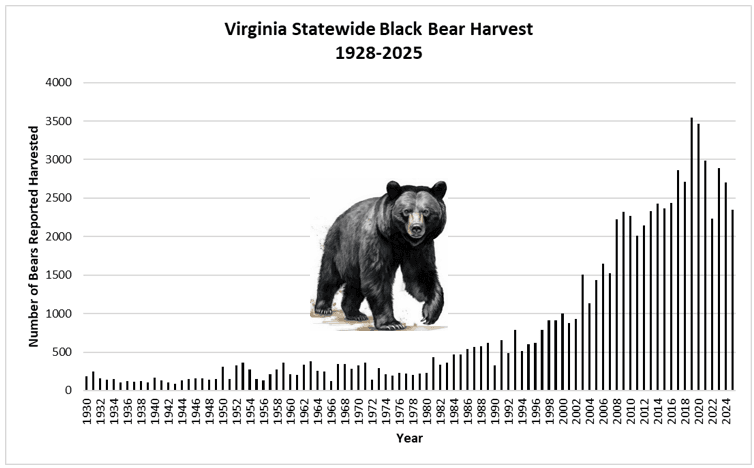
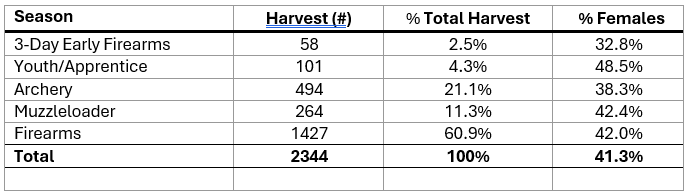
Hunters reported harvesting 2,344 bears in Virginia during the 2025–26 bear hunting season (Figure 1), which was approximately 13.3% lower than the previous year’s harvest and 18.0% lower than the previous 5-year average (2020–2024). Statewide, a higher proportion of the 2025-26 season harvest consisted of female bears (41.3%) than the previous year (38.4%).
When compared to 2024, the archery, youth/apprentice, and muzzleloader harvests declined 31.4%, 25.4% and 24.6%, respectively. Although there was significant regional variation, the general firearms harvest increased by 4.0% statewide (Table 1). Harvest during the 3-day early season, which was closed in 35 northwestern counties over the last several years, decreased by 45.3% from the previous season in the seven southwestern counties where it remained open.
The decrease in the total bear harvest during 2025 is likely the result of several factors. A decrease in harvest was expected following significant season reductions across 24 counties where mange is of most concern (shown in green on the map on the bear hunting season webpage), coupled with the closing of the 3-day early season in nine additional southwestern counties. Although the magnitude varied regionally, harvests declined by 33% from the previous year and 39% from the previous 3-year average in the mange impacted counties. While statewide there was an increase in female bear harvest, there was 37% decrease in the mange impacted counties compared to the previous season and a 43% decrease from the previous 3-year average. While the new management goal of harvesting 60-65% fewer female bears was not achieved across this whole area, the observed reductions were an important step in the right direction for population recovery. While harvests declined (as intended) in the mange impacted counties, increased harvests were reported elsewhere in the state, especially in the southern Piedmont. These can likely be attributed to hunter movements to areas where seasons had not been shortened and the extension of seasons in several bear management zones.
Across all seasons in which hounds could be used, an estimated 68.9% of bears were taken by hunters using hounds; across all bear seasons, 46.6% of bears were taken with hounds. Season estimates for the proportion of bears harvested by hunters using hounds were as follows: 3-day early firearms season – 34.5%, firearms season – 69.8%, and youth/apprentice weekend – 76.2%.
Virginia continues to provide diverse opportunities for a successful bear hunt. For additional details on black bear management in Virginia please visit the DWR bear webpage. Data presented in this summary only include bears killed during the regulated bear hunting seasons and do not include bears taken on kill permits or struck by vehicles.

Reported black bear harvest in Virginia 1928–2025. (Va DWR( 
Summary of 2025–2026 bear harvest by season in Virginia. (Va DWR) White-Tailed Deer
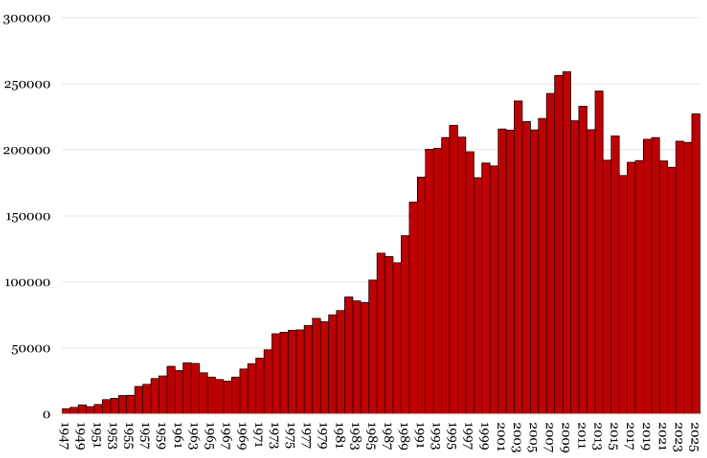
During the 2025-2026 deer seasons, including the early September antlerless seasons (firearms and urban archery), hunters reported harvesting 227,302 deer. This was up approximately 10% from last year’s total of 205,759 over the same timeframe, and up 14% from the previous 10-year average of 198,666. This year’s total included 108,163 antlered bucks, 14,631 button bucks, 973 shed bucks, and 103,535 does (45.5%).
Archers took 32,730 deer, while 51,472 deer were taken with muzzleloaders, and 143,100 with firearms. During the youth and apprentice weekend, 2,636 deer were reported harvested. In counties where it is legal to hunt deer with dogs, dogs were used to take 50% of the deer killed during the general firearms season and 35% of the total deer taken across all seasons.
A significant number of deer hunting regulation changes were implemented this past season—mostly during the general firearms season west of the Blue Ridge—to increase opportunity and increase doe harvest to meet population objectives. While these regulations likely contributed to the increased deer harvest, the daily deer kill was ahead of last year’s pace from opening day of archery onward. Currently, 58% of the state’s deer management units (counties) are above population objectives, 38% are meeting the current objective, and 4% are below current objectives.
The data presented in this summary are preliminary and do not include deer taken during the late urban archery or antlerless-only firearms seasons. Additionally, the data exclude deer taken under kill permits or those hit and killed by vehicles. Annual deer harvest totals by county dating back to 1947 can be found on DWR’s deer webpage along with additional information on deer management in Virginia.
DWR is thankful to Virginia’s deer hunters in helping the Department get closer to deer management objectives.
Virginia Annual Deer Harvest, 1947 to present. (Va DWR) Wild Turkey
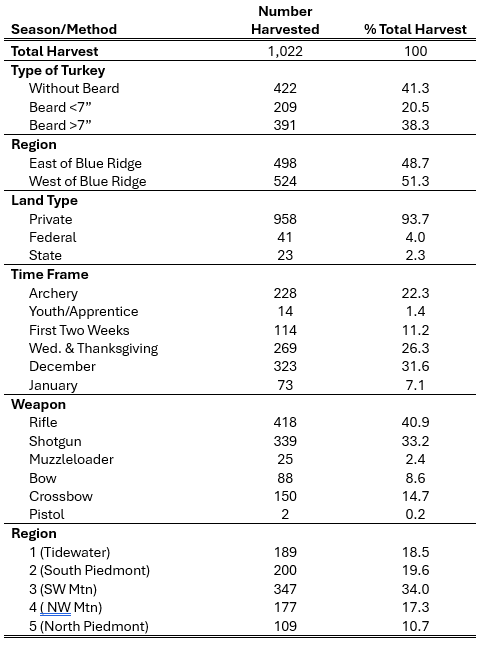
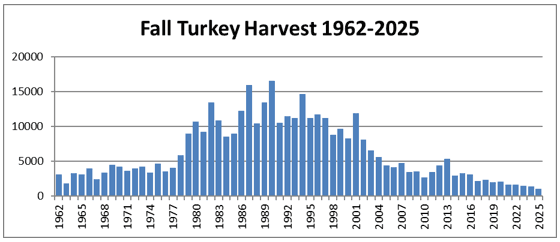
A total of 1,022 wild turkeys were harvested in Virginia during the 2025-26 fall turkey hunting season, well below the 2024-25 season total of 1,423. This represents a 28% decline from the 2024-25 season and 38% below the previous 5-year average (2020 through 2024-25 seasons).
The decline in fall turkey harvest noted over the past several seasons can likely be attributed most to declining hunter participation. DWR hunter survey data indicates that fall turkey hunter numbers have declined by approximately 64% since 2005 and that many turkey hunters are choosing to either hunt other species in the fall or are saving turkey tags for the more popular spring turkey season.
Besides hunting participation, another important driver of fall hunting success is the annual reproductive success. In 2025, the productivity estimate (1.3 poults/hen) was far below the long-term average (2.6 poults/hen) and the lowest since the survey began in 2007. Decreased productivity was evident in all regions of the state, except for southwestern Virginia, where observed poult productivity was near the long-term average, thanks in part to a periodic cicada hatch in the coalfield counties. Since juvenile birds can account for 40-60% of the fall harvest, reproductive success greatly influences turkey populations available for fall harvest.
The harvest declines from the previous season seemed to be most apparent during the October firearms segment (38%) and the Thanksgiving segment (33%), which has historically been the most heavily utilized portion of the fall turkey hunting season. The largest decreases came from changes in hen harvest, which declined approximately 42%. Adult gobbler harvest was also down approximately 20%, while juvenile male harvest was almost identical to the previous season.
While all regions experienced a decrease in harvest, southwest Virginia observed the least significant decline (8%), which is likely due to improved reproduction in that region during the summer of 2025. In general, counties east of the Blue Ridge experienced greater declines in harvest than those west of the Blue Ridge. The majority of the harvest (94%) occurred on privately owned land.
Fall turkey hunting remains one of Virginia’s most unique hunting opportunities, and as such, potential strategies that might enhance participation moving forward were included during revision of the Virginia Turkey Management Plan, endorsed by the Board of Wildlife Resources during the May 2025 meeting.
Fall 2025-2026 Turkey Harvest Summary:
Turkey Harvest data from Va DWR 
Fall Turkey Harvest data from Va DWR Information from a release. Posted by Dan McDermott.
Virginia wildlife officials warn residents not to feed deer during winter

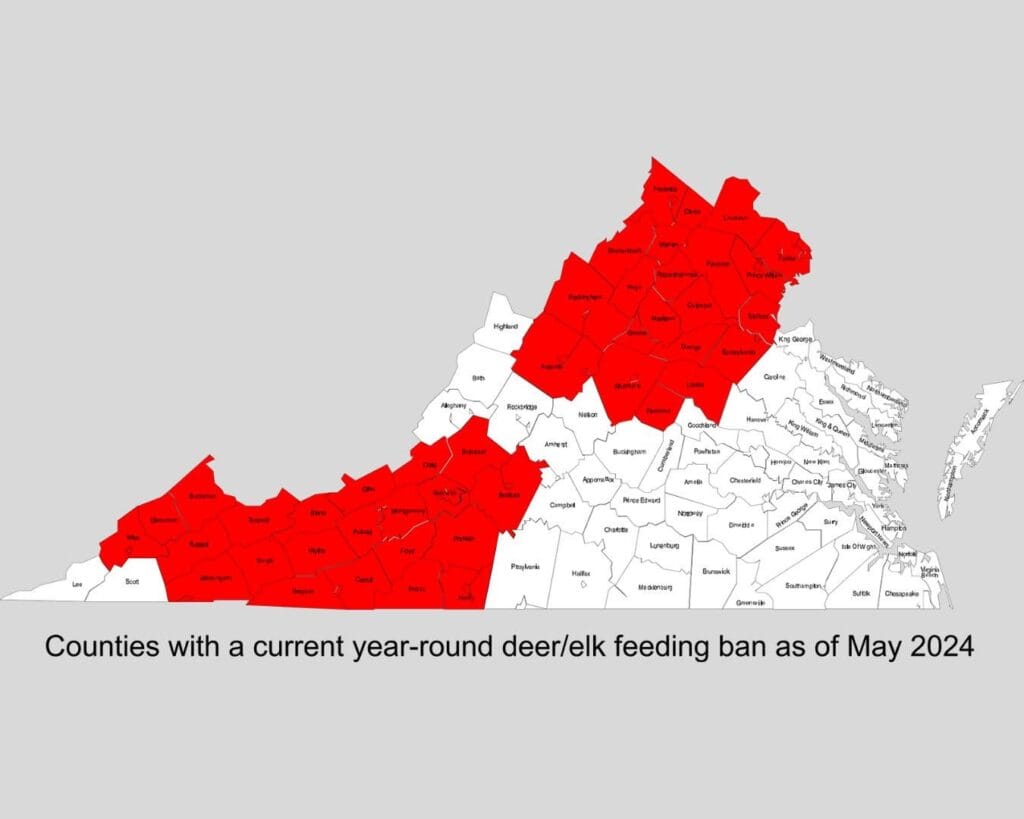
A Virginia Department of Wildlife Resources map shows counties with a year-round deer and elk feeding ban, highlighted in red as of May 2024. Wildlife officials say feeding deer can harm animals, increase disease spread and is illegal in many parts of the state. The Virginia Department of Wildlife Resources is reminding residents not to feed deer during winter weather, warning that the practice can harm animals, increase disease spread and, in many areas, violate state law.
Wildlife officials say recent ice and extreme cold may prompt well-meaning people to put out corn, grain or other food for deer. However, biologists stress that deer are naturally adapted to survive winter conditions without human feeding.
Deer grow thick winter coats made of hollow, insulating hair and build fat reserves in the fall, largely from acorns and other natural foods. During winter, they lower their metabolism and shift to a diet of woody browse and other low-quality natural forage. Their digestive system relies on bacteria suited to that seasonal diet.
A sudden change to foods such as corn or grain can overwhelm that system, officials say, leading to rumen acidosis, bloat and potentially death. “A deer’s stomach in winter is not equipped to handle large amounts of grain,” the department said in public guidance.
Feeding also creates broader problems, according to wildlife managers. Concentrating deer around homes and roads increases the risk of vehicle collisions and residential plant damage. Animals that become accustomed to people can lose their natural wariness, which can lead to aggressive encounters. Officials note that more people nationwide are injured each year by habituated deer than by bears.
Artificial feeding sites can also speed the spread of disease. Gathering deer in close quarters has been linked in other states to the transmission of tuberculosis and chronic wasting disease, a fatal neurological illness affecting deer and related species.
There are also concerns about feed quality. Corn sold as “deer corn” may contain aflatoxin, a mold-produced toxin that can poison wildlife, officials say.
State law further restricts feeding. In Virginia, feeding deer is illegal statewide from Sept. 1 through the first Saturday in January. In addition, feeding deer is prohibited year-round in dozens of counties and the cities and towns within them, including Warren, Shenandoah, Frederick, Clarke, Fauquier, Loudoun, Prince William, Rockingham, Albemarle, Augusta and others.
The definition of feed or bait includes corn, grain, pelleted feed, mineral or salt licks, apples or other fruit and bird seed placed to attract wildlife. If deer are eating from a bird feeder, officials say, that can qualify as illegal feeding.
The rules do not apply to wildlife food plots, normal agricultural operations such as crop plantings or livestock feeding, or wildlife management activities authorized by the department.
While winter can be a stressful time for wildlife, the department says deer populations range from South Texas to Maine and are built to handle seasonal hardship. The best way for residents to help, officials say, is to avoid feeding and allow deer to rely on natural food sources.
Information from a release. Edited by Dan McDermott.
Multi-jurisdictional window vandalisms investigated across Front Royal, Stephens City and Warren County
A multi-agency investigation is underway into a series of window-shattering vandalism incidents spanning multiple jurisdictions in the northern Shenandoah Valley, including the Town of Front Royal and areas of Frederick and Warren counties.
The Front Royal Police Department said it is working in conjunction with the Warren County Sheriff’s Office and the Frederick County Sheriff’s Office on what authorities describe as related acts of vandalism that may involve the same suspect or suspects.
According to Front Royal police, four reports of vandalism have been received within the town limits to date. All four incidents are similar in nature and are believed to have occurred during the overnight hours of Jan. 31. Two of the incidents involved damage to business windows, and two involved vehicle windows. No injuries were reported in connection with those cases.
Preliminary investigation by Front Royal officers indicates the damaged windows were struck with a small metal ball bearing. The police department said it is actively investigating and encouraged anyone with information to contact Officer J.A. Grim by email at [email protected] or by phone at 540-635-2111.
Additional information is expected in a future release as the investigation progresses.
In a related case, deputies with the Frederick County Sheriff’s Office responded Jan. 31 to the 5000 block of Main Street within the town limits of Stephens City for a report of a possible shooting into a dwelling. Upon arrival, deputies determined that unknown person or persons may have fired some type of projectile through a window of the building. Witnesses on scene were unable to provide descriptions of suspects or vehicles.
A review of video surveillance later showed the glass shattering at approximately 8:13 p.m. as a pickup truck was passing by, according to the sheriff’s office.
Investigators said similar situations had been reported in Front Royal and Warren County and that a suspicious pickup truck also appeared to be in those areas at the time of the incidents.
The Front Royal Police Department was reportedly able to access license plate reader data and develop a possible suspect based on vehicle registration information. The suspect vehicle was linked to a Frederick County address. Law enforcement made contact attempts there but did not initially locate the truck or its registered owner.
Authorities obtained a search warrant for the suspect vehicle and the residence to which it was associated. However, before those warrants were executed on Feb. 2, the vehicle was located in motion and deputies made contact with the driver. The sheriff’s office said evidence of possible involvement in the vandalism incidents was found inside the vehicle, and the driver gave statements to investigators confirming his involvement.
Officials said they believe additional individuals may also be involved in the series of vandalisms, which may span as many as eight properties across four different jurisdictions.
As of now, no charges have been placed in Frederick County. The sheriff’s office said charging decisions are pending the completion of ongoing investigations by the Front Royal Police Department, the Warren County Sheriff’s Office and the Strasburg Police Department. Because no charges have been filed, authorities said they are not releasing suspect information at this time.
The investigation remains active across all involved agencies. Anyone with information is urged to contact the appropriate law enforcement agency.
Information from releases. Edited by Dan McDermott.
Rideshare, delivery taxes proposed in Virginia
Photo: Grace David / The Center Square By Shirleen Guerra | The Center Square
(The Center Square) – Uber says proposed transportation taxes moving through the General Assembly could raise costs for riders and drivers, even as lawmakers look to generate new funding for transit projects across the Commonwealth.
It also raised the question of safety for those out partying, and accessibility to appointments for those with medical concerns.
“As Virginia residents continue to struggle with high cost of living, efforts to impose new taxes and fees on rideshare and delivery services are unwise,” Uber said in a statement. “While we share legislative leadership’s goal of funding transportation and lowering costs for Virginians, these proposals will likely have the opposite effect.”
The comments come as lawmakers consider a pair of bills that would add new taxes and fees to rideshare trips and retail deliveries as part of a broader transportation funding package.
House Bill 1179, introduced by Del. Kathy Tran, D-Fairfax, and Senate Bill 638, introduced by Sen. Adam Ebbin, D-Alexandria, contain matching language that would change how transportation revenue is collected and distributed statewide and within certain regions.
According to fiscal impact statements prepared by the Department of Planning and Budget, the legislation would generate an estimated $585.8 million in fiscal year 2027 and $639.5 million in fiscal year 2028 through a combination of statewide and regional taxes and fees.
Under the proposals, retail deliveries would be subject to a 50-cent statewide fee, while fares charged by transportation network companies, including rideshare services such as Uber, would face a 4.3% statewide tax.
Additional taxes would apply only within designated transportation districts, including parts of Northern Virginia and localities served by the Potomac and Rappahannock Transportation Commission. Those regional charges include local sales taxes, parking taxes and highway use fees and would not apply statewide.
Revenue generated under the bills would be directed primarily to the Commonwealth Mass Transit Fund and regional transportation authorities to support transit operations, capital projects and long-term transportation planning.
Uber said it supports efforts to fund transportation but warned the added costs could reduce access for people who rely on rideshare services for work, medical appointments and other essential trips. The company also pointed to research linking increased rideshare availability with lower rates of drunk driving fatalities nationwide.
The bills remain under consideration as lawmakers continue transportation and budget discussions during the 2026 General Assembly session.
If approved, the proposals would add new taxes and fees tied to everyday transportation and delivery services used by Virginians across the Commonwealth.
Virginia lawmakers advance veteran suicide prevention bill
U.S. soldiers use training grenades during a field training exercise at Fort Bragg, N.C., Sept. 29, 2025. Pfc. Alexis Fischer / U.S. Army via DVIDS / Public Domain By Shirleen Guerra | The Center Square
(The Center Square) – Improving tracking and responding to suicides involving veterans and military service members is in legislation advanced by lawmakers in Virginia.
House Bill 529 would create a Suicide Prevention Program within the Department of Veterans Services focused on collecting data, coordinating prevention efforts and reporting trends to commonwealth leaders and lawmakers.
According to the bill language, the department would be responsible for compiling and analyzing information related to suicides of veterans and military service members. That data would be included in an annual report submitted to the secretary of Veterans Affairs, the governor and the General Assembly.
The legislation would also require greater coordination between commonwealth agencies.
When a death certificate lists suicide as the cause and manner of death for a veteran or military service member, the State Registrar of Vital Records would be required to provide that information to the Department of Veterans Services.
In addition, the Office of the Chief Medical Examiner would be required to provide copies of autopsy reports related to those deaths to the department upon request. The bill also requires the office to notify a decedent’s next of kin when an autopsy report is released to a physician or personal representative.
The program would also coordinate with federal, state and local partners on suicide prevention efforts, including substance use and behavioral health support for veterans, service members and their families.
A separate research project conducted by psychologists at the Virginia Military Institute, released in February 2025, examined factors linked to veteran suicide based on survey responses from veterans across multiple military branches.
The study, funded by the Virginia Department of Veterans Services, found that experiences during military service, access to mental health care, substance use, chronic pain and challenges finding work after leaving the military can all play a role in suicide risk among veterans.
According to the bill text, the legislation would eliminate the existing suicide prevention coordinator position within the Department of Veterans Services and transfer those responsibilities to the newly created program.
Lawmakers considered a similar proposal during the 2025 General Assembly session. That bill, House Bill 1738, passed the House unanimously and died in the Finance and Appropriations Committee of the Senate.
HB529 has advanced through House Health and Human Services subcommittees with amendments and has been referred to the House Appropriations Committee.
Planned Parenthood ends suit against Trump administration over serving Medicaid patients

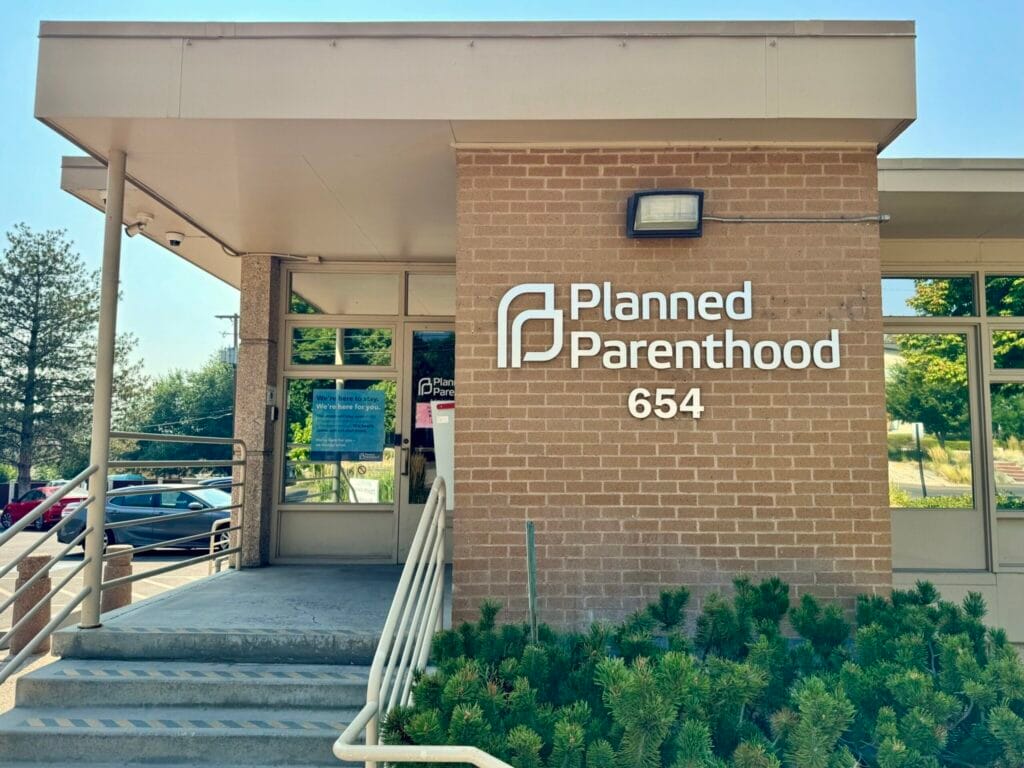
A Planned Parenthood clinic in Salt Lake City on Wednesday, July 31, 2024. (Photo by McKenzie Romero/Utah News Dispatch) By Jennifer Shutt
States NewsroomWASHINGTON — A federal judge on Monday closed the lawsuit Planned Parenthood filed last summer after Republicans’ “big, beautiful” law blocked Medicaid patients from visiting its clinics for any health care appointments for one year.
Planned Parenthood filed notice with the court Friday that it had dismissed “without prejudice all claims against” the Trump administration in the case. Massachusetts District Court Judge Indira Talwani issued an electronic order Monday closing the case “Pursuant to Plaintiffs’ Notice of Voluntary Dismissal without Prejudice.”
The law prevents people on Medicaid from being seen at Planned Parenthood facilities through early July, when the one-year period would expire.
Planned Parenthood Federation of America President and CEO Alexis McGill Johnson wrote in a statement released last week that President Donald Trump “and his allies in Congress have weaponized the federal government to target Planned Parenthood at the expense of patients — stripping people of the care they rely on.
“Through every attack, Planned Parenthood has never lost sight of its focus: ensuring patients can get the care they need from the provider they trust. That will never change. Care continues, as does our commitment to fighting for everyone’s freedom to make their own decisions about their bodies, lives, and futures.”
The Department of Justice did not immediately respond to a request for comment from States Newsroom.
Talwani originally ruled for Planned Parenthood in the case, temporarily blocking the defunding provision from taking effect. But an appeals court later overturned that decision, allowing the Trump administration to legally withhold Medicaid funding from going to Planned Parenthood.
Talwani was nominated by former President Barack Obama.
The provision in Republicans’ “big, beautiful” law that blocks all Medicaid funding from going to Planned Parenthood was originally slated to last for a decade, but the final version covered one year.
Federal law for decades has barred spending from covering abortions with limited exceptions for rape, incest, or the woman’s life.
So the new language prevented Medicaid patients from scheduling appointments at Planned Parenthood for other types of health care, like annual physicals, cancer screenings, or birth control appointments.
Shireen Ghorbani, president and CEO of Planned Parenthood Association of Utah, which filed the lawsuit along with Planned Parenthood League of Massachusetts and Planned Parenthood Federation of America, wrote in a statement that its health care providers would “continue to see patients and deliver on our mission to provide high-quality care and education to everyone who needs it, no matter where they live or how much money they make.”
A Planned Parenthood spokesperson, who did not want to comment on the record, said that certain clinics may choose to cover the cost of treating Medicaid patients, even though the clinic will not receive reimbursement from the federal government under the law.
Angela Vasquez-Giroux, vice president of communications at Planned Parenthood Federation of America, wrote in a statement that the organization’s “health centers initially shielded the overwhelming majority of patients who rely on Medicaid from the harm of this cruel law. Unfortunately, the consequences for patients will worsen considerably over time as health centers close, costs rise, and access to their trusted provider is pushed further out of reach.”
Va. bill to boost local approvals of solar projects advances
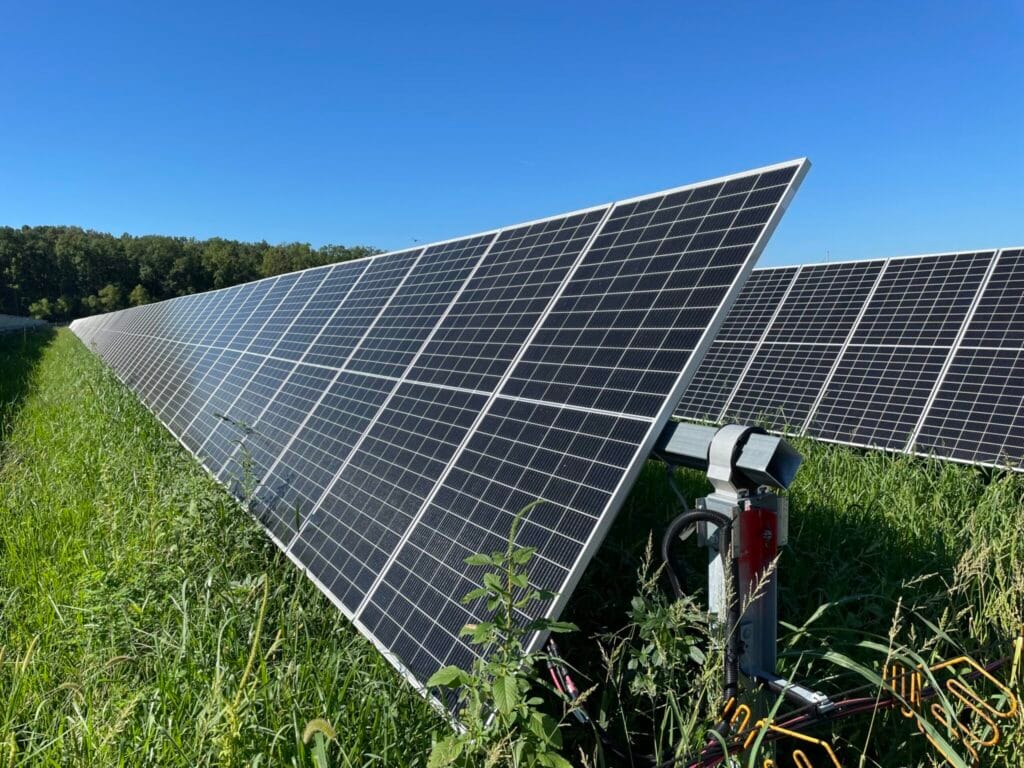
A solar and battery storage development operated by Entergy in Searcy, Arkansas. Solar power growth is expected to help some parts of the country meet electric demand last summer. (Photo by Robert Zullo/ States Newsroom) By Shannon Heckt
Virginia MercuryA bill that would set up a framework for siting solar projects that localities could follow and that prohibits the premature rejection of solar infrastructure development has passed the Virginia Senate.
Senate Bill 347 by Sen. Schulyer VanValkenburg, D-Henrico, is a way to meet the state’s growing energy while combating political messaging against renewable energy sources that hampers development, the senator said.
“One of the big complaints has been that there are solar developers who come in and don’t do it the right way,” VanValkenburg said. “And so this lays out kind of basic guidance about what the right way might look like.”
The bill is not a mandate for localities to approve solar projects but it would keep them from outright barring the energy projects from even applying for permits. Localities would still have the ability to approve or withhold permits.
VanValkenburg said there are counties more readily approving data center development than they are energy production projects, which has made it more challenging for utilities to keep up with energy demands.
“When you actually look at the individual project, you talk to the property owner, you look at the economics of it for a locality. I think we’ll get more projects,” VanValkenburg said.
The recommended solar siting guidelines proposed in the bill are considered best practices that can give localities a framework for solar projects. The key recommendations for the location of the solar arrays:
-The project should be between 150-200 feet from the nearest point on the outer wall of existing occupied community buildings and dwellings on non-participating properties.
-The project should be between 50-100 feet from the outside edge of the roadbed of any road abutting the property.
-The project should be between 100-250 feet from the edge of tidal wetlands or non-tidal wetlands, or perennial streams
-The project should be between 50-75 feet from the nearest shared property line for nonparticipating properties.
During debate on the House companion bill, House Bill 711, representatives of the Virginia Farm Bureau and the Association of Counties raised concerns that the standards laid out in the bill are one-size-fits-all parameters, although solar projects will vary.
“Whether it’s a one megawatt project, to a 100 MW project, they vary in size from several acres to square miles. There’s also differences in geography and physio-geographic provinces across the commonwealth,” said Joe Lerch with the Virginia Association of Counties.
The bill may meet pushback from localities, Lerch said, “because our members just want to retain that ability to craft those ordinances and craft those agreements at the local level.”
The senator emphasized that the legislation is not a requirement for localities to approve solar projects but it is an effort to help bridge some of the gaps in local decisions when it comes to determining how a solar project could look in their area.
“We do not believe that this is a magic bullet that is going to solve affordability and reliability and get more clean energy on a grid,” said Sarah Graham Taylor on behalf of Marec Action, a coalition of renewable energy agencies that promotes the build out of solar and wind projects. “But it is an important step forward to getting more good projects sited, while still protecting landowner rights and local voting.”
With the increasing demand for energy and the requirements under the Virginia Clean Economy Act, VanValkenburg said this is a first step to prevent needing state intervention.
“But I’d rather try doing that than do nothing. And in 2-3 years (if we do nothing), now we have to do something, you’ve left us with no choice. Every day that goes by where they do green light data centers and reject energy projects, that decision making gets moved up,” VanValkenburg said.
In the hearings for the bills, Virginia Farm Bureau representatives broached a common concern: the potential loss of agricultural land to solar projects. During community meetings in rural portions of the state, it is a familiar theme among residents, who often want to preserve the character of the county.
“I get everybody being afraid that, you know, farmland’s gonna go away or, you know, this or that thing is gonna happen. But it’s really important to note that we’re not mandating anything here,” VanValkenburg responded.
Del. Charniele Herring, D-Alexandria, who is carrying the house version of the bill, said that it won’t ensure that all solar projects are approved, but it is meant to weed out bad actors to put local residents at ease when it comes to considering a solar project.
“It sets the project standards ensuring communities and trust in solar facilities are well designed and responsibly managed,” Herring said.
SB 347 cleared the Senate with a vote of 21-17. It now heads to the House for more debate. HB 711 awaits a vote on the House floor.
Fairfax case alleging school-assisted abortions now in federal court
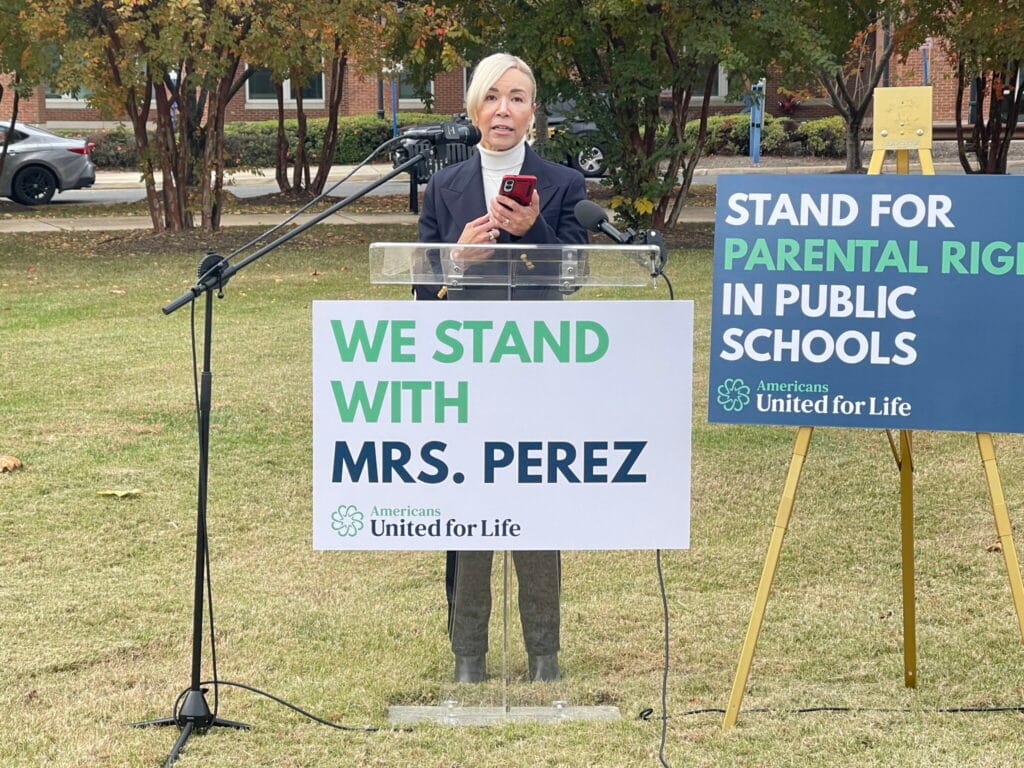
Fairfax County Public Schools Teacher Zenaida Perez, speaking to supporters and reporters after filing a suit against the school division on Oct. 29, 2025. (Photo by Nathaniel Cline/Virginia Mercury) By Charlotte Rene Woods
Virginia MercuryA legal challenge alleging that a Fairfax County Public Schools employee helped minors get abortions without their parents’ consent is now in federal court in a case that hinges on a First Amendment free speech claim.
FCPS teacher Zenaida Perez, plaintiff in the case, is seeking to prove that school officials have defamed her and are in violation of the Virginia Whistleblower Protection Law. Perez alleged in 2025 that another FCPS staff member assisted minors with seeking abortions. FCPS’ internal probe refuted her claims.
A public statement from superintendent Michelle Reid claimed that Perez’ allegations are “based largely on statements that were misinterpreted, mistranslated, taken out of context, or in some cases knowingly fabricated.”
A Virginia State Police investigation, launched late last summer by the order of former Gov. Glenn Youngkin, remains active as of January 2026. The school system has also submitted materials to members of Congress for a federal inquiry.
She said, they said
Ahead of Virginia’s gubernatorial and House of Delegates elections last fall, Perez accused a fellow school staff member of assisting students in obtaining abortions and the matter quickly became a Republican political talking point.
Virginia law allows minors to get abortions only if their parents or guardians agree to it or a minor successfully petitions a court. Such petitions are also exempt from the Freedom of Information Act, so it’s unclear how the students Perez purported to have gotten abortions would have obtained them.
While the public airing of the allegation and subsequent lawsuit came to light in recent months, Perez had first tried to report matters to Centreville High School administration in 2021 and 2022, the lawsuit revealed.
In August 2025, conservative blog WC Dispatch published the allegations and a note allegedly written by a student who’d been assisted in getting an abortion.
“I was afraid my family would react poorly if they knew about my pregnancy so I sought the abortion,” the note, translated from Spanish, reads in the court filing.
A previous internal review by FCPS indicated similarities between the handwriting in the student’s letter and Perez’ own; she then admitted that she was the one who actually wrote it.
“(The student) didn’t write it, she was absolutely not well with the writing — she cannot write in English or in Spanish — and she told me she ‘only had 15 minutes for my break,’” Perez said in an Americans United For Life webinar late last year. Perez added she had written the letter based on the student’s dictation while the student was working at a restaurant in Chantilly.
Attorneys from Americans United For Life, the anti-abortion group that hosted the webinar, are representing Perez in her case.
“AUL has filed an amended complaint on behalf of Mrs. Perez, and we are expecting a renewed motion to dismiss the case from Fairfax County’s lawyers,” AUL spokesman Gavin Oxley said Friday.
Perez’ petition to court
Perez’s suit claims CHS officials retaliated against her through disciplinary memos, reprimands and a suspension. Her medical provider gave her medication for depression and anxiety, the suit stated.
The filing noted the school officials’ alleged retaliation has a “lifelong impact” on Perez emotionally, and added that the defendants’ claims will “be a stain on her record forever and these allegations may resurface for any teaching position that she may seek in the future.”
The school system remains steadfast in refuting Perez’s claims.
FCPS’ own review uncovered “no credible evidence” supporting Perez’s allegations. This was relayed in materials the school system sent to the U.S. Senate committee on Health, Education, Labor and Pensions.
The supplemental statement read that FCPS “remains open to receiving and reviewing any new, pertinent information that may become available” but concluded that further investigation isn’t necessary at this time.
The statement also accusedPerez of withholding additional evidence when the Centreville High principal initially looked into the alleged student abortions Perez reported to him in 2022.
“While she has claimed to possess evidence of serious criminal wrongdoing occurring within the school and impacting students from vulnerable backgrounds, Mrs. Perez nonetheless waited nearly three years before surfacing the ‘evidence’ she had privately collected, choosing to do so through a sensational social media story she collaborated in producing, which contained numerous unfounded allegations,” the statement read.
Perez, whose case was filed in the U.S. District Court for the Eastern District of Virginia in the Alexandria division, is seeking a trial by jury and to be awarded $2 million.
AUL spokesman Oxley told The Mercury that the organization and their client are “looking forward” to “prosecuting the case as far as necessary.”
Virginia Mercury reporter Nathaniel Cline contributed to this story.
Bill seeks to ban toxic ingredients used in beauty industry
File photo of shampoo by CNS By Stef Anderson
Capital News Service
RICHMOND, Va. — Virginia lawmakers want to remove toxic chemicals from cosmetics to better protect public health, something advocates say is also better for the environment.
Del. Karen Keys-Gamarra, D-Fairfax, introduced the Humane and Toxin-Free Cosmetics Act, or House Bill 122. The proposal updates the Virginia Consumer Protection Act to ban use of certain chemicals such as formaldehyde and methylene glycol, among others.
Formaldehyde is known to induce contact dermatitis, a form of eczema, according to the National Health Service. It is found in preservatives that release formaldehyde through activation by water. Shampoos and creams are a common carrier, according to the National Library of Medicine.
Formaldehyde, at high levels or prolonged exposure, is also considered a human carcinogen, according to the Food and Drug Administration.
Methylene glycol is a liquid form of formaldehyde found in hair smoothing products. When the hair smoothing solution is heated, formaldehyde is released into the air as a gas. Formaldehyde, when airborne, can cause irritation to the eyes, nose and lungs, according to the FDA.
Keys-Gamarra was inspired to introduce the measure because of a National Conference of State Legislatures training. The toxins have been a focus in bills introduced in other states. She noted concern regarding products for perms and lipstick.
“I know perms, lipsticks … we don’t even know what’s in there and there’s no real way to know unless you do a lot of research and that’s not what you’re doing when you go to CVS,” Keys-Gamarra said.
The chemicals have a human impact, according to Keys-Gamarra.
“I am aware, for example, with chemicals used for Black women and other women, there are chemicals in there that can cause cancer, that can cause other health problems and it’s treated as though it’s a cost of business,” Keys-Gamarra said.
Autumn Carter owns Red Salon Organics in Richmond. She was inspired to create an environmentally-friendly salon after being diagnosed with autoimmune issues. She researched potential causes of the autoimmune concerns and the environmental and bodily impacts of daily items she was around, according to Carter.
“I just started researching it in my own personal life and then I was like: ‘Well, wait a minute, what am I inhaling at work?’” Carter said. “What is going into my skin and being absorbed into my bloodstream?”
Carter decided that she wanted an environmentally-conscious salon that would also prioritize safety of her guests. The salon does not use any product with formaldehyde.
Carter hopes to see more regulation in cosmetics of any carcinogenic product that causes harm to people and the environment. Unlike Europe, the U.S. cosmetic and hair industry is not really FDA controlled, she said. She used Brazilian blowouts as an example and said a certain ventilation system is often needed to offset chemical exposure, but only a small number of salons have those in place.
“There’s no real regulation, or people kind of overseeing, to make sure that these things are safe for us to be inhaling and for us to have absorbed into our skin and our bloodstream,” Carter said.
The FDA does not require cosmetics and ingredients, besides color additives, to have FDA approval before going on the market. The products must follow laws and regulations regarding interstate commerce, according to the FDA. The Occupational Safety and Health Administration regulates workplace safety in regards to exposure to identified hazardous chemicals.
Carter works with a retired nurse practitioner, whose focus is women’s health, to determine the impact and use of products. There are some items that are completely unavoidable, but her decisions include the type and percentage used in a product and its impact on people and the environment.
Keys-Gamarra’s bill was assigned to the House Housing/Consumer Protection subcommittee, but has not been heard yet. Del. Rae Cousins, D-Richmond, introduced House Bill 864, a similar piece of legislation that also remains in the subcommittee.
Capital News Service is a program of Virginia Commonwealth University’s Robertson School of Communication. Students in the program provide state government coverage for a variety of media outlets in Virginia.
Gun policy debate returns in Virginia legislature
File photo of Gun Show by CNS By Nathan Edwards
Capital News ServiceRICHMOND, Va. — A bill that would regulate high-powered firearms has reported out of a House committee, with renewed debate over what it could mean for gun owners and public safety across the state.
House Bill 217 proposes changes to Virginia’s firearm laws that supporters say would help reduce gun violence and improve public safety. Opponents argue the measure could place new restrictions on lawful gun owners without addressing the root causes of violent crime.
The bill is one of several firearm-related proposals, including change of purchase age to 21, under consideration this session as lawmakers revisit an issue that has long divided the General Assembly along party lines.
If passed, the proposal would prohibit the manufacture, sale, import, purchase and transfer of many semi-automatic rifles, pistols and shotguns that meet its newly expanded definition of “assault firearms.” This definition is based on features such as pistol grips, threaded barrels, adjustable stocks and detachable magazines.
The bill exempts some people serving in the government or military, among others. A penalty would not apply to those who purchased the assault firearm before July 1.
Chief patron Del. Dan Helmer, D-Fairfax, said his support for the bill is informed by his military experience, and concerns about civilians having access to certain high-powered firearms.
“Our schools and our communities shouldn’t be war zones,” Helmer said. “Weapons similar to those I carried in Iraq and Afghanistan have no place in our streets, and this bill seeks to address that.”
Supporters also say the legislation would bring Virginia in line with policies adopted in other states and help close gaps in existing law.
During a gun violence prevention conference on Jan. 24, Del. Nadarius Clark, D-Suffolk, stressed the importance of stricter gun regulations, particularly as it pertains to young people in Virginia.
“Firearms are still the No. 1 cause of death for children, which means firearms are the No. 1 killer of the future of this country and the commonwealth,” Clark said. “My colleagues and I will continue to fight for policies and funds to keep our community safe from gun violence.”
The political outlook for HB 217 is favorable, but not necessarily guaranteed. Democrats currently hold majorities in both chambers of the General Assembly, a factor that improves the bill’s chances of advancing. Similar proposals previously introduced have failed, sometimes as a result of hesitation from Democrats, or the bills were vetoed by the former Republican governor.
Gun policy has been a recurring issue in Virginia politics, particularly in the years following high-profile incidents of gun violence and after Democrats gained their first governing trifecta in 2020. Democrats have pushed for tighter firearm regulations, while Republicans have framed the debate around constitutional rights and personal responsibility.
Senate Minority Leader Ryan McDougle, R-Hanover, criticized the proposed regulations, saying they could have unintended consequences for responsible gun owners.
“We’re going to keep Virginians safe. That’s how you address violent crime, is you take people that commit those acts and you make sure that they are not in a position to harm other people,” McDougle said. “Taking the Second Amendment rights away from individuals that legally possess guns does not make Virginia safer.”
Some state Republican lawmakers have, in the past, supported certain measures, but are mostly opposed to broadening the scope of gun regulation. McDougle sponsored Senate Bill 226 in 2008, a bill introduced after the Virginia Tech shooting that now requires firearm purchasers to disclose whether they have ever been involuntarily committed for mental health treatment as part of the background check process. It passed both chambers with unanimous support.
Advocacy groups on both sides of the issue are closely monitoring the bill’s progress. Gun rights groups have urged lawmakers to reject the measure, calling it an overreach. Gun safety organizations testified the proposal could help prevent mass shootings and save lives.
This is the fourth time Helmer has sponsored such legislation, and the last two were vetoed.
“Still today, Republicans are too beholden to the NRA to move forward with commonsense legislation that keeps Virginia safe,” Helmer said. “The door is open, the water is warm, and we’d love to have them stand with us in support of our communities.”
HB 217 advanced from the House Public Safety committee on Jan. 30, with a minor substitute to ensure compliance with the U.S. Nuclear Regulatory Commission, according to Helmer’s office. A similar measure in the Senate, sponsored by Sen. Saddam Azlan Salim, D-Fairfax, cleared committee but must next clear an appropriations committee before heading to the Senate floor.
Capital News Service is a program of Virginia Commonwealth University’s Robertson School of Communication. Students in the program provide state government coverage for a variety of media outlets in Virginia.
Fatal Crash in Fauquier County
Virginia State Police is investigating a fatal single vehicle crash that occurred yesterday (Feb.1, 2026) at approximately 2:30 a.m. on Route 17 in Fauquier County.
A 2019 Kia Forte was driving northbound on Route 17 near Dyes Lane when the Forte went off of the right side of the road and struck a tree.
The driver of the Forte, Kristin L. Gheen, 36, of Sumerduck, Va., died at the scene. Gheen was not wearing a seatbelt.
The crash remains under investigation.
Information from a release. Posted by Dan McDermott.
Voter mood poll shows broad support for policy changes
Voters line up outside the Simi Valley Public Library in Simi Valley, Calif., to cast ballots on the state’s congressional redistricting measure, Nov 4, 2025. Photo: Dave Mason / The Center Square By Shirleen Guerra | The Center Square
(The Center Square) – Virginians say they support a wide range of policy proposals under debate in Richmond, according to a new statewide poll.
The survey found broad support for proposals tied to wages, paid leave, marijuana sales, data center regulation and several potential constitutional amendments. The results come as Democrats hold majorities in both chambers of the General Assembly and control the governor’s office.
The poll was conducted by the Wason Center for Civic Leadership at Christopher Newport University. Sampling of 807 registered voters in the state was conducted Jan. 13-20 and has a +/-4.4% margin of error.
When asked about the direction of Virginia, 46% of voters said the state is headed in the right direction, while 35% said it is headed in the wrong direction. Another 10% said they were unsure.
Views of the country were more negative. Sixty-five percent of respondents said the United States is headed in the wrong direction.
Looking ahead to Gov. Abigail Spanberger’s term, 60% of voters said they feel optimistic, while 33% said they feel pessimistic.
Inflation and the cost of living ranked as the top issue facing the state, followed by political extremism or threats to democracy, health care and K–12 education.
Sixty percent supported allowing the retail sale of recreational marijuana. A majority also favored eliminating the 1% local option sales tax and replacing it with state funds.
Workplace policies drew broad backing. Seventy-eight percent of respondents supported increasing Virginia’s minimum wage to $15 an hour by 2028, and 80% favored requiring employers to provide paid sick leave.
Support was even higher for establishing a paid family and medical leave program providing up to 12 weeks of benefits for eligible workers.
Views were more mixed on Virginia’s right-to-work law. A majority supported keeping the law as it is, while voters were divided on proposals that would modify it.
Data center development also drew clear responses. Large majorities supported restrictions on locating facilities near parks or historic sites, along with requirements for site assessments, noise studies and energy sourcing standards.
The poll also measured support for constitutional amendments. Large majorities of voters supported guaranteeing reproductive rights in the state constitution and restoring voting rights to people confsupportvicted of felonies after they complete their prison sentences.
Opinions were narrower on redistricting. While most voters supported Virginia’s current commission-based system, just over half said they would support a temporary change allowing the General Assembly to redraw congressional districts mid-cycle.
On Tuesday, a judge ruled lawmakers failed to follow required procedures when advancing that proposal, blocking it from moving forward under the current timeline.
Respondents were 39% Democrats, 27% Republicans and 32% independent. The Wason Center bills itself as “unbiased, nonpartisan insight into the policy issues shaping the future of the commonwealth.”
Hanover County opposes proposed ICE facility
An ICE officer coordinates with officials during an enforcement operation in San Antonio on Feb. 5, 2025. Photo: U.S. Immigration and Customs Enforcement via Flickr / PDM 1.0 By Shirleen Guerra | The Center Square
(The Center Square) – County officials in Virginia say they oppose a federal plan to purchase a warehouse along Lakeridge Parkway for use as a U.S. Immigration and Customs Enforcement processing facility.
In Hanover County, land-use concerns, potential strain on county services and the loss of local tax revenue are being cited.
The issue stems from a Jan. 21 letter from the U.S. Department of Homeland Security notifying the county of ICE’s intent to purchase and rehabilitate a privately owned warehouse at 11525 Lakeridge Parkway in Ashland. County officials said the proposal was not initiated by Hanover County and that local leaders were not consulted during the site-selection process.
The letter outlines potential upgrades to support ICE operations, including interior modifications for holding and processing areas, office space, visitor areas and health care rooms. Exterior improvements could include fencing, lighting and security features.
Homeland Security said all construction and staging would occur on site.
Following a recent Board of Supervisors meeting, county officials released a formal statement opposing the proposed purchase.
Supervisors said the location is inconsistent with current surrounding uses and could place unplanned demands on county services, including public safety.
In the county’s statement, Board Chairman Sean Davis said the proposed use does not align with long-standing planning decisions.
“A DHS facility at this property on Lakeridge Parkway is not consistent with the established land use for this business, residential and commerce area,” Davis said.
County officials also pointed to the potential financial impact of the proposal. In their statement, supervisors said removing the property from the local tax rolls could cost the county at least $1 million a year, revenue the county said typically supports essential services delivered to residents.
The Board of Supervisors directed county staff and the county attorney to draft a formal response to Homeland Security outlining land-use policies and potential impacts. That response is due in mid-February.
County officials said that while the federal government is generally exempt from local zoning requirements, the board expects Homeland Security to reconsider the proposed purchase after reviewing the county’s submitted concerns.
Later Friday, the warehouse owner posted a brief statement on its website saying the transaction to sell the Ashland property would not proceed. County officials said they were aware of the statement and would share additional information if it becomes available.
Think you found a bear den? Leave it alone!
RICHMOND, VA – As temperatures fall and food sources become less abundant, many bears in Virginia will enter a winter den. Denning allows a bear to conserve energy when food resources are limited. Movements and denning behavior vary greatly across regions of the state depending on weather and available foods. With the abundant hard mast crop this fall, many bears likely stayed out a bit longer into the winter; but as food sources have become scarce most bears have found a cozy den to wait for spring green-up. It is critical even in the winter to remain Bearwise® around your home, workplace, or recreating to ensure that bears aren’t finding unnatural food sources and are thus following their natural rhythms of denning during the winter.
Black bears in Virginia will den in a variety of places including brush piles, trees (cavities within tree), rock outcroppings, ground nests, debris piles, and occasionally under porches or unsecured crawl spaces. Not all black bears den for the full winter season. Often, black bears that enter a winter den are females who will birth their cubs in the den or females with yearlings. Male black bears may den but generally do not stay in a den for the entire winter due to the lack of extreme cold weather and food availability across much of Virginia.
While many of us also slow down for the winter, there are still ample opportunities that take us afield in bear country. Whether enjoying a hike, cutting firewood, clearing brush, small game hunting, or doing other activities, you may inadvertently stumble upon a black bear den. A female black bear, particularly one who has cubs, will likely remain at the den unless they feel pressured to leave. Here are a few tips to avoid disturbing a bear den and what to do should a female leave her den.
TIPS TO AVOID A DEN
- Avoid hiking in dense brushy thickets or young cutover timber stands. If you must work in these areas, be mindful of brush piles, gullies with debris piles, or storm damage areas with thickets of limbs/root balls.
- Always maintain your dog on a leash to avoid a dog-bear encounter at a den site.
When burning a brush or debris pile on your property, look around the entire pile for signs of digging (fresh dirt, holes) or entry routes into the pile. - If you notice large, excavated holes or fresh trails into debris or brush piles listen closely for the sound of cubs from a distance of at least 30ft away. They often emit a high-pitched cry or “squall”.
- To prevent a bear from denning under an occupied dwelling, ensure that crawl spaces, mobile home underpinnings, and porches are closed and secured prior to Dec. 1 each year.
TIPS IF YOU FIND A DEN
- If you find a den on your property or while recreating, do not disturb it or approach the area. Leave the area, and if on public property, alert an employee of the location.
- If you inadvertently flush a female bear from a den, DO NOT approach the den. Take a GPS point of the location (or mark a nearby area with flagging) and leave the area immediately. If you have a dog with you, leash it and keep it maintained on a leash as you leave the area. Contact the Wildlife Helpline (1-855-571-9003) to report the den location.
- Most often when left alone the female will return to the den, although they may not return until night. Do not go back to the den area as additional disturbance may cause the bear to leave again and not return.
EXAMPLES OF DEN SITES IN VIRGINIA

Fallen trees and debris make great hiding spots! 
A hollow tree is a good denning spot. 
A hollow tree is a good denning spot. 
While this pile of trees, limbs, and other debris
left over from a storm may not look too “homey,” it
does the trick for a black bear and her cubs.
A room with a view! This bear chose a nice hollow spot in a tree, approximately 40ft in the air to snooze through the winter. Photo credit: Tom Davis, NPS. 
While not the ideal spot (according to the homeowner), bears can
even make their winter den under porches or unsecured crawl spaces!Information from a release. Posted by Dan McDermott.
Warren County Fire and Rescue honors Lt. Brian Foley on retirement after 35 years of service
Warren County Fire and Rescue Lieutenant and Deputy Emergency Manager Brian Foley is presented with his retirement badge by Fire Chief James Bonzano on his final day of service. Foley retires after 35 years in public safety, including six years serving Warren County. (Photo courtesy of Warren County Fire and Rescue) Warren County Fire and Rescue recognized Lieutenant and Deputy Emergency Manager Brian Foley on his retirement, marking the conclusion of a 35-year career dedicated to public safety.
Foley spent the final six years of his career serving the citizens of Warren County, where he played a key role in emergency management operations and provided leadership across the department. Colleagues credit Foley with steady guidance, institutional knowledge, and a deep commitment to preparedness and community safety.
To commemorate his final day of service, Fire Chief James Bonzano presented Foley with his retirement badge, a traditional symbol honoring a lifetime of service, sacrifice, and professionalism.
Fire and Rescue officials expressed gratitude for Foley’s contributions, noting his impact as both a leader and mentor within the department. As he transitions into retirement, Foley was wished continued health, relaxation, and fulfillment in the years ahead.
Edited by Dan McDermott.
Warren County Sheriff’s Office honors deputies and dispatchers for years of service
Members of the Warren County Sheriff’s Office pose following a service awards presentation during the Warren County Board of Supervisors meeting on January 27. Deputies and emergency communications staff were recognized for five and twenty years of service to the community. (Photo courtesy Warren County Sheriff’s Office) The Warren County Sheriff’s Office recognized several deputies and emergency communications staff for milestone service anniversaries during the Warren County Board of Supervisors meeting on January 27.
Sheriff’s Office leadership honored both sworn deputies and communications personnel, noting that careers in law enforcement and emergency communications demand long hours, professionalism under pressure, and a sustained commitment to public service.
Those recognized for five years of service include Deputy Omar Fuentes, Deputy Dominic Guizar, Communications Supervisor Jessica Atchison, Sgt. Kristin Hajduk, Lt. Calvin Clatterbuck, Lt. Terry Fritts, and Sgt. John Gregory and Deputy Aaron Dawson, who were not pictured.
Recognized for twenty years of service were Deputy Cindy Burke and retired Deputy Karenann Negron, who was also not pictured.
Officials thanked the honorees for their dedication, sacrifice, and professionalism, emphasizing that their service plays a direct role in keeping Warren County residents safe.
Edited by Dan McDermott.
Warren County Fire and Rescue honors Lt. George Lewis upon retirement after 50 years of service

Fire Chief James Bonzano (left) presents Lt. George Lewis with his retirement badge during Lewis’s final shift with Warren County Fire and Rescue. Lewis retires after 50 years of service in fire and EMS, including 15 years serving Warren County. (Photo courtesy Warren County Fire and Rescue) Warren County Fire and Rescue marked the retirement of Lt. George Lewis during his final shift Thursday evening, recognizing a career that spans an extraordinary 50 years in fire and emergency medical services.
During the shift, Fire Chief James Bonzano presented Lt. Lewis with his retirement badge, honoring a half-century of dedication to public safety. While Lewis spent the last 15 years serving the Warren County community, his career reflects decades of commitment, leadership, and service across the fire and EMS profession.
Colleagues described Lewis as a steady presence within the department and a mentor to generations of firefighters and emergency responders. His longevity and experience represent a rare milestone in the field.
Fire and Rescue officials thanked Lt. Lewis for his courage, professionalism, and lasting impact on the department, wishing him a well-earned retirement after a remarkable career.
Edited by Dan McDermott.