Virginia holds B grade as labor fight continues
(The Center Square) – Virginia received a B for its public-sector labor laws for the second straight report as lawmakers continue pushing to expand collective bargaining for government workers.
The Commonwealth Foundation’s fifth annual 50-State Labor Report gave Virginia the same grade it received in 2024, years after the Commonwealth dropped from an A+ as its collective bargaining laws changed.
The Pennsylvania-based free-market group grades states based on laws governing public-sector unions, generally giving higher marks to states with more restrictions on collective bargaining and union activity.
Virginia received an A+ in 2017 and 2019, fell to a C in 2022 and moved back to a B in 2024.
The biggest change came after lawmakers approved legislation in 2020 allowing counties, cities, towns and school boards to authorize collective bargaining. The law took effect in 2021 but left the decision to individual local governments rather than creating a statewide system.
Lawmakers tried to go further this year.
The General Assembly passed House Bill 1263 and Senate Bill 378, which would have created a statewide collective bargaining framework for public employees and established a Public Employee Relations Board.
Gov. Abigail Spanberger proposed amendments giving localities more flexibility in setting up bargaining and clarifying that agreements with budget implications would remain subject to approval by the governing bodies responsible for those budgets.
She later vetoed the legislation after lawmakers rejected her amendments.
The issue is already resurfacing.
Senate Majority Leader Scott Surovell, D-Fairfax, the chief patron of Senate Bill 378, used Labor Day to call for another push to extend collective bargaining rights to state and local public employees.
Virginia was one of 10 states to receive a B. The report gave seven states an A+, six an A, two a C, 15 a D, four a D- and six an F.
David Osborne, the foundation’s senior director of labor policy and author of the report, said “government unions are rebounding after the 2018 Janus decision.”
In Janus v. AFSCME, the U.S. Supreme Court ruled in 2018 that public employees who choose not to join a union cannot be required to pay agency fees to support collective bargaining. The court held that requiring those payments violated the First Amendment.
The Commonwealth Foundation says public-sector unions have increasingly turned to state legislatures to rebuild membership and expand organizing rights since the decision.
Virginia still prohibits strikes by public employees and remains a right-to-work state.
The foundation lists repealing Virginia’s local-option collective bargaining law and establishing a public employees’ bill of rights among what it calls reform opportunities for the Commonwealth.
This post was originally published on The Center Square.
Andrea Fletcher tapped to lead Virginia’s government technology overhaul
Virginia is creating a team of technology specialists to improve state websites and computer systems while guarding against costly technology contracts and wasted taxpayer dollars.
Gov. Abigail Spanberger on Tuesday named Andrea Fletcher director of the new Virginia Digital Service, which will bring together engineers, designers and other technical experts to modernize state government operations and make public services easier to use.
The team will also review how Virginia buys and uses technology, with an eye toward identifying problems before the state commits taxpayer money to poorly designed systems or contracts.
“State government should work for the people it serves — and that means making sure Virginians can access the services they need quickly, easily, and reliably,” Spanberger said in a statement.
Spanberger proposed establishing the Digital Service through an amendment to Virginia’s biennial budget after her administration said it discovered the state had lost $52 million on a failed IT project under former Gov. Glenn Youngkin’s administration.
The project involved a two-year effort by the Virginia Department of Social Services to modernize APECS, the state’s decades-old child support enforcement computer system. The department had hired CGI Technologies and Solutions for the project, known as vCHAMPS, but abandoned the overhaul after what an internal report described as “significant issues.”
Under Fletcher’s leadership, the team will work with agencies across state government computer systems, improve websites and speed up delivery of programs used by Virginia families, according to the governor’s office.
“We also have a responsibility to make sure every taxpayer dollar is used as effectively and efficiently as possible,” Spanberger said. “At a time of unprecedented uncertainty and disruption out of Washington, Virginia can — and should — be a model of how we make smart, sound investments in technology.”
Fletcher previously served as the first chief digital officer at the federal Centers for Medicare and Medicaid Services, where she led the agency’s Digital Service team. She also established what the governor’s office called the federal government’s first Open Source Program Office.
She began her tenure with the federal government through the U.S. Digital Service in 2021 after working in federal healthcare information technology policy, artificial intelligence governance and global health systems. Her work included projects in more than 20 countries and support for digital health systems responding to COVID-19, Ebola and HIV.
Fletcher received a Service to the Citizen Award in 2025 and was nominated in 2024 for the Samuel J. Heyman award for emerging government leaders.
“Virginians should have an expectation that government services be intuitive and easy to use,” Fletcher said in a statement. “I’m excited to help deliver on that goal for the people of the Commonwealth and demonstrate that government can build great technology.”
David Wilkinson, Virginia’s chief transformation officer, said residents should be able to navigate state systems easily whether they are applying for a driver’s license, opening a business or seeking essential services.
“In launching the Virginia Digital Service, the governor is bringing a proven approach to Virginia,” Wilkinson said. “Andrea Fletcher is a nationally respected digital leader with a track record of delivering results that save time and money.”
Originally from western Pennsylvania’s Appalachian region, Fletcher earned a bachelor’s degree from Washington & Jefferson College and a master’s degree in public health from Emory University. She lives in Alexandria with her husband and daughter.
One of the new team’s early assignments will be helping state agencies respond to federal funding and eligibility changes under H.R. 1, the tax and spending reconciliation bill Congress passed last summer at the behest of President Donald Trump.
The administration said the Digital Service will support efforts to maintain access to healthcare coverage and Supplemental Nutrition Access Program.
The move follows a separate legislative effort to modernize Virginia’s benefits system. House Bill 66, sponsored by Del. Michael Feggans, D-Virginia Beach, would have directed the departments of Social Services and Medical Assistance Services to develop a plan for updating technology used to administer federal medical and other benefit programs. The measure was continued to the 2027 session.
Last month, Spanberger launched the “Keep Virginia Covered” policy directing executive agencies as they implement the federal law and seek to limit its effect on Virginians.
Virginia is not the first state to create a government-run technology team. Similar programs elsewhere have been used to review contracts, simply applications for public benefits and rebuild government websites.
In Colorado, the state’s digital team helped negotiate a grant-management system covering 17 programs and more than $60 million in annual grants before money was committed to the system.
Pennsylvania used its team to haul over the process for appealing denied insurance claims, replacing what Spanberger’s administration described as a confusing form with a simpler system.
Meanwhile, Maryland consolidated applications for Medicaid, SNAP, Temporary Assistance for Needy Families, the Special Supplemental Assistance Program for Women, Infants and Children, and energy assistance into a single process. More than 220,000 applications were completed through the new system in six months, according to the state’s Gov. Wes Moore.
Maryland also redesigned its unemployment insurance website around a five-step process for claimants. The changes reduced the number of pages on the site by 40% and increased its completion rate by 15%.
This post was originally published on Virginia Mercury.
Sturtevant presses Spanberger for data center pause
(The Center Square) – Pressure is building on Gov. Abigail Spanberger to support a statewide pause on new data center approvals as Virginia continues debating the industry’s effects on the electric grid, water resources and utility costs.
Virginia Sen. Glen Sturtevant, R-Chesterfield, released a 30-second campaign ad Tuesday renewing his call for a moratorium.
“I’ve called on Governor Spanberger to issue a moratorium on all new data center approvals across Virginia,” Sturtevant says in the ad.
He says data centers are “straining Virginia’s power grid, using millions of gallons of water, raising families’ electric bills while big tech lays off thousands of Americans.”
The ad contrasts the noise of a data center with a quiet Virginia landscape before closing with the message, “That’s Virginia, and it’s worth protecting.”
Spanberger has not supported a statewide moratorium and has instead pointed to measures aimed at making data centers bear more of the costs associated with their growth.
Virginia regulators have moved to require large-load customers, including data centers, to bear more of the transmission costs tied directly to serving them. The State Corporation Commission has approved a framework intended to make large-load customers fund direct-connect transmission facilities built specifically to serve them.
Virginia also began imposing a new electricity consumption tax on data centers July 1. The tax is set at $0.011 per kilowatt-hour, or 1.1 cents, through June 2028.
The debate has increasingly played out at the local level.
Several Virginia localities have considered pauses, moratoriums or tighter restrictions on new data center projects as residents and officials weigh concerns over noise, land use, power demand and water consumption.
Sturtevant argues those local decisions do not fully address the broader effects of continued expansion.
“The consequences do not stop at county lines,” he said in a statement accompanying the ad. “A local zoning vote cannot answer what continued expansion means for Virginia’s power supply, water resources and electric bills.”
He is calling for new approvals to be paused while Virginia determines whether additional projects should be permitted and under what conditions.
“Governor Spanberger should hit pause before Virginia makes more commitments,” Sturtevant said.
This post was originally published on The Center Square.
‘Priceless to me’: Valley Link transmission line threatens generational farm in Orange County

Michael Carter Jr. stands on his family’s 116-year-old farmland in Orange County, Va. One of the proposed routes of the Valley Link transmission line will encroach on the property, Carter says. (Photo by Shannon Heckt/Virginia Mercury)
“It started November 5th, 1910. My great-great-grandparents purchased this property for $722.50,” Michael Carter Jr. said at a picnic table outside the Orange County home where generations of his family have been born and died.

Michael Carter Jr. walks through a pasture on his family’s farmland in Orange County, Va. (Photo by Shannon Heckt/Virginia Mercury) As insects chirp in the grass and cows mull around the pasture, Carter points to the tree line at the back of the property, on the other side of the creek that separates the property from his neighbor’s. That is where a portion of the proposed 115-mile, 765 kilovolt Valley Link transmission line will slice through, if state regulators approve the project.
While the final route preferred by the company is yet to be determined, all three of the current iterations of the route all converge on this spot bordering Carter’s family’s land. The line will send surges of power to Northern Virginia, where most of the state’s data centers are clustered.
“This was considered to be kind of the black and poor side of town.”
Carter has used the land for farming for years, specializing in growing organic African crops.
“This was considered to be kind of the Black and poor side of town,” he said of the historic acreage.
He has taught courses on these farming techniques at multiple Virginia universities and recently became a consultant to help others make their farms financially viable.
The Valley Link line line, which is a joint venture between Dominion and two other companies, will stretch from Lynchburg to Culpeper County to bring more power to Northern Virginia where the demand is greatest – largely due to the world’s largest concentration of data centers being housed there.
The line would be the biggest transmission project in Dominion’s territory. But Carter said it would infringe on land that is immeasurably valuable to his family and community.
“You know, births, deaths, joys, and pains have all been experienced here, and you’re trying to rob me of that because you want to provide more electricity to the data centers,” Carter said.
The project was identified by the regional grid operator PJM, which manages the power grid for 13 states and D.C., as crucial to maintain grid reliability. Valley Link will be able to carry 6.6 gigawatts of power from Joshua Falls in Campbell County to a new substation in Culpeper.
Depending on which route makes the final cut, the transmission line could cut through nine counties: Campbell, Appomattox, Buckingham, Fluvanna, Louisa, Orange, Goochland, Spotsylvania and Culpeper.
Carter had been planning a major farm expansion to create a nature-based health resort and rural retreat for city dwellers and had purchased nearby property to facilitate that vision when he first got word of the planned transmission line. Now, the future of his dream is uncertain.
“It’s beyond frustrating. It’s disheartening,” Carter said. “We’ve been fighting for this land for the last 116 years. I’m the fifth generation (and) now I have to continue to fight to just maintain peace of mind.”
Transmission lines are built within a wide berth of the trees, which would mean that the trees lining Carter’s homesite would likely have to be cut down. He also worries the creek would be damaged during construction.
Carter is extremely concerned about how exposure to the Electromagnetic Field (EMF) from the lines could impact human health. Research on potential links between EMF exposure and certain cancers is inconclusive, according to the National Cancer Institute. Carter said it’s still too risky.
“I’m old enough to remember the class action lawsuits related to asbestos. It was 100% safe and then, 20 years later, ‘have you or your family ever been exposed to asbestos?’” I love my health too much … to put my grandchildren in jeopardy of harm because (they) wanted to make sure that (they) can build another 700 to a 1,000 data centers in Virginia,” he said.

A view of proposed transmission lines in relation to Carter Farms. (Map courtesy Valley Link Transmission Line project) Valley Link’s developers said they are studying the EMF impacts and are aiming to design lines that reduce EMF exposure.
The concern is so great that Carter has discouraged his children from continuing the farm if the transmission lines are built near the property.
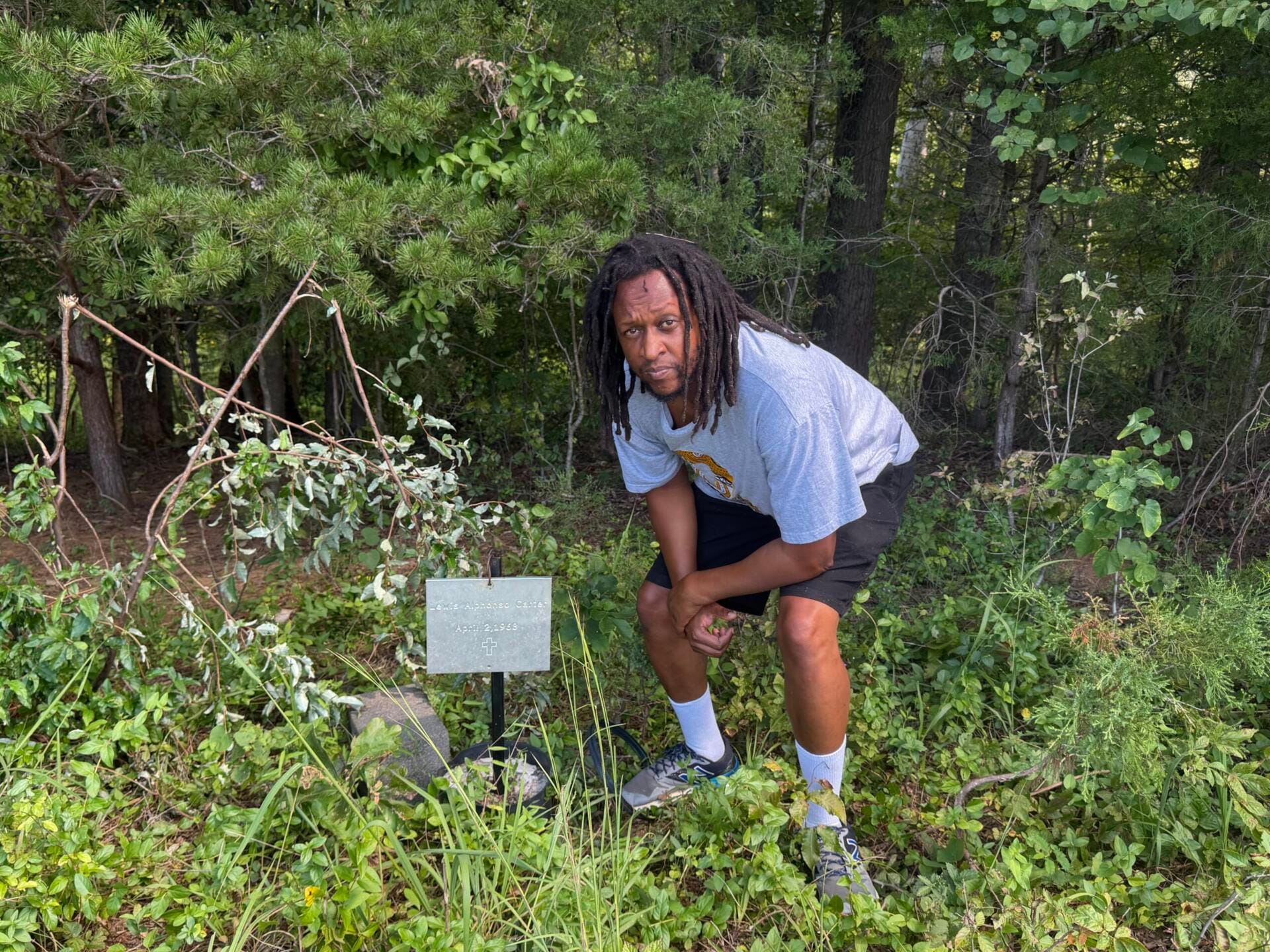
He said he is willing to walk away from the land his ancestor acquired over a century ago, where a marker nestled in trees still marks the place where an uncle died in a farming accident — and where Carter envisioned generations of his family would continue to live and work.

Michael Carter Jr. stands next to the marker where his great-uncle, Lewis Carter, died in a farming accident. (Photo by Shannon Heckt/Virginia Mercury) “How do we get back to the indigenous understanding of making a decision for seven generations? We’re constantly making decisions for seven figures, and it’s costing us our lives,” Carter said. “It’s costing us our future because we’re not looking at seven generations. Our future is not in our children anymore. It’s money.”
Photos hanging inside the ancestral home of Michael Carter Jr., which he said will be severly impacted by the Valley Link Transmission project. (Photo by Shannon Heckt/Virginia Mercury) Before she was governor, Abigail Spanberger visited the farm during her time in Congress, a nod to the role the property plays in Virginia history. U.S. Sen. Tim Kaine, D-Va., has also visited the historic house that Carter had slowly been turning into a museum.
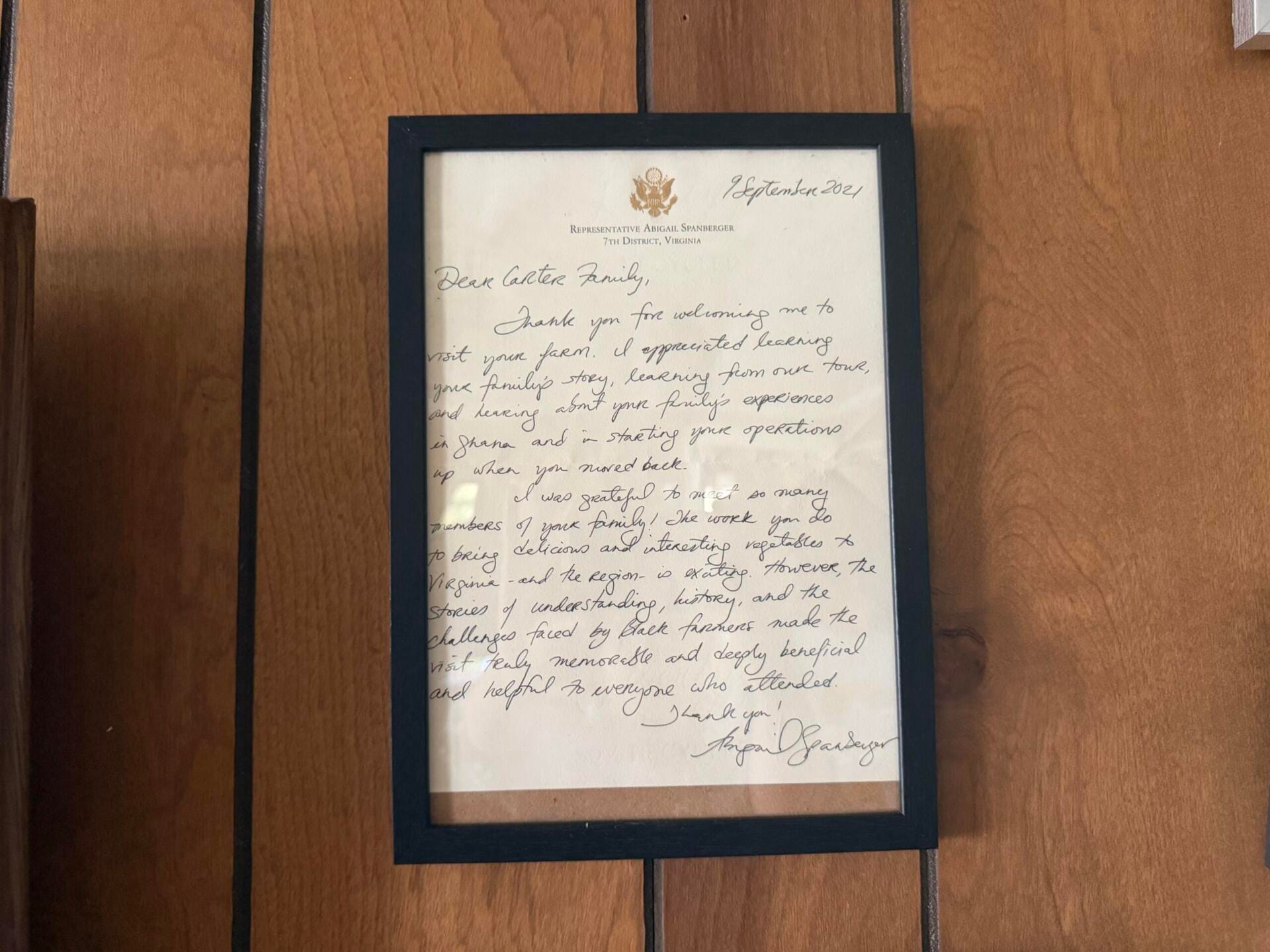
Inside, a commemorative letter by Spanberger hangs on the walls next to pictures of his grandmother, an aunt’s diploma and news clippings that show the evolution of a Black Virginia family who dared to chase the American dream in the nadir of the Jim Crow South.
A letter from then-Congresswoman Abigail Spanberger sent to Michael Carter Jr. in commemoration of his family’ Black farming legacy in 2021. (Photo by Shannon Heckt/Virginia Mercury) “I’m fighting for the legacy of my great-grandmother, for my great-great-grandparents, for all those who have sacrificed to make sure that we had this,” Carter said. ”I can’t, as much as I know I may have to walk away, I can’t walk away without a fight.”
Others are also opposing the power line, with grassroots efforts to reject the project mobilizing across the nine impacted counties.
The line’s developers are still determining their preferred route and back up options for the State Corporation Commission to consider. Virginians interested in learning more about the project may visit its website.
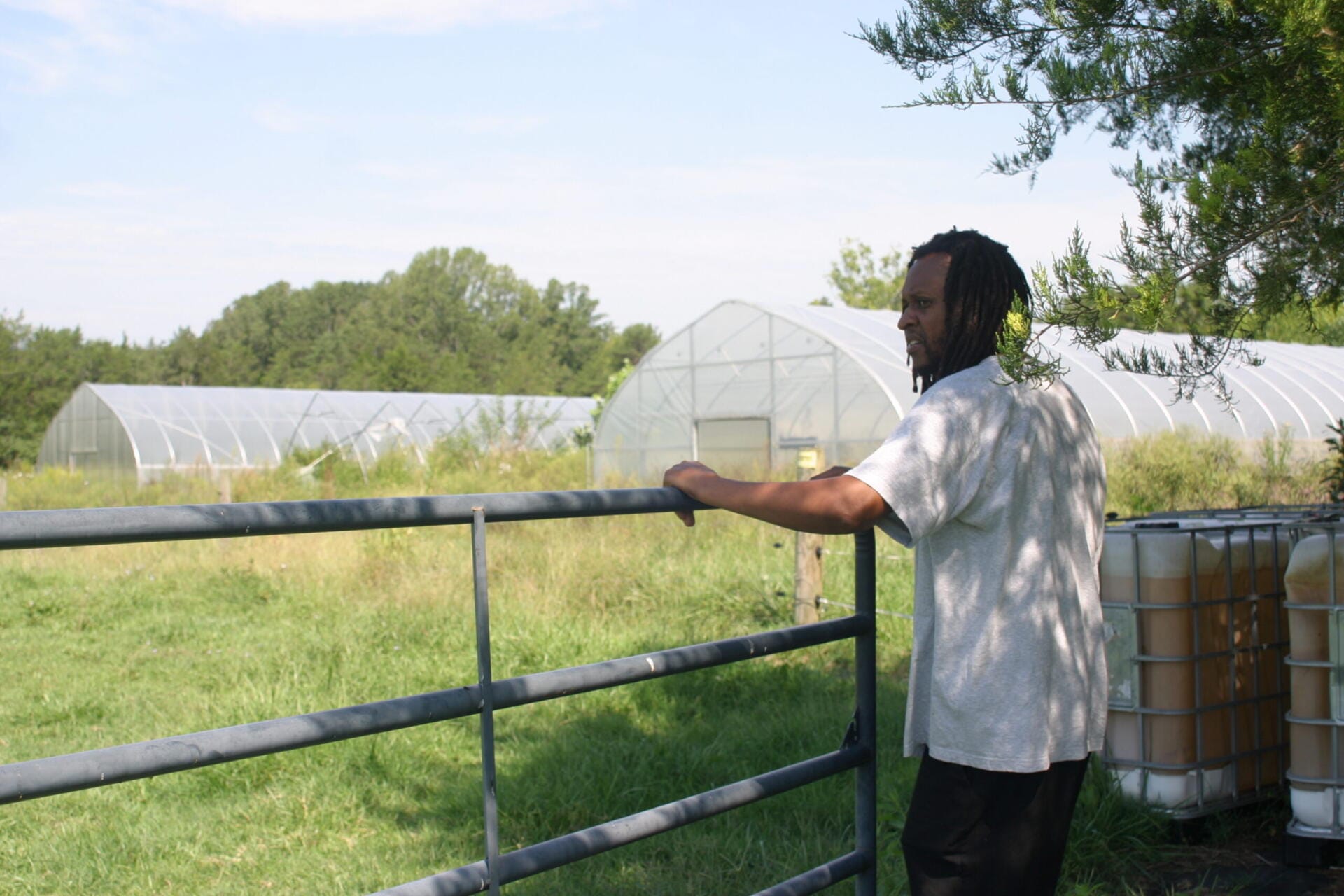
Michael Carter Jr. stands near greenhouses and water tanks on his historic farm in Orange County, Va. (Photo by Shannon Heckt/Virginia Mercury) This post was originally published on Virginia Mercury.
Nixing Black hero’s name from Va.-built aircraft carrier is offensive, affront to military members
It’s not just that the administration of President Donald Trump, who’s proved repeatedly that he’s racist, wants to remove the name of Pearl Harbor hero Doris “Dorie” Miller from an aircraft carrier under construction at Newport News Shipbuilding – and name it for Trump, according to a published report.
The USS Doris Miller would be the first carrier named for a Black person. No carrier has been named for a sitting president, CNN reported recently.
Nor is it that Trump dodged military service himself during Vietnam with repeated deferments. (He was like many other men from rich, influential families who avoided conscription.)
Let me make it plain: How could any congressperson or military official countenance such a special honor for Trump, who has called American troops who died in war “losers” and “suckers”?
During Trump’s first term, the service announced the Ford-class vessel would honor Miller. Sources told CNN that internal conversations have discussed renaming it for Trump. The carrier is scheduled to be delivered to the Navy in 2034.
It would be a stunning betrayal to celebrate a man who’s requested that wounded veterans be prevented from participating in military parades where he attended. Trump’s disdain for the sacrifice of military men and women is reprehensible – especially in a commander in chief.
A Pentagon spokesperson told me by email last week there was “nothing to announce” right now about the issue – but notably didn’t deny the CNN report.
This is a huge insult to Miller’s legacy, African-Americans and service members in general. Miller, from Waco, Texas, enlisted in the segregated Navy in 1939, when Black people were limited to support roles. He completed boot camp in Norfolk, and he then was assigned to the battleship USS West Virginia.
Miller was a mess attendant at the time of the Japanese attack on Pearl Harbor on Dec. 7, 1941, but he proved his skill and love of country – at a time when the country didn’t love Black people back.
During the onslaught that killed or wounded more than 3,500 Americans, Miller rescued wounded sailors. He also wielded an anti-aircraft gun – for which he had no training – and fired on enemy planes. It’s unclear whether he downed any, though Miller said he thought he hit one, according to Navy records. He earned the Navy Cross, the service’s second-highest honor.
Miller was killed in action in November 1943 when a Japanese submarine sank the Liscome Bay in the Pacific.
CNN reported the Navy is now referring to the new aircraft carrier internally only by its hull number, CVN-81.
From the Kennedy Center to the Great Lakes, Trump has become downright pathological about nomenclatures and edifices. His sycophants may care about the name changes, but many Americans see his campaign as childish.
The Navy could rename another warship after Miller, CNN reported, and recommend him for the Medal of Honor. It’s the highest decoration for military valor and, likely but for racism, was denied decades ago.
Miller deserves both honors – including his name on the carrier. A ceremony in January 2020 at Pearl Harbor announced the recognition.
“In selecting this name, we honor the contributions of all our enlisted ranks, past and present, men and women, of every race, religion and background,” said Thomas Modly, then-acting secretary of the Navy.
More than 70 Democrats in Congress, including several from Virginia, have urged the U.S. secretary of defense and acting secretary of the Navy to keep Miller’s name on the carrier.
“When he served, segregation restricted the roles available to Black sailors and servicemembers,” the Aug. 26 letter says. “Yet, when his country came under attack, Miller did not hesitate for one second to put himself in harms’ way to defend his fellow sailors and his nation.
“This story embodies the finest traditions of the United States Armed Forces.”
I asked Rep. Jen Kiggans, R-Virginia Beach, and a former Navy helicopter pilot, why she didn’t sign the letter. Her spokesperson didn’t respond to my emails. She’s in a tough campaign rematch against Elaine Luria.
Her decision to stay mute is craven.
That Trump is relegating someone who is African-American is no surprise. His racism toward people of color – and Black people in particular – is well-documented and decades old. Here are several examples:
- In 1973, the U.S. Justice Department sued Trump and his father for racial bias at Trump housing developments in New York. The case was eventually settled in which the Trumps promised not to discriminate. Testers for the New York City Human Rights Division said Black people who went to Trump buildings were told there were no apartments available, while white people were offered units.
- He ran newspaper ads calling for the return of the death penalty in New York state following the arrests of five Black and Latino boys dubbed the Central Park Five, at a time of heightened emotions in the city. They were charged in the 1989 rape and pummeling of a white woman. They were convicted and served prison time, but those convictions were later overturned after another man admitted the rape. Trump has never apologized to them.
- Trump led the lying, toxic birtherism claims that Barack Obama wasn’t born in the United States. Obama became the nation’s first Black president in 2009.
- Trump has fought diversity, equity and inclusion initiatives that have provided Black and Latino people with a foothold into education and employment. He has said little about the centuries of discrimination and enduring governmental structures that prohibited Black people from a level playing field.
- He put the brakes on efforts to place abolitionist and Underground Railroad conductor Harriet Tubman on the $20 bill.
- He repeated false, racist stereotypes that Haitian immigrants were eating dogs and cats in Ohio during the 2024 presidential campaign.
- In the wake of the Army helicopter-airline crash near Reagan Washington National Airport in January 2025 that killed 67 people, and with investigations just starting, Trump baselessly rushed to blame the collision on DEI policies to boost hiring of air traffic controllers. Nor did he acknowledge the crowded airspace around Reagan National and its shorter-than-average runways that have long been challenges for pilots.
Against this backdrop, the administration’s attempt to remove Doris Miller’s name should be seen for what it is: Racist. Usurping a real hero’s rightful honor. Sucking up to someone who denigrates military men and women.
Trump isn’t worthy of this recognition. Miller is.
This post was originally published on Virginia Mercury.
Beyer criticizes ‘Republican price tag’ ahead of November midterm elections
U.S. Rep. Don Beyer, D-Alexandria, joined a recent call with small business owners from around the country to discuss economic challenges Americans are facing due to rising healthcare, food and fuel costs, which he said are the result of President Donald Trump and congressional Republicans not meeting their promise to lower costs.
Beyer — one of the richest members of Congress — said everything he does is informed by his “small business background” that keeps him attuned to the public’s fiscal frustrations. He is seeking a seventh congressional term.
“I spent 46 years running the family car dealership,” Beyer said. “So fixing cars, selling cars, selling parts. You know, having an anxiety attack on the 10th of every month, wondering whether we made money, whether we lost money.”
How 8th Congressional District Democratic primary reflects party’s shifting identity and priorities
Unrig Our Economy, a left-leaning organization that advocates for economic reforms and policies such as “tax the rich,” organized the call. The group released a figure detailing the “Republican price tag,” the average extra amount Americans have paid for healthcare, groceries, utilities, clothing, gas and basic household expenses since Trump’s second term started.
Their original estimate was $3,500, but that number has since grown to $3,800. The report cites data from a report by Democrats in the Congressional Joint Economic Committee, of which Beyer is the senior House Democrat.
On the state level, Virginians have paid about $3,200 more for goods and services under the Trump Administration; about $686 on housing costs, $310 for groceries, $702 in gas and $107 for electricity, according to Democrats’ report.
New polling shared by the Democratically-aligned research group Navigator showed three out of four Americans view the economy negatively. Three out of five said they are feeling “uneasy about their personal financial situation over the next few months.”
Beyer, opponents weigh in on affordability struggles
Beyer has spoken this year about how people in and around his Northern Virginia district have suffered due to federal workforce cuts — an issue that defined the five-way primary election he overwhelmingly won in August.
Now, the longtime congressman is refining his message to focus on the extra costs for consumers on Republican’s watch.
The GOP’s passage of the “largest healthcare cut in American history” in their “big ugly bill,” Trump’s renewed reliance on global tariffs and his “illegal” war with Iran that has costed billions in defense spending and driven up gas prices are the root cause of the nation’s economic woes, Beyer said.
“Republicans have done almost nothing to lower prices,” Beyer said. “They have total control of government. They have the House, the Senate and the White House, and they’re using it to give Donald Trump his rubber stamp for everything he does to make the problem worse.”
Beyer is asking voters to elect Democrats to Congress, who are focused on lowering prices for the American people, his deputy chief of staff Aaron Fritschner stated in an email.
“Our leadership, including Congressman Beyer, have identified specific, substantive steps that they intend to take early in their majority, including repealing health care cuts from Republicans’ one big ugly bill, restoring trade authority to Congress and stopping President Trump’s destructive trade wars, and ending Trump’s illegal war with Iran,” Fritschner stated.
In the race to represent Virginia’s 8th Congressional District, which includes Arlington, Alexandria, Falls Church and parts of Fairfax, Beyer is facing three challengers.
Republican Tony Sabio is a “Reagan-style conservative” who served in the military, Secret Service and the CIA. Libertarian and “Fairfax warrior mom” Shelly Arnoldi and independent candidate Tim Sharman are also on the ballot.
Sabio has raised $21,917 according to the Virginia Public Access Project. Sharman has raised $25,000 and Arnoldi does not have any finances reported. Beyer’s fundraising dwarfs the competition’s, with over $2.1 million raised and $860,000 cash on hand as of July 1.
In a statement provided to the Mercury after Beyer’s press call, Sabio acknowledged the financial strains many are facing, but said “Northern Virginia families don’t need another Washington blame game.”
“These issues did not appear overnight. Families in Northern Virginia have been struggling with affordability for years, and I do not believe Congressman Beyer’s record has delivered enough improvement in the everyday lives of the people he serves,” Sabio stated.
Sabio said a more “strategic” use of tariffs could provide solutions, as well as expanding American nuclear energy efforts, creating home ownership incentives for essential workers and building out a private-sector jobs ecosystem in the region centered around technology and cybersecurity that is less dependent on Washington.
Sharman said the answer to beating rising costs is not “simply to tax and spend more.”
“We need greater efficiency, smarter regulation, an end to abusive corporate practices, higher wages, and economic growth that reaches more Americans,” Sharman stated.
Congress “cannot fix every price overnight,” Arnoldi stated, but can stop driving costs up through reckless spending, bad energy policy, unnecessary wars, tariffs, taxes and red tape.”
“My approach is simple: peace, affordable energy, lower taxes, less regulation, less spending and no hidden taxes on the things Virginians need every day,” she stated.
Election Day on the horizon
Having cleared his primary hurdles, Beyer appears to be in a strong position heading into the midterms in his Northern Virginia district, a Democratic stronghold. He has not won a general election by less than 70% since 2014.
Beyer — a major fundraiser for his party — has acted to shore up other Democratic races down ballot and in other congressional districts. He said he’s also looped in with candidates in swing districts across the country.
He also maxed out his donations to Virginia’s 1st Congressional District Democratic nominee Shannon Taylor, 2nd District nominee Elaine Luria, 5th District nominee Tom Perriello and 6th District nominee Beth Macy.
Early voting in Virginia starts on Sept. 18. The deadline to register to vote or apply for a mail-in ballot is Oct. 23. Election Day is Nov. 3.
This post was originally published on Virginia Mercury.
Virginia Lt. Gov. Hashmi to host Richmond energy costs listening tour, more headlines
• “Virginia Lt. Gov. Hashmi to host Richmond energy costs listening tour: ‘It’s my top-line concern.’” — WTVR
• “Virginia health leaders track uptick in rabies cases.” — WWBT
• “Amending Virginia: Virginians may change the voter rights restoration process for felons.” — VPM News
• “Virginia’s clerks of court are elected to be record keepers, among hundreds of other jobs.” — WHRO
• “See how Virginia players stand on NFL depth charts before season openers.” — The Virginian-Pilot
This post was originally published on Virginia Mercury.
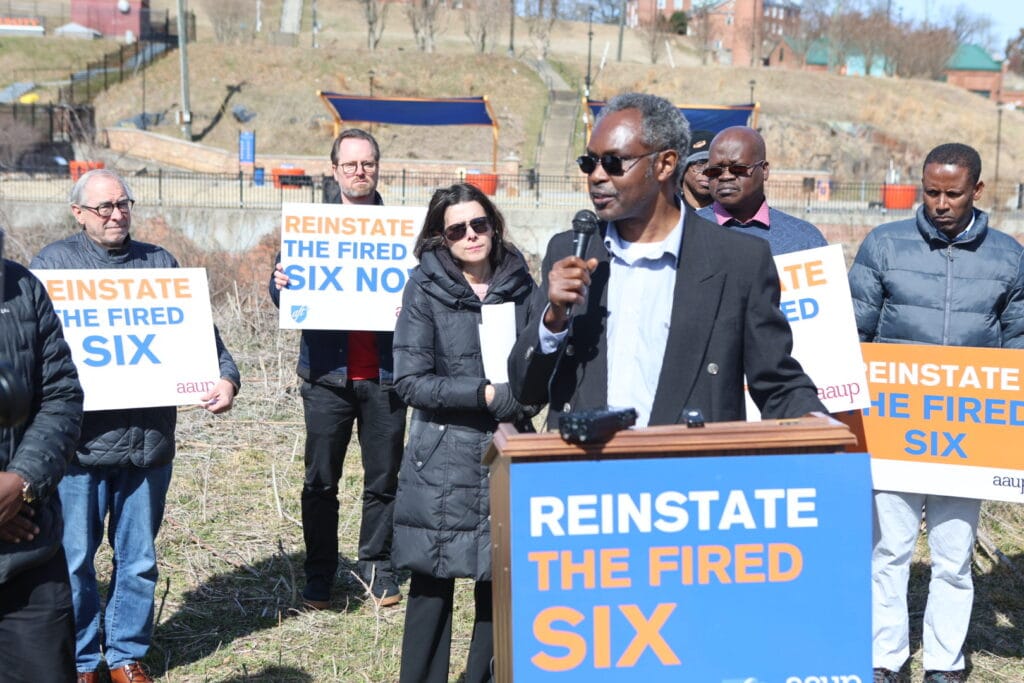
Fired Virginia State University professors file civil rights complaint with AG’s office
The Virginia State University Board of Visitors will meet on Friday, roughly a week after the legal team representing six professors fired late last year filed discrimination complaints against the university with the Virginia Attorney General’s Office of Civil Rights.
Faculty leaders have recommended the instructors, dubbed The Fired Six, be reinstated and cited policy violations in the “reorganization” process that led to their terminations.
Virginia State University faces questions after firing six agriculture research experts
VSU’s firing of the Agricultural Research Station faculty members drew heavy criticism and prompted questions about how the institution could remove tenured faculty members from their offices.
In May, a VSU Faculty Senate subcommittee found that the terminations, carried out by deans and human resource managers, violated the university’s termination authority policy, making them unauthorized and illegitimate.
The policy states that only officials at the vice presidential level or higher have the legal authority to dismiss staff and notify them of their release.
The committee has since determined that the university should restore the professors’ jobs and pay them lost wages.
VSU did not respond to questions about the findings or if it would act on the subcommittee’s recommendation.
Vitalis Temu, one of the fired professors, said VSU’s Board of Visitors, which is responsible for formally discussing and approving any major academic restructuring of university departments, had yet to respond to or take up the findings or recommendations made by his former colleagues, nearly four months after they were published.
“This is a shame for the university,” said Temu.
The controversial VSU dismissals followed federal government changes to agricultural research funding, policy priorities, and USDA operations..
In 2000, VSU was also the subject of another investigation involving the treatment of faculty members by the American Association of University Professors (AAUP).
Following that investigation, AAUP concluded the university violated academic due process and principles of tenure in dismissing two professors when it improperly changed and applied post-tenure review procedures, and placed the burden on the professors to prove they should be retained.
The school also failed to provide the faculty participation and procedural protections required for dismissal of tenured faculty, the AAUP probe found.
Background on the firings
The six faculty members were cut from VSU starting Dec. 16, after being called into individual meetings to discuss the research station’s transformational efforts.
Instead, at the meeting they learned their research programs were being sunset and their jobs were ending immediately.
The former professors said they declined to sign severance agreements at the meeting, largely because they didn’t have sufficient opportunity to review the documents. They said university personnel warned them they would lose any severance if they refused.

Vitalis Temu, an agricultural research expert, speaking to reporters outside of Virginia State University, which fired him and several faculty members from the institution’s agricultural research station on Feb. 24, 2026. (Photo by Nathaniel Cline/Virginia Mercury) When they refused to sign, they were escorted off campus, required to surrender all items belonging to the university like equipment, identification and keys, and issued trespass warnings.
In February, following a rally for the fired faculty members, a university spokeswoman said VSU made “programmatic adjustments” in the College of Agriculture to align research and operations with the university’s strategic goals.
She said personnel matters are confidential and that the institution does not comment on individual employment actions.
More details of the Faculty Senate subcommittee’s findings
In addition to determining that the deans and HR staff who notified the professors of their terminations weren’t qualified to do so, the school’s Faculty Senate developed several recommendations for recourse and future action.
The group’s subcommittee recommended that the institution issue a formal apology, provide financial compensation if the institution cannot return overdue pay, and engage in a conversation with the faculty members to discuss the situation.
Joshua Erlich, the attorney representing the fired faculty members, said his clients are proud to have been vindicated by the faculty committee.
“VSU used this false reorganization as a pretext to terminate respected members of the VSU academic community, marching them out without time to pack up their offices, say farewell to their colleagues, or transition their research,” Elrich said.
“VSU’s conduct was illegal, destructive, and disrespectful. The Fired Six greatly appreciate this first step towards vindication and look forward to being made whole by VSU, whether through settlement or in court.”
This post was originally published on Virginia Mercury.
Trump administration asks Supreme Court to allow Postal Service vote-by-mail rule
A U.S. Postal Service rule restricting mail-in voting, like the executive order from President Donald Trump that spurred it, is unconstitutional, U.S. District Judge Indira Talwani said in a Friday order extending a freeze on the policy.
The Trump administration quickly appealed the order to the 1st U.S. Circuit Court of Appeals on Friday.
Then Sunday, the administration also asked the U.S. Supreme Court to overturn the preliminary injunction, saying Talwani rushed it without considering the actual text of its final rule.
“The district court’s continuing prejudgment of the rule is baseless, and an immediate stay is warranted,” U.S. Solicitor General D. John Sauer wrote in a Sunday application to the court.
Sauer described the rule as containing “only modest envelope-design and addressee-information requirements for federal-election ballots sent via U.S. Mail.” He added that USPS had long recommended the design requirements it was seeking to codify in the rule.
The Supreme Court will consider the application on its emergency docket. Justice Ketanji Brown Jackson on Sunday asked the states and voting rights groups challenging the rule to file their response to the application by Wednesday. It’s unclear when a ruling would come.
Friday injunction
Talwani, who was appointed by President Barack Obama, issued a preliminary injunction late Friday, 60 days before Election Day, blocking the U.S. Postal Service rule from going into effect while court challenges play out. The injunction converts a 14-day pause she ordered a week prior.
The Massachusetts federal judge voiced several serious concerns about the policy, including that it infringes on states’ constitutional power to administer elections and Congress’ power to legislate election policy.
The rule, which the Postal Service published last month based on a Trump executive order in March, would disenfranchise voters who depend on mail voting, give states the impossible task of overhauling their election systems ahead of a fast-approaching election and assert power the agency does not have under the U.S. Constitution, Talwani said.
Not an election regulation, USPS says
The administration and a handful of GOP state attorneys general have defended the rule as regulating mail, not elections.
A statement from U.S. Postmaster General David Steiner restated the claim earlier Friday.
The portions of the rule establishing technical standards for ballot envelopes were based on longstanding best practices and were not “breaking new and uncharted ground,” Steiner wrote.
Similarly, a more controversial provision requiring states to send the Postal Service a list of eligible voters was also not complicated for the agency, he said, noting that USPS would not amend the lists.
“The USPS does not edit, change, review or question the contents of the list—the list is merely a list of voters that a State says are receiving a ballot through the mail,” he wrote. “So basically, the State provided list is a manifest identifying the recipients of ballot mail.”
Clash with law passed by Congress
Talwani said Friday the federal government’s denial that the rule is an election regulation “rings hollow.”
“Throughout its body of election legislation, Congress has never delegated its Elections Clause power to the USPS,” she wrote. “Unauthorized by the Elections Clause, the Final Rule clashes with Congress’s statutory scheme, and is unconstitutional where it intrudes not only on Congress’s Elections Clause powers but also that power left to the States.”
In addition to the constitutional principles the rule violates, it is unworkable ahead of the Nov. 3 midterm elections that will determine control of Congress, she said.
All states allow some form of mail-in voting. The first ballots were sent Friday, with North Carolina starting to mail ballots to certain voters.
Sauer noted that ballots had begun to “enter the mailstream,” with more states set to send ballots in the coming weeks.
That added urgency for justices to act, he said. If courts eventually allow the rule to take effect and states have not taken action to comply, it could threaten voters’ ability to cast mail ballots in those states, he said.
“There is a grave risk that States may not have taken the necessary steps to comply, due to the false sense of latitude created by the court’s improper injunction, potentially depriving those States’ citizens of the ability to vote by mail,” he wrote.
In a statement, Massachusetts Attorney General Andrea Joy Campbell, one of the Democratic attorneys general who sued to block the rule, said Talwani’s order would keep the commonwealth’s election administration on track.
“This order protects our ability to effectively deliver mail ballots to all residents relying on them to make their voices heard in the November election,” she said. “Voters should continue to vote-by-mail as usual and know that this system is safe and secure.”
This post was originally published on Virginia Mercury.
25 years after 9/11: Arlington marks 25 years since Pentagon attack
(The Center Square) – Twenty-five years after the terrorist attacks on the Pentagon, the Twin Towers and in rural Pennsylvania, Arlington is preparing to bring together more than 200 first responders as the county looks back at a response that quickly grew across Northern Virginia and continues to shape emergency preparedness today.
Many of the first responders expected at Arlington’s Sept. 11 ceremony were part of the response in 2001, when American Airlines Flight 77 struck the Pentagon.
“September 11, 2001, changed Arlington County and the Arlington County Fire Department forever,” the department told The Center Square in a statement. “Twenty-five years later, we continue to remember the 184 people who lost their lives at the Pentagon, the nearly 3,000 victims of the attacks, and the families, friends and communities forever changed by that day.”
A total of 184 people were killed at the Pentagon and aboard Flight 77, while 2,996 people, including the terrorists, were killed overall in the attacks that day.
Arlington firefighters, police officers and other public safety personnel responded within minutes of the attack.
What began as a rescue operation developed into extended firefighting, search and recovery efforts and a regional emergency response involving agencies from across Northern Virginia and the Washington D.C. area.
The Fire Department said Arlington personnel worked alongside the Arlington County Police Department, Metropolitan Washington Airports Authority, Fort Myer, Alexandria, Fairfax County, the District of Columbia and numerous other agencies.
“The response demonstrated the importance of relationships, training, unified command and regional cooperation,” the department told The Center Square. “Those partnerships allowed us to work together during an unprecedented event, despite the tremendous uncertainty and challenges at the scene.”
Arlington’s response was later recognized nationally as a model for managing a large-scale emergency, according to the department.
Those lessons did not end with the response at the Pentagon.
“The lessons learned from that day have influenced how we train, prepare, communicate and respond to major incidents,” the department said. “We are better prepared today because of the experiences and sacrifices of those who came before us.”
The department also pointed to the lasting toll on those who responded.
“The consequences of the work performed at the Pentagon did not end when the fire was extinguished or the recovery operation concluded,” the department said. “Many first responders have faced serious health consequences in the years since, reminding us that the impact of Sept. 11 continues to be felt a quarter-century later.”
U.S. Sen. Barbara Favola, D-Arlington, who served on the Arlington County Board at the time of the attacks, said the response also extended into the surrounding community.
Favola told The Center Square there was an outpouring of residents volunteering to help first responders with first aid, warm food, errands and other needs.
She said Arlington residents took pride in the firefighters who quickly arrived at the Pentagon and recalled two images that remained especially significant to her: the placement of an American flag on the damaged Pentagon and the community coming together afterward.
Del. Patrick Hope, D-Arlington, said the anniversary also comes as a generation of Americans has grown up without a living memory of the attacks.
“The attack on the Pentagon happened right here on Virginia soil, and as we approach 25 years, an entire generation of Americans has grown up with no living memory of Sept. 11th,” Hope told The Center Square.
Hope pointed to the planned Pentagon Memorial Visitor Education Center as one way that history will be carried forward.
Virginia’s current budget provides $1 million to Arlington County to support construction of the center, which is planned near the National 9/11 Pentagon Memorial.
Arlington’s 25th anniversary ceremony is scheduled for 11 a.m. Friday, Sept. 11, at Fire Station 5.
More than 200 first responders are expected, including many who responded to the Pentagon. Retired Arlington Deputy County Manager Jim Schwartz, who served as incident commander during the Pentagon response, is scheduled to participate along with Arlington Fire Chief David Povlitz, Police Chief Andy Penn and elected officials.
The ceremony will include remarks, a wreath laying and a rose-laying ceremony at a steel beam from the World Trade Center displayed outside the station.
For Arlington firefighters, the anniversary is both remembrance and preparation for what comes next.
“We will never forget September 11, 2001,” the department told The Center Square, “and we will continue to carry its lessons forward for the generations of firefighters and first responders who follow.”
This post was originally published on The Center Square.
The energy Virginia needs is the energy we can build now
Virginia’s energy needs are changing quickly, and to address them we must respond even quicker. Data centers, new manufacturing, population growth and other economic development are driving electricity demand higher, putting additional pressure on an already strained grid.
At the same time, Virginia imports more power than any other state in the nation, and Dominion Energy anticipates 23% of our electricity supply to come from out of state in 2027. Relying on other states’ wholesale electricity prices, instead of allowing Virginia utilities and regulators to set rates by Virginians for Virginians, is costing ratepayers.
If we want to keep our economy growing, attract new investment and maintain reliable electricity for families and businesses, we need to produce more of the energy we use here at home, and we need to do it quickly.
This is becoming more than an energy policy question, but rather an economic development question.
Companies considering Virginia for business need confidence that the electricity will be available and affordable when they need it. Communities need reliable power to support existing businesses and attract new ones, and families need an electric grid that can keep pace with growing demand without placing unnecessary upward pressure on their bills.
If Virginia cannot provide enough electricity to support growth, we risk limiting the very economic opportunities that have made the commonwealth an attractive place to live and do business.
Ensuring reliability statewide is one reason we are seeing more rapid solar development.
A recent “Speed-to-Deploy” fact sheet from the Solar Energy Industries Association illustrates how quickly different energy resources can move from early-stage development to operation. Utility-scale solar takes an average of about 1.4 years to reach operation, while battery storage takes about 1.7 years.
By comparison, a natural gas combustion turbine takes a little over two and a half years, a natural gas combined-cycle plant requires about four years and nuclear projects can take more than 15 years.
Natural gas timelines, however, could be much longer due to various parts backlogs, with some manufacturers claiming it could take five to seven years to manufacture a gas-powered turbine.
Those timelines matter. Virginia is not planning for an energy challenge that might arrive decades from now. Demand is increasing, and we need new generation that can come online within a reasonable timeframe, and frankly, we needed more energy yesterday.
Solar and battery storage give Virginia tools that can be deployed relatively quickly to help meet that growing demand. They can also be developed across a range of communities and project sizes, allowing localities to reap the economic benefits of new energy infrastructure.
That does not mean these resources should replace longer-term investments in baseload generation. It means Virginia should use the resources available to us based on what they can contribute, and when they can realistically come online.
Those aforementioned benefits extend beyond the electricity itself. Solar projects can provide new tax revenue for counties and local governments, create construction and maintenance jobs, support local businesses and provide landowners with a new source of income.
For rural communities in particular, responsible solar development can bring private investment to areas that may otherwise have limited opportunities for large-scale economic development, without adding strain to public services. When projects are properly sited and developed with community input, they can become another piece of a locality’s economic development strategy.
Solar can provide another avenue for private investment, while giving willing landowners an opportunity to generate income from their property and giving local governments a new source of tax revenue.
None of this means solar is the only answer to Virginia’s energy needs. We need a diverse energy portfolio that includes nuclear, solar, natural gas, battery storage and other resources, along with continued investment in transmission and the broader electric grid. Different technologies have different strengths, and reliability requires us to lean into all of them.
However, diversification of our grid should not mean overlooking the resources that can be deployed the quickest. If Virginia is serious about meeting rising electricity demand, strengthening our energy security and reducing our reliance on power imported from other states, we should use every responsible tool available to us.
The challenge before us is not simply finding more energy. It is creating enough energy, in the right places, and getting it online in time to meet the demand that is already here. On that front, solar and storage have a clear and important advantage.
We should be planning for the energy system we will need decades from now while also deploying resources that can help address demand in the next several years. The commonwealth should not have to choose between planning for 2040 and meeting the energy needs of 2028. We can and should do both.
This post was originally published on Virginia Mercury.
Labor unions are growing, but where depends on state politics
Labor union membership continues to climb in the United States, though the increase remains sharply divided by the politics of individual states.
Last year, the nation added more than 411,000 union members — the largest annual growth since 2008, according to a study published just ahead of the Labor Day holiday by the Illinois Economic Policy Institute and the Project for Middle Class Renewal at the University of Illinois at Urbana-Champaign.
At the end of last year, more than 14.6 million American workers belonged to a union — about 10% of the workforce, the study said.
While union membership grew across the country, the State of the Unions report found that states that have sought to protect or strengthen collective bargaining rights added three times as many union members as so-called right-to-work states, which prohibit mandatory union membership or dues as conditions of employment.
“What seems to be the number one driver is the state of the state,” said one of the study authors, Robert Bruno, who leads the labor education program at the University of Illinois at Urbana-Champaign. “If the policy is anti-union, it suppresses worker will. Where the law allows worker will to flourish, as I would argue it should, then you see higher numbers. So you can’t ignore politics. You can’t ignore policy.”
State governments are nearly evenly divided on labor policy, with 26 states having right-to-work laws. Union membership rates sit at about 14% in collective bargaining states and 5% in right-to-work states, the study found.
The study shows that workers in collective bargaining states earn significantly more than those in other states. After adjusting for cost of living variances, the report calculated average hourly earnings of $34.16 in right-to-work states and $37.24 in collective bargaining states.
Union density is nowhere close to its record high. In 1954, more than a third of American workers belonged to unions. Today, that rate is about 10%. And unions face major policy headwinds at the state and federal levels. In recent years, Southern states have passed new laws aimed at curbing union expansion. And President Donald Trump has sought to strip collective bargaining rights from more than 1 million federal workers.
Researchers said it’s unclear how federal actions will affect union membership figures. Many of the president’s moves are being litigated in courts and more federal workers have sought to unionize under this administration.
But public support for labor unions is growing among Republicans and Democrats, Gallup polling shows.
“More Americans are turning to unions as a bulwark against the rising cost of living, and more public sector workers turned towards unions last year in the wake of some federal actions and federal headwinds,” said State of the Unions coauthor Frank Manzo IV, an economist at the left-leaning Illinois Economic Policy Institute.
Conservatives have long argued that unions’ benefit on wage growth has been overstated by pro-labor interests.
In a 2025 review of 147 studies, researchers at the free-market think tank Mercatus Center concluded that powerful labor unions can lead to slower job growth and fewer jobs for unionized workers, reduce company investments in research and development, and increase the likelihood of company closures.
Researchers at the George Mason University think tank said the difference between the wages of unionized workers and nonunionized workers has declined in recent years and may even be negligible.
“When powerful and adversarial unions operate with government-granted monopoly privileges and press for unsustainable terms, it can backfire and result in lost jobs and fewer opportunities for workers,” that report said.
This year, state lawmakers passed dozens of bills seeking to boost worker protections across 19 states, according to tracking by State Futures, a nonprofit coordinating hundreds of Democratic lawmakers across the states.
Those measures included three bills aimed at expanding collective bargaining.
Illinois lawmakers granted rideshare and gig drivers the right to organize and to bargain collectively. Washington state extended collective bargaining rights to certain university student employees.
And Virginia lawmakers approved a measure to repeal the state’s longstanding ban on public-sector collective bargaining. That would have expanded the possibility of union membership to half a million public employees in the commonwealth. But Democratic Gov. Abigail Spanberger vetoed that measure in May.
The governor said she agreed with the goal of expanding collective bargaining rights. But she urged the legislature to adopt specific amendments, including delaying provisions of the bill until 2030 and shifting authority over how the system operates to a state board.
“While preserving the enrolled bill’s focus on allowing public employees to achieve collective bargaining, my amendments would have also provided additional flexibility for public employers to take into account existing local budget timelines and processes,” Spanberger wrote in her veto message. “However, the General Assembly rejected these amendments.”
Stateline reporter Kevin Hardy can be reached at [email protected].
This story was originally produced by Stateline, which is part of States Newsroom, a nonprofit news network which includes Virginia Mercury, and is supported by grants and a coalition of donors as a 501c(3) public charity.
This post was originally published on Virginia Mercury.
Amtrak to suspend Virginia-to-D.C. service for critical track upgrades Oct. 16–26
Rail passengers traveling through Virginia’s Northeast Corridor should expect cancellations, route changes and may need to rely on bus connections beginning Oct. 16, due to major track upgrades.
This is part of Amtrak’s “Pause for Progress,” a critical infrastructure upgrade to replace aging track components at the A-interlocking control point in Washington D.C., temporarily suspending service from Oct. 16 to Oct. 26.
Amtrak said the A-Interlocking in the First Street Tunnel is responsible for routing Amtrak and Virginia Railway Express services between Virginia stations and Washington D.C.
Amtrak said the existing switches and crossovers are “beyond their service life,” which requires a 10 mph speed restriction that affects operations.
“Customers traveling to or from Washington, D.C. from the south should expect significant service reductions and train cancellations,” Amtrak said in a statement.
Due to the suspension, trains traveling through Virginia will effectively end at Alexandria, with only a limited number continuing north. Most trips to Richmond, Charlottesville, Lynchburg and Hampton Roads will be served by express buses.
Once travelers are north of Washington, the Northeast Corridor trains continue normally on the Washington–New York–Boston segment.
Amtrak said the work will improve safety and reliability, reduce delays and meet future demand by replacing outdated switches, installing modern electric switch systems and repairing and strengthening the tunnel’s foundation.
Representatives from Virginia Railway Express and Virginia Passenger Rail Authority, in statements to the Mercury, acknowledged the disruption while underscoring the project’s importance to Virginia’s passenger rail network.
“VRE supports Amtrak’s work to upgrade A-Interlocking in the First Street Tunnel, and we applaud investments that keep our rail corridor in a state of good repair,” said Katie Choe, VRE CEO. “While some VRE passengers will need to adjust their travel plans during the week of October 19-23, these upgrades will ultimately allow us to run more reliable service and improve the passenger experience at Union Station.”
Mike McLaughlin, chief operating officer for the Virginia Passenger Railway Authority, said the agency has worked with Amtrak, CSX, Norfolk Southern, VRE and the North Carolina DOT to minimize the impact of the “Pause for Progress” construction on passengers.
“We understand that these infrastructure projects are a disruption to our passengers,” McLaughlin said.
Amtrak Virginia will offer some service to Alexandria, VRE will operate service to L’Enfant in Washington during the construction period, and the agency is coordinating additional connections with Amtrak, VRE and WMATA to help passengers affected by the disruption.
McLaughlin said replacing A-Interlocking is critical to Virginia’s passenger rail service because just over 40% of Amtrak Virginia passengers connect to Amtrak’s Northeast Corridor via the route.
Service resumes the morning of October 26. Click here for a list of the operational changes.
This post was originally published on Virginia Mercury.
US Supreme Court again urged to permit Trump vote-by-mail restrictions
The Trump administration asked the U.S. Supreme Court on Thursday to overturn a lower court and allow it to enforce a U.S. Postal Service rule restricting mail-in voting.
The trial judge, Indira Talwani of the U.S. District of Massachusetts, prejudged the rule before it was final when she issued a temporary restraining order last month and upheld it last week, U.S. Solicitor General D. John Sauer wrote. The rule only regulates standards of mail delivery and doesn’t interfere with election administration, Sauer argued.
“Contrary to the claims of the district court and respondents that the Postal Service is trying to federalize the rules for mail-in voting, the Postal Service’s final rule imposes only modest envelope-design and addressee-information requirements for federal-election ballots sent via U.S. Mail,” Sauer said.
Temporary restraining orders are not typically appealable, but Sauer argued that because of the impending midterm election, the court should hear the appeal. The rule carries out an executive order made earlier this year by President Donald Trump.
Election Day is two months from Thursday. One state, North Carolina, is expected to begin mailing ballots Friday.
Morning hearing
The government filed the application just hours after Talwani, whom former President Barack Obama appointed, heard oral arguments on whether to convert her two-week restraining order into a longer preliminary injunction to block the administration from applying the rule during the fast-approaching election.
Over months of litigation, Talwani has communicated disapproval of the rule and the government’s legal arguments and appeared skeptical of USPS’s position Thursday, according to reporters in the courtroom.
The rule would create new standards for the envelopes used to send ballots to people who vote by mail. It would also allow the federal government to verify voters receiving ballots are eligible.
Democratic state officials and voting rights groups say that is an unconstitutional violation of states’ role in administering elections and goes beyond anything Congress has authorized the agency to pursue.
In addition to constitutional concerns, the rule raises practical ones. Experts in election administration say mandating wholesale changes to mail-in voting this close to an election would cause chaos.
All states made arrangements to design, print and send mail ballots months ago. Changing those plans at this late stage would send them scrambling to update ballot envelope designs, have them approved by the USPS, printed in bulk and sent to voters — along with several other challenges, states have argued in court documents.
Multiple court decisions
The Trump administration has fought in court for weeks to allow the rule to go into effect before the midterms.
Administration officials appealed an earlier Talwani restraining order blocking enforcement of the rule. That appeal is currently before the 1st U.S. Circuit Court of Appeals.
The Supreme Court last month sided with the administration in a procedural ruling finding that the Democratic state officials and voting rights groups did not have the ability to challenge Trump’s executive order before USPS issued its final rule. The challengers quickly refiled suits to reflect that the rule had been published.
The U.S. Justice Department and a handful of Republican-led states, including Missouri and Texas, defended the rule in the Thursday morning hearing, saying that it was a mail regulation within the agency’s purview, and did not seek to administer elections.
Voting rights groups have argued the rule risks disenfranchising voters and solves no urgent problem.
Several phases of mail voting under the rule would put legitimate ballots at risk of rejection, they said, while the administration has shown no evidence that mail voting is particularly susceptible to fraud, as Trump repeatedly has claimed.
Portal problems
The buildout of an online tool the Postal Service plans to use to enforce the rule’s requirements for ballot designs and voter eligibility has also encountered problems, according to an explosive whistleblower report this week.
A USPS official provided a written declaration following Thursday’s hearing that the portal would be accessible to states that want to use it “sometime next week.”
The whistleblower account published Tuesday detailed many problems with the tool, which the whistleblower said should have been a yearlong project but was rushed out in months.
This post was originally published on Virginia Mercury.
Spanberger taps Daniel Young to lead government watchdog office
Gov. Abigail Spanberger has appointed Daniel Young, a former federal prosecutor whose cases included an $80 million defense procurement fraud scheme, as Virginia’s next state inspector general.
Young’s appointment is subject to confirmation by the General Assembly. The state inspector general serves a four-year term and oversees an office responsible for investigating alleged fraud, waste and abuse in Virginia government, conducting performance audits and reviewing state facilities and operations.
Most recently, Young served as an assistant general counsel at the Public Company Accounting Oversight Board, which Congress created after the collapse of Enron to protect investors and oversee audits of public companies.
His career also includes work at the U.S. Securities and Exchange Commission and more than five years as an assistant U.S. attorney in the Eastern District of Virginia, according to the governor’s office.
In announcing the appointment Friday, Spanberger highlighted Young’s experience prosecuting fraud and overseeing accountability.
“Mr. Young has a demonstrated record of prosecuting fraud, protecting taxpayers, and holding government accountable,” Spanberger said in a statement.
She also thanked former State Inspector General Mike Westfall, who was first appointed in 2018 by then-Gov. Terry McAuliffe, for his years of service and the office’s managers for sustaining the agency’s work during the search for a new permanent leader.
“The commonwealth must always work with a focus on serving the public and protecting taxpayer dollars,” Spanberger said.
Young said combating fraud and corruption has been a focus throughout his public service career.
“As a proud Virginian, I am honored to have been entrusted by Governor Spanberger with the responsibility of serving as the next state inspector general,” he said in a statement.
He also credited the inspector general’s staff for its work on government transparency and accountability.
“The dedicated public servants who work in the Office of the State Inspector General are committed to making government more transparent and more accountable for all Virginians, and it is a privilege to support their efforts,” Young said.
During his time as a federal prosecutor in Norfolk and Alexandria, Young focused on white-collar crime and appellate matters. Beyond the $80 million defense procurement fraud scheme, his major cases included a prosecution involving NASA contracting fraud.
Both prosecutions received awards recognizing excellence from the Council of Inspectors General on Integrity and Efficiency. Young also handled appeals in major cases involving national security, a gang-related murder and crimes against children.
At the SEC, Young defended enforcement actions involving fraud. He previously clerked for two federal judges after law school and worked as a litigator in private practice.
That work included an active pro bono docket, according to the governor’s office. Young handled voting rights litigation and represented victims of loan-modification scams following the 2008 financial crisis.
A Hampton Roads native and the son of a police officer, Young attended Princess Anne High School in Virginia Beach before graduating with honors from the University of Virginia, where he was a Jefferson Scholar.
After college, he received a Jack Kent Cooke Graduate Fellowship and was selected as a fellow at Harvard’s Center for Public Leadership. He later earned his law degree from Yale Law School and a master’s degree in public policy from Harvard Kennedy School.
Young lives in Reston with his wife and their two sons.
This post was originally published on Virginia Mercury.
Virginia overdose deaths drop as Chesapeake offers free Narcan training and more headlines
• “Former Virginia Rep. Elaine Luria says Hung Cao is ineligible for Navy secretary post after Trump nomination.” — 13newsnow
• “Virginia overdose deaths continue to drop as Chesapeake offers free Narcan training.” — WTKR
• “Virginia lawmakers call Petersburg’s Perry Street Lofts displacement disgraceful.” — WRIC
• “At least a dozen Virginia localities have pulled away from Flock Safety devices since July. Lynchburg could be next.” — Cardinal News
• “Labor Day preps underway at the Virginia Beach Oceanfront ahead of inaugural Super Girl Surf Festival.” — WAVY
This post was originally published on Virginia Mercury.
Trump doesn’t have the power to limit mail-in voting, lawmakers tell US Supreme Court
The hotly contested U.S. Postal Service rule restricting mail-in voting usurps Congress’ authority, as well as states’ power to administer elections, more than 250 current and former members of Congress said in a filing to the U.S. Supreme Court on Tuesday.
All 47 members of the U.S. Senate Democratic Caucus, 199 current House Democrats and 15 former House Republicans signed the friend-of-the-court brief opposing President Donald Trump’s policy to add several requirements to mail ballots.
The U.S. Constitution “is unambiguous” in empowering states to run elections, while Congress can enact laws to oversee elections generally, they argued.
“Congress has passed several laws regulating federal elections—though it has always done so surgically, deliberately leaving the States with considerable room to maneuver,” they wrote.
The executive branch has no role, they said.
The Trump administration has argued the rule, published last month, requires only “modest” technical specifications for mail ballots and that states transmit lists of eligible voters to receive the ballots. The rule is a targeted measure affecting mail delivery, not elections, the administration says.
But the lawmakers say that argument fails.
The agency cannot take action related to elections without a congressional directive, they wrote. Congress never wrote a law asking for the requirements included in the USPS rule, they said.
Executive order
In this case, Trump spurred the Postal Service to write the rule in a March executive order, based on the unsubstantiated premise that vote-by-mail is vulnerable to fraud.
That shows the rule is meant to address Trump’s concerns about election administration, not mail specifications, the lawmakers said.
“The integrity of our constitutional system depends on each branch keeping to its assigned role,” they wrote. “The Framers set up a two-part system that gave States default authority to regulate federal elections subject to Congress’s authority to override the States. The Framers did not provide the President with any authority to interfere in that system, nor has Congress imbued the Executive Branch with any such authority by statute.”
Spokespeople for the White House, USPS and the Department of Justice, which is representing the Trump administration in the case, did not immediately return messages seeking comment Tuesday.
In a separate brief, the legal advocacy group the Society for the Rule of Law made a similar argument, saying the federal postal law the administration has cited provides only broad language that does not empower the agency to regulate election mail.
“The non-election, boilerplate … provisions on which Applicants rely are not a secret, alternative way for the USPS to bar ballot mail, conditionally or otherwise, on the eve of election day,” the group wrote. “Under the federalism presumption and the major question doctrine, the USPS needed a clear statement of statutory authority.”
Rushed delivery
The rule would require technical elements such as unique barcodes on ballot envelopes. Elections experts say those requirements are unworkable in time for the fall’s midterm elections because states have already designed, printed and — in some cases — begun sending ballots.
The rule would also require states to send to the federal government lists of eligible voters, which would be checked against a Department of Homeland Security database to verify citizenship.
The rule bans the Postal Service from delivering ballots to registered voters who are not verified through that method.
The online portal that the rule says states should use for this process has still, less than two months until Election Day, not been introduced to states. A whistleblower last week reported the rushed development has led to myriad problems with the tool, which could result in legitimate ballots being rejected.
Opponents, including more than 20 Democratic state officials and voting rights groups that sued to challenge the rule, say it would risk disenfranchisement for the millions of voters, including Trump, who vote by mail.
High court ruling pending
The rule has been the subject of rapidfire legal fighting over the past several weeks, and the Supreme Court is now weighing whether to overturn a Massachusetts federal judge’s order pausing the rule while litigation continues, after the Trump administration filed an appeal over the weekend.
Justice Ketanji Brown Jackson on Sunday asked the states and voting rights groups challenging the rule to file their response to the application by Wednesday at 4 p.m. Eastern.
That district court injunction from Judge Indira Talwani, who was appointed by President Barack Obama, held that the rule was likely unconstitutional and unlawful for reasons the members of Congress articulated Tuesday: The Constitution grants states and Congress the power to oversee elections and states would be harmed if they are forced to comply with the regulation before courts can determine its legality.
This post was originally published on Virginia Mercury.
Trump’s trade war with Canada escalates as new tariffs launch
WASHINGTON — Canada’s retaliatory tariffs on American goods kicked in Tuesday, escalating a trade war with one of the largest U.S. trading partners that President Donald Trump continued to antagonize over the holiday weekend.
Trump posted an AI-generated cartoon image of himself Sunday evening in which he is depicted as a hockey player striking Canadian Prime Minister Mark Carney, who is shown down on the ice, with a hockey stick.
“Get up, governor,” a speech bubble from Trump’s mouth reads, apparently referring to Canada as a U.S. state rather than a sovereign country.
Nearly $28 billion in U.S. exports crossing the border to Canada now carry up to 50% tariffs, a dollar-for-dollar match on Trump’s taxes on Canadian goods imposed last month, according to Canadian officials.
Among the 629 categories of products Canada has targeted are key outputs from U.S. states with hotly contested races in the fast-approaching November midterm elections, including Maine’s paper and lumber industry, Michigan’s vehicle manufacturing and Wisconsin dairy production.
U.S. Sen. Susan Collins, a Maine Republican who’s in the midst of a tough reelection campaign, warned in late August roughly $170 million of her state’s goods will be impacted by the Canadian tariffs, with more than half of that coming from the forest product sector. Canada revised its tariff proposal Aug. 27 to exclude seafood, including Maine’s significant lobster industry.
5% of goods in question
The United States and Canada’s dueling tariffs represent roughly 5% of the two countries’ massive and intertwined trading partnership, which totaled $879.9 billion in goods in 2025, according to the U.S. Bureau of Economic Analysis.
But the escalation has been accompanied by Trump’s near constant trolling of the U.S. northern neighbor, including threats since his days on the 2024 campaign trail to annex Canada as the 51st state.
Over the Labor Day weekend, the president declared on his Truth Social platform “NO MORE SELLING BOMBARDIER IN THE UNITED STATES!”
“If they want our Market, they must build here, and stop treating America like a ‘piggybank.’ BUY AMERICAN. FLY ON AMERICAN AIRLINERS. ENJOY AMERICAN LIQUOR AND BEVERAGES. SAIL ON LAKE AMERICA. AMERICA FIRST!” Trump wrote, referencing his executive order Aug. 27 renaming Lake Ontario to Lake America.
The Canadian airline maker Bombardier has multiple manufacturing partners and facilities in the United States, including in Arizona, Florida, Indiana, Kansas and New Jersey, according to the company.
“Bombardier aircraft create tens of thousands of U.S. jobs through the company’s growing American footprint as well as within its supply chain made up of approximately 2,800 American companies across 47 states,” according to a Bombadier statement issued Monday.
“The company spends over $2.5 Billion with suppliers each year. This deeply integrated network and incredible growth stem from the company’s heritage in the business jet industry, dating back to the innovations of Learjet in Wichita, Kansas, and the first business jets to enter service,” the statement continued.
U.S. Sen. Jerry Moran said in a post on X Monday evening that he contacted Trump “to make certain the President is aware of the significant contributions of Bombardier to Kansas and the importance of its presence in Wichita to many Kansas workers at Bombardier and in the Bombardier supply chain.”
The company supports roughly 1,000 jobs in the state, according to the Kansas Republican.
Executive orders
Trade talks between the U.S. and Canada collapsed Aug. 21. In days prior Trump had said he would delay new tariffs on Canadian goods while negotiations continued.
Trump signed three executive orders for new tariffs on Canada in late July using a Depression-era law that has never been enforced.
Section 338 of the Tariff Act of 1930 authorizes the president to impose duties up to 50% of a product’s value in response to discrimination against U.S. commerce.
This post was originally published on Virginia Mercury.
Restitution delivered for Virginia families in 6-year housing discrimination case
Damien and Angela Smith and their friends Amanda and Michael Mills said Wednesday they feel a sense of relief at the conclusion of their years-long housing discrimination case. Each couple has received nearly $420,000 in restitution, Virginia Attorney General Jay Jones announced this week
The families had retreated to a Smith Mountain Lake property in 2020, where they faced harassment and racially derogatory comments by owner Regina Smith.
After a jury sided with the families in their case last year, Smith owed the families nearly $800,000. Smith’s 18-acre waterfront property has since been sold, facilitating the payments.
The awards come after Turner failed to comply with multiple court orders and refused to pay damages following last year’s verdict. The Office of the Attorney General then initiated a special auction to sell her property and collect the court-ordered damages. Turner was also sentenced to 30 days in jail.
Looking back on how the case began, Damien Smith, a Black man, said he’d been in the car when his white wife and their friends toured the site. Turner didn’t notice him.
“I told Angie ‘I’ll give it a try, but typically, you know, Black people in campgrounds in the South don’t mix,’” he explained. “I don’t think if (Turner) had seen me that night she would have let the sale go through.”
Amanda Mills said after the sale, Turner called her and expressed frustration at learning of Damien Smith’s race. She said wouldn’t have approved of the couples on her campground if she’d known, Mills recounted.
Though Turner had initially seen the Smiths’ mixed-race son, she relayed to Amanda Mills that she’d assumed he was a “mistake from (Angie Smith’s) past.”
“No child of any nationality, any race, is a mistake,” Amanda Mills said. “For someone to truly feel that way, so deep in their heart, it just shows how much room for improvement there is in this world.”
Hampton Roads tenants describe landlord’s abuse, retaliation after landmark fair housing settlement
The families said Turner pressured them to leave and refused to return their rental fees or allow them to sell their campers on site.
“We ended up having to tear down decks and pull the camper out of there in order to get it sold for a much lesser value than what it was if it was on the water, and much less than what we paid for it,” Angela Smith explained.
Turner’s comment about the Smith’s son disturbed the couples deeply and spurred the Smiths to file a complaint with the Virginia Fair Housing Board.
Damien Smith was skeptical that it would yield justice but the case’s outcome represents the importance of “sticking to your guns,” he said.
It’s arduous to pursue legal remedy for these types of wrongs, Helen Hardiman, a lawyer in the Office of the Attorney General, noted, adding that the rigorous process sometimes deters people from taking action.
The Smiths and Mills had to make about a dozen court appearances over the years and continued to encounter Turner in that process.
“(They) had to disrupt their lives and place themselves back in what I would imagine is pretty emotionally frustrating space to be in the same room with a woman who had discriminated against them all those years ago,” Hardiman said.
The longrunning case, first undertaken by former Attorney General Mark Herring, continued by former Attorney General Jason Miyares, and now concluded through Jones, resulted in the state’s largest payout to individual complainants in the history of the state’s attorney general office and fair housing office.
“Justice was slow here — delayed but not denied,” Hardiman said.
This post was originally published on Virginia Mercury.
Advocacy group seeks answers in Dominion merger
(The Center Square) – A Virginia advocacy group is asking regulators to require Dominion Energy and NextEra Energy to provide additional information as the State Corporation Commission reviews their proposed merger.
Clean Virginia filed a motion to compel Tuesday, arguing the companies have not fully answered questions involving enforcement of merger conditions, competition, costs to customers and NextEra’s management history.
The group is asking the hearing examiner to overrule objections from the companies and require complete responses within 10 days.
The filing focuses in part on what would happen if Dominion or NextEra violated a condition imposed by the commission as part of an approval.
Clean Virginia asked what steps NextEra would have to take to divest Dominion if the commission determined a condition had been violated. It also asked what consequences the companies believe should follow.
Dominion and NextEra objected to those questions, arguing they were hypothetical and sought speculative responses or legal conclusions.
Clean Virginia also challenged the companies’ responses to questions involving competition for large electric customers.
One request asked whether Dominion’s tariffs and cost-allocation practices could give the utility an advantage over competitive retail suppliers or shift certain generation costs to other customers.
The companies objected that the questions were not relevant and sought legal conclusions.
The motion also seeks more information about NextEra’s past political activity through Florida Power & Light, its principal utility subsidiary.
Clean Virginia requested records related to an internal investigation discussed publicly by former NextEra Chairman James Robo in 2022 involving allegations about political consultants and Florida Power & Light.
The companies objected that the material was not relevant to the Virginia merger proceeding and also cited concerns involving privilege, ongoing litigation and the scope of the requests.
Clean Virginia argues the information is relevant to the qualifications and track record of the management that would take control of Virginia’s largest electric utility.
“For this deal to go through, the Commission must find with certainty that it will not impair or jeopardize adequate service at just and reasonable rates,” Clean Virginia Executive Director Brennan Gilmore said in a statement.
The SCC is reviewing NextEra’s proposed acquisition of control of Dominion Energy Virginia as part of the companies’ broader merger. Public comments are due Nov. 9, and the evidentiary hearing is scheduled to begin Nov. 17.
This post was originally published on The Center Square.
Consumer sentiment tumbles as Virginians feel pressure from inflation, new poll finds
Virginia consumer sentiment fell sharply in August, wiping out modest gains from earlier in the year as renewed inflation and a lackluster labor market weighed on household finances, according to a new Roanoke College poll released Thursday.
The Virginia Index of Consumer Sentiment fell to 59.6, down 7.8 points from February and 4.9 points from a year ago. The overall index and its two components — current conditions and consumer expectations — are now below their five-year average of 68.1.
“Virginia households are feeling the economy’s ups and downs much more in their day-to-day finances than in their outlook for the future,” said Alice Kassens, professor of economics and dean of Roanoke College’s School of Business, Economics, and Analytics.
“The drop in how households view current conditions reflects the toll that renewed inflation and a cooling labor market has taken on household budgets. Wage growth, which had been outpacing inflation for much of the past year, is nearly even, leaving consumers with little real income cushion.”
Virginians were particularly downbeat about their current circumstances. The Index of Current Conditions dropped 11 points to 53.7, the lowest level since the inflation spike of 2022 and 12 points below where it stood a year ago.
Expectations for the future held up somewhat better. The Index of Consumer Expectations fell 5.8 points to 63.5, essentially matching the lowest level in the survey’s 15-year history, last reached in March 2022. However, unlike the current conditions measure, the expectations index is largely unchanged from a year ago.
“Even so, Virginians’ expectations for the year ahead have held up comparatively well, and the commonwealth continues to outperform the nation on every measure of sentiment,” Kassens said.
The data suggests Virginia households tie the price pressures to “a specific, and potentially temporary, geopolitical shock,” not a lasting economic paradigm shift, she said.
“Whether that optimism holds will depend heavily on how inflation and the labor market evolve over the next two quarters.”
Despite the declines, Virginian’s sentiments exceeded national ones. The state’s current conditions index of 53.7 remained slightly above the national reading of 51.9.
Forty-two percent of respondents said their financial situation was worse than it was a year ago, while 51% said it was a bad time to purchase large, durable goods.
The gap was wider when Virginians were asked about the future. The state’s consumer expectations stood 12 points above the national reading of 51.5, the largest difference between Virginia and the rest of the country among the three sentiment measures.
Thirty-four percent of Virginians said they believed their household finances would improve over the next year, while 9% expected strong economic growth over the next five years. Concerns about gas and grocery prices appeared to weigh more heavily on views of the current economy than on longer-term expectations.
Those concerns come as the national economy continues to send mixed signals. Real gross domestic product rose at an estimated annualized rate of 1.5% during the second quarter of 2026, down from 2.1% in the first quarter. Consumer spending moved into the opposite direction, accelerating from an annualized rate of 0.5% to 3.4%.
Hiring also slowed over the summer. The national unemployment rate dipped to 4.1% in July, but the economy lost a net 23,000 jobs that month after adding just 20,000 in June. The ratio of job openings to unemployed workers increased modestly to 1.1 in July, suggesting labor demand had not collapsed even as hiring stalled.
At the same time, wage gains fell behind inflation. Average hourly wage growth slowed down from 3.7% in February to 3.2% in July, while inflation, as measured by the Consumer Price Index, rose from 2.4% to 3.3%.
Much of the renewed inflation was attributed to higher gas and energy prices stemming from the conflict in the Middle East.
Thursday’s survey, the only regular poll measuring consumer sentiment in Virginia, was conducted online from Aug. 4 through Aug. 7 using Qualtrics survey software. Participants were recruited through Prolific, an online research panel, and eligibility was limited to Virginia residents age 18 and over.
Researchers collected a total of 574 responses. After incomplete responses were removed, the weighted sample included 547 respondents.
This post was originally published on Virginia Mercury.
Wittman voted 60 times to undo the Affordable Care Act. Then he backed extending its subsidies.
In 2017, U.S. Rep. Rob Wittman, R-Westmoreland, touted voting to repeal and replace the Affordable Care Act 60 times. Nearly a decade later, he was one of just 17 Republicans nationwide to vote to extend expired ACA subsidies, before Congress ultimately let them lapse.
The expired subsidies have spurred 94,000 Virginians to drop their insurance so far and is the latest healthcare issue congressional candidates in Virginia and elsewhere must contend with on the campaign trail.
“Every House Republican in a competitive race is having to walk a tightrope on healthcare affordability,” said Erin Covey, a Cook Political Report analyst.
University of Virginia Professor Larry Sabato, who helms Sabato’s Crystal Ball, said that Wittman’s January ACA vote is “a recognition that his district is competitive enough that he can’t stick to (President Donald) Trump and GOP congressional positions 100% of the time.”
With polling indicating healthcare affordability and access among top concerns for voters this year, Democrats have seized on the issue as a potentially winning platform and pushed Republicans on the defensive.
Why Wittman broke from the pack and how it could impact the VA-01 race
While Wittman still doesn’t fully embrace the ACA, he said he voted to extend the subsidy primarily because of how it would impact his constituents in Virginia’s 1st Congressional District.
“I did not believe families should face dramatic increases in their health insurance costs without a transition,” Wittman said this week.
When asked if he would back future repeal efforts, he didn’t clarify, but shared broad health policy goals if re-elected.
“Going forward, I will continue working to make healthcare more affordable, accessible, and transparent by increasing competition, expanding patient choice, improving price transparency, and giving patients and families greater control over their healthcare decisions,” Wittman said.
Data shows 94,000 Virginians have dropped their ACA insurance since last year
Of the 16 other Republicans to side with Democrats on the recent ACA vote, only four of them were in the House for the 2017 repeal attempt.
Pennsylvania representative Brian Fitzpatrick and Ohio representative Dave Joyce voted against the repeal nearly 10 years ago, while California representative David Valadao joined Wittman in voting for it.
Valadao then lost his reelection bid in the 2018 midterms, when Democrats made big gains in both congressional chambers. Both healthcare and the economy were campaign-year focal points.
Covey attributes some of Valadao’s ousting to his repeal vote, while Wittman was in a safer seat at the time, and less vulnerable to pushback for it.
Though Virginia’s 1st District still has a Republican lean, it has grown more politically purple in recent years, so it’s unclear how voters there will judge his turnabout vote at the ballot box.
Wittman’s Democratic challenger, prosecutor Shannon Taylor, doesn’t think he should get too much praise for his shift in stance.
“Now, with an election around the corner and families facing higher premiums, he wants to try and change his tune,” she said. “We deserve a representative who will lower costs and expand care, not one who brags about their votes to rip it away.”
Recent KFF polling found that 55% of independent voters see healthcare costs as an important candidate discussion topic while courting their votes this year, while 60% of democrats say the same and 37% of republicans agree.
Democrats have hammered Republicans all year on their failure to renew the expired subsidies as well as their votes for H.R.1, the Trump-backed reconciliation bill that entails forthcoming changes to Medicaid.
About 300,000 Virginians are at risk of losing that health insurance next year while 5,800 lawful immigrants are guaranteed to lose it next month. The bill’s changes to hospital funding mechanisms may also contribute to potential closure or reduced services of rural hospitals and a predicted $31 billion reduction in the state’s Medicaid funding over the next decade.
As H.R. 1 was debated, Wittman — and incumbent U.S. Rep. Jen Kiggans, R-Virginia Beach, who is running in a competitive district — pushed back on aspects of the bill, before ultimately voting for it.
As a compromise, Congress also created the Rural Health Transformation Fund, a $50 billion investment for states over the next five years.
Republican National Committee spokeswoman Emma Hall said that Wittman and Kiggans had “put Virginians first and delivered a huge win for rural communities,” as $122 million in RHTF funding disbursements were announced last week.
Wittman has also backed the “Lower Health Care Premiums For All Americans Act,” which passed the House last December but has not yet become law. That bill would expand association health plans by allowing small businesses and self-employed people to band together to purchase insurance.
Health care fight intensifies as Congress weighs GOP-backed insurance changes
Some analysts describe it as a way to chip away at the ACA, but Wittman and others see it as a different pathway to help people access care.
“(Small companies) just can’t band together in large enough numbers to get the advantages of these larger plans,” Wittman said. “Anything that you buy in bulk or in mass quantities, you get a reduction in price. That’s what the idea is here.”
Since the passage of ACA, insurers have not been able to use a person’s health risk to determine the premiums they pay.
Wittman said that his issue with the current makeup of government-funded healthcare is that it is “a system based on reimbursement for treatment.”
Having healthier and less healthy people in the same insurance pools is meant to drive down costs broadly, Georgetown University researcher Sabrina Corlette said.
“We all get older and sicker,” she said. “(The Democrats’ approach) is recognizing that you might be subsidizing a sicker person today, but someone else will be subsidizing you down the road.”
As midterm elections draw nearer and candidate debates grow fiercer, campaign messaging to the public across party lines have honed in on affordability.
Voters are experiencing inflation in gas, groceries and healthcare costs made worse by Trump’s war with Iran and his directives to Congress like H.R. 1, which will likely be reflected in the way they vote this fall.
”It’s all connected,” Saboto said.
Though Wittman’s district “is not quite a tossup yet,” Sabato said, “if Shannon Taylor wins, it’s because this is such an anti-Trump year.”
This post was originally published on Virginia Mercury.
As sports betting surges, Virginia weighs how to curb gambling harms
As college football season gets into full swing over Labor Day weekend, sports betting companies, public health experts and Virginia lawmakers are confronting a question that has grown more pressing since wagering moved into smartphones: How can the industry keep gambling from becoming an addiction?
Representatives from those groups gathered Wednesday at the Hilton Richmond Downtown for a Responsible Gaming Roundtable hosted by the Sports Betting Alliance, an advocacy organization representing bet365, BetMGM, DraftKings, Fanatics and FanDuel — five of the nation’s largest online sports betting operators.
The discussion focused on tools that help customers control their betting, educating young people about gambling risks and connecting people with treatment when gambling stops being entertainment.
“Responsible gaming is not a regulatory obligation to us; it’s the foundation of a sustainable, durable legal market,” said Joe Maloney, president of Sports Betting Alliance and one of the roundtable’s moderators, along with state Sen. Mike Jones, D-Richmond. “Getting this right takes more than one company working on its own.”
The industry has expanded rapidly in the commonwealth since Virginia lawmakers legalized sports betting in 2020. The law took effect that July, and the first online wagers were accepted in January 2021. Lawmakers also authorized casinos in certain cities, subject to local voter approval.
Virginia now has five operating casinos and 11 approved sports betting permit holders. Casinos reported more than $102 million in adjusted gaming revenue in July 2026, while bettors wagered more than $589 million on sports in June, according to the Virginia Lottery.
Maloney said legal sports betting has generated more than $400 million in state tax revenue since its launch. But a regulated market, he argued, should be judged not only by the money it generates but by how well it protects customers.
Licensed operators verify betters’ ages and locations and allow customers to set limits on deposits and time spent gambling. Voluntary self-exclusion programs also let people block themselves from betting. Maloney said over half of online sports bettors use at least one responsible-gaming tool.
Technology offers both tools and new risks
Industry representatives said licensed online platforms can monitor betting patterns and intervene when someone’s behavior suggests a potential problem.
Cameron Zuckert, senior manager of responsible gaming partnerships and programs at FanDuel, said customers are encouraged to decide ahead of time how much they are willing to spend.
“We do a lot of work to drive awareness of not just what it means to play responsibly, but also the risks associated with problem gambling,” Zuckert said. “You don’t want to shy away from that topic. It’s a very real topic.”
Fanatics Betting and Gaming does not allow customers to wager on credit. Anthony D’Angelo, the company’s head of responsible gaming, said preventing harmful play is also in its business interest.
“We want a long-term, sustainable business, and we can’t do that if customers are on our platform playing irresponsibly, not getting the help they need and then never play again,” D’Angelo said.
Research shows the risk can be significant, particularly for younger bettors.
The National Council on Problem Gambling’s 2024 national survey found that 8% of American adults — nearly 20 million people — frequently experienced at least one indicator of problematic gambling. The rate was 17% among traditional sports bettors and 24% among fantasy sports players.
Adults ages 18 to 34 faced substantially greater risk than older Americans. Online gambling participation also rose from 15% of adults in 2018 to 22% in 2024.
Keith Whyte, founder and president of Safer Gambling Strategies, said risky gambling behavior increased during the COVID-19 pandemic alongside depression, loneliness, isolation and job loss.
The latest survey found overall indicators of problematic play had returned to 2018 levels, though Whyte cautioned that gambling expansion will always carry risks.
“You can’t expand gambling without risk, without additional casualties,” Whyte said.
He also argued that gambling education needs to reach children before advertising and celebrity endorsements begin shaping their views of betting.
“Everybody should have a conversation around gambling, especially with young people,” he said.
Adults should routinely use spending and time limits as well, Whyte added, “not because they think they have a problem, but because they want to prevent themselves from having a problem.”
Treatment and other expansion debate
Virginia has built a statewide network offering treatment, peer-recovery support, support groups and financial counseling, said Dr. Carolyn Hawley, director of the Virginia Partnership for Gaming and Health at Virginia Commonwealth University.
The program also trains treatment providers and conducts prevention work in schools and universities. Hawley said addressing gambling addiction requires coordination among the industry, government and public health system, particularly as betting companies collect more data that could help identify customers at risk.
But finding qualified clinicians remains a challenge, experts say.
“It’s one thing to have money for treatment,” Hawley said. “It’s another thing to have capacity — providers who know how to deliver that treatment.”
Virginia directs portions of sports betting and casino tax revenue to the Problem Gambling Treatment and Support Fund.
New Jersey, which legalized online casino gambling in 2013, requires operators to analyze customer data for warning signs. Platforms must contact customers whose activity shows certain markers of risky behavior, beginning with automated outreach and escalating to direct contact from responsible-gaming staff.
In Virginia, lawmakers considered another gambling expansion this year through Senate Bill 118 and House Bill 161, which would have allowed licensed casinos to offer online slots, blackjack and other games. Both chambers passed versions of the legislation but failed to resolve their differences before adjournment. The issue is expected to return in 2027.
Supporters of online betting argue that Virginians already gamble through offshore or sweepstake-style sites operating outside the state’s regulatory system. Maloney called the illegal market the most serious obstacle facing licensed operators, saying those sites offer no meaningful accountability, monitoring or statewide self-exclusion system.
Virginia Secretary of Finance Mark Sickles, a former lawmaker who has long been skeptical of gambling expansion, said tax revenue should not determine whether the state legalizes another form of gambling.
“I would not support legalizing or keeping it illegal based on revenues to the state,” Sickles told The Mercury Wednesday.
If Virginia does expand gambling, he said, lawmakers should ensure some proceeds support prevention and treatment. Sickles also endorsed including gambling in school lessons about addiction.
“I don’t think we will stop gambling by keeping it illegal,” Sickles said. “I think everyone needs to put on their work shoes and get out their pencils and figure out if there’s a way to make it happen — and everybody’s satisfied with it, and it has consumer protections in the law.”
This post was originally published on Virginia Mercury.
Cumberland county residents split on proposed gas plant, slated to be second largest in the nation
Cumberland County residents meet Aug. 31, 2026 to discuss the proposed Dominion Cumberland Energy Center. (Photo by Shannon Heckt/Virginia Mercury)
In a crowded school cafeteria in Cumberland Monday evening, residents of the rural county gathered to hear Dominion Energy representatives detail the gas plant the utility is pitching to the local leaders and state regulators.
The Cumberland Energy Center will be able to generate three gigawatts of power, making it the second largest gas plant in the nation if it is approved.
The gas plant is part of Dominion’s proposed fleet of energy generation projects to meet the increased demand for power, which is expected to more than double by 2045. If approved, the plant would take about ten years to come online, with construction slated to begin in 2029.
The site plan is located off Duncan Store Road bordering the James River, lining Buckingham County. The project would generate local tax revenue of approximately $500 million in the first 35 years.
Neighbors in the county shared mixed responses to the proposal, with some touting its potential harm to the environment and quality of life and others touting the economic benefits it could reap for the area.
“We have kids now that have to have car washes, they’re going to churches, civic organizations, begging for money, so they can buy band uniforms or whatever. This project would increase the tax base of this community, which desperately needs it,” resident Fred Shoemaker said at the meeting.
The Cumberland gas plant would be larger than Dominion’s Coastal Virginia Offshore Wind project that tops out at 2,600 megawatts and is in the process of powering on. Dominion representatives emphasized that the gas plant is just a portion of their energy profile, with renewable energy sources also in the pipeline.
Opposition rallies across counties
Residents from multiple counties rallied against the plant ahead of the meeting, citing air pollution as a major health risk, sound and light pollution as a disruption of the county’s rural character.
The plant’s opponents, some wearing yellow shirts reading “Protect Cumberland” and “Rural Virginia is not for sale”, also criticized the plan for the power generated by the plant to be used in places far from Cumberland.
Dominion spokesman Jeremy Slayton said they selected this particular site in Cumberland County to develop the plant because “it’s near existing utilities and a reliable water supply, which is critical because it minimizes impacts to the community.”
Slayton said the company is finalizing the details for the natural gas and water and will share them publicly soon.
Muriel Miller Branch, a community advocate and former teacher whose family is from Cumberland, was one of the fiercest opponents of a large-scale garbage dump in the southern part of the county. Now, she is fighting to keep the gas plant out.
Miller highlighted particulates that gas turbines release into the air as a potential health hazard for those who live nearby. The American Heart Association reports that air particulates can worsen existing conditions and have been linked to cardiovascular challenges.
“Is profit worth the displacement due to air, water, land, and noise pollution of families who have lived on this land for generations?” Branch asked the Planning Commission Monday. “Is profit worth the price of increased severe health problems? The moral question before you this evening, ladies and gentlemen, is what is the human cost of profit?”
The Southern Environmental Law Center recently commissioned a health impact study on the proposed plant that found exposure to fine particulate matter from burning fossil fuels will “result in 3–7 premature deaths annually, approximately 7 new cases of asthma, 2,430 minor restricted-activity days, 410 days of lost work, and other cardiovascular and respiratory illnesses, hospital admissions, and emergency room visits.”
The study, conducted by EmPower Analytics Group, also analyzed atmospheric modeling, scientific health research and EPA health-impact methods. It found that residents of surrounding counties such as Powhatan, Amelia, Goochland and even the city of Richmond, 60 miles away, could experience health impacts from the plant’s air pollution.
Dominion maintains that the turbines would follow state and federal regulations laid out in the air permit that the Virginia Department of Environmental Quality must grant in order to operate.
“Emissions will be monitored through various means and technologies to ensure we remain in compliance with permitted limits. This includes continuous emissions monitors, stack performance testing and engineering process calculations,” Slayton said.
Supporters say Virginia needs power, Cumberland needs jobs
A digital rendering for Dominion Energy’s proposed Cumberland Energy Center, a 3,000 megawatt (3 gigawatts) combined cycle natural gas plant planned to come online by 2033 or 2034. (Photo courtesy Dominion Energy) Dominion said the plant will generate enough electricity to power 750,000 homes. Cumberland makes up just under 3,000 of Dominion’s customers.
TheValley Link transmission line is proposed for development near the gas plant’s location, which is expected to carry more energy to Northern Virginia to meet major power demands driven by data centers.
When asked if the plant would be connected to the Valley Link line, Dominion said that the regional grid operator PJM is studying the project to determine “what infrastructure is needed to maintain a reliable grid.”
Jenny Bales and her husband Gerald came to the meeting to support the project and hope the expected tax revenue will bring down property taxes. Their home is about 10 miles from the plant site but they’re not worried about the facility’s potential impact on their health.
“Our son works for Dominion and he says it’s a clean plant,” Bales said. “A lot of the things people are concerned about are not going to be an issue.”
Members of the International Brotherhood of Boilermakers union, sporting stickers that promote reliable energy, said building the plant could help a generation of workers retire and give jobs to apprentices in the area – creating much-needed vocational opportunities for young workers.
Union member and Cumberland resident Jared Turner said the new plant would be the latest in the area, pointing to the Bear Garden gas plant in Buckingham that is operated by Dominion – a fraction of the new plant’s size at 628 MW – and the proposed 1540 MW Tenaska gas plant in Fluvanna County.
“The reality is, five miles down the road, there’s already a gas plant. So, it’s already happening whether they like it or not,” Turner said. “If Cumberland doesn’t want to have it, I bet you Powhatan, or Buckingham, or Goochland – one of them is gonna take it. And then guess what? The same people are still gonna be affected equally by whatever the environmental impact is, yet Cumberland wouldn’t get any of the benefits.”
County commissioners would need to rezone the area where the plant is proposed, which is currently zoned as agricultural. It’s a necessary change, some residents said, denouncing concerns about development impeding on the county’s rural character.
“(They believe) that’s what’s wrong with this podunk backward county, that we don’t embrace modern development,” Cumberland resident Luke Fleischman said. “Our county is rural and agriculturally based. We don’t even have a grocery store. We just got a small mom and pop grocery. But, you know, there are things that we can develop that are good for the county.”
Fenceline communities fight despite steep challenge
Annie Riddle, 88, wasn’t at the meeting but expressed apprehension about the planned gas plant. Riddle lives on the border of the project site in the home she and her husband built in the late 1960’s. Some of her children and their children live on the property with her.
Annie Riddle on the porch of her home that will be across the street from Dominion Energy’s proposed Cumberland Energy Center. (Photo by Shannon Heckt/Virginia Mercury) She said the county did not alert her about the project that would be housed across the street from her, a key point of her opposition.
“I only got my information out of the newspaper. You know, nobody stopped by to talk to nobody,” Riddle said.
A woman who refuses to sit still, Riddle spent the day of the meeting fixing up her lawn mower before doing some yard work. She said that the gas plant’s noise, construction trucks barreling down her small road, and the years of pollution yet to come are disheartening.
“I ain’t worried about me, ’cause, they talk about this thing won’t come in until the 2030s,” Riddle said. “Who said I’m gonna be here that long? But my grandchildren are here, and my great grandchildren are here. They are the ones that are gonna suffer.”
Some of her neighbors’ view of the plant as a source of revenue and jobs is understandable, she said. Still, she said she and others, like family friend and Protect Cumberland organizer Katie Hoffman, don’t believe it’s the right fit for their home. They will continue working to learn and illuminate the full impact it would have on the surrounding communities.
After multiple hours of public testimony, the Cumberland Planning Commission voted to recommend approval of the conditional use permit for the power plant. Next, the county Board of Supervisors must approve or reject the proposal, and the State Corporation Commission will also have to determine if the plant is in the public interest.
Sign shows opposition to Dominion’s proposed Cumberland Energy Center. (Photo by Shannon Heckt/Virginia Mercury) This post was originally published on Virginia Mercury.
Va. House speaker details ‘concerns’ about NextEra-Dominion merger in letter to state regulators
In an official filing in the State Corporation Commission’s review of the proposed $67 billion NextEra-Dominion Energy merger, Speaker of the Virginia House of Delegates Don Scott, D-Portsmouth, on Wednesday aired his concerns and advice about the deal in a letter to SCC Chair Kelsey Bagot.
“If this merger is not built around affordability for Virginians then it should not go through. That is my starting point, and it should frame every question this Commission asks over the coming months,” Scott wrote in the Sept. 2 missive. The House leader has received nearly $4 million in campaign donations from Dominion over the years.
Scott included a list of eight key points of consideration that he said commissioners should keep top of mind, including ensuring that the combined company adheres to Virginia Clean Economy Act environmental and clean energy standards, and that Virginians don’t “see a single dollar of rate increase as a result of this merger.”
Data centers should “cover the full cost of the generation, transmission, and distribution infrastructure required to serve them,” Scott wrote. He also emphasized that Virginia jobs must be protected, and suggested the planned energy titan host its co-headquarters in Richmond.
“Virginia has the chance to get this right and to show the rest of the country how it is done. But that outcome depends on this Commission demanding more than assurances,” Scott wrote. “It depends on enforceable conditions, on real accountability, and on affordability being the organizing principle of the entire review.”
SCC commissioner, former NextEra attorney declines to recuse herself from merger case
Days before Scott’s letter to Bagot, a former NextEra attorney who has declined to recuse herself from reviewing the merger case, 14 state lawmakers signed onto a letter to Gov. Abigail Spanberger, urging her to call a special session to facilitate an extension of the SCC’s review period for the merger.
Under current law, the SCC must approve or reject the merger proposal within 180 days of its official application, which was filed July 15.
The all-stock trade deal between Virginia’s largest utility and the Florida-based NextEra has raised concerns for a growing cadre of lawmakers who say review period is too short for such a major decision that could have major implications for ratepayers.
“Ratepayers, local governments, businesses, and consumer advocates need a real opportunity to examine the filings, participate in hearings, and submit comments — not a compressed window that forecloses genuine scrutiny,” the lawmakers’ Aug. 31 letter stated.
The democratic legislators’ letter echoes similar concerns of two Republican lawmakers, who called for a special session earlier this summer.
Lawmakers call for special session to debate Dominion-NextEra merger
In order for legislation passed in a special session to go into effect, the session has to be officially adjourned sine die, and then the legislation is enacted 90 days later. This leaves a narrow window for the legislature to meet and pass a bill allowing for an extension before the SCC’s Jan. 11 deadline, the lawmakers’ letter said.
Currently, the General Assembly is in an active special session. Because that session was recessed, not adjourned, theoretically they could call themselves back in to do the work. It’s not yet clear if lawmakers will use this option.
Spanberger has not confirmed whether she will fulfill the request to convene a special session. She made the unprecedented move to file as an official intervenor to the case last month.
As an intervenor, her administration will be allowed to directly question the companies, review confidential documents and argue for conditions in the agreement.
A few localities and advocacy group Clean Virginia have also filed motions to intervene in the case.
Lt. Gov. Ghazala Hashmi has been traveling the state this summer on a listening tour, asking residents to discuss their concerns of the merger and learn how they submit official testimony in the case. The latest stop was in Loudoun on Wednesday.
Utility regulation experts have also warned lawmakers about potentially concerning impacts to ratepayers should the merger succeed.
The public testimony portion of the case is set to begin on Nov. 5. A full schedule of hearings can be found on the SCC website.
This post was originally published on Virginia Mercury.
Lockdown lifted at Virginia elementary school after reported shooting on campus
A lockdown was lifted at a Waynesboro elementary school in western Virginia this afternoon after reports of a shooting there Thursday morning, three weeks after the school year began.
Multiple media outlets reported a shooting occurred inside Westwood Hills Elementary School and that at least one adult was transported for emergency assistance before 11 a.m. The Waynesboro Police Department responded to the “critical incident” at the school along with other response teams, including the Augusta County Sheriff’s Office.
Waynesboro police said the school division reunited students and families at Westminster Presbyterian Church, located at 1904 Mt. Vernon Street in Waynesboro.
Gov. Abigail Spanberger posted on social media Wednesday morning that she is monitoring the situation.
“My heart is with these young students, their parents and families, and the teachers and staff at the school,” Spanberger posted. “Thank you to the first responders who are assisting at the scene.”
The reported shooting is the latest on k-12 school property since a summer shooting at an Arlington middle school in July. In 2023, a then-6-year-old student brought a firearm from home to his Newport News elementary school and shot his teacher.
Around noon, Waynesboro Public Schools said the lockdown was lifted and all students from Westwood have been released to their parents and guardians, and law enforcement remains out of an abundance of caution.
“Again, all students, staff, and teachers are safe.”
This story is ongoing and will be updated as more information becomes available.
This post was originally published on Virginia Mercury.
Virginia economy grows as job losses continue
(The Center Square) – Virginia’s economy is projected to grow in 2026 even as employment declines for a second straight year, according to a new forecast from the University of Virginia.
The August forecast from the Weldon Cooper Center for Public Service projects Virginia’s real gross domestic product will grow 0.5% this year while employment falls by about 18,050 jobs.
Virginia lost about 9,100 jobs during the first half of 2026, according to preliminary federal data cited in the report. The Cooper Center projects the total loss will reach about 18,050 jobs by the end of the year.
The report projects employment will decline 0.4% in 2026 before returning to growth in 2027.
Virginia’s economy is also expected to grow more slowly than the nation. The report projects U.S. real GDP growth of 2.1% this year, compared with 0.5% in Virginia.
The Cooper Center said the combination of economic growth and declining employment points to productivity and output gains rather than broad hiring.
Job losses have varied by industry.
Professional services, Virginia’s largest private-sector employer, lost about 9,500 jobs between December and June, according to the report. Manufacturing lost about 4,400 jobs during the same period, while administrative support lost about 4,900.
Retail added about 4,500 jobs during the first half of the year, while healthcare added about 2,800.
Government employment has also moved in different directions.
Virginia lost about 22,000 federal jobs in 2025, according to the report. Between December and June, federal employment fell by another 2,900 jobs while local government added about 9,400 and state government added about 1,700.
The Cooper Center projects total government employment will finish 2026 higher than it began the year.
Virginia’s labor force has also declined. The report estimates the civilian labor force fell by nearly 68,000 people between early 2025 and June 2026. The Cooper Center said the shrinking labor force helps explain why the unemployment rate has risen less than employment has fallen.
Virginia’s unemployment rate is projected to remain around 3.9% through late 2026.
Looking ahead, the Cooper Center projects Virginia employment will grow 0.6% in 2027 and 1.1% in 2028. Real GDP growth is projected at 1.4% in 2027 and 1.6% in 2028.
The Cooper Center’s forecasting model uses more than 300 variables and draws on federal and Virginia economic data, along with national projections from Moody’s Analytics.
This post was originally published on The Center Square.
Richmond wants to push Virginia to lower BAC limit and more state headlines
• “VDH warns of rising heat-related illnesses across Eastern Virginia.” — WAVY
• “Virginia’s strangest attractions.” — Virginia Scope
• “Richmond wants to push Virginia to lower BAC limit.” — Axios
• “Virginia Beach Mayor Bobby Dyer announces run for state Senate.” — The Virginian-Pilot
• “Virginia State Police remind drivers to take extra precautions this Labor Day weekend.” — 13newsnow
This post was originally published on Virginia Mercury.
Virginia lawmakers seek longer Dominion merger review
(The Center Square) – Fourteen Democratic lawmakers are asking first-year Democratic Gov. Abigail Spanberger to call a special session to give regulators more time to review the proposed merger between Dominion Energy and NextEra Energy.
In a letter dated Monday, the lawmakers said the State Corporation Commission’s current review timeline does not give regulators enough time to fully examine the deal.
“A transaction of this magnitude cannot be meaningfully examined on that schedule,” the lawmakers wrote.
Under Virginia law, the SCC has 60 days after a completed application is filed to approve or reject the transaction, with the option to extend that period by up to another 120 days. If the commission does not act within that time, the application is deemed approved.
The lawmakers said a special session convened and adjourned by the end of September would allow legislation extending the review period to take effect while the case is still underway.
The request follows a similar push from Republicans earlier this summer.
Sen. David Suetterlein and Del. Joe McNamara asked Spanberger in a July 21 letter to call a special session to extend the commission’s review period. They said Virginia could otherwise be forced to act before regulators in other jurisdictions considering the merger.
In a Tuesday joint statement, the Republicans welcomed the new Democratic support.
“We appreciate that 14 more of our Democratic colleagues from across the Commonwealth are publicly urging the Governor to call for this special session that working Virginians plainly know is necessary to prevent a rushed merger that could result in even higher electric bills,” they said.
Dominion and Florida-based NextEra filed their merger application with the SCC on July 15.
Public witness testimony is scheduled for Nov. 5, 9 and 10, with written comments due Nov. 9 and an evidentiary hearing beginning Nov. 17.
Spanberger formally intervened in the commission proceeding in August. Her office has said her priorities include energy affordability, Virginia utility jobs and the Commonwealth’s long-term energy needs.
The companies announced the proposed $67 billion merger in May. If approved, the combination would serve about 10 million customers across Virginia, Florida, North Carolina and South Carolina.
This post was originally published on The Center Square.
Driving while streaming is now illegal in Virginia and more state headlines
• “Driving while streaming is now illegal in Virginia.” — WVTF
• “More Virginia lawmakers call for special session to weigh Dominion merger.” — The Virginian-Pilot
• “Breaking the silence around suicide: A Virginia mother shares thoughts on prevention.” — WTOP
• “DWR reports numerous suspected cases of deer with hemorrhagic disease in Virginia.” — WSLS
• “’Angels of agriculture:’ VDACS distributing beehives to help boost local pollinators.” — WSET
This post was originally published on Virginia Mercury.
BLACK FRIDAY MEMBERSHIP SPECIAL: Two Websites. One Price.
Join WarrenCountyVA.com and we’ll also feature your membership listing and any banner advertising on Route11DJ.com at no additional charge through May 2027.