Virginia orders statewide emergency readiness overhaul
(The Center Square) – Virginia agencies responsible for public safety, emergency management and critical infrastructure will coordinate under a new statewide preparedness framework announced Tuesday.
First-year Democratic Gov. Abigail Spanberger signed Executive Order 19 establishing the Commonwealth Unified Readiness Framework, which is intended to bring emergency planning, communications, training and response efforts under a more coordinated system.
The order defines unified readiness as “the continuous integration of planning, coordination, information sharing, logistics, capabilities, resource management, training, exercises, technology, and decision-making across sectors” to strengthen Virginia’s ability to prevent, respond to and recover from hazards.
The framework covers areas including emergency management, homeland security, public health, transportation, cybersecurity and continuity of government.
Under the order, the secretary of public safety and homeland security will establish and coordinate the framework. Existing emergency plans, hazard assessments and continuity plans will be incorporated into the system rather than replaced.
The framework focuses on five areas: operational readiness, workforce readiness, infrastructure and technology readiness, community readiness, and risk and security.
Priorities include emergency communications, disaster logistics, mutual aid, cybersecurity, critical infrastructure protection and health care readiness.
Executive branch agencies with emergency-related responsibilities must designate a unified readiness coordinator and participate in statewide assessments, exercises and improvement planning.
The order also says emergency-related plans maintained by those agencies should be reviewed and updated, as appropriate, with the Virginia Department of Emergency Management by Dec. 31.
The framework calls for a continuing preparedness cycle that includes planning, training, exercises, evaluation and corrective action.
The governor’s office said the order follows seven regional readiness summits held across Virginia this spring involving more than 750 participants from law enforcement, fire and emergency services, public health, local governments, utilities and other sectors.
“Keeping all Virginians safe requires a modern, seamless, and proactive preparedness system,” Spanberger said in a statement announcing the order.
The executive order took effect immediately and will remain in force until it is amended or rescinded.
This post was originally published on The Center Square.
Virginia secures $17 million to upgrade rail service and improve transportation infrastructure
Virginia has received $17 million in federal funding to improve transportation in Staunton and Chesterfield County, and to invest in new Amtrak trains serving routes across the commonwealth.
U.S. Sens. Tim Kaine and Mark Warner said the funding comes from the Department of Transportation’s Federal-State Partnership for Intercity Passenger Rail Grant Program, created by the Infrastructure Investments and Jobs Act. The law has supported several transportation and environmental projects in Virginia, including the Long Bridge Project’s expansion, since 2021.
“Reliable passenger rail plays a critical role in connecting Virginians to their jobs, families, and communities, while also giving travelers more options to get where they need to go,” the senators said in a joint statement.
“This funding will help modernize the Amtrak services that folks rely on, improve accessibility in Staunton, and lay the groundwork for safer rail crossings in Chesterfield County,” they added.
As part of the program’s efforts to improve passenger rail, the new trains will replace aging equipment and expand Amtrak’s fleet. This will allow additional state-supported service and aid numerous services operating in Virginia, including the Carolinian and routes connecting Washington D.C. with Newport News, Norfolk and Roanoke.
The Virginia Passenger Rail Authority, which manages Amtrak Virginia’s passenger rail service, will receive $15 million to make the Staunton Station safer and more accessible. The upgrades will support the platform, canopy and accessibility upgrades, including handrails and curb ramps.
Chesterfield County was awarded a $2 million grant to improve two railroad crossings on Curtis Street and West Street. The goal is to separate the roads from the railroad tracks with an overpass or underpass so vehicles and trains do not have to cross paths.
The current authorization of the Bipartisan Infrastructure Law is scheduled to expire on Sept. 30, barring subsequent congressional action.
IIJA is the current law, but lawmakers are seeking to pass the BUILD America 250 Act, a five-year surface transportation reauthorization bill that would succeed IIJA by investing in America’s roads, bridges, transit, rail transportation, and highway and motor carrier safety programs.
This post was originally published on Virginia Mercury.
Mice may drive Lyme disease more than deer
For more than three decades, researchers have been tracking ticks, mice, oak trees and other wildlife in a New York forest to better understand what makes Lyme disease more likely to spread.
Their latest findings challenge some long-held assumptions — including the idea that deer are a major driver of Lyme disease risk.
Researchers at the Cary Institute of Ecosystem Studies, a nonprofit environmental research group, found that white-footed mice, not white-tailed deer, are closely linked to the number of young blacklegged ticks, the life stage most likely to infect people with Lyme disease.
A year with a large mouse population was followed by about a 40% increase in nymphal ticks the following year. But more mice don’t necessarily mean a higher percentage of ticks carrying Lyme bacteria. Researchers initially expected the two to rise together because white-footed mice are especially good at transmitting the bacteria to ticks.
The researchers found that other animals, including skunks, squirrels and opossums, also feed larval ticks. Because those animals are less efficient at transmitting the bacteria, the mix of hosts can affect how many ticks become infected.
In other words, mouse populations can help predict how many ticks there will be, but not necessarily how many will carry Lyme bacteria.
The researchers also found that large crops of acorns can set off a chain reaction: More acorns mean more food for mice, which can mean more ticks two years later.
The findings come as tick-borne diseases are an increasing public health concern. Lyme disease is the most commonly reported tick-borne disease in the United States, with nearly half a million people diagnosed each year, according to the federal Centers for Disease Control and Prevention.
The study, published in the peer-reviewed Proceedings of the National Academy of Sciences journal, draws on data collected since 1991 at a 2,000-acre research site in Dutchess County, New York.
The researchers also found that extreme heat and cold don’t necessarily kill blacklegged ticks in the wild. The ticks appear able to shelter in soil and leaf litter during extreme temperatures. The team plans to continue monitoring how ticks, wildlife, trees and climate interact — and what those changes could mean for human health, according to a news release.
This new research comes as scientists and public health officials are also watching ticks expand into new parts of the country.
Lone star ticks, once primarily associated with the Southeast, are now established across much of the South, Midwest and Northeast. An adult female is distinguished by a white dot or “lone star” on her back. The ticks can transmit several diseases and are associated with alpha-gal syndrome, an allergy to a molecule found in red meat and other products from mammals.
As lone star tick populations have spread, more states are paying attention to alpha-gal syndrome, which experts believe is significantly underdiagnosed.
Massachusetts, Missouri and Oklahoma have expanded surveillance or public education efforts in recent years, and all three have joined the growing list of states that require alpha-gal syndrome to be reported to public health officials.
At least 14 states have added or will soon add alpha-gal syndrome to their lists of reportable diseases, according to the Alpha-gal Alliance Action Fund, a nonprofit advocacy group. In those states, health care providers and laboratories must report cases to state health departments.
Lawmakers in Ohio also are considering a similar measure that would make alpha-gal syndrome a reportable disease. The bill has passed the House and remains under consideration in the Senate. The legislature will adjourn in December.
Unlike Lyme disease, alpha-gal syndrome is not required to be reported nationwide, making it difficult to determine how common the condition is or how its prevalence is changing. The CDC estimates that as many as 450,000 people in the United States may have the disease.
Stateline reporter Amanda Watford can be reached at [email protected].
This story was originally produced by Stateline, which is part of States Newsroom, a nonprofit news network which includes Virginia Mercury, and is supported by grants and a coalition of donors as a 501c(3) public charity.
This post was originally published on Virginia Mercury.
Alongside Kiggans, US House Speaker says Va.’s 2nd District ‘will determine the fate of the country’

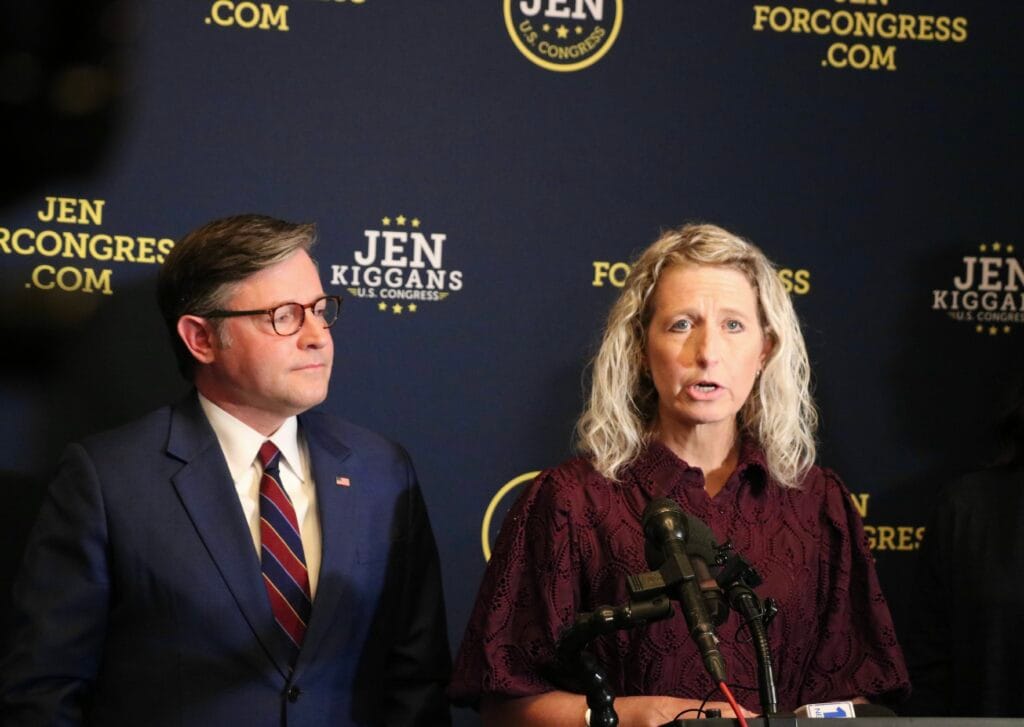
U.S. Rep. Jen Kiggans, R-Virginia Beach, speaks at a campaign event in Virginia Beach featuring U.S. Speaker of the House Mike Johnson, R-Louisiana, on Aug. 17, 2026. (Photo by Charlotte Rene Woods/Virginia Mercury)
As part of an 18-state tour through more than 30 congressional districts, U.S. House Speaker Mike Johnson, R-Louisiana, said Monday that “Virginia’s 2nd District will determine the fate of the country because this will be a close election.”
As Johnson stumped for U.S. Rep. Jen Kiggans, R-Virginia Beach, at the Cavalier Hotel on Monday, he and the incumbent congresswoman framed partisan control of the nation’s legislature during this year’s congressional midterm elections as a battle between “common sense” and “chaos.”
“This is not a new fight now we’re in,” Kiggans, who is seeking another term in Congress, said. “It’s a fight right now between craziness and common sense and real civility and communism, socialism, and the direction that the Democratic party has gone in to the left.”
Amid a wave of non-establishment Democrats winning primary elections earlier this month in other states and internal struggles within the party’s centrist and progressive factions, Johnson said “they don’t know where they stand, what they stand for, and who stands with them — they’re kind of a rudderless ship.”
Leftist democrats gained traction elsewhere in the primaries, but Virginia’s establishment democrats prevailed in the state’s Aug. 4 contests.
At the Democratic National Committee meeting over the weekend, former Virginia Gov. Terry McAuliffe urged his party to end any “hand-wringing” over internal differences. Virginia was also confirmed as an early primary state for the 2028 election cycle at the meeting.
Democrats across the spectrum, however, have spent much of this year attacking Kiggans and other Republicans over healthcare policy and the rising costs of living.
As Kiggans and Johnson spoke at the Virginia Beach fundraiser, her opponent, Democrat Elaine Luria, highlighted Kiggans’ record, including her vote in favor of the reconciliation bill Congress approved last summer that put thousands of Virginians at risk of losing their Medicaid health insurance.
Luria also noted that Kiggans voted to allow Affordable Care Act subsidies to expire, which has led to thousands of people in the state losing that form of insurance.
Health care fight intensifies as Congress weighs GOP-backed insurance changes
When asked about the ongoing war in Iran that Republican President Donald Trump initiated without congressional approval earlier this year, Johnson said he believed the conflict will be resolved soon.
“I talk to the president multiple times every day on average. He is laser focused on this,” Johnson said.
Luria — a former member of Congress whom Kiggans ousted from the seat in 2022 — said Kiggans and Johnson “refuse to stand up to Donant Trump, and Hampton Roads is paying the price.”
“As corrupt Jen Kiggans and Mike Johnson meet with wealthy donors today, working Virginians are seeing their gas and grocery bills skyrocket, their friends and family members in uniform sent to fight in another foreign war, and their healthcare taken away to pay for tax cuts for billionaires,” Luria wrote.
Kiggans and Johnson took jabs at Luria over her wealth, as bipartisanship efforts to ban congressional stock trading have ramped up over the past year. Kiggans is a co-sponsor of a recent attempt to reign in the practice.
Luria, who previously spoke against congressional stock trading while in congress, has evolved in her support for it as the issue has gained traction nationally.
With early voting set to kick off Sep. 18 and Election Day on Nov. 3, Kiggans and Luria are escalating their campaigns in one of the country’s most competitive swing districts this cycle.
Virginia’s 2nd Congressional District has been represented by both parties over the years but leans Republican. Still, its nearly 600,000 residents backed Democratic Gov. Spanberger last year by 53%. Luria first flipped it to Democratic control in 2018 before Kiggans flipped it back to Republican in 2022.
While Kiggans did not take questions from the media at the event, Johnson made his pitch for Republicans on ballots nationwide this year.
“If you believe in America, you believe in individual freedom, limited government, the rule of law, peace through strength, and fiscal responsibility, and free markets, human dignity — we have a place for you,” he said.
This post was originally published on Virginia Mercury.
DOJ probes William & Mary over alleged race-based scholarship policies
The U.S. Department of Justice is investigating historic Williamsburg university William & Mary over scholarships and benefits programs that the department said may discriminate against students.
According to the DOJ, the agency opened a compliance review to determine whether the school’s scholarships and student benefits include racial criteria that violate Title VI of the Civil Rights Act of 1964, which prohibits discrimination based on race, color, and national origin.
“Awarding scholarships or offering coveted opportunities to students based on the color of their skin is illegal and offends the guarantees of our color-blind Constitution,” said Harmeet K. Dhillon, assistant attorney general of the Justice Department’s Civil Rights Division, in a statement on Monday.
He added, “The department will not turn a blind eye to race-based preferences, however they are packaged or portrayed by universities.”
The federal agency is focusing on five programs, including the W&M Scholars scholarship program for first-year undergraduate students. The DOJ quoted the program as saying applicants with an “interest in diverse people and perspectives” receive “top consideration.”
The Martha L. Muguira Fellowship and Holmes Scholars program, offered by the university’s School of Education, is also under review for allegedly giving “preference” to Hispanic or Latino women and “future education leaders of color,” respectively, the DOJ said.
W&M’s Law School faces a review for its Lemon Legal Scholars Program and the Reaching Back Scholarship program, which are geared to graduates from Historically Black Colleges and Universities and those who “contribute to the diversity” of the law school.
In a statement on its website, W&M said it is “committed to nondiscriminatory learning environments across our campus and complying with all state and federal laws.”
The institution further stated it would not comment on the pending legal matters.
Because the school receives federal financial assistance, the agency is permitted to conduct an investigation.
The DOJ’s review of W&M is the third investigation into a Virginia higher learning institution over the past two years, largely because of conflicts with President Donald Trump’s administration over diversity, equity and inclusion initiatives. The department launched probes at the University of Virginia and George Mason University last year.
UVA’s five federal civil rights investigations were suspended after the university reached an agreement with the DOJ, which will remain in effect through Dec. 31, 2028 if UVA stays in compliance.
The federal investigation involving George Mason University and President Gregory Washington is still ongoing.
The DOJ said it recently became aware that GMU offers or administers scholarships and other educational benefits that may include unlawful racial criteria. The agency did not state a timeline for the review.
This post was originally published on Virginia Mercury.
Spanberger formally enters Dominion-NextEra merger case
(The Center Square) – Virginia Gov. Abigail Spanberger has formally entered the state case reviewing the proposed $67 billion merger of Dominion Energy and NextEra Energy.
Spanberger and Chief Energy Officer Josephus Allmond filed a notice of participation Monday with the State Corporation Commission, following through on the governor’s earlier announcement that she would seek a role in the case.
The filing says Spanberger and Allmond will participate as respondents in the proceeding and lays out several areas they intend to examine as regulators review the proposed acquisition.
Those include the effect of the deal on Virginia’s utility workforce, energy affordability, clean energy procurement and development, and corporate governance.
The administration argues the transaction could bring significant changes to Virginia’s economy, labor market and regulation of electric utilities.
In the filing, Spanberger and Allmond said their participation is intended to ensure regulators have a full record as they consider potential consequences for employees and customers if the acquisition is approved.
They also said they plan to address what they describe as deficiencies in the companies’ application and whether the transaction could jeopardize affordable electric service or Virginia utility jobs.
“As governor, I remain skeptical of the benefits this merger would deliver to Virginia – particularly if those benefits come at the expense of affordability, existing jobs, or meeting our homegrown clean energy goals,” Spanberger said Monday.
As respondents, Spanberger and Allmond can participate directly in the proceeding, raise concerns and request information about the proposed transaction.
Dominion, NextEra and related companies filed their joint petition with the commission July 15 seeking approval of the acquisition.
The proposed merger has drawn scrutiny over its potential effect on electric rates and Virginia utility workers.
Spanberger had announced earlier this month that she intended to intervene, saying she wanted Virginians represented during the review.
Monday’s filing formally puts that plan into action.
The SCC has not ruled on the companies’ application.
This post was originally published on The Center Square.
Virginia ranks among worst states for women’s equality and more headlines
• “Virginia ranks among worst states for women’s equality.” — WAVY
• “Virginia childhood vaccines schedule unchanged after new Trump EO.” — VPM News
• “Trump’s shipbuilding plan can’t come at expense of Hampton Roads, Virginia lawmakers say.” — The Virginian-Pilot
• “Court documents reveal Instagram messages from alleged VSU shooter: ‘It was us.’” — WTVR
• “‘Project Flash’ data center proposal fizzles out in Franklin County.” — The Roanoke Times
This post was originally published on Virginia Mercury.
Youngkin-backed group launches ad campaign for federal school choice program
(The Center Square) – A new organization founded by a former Republican governor and potential 2028 presidential candidate has launched an ad campaign that is urging Pennsylvania to opt into a federal school choice program.
Empowering America’s Parents, created by former Virginia Gov. Glenn Youngkin, is a national policy advocacy organization promoting the Education Freedom Tax Credit, signed into law by President Donald Trump. The federal program, enacted as a result of the Working Families Tax Cut Act, established a new federal tax credit of up to $1,700 for contributions made to a scholarship granting organization.
The Department of Education describes these organizations as “nonprofits that accept qualified contributions from individuals and use the funds to provide scholarships for education-related services at private or public schools, including tuition, fees, academic tutoring and classroom supplies.”
“The crazy thing is that we have 30 states that have opted in, but we have 20 states that have not,” Youngkin said. “And of the 20 states that have not opted in, there’s one basic characteristic: nearly every one is led by a Democrat governor. These Democrat governors are being literally puppeted by the teachers unions, and they need to get over this.”
A source familiar with the organization’s plans tells The Center Square a multi-million paid media blitz has been launched in several states led by governors that have not yet opted into the program, including Pennsylvania.
The first wave of what will be a six-figure digital and text campaign in the Philadelphia and Pittsburgh suburbs was launched on Friday as they attempt to reach who they view as persuadable voters who support school choice.
“Nothing is more important than our kids, so who’d be against scholarships for tuition, tutoring, services for kids with disabilities, all paid for by a federal tax credit with no state dollars, not hardworking parents,” a voiceover reads in the ad. “20 governors have not opted in, including Pennsylvania, and it’s blowing this opportunity.”
Internal polling from the organization suggests that awareness about the Education Freedom Tax Credit is low, according to a source familiar with the organization’s plans, however, they say it is popular after voters are made aware of what it entails.
“While children in other states benefit, Pennsylvania should opt in for scholarships and education freedom tax credits, so hardworking families can choose the best path for their child,” is said at the conclusion of the 30-second spot.
A spokesperson for the Shapiro administration said the governor is “awaiting federal guidance” to address key questions about how this program would work, including which students will be eligible, how this federal initiative will interact with existing programs, and more.”
Youngkin is the latest conservative to apply public pressure to Gov. Josh Shapiro to opt into this program.
U.S. Education Secretary Linda McMahon joined Republican lawmakers in April for a rally on the steps of the Capitol Rotunda in Harrisburg, and later spoke at a conservative conference about the program.
U.S. Sen. Dave McCormick, R-Pa., held a press call in June with fellow advocates of the federal school choice program, where he touted the benefits of it, while also expressing optimism that Shapiro would decide to opt Pennsylvania into it.
“I think that the rationale of this opportunity will hopefully convince him to opt in,” McCormick said in June. “I hope and expect he will.”
At the state level, several GOP state Senators and one Democrat, Anthony Williams, have introduced legislation that would require Pennsylvania to opt into this program.
However, some groups, like AFT Pennsylvania, have expressed opposition to tuition tax credits and voucher programs in the past, arguing it would take resources away from traditional public schools.
Outside of Pennsylvania, NBC News reports that the decision from Youngkin to create this group is “likely to intensify speculation that he will seek the Republican nomination for president in 2028.”
Shapiro, who is seeking a second term in office in November, has also been mentioned as a potential presidential candidate in the next cycle.
This post was originally published on The Center Square.
Federal judge denies hemp entrepreneurs’ request to overturn Virginia’s new THC limit
A federal judge in Roanoke on Friday declined seven Virginia business owners’ request to eliminate a new regulation that removes an exception to the state’s limit of 2 milligrams of tetrahydrocannabinol (THC) per product package. The new standard took effect Aug. 15.
The entrepreneurs had asked the U.S. District Court for the Western District of Virginia in Roanoke for a temporary restraining order and preliminary injunction to block the rule stemming from the state budget lawmakers passed and Gov. Abigail Spanberger signed in late June.
They said the removal of the 25-to-1 ratio, which allowed hemp products to exceed the 2 mg THC limit if they contained 25 times as much cannabidiol (CBD), would devastate their businesses, cause severe financial strains and undermine Virginia’s small business owners.
Hemp businesses ask federal judge to block Virginia’s new THC cap
The court found that the plaintiffs did not prove that the new standard would significantly harm their businesses, and determined that the new rule was created in the public’s best interest.
“Because Plaintiffs have not demonstrated either a likelihood of success on the merits or irreparable injury if HB 30 becomes effective, and because the balance of equities and the public interest weigh in favor of Defendants, the Motions for Preliminary Injunction … and Temporary Restraining Order … are DENIED,” Judge Robert S. Ballou wrote on Aug. 14.
The plaintiffs and other hemp industry representatives reacted quickly, expressing disappointment in the judgment, requesting lawmakers discuss the matter in a special legislative session and asking authorities to pause the new law.
“We are incredibly disappointed with today’s news. The judge himself acknowledged that this was rushed legislation, leading to complications and unintended consequences,” Barbara Biddle, president of the Cannabis Small Business Association and owner of District Hemp Botanicals, said in a statement. “We are calling on legislators to convene a special session to address the gap in access for consumers, protect businesses from bankruptcy, and reinstate the previous definition of hemp.”
Biddle added: “We’re also asking the Virginia Cannabis Control Authority, Office of the Attorney General, and local law enforcement to consider halting enforcement of the redefinition until legislators are able to resolve this issue.”
Travis Lane, owner of Northern Virginia Hemp & Agriculture LLC, placed blame for the new standard squarely on Spanberger and her administration.
“If Virginia small businesses are pushed toward bankruptcy while a new state-regulated cannabis market is being built for 2027, voters deserve to remember who made that choice, and our elected leaders still have an opportunity to change it,” Lane said in a statement.
Spanberger has not commented on the ruling but earlier this month, her spokesperson said gaps between the state’s marijuana and hemp laws created dangerous conditions.
“For years, untested and highly-intoxicating products have flooded Virginia with little oversight, inadequate protections for kids and teenagers, and few tools for law enforcement to address the illicit market — all because of a loophole in state law that bad faith actors have exploited and pushed the limit of its intended use,” the spokesperson said.
He added that the state’s adult-use cannabis market, slated to open next year, will streamline the industries, shore up safety and create new opportunities for small businesses owners.
Learn more about the new regulation and other hemp and marijuana changes in the state at the Virginia Cannabis Control Authority’s website.
This post was originally published on Virginia Mercury.
DNC approves 2028 presidential nominating cycle starting in South Carolina, Nevada
The Democratic National Committee on Saturday approved by voice vote its lineup of six early primaries for the 2028 election cycle, kicking off with South Carolina and Nevada.
DNC Chair Ken Martin said during Saturday’s meeting that the early lineup reflects the diversity of the party’s electorate.
“Our 2028 nominee, whoever they are, will have to earn the support across the full breadth of America — every region, every demographic, every generation, every economic station in life,” he said. “No shortcuts. No coronation. You want to lead this party? You go earn it.”
Saturday’s vote ratified the DNC’s rules and bylaws committee vote in late July to recommend the lineup for approval by the full party.
Throughout the meeting, speakers and party officials from each of the six states to hold an early contest praised the impact the calendar will have for regions that haven’t always been top of mind for national candidates.
Jaime Harrison, the former DNC chair who challenged the late South Carolina Sen. Lindsey Graham in 2020, said the calendar will tell a “whole new generation” of voters that the party is fighting for them.
Other speakers included Nevada Secretary of State Cisco Aguilar, New Hampshire Democratic Committeewoman Donna Soucy and Michigan Democratic Party Chair Curtis Hertel Jr.
Martin said that the lineup is a “stronger, more representative path to selecting our nominee.”
“This is much bigger than a lineup of dates on a calendar,” Martin said. “This is about our approach to winning back the presidency. It’s about the kind of Democratic Party and the kind of country we aspire to be.”
South Carolina, Nevada come out on top
For the second straight presidential cycle, South Carolina will kick off the party’s nominating process.
The full lineup of primaries is as follows:
- South Carolina on Jan. 22, 2028
- Nevada on Feb. 1, 2028
- New Hampshire on Feb. 8, 2028
- New Mexico on Feb. 15, 2028
- Michigan on Feb. 22, 2028
- Virginia on Feb. 29, 2028
The lineup includes at least one state from each of the DNC’s four regions. The party’s rules and bylaws committee also voted in July to expand the number of early primaries to six, selecting New Mexico and Virginia to hold the additional contests.
Several speakers Saturday said the calendar will better serve Latino and Black voters.
U.S. Rep. Teresa Leger Fernández, D-New Mexico, said the calendar will show Latino voters they aren’t ignored.
“With over 4.2 million Latinos in the early voting states, Latinos will not (just) be talked about,” she said. “Our stories will shape the policies of the next president of the United States, who will be a Democrat.”
Terry McAuliffe, the former governor of Virginia and DNC chair from 2001 to 2005, said the calendar will put the party’s 2028 nominee “through the crucible” and force them to reach rural, suburban, urban and military voters alike.
Iowa left out
Notably, the early lineup excludes Iowa, despite a push from its state party officials to keep it among the initial contests.
The Hawkeye State had long held a first-in-the-nation spot in the Democratic presidential nominating cycle, including in 2020 and 2016. But after delays in reporting results of the 2020 caucus, leading to no declared winner on the night of the caucus, many national Democrats looked elsewhere to kick off the nominating cycle.
In a speech opposing the 2028 calendar Saturday, Iowa Democratic Party Chair Rita Hart said that it “fundamentally misses the mark.”

Kentucky Gov. Andy Beshear, a potential candidate for the 2028 Democratic presidential nomination, speaks at a campaign event at the River Place in Des Moines on June 7, 2026 in support of Iowa Democratic gubernatorial candidate Rob Sand. Iowa, with its first-in-the-nation caucuses, was a focal point of Democrats aspiring to the presidency for decades, but is no longer on the party’s early nominating contest calendar. (Photo by Robin Opsahl/Iowa Capital Dispatch) “It’s a product of broken promises, and it excludes huge swaths of the country and the voters that Democrats need to win the kind of majorities it takes to restore democratic principles and reject this misguided and corrupt Trump administration,” she said. “The 2028 calendar has no representation of states with a majority of central or mountain time zones, and no Midwest state is among the first four.”
Hart noted that Republicans have kept the Iowa Caucus as its first contest of the 2028 presidential nominating process, and the resulting surge in spending in the state during its contest could harm Democratic candidates for elected office in the state if that spending is not met by Democrats.
New Hampshire, which has also long held an early position in the nominating process, kept its position, however.
Democrats look South
The primary calendar reflects Democrats’ effort to court voters in the South, as well as a partial shift away from the Midwest.
Martin began the meeting Friday — held in Austin, Texas — by emphasizing Democrats’ chance at flipping a Texas Senate seat, long held by Republicans.
An Emerson College and Nexstar Media poll conducted from Aug. 9-10 showed state Rep. James Talarico, a Democrat, within one point of Republican nominee and Texas Attorney General Ken Paxton.
On Friday, the DNC also announced a new initiative to help local Democratic parties in Southern states build up their infrastructure in order to win elections.
The DNC said in a statement Friday that the Southern States Resource Hub will seek to address “years of underinvestment” in those Southern parties, and allocate resources for organizing, voter registration, data collection, fundraising efforts and communications systems so they can better compete in a region with a rapidly changing electorate.
This post was originally published on Virginia Mercury.
Suspect in Virginia State University shooting arrested, found hiding in closet and more headlines
• “Suspect in Virginia State University shooting arrested, found hiding in closet.” — WRIC
• “Henry County suspends Flock camera access as privacy debate grows.” — Martinsville Bulletin
• “Virginia Beach mulls data center moratorium until it can devise regulations.” — WHRO
• “Virginia could owe $266M for SNAP benefits next year amid program declines.” — Richmond Times-Dispatch
• “Former Patrick & Henry Community College player makes it to the big leagues with New York Yankees.” — Cardinal News
This post was originally published on Virginia Mercury.
As Va. officials weigh data center pushback, report details industry’s public service funding
As a single mother balancing work against earning a nursing degree, Yvettrise Hoskie thought homeownership was out of her reach. Now, she’s settling into a Henrico County townhome development.
The county’s Affordable Housing Trust Fund helped with her downpayment, but the financial assistance was made possible by one of the state’s more controversial neighbors — data centers.
The fund was created in 2024 and helps first-time homebuyers making between 60% and 120% of the area’s median income. The fund is fueled by data center tax revenue.
Eric Leabough, Henrico community revitalization director, explained that the median income range is meant to help some lower-income earners and middle-class families that have otherwise been priced out or struggle with down payments.
He added that the goal is to make 750 new homes available to residents in the first five years. He said that 472 have been approved since the fund launched and 85 deals have been completed so far, with families like Hoskie’s living in them.
“A lot of these homes have to be built, so we are at the mercy of construction timelines,” he said.
Henrico supervisor Tyrone Nelson, who championed the creation of the fund and tethering it to data center revenue, said it “will have impact for generations.”
Hoskie said she can now build a stronger financial foundation for her family.
“For anyone trying to buy a home and struggling, just know that it’s out there and Henrico is willing to help you,” she said.
Nelson explained that his locality decided to focus specifically on supporting first-time homebuyers because the greater Richmond region’s population has grown and addressing housing supply for both renters and buyers has broadly been a goal for regional elected officials.
Nelson said that he hopes Henrico’s story can inspire other localities.
Henrico, with its 37 data centers, is one of severalVirginia localities that have funneled revenue from the facilities towards public benefit, but their massive power demands and siting issues present persistent challenges for residents and local leaders.
Local tax dollars show benefits, but residents don’t feel the balance
A new analysis by centrist-left think tank Chamber of Progress, which is funded by the tech industry, highlighted how Loudoun County — dubbed the data center capital of the world — has lowered its property tax rates over the past decade while boosting public service funding.
County officials have been able to reduce real estate tax rates every year for a decade due to data center tax revenue ballooning. It’s projected to total $1.3 billion in 2027.
In the beginning of the 2026 tax year, Loudoun cut the $25 vehicle license fee for residents. Annually, data center tax revenue directs over $100 million towards county schools and other programs.
The Chamber of Progress report also highlighted Prince William County, which is a similar size as Loudoun but has lower per-pupil school investment and a higher property tax rate.
How Virginia became the world’s data center capital and how it’s going
While many of Loudoun’s residents are affluent, Chamber of Progress economist Kaitlyn Harger said that the locality’s use of data center revenue can be a blueprint for areas with fewer resources, too.
“Loudoun provides a really good example of how you can use data center tax revenue to lower burdens on households,” she said. “I think that’s a huge way that data centers can be better neighbors.”
State officials take a closer look at how to regulate data centers
Residents’ appetite for data center development has abated across the commonwealth, and even Loudoun may be ready to roll up the welcome mat for the industry.
The county Board of Supervisors will vote at their Sept. 15 meeting whether to implement a temporary pause on all new data center applications while the county’s comprehensive plan zoning ordinances are being reviewed and updated.
“The community has basically been begging us to do something about the unchecked growth of data centers,” County Supervisor Juli Briskman said in a July interview. “The communities have been asking us to fight back against these big corporations that have basically been able to run roughshod over the county.”
Suffolk, Front Royal, and Chesapeake have also discussed policy shifts to limit the industry.
Virginia does not have a statewide standard for siting of data centers, which has left local communities to learn about the process as they go.
Residents statewide have amplified their opinions on noise, water use, power infrastructure, and other impacts that accompany data center development. This has led to a major increase of local engagement at public hearings for data center applications and zoning considerations.
A new Chamber of Progress data center policy guidebook advises leaders against adopting moratoriums. Harger noted that any data center siting or rejections are important for localities to consider individually.
The organization suggested data centers can be good neighbors if developments “bring, build or buy” their own power and ensure that water used to cool servers is recycled.
Local leaders should also work with data center developers to set clear agreements and enforcements for violations of the terms in writing prior to construction, the report advised.
Data centers building their own power may hinder Virignia’s near-term clean energy goals.
Under the Virginia Clean Economy Act, the major utilities are required to retire their carbon emitting power generation facilities by 2045.
But data centers who build their own on-site power — otherwise known as behind-the-meter power, which recent proposals show is mainly gas generation – do not fall under those requirements.
“I do not want to see us move in a place where we think, as a commonwealth, we’re on path towards meeting the VCEA goals but that’s because there’s all this generation that is sort of outside of the scope of what is counted,” Gov. Abigail Spanberger said in a July interview about behind-the-meter gas proposals from data centers.
Instead, the governor said the state should focus on “Now how does Virginia become the place where (there are) the best in class generation efforts in newer technologies?”
Data centers tied up state budget negotiations for months and almost triggered the state’s first government shutdown this summer.
The crux of the fight was whether the data center industry should be allowed to keep their state sales and use tax exemption, which saves the tech industry an estimated average of $1.6 billion yearly.
Virginia legislators advance $205 billion budget including new tax on data centers
Ultimately, the exemption was left in place with some new environmental and regulatory changes laid out in the budget text.
Lawmakers across the political spectrum have pledged to revisit these data center issues on a statewide scale when the General Assembly returns in January.
Hoskie, the Henrico homeowner, has registered her 14-year-old son for his new school. Her mortgage provides stability, she said, and costs less than her previous rent.
She doesn’t have strong sentiments in favor of or against data centers, but Hoskie said that any locality that approves the facilities should ensure they bring public service investments or fund programs like the one in Henrico that made her a homeowner.
This post was originally published on Virginia Mercury.
Hampton leaders cool to limited Army Corps flood solutions

The cover image of the U.S. Army Corps of Engineers Norfolk District report, “Peninsula Regional Coastal Storm Risk Management,” released in July 2026. (Photo courtesy US Army Corps of Engineers, Norfolk Division)
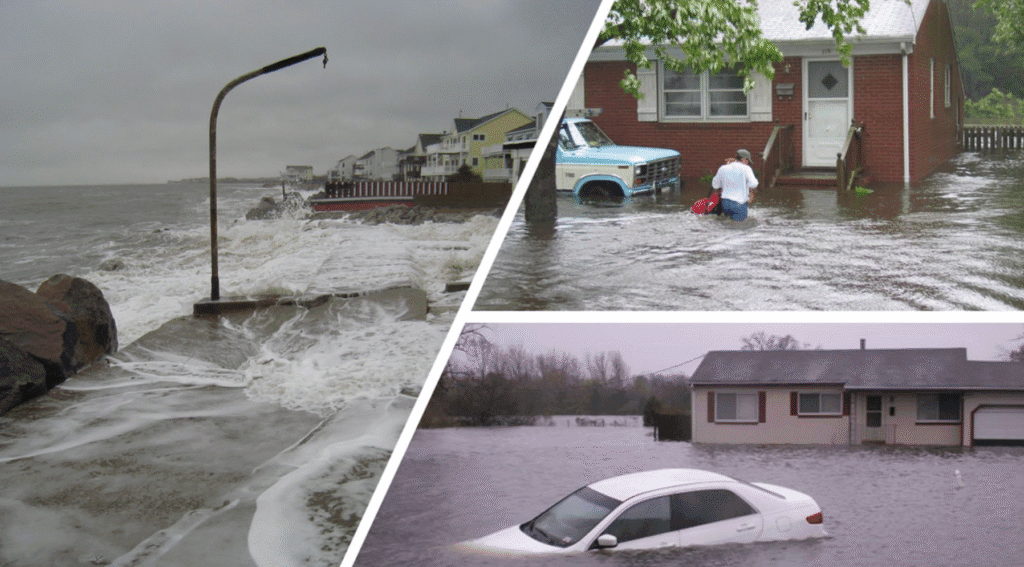
A U.S. Army Corps of Engineers draft feasibility study proposing scaled-down protection without structural elements like floodwalls for vulnerable portions of Hampton and Poquoson got a frosty reception from Hampton’s city manager during a recent presentation to City Council.
The $4.2 billion Coastal Storm Risk Management plan, now open to public comment, calls for elevating nearly 4,000 structures voluntarily in the two cities, something the Corps acknowledged it has little experience doing.
Mary Bunting, Hampton’s city manager, told council members during the Aug. 12 meeting that Hampton would not be able to afford the city’s share of the plan, nearly $1.5 billion, describing the cost as “pretty staggering.”
The study proposes elevating 300 homes a year. There are not enough contractors in the area to accomplish that, nor could the city afford the price tag, Bunting said, adding that the same amount of funds would be better spent on structural solutions.
But the study is a gateway to receiving federal funding and Hampton will press the Corps to do a second study examining structural solutions, as it has done for Virginia Beach and Norfolk, where the proposed projects include miles of floodwalls, Bunting added.
Study calls for nearly 4,000 homes to be raised, infrastructure to be floodproofed
The study was originally to include Hampton, Poquoson, Newport News, Williamsburg, and James City and York counties. But the Corps refocused it only on Hampton and Poquoson and only on non-structural solutions like house raisings because of a congressional requirement that the study be completed in three years at a cost of $3 million.
The provision was enacted after Hurricane Sandy as a solution to the Corps’ decades-long projects backlog and to create protections before storm damage occurred, rather than after.
“We could not put any additional money into it, nor could the federal government,” Bunting said. “And because it was capped at $3 million, (the Corps) would not be able to look at structural solutions, which we believe are absolutely necessary and warranted.”
An appendix to the study said a comprehensive examination of all solutions , including floodwalls and levees, for the six localities, including floodwalls and levees, would have cost nearly $20 million and taken about six years.
The plan includes elevating up to 3,926 residential buildings and floodproofing up to 51 nonresidential buildings and 21 critical infrastructure facilities in three Hampton neighborhoods (Aberdeen, Buckroe, and Fox Hill) and six Poquoson areas. Nearly 2,300 of the elevations would be in Hampton.
Over 50 years, the study reported total average annual benefits of $140.5 million and total average annual costs of $127 million, just topping the congressional requirement that benefits must outweigh costs.
Implementation, if approved by Hampton City Council, would begin in 2027, with construction projected for completion by 2040, if Congress appropriated funding.
Olivia Askew, Hampton’s resilience officer, said the plan will continue to be refined resulting in “an interim solution” knowing that nature-based and structural measures are needed. That refinement would focus on reducing the price tag to what the city could afford by reducing the number of buildings to be elevated.
The report noted there “remains a strong federal interest” in an expanded future study that includes such structural measures. But there is no funding and no timeline for that to happen.
Scott Smith, the city’s coastal resilience engineer, told council members that more than 45,000 Hampton “assets” were identified by the Corps as at risk, including critical infrastructure like fire stations, emergency operations, shelters, and the hospital.
But the narrowing of the study required a focus only on certain areas and only on nonstructural solutions. There were 27,000 structures in the areas considered by the study, 94% of them single family homes.
“The need didn’t get smaller,” he told council members. “The federally actionable project did.”
Federal law requires localities to fund 35% of any Corps project. Norfolk, the only local city to sign a partnership agreement with the Corps for a storm risk project, has said it cannot afford its share of the $6.1 billion project there.
The city has reached out to the state for funding help and asked its congressional delegation to explore reducing the share to 10%, so far without success.
Army Corps studies for other cities have expanded beyond the time and dollar barriers Hampton faced.
The Virginia Beach study, which is in draft form and not expected to be complete until 2028, has been ongoing since 2022.
Studies in New York and Miami, which pushed back against draft plans, were also extended, an indication that the three-year timeline for studies in cities with complex shorelines is insufficient.
A spokesman for the Norfolk district office of the Corps said going forward feasibility studies like the one in Hampton will have to meet the requirement to be completed in three years at a cost of $3 million.
“There will be very few feasibility studies with additional time or funding beyond the existing legal limits,” he added.
Olivia Askew, Hampton’s resilience officer, said the plan will continue to be refined resulting in “an interim solution” knowing that nature-based and structural measures are needed.
That refinement would focus on reducing the price tag to what the city could afford by narrowing the number of buildings to be elevated.
Environmental groups urge caution
Mary-Carson Stiff, executive director of Wetlands Watch, a local advocacy nonprofit that has worked with Hampton, described elevating structures as a “band-aid solution.”
“They are a necessary part of adaptation, but they have a time limit, an expiration date for their effectiveness,” she said. “You have to acknowledge that you are adding an additional cost to local government maintenance and provision of services that you may not be factoring into your life cycle cost of elevating a property.”
Once a property has been elevated, a locality must consider raising the street and repairing damaged electrical, sewer, and water lines after flooding, Stiff said. Keeping residents in place through elevations means they remain at risk.
Stiff said communities like Hampton should think not only about the short-term, but the mid-term and long-term, and anticipate when short-term solutions like elevating homes are no longer financially viable or safe.
“It isn’t a solution that is going to last into the future, and we’re treating it like it might be,” she said. “There’s a danger to that.”
The Corps acknowledged in the study that it has little experience with large-scale elevation projects like this, which present “unprecedented programmatic, legal, and administrative risks for the USACE,” the draft noted.
“These risks stem from the shift from centralized, large-scale civil works to managing hundreds/thousands of decentralized, voluntary residential interventions.”
The study said pilot home elevation projects were underway and could shift how such plans are implemented. Because elevations will be voluntary and require a perpetual easement, the Corps study noted it is unclear how many people will participate. But it added that the benefit-cost ratio assumed 100% participation.
Corps regulations require that any buildings elevated with government funding be structurally sound, absent leaks, mold, water damage, or other issues. Bringing a building up to that standard is the responsibility of the owner.
A spokesman for the Corps said homeowner participation in past elevation projects has been between 30 and 50%.
”The localities (Hampton and Poquoson) will play a major partnership role in the design and implementation of the future recommended home elevations,” he said, adding that the plan will be further refined.
Bunting pointed out to council members that a few days prior, 1.87 inches of rain fell over the city in 10 minutes.
“Let that sink in,” she said. “If you had extra flooding in your neighborhood or on your property, that’s why. None of the systems that were built 50 to 100 years ago to protect our city anticipated intense rain events of that nature.”
Smith said that without the storm risk project, the Corps estimated $10 billion in future flood damage to Poquoson and Hampton, with $7.6 billion of that in Hampton. These figures put the scale of the long-term resilience challenge into perspective, he said.
He also reminded council members that the study did not examine solutions to compound flooding from rain bombs, like the one Bunting mentioned.
The draft Corps plan, he added, “is one of the components of the broader living with water strategy, and not the city’s entire flood resilience program.”
The city, Askew said in an interview, will also need to update its drainage infrastructure. There’s no price tag yet for those needs, she said.
Comments on the plan will be accepted until Sept. 5 and should be sent to [email protected].
This post was originally published on Virginia Mercury.
Black lung cases surging again in Southwest Va., Appalachia; miners blame blocked regulations
With new research showing that black lung disease among Appalachian coal miners has reached an almost 50-year high, advocates are demanding federal regulations be enforced.
The data published in the American Journal of Respiratory and Critical Care Medicine is also part of a peer-reviewed research letter from the National Institute for Occupational Safety and Health (NIOSH).
Congress previously passed regulations meant to limit miners’ exposure to coal dust, which causes the incurable lung disease.
Typical mitigation measures include spraying drilling machinery with water to suppress dust particles, use of personal protective equipment like respirators and inspections by the Mine Safety and Health Administration.
The last time black lung cases were at current rates was in the 1970s, according to the NIOSH letter. While black lung disease dipped in the late 1990s, cases in workers who have spent 25 years or more in mines have climbed since 2000. A third of miners who have spent 25 years or more underground now have the disease.
There has also been an increase in miners with less experience, which “indicates that the burden of the disease is affecting younger miners and not confined to the most experienced workers,” researchers wrote.
“This tells you that companies aren’t doing what they’re supposed to be doing,” said Vonda Robinson, vice president of the National Black Lung Association.
The Southwest Virginia resident is the wife of longtime coal miner John Robinson. Since his black lung diagnosis a little over a decade ago, he’s helped her work for laws and regulations to improve safety and benefits.
This entails lots of conversations with federal lawmakers in multiple states and political activism. Last year, they joined a multi-state coalition of miners in Washington D.C., to protest a court order blocking a President Joe Biden-era safety rule.
Under Biden’s presidency, the Mine Safety and Health Administration created stricter safety standards by lowering exposure limits for workers — a critical move, John Robinson said, as miners over time have needed to drill deeper and deeper into rock to reach coal seams.
“It took us two and a half years to get to the coal seam,” he said. “We basically breathed rock for two and a half years.”
That means exposure not to coal at first, but also to silica dust from cutting through the rocks in the area.
Quenton King, government affairs specialist with Appalachian Voices, said the mining industry suspects silica dust plays a role in continued black lung cases.
The Biden-era rule was supposed to take effect in April 2025, but cuts to federal workers contributed to a delayed enforcement timeline before ultimately winding up in court. President Donald Trump’s administration did not defend the rule in court and petitioned the court to block labor unions and the Black Lung Association from intervening in the case.
National Mining Association spokesman Conor Bernstein told The New York Times late last year that the organization is “absolutely supportive of the new lower levels” but did not respond to inquiry from the Virginia Mercury by the time of this publication.
While the litigated rule would require operators to reduce silica concentration through a variety of measures beyond personal protective equipment, the association suggests PPE should be sufficient.
King said that miners struggle to keep their respirators on at all times because of communication challenges in noisy mines as drilling machines are running. Still, he added, “If you aren’t trying to have a dust-free environment, respirators will clog up multiple times in a shift.”
Appalachian Voices views respirators as the back up to back up measures and sees the Biden rule as a more solid frontline defense.
Just before pulling back on the Biden-era rule, Trump’s 2025 State of the Union address to Congress focused on his goal of ramping up coal production for energy.
“Trump can say ‘drill baby drill,’ but if we aren’t taking care of our miners, there isn’t going to be any drilling going on,” Vonda Robinson said, referring to the speech.
The Trump administration recently completed a review of a new coal dust rule as replacement for the Biden administration’s, POLITICO reported. The proposal has not yet been publicly unveiled.
Congress, in the meantime, has been exploring legislation to support coal workers and their families.
U.S. Sens. Mark Warner and Tim Kaine, both Virginia Democrats, have carried the Black Lung Benefits Improvement Act and the Relief for Survivors of Miners Act. The former is meant to improve the process for miners to receive financial benefits, while the latter is meant to help surviving spouses.
King said that receiving the compensation has often been challenging for miners and their families, with the process often taking years and at times with litigation from coal companies.
Democratic lawmakers in Appalachian states have championed the legislation, but it has not yet passed congressional chambers. Vonda Robinson said that bipartisanship is needed and said that she has been in touch with her U.S. representative, Morgan Griffith, R- Salem.
Griffin didn’t endorse or oppose the bills. He said in an email to the Virginia Mercury that he looks “forward to studying various proposals and determining the best course of Congressional action on this issue.”
He pointed to federal funding that already supports a black lung clinic at a federally qualified health center in his district, and noted that the reports of a surge in cases “merit federal attention.”
Meanwhile, the Robinsons’ fight continues, the couple said, as they advocate for newer generations of miners.
Robinson’s diagnosis in his late 40s is not an uncommon occurrence for miners who spend decades drilling through rocks and into coal seams. But the couple said encountering younger men developing the disease has been jarring.
The couple shared that they knew of a 28 year old miner who has spent about a decade in the industry and now suffers from black lung.
“It upsets me because they have small children and they’re probably not going to see their children graduate high school or meet grandkids,” she said.
Vonda Robinson said she’s written to Vice President J.D. Vance, both due to his family’s roots in Appalachia and his role presiding over the Senate, in hopes he will spur congressional movement. Future demonstrations in the nation’s capitol are also on the horizon.
“We just need to make some more noise,” she said.
This post was originally published on Virginia Mercury.
DOT says it’s entitled to CDL information as 22 states sue
(The Center Square) – Twenty-two states have gone to court to block the Trump administration from accessing a database containing the personal information of roughly 17 million commercial drivers. Transportation Secretary Sean Duffy says the federal government is entitled to that data and needs it to keep the highways safe.
This is the latest in a series of legal fights. The same coalition of attorneys general has also challenged federal efforts to obtain state data tied to Supplemental Nutrition Assistance Program and Temporary Assistance for Needy Families participation and, separately, voter registration records.
In each case, the states that have sued argue the demands exceed federal authority and threaten privacy. The administration argues the information is necessary to enforce existing law.
The Center Square’s Enterprise and Investigating Unit previously reported that nearly two dozen state attorneys general began coordinating potential litigation against Donald Trump as early as April 2024 – months before his election to a second non-consecutive term.
The newest lawsuit, announced Thursday, names the Department of Transportation, the Federal Motor Carrier Safety Administration, and the American Association of Motor Vehicle Administrators. A related case targets the Department of Homeland Security.
The states suing claim the administration’s demand for the commercial driver data is unlawful.
“This database was created 40 years ago so states could share information with each other to stop unsafe drivers from operating commercial vehicles, and the federal government’s decision to ransack that database puts the whole system in jeopardy,” Illinois Attorney General Kwame Raoul said in a statement.
New York Attorney General Letitia James posted about the lawsuit on social media.
“I’m suing to stop the Trump administration from seizing millions of confidential state driving records without any lawful justification,” James wrote. “We won’t allow the federal government to force states to choose between protecting Americans’ privacy and upholding public safety.”
Duffy responded on social media, saying the lawsuit shows “liberal states are siding with illegal truck drivers over the safety of American citizens.”
He added that the 22 states are trying to block the department from obtaining DMV files “to verify who is driving semis – information that we are ENTITLED to get,” and called the lawsuits “another tactic by the left to protect illegals in this country.”
Federal officials point to recent enforcement results. In “Operation Highway Shield,” Homeland Security and the Transportation Department said they removed more than 800 dangerous truck drivers from the roads, including more than 50 who were in the country illegally.
So what exactly is being demanded? According to the attorneys general suing, the federal government has ordered production of the full Commercial Driver’s License Information System database – records covering about 17 million drivers – and has threatened to cut more than $10 million in federal funding to American Association of Motor Vehicle Administrators if the organization does not comply.
Faced with that threat, AAMVA informed the states it would turn over the data. That prompted the lawsuit from the AGs seeking to block the transfer.
The states note that they, not the federal government, are responsible for verifying a driver’s identity, medical fitness, immigration status, and driving history across jurisdictions. They argue the personal data in the system belongs to the states and that the federal demand reaches back five years without sufficient legal authority or privacy limits.
This post was originally published on The Center Square.
Downey joins race for Virginia Senate seat
(The Center Square) – Two Democrats are now seeking the nomination to challenge Republican Sen. Danny Diggs in Virginia’s 24th Senate District next year.
Del. Mark Downey announced his campaign Thursday, joining Jason Parker in the race. Diggs is seeking reelection to a second term. The district includes York County, Williamsburg and Poquoson, along with portions of Newport News and James City County.
Diggs won the seat in 2023 by 725 votes over Democratic Sen. Monty Mason. Diggs received 50.4% of the vote, while Mason received 49.4%.
Democrats have carried the district in several statewide and federal races since then.
Gov. Abigail Spanberger received 57.7% of the district’s vote in 2025, according to the Virginia Public Access Project. Kamala Harris received 53.1% there in the 2024 presidential election, while U.S. Sen. Tim Kaine received 55%.
Diggs, a former York-Poquoson sheriff, has served in the Senate since 2024.
Downey is a first-term delegate representing House District 69. He is also a pediatrician and the only physician currently serving in the General Assembly, according to his campaign.
“As a doctor, I look into the eyes of parents doing everything they can to do right by their children but are being squeezed by the rising costs of health care, housing, child care, and other everyday necessities,” Downey said. “I’m running for the Senate because our children and families need a Senator who not only understands the struggles they face but can turn those problems into practical legislation and results.”
Downey’s campaign also announced endorsements from Del. Jessica Anderson, Del. Virgil Thornton, Newport News Sheriff Gabe Morgan and James City County supervisors John McGlennon and Jim Icenhour.
Parker is president of the Virginia State Building and Construction Trades Council and is also seeking the Democratic nomination.
The general election will be held in November 2027.
This post was originally published on The Center Square.
Lowdown from Loudoun: Virginia official shares data center tips with Maryland audience
Michael Turner, a county supervisor in Loudoun County, Virginia, estimates that the public perception of hyperscale data centers has shifted considerably in the last six to nine months — and he isn’t sure why.
Turner, a government official in the county with one of the world’s highest concentrations of data centers with over 250, said constituents calling to ask about them used to be pacified when they learned that their real property taxes were 25% lower than any other region in the Washington D.C. metro area.
But no longer.
“The answer now is: ‘I don’t care. Raise my taxes. Don’t build any more data centers,’” Turner told a packed room at the Ocean City Convention Center on Wednesday, the opening day of the Maryland Association of Counties summer conference, where artificial intelligence and data centers are a hot-button issue
Still, Turner said he disagrees with counties taking the step to ban data centers altogether, in response to an angry constituency.
Numerous Maryland counties have temporary data center moratoriums of varying lengths. In Frederick County, where a large data center campus is still planned, officials set a moratorium on new proposals through the end of December. In Prince George’s County, the pause is two years long. In Harford County, it’s a ban with no expiration date.
“Just having a blanket moratorium, saying we don’t ever want data centers in our community — if you do it, I think it’s short-sighted,” Turner said. “They can really help the community. We have great schools. We have great roads.”
Turner maintains a detailed list of tips for county officials hoping to place guardrails around data center development. Never sign a non-disclosure agreement. Pass an ordinance limiting data center noise. Require information to be submitted on energy use, water use and wastewater disposal. Build them close to power lines — but not too close. Set limitations on pollution and noise from back-up generators. The list goes on from there.
Frederick County, which neighbors Loudon, is perhaps at the forefront of the issue among Maryland counties.
In 2025, the county passed a zoning ordinance essentially expanding an existing data center campus centered on a brownfield near Adamstown, but preventing data center development elsewhere.
But the reaction from voters to the roughly 2,500-acre campus was strong. More than 20,000 county residents signed a petition to bring the issue to voters in a ballot question in November, but the Maryland Supreme Court squashed it, citing legal problems with the question. Still, in the June primary election, voters unseated the Frederick County Council’s president, Brad Young, and selected candidates who opposed the new data center zoning changes.
Deborah Carpenter, director of Frederick County’s planning and permitting division, said she isn’t sure where the public sentiment will turn next. Currently, it’s a stalemate. There is a hunger for AI, but a growing distaste for data centers.
“I don’t foresee the need getting less, and I don’t see the controversy getting less,” Carpenter said. “From a government perspective, you do what your job is, and you keep going, and you just keep doing the hard things.”
One detractor was Del. April Miller (R- Frederick), who brought her concerns to Tuesday’s panel, including about the high quantity of diesel back-up generators that the Frederick data center campus could require.
“That is what the issues of my community are,” she said. “We’re not looking at cumulative impact.”
This story was originally produced by Maryland Matters, which is part of States Newsroom, a nonprofit news network which includes Virginia Mercury, and is supported by grants and a coalition of donors as a 501c(3) public charity.
This post was originally published on Virginia Mercury.
Hampton Roads tenants describe landlord’s abuse, retaliation after landmark fair housing settlement

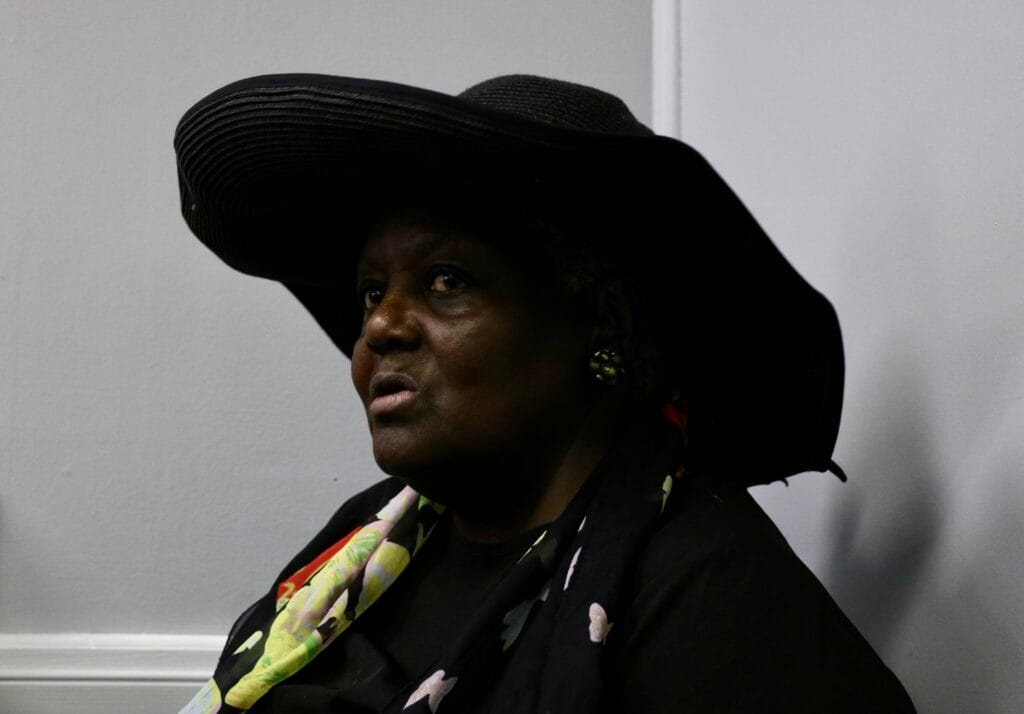
Lorraine Patterson-Davidson describes her displacement following harassment and retaliation from former landlord David Merryman, who has been convicted of numerous financial crimes and settled in a fair housing lawsuit. (Photo by Charlotte Rene Woods/Virginia Mercury)
A new settlement with Hampton Roads landlord David Merryman — who is currently serving a 17-year sentence for defrauding the federal government — means several of his former tenants will receive a piece of $2.5 million in financial compensation over the next year.
Merryman must sell his Virginia properties, numbering over 60, and can never operate as a landlord in the state again, Attorney General Jay Jones reiterated at a roundtable discussion with some of Merryman’s former tenants Wednesday in Hampton.
The settlement money can help Lorraine Patterson-Davidson and her daughter Edwina Patterson recoup some of the financial damages caused by Merryman that resulted in their displacement, the women said.
But it can’t heal emotional wounds or recover priceless family heirlooms that were lost in the process.
“There is no money that can compensate for a Bible that’s over 100 years old,” Patterson-Davidson said. “Nothing can replace that.”
The lost bible was just one of the problems the women encountered during their tenancy with Merryman. They also dealt with maintenance issues the landlord neglected; the family ended up paying for them on their own, which triggered financial setbacks.
The women said they faced multiple eviction filings and numerous occasions of racial or sexual harassment from Merryman.
Patterson, who works at Newport News ship-building, recalled sleeping in her car at times. Patterson-Davidson, a widowed military-spouse with seven other children, has had to stay with her adult kids or in hotels due to the unfair housing conditions imposed by Merryman.
The multimillion dollar settlement is the largest fair housing case payout to victims in the state’s history, Jones said at the roundtable on Wednesday.
Whether a tenant wins or loses an eviction proceeding, such records can make it challenging for people to have rental applications accepted elsewhere.
A provision of the settlement requires eviction filings against Merryman’s former residents be scrubbed. That may allow Patterson to finally be eligible for a new apartment or rental home, she said.
Her mother is afraid to rent ever again and hopes she will be able to buy a home.
Tenants describe landlord’s pattern of abuse, retaliation
The case against Merryman was first filed by former Attorney General Mark Herring in 2021 and concluded by Jones.
State courts have found that Merryman tried to evict renters like Patterson who requested repairs to their units and levied racist and sexist slurs at his predominantly Black women tenants.
“My son was afraid he was going to rape me,” Patterson said, adding that Merryman would come to her home unannounced.
“He had pictures of her body parts,” her mother said, recalling Merryman knocking on her door early one morning with no shirt on.
While the family navigates housing and financial recovery, Patterson-Davidson noted the emotional damage they are healing from.
“I’m not sure I’m the same person. But (the Bible) says ‘be angry and sin not,” she said.
Also present at the meeting with Jones was Yugonda Sample-Jones, whose experience “ignited a fire” within her for fair housing advocacy.
She described how she defended her family through tenant assertions in court, a process allowing tenants to pay their rent into escrow rather than to the landlord until maintenance issues are resolved.
Sample-Jones began educating other Merryman tenants about this tool whenever she encountered them.
The settlement is “a long time coming,” Sample-Jones said.
“We don’t have to deal with him anymore,” she said. “I’m going to stop crying (over) this fool.”
Helen Hardiman, a civil rights attorney in Jones’ office, said the first portion of Merryman’s settlement payment is expected to go out to former tenants within the next month.
From there he has to sell all his Virginia properties within a year, with proceeds from that fueling the rest of the settlement.
“Anyone who was a witness in this case is squarely on our list,” she said of ensuring payments are made and relevant eviction proceedings are remedied.
Jones’ office will work to connect with others who’ve been harmed by Merryman who have yet to be identified.
Jones framed the case as an example of law and order defending fair housing rights.
“I know that you’ve been through a lot,” Jones told the women. “But I hope what you can take away from today is this idea that you did win and you have set an example for people all across Virginia.”

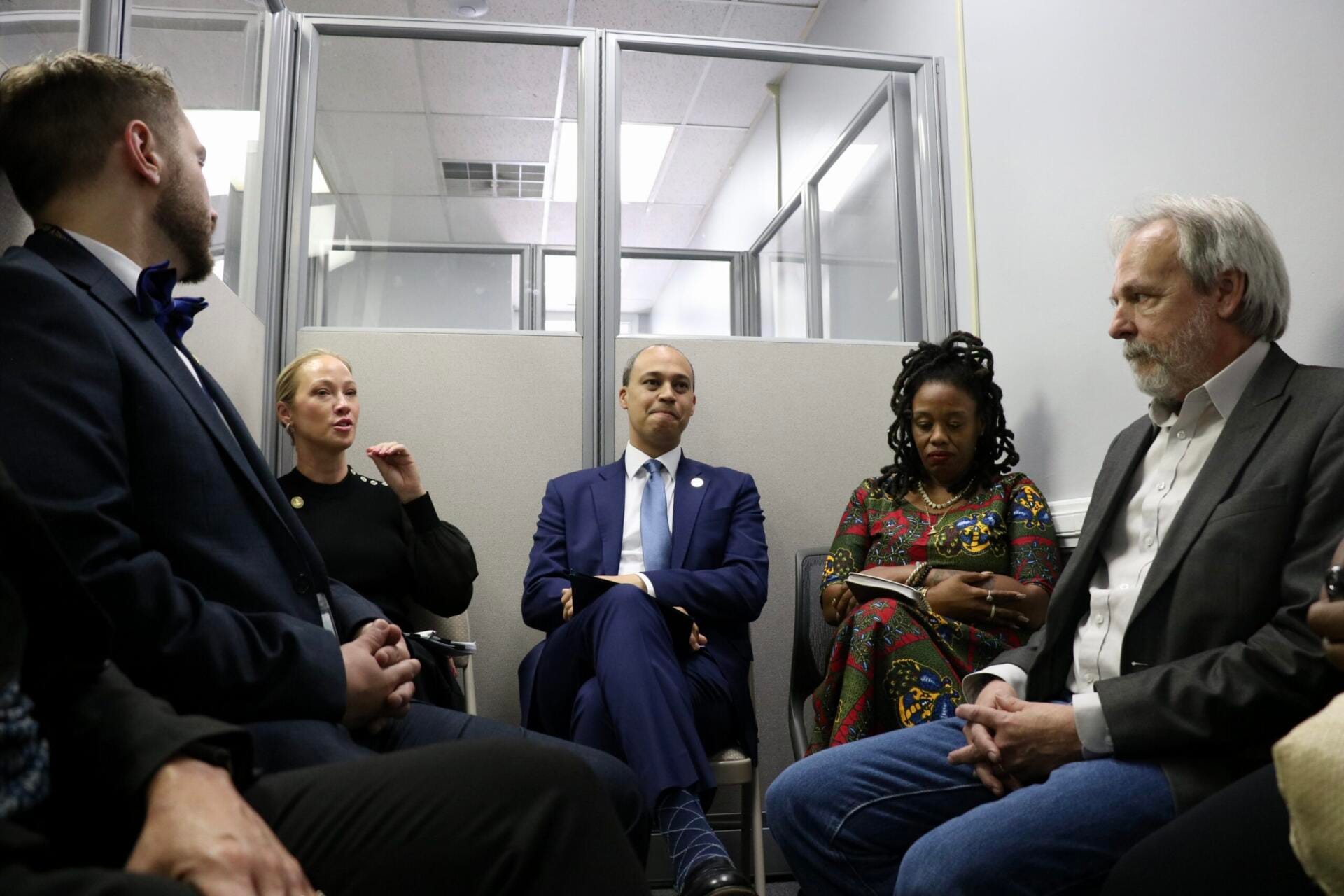
Virginia Attorney General Jay Jones (center) and members of his office meet with Legal Aid Society of Eastern Virginia staff and Hampton-area residents who’d experienced harassment and retaliation by their now-convicted landlord. (Photo by Charlotte Rene Woods/Virginia Mercury) This post was originally published on Virginia Mercury.
Voting rights anniversary spotlights America’s enduring anti-Black contempt
Civil rights stalwarts, politicians and academics held a requiem for the Voting Rights Act on its 61st anniversary last week, lamenting the neutering of a law that had propelled African Americans – especially in the South – into choosing their own leaders without fear of violence, murder or lesser polling place obstacles.
Activists didn’t call it a “funeral.” Yet no one underplayed the latest reversal of progress for Blacks, Latinos and other people of color in this nation’s long, tortured and oft-racist history.
The hollowing out of the Voting Rights Act reveals again how too many white Americans abhor notions of equality with Black Americans, and the steps they will take to hinder equitable Black and Latino representation in Congress and at the state and local levels.
President Lyndon Johnson signed the legislation on Aug. 6, 1965, several months after Alabama state troopers pummeled peaceful marchers on “Bloody Sunday.” Rulings by the U.S. Supreme Court in 2013 and earlier this year, though, have gutted one of the landmark achievements of the civil rights era.
The former decision ended federal preclearance that state and local governments – mostly in the South – had needed before changing voting procedures. (A 2023 analysis found that at least 29 states had passed 94 restrictive voting laws in the decade following that decision.)
The latter Supreme Court decision said Louisiana’s congressional map was an unconstitutional racial gerrymander – thus making it difficult to create a second majority-minority district in the U.S. House of Representatives.
“As a direct result” of Chief Justice John Roberts’ court’s “decades-long quest to undermine the right to vote, our nation is experiencing a modern-day political Jim Crow where too many Republicans act with impunity to dilute the voting power of Black and Latino communities across the country,” said Eric Holder, a former U.S. attorney general and chair of the National Democratic Redistricting Committee.
U.S. Rep. Jennifer McClellan, D-Richmond, led passage of a Virginia Voting Rights Act in 2021 while in the state Senate. It created new protections against voter discrimination based on race, color or language. It made the commonwealth an outlier across the South when providing equal access at the polls.
Virginians should feel confident about enfranchisement, McClellan told me in an interview. “But I’m fighting at the national level so that everybody’s right is protected,” she said.
However, McClellan noted of the federal law: “It’s on life support.”
That’s much too optimistic.
Henry Chambers Jr., law professor at the University of Richmond, told me the violence that was once commonplace against African Americans before the VRA became law is basically non-existent today.
State legislatures, though, can often draw districts that negate the will of voters – and keep people of color wondering whether their votes have any meaning.
“It’s possible you get people who say voting is pointless,” Chambers added. “The clearer it becomes people of color will be ignored,” the more likely they might stop heading to the polls.
That’s exactly what conservatives – including today’s Republican Party – would love to see.
Other factors include voter identification requirements and felon disenfranchisement, issues that tend to affect African Americans and Latinos moreso than whites. Virginia has been one of the toughest states for freed felons to regain civil rights. It could finally change that process – born in racism during the 1901-02 Virginia constitutional convention – through a referendum this fall.
Chambers said that If more nonwhites voted for Republicans, voter suppression tactics would decrease. Blacks and Latinos, however, usually select Democratic candidates overwhelmingly because of the party’s agenda and its embrace of their concerns.
Still, the professor added: “Blacks have historically been treated differently by the government.”
When African Americans advance in the United States, too often there’s a virulent white backlash – and not just regarding voting. It seems as if the majority wants to dehumanize people of color just to prove a point: You will never be equal.
Examples are painfully easy to cite.
Abraham Lincoln, the “Great Emancipator,” didn’t even want freed slaves to remain in the country. I guess Lincoln saw no use for Black Americans after they weren’t working for free any more.
Before the Civil War, he discussed plans to export Black people to Liberia. After the war’s start in 1861, the year he became president, Lincoln explored options to extradite freedmen to Panama and an island near Haiti.
Then in August 1862, he invited five Black men to the White House – not including Frederick Douglass, the most prominent abolitionist of the day – to urge an exodus.
“But for your race among us there could not be war,” Lincoln said, “although many men engaged on either side do not care for you one way or another,” according to David W. Blight in “Frederick Douglass, Prophet of Freedom.”
Victim-blaming at its absolute worst. Black activists and abolitionists excoriated the idea, and it never gained much traction.
The war’s end led to Reconstruction, the period from 1865 to 1877 that saw African-Americans gain political and economic clout. The reaction to the Black empowerment was swift, violent and merciless:
Jim Crow. Lynchings. Black codes. Second-class citizenship in education, employment, housing and human decency. Verdicts in criminal cases, including the murder of 14-year-old Emmett Till, that blessed white killers.

Norfolk civil rights activist Evelyn Thomas Butts (1924-1993) helped secure voting rights for African Americans, when in 1963 she initiated a federal lawsuit asserting that Virginia’s poll tax was unconstitutional. (Virginia Department of Historic Resources) Where violence wasn’t an issue, African Americans still got the shaft. Among the most notable was the passage of a GI Bill toward the end of World War II that, in practice, denied mortgages to Black veterans. Urban Renewal projects, time and time again, destroyed Black communities for a perceived “greater good” for cities.
President Donald Trump now has the gall to continue advocating for a nearly $1.8 billion, taxpayer-backed slush fund to “comfort” his supporters – including those who attacked the U.S. Capitol while trying to overthrow the 2020 presidential election.
Meanwhile, the few surviving victims of the racist siege of Black Wall Street in Tulsa, Oklahoma, in 1921 – which killed as many as 300 Black people – never were able to collect reparations in court. The Oklahoma Supreme Court dismissed their lawsuit in 2024.
With the weakening of the VRA, people of color will keep fighting for voting rights and fair representation. They fear regression.
The regret is that, in this country, it’s always been this way.
This post was originally published on Virginia Mercury.
Firefighters union censures Spanberger over collective bargaining, more Va. headlines
• “Firefighters union censures Spanberger over collective bargaining.” — Richmond Times-Dispatch
• “James City County partners with Virginia Commonwealth University to test drone defibrillator delivery.” — WHRO
• “(Virginia Lt. Gov.) Hashmi teams up with Virginia Humanities for student poetry contest.” — CBS 19
• “‘A beautiful tradition’: What goes behind the upkeep of the Appalachian Trail.” — Cardinal News
• “Virginia’s Revolutionary secret: How a church became the state capitol.” — WSET
This post was originally published on Virginia Mercury.
DOJ targets 3 more states in effort to axe in-state tuition for immigrants
WASHINGTON — The U.S. Department of Justice has sued New York, Connecticut and Vermont over laws that allow immigrants in the country without permanent legal status to pay in-state college tuition in the states where they live.
The suits, filed Aug. 10, are part of a larger push from the Trump administration to go after states with such policies, as the administration seeks to curb any benefits that could be extended to people without permanent legal status.
Since President Donald Trump re-took office, the DOJ has sued 17 states over laws that allow noncitizen students who meet certain requirements access to in-state tuition at public colleges and universities, regardless of their immigration status.
In five of those lawsuits the DOJ filed — targeting Texas, Kentucky, Nebraska, Oklahoma and Illinois — courts have already struck down the laws. All of those states, except for Illinois, had joined with the federal government rather than defend their laws.
Beyond New York, Connecticut and Vermont, lawsuits are also pending in California, Colorado, Kansas, Maryland, Massachusetts, Minnesota, New Jersey, Rhode Island and Virginia.
The lawsuits argue that the policies allow students without permanent legal status to pay drastically lower tuition for public education than U.S. citizens from other states.
“This is a simple matter of federal law: colleges cannot provide benefits to illegal aliens that they do not provide to U.S. citizens,” Assistant Attorney General Brett Shumate of the DOJ’s Civil Division said in a statement regarding the New York, Connecticut and Vermont lawsuits.
“This Department of Justice will not tolerate American students being treated like second-class citizens in their own country,” Shumate said.
Landscape of state laws
At least 20 states and Washington, D.C., offer in-state tuition to “the states’ undocumented students,” according to the Higher Ed Immigration Portal, a project of the Presidents’ Alliance on Higher Education and Immigration, a nonprofit and nonpartisan organization.
Roughly 525,000 “undocumented students” are enrolled in colleges and universities across the U.S., according to the Portal. An estimated 129,900 “undocumented students” are eligible for the Deferred Action for Childhood Arrivals program.
DACA is intended to help people brought into the country without legal documentation as children. The program, created by the Obama administration in 2012, protects participants from deportation and allows them to receive work permits and obtain driver’s licenses.
Five states, Arkansas, Idaho, Maine, Ohio and Texas, limit in-state tuition access to DACA recipients, according to the Portal.
Ongoing court battles threaten DACA recipients in Texas with the possibility of losing their ability to obtain a work permit.
‘Unprecedented’
Diego Sánchez, vice president of policy and strategy at the Presidents’ Alliance on Higher Education and Immigration, said the DOJ’s efforts to pursue states that offer in-state tuition benefits to students without permanent legal status is “unprecedented.”
“It’s a coordinated federal effort to dismantle state tuition equity policies that have existed for decades,” Sánchez told States Newsroom.
Sánchez added that the policies “do not provide free college or special tuition discounts — they generally allow students who attended and graduated from high school in the state and meet additional state requirements to pay the same in-state tuition rate as the classmates they grew up with.”
The students “still have to apply, they still have to be admitted, pay tuition and meet the same academic requirements as everyone else,” he said. “The state has already invested in these students … these are benefits that don’t only apply (to) undocumented students.”
DOJ goes after Texas first
The DOJ’s lawsuits came after Trump signed an executive order in April 2025 that calls on the U.S. attorney general to stop the enforcement of state laws and policies “favoring aliens over any groups of American citizens that are unlawful, preempted by Federal law, or otherwise unenforceable, including State laws that provide in-State higher education tuition to aliens but not to out-of-State American citizens.”
Texas was the first state the DOJ pursued over such policies.
The Justice Department challenged in June 2025 the Lone Star State’s 2001 law — the first of its kind in the country — signed by former Gov. Rick Perry, a Republican.
Rather than defend the law, Texas Attorney General Ken Paxton, a Trump-aligned Republican, sided with the DOJ to try to permanently block the state law and signed an agreement the same day the DOJ filed suit. A federal judge then blocked the Texas law.
A federal appeals court in July rejected an attempt from two advocacy groups, a Texas community college and a student to intervene in the case and defend the Texas law. The appeals effort came after the federal judge had earlier rejected the groups’ attempt to intervene.
“It’s not the end of the road yet, but it’s been an uphill battle,” said Efrén Olivares, vice president of litigation and legal strategy at the National Immigration Law Center, one of several public interest groups that sought to intervene on behalf of one of the advocacy groups, the Texas community college and the student.
“It’s a shame because for the last year, thousands of kids who, all they’re doing is trying to get a college education to better themselves and their families, are now prevented from doing so by exorbitant tuition.”
This post was originally published on Virginia Mercury.
Firefighters’ union censures Virginia governor
(The Center Square) – A national firefighters union has censured Virginia’s governor over her veto of legislation that would have expanded collective bargaining rights for public employees.
Delegates to the International Association of Fire Fighters voted unanimously Wednesday to approve the censure during the union’s convention in Arlington, Texas. The resolution was submitted by the Virginia Professional Fire Fighters, which represents more than 11,000 firefighters, emergency medical workers and 911 communications officers across the Commonwealth.
The dispute centers on House Bill 1263 and Senate Bill 378, which passed the General Assembly earlier this year and would have created a statewide collective bargaining system covering many state and local public employees.
Gov. Abigail Spanberger supported expanding collective bargaining but sought changes to the legislation before vetoing it in May.
Her amendments would have delayed implementation of the new system for local governments until Jan. 1, 2030, while making other changes aimed at addressing concerns raised by local governments.
Lawmakers rejected the amendments in April and returned the legislation to its original form.
“I support establishing collective bargaining rights for public sector employees,” Spanberger said in her veto explanation. She said additional changes were needed to create a system that was “strong, feasible, and durable.”
The veto drew criticism from labor groups that had supported Spanberger during her campaign. The firefighters union says she failed to follow through on commitments made to public safety workers.
The IAFF said it will oppose Spanberger in future federal or national political endeavors unless she takes what the union considers meaningful action to establish collective bargaining rights for Virginia firefighters and emergency medical workers.
Kurt Detrick, president of the Virginia Professional Fire Fighters, said the organization remains willing to work with Spanberger and would retract the censure if legislation is enacted.
The legislation also faced significant opposition from local governments.
The Virginia Association of Counties said roughly 70% of Virginia counties passed resolutions opposing the bills. The group argued the legislation would limit local decision-making, create new administrative and fiscal obligations and give a state Public Employee Relations Board authority over local labor relations.
VACo urged Spanberger to veto the legislation after lawmakers rejected her amendments.
Virginia law currently allows local governments to choose whether to authorize collective bargaining with their employees.
This post was originally published on The Center Square.
Three amendments head to Virginia voters this fall
(The Center Square) – Virginia voters will decide three proposed changes to the state Constitution this fall.
The questions deal with reproductive freedom, marriage and voting rights for people convicted of felonies. All three will appear on the Nov. 3 ballot.
The General Assembly approved each amendment in two consecutive sessions, as required before a proposed constitutional amendment can go before voters.
The first question would add a fundamental right to reproductive freedom to the Virginia Constitution.
It would protect decisions involving prenatal care, childbirth, postpartum care, contraception, abortion, miscarriage management and fertility care. The amendment would allow Virginia to regulate abortion during the third trimester but would require exceptions when a physician determines an abortion is needed to protect the life or physical or mental health of the pregnant woman or when the fetus is not viable.
Virginia’s Constitution currently does not explicitly guarantee a right to reproductive freedom.
The second question deals with marriage.
Virginia’s Constitution still contains language defining marriage as between one man and one woman, although that provision has not been enforceable since the U.S. Supreme Court legalized same-sex marriage nationwide in 2015.
The amendment would remove that language and establish a right for two adults to marry regardless of sex, gender or race. It would also require Virginia to recognize lawful marriages equally.
The third question would change when people convicted of felonies can vote.
Under the amendment, a person convicted of a felony would be unable to vote while incarcerated but would automatically regain voting rights upon release. It would also establish a fundamental right to vote in Virginia and change the Constitution’s language concerning people who lack the capacity to understand the act of voting.
The current system has already changed this year. A federal court ruled in January that, under the Virginia Readmission Act, people can lose their voting rights only for felony offenses that correspond to felonies recognized at common law in 1870.
The Virginia Department of Elections says people whose offenses do not fall into those categories may register without first having their rights restored by the governor. People convicted of offenses that do correspond to those common-law felonies still need gubernatorial restoration. Some cases require additional review by the attorney general’s office.
Gov. Abigail Spanberger announced July 31 that her administration had restored voting rights to 66,085 Virginians since she took office in January.
Polling earlier this year found majority support for two of the amendments.
A Wason Center survey at Christopher Newport University found 66% of registered Virginia voters supported a constitutional amendment protecting reproductive rights, while 64% supported automatically restoring voting rights after a prison sentence.
The survey was conducted Jan. 13-20 among 807 registered voters and had a margin of error of plus or minus 4.4 percentage points.
Early in-person voting for the Nov. 3 election begins Sept. 18 and runs through Oct. 31.
This post was originally published on The Center Square.
ICE agent pulls gun on Virginia woman who yelled at them in parking lot, more headlines
• “Virginia sets clearer triggers for nursing home sanctions.” — Axios Richmond
• “‘ICE agent pulls gun on Virginia woman who yelled at them in parking lot.” — NBC News
• “Zero sanitizer found at McLean-area restaurant.” — Patch
• “Virginia Department of Conservation and Recreation adopts master plan for future Mayo River State Park.” — WSLS
• “Three charged after 60+ reptiles stolen from pet stores across Virginia, Maryland.” — DC News Now
This post was originally published on Virginia Mercury.
Dominion asks SCC to recover an additional $922 million for fuel costs over multiple years
Dominion Energy asked the State Corporation Commission to recover an additional $922 million in fuel costs, citing extreme power demands during as well as a national rise in gas prices as reasons for the escalation beyond its original calculations
SCC staff reported that Dominion’s “actual fuel and purchased power expenses rose dramatically from approximately $1.7 billion in 2020 to $4.4 billion in 2025, an increase of $2.7 billion, or 152%, over a five-year period.”
The “fuel factor” portion of monthly bills is a pass-through cost, meaning Dominion does not make a profit off the fuel expenses and can pass up to 100% of the cost to customers.
Instead of recovering those extra costs over the course of a typical year, which would add an estimated $21 a month on the average residential customer bill, Dominion has proposed securitizing those costs over a seven to 10-year period. This would reduce the monthly increase to around $8, depending on the mitigation plan selected.
Securitizing means the company will put their unrecovered costs to be sold as bonds. Creditors will purchase those bonds and Dominion can recover the cost to pay back those bonds over time.
But environmental advocates said this is a familiar and unwelcome request from the state’s largest utility.
“Effectively taking on a mortgage, that will mean customers will be paying those costs plus interest over a decade, unfortunately, this is not a new thing,” Appalachian Voices representative Grayson Holmes said.
“In three of the past five years, Dominion has underestimated its fuel costs by 1 billion or more. And in 2023 it also asked the commission to securitize about $1 billion in fuel costs. We still have about five years to go on that mortgage, and now Dominion is seeking a second one,” Holmes added, according to case documents.
Dominion argued that they regularly look for ways to reduce customer exposure to the volatile energy markets, but it can be a challenge as they work to build out their own energy profile to meet demand.
The increase in cost is partially due to the increase of gas prices. The power purchase price tag for energy Dominion has to buy from the regional grid operator PJM is continually changing as well, due to increased demand across the region.
“It is important to recognize that the Company’s most significant and effective hedge against PJM energy market prices is its owned and contracted generation portfolio,” K. Scott Gaskill stated in his rebuttal testimony filed on July 28.
Dominion also suggested in Gaskill’s rebuttal advocacy for the state’s return to the Regional Greenhouse Gas Initiative also exacerbates the power purchasing demands.
SCC staff member Carol Myers wrote in her testimony for the case that Dominion may not have accurately calculated the load growth in their Virginia territory into their fuel needs.
“Staff believes that the company’s purchased power expense forecasts did not fully capture these changing dynamics, contributing to the significant under-recovery balances the Company has experienced recently,” Myer’s testimony stated.
However, the SCC staff did not take a position on a cost recovery mechanism, leaving that fully up to the commissioners to decide. Consumer advocates said that in future cases, Dominion should have to analyze the root causes for the repeated increases in fuel and power purchasing demands.
“It would be good to kind of look into these questions of why a winter storm can cause that much of a spike,” Holmes said. “It does seem like a good chunk of it is data center load, and the fact that load is increasing so much relative to the company’s generation fleet, but it also does look like volatile gas prices, and susceptibility to extreme weather does all play a role in it.”
Del. Irene Shin, D-Fairfax, testified in the case and highlighted her recently passed legislation directing the SCC to consider if the fuel purchasing practices by Phase II and Phase I utilities, including Dominion, are being managed in an efficient way.
“I ask the commission to hold Dominion accountable for the planning and purchasing decisions that are squarely within their control, require Dominion to justify every dollar it seeks, reject any costs not shown to be prudent, and to take real steps towards correcting this moral hazard,” Shin said on Tuesday during the hearing.
That law did not go into effect until July 1, after the documents for this case had already been filed. Shin told the commissioners in her testimony that that does not preclude them from applying those considerations in this case.
SCC Staff suggested through Myer’s testimony that in the next fuel factor case, Dominion should analyze the “root cause analysis of the growing power purchase quantities and high prices.”
The utility should also consider “potential solutions to minimize weather-driven Fuel Factor under-recoveries going-forward” that would help minimize the impact of severe weather on the fuel factor and customers’ bills as much as possible.
This post was originally published on Virginia Mercury.
Va. school board to appeal federal court order to remove Confederate school names

Stonewall Jackson High School in Shenandoah County, Virginia. (Nathaniel Cline/Virginia Mercury)
After more than two hours in the second of two closed sessions, the Shenandoah County School Board voted unanimously 6-0 Thursday night to appeal a federal court’s order for the district to remove Confederate names from schools in the county. It may cost millions in taxpayer dollars to contest the decision.
Judge: Shenandoah School Board violated students’ civil rights by reinstating Confederate names
On Aug. 6, U.S. District Court Judge Michael F. Urbanski ruled in favor of the Virginia State Conference of the NAACP and families of six students who sued over the school names. Urbanski found the district’s decision to rebrand the schools with the names of Confederate generals violated multiple civil rights laws and ordered the district to remove them immediately.
The board met Thursday for the first time since the verdict was released, hearing from multiple speakers, with some advocating that the board appeal and fight for the names, and others urging them to move on and avoid the potential costs.
Before going into a closed session on Thursday, the board said it wanted to defend what it views as its lawful local authority over school naming and to challenge what it considers legal, procedural, and factual errors in the district court’s ruling.
“When a federal court’s remedy reaches directly into that local decision-making authority, I believe this board has every right and a responsibility to carefully examine whether that solution is legally justified and whether review by appeals is appropriate,” Board Vice Chair Whitney Pence said at the meeting.
Urbanski wrote that by renaming schools after Gens. Turner Ashby, Robert E. Lee, and Thomas “Stonewall” Jackson in 2024, the school board violated the students’ First Amendment rights, the 14th Amendment, the Civil Rights Act and the Equal Educational Opportunities Act.
AD Carter, a former student and one of the plaintiffs in the case, this week reflected on his time at Stonewall Jackson before deciding to join the case two years ago.
“I thought deeply about this case, not only because I’m a Black student in Shenandoah County, who walked under the name Stonewall Jackson every day, but also because I knew it would affect future students attending the renamed Stonewall Jackson High School,” Carter said in an interview. “I didn’t want anyone else to have to go through what I experienced. I really wanted future students to have hope for a brighter day.”
The schools had been rebranded in 2021 to strip the names of the Confederates, who seceded from the United States during the Civil War and fought to continue enslaving Black people. But in 2024, the school board argued that its decision to restore the names was necessary to “restore the public’s trust.”
One area the board sought to challenge was the alleged legal error in finding the board liable without a finding of racial intent, members said.
Board members also argued that an appeal is the proper legal remedy to protect taxpayers and the county from a potentially costly settlement and to resist what they perceive as undue external pressure on local governance.
Plaintiffs proffered remedy that board rejected
A few days before the board meeting, the legal team representing the Virginia State Conference of the NAACP and families of six students sent to the board’s defense counsel a proposal to resolve the issue.
“Where we go from here rests entirely with the school board,” the plaintiffs’ legal team wrote. “We are once again trying to provide an off-ramp to bring a prompt resolution to this litigation … while … ensuring that the school board’s illegal and unconstitutional conduct is quickly remedied and … its schools no longer serve as memorials to the Confederacy and are welcoming institutions for all American school children.”
According to the letter sent to the board’s defense, the plaintiffs’ legal team — The Washington Lawyers’ Committee, Covington & Burling LLP, and Holland & Knight LLP — wrote that their clients are offering to fund a private mediator to establish a “community-driven” renaming process and resolve legal fees.
Under the proposed terms, the board would agree to stop using the Confederate names by Monday, choose a mediator both sides accept by Aug. 31, and finish mediation by Sept. 30.
“Should the school board once again elect to continue this litigation by pursuing an appeal, we are respectfully putting you and the school board on notice that we will not agree to any discounting of the amount of costs and fees following such an appeal,” the legal team wrote.
The cost to the school board for this case could be substantial and is expected to rise if the board decides to appeal, including the plaintiffs’ additional costs and fees for opposing the appeal.
The letter says the board has incurred about $500,000 in actual costs related to the litigation, while total attorneys’ fees have exceeded $15 million.
The plaintiffs plan to file a petition for approximately $7 to 10 million in legal fees. This request reflects a voluntary reduction of approximately $6 to 8 million from the total fees incurred, intended to ensure the rates and scope of work are consistent with what a court would likely deem reasonable, the legal team said.
They have reminded the board multiple times about its liability for attorneys’ fees, the plaintiffs’ lawyers said, dating back to last September.
If the board chooses to appeal, the attorneys stated the cost will be “significantly higher,” largely because the final award would then include the “enormous additional costs and fees” required for the plaintiffs to oppose the appeal.
In response, board member Lewis Michael Scheibe said Thursday, “We may be a small county and a small school board, but we should not be bullied by strong-arm tactics by an organization that is claiming to want to protect the kids.”
“Appeals are there for a reason. It is part of the legal process,” Scheibe added.
This post was originally published on Virginia Mercury.
Beyond the Flags: Five Lines VA811 May Not Mark

File image of utility locate flags and spray-painted markings in a residential yard beside a shovel and freshly disturbed soil. This week’s VA811 Day is designed to remind commonwealth residents to contact Virginia 811 before starting any project that disturbs the ground.
Submitting a request at VA811.com or by calling 811 gives utility companies time to mark the approximate locations of their underground lines. But those colorful flags and paint may not tell the whole story.
This year, Rappahannock Electric Cooperative (REC) reminds members to be mindful not only of what Virginia 811 marks, but also of what it may not mark. Some lines on private property belong to the homeowner rather than a utility company and may not be included in the standard locating process.
Before digging, watch for these five common examples:
1. Power lines beyond the meter
Underground wiring to a detached garage, shed, barn, workshop, landscape lighting or other outdoor feature may be privately owned.
2. Water and sewer lines on private property
The portion of a water or sewer line between the home and the utility connection may be the homeowner’s responsibility and may not be marked.
3. Septic systems
Septic tanks, drain fields and connecting pipes are private facilities. Property records, installation plans or local health department records may help identify their locations.
4. Propane tanks and fuel lines
Underground propane tanks and the lines serving homes, generators or appliances may require help from the propane provider or a private utility locator.
5. Irrigation and other outdoor systems
Sprinkler systems, invisible pet fences, landscape lighting and some communications lines may be buried only a few inches below the surface.
Contacting Virginia 811 should always be the first step before digging. The next step is looking beyond the marks.
Check property records, ask about previous improvements and consider whether a private locator is needed. A few extra questions before the shovel hits the ground can help prevent damaged equipment, interrupted service and serious safety hazards.
To submit a locate request, visit VA811.com or call 811.
About Rappahannock Electric Cooperative
Serving more than 185,000 connections across portions of 22 Virginia counties, REC is a pillar in its communities, with over 18,000 miles of power lines extending from the Blue Ridge Mountains to the Chesapeake Bay. For more information about REC, please visit www.myrec.coop. Follow REC on Facebook, X, Instagram, LinkedIn and YouTube.
Trump administration urges Supreme Court to rule soon on limiting vote-by-mail in midterms
The Trump administration on Wednesday renewed its request to the U.S. Supreme Court to quickly decide a case over an executive order restricting voting, a day after a Massachusetts federal judge expanded an injunction on the order nationwide.
The Tuesday order from U.S. District Judge Indira Talwani that blocked President Donald Trump’s executive order from taking effect anywhere in the country makes the administration’s request to the Supreme Court more urgent, U.S. Solicitor General D. John Sauer wrote.
“The district court’s new order confirms the urgent need for this Court to grant the stay of the permanent injunction and to explain its rationale for doing so,” Sauer wrote.
Election Day is Nov. 3, less than three months away.
Decisions in two cases at district and circuit courts have reached different conclusions about whether the rulemaking could continue in the lead-up to this fall’s elections.
That means the Supreme Court’s decision, now on its emergency docket, will likely determine whether the executive order can move forward. A decision could come any day.
The Trump executive order would limit vote-by-mail, the primary method of voting in several states, especially in the West.
It would require states to send the federal government lists of voters who intend to vote by mail ahead of the election and restrict the U.S. Postal Service from delivering ballots to or from people not on the list, among other things.
The administration has sought to focus arguments on the narrow legal question of whether an executive order can be challenged before an agency, in this case the U.S. Postal Service and the Department of Homeland Security, issues a final rule. The government argues that the executive order only instructs the agencies to issue rules, and those rules are not yet final, and therefore cannot be challenged.
Trial court order
Talwani’s memorandum and order on Tuesday rejected that argument, and she expanded a previous injunction from just the 23 states and the District of Columbia that brought the suit to be effective nationwide.
Talwani said — in her order published just 12 weeks before Election Day — she was only blocking the order with respect to the “fast-approaching” midterms. Further arguments over the merits of federal voting regulations could still happen, but federal law requires the status quo to be preserved this close to an election, she said.
Because of the tight timeline and the assumption that a final rule will be similar to a June 2 notice of proposed rulemaking, Talwani said she could rule simply on the constitutionality of the executive order. It was an easy call, she said.
“The executive branch has no authority to regulate elections,” she wrote, citing the Constitution.
The administration has not shown how blocking the executive order would harm the public, as it has not documented any “illegal or fraudulent absentee voting,” while the voting rights organizations challenging the order have shown that voters with disabilities, in rural areas, who need translation help, attend college outside their home states and in other circumstances would be harmed, she said.
In fact, the organizations showed their members in states across the country are already being harmed by the uncertainty around what rules will govern the midterm elections, said Talwani.
“Where the (executive order) is presently causing confusion and threatening both increasing chaos and an erosion of trust in our democracy, the court finds that enfranchisement heavily outweighs the executive’s attempt to unconstitutionally insert itself into the domain of election regulation,” Talwani wrote. The proximity to Election Day “underscores the critical need for an injunction to prevent Defendants from changing election rules on the eve of the election.”
The Federal Voter Registration Act also prohibits states from purging voter rolls within 90 days of an election, Talwani wrote.
DOJ’s double bind
The nature of the argument puts Sauer and the U.S. Department of Justice in a seemingly difficult legal position, arguing both that the executive order cannot be challenged because it is not enforceable and that the administration must be allowed to put an enforceable rule in place before Election Day.
Sauer asked the court Wednesday to rule for the government and “make clear” that it was doing so “based on the uncertainty concerning the government’s future actions.”
But in the next paragraph, he said implementing the executive order was crucial to the public interest.
“In all events, it is critical that the Court act promptly on the pending stay,” Sauer said. “Otherwise, the district court’s erroneous orders will effectively run out the clock on the government’s ability to implement Section 3 of the Executive Order for the federal elections in November, thereby causing irreparable harm to the federal government, the public, and election integrity.”
This post was originally published on Virginia Mercury.
This program helps Virginia military members place their pets with carers during deployment
While living alone in an apartment in Hampton Roads, about 20 minutes from his work as an E5 (petty officer, second class) at Naval Station Norfolk, David Morrow decided it was time to look for an animal companion to enrich his time off-base.
“My little dog, named Lola, (is) a very energetic lab. She’s about four,” said SCA2 David Morrow. “I picked her up from the shelter in August of last year. I wanted somebody around in the house, she seemed the most comfortable with me.”
Several months ago, Morrow got word that he was about to be deployed.
“My ship had just come back from a normal exercise and then we got told right after the exercise that, ‘Hey, in about 2 weeks, we’re going to be deploying,’” he said. “It kind of freaked me out a little bit because we had a different schedule initially. But things changed due to the geopolitical climate.”
Morrow needed to quickly find a home for Lola while he was away, which could last for months or years. First, he checked the pet sitter site Rover.
“They’re super, super expensive,” he said. “I’m (also) looking for military options, but they just didn’t have any openings.”
That’s when he came across the website Operation Foster.

David Morrow, was a petty officer, second class at Naval Station Norfolk when he worked with Operation Foster to place his dog Lola with a temporary owner during his deployment. (Photo courtesy David Morrow) The nonprofit specializes in placing the pets of military personnel into temporary foster homes while the service members are deployed or are seeking treatment for conditions like Post-Traumatic Stress Disorder. Operation Foster falls under the umbrella of the PACT Act, which is part of veterans’ healthcare benefits.
Morrow’s failed search for other military options to help him with Lola left him jaded, but he tried Operation Foster anyway.
“I reached out on a Tuesday. They got back to me Wednesday afternoon. They found somebody within two days,” he said. Lola was eventually placed with a foster home in Westwood, New Jersey.
Operation Foster has fostered and reunited over 3,500 pets nationwide, said Giselle Boretto Fetterman, the organization’s development director.
“It’s not just dogs. It’s been dogs, cats, bunnies, snakes and a horse. And all kinds of reptiles,” Fetterman said. “We’ve learned that folks in the military really have interesting pets. In life, you don’t plan for a crisis, right?”
How it works
Signing up an animal for foster care is an easy process, said Jody McGovern, the nonprofit’s operations specialist. There’s an application form on the website that ends up in McGovern’s inbox.
“We do a qualification process, making sure that animals are up to date on vaccines, that they’re fixed, that they have a good temperament, and that nobody’s aggressive,” she said.
“Once they’re qualified, it goes over to our foster coordinator and she tries to find a foster in our database. And if for some reason, we don’t have somebody, we also post online and on social media, and we do outreach to try to find more.”
Once a pet is placed, it’s up to the owner to pay for all care and expenses.
“We actually have a process, where basically if it’s vet care, the owner leaves a credit card with the vet so that the foster never has to pay ahead. We also have them set up online pet supplies so food, any supplies the pets need, are being automatically delivered,” said McGovern.
And, as was the case for Morrow’s labrador Lola, the foster may not be in the same location as the veteran. The goal is to keep the pet as local as possible, with an understanding that military members are very transient.
“Oftentimes we’ll get a placement and they’ll say, ‘this is where I’m based out of, but I’m actually in training (in) this other state. And then I’m going to be moving to this place’” Fetterman explained. “There are cases where the foster is literally your physical neighbor, and we love when that happens, but that’s not always the case.”
For Fredericksburg resident Wendy Weldon, the choice to foster a veteran’s animal was a no brainer. She has family in the military and knows how to take care of pets. But it was her first time being a temporary pet parent.
“I started looking on the internet after we lost our dog Duke last year, and Operation Foster came up,” she said. “I was interested in any dog, but then Chopper came up and I was like, ‘oh, he’s really cute. We could probably do that.’”
Chopper, whose owner is in the Marine Corps Reserves, is from Massachusetts. He’s been with Weldon since January who regularly sends updates to Chopper’s owner, Pfc. Samuel Compail.
“We’ve been able to communicate via pictures, texts. I send him information, (such as) vet bills and food costs,” Weldon said. “He’s 21 years old and he’s so responsible.”
Fetterman said that Operation Foster has helped foster veteran’s animals in all 50 states, including many who live in rural areas of the country that lack a solid fostering community.
She added that many vets now have options when they’re about to deploy or when they’re trying to seek medical help, thanks to the program.
“Now they’re finally at this point in their life deciding to seek mental health treatment or to address an old PTSD they’ve been carrying all this time. And there may not be someone in the community that is available,” she said.
“ In those cases, we ask them, ‘What’s the distance that you’re comfortable expanding?’ … We have to be creative and our goal is always a successful match, a successful reunification.”
Fetterman said they also partner with different shelters and organizations to achieve that goal.
“We’ve worked with domestic violence situations and shelters will tell you, there are women that will not leave a domestic situation because they’re worried about their dog,” said Fetterman.
They also partner with Roger, the hotline for suicide prevention for current active military personnel and veterans.
“If you call 988 anywhere in the country, you are directly connected to a suicide crisis (specialist). When they start asking you questions, they’ll ask you, ‘Are you a veteran?’ If you’re a veteran and they ask, ‘do you have a pet,’ they’ll refer them to us,” Fetterman said.
The best part of the fostering process, McGovern said, is when they hear back from either the foster family or from the veteran who sought help.
“There was a soldier and her husband, both deployed. They had two dogs, and they were only supposed to be gone for two years, but it got extended (and) ended up being away for three years. The video that they sent us was incredible,” said McGovern. “Those dogs remembered exactly who they were, practically knocked her over.”
This post was originally published on Virginia Mercury.
Dominion fuel case puts focus on customer bills
(The Center Square) – A typical Dominion Energy residential customer is already paying about $8 more per month for fuel, and another roughly $13 could be added depending on how Virginia regulators decide the utility should recover deferred fuel costs.
The State Corporation Commission spent two days considering Dominion’s fuel costs and how the company should recover money it has already spent but has not yet collected from customers.
Dominion is asking the commission to approve a fuel factor of 3.7648 cents per kilowatt-hour for the July 2026 through June 2027 fuel year. That rate is already being charged on an interim basis.
The larger question is how Dominion should recover its deferred fuel costs.
Recovering the money through the traditional fuel factor could add roughly another $13 per month to a typical residential bill.
Dominion has also asked to recover the costs through securitization, which would spread payments over several years and reduce the immediate impact on monthly bills.
A 10-year option would add about $1.75 per month to a typical residential bill. A seven-year option would add about $2.25. SCC staff recommended the seven-year option if the commission approves securitization, and Dominion said it would not oppose it.
Much of Wednesday’s testimony and closing arguments focused on what is driving higher fuel and purchased-power costs.
Company witness Scott Gaskill said electricity prices in the PJM regional market have become more volatile and difficult to forecast as supply and demand have tightened.
SCC staff said it has seen a concerning trend of Dominion purchasing more electricity when its own generation falls short, combined with rising market prices and significant load growth in the company’s service territory.
Staff recommended Dominion further examine what is driving those costs and consider different ways of allocating fuel expenses that could reduce the effect of high-load customers.
The Office of the Attorney General’s Consumer Counsel said evidence in the case suggested data center load growth is a primary driver of increased exposure to market prices and purchased-power costs, and supported staff’s recommended analyses.
Virginia’s electricity demand has grown sharply in recent years. The U.S. Energy Information Administration reported that summer peak load in PJM’s Dominion zone reached 23,905 megawatts in 2025, 23% higher than in 2019.
Dominion has said its own generation provides protection from volatile PJM prices because electricity produced by its resources reduces how much power it must buy from the regional market.
The utility is also seeking approval for its proposed $67 billion combination with NextEra Energy in a separate SCC case. The companies have said the combination would increase their ability to invest in generation, transmission and the electric grid as demand grows.
Gov. Abigail Spanberger has moved to intervene in the merger review, raising questions about what the deal could mean for Virginia customers and the Commonwealth’s energy future.
This post was originally published on The Center Square.