
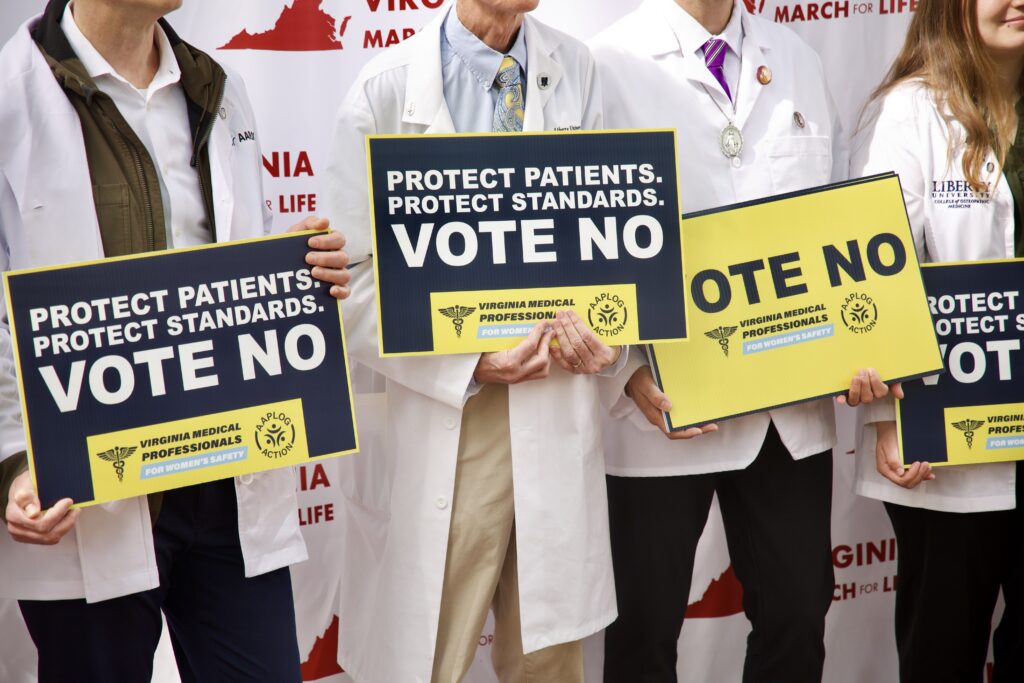
As OBGYN Dr. Christina Francis stood in Virginia’s General Assembly Building earlier this month to speak against a proposed reproductive rights constitutional amendment, she said that voters “should not look at this as a political issue.”
But the ballot referendum to enshrine reproductive rights into Virginia’s constitution — along with the surge of states enacting bans, restrictions or protections like Virginia’s proposal — has prompted doctors here and across the nation to wade into the increasingly-heated political discourse.
VCU Health fetal medicine doctor Edward Springel, who works blocks from the state Capitol, joined Francis and a handful of other medical professionals in downtown Richmond that day.
He said that he typically doesn’t get involved in politics, but that the language of Virginia’s pending reproductive rights constitutional amendment prompted him to publicly oppose it.
Doctors like Springel and Francis argue the amendment could reduce safety standards for abortions at all stages of pregnancy or make it too easy for people to get them in the first place.
Other medical professionals who support the amendment say it would cement Virginians’ reproductive healthcare rights and bodily autonomy, after the Supreme Court overturned federal protections for abortion four years ago.
Current law allows abortions to the end of the second trimester for any reason with three physicians’ needed to approve third trimester abortions should the life or health of the pregnant person be “irremediably impaired.”
With the addition of contraception and fertility treatment protections, the amendment would essentially affirm Virginia’s current law. However, the language would reduce the three-physician requirement to one.
Proponents argue this is helpful for rural patients who have to travel further for care or during dire emergencies. Opponents, like Springel, say less consultation reduces safety.
As survival rates for fetuses increase around 25 weeks of pregnancy onward, Springel suggested that premature births could be sought instead of third trimester abortions amid life-threatening complications.
“The baby could be delivered alive, and then you would have two living patients,” he said.
But Dr. Kimi Chernoby, a Northern Virginia-based emergency medicine doctor who supports the amendment, stressed that every pregnancy is different.
“People are getting third-trimester abortions for things like fatal fetal anomalies, where they know that the fetus does not have a chance of survival,” Chernoby said.
“No one,” Chernoby said for example, “is doing an induction at 17 weeks and thinking that there is going to be a survivable birth.”
Third-trimester abortions, which make up 1% of the procedure nationwide, are often due to a late-developing issue with the fetus or parent, a National Institutes of Health study found.
Such abortions also typically occur closer to the start of the third trimester than later into it, an American Medical Association study indicated, usually because the issues weren’t detected or fully diagnosed until then, according to another NIH study.
Constitutional: The amendment that could permanently protect reproductive rights in Virginia
Abortions earlier in a pregnancy can also be health-related, but may also be socio-economic or personal reasons Dr. Ramesh Shanthi, an OB/GYN with Planned Parenthood, said. She’s seen various reasons play out for her patients that have sought her care.
A pregnant patient who’d recently given birth, she said for example, who didn’t realize she could conceive again so soon may be not ready for another child.
“Others are caring for a special needs child, caring for an elderly family member, finishing school, in the military, or ending a relationship with a partner they didn’t want to parent with,” Ramesh explained.
In her outpatient care work, Ramesh regularly encounters people in earlier stages of their pregnancies that seek prenatal care or abortions.
Conversely, Springel tends to encounter patients for whom abortion is a last resort, as a high risk pregnancy specialist within a hospital setting.
Springel said he doesn’t support abortions happening “for social reasons.”
He and other doctors affiliated with the American Association of Pro-Life OBGYNs allege that the amendment could override Virginia’s existing abortion restrictions and make it too easy to obtain at all stages.
The only existing abortion restriction the amendment would alter is reducing the three-doctor requirement to one.
Francis, who helms APPLOG, said that it would also allow the procedure “to be done by unlicensed providers in unlicensed facilities,” an unproven claim that has no factual basis within the amendment’s language.
State agencies already regulate safety standards of medical facilities, a point Ramesh highlighted.
Chernoby added that “unlicensed care” is already happening in non-medical centers designed to dissuade people from abortions.
Known as crisis pregnancy centers or pregnancy resource centers, such facilities offer diapers, formula or financial assistance to distressed people and encourage them to keep their pregnancies.
Though some of these facilities offer pregnancy tests and ultrasounds, most are not medical centers. Because they don’t bill insurance for their services, they are not subject to patient privacy standards and are not treated as medical centers.
That can get risky, Chernoby said.
As conditions like internal bleeding or clotting along with ectopic pregnancies can be detected in early ultrasounds, if not interpreted properly, patients may not seek appropriate follow-up medical care.
Chernoby said she has cared for patients in the emergency department who’d previously received an ultrasound at a center and not realized they had complications.
Medical debates aside, the matter is still political and personal.
Every Republican in Virginia’s legislature voted against sending the Democrat-led referendum to ballots. The amendment cleared Virginia’s legislature for the first time in 2025 and passed again earlier this year, as required by state law to make it to ballots.
House Majority Leader Charniele Herring, D-Alexandria, said people “are tired of their freedom being a political football.”
With the matter now out of the hands of Virginia’s 140 state lawmakers, Herring said that ultimately, “the voters will decide.”
Early voting runs through Oct. 31 and Election Day is Nov. 3.
This post was originally published on Virginia Mercury.