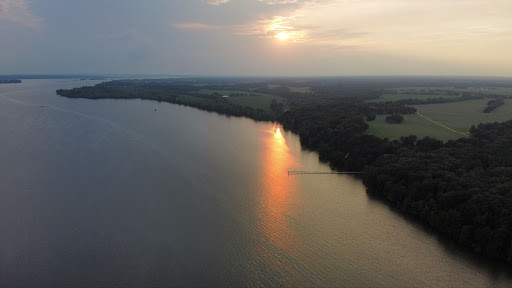
Clean water is not simply a resource. It is the foundation of our health, our culture and our identity.
For the Chickahominy Indian Tribe, Virginia’s rivers, wetlands and landscapes are living connections to our ancestors and to the generations who will come after us. They sustain fish and wildlife, support our traditions and remind us of a responsibility that has endured for centuries: to care for the lands and waters of Tsenacommacah, our ancestral homelands.
That is why the Virginia Department of Environmental Quality should not approve a stormwater permit for Richmond International Airport that allows PFAS pollution to continue without enforceable limits.
DEQ’s proposed permit includes requirements for monitoring and a pollution minimization plan. Those measures are better than doing nothing. But they are not enough.
Monitoring pollution after it occurs does not prevent that pollution from entering Virginia’s waterways. And a plan to minimize pollution without enforceable limits leaves too much to voluntary compliance.
Virginia can and should do better.
PFAS — per- and polyfluoroalkyl substances — are known as “forever chemicals” because they persist in the environment. They can accumulate in water, soil, fish and wildlife, and exposure to certain PFAS has been associated with serious human health concerns. Once these chemicals enter the environment, they can remain there for years and move beyond the place where they were originally released.
That makes PFAS fundamentally different from an ordinary, short-lived pollutant. The consequences of a decision made today can follow a watershed for decades. For the Chickahominy Tribe, that matters deeply.
Our relationship with Virginia’s waters is not new. Rivers, wetlands, fisheries and the natural resources around them have long been part of our communities and our cultural traditions. These places connect us to our ancestors and provide opportunities to pass knowledge and responsibilities from one generation to the next.
When those waters are polluted, the damage is not confined to a technical measurement in a permit or a line on a monitoring report. It can affect the resources our people rely on, the places where traditions are practiced and the ability of future generations to maintain those connections.
That is why protecting water quality is also a matter of honoring the relationship between Tribal Nations and the commonwealth of Virginia.
Our relationship with Virginia is rooted in the Treaty of Middle Plantation, entered into in 1677 between the English Crown and Virginia Indian Tribes following Bacon’s Rebellion.
The treaty affirmed the continued existence of Virginia’s Tribal Nations, acknowledged our relationship with the Crown and recognized our connection to our communities and homelands.
The legal framework surrounding Tribal rights and governmental relationships has evolved since then. But the history remains important. Virginia’s Tribal Nations are not newcomers asking to be heard about what happens to these lands and waters. We are part of Virginia’s history and present, with enduring responsibilities to the places our ancestors called home.
Those responsibilities do not end with a particular parcel of land. Water does not recognize political boundaries. What enters a watershed upstream can affect communities, ecosystems, wildlife and cultural resources downstream — including resources within our ancestral homelands.
That is precisely why the commonwealth should act before contamination becomes a larger problem.
Richmond International Airport has committed to ending the use of PFAS-containing firefighting foam by 2030. That is a positive step, but it is not a substitute for action now.
Decades of PFAS use have already left a legacy of contamination, and ending future use does not make existing contamination disappear.
Nor should Virginians be asked to accept pollution today in exchange for a promise that conditions may improve years from now.
The purpose of environmental regulation is not simply to document harm. It is to prevent harm where we can.
DEQ has an opportunity to do that through this permit.
Enforceable PFAS discharge limits would provide a clear standard and a meaningful mechanism for accountability. They would tell the airport, downstream communities and Tribal Nations that preventing pollution is a requirement, not merely a goal.
They would also establish that Virginia takes seriously its responsibility to protect water resources before contamination spreads and becomes more difficult — and more expensive — to address.
Some may argue that additional requirements are unnecessary because PFAS use will eventually end. But “eventually” is not good enough when we are dealing with chemicals that can persist for decades.
Some may argue that monitoring will give regulators the information they need. It will. But information is not protection by itself.
If we know pollution is occurring, the responsible response should be to stop or reduce it — not simply to keep measuring it.
Virginians deserve more than a paper trail showing that pollution occurred. They deserve clean water. They deserve healthy rivers and wetlands. They deserve healthy fisheries and wildlife. AndTribal Nations deserve to know that the Commonwealth’s environmental decisions recognize the cultural and historical significance of the waters that connect our communities to our ancestral homelands.
The Chickahominy Indian Tribe’s Environmental Office urges DEQ to strengthen the proposed Richmond International Airport stormwater permit by establishing enforceable limits on PFAS discharges.
This is a decision about more than one airport and more than one pollutant. It is a test of whether Virginia is willing to prevent contamination rather than simply document it; whether environmental protections will have the force of law behind them; and whether we are willing to leave future generations cleaner water than we inherited.
For the Chickahominy Tribe, stewardship is not an abstract principle. It is an obligation passed from one generation to the next.
We know that we cannot undo every environmental decision of the past. But we can decide what we do next.
DEQ should choose prevention over pollution, accountability over promises and clean water over another generation of “forever chemicals.” Virginia’s waters are worth protecting. Our ancestral homelands are worth protecting. And the generations who come after us deserve nothing less.
This post was originally published on Virginia Mercury.