
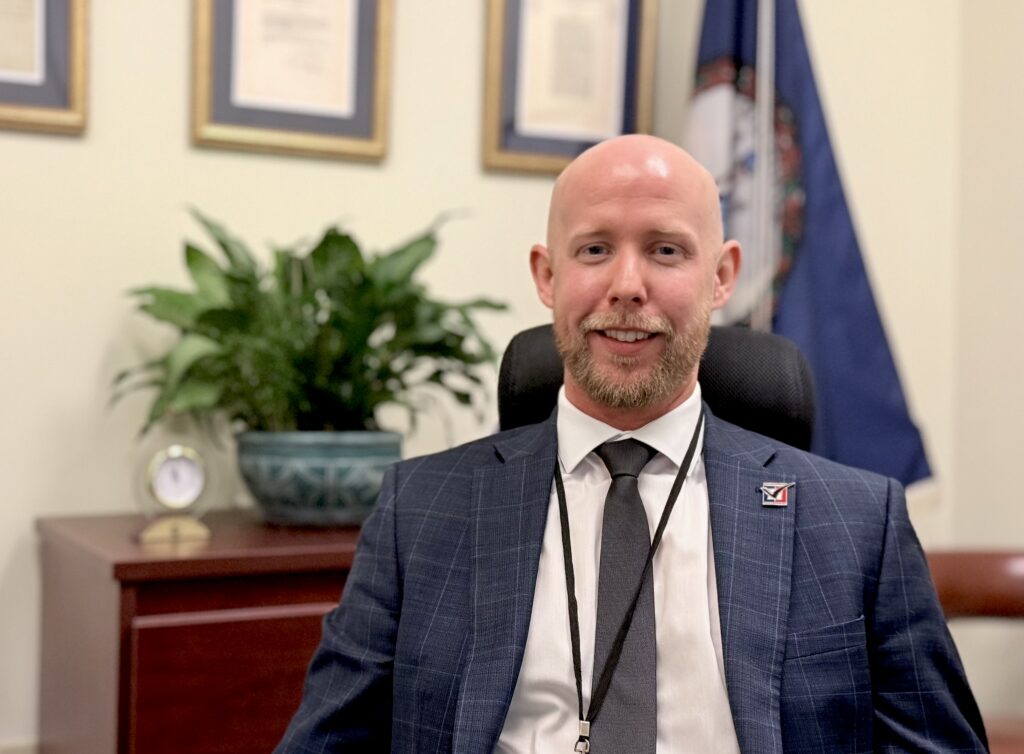
Virginia’s top elections official says voters can have confidence in both the integrity of the Nov. 3 midterms and the results, even if President Donald Trump or his allies challenge Republican losses or attempt to interfere with the election process.
“I think Virginia voters should be very confident in the level of preparation and experience that their local election officials have in administering elections,” Steve Koski, the state’s new elections commissioner, said in a lengthy interview with The Mercury.
Appointed by Democratic Gov. Abigail Spanberger after she took office in January, Koski said election officials have prepared for potential disruptions but would not speculate about how the Trump administration might respond if Democrats capture congressional seats now held by Republicans.
“I cannot speak for any potential actions that anybody else would take. But regardless, I feel prepared, I feel our localities are prepared to run this election well, and we will do so in accordance with the law,” he said.
Koski also addressed Republican concerns about election integrity, including unsubstantiated allegations of noncitizen voting and ballots being sent to deceased voters.
Asked whether the Department of Elections had evidence of noncitizens casting ballots, he said: “We have no information at the department to indicate that.”
Citizenship checks and disputed removals
Last week, White House spokeswoman Lauren Bias accused Virginia Democrats of “mailing ballots to dead felons” and dismissed Attorney General Jay Jones’ new voter protection unit as a political stunt.
The accusation followed reports that voting-rights restoration letters had been sent to deceased Virginians as part of Spanberger’s effort to restore rights to people with felony convictions who had finished their time behind bars.
Spanberger said her administration was investigating the erroneous mailings.
“The restoration is completely separate from voter registration and requesting absentee ballots,” Koski said, adding that people whose rights are restored must still register, meet eligibility requirements and request an absentee ballot.
Noncitizens cannot legally vote in Virginia. Registration applicants must attest to their citizenship, and election officials compare voter records with monthly information from the Department of Motor Vehicles to identify potentially ineligible registrations.
Local registrars review those records individually, providing notice and an opportunity to confirm citizenship, Koski said.
The procedures became the subject of litigation before the 2024 presidential election, when then-Gov. Glenn Youngkin ordered daily data sharing to identify potentially ineligible voters.
The U.S. Justice Department and voting rights organizations challenged this effort, arguing it violated federal restrictions on systematic voter removals within 90 days of an election. Youngkin’s administration maintained the reviews were individualized and permitted under state law.
Voting rights groups warned that eligible citizens could be removed because of outdated DMV records or errors. A federal judge ordered roughly 1,600 registrations restored, but the U.S. Supreme Court stayed that order shortly before Election Day.
Koski said Virginia now suspends its noncitizen list-maintenance process during the 90-day period.
The disputed registrations did not establish that those removed had voted illegally. Asked about documented election fraud more generally, Koski described the state’s safeguards but did not provide a number.
Preparing for possible federal involvement
On Oct. 15, the Department of Elections and Jones’ office issued a joint bulletin explaining how local officials should respond to federal election monitors, armed agents near polling places or attempts to seize election materials by federal officials.
The guidance distinguishes among U.S. Justice Department monitors, who generally need local authorization, congressional observers and monitors authorized by federal courts. Local officials are instructed to verify credentials and report disruptive conduct.
Observers cannot photograph inside polling places, handle sensitive election materials or position themselves where they can see a voter’s marked ballot. Officials may remove those who violate the rules.
As of last week, no active court order required Virginia localities to admit federal observers under the Voting Rights Act, according to the bulletin.
If federal agents appear at polling locations, officials should contact attorneys and local law enforcement and, when safe, ask agents to remain outside the 40-foot restricted area. They should document what happens without physically obstructing agents.
The bulletin also instructs officials to contact counsel immediately if presented with a search warrant, without delaying lawful access, and to record any materials seized. Subpoenas should be reviewed with attorneys.
Koski said his department recently participated in a tabletop exercise with state and federal partners to prepare for security problems. Officials have also worked with local attorneys and law enforcement to clarify responsibilities before Election Day.
Earlier this month, Jones established a Voter Protection Section to investigate complaints about intimidation, improper registration cancellations, absentee ballot denials and other voting barriers.
Koski said the attorney general’s office advises his department while exercising separate civil enforcement responsibilities.
“We certainly will cooperate with their efforts,” he said.
Asked about federal requests for voter records, Koski cited ongoing litigation and said Virginia had not provided voter information for federal citizenship checks.
His department also has regional liaisons who help localities resolve problems. Recruiting poll workers remains a challenge, Koski said, encouraging Virginians to volunteer.
Paper ballots and safeguards against fraud
Virginia’s ballot scanners are not connected to the internet, and must meet state certification standards, Koski emphasized. “Each locality is required to go through rigorous testing for voting equipment prior to the election,” he said.
Afterward, risk-limiting audits compare hand-counted samples of paper ballots with machine totals. State law requires an audit of at least one randomly selected U.S. House race in congressional election years.
“It’s important to know that every vote in Virginia has a paper ballot record attached to it, and these all have strict chain-of-custody requirements that are followed,” Koski said.
Ballots are sealed and stored after elections, with local circuit court clerks responsible for their custody.
Koski also assured absentee voters following the Trump administration’s attempt to impose new postal requirements before the midterms.
The rule would have required states to submit voter information to the U.S. Postal Service and meet new ballot-envelope standards, including specialized barcodes.
On Sept. 15, the U.S. Supreme Court declined to lift a preliminary injunction, leaving the rule blocked for the 2026 election without deciding its legality.
“Voters should be confident in voting absentee by mail,” Koski said.
The administration argued the requirements would prevent fraud. But states challenging the rule warned they could prevent eligible voters from casting ballots. Justice Brett Kavanaugh separately cited the lack of time to implement the rule while leaving open whether the Postal Service had authority to adopt it.
Voters may return absentee ballots to local registrars, designated drop boxes or polling places until 7 p.m. on Election Day.
Mailed ballots must be postmarked by Nov. 3 and received by noon Friday, Nov. 6. Koski recommended requesting a hand-stamped postmark. The deadline to request an absentee ballot by mail is Friday, Oct. 23.
Election night results are unofficial, Koski emphasized, “because the local canvas has to happen.” Local electoral boards reconcile precinct records with machine totals, review provisional ballots and count eligible absentee ballots arriving after Election Day.
The State Board of Elections is scheduled to certify results on Dec. 7.
Asked about pressure to reject results, Koski said certification is a ministerial duty, meaning officials are legally required to carry it out. Virginia law also provides procedures for recounts and election challenges, including court review.
“We have secure and transparent processes in place for the handling of ballots, the tabulation of ballots, and voters should be confident about these processes,” Koski said.
This post was originally published on Virginia Mercury.