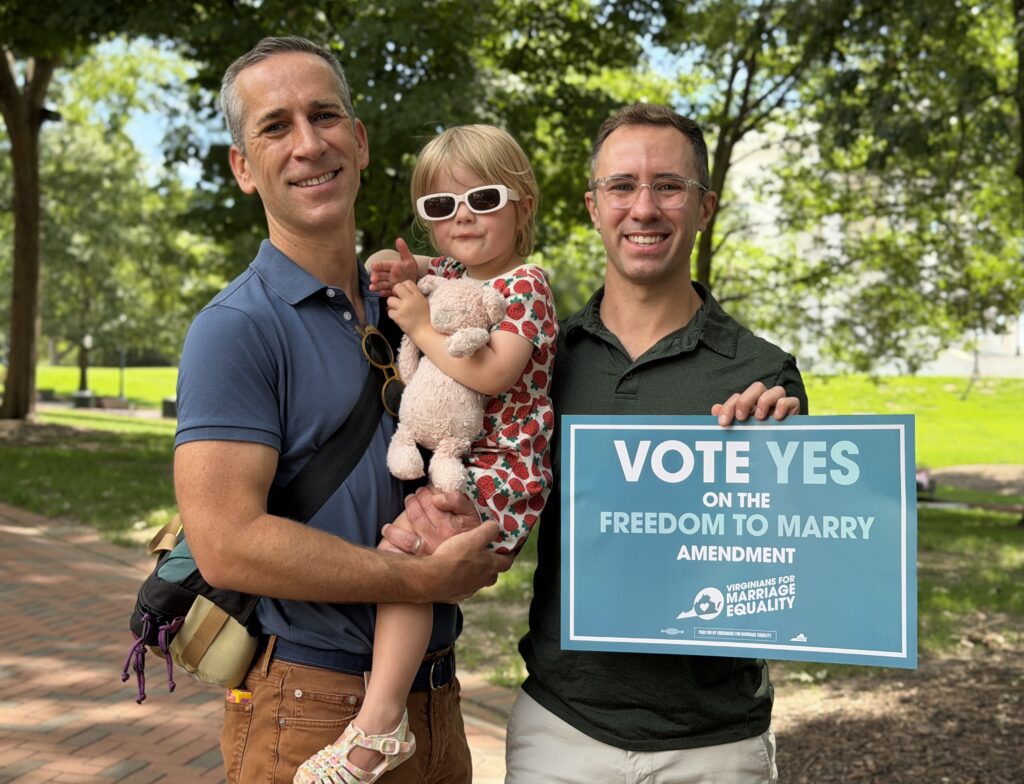
As Republicans, we believe in personal freedom, individual responsibility and a government that treats all people – and all families – fairly under the law. And now, as Virginians head to the polls, we all have an opportunity, regardless of our political party, to put those values into practice and affirm the freedom to marry for same-sex couples.
One of the constitutional amendments on our ballot in 2026 is an amendment to repeal our state’s long-outdated but still-on-the-books ban on marriage between same-sex couples. A “Yes” vote on Question 2 would remove that 20-year-old restriction and replace it with a guarantee of the freedom to marry between two people, regardless of sex, gender, or race.
Constitutional: The amendment that could safeguard same-sex marriage in Virginia
Functionally, it would bring our Constitution in line with the current law of the land, and would do so in a way that reflects shared bipartisan values across Virginia.
Tens of thousands of same-sex couples have built their lives here in Virginia, creating homes, raising children, and contributing to their communities. Nearly two-thirds of those couples are married – bringing not only the joys of professing love and commitment, but also the legal protections and financial stability that marriage provides.
These families shouldn’t have to live with the uncertainty brought on by an outdated policy in our Constitution – or the worry that, should the U.S. Supreme Court ever revisit the landmark 2015 court ruling striking down marriage bans, the legal safety of their families could be called into question.
Individual liberty, limited government and the importance of family are central to the conservative tradition – and we are grateful to see the many ways that Republicans and conservatives have voiced their support for marriage between same-sex couples.
Recently, George Allen, our former Virginia governor and U.S. senator, publicly shared how his views on marriage changed, stating in an interview, “the prohibition on gay marriage, I am going to vote for that…many years ago I changed my view on it and I don’t see any harm to me if two people of the same sex get married.”
We have seen that evolution in our own lives, too. In 2019, Denver officiated the wedding of two men, friends who had volunteered for his congressional campaign. It was a straightforward expression of a belief that people who love each other and want to make a lifelong commitment should be able to do so.
Barbara has also spoken publicly about the benefits of marriage equality, including stronger families, better access to health care, and greater well-being. Those outcomes reflect values that cross party lines.
The prominent Virginian, the late Ted Olson, who served as an attorney to President Ronald Reagan as well as in his administration as the assistant attorney general for the Office of Legal Counsel and then as solicitor general in the Bush administration, argued the conservative case for marriage equality in a 2009 interview with the Los Angeles Times.
“It is a conservative value to respect the relationship that people seek to have with one another, a stable, committed relationship that provides a backbone for our community, for our economy,” Olson said.
Other conservatives who have not been expressly or full-throatedly supportive of marriage between same-sex couples also understand that it’s well past time to move on from this issue, which has been settled here in Virginia for more than a decade.
Many Republicans have made it clear that whether or not they agreed with same-sex couples marrying in the past, the reality is that legal marriage for same-sex couples hasn’t hurt anyone – and, in fact, has provided critical stability for so many families. Why disrupt something that’s working?
Youngkin signs marriage equality measure, takes tougher line against gun control
We saw that in 2024, when Republican Gov. Glenn Youngkin signed legislation repealing a state statute that banned marriage between same-sex couples. It was an important step forward, and we were grateful to see that discriminatory statute repealed.
In just a few weeks, Virginia has the chance to complete this journey on the freedom to marry and close one of the final loose ends when it comes to marriage equality. When we cast our votes on Question 2, we’ll be thinking about the many ways that Virginians have come to rely on the freedom to marry.
It’s up to all of us, Republican and Democrat, liberal and conservative, to come together, vote yes on Question 2, and ensure Virginia can be a place where all families can build their lives with confidence and security.
These families experience the same joys, hopes, and challenges as every other family. You could join us in ensuring that Virginia’s constitution will provide their families the same protections as yours and ours.
This post was originally published on Virginia Mercury.