Once a new renewable natural gas facility is completed in Virginia Beach, the flush of a toilet could help power homes across the Hampton Roads region, developers say.
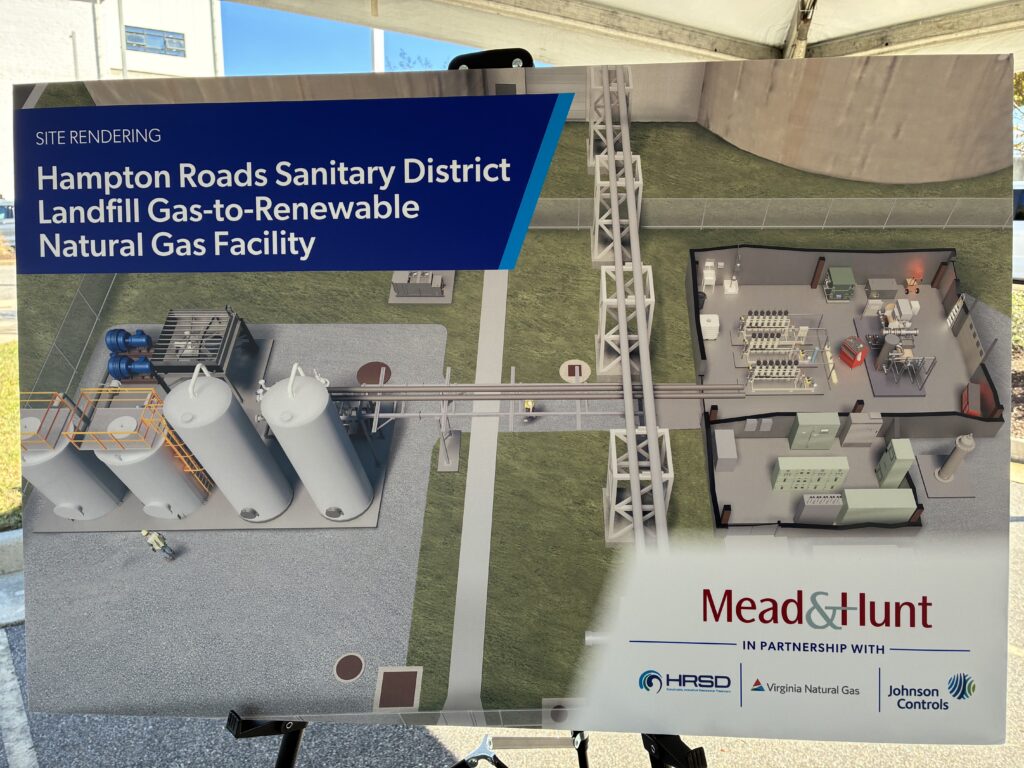
Hampton Roads Sanitation District has partnered with Virginia Natural Gas, who provides power for about 315,000 homes in the area, to build technology that captures the gas that emanates off of wastewater when it is treated.
Currently, biogas is created during normal wastewater treatment operations called anaerobic digestion, when organisms break biosolids down without oxygen. Once the gas is produced, a flare is used to burn off the methane, CO2 and other gases.
With the new system, instead of burning the gases, machinery will purify the gas, which can then be funneled into VNG pipelines and used for energy generation. A 200-foot interconnection pipe will be built from the HRSD facility property to existing VNG lines.
“There’s an environmental benefit to this in that we are pretty much eliminating that flared gas,” Carl Garofalo with Southern Company Gas said Monday.
The facility that will operate on HRSD’s existing treatment facility in Virginia Beach will create enough gas to power 5,000 homes annually. The project is estimated to cost $30 million, which will be paid by VNG customers.
“This project demonstrates how collaboration can transform a byproduct of wastewater treatment into a renewable energy resource that benefits our environment, strengthens our region’s energy future and advances our commitment to sustainability,” Jay Bernas, general manager and CEO of HRSD, said in a statement.
The company anticipates filing for approval of the cost recovery for the project with the State Corporation Commission in the next four months. The project is expected to increase the average residential customers’ bills by about $0.36 a month.
The project will eventually save customers money, Garofalo said, because it will eventually allow them to purchase less gas.
“We’re monetizing the environmental attributes for the project, and using that to minimize rate impact,” Garofalo said. “We do forecast, in the out years of the project, that we will actually provide a benefit to the customers in the form of possible bill credits.”
This is not the first facility of its kind in the commonwealth. In 2022, Western Virginia Water Authority and Roanoke Gas Company partnered to build a smaller-scale renewable natural gas facility at the Roanoke Regional Water Pollution Control Plant. The plant became fully operational in 2023 and is able to provide enough gas power for 500 homes in the region.
Biogas from wastewater treatment could be harnessed for other power uses, as well.
Garofalo explained that landfills produce five times as much gas as treatment facilities like the forthcoming one inVirginia Beach, and could be a new avenue into reducing emissions and bringing more power to the grid.
“There’s a lot of organic waste, and this is a way to add a substantial amount of energy to the system while dealing with a problem for existing customers,” Garofalo said.
Virginia lawmakers have recently examined what to do with the leftover products of wastewater treatment.
Legislation passed during this year’sGeneral Assembly session put new regulations on the use of biosolids, the sewage sludge that is left after treatment, as fertilizer on agricultural land.
Residents across the commonwealth have become increasingly concerned about the presence of per- and polyfluoroalkyl substances or PFAS, otherwise known as forever chemicals that could pose health risks with exposure, in the biosolids.
PFAS are in everyday products like water resistant clothing, fast food packaging, and much more – and the substance ends up in human waste.
A new state law imposed new restrictions on how much PFAS can be present in biosolids before their use on farmland is limited.
This post was originally published on Virginia Mercury.