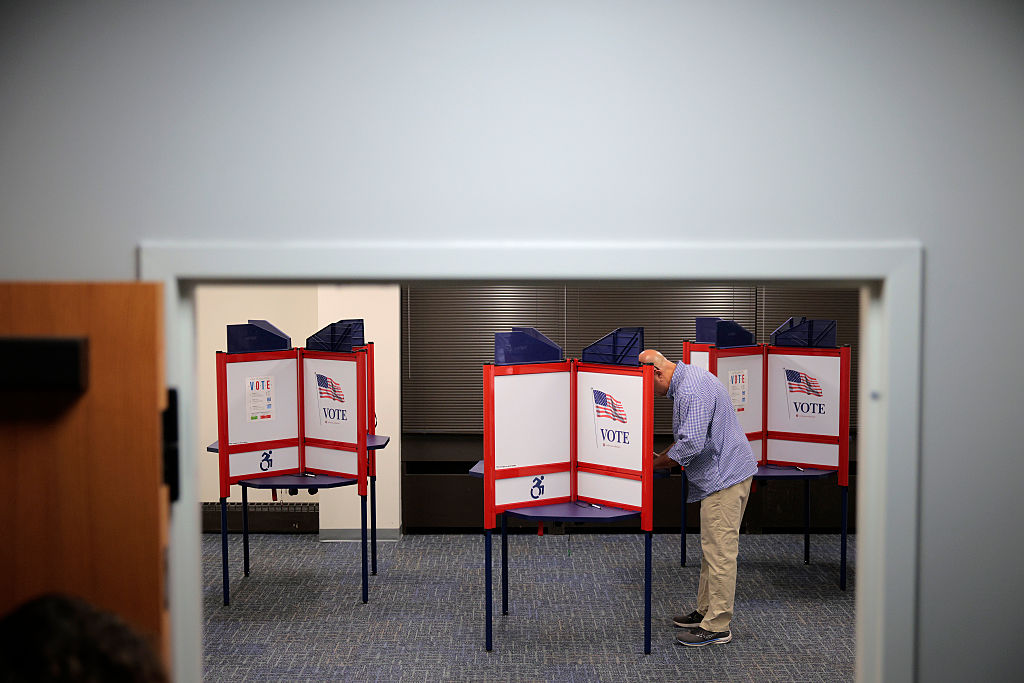
Virginians will vote Tuesday in the 2026 midterm elections, with control of Congress and three proposed constitutional amendments at stake after a record early voting turnout.
Polls are open statewide from 6 a.m. until 7 p.m., giving voters their final opportunity to weigh in on races for the U.S. Senate and all 11 of Virginia’s U.S. House seats, along with proposed protections for reproductive rights, marriage equality and voting rights.
More than 1.6 million Virginians voted early through Saturday, the final day of in-person early voting. The Call the Map tracker recorded 1,630,073 ballots, including 1,310,540 cast in person and 319,533 returned by mail. Additional mail ballots are still arriving.
That total surpasses the 976,558 early ballots cast in the 2022 midterms. Stephen Farnsworth, professor emeritus of political science at the University of Mary Washington, said the growing participation reflects voters’ embrace of early voting.
“Virginians really like no-excuses early voting. That steadily increasing turnout speaks to how convenient it is as well as how comfortable voters feel with that approach,” he said.
Farnsworth said polling and early voting patterns give Democrats reason for optimism, particularly as they challenge Republicans in districts that previously drew less attention.
“It’s clear that Democratic efforts to expand the map to previously less competitive congressional districts have triggered a lot of enthusiasm among voters who are used to living in places where the contests were less uncertain.”
What voters need to know
Anyone in line by 7 p.m. can vote. Virginians can find their assigned precinct through the Department of Elections’ voter information portal. Election Day polling places may differ from early voting locations.
Voters should bring acceptable identification, although those without it may sign an ID confirmation statement. Eligible residents who missed the registration deadline can register at their precinct and cast a provisional ballot, subject to eligibility verification.
Completed absentee ballots delivered in person must arrive by 7 p.m. Tuesday. Mailed ballots must be postmarked by Election Day and delivered no later than Friday, Nov. 6.
Election night results will remain unofficial until local officials finish reviewing provisional ballots, counting eligible late-arriving absentee ballots and completing the canvas.
State officials will then certify the results, a process that state law dictates must be carried out no later than the first Monday in December, which is Dec. 7 this year.
Virginia’s congressional battlegrounds
Democratic U.S. Sen. Mark Warner is seeking a fourth term against Republican Bert Mizusawa, a retired U.S. Army major general.
Warner has emphasized his legislative experience and opposition to President Donald Trump’s economic and healthcare policies. Mizusawa argues his military background and Republican connections would give Virginia greater influence with the administration.
Democrats currently hold six of Virginia’s 11 House seats, compared with five for Republicans, and hope to expand that advantage as both parties compete for the national majority.
In the 1st District, Henrico Commonwealth’s Attorney Shannon Taylor is challenging Republican U.S. Rep. Rob Wittman of Westmoreland, who has served since 2007. The district stretches from Richmond’s suburbs to the Northern Neck and Williamsburg area. Taylor has criticized Wittman’s healthcare votes, while he has defended Republican spending policies.
The 2nd District features a rematch between Republican U.S. Rep. Jen Kiggans and Elaine Luria, whom Kiggans defeated in 2022. Both are U.S. Navy veterans competing in a Virginia Beach-centered district with a large military population. Independents Matt Baker and Bishop Staten are also running.
Former Democratic U.S. Rep. Tom Perriello hopes to reclaim the 5th District from Republican U.S. Rep. John McGuire of Goochland. Trump carried the Charlottesville-to-Southside district by about 12 percentage points in 2024.
Perriello has focused on affordability and independence from party leadership, while McGuire has emphasized his support for Trump. Independent Cooke Harvey is also on the ballot.
In the 6th District, journalist and “Dopesick” author Beth Macy is challenging Republican U.S. Rep. Ben Cline of Botetourt County. Macy has outraised the incumbent, although major election forecasters continue to rate the Shenandoah Valley-to-Roanoke district safely Republican.
Democrats are defending the 7th District, where first-term U.S. Rep. Eugene Vindman of Woodbridge faces Republican Douglas Ollivant and four other candidates. Housing cost, federal jobs and data center development have figured prominently in the contest
Three constitutional amendments
Virginia voters will also decide whether to amend the state Constitution on reproductive rights, marriage and voting eligibility.
Question 1 would protect decisions involving abortion, contraception, fertility treatment and pregnancy-related care, along with patients and providers.
Third-trimester abortion restrictions would remain permissible, with exceptions when the patient’s health is at risk or the pregnancy cannot survive. One doctor instead of three would be required to sign off on the late-term abortions.
Virginia’s constitutional ban on same-sex marriage would be removed under Question 2. The measure would guarantee the right of two adults to marry regardless of sex, gender or race and require equal treatment of legally valid marriages.
Under Question 3, voting rights would be automatically restored upon release from incarceration following a felony conviction. The proposal would also establish a fundamental right to vote and revise the constitutional disqualification involving mental capacity.
Local races and school funding referendums
Local offices are also on the ballot in several Virginia communities, including a contentious school board race in Chesterfield, along with referendums on school funding.
Voters in 47 localities, including Richmond, Chesterfield County, Norfolk and Newport News, will decide whether to authorize an additional sales tax of up to 1% to pay for public school construction and major renovations.
The tax would not apply to groceries or essential personal hygiene products, and voter approval would allow, but not require, local governments to impose it.
This post was originally published on Virginia Mercury.