The number of confirmed measles cases across the U.S. this year has soared to 5,412 as of Nov. 12, more than double the 2,289 cases through all of 2025, according to the latest release of data from the federal Centers for Disease Control and Prevention. The trend has pushed the nation to lose its official “measles elimination status” after more than 25 years, according to news reports.
“It’s pretty clear we’re hitting one grim milestone after the other,” Dr. Susan Kansagra, chief medical officer of the Association of State and Territorial Health Officials, a group representing local health officials, told Stateline. “It’s really, really just a hard time to see something that we know has been eliminated in the past, and to see this rapid growth that we have seen over these last two years.”
The U.S. launched a national campaign to eliminate measles in the 1960s, around the time the first official measles vaccine was licensed to the public. In 1994, the Pan American Health Organization (PAHO), a regional office of the World Health Organization representing states across the Americas, set a goal of ending the measles epidemic through a concerted vaccination effort, and by 2000 a panel of experts had concluded that the United States had eliminated measles from its population.
This elimination status means that the nation is able to squash instances of measles transmission for 12 months or more. To reverse that status, measles must be spreading for 12 months or more – and now that’s where the U.S. is. A panel of experts at PAHO meeting in the past week to review cases has determined that the United States is no longer in elimination status, according to KFF Health News, which reported the news Nov. 14 citing researchers with direct knowledge of deliberations. The Wall Street Journal first reported the change Friday night.
“And that means the disease has become what we call endemic again, meaning it’s just spreading in the community,” Katrine Wallace, an epidemiologist at the University of Illinois, Chicago School of Public Health, told Stateline. “I definitely blame it on the anti-vaccination kind of propaganda that’s been all over, and the lack of our (U.S. Department of Health and Human Services) really doing anything about these cases.
“There’s not been a real push for vaccination efforts to counteract the 5,000 cases or something that we have now,” Wallace said.
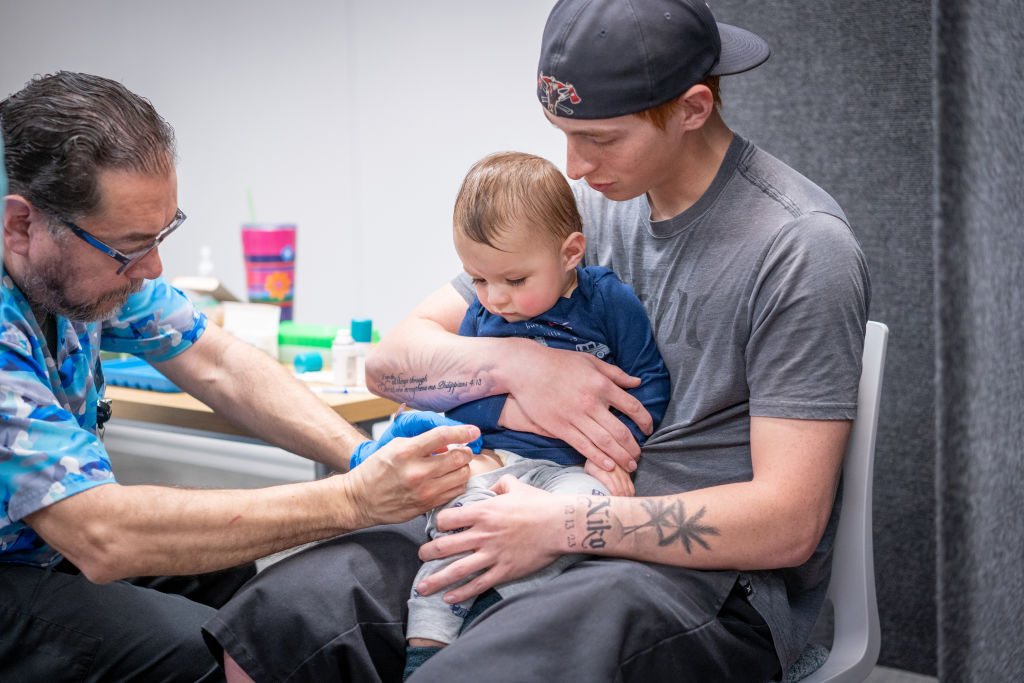
Measles is a highly contagious respiratory virus that leads to symptoms of fever, rash, and other serious health complications, including death, but is entirely avoidable through the two-dose MMR, or measles, mumps, and rubella vaccine. Children, who generally don’t get vaccinated before a year of age, are highly susceptible.
But in his time in charge, U.S. Health and Human Services Secretary Robert F. Kennedy Jr. has been an outspoken vaccine skeptic who opposes many vaccine mandates. His agency has called into question the safety and efficacy of vaccinations and recommended fewer vaccines for children. Many Republican-led states have ended vaccine mandates for their populations. Thirty-nine states now have MMR vaccination rates below 95% – the percentage necessary for herd immunity.
According to the latest CDC data, measles cases have been reported this year across 47 states, plus the District of Columbia, and New York City. Among those cases, 58% of them, or 3,134, are among people under the age of 19.
Among all cases, 96% are within people who are unvaccinated, and 11%, or 591 cases, have resulted in hospitalizations. The CDC has confirmed six measles-related deaths so far, though other investigations are continuing within individual states.
Pennsylvania is experiencing a major outbreak, with 1,542 cases confirmed so far this year, including 37 cases since Nov. 9, according to the state’s health department.
Just since Election Day, Pennsylvania has reported two “measles-associated” deaths, the most recent one announced Nov. 13. Two other deaths, in New York and Wisconsin, have been reported by state health agencies during the same period.
“Revoking our elimination status doesn’t really change the reality on the ground, right? We all know, you know, that we have measles in our community,” said Dr. Ali Khan, a medical epidemiologist and dean of the College of Public Health at the University of Nebraska Medical Center.
“Measles has always been the sort of ultimate stress test for public health infrastructure,” Khan said in an interview Friday. “And we’re failing that test … if you can’t get people vaccinated, that says something about the quality of your health system.”
Khan said the real message behind the potential revocation of the elimination status is that the nation’s leaders desperately need to fund and promote public health infrastructure in communities, so that people can protect themselves.
Kansagra, who works with local and state health departments, said it’s particularly worrisome that major federal public health grant programs and pandemic-era funds are expiring at the end of next year.
“That type of core infrastructure support for public health is so important because these are exactly the types of threats that public health is dealing with and working to respond to,” Kansagra said.
Wallace is hopeful on the heels of the 2026 midterm elections in November that Democrats, especially ones steeped in public health like Michigan Sen. Abdul El-Sayed, a medical doctor, can change the direction of the country’s public health policy in time to prevent more death and spread of disease.
“We’re voting these people in,” Wallace said. “So it seems like the country is moving towards wanting to rein this in.”
Stateline reporter Shalina Chatlani can be reached at [email protected].
This story was originally produced by Stateline, which is part of States Newsroom, a nonprofit news network which includes Virginia Mercury, and is supported by grants and a coalition of donors as a 501c(3) public charity.
This post was originally published on Virginia Mercury.