

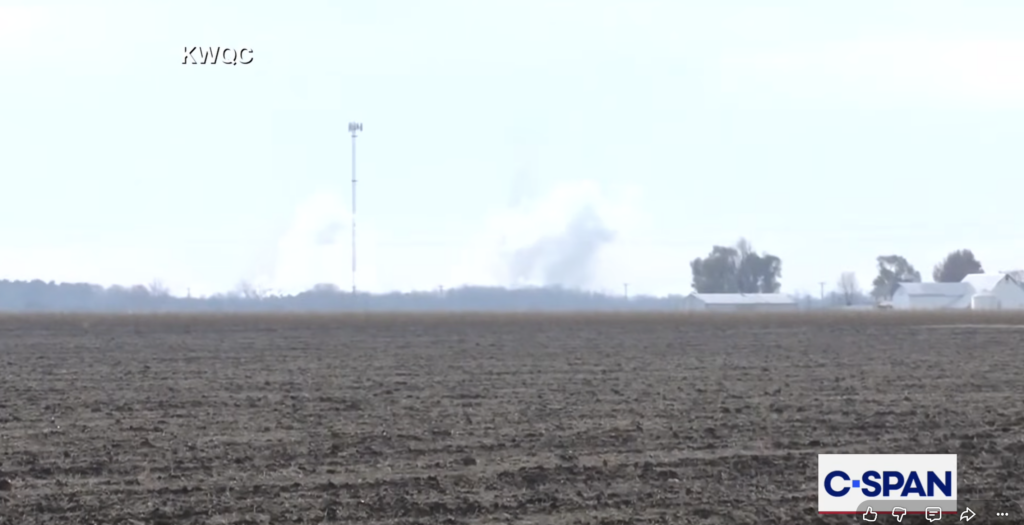
A plume is visible from the detonation of nearly 5 tons of lead-based explosive material in Middletown, Iowa Nov. 25, 2026. (Screenshot via C-SPAN livestream)
The U.S. Army intentionally detonated degraded, lead-based explosive Wednesday morning in southeast Iowa.
The operation has drawn public criticism in Iowa, and across the country, due to concerns of the spread of lead, which is toxic, from the detonation.
The Army decided to go ahead with the blast, after significantly increasing mitigation strategies and working to evacuate the area, because they determined intentional detonation was the best way to get rid of the material which was liable to detonate on its own.
The Army said it would update the public about the status of the operation by 11 a.m. at the latest.
The most recent maps from the U.S. Army showed lead particles released from the blast were likely to travel southwest of the site, as far as 100 miles over the next several hours. Dust with lead particles was expected to settle as far as 40 miles southwest of the blast site.
Residents in those areas have been advised to remain indoors, with windows and doors closed until the Army gives an all clear. Updates can be found online. The Army is also working with the Federal Emergency Management Agency to distribute mobile notifications to people in the area.
The U.S. Environmental Protection Agency and the Army have been in Middletown and surrounding communities taking samples and are slated to take samples following the detonation to determine how much lead was released by the blast.
EPA has published a dashboard with air sampling and monitoring.
EPA leader says mitigation ‘exceeded expectations’
EPA Administrator Lee Zeldin said in a live interview with CNN Wednesday morning, that the initial feedback he received from the U.S. Department of Defense was that the mitigation efforts “exceeded expectations” in containing the plume.
Zeldin said that while EPA monitors on the ground currently show no detectable lead concentrations in the surrounding area, he encourages people in the area to wait for additional feedback before going outside.
Zeldin referenced the aftermath of the Sept. 11, 2001 attacks on the trade center and said in that instance, EPA told people it was safe to go outside too soon.
“I’m not going to rush and just immediately declare, everything is safe before I can receive the data, that we can transparently release it publicly,” Zeldin said.
Zeldin also attributed the cross-department federal response to White House Chief of Staff Stephen Miller, who was only recently appointed to the role.
“I have never witnessed an individual take the reins of the interagency process as exceptionally as what I have witnessed over the last few days to make sure that absolutely every possible option was being considered,” Zeldin said.
Public responses
Missouri Gov. Mike Kehoe posted on X saying the blast had occurred and that initial analysis he received from federal partners “indicates that the mitigation measures appear to have been successful and the explosion was well-contained.”
President Donald Trump, posted on his social media platform that “early reports from Iowa are that the Army’s mitigation efforts have far exceeded expectations.”
Acting Secretary of the Army Adam Telle posted on X that the detonation was a “HUGE success.”
“The threat of an uncontrolled spontaneous detonation has been eliminated,” he wrote. “I am so proud of our SOLDIERS for their courage, training, mitigation, and precision! They put it on the line for all of us just like this every day!”
Telle thanked the administration for “mobilizing an unprecedented whole of government approach to fix this problem once and for all.” Telle said the Army will continue to send updates throughout the day.
“To the people of Iowa, we are with you all the way,” Telle said.
Gov. Kim Reynolds echoed that the detonation was successful. She shared photos on X from inside what appears to be the Army’s operation site.
“We remain in close contact with authorities on the ground, while state agencies continue to monitor incoming data from the State Emergency Operations Center,” Reynolds wrote. “We will keep Iowans informed as details become available.”
This story will be updated as more information is released.
This story was originally produced by Iowa Capital Dispatch, which is part of States Newsroom, a nonprofit news network which includes Virginia Mercury, and is supported by grants and a coalition of donors as a 501c(3) public charity.
This post was originally published on Virginia Mercury.