Virginia Republicans seek 90-day fuel tax suspension
(The Center Square) – Virginia Republicans renewed their call for a 90-day suspension of gasoline and diesel taxes, asking Gov. Abigail Spanberger to bring lawmakers back for a special session.
Lawmakers outlined the request Tuesday at Owens Market Deli and Truck Plaza in Forest, saying the temporary break would reduce fuel costs for drivers, farmers and trucking companies.
Del. Scott Wyatt, R-Hanover, estimated the suspension would reduce tax collections by about $410 million. He said stronger-than-expected state revenues could cover the cost.
Virginia’s motor fuels tax is 32.6 cents per gallon for gasoline and 33.6 cents for diesel. Suspending those taxes would save a driver about $4.89 on 15 gallons of gasoline if the full reduction reached customers.
“This is about giving our voters, our constituents, Virginians, a temporary pause in the gas tax so that life becomes more affordable,” said House Republican Leader Terry Kilgore, R-Scott.
Regular gasoline averaged $4.20 per gallon in Virginia Wednesday, according to AAA. That was little changed from the $4.22 reported Sept. 28, but about $1.25 higher than a year ago.
Diesel averaged $6.24 per gallon, down about 12 cents since Sept. 28 but above the $3.60 average a year ago. Virginia’s diesel average reached a record $6.39 on Sept. 22.
Del. Wendell Walker, R-Lynchburg, said lawmakers could replace transportation funding when they return for the regular legislative session in January.
“This is not going to impact the VDOT maintenance,” Walker said. “We can backfill this when we go back into session in January.”
U.S. Rep. John McGuire, R-Va., joined the lawmakers and backed the proposed suspension, saying it could help families, farmers and truckers.
Christian Snead, a Bedford County trucking company owner who spoke at the event, said higher diesel costs squeeze business margins and get passed along to customers. He estimated his 28-truck fleet pays about $4,000 a week in Virginia diesel excise taxes, or about $210,000 annually, based on each truck traveling 3,000 miles a week and getting 7 miles per gallon.
Gov. Abigail Spanberger’s office said she is assessing options to address rising costs and working on longer-term affordability measures. The office attributed higher prices to President Donald Trump’s war in Iran but did not say whether she supports the proposed tax suspension or is considering calling a special session.
Republicans proposed a similar suspension in March, when Kilgore estimated the cost at about $125 million per month, or roughly $375 million over three months.
Virginia also charges separate fuel sales taxes and a storage tank fee.
Combined with the motor fuels tax, those state charges total 42.4 cents per gallon for gasoline and 43.5 cents for diesel.
The suspension discussed Tuesday focused on the motor fuels tax. It would require legislative action and has not taken effect.
This post was originally published on The Center Square.
Poll: Virginia voters broadly support increased investment in public schools and more headlines
• “Virginia voters broadly support increased investment in public schools, poll finds.” — Cardinal News
• “Virginia felony voting errors collide with Question 3.” — Axios
• “Virginia’s ‘Rap Back’ program tops 56,000 enrollments in first year.” — 13newsnow
• “Virginia Beach makes progress on flood prevention 10 years after Hurricane Matthew.” — WAVY
• “Open for comment: Environmental justice in Virginia’s permitting process.” — Bay Journal
This post was originally published on Virginia Mercury.
Virginia Republicans urge Spanberger to call special session for fuel-tax holiday
Virginia Republican leaders on Tuesday called for Gov. Abigail Spanberger to summon lawmakers to Richmond and suspend the state’s gasoline and diesel taxes for 90 days, arguing that the temporary break would help families, farmers and trucking companies cope with high fuel prices.
Diesel prices have climbed sharply amid disruptions to global fuel supplies from the war with Iran and other pressures on the international market.
Gathered at Owens Market Deli and Truck Plaza in Bedford County, Republicans said stronger-than-expected state revenues could replace the money normally collected from the taxes to give residents relief. They want lawmakers to act before the General Assembly returns for its 2027 session in January.
“Basically, this should be a bipartisan issue,” said House Minority Leader Terry Kilgore, R-Scott. “This is about giving our voters, our constituents, Virginians, a temporary pause in the gas tax, so that life becomes more affordable.”
A Spanberger spokesman said the governor is considering options to provide relief while blaming the increase in fuel prices on President Donald Trump’s war with Iran.
He said Spanberger is also “assessing all available options to address the extra costs” while “working to create long-term solutions to make the commonwealth more affordable so families can keep more of what they earn.”
Virginia currently taxes gasoline at 32.6 cents per gallon and diesel at 33.6 cents. If the entire cut reached consumers, someone buying 15 gallons of gasoline would save $4.89.
Del. Scott Wyatt, R-Mechanicsville, estimated a 90-day suspension would cost the state about $410 million. He said revenue collections running ahead of projections would give the state room to absorb the loss.
Del. Wendell Walker, R-Lynchburg, said lawmakers could replace the transportation money when they return to Richmond next year. Fuel taxes help pay for road construction and maintenance, so replacing that revenue would be a central part of any legislation.
For Christian Snead, who owns a Bedford County trucking company with 28 vehicles, the immediate concern is what happens every time one of them needs fuel.
“Fuel is a necessity for us, it’s an operating expense, not something we can live without,” Snead said at the event.
Diesel was posted at $5.99 a gallon at the truck plaza Tuesday. Removing Virginia’s excise tax would reduce that to about $5.65 if the entire savings were passed along to customers.
Snead said higher fuel costs eat into his company’s margins and eventually show up in the prices customers pay for goods moved by truck.
“Let’s give businesses the ability to recover,” he said.
U.S. Rep. John McGuire, R-Goochland, also took a prominent role in Tuesday’s event, defending Trump’s energy policies four weeks before the Nov. 3 midterm elections.
Asked whether Trump should pursue an end to the war with Iran to help bring down fuel prices, McGuire argued that keeping more American refineries would have left the country less vulnerable to disruptions overseas.
“Obviously, we all want to find a solution the right way. But in the meantime, let’s give Virginia some relief at the pumps,” he said.
Kilgore added Virginia lawmakers should focus on what they can do at the state level. “We can’t control what’s going on in Washington or what’s going on in Iran,” he said.
Tuesday’s event came a day after Trump signed an executive order temporarily allowing broader highway use of red-dyed diesel, which usually is reserved for off-road uses such as agricultural equipment.
Trump’s order directs federal officials to determine whether applicable federal excise tax payments can be deferred through Dec. 31 without interest or penalties. It also directs officials to explore ways, including legislation, to forgive those deferred taxes. Deferring a tax does not by itself eliminate the obligation to pay it.
Part of Bedford County falls within the 5th Congressional District, where former U.S. Rep. Tom Perriello, the Democratic nominee, is trying to unseat McGuire. Republicans have held the seat since Perriello lost reelection in 2010, although its boundaries have changed since.
A Washington Post-Schar School poll released last week found McGuire leading Perriello 51% to 45% among likely voters in a district that Trump carried by 12 points in 2024.
McGuire used the appearance to criticize Perriello’s past support of cap-and-trade legislation and Spanberger’s climate policies, arguing that Democratic energy legislation has contributed to higher costs at the pump.
Perriello has also put affordability at the center of his campaign. He told The Mercury last week that ending the Iran war would be among his priorities if elected to Congress.
Republicans have tried the gas-tax approach before.
They proposed a similar 90-day holiday in March as fuel prices climbed. Spanberger responded at the time by blaming Trump’s decision to launch the war with Iran, saying Virginians were “feeling the brunt of the president’s actions at the pump and grocery store.”
Republicans returned Tuesday to Spanberger’s own emphasis on affordability, arguing that suspending the gas tax would give consumers some immediate relief.
Kilgore said the differences in fuel taxes among neighboring states are particularly noticeable in Southwest Virginia, where drivers can easily cross state lines to refill their tanks.
Other states are considering or have already taken similar steps. Georgia suspended its motor fuel excise taxes from Sept. 29 through Oct. 29. Lawmakers in North Carolina plan to return for a special session Wednesday to consider fuel-tax relief.
This post was originally published on Virginia Mercury.
Virginia lawmakers question Dominion, NextEra acquisition
(The Center Square) – Virginia lawmakers questioned Dominion Energy and NextEra Energy executives Tuesday about employee protections, financial safeguards and clean energy requirements under the proposed acquisition.
Dominion Energy Virginia President Ed Baine and NextEra Vice Chairman Armando Pimentel briefed the Energy Commission of Virginia. Members also asked about records involving alleged political misconduct in Florida.
Baine reviewed commitments announced Sept. 14 including the proposed $10 monthly residential bill credits for four years and another $100 million for EnergyShare assistance through 2038. He said the expanded credits would redirect money previously planned for data centers and add shareholder funding.
Baine said NextEra would add 600 jobs in Virginia, along with 400 supplier jobs and a shareholder-funded headquarters tower beside Dominion’s existing headquarters. The commitments depend on the acquisition receiving approval.
Del. Destiny LeVere Bolling, D-Henrico, asked about long-term job security. Baine said employees’ jobs would remain unchanged for 18 months and their compensation for 24 months. He also cited a five-year commitment to maintain a minimum number of employees in Virginia.
Commission Chairman Sen. Scott Surovell, D-Fairfax, asked about safeguards involving dividend payments and whether affiliated companies could gain an advantage when competing for utility projects.
Pimentel said Dominion Energy Virginia would retain separate management, its current board and its own finance and treasury operations. Its funds would remain separate from those of NextEra and its other subsidiaries, he said.
Discussing NextEra’s unsuccessful bid to acquire Texas utility Oncor, Pimentel said the company opposed restrictions that could prevent dividends from reaching the parent company because they could affect the parent’s credit rating. He said Dominion’s circumstances were different.
Del. Rip Sullivan, D-Fairfax, asked whether NextEra’s board and management recognized their obligation to meet Virginia’s clean energy requirements and believed they could achieve them.
Pimentel said NextEra intends to comply with the Virginia Clean Economy Act, while leaving open future discussions about affordability.
“What I see today is that we will meet the goal by 2045,” Pimentel said.
Responding to Del. Michael Webert, R-Fauquier, Pimentel said NextEra’s experience with solar and battery storage, along with its scale and relationships with manufacturers and contractors, could help Dominion build more efficiently and faster.
Del. Irene Shin, D-Fairfax, asked about a memorandum sent to former NextEra Chairman James Robo concerning alleged misconduct involving Florida Power & Light. She asked whether commission members could review it.
Pimentel told members that Robo received the memo from an outside law firm and commissioned an independent investigation. He described its allegations as unsubstantiated.
As previously reported by The Center Square, State Corporation Commission Chief Hearing Examiner D. Mathias Roussy Jr. ruled Friday that the companies must provide the memo to Clean Virginia by Thursday, if it exists and is within their possession or control.
The ruling does not establish wrongdoing or decide whether to approve the acquisition.
Pimentel said NextEra would not release the memo publicly while related litigation remains active, but would work out how to provide information to the SCC and those requesting it.
He said NextEra expects another Federal Energy Regulatory Commission filing in the next week or so and anticipates approval in January.
SCC public hearings are scheduled Wednesday in Newport News and Friday in Fairfax County. Written comments are due Nov. 9, and the evidentiary hearing begins Nov. 17.
This post was originally published on The Center Square.
Virginia Board of Education reinstates adult education advisory committee after 3 years
The Virginia Board of Education recently reestablished its adult education advisory committee after a three-year hiatus to guide how the state uses resources to improve its adult education and literacy program.
The programs combine education and job training that can help enrollees earn recognized industry credentials and provide academic and parenting support for adults and their children. They also help learners strengthen English proficiency, develop civic and workplace skills, and improve basic academic skills through in-person or remote classes.
The committee’s return follows a three-month listening tour led by Gov. Abigail Spanberger’s administration, where educators, school leaders and parents spoke about strengthening Virginia’s K-12 system.
At the board’s Aug. 27 business meeting, Superintendent of Public Instruction Jenna Conway said the committee helps the board by gathering feedback from stakeholders, considering adult learners’ access to rigorous programs and making effective use of funding, while keeping adult education and literacy moving forward.
The board voted to re-establish the committee on Sept. 24.
“We can’t always have all those folks represented here on the board, and so we welcome reestablishing this committee to think through how we make sure that these students are having access to sort of equal rigor,” said Conway.
She added, “We want to make the most of every dollar, and we want to make the dollars go as far as possible.”
Virginia serves over 17,000 adults annually and has awarded $18 million to local adult-education providers for 2026-27 program year, according to the Virginia Department of Education.
Over the past three years, the agency said recipients reported over 52,000 student enrollments, and 7,400 secondary and industry-recognized credentials have been earned.
On June 20, 2001, a previous board created the first 14-member committee. However, the agency said the board’s action did not specify seat requirements, meaning seats could be added or taken away in future years.
Staff recommended no changes to the number of members, but asked that the ex officio role be reserved for the Adult Student of the Year, chosen through the Virginia Association of Adult and Continuing Education.
VDOE said it will seek nominations using the agency’s form and processes, review them for a balance of stakeholder groups and geographic representation, and then the board will review and approve recommendations.
The agency did not immediately respond to questions about the reason for the committee’s three-year break.
This post was originally published on Virginia Mercury.
Workforce training program earns another No.1 ranking for Virginia
Virginia’s workforce training program has earned another No. 1 national ranking as the commonwealth competes for companies looking for workers trained for specialized jobs.
Area Development, a major national trade publication, ranked Virginia first for workforce training programs in its 2026 Top States for Doing Business report. The recognition highlights the Virginia Talent Accelerator Program, which provides customized recruitment and training at no cost to qualifying companies opening or expanding operations in the commonwealth.
Since its launch in 2019, the program has supported projects representing more than 22,000 announced jobs across the state, according to Gov. Abigail Spanberger’s administration.
Virginia placed eighth overall in Area Development’s nationwide rankings and also finished fifth for innovation and research, sixth for site readiness programs and seventh for logistics and transportation infrastructure.
The workforce recognition comes after Business Facilities ranked Virginia first for customized workforce training for the fourth consecutive year this summer.
“Workforce is one of the most important factors in any company’s location decision, and Virginia continues to distinguish itself nationally,” Virginia Secretary of Commerce and Trade Carrie Chenery said in a statement Monday.
“The Virginia Talent Accelerator Program is a clear competitive advantage because it drives business growth by customizing talent solutions. This recognition reinforces that the commonwealth is not only attracting investment but also preparing Virginians for the jobs those investments create.”
Created by the Virginia Economic Development Partnership in collaboration with the Virginia Community College System, the Talent Accelerator receives funding support from the governor’s administration and the General Assembly. Its services are offered as an incentive for companies creating jobs in Virginia.
The work varies from project to project. Before training begins, the Talent Accelerator assesses a company’s recruitment processes and workforce needs. That can lead to assistance before an employee is even hired, including brief training sessions and assessments that give applicants a look at the work while allowing employers to evaluate potential hires.
Recruitment help can include digital advertising and campaigns on streaming and podcast platforms. The program’s in-house team also produces videos, websites and 3D animations to help companies recruit workers and demonstrate workplace tasks.
Once workers are hired, training can range from safety and basic skills to detailed instruction on production processes and individual jobs. Teamwork, conflict resolution and leadership training are also available.
Manufacturing projects are paired with a regional community college, while the program also works with universities, including historically Black colleges, according to VEDP.
Spanberger said Virginia’s latest rank shows the value of connecting economic development with workforce preparation.
“Virginia is building the best workforce in America, and industry is taking notice,” Spanberger said in a statement. “The Virginia Talent Accelerator Program gives businesses a powerful reason to choose the commonwealth by delivering customized training that prepares Virginians to succeed from day one.”
Area Development has covered corporate site selection and relocation since 1965. Its 2026 rankings are based on a survey of 50 site consultants who evaluated states across 20 categories affecting corporate location and investment decisions.
The magazine then weighted those results based on the importance of each factor in corporate site selection.
Virginia finished behind Georgia, Texas, Tennessee, North Carolina, Ohio, South Carolina and Alabama in the overall ranking. But it took the top spot for workforce training, ahead of Georgia and South Carolina.
VEDP President and CEO Jason El Koubi said the Talent Accelerator’s value lies in building recruitment and training around an employer’s particular operation rather than offering a standard package.
“Our team works directly with companies to design recruitment and training strategies that reflect their operations, culture and long-term growth plans,” El Koubi said in a statement. “Area Development’s recognition underscores the program’s impact and the value Virginia delivers to companies creating jobs across the commonwealth.”
Several companies that announced Virginia projects this year are using the program.
Avio USA plans a roughly $500 million manufacturing facility in Hurt that is expected to create more than 1,000 jobs. RINGANA, an Austrian skincare and nutritional products company, announced an $85 million U.S. headquarters, production and distribution operation in Roanoke with 435 jobs. Jabil plans a manufacturing facility in Prince George County expected to create 352 jobs.
Merck & Co. also plans to use Talent Accelerator as part of its $3 billion expansion in Elkton. The project is expected to create 500 jobs and will serve as the company’s Center of Excellence for Pharmaceutical Ingredients and Small Molecule Manufacturing.
The Spanberger administration’s figure of more than 22,000 jobs reflects announced positions associated with projects supported by the Talent Accelerator. It does not indicate how many of those jobs have been filled or how many workers have completed training through the program.
This post was originally published on Virginia Mercury.
Virginia dairy farm launches virtual ‘Adopt a Cow’ program for students, more headlines
• “In Virginia, voting rights restoration is tough. A ballot measure could change that.” — NPR/WAMU
• New data shows lifetime return on investment of Virginia degree programs.” — VPM News
• “Southwest Virginia fish farm project ‘on pause’ due to tariffs, gas prices.” – Cardinal News
• “Virginia ranks No. 12 among ‘Safest States in America.’” — WAVY
• “Virginia dairy farm launches virtual ‘Adopt a Cow’ program for students.” — WTKR
This post was originally published on Virginia Mercury.
US House Dems’ campaign chief predicts they’ll gain majority control in midterms
WASHINGTON — Democrats expect they’ll gain a majority of seats in the U.S. House following November’s midterm elections, giving the party a platform to serve as a check on the president’s power.
Democratic Congressional Campaign Committee Chair Suzan DelBene said during an interview Monday that curbing the war in Iran and working on legislation to address the costs of healthcare would be at the top of the party’s agenda if it is able to flip that chamber.
“And of course, act as an independent branch and do our job to hold the administration accountable,” she said.
The Washington state Democrat said she views Republican super PACs spending millions of dollars in safe GOP districts as a sign that voters are moving toward Democratic candidates.
“We’ve seen MAGA Inc. pour millions into House races and spending deep in red territory. Of the 38 districts that MAGA Inc. is spending in so far, 26 are on defense,” DelBene said, referring to the president’s super PAC. “And the speaker and the majority leader were campaigning recently in districts Trump won by double digits in 2024.”
Additions to list of targeted races
The DCCC announced earlier in the day that it had added six candidates to its “Red to Blue” program — Chris Jones in Arkansas’ 2nd Congressional District, Dwayne Romero in Colorado’s 3rd Congressional District, Eliott Rodriguez in Florida’s 27th Congressional District, Teresa Benitez-Thompson in Nevada’s 2nd Congressional District, Blake Gendebien in New York’s 21st Congressional District and Justin J. Pearson in Tennessee’s 9th Congressional District.
The additions bring the DCCC’s targeted House races to a total of 46.
DelBene said during the interview with States Newsroom and other journalists in the Regional Reporters Association that “while Republicans seem to have infinite amounts of money to throw at us, our momentum is simply too strong to stop.”
“Republicans may have more money, but they have zero substance,” she said. “We know we don’t need to spend more, but we do need to spend enough.”
National Republican Congressional Committee Chairman Richard Hudson, of North Carolina, wrote in a statement released Sunday that with less than a month to go until voting ends on Nov. 3, GOP candidates “are on offense.”
“We’re competing in districts Democrats swore were safe. We’ve recruited candidates who served in uniform, built businesses, and put criminals behind bars,” he said. “And we’re running on results: lower taxes, a secure border, and an economy that works for working families.”
Where analysts see the House races
The Cook Political Report with Amy Walter categorizes 197 House districts as solid or likely Democratic and another 195 as solid or likely Republican.
That leaves voters in 43 districts throughout the entire country to determine whether the House remains in Republican hands for another two years or shifts to Democratic control. Of those, 11 are rated as leaning Democratic, 10 are leaning toward a Republican candidate winning and 22 are true toss-up seats.
The magic number for House control is 218, though every additional seat beyond that threshold makes governing much easier for party leadership.
Speaker Mike Johnson, R-La., has had to consistently balance the demands of moderate and far-right members to move legislation across the floor. The House majority currently sits at 218 Republicans, 214 Democrats, one independent who used to be a Republican and two vacancies.
Erin Covey, editor for the House of Representatives at Cook, said on the “Stories from the States” podcast that during the last month or so “the overall political environment has really solidified to favor Democrats.”
“At this point, our estimation is that Democrats will likely end up with around 220 to 230 seats at the end of the day,” she said. “Of course, that would be a majority in all of those cases. But on the lower end that would be a pretty slim majority. Some of that is because the battleground of competitive districts is relatively small compared to previous cycles. And so the number of truly vulnerable seats that Democrats can pick up is capped in a way it wasn’t in 2018, for example. But the national political example is just as good as it was for Democrats in 2018.”
This post was originally published on Virginia Mercury.
Henrico to end Flock camera contract over privacy
(The Center Square) – Henrico County police plan to end their license plate camera contract with Flock Safety over concerns about residents’ privacy.
The county announced Tuesday that police intend to cut ties with the company within seven days. Officials will review other options to maintain police operations.
The county does not anticipate any cost to exit the contract, Communications Director Ben Sheppard told The Center Square.
The decision follows a July agreement to renew the contract from Nov. 15 through Nov. 14, 2027. The renewal included a 3% increase in the annual camera fee.
Board of Supervisors Chair Roscoe D. Cooper III, who represents the Fairfield District, said residents had raised concerns about the company’s expanding camera network and whether collected information was adequately protected.
Cooper said county officials were confident Henrico police had used the data appropriately for legitimate law enforcement purposes.
“We cannot ignore the potential for misuse of system data by others,” Cooper said in the county’s announcement.
The renewal agreement lists an annual fee of about $2,652 per camera.
Henrico began contracting with Flock in 2022. According to the police division’s website, the cameras photograph license plates and vehicle details, including make, body type and color, on public roads.
Police say the system alerts officers when it detects a vehicle associated with a crime or missing person case. The division credits the cameras with helping investigators identify suspects.
The division says images are deleted after 21 days unless needed as court evidence. It also says it conducts monthly audits and shares data only with other law enforcement agencies in the Commonwealth.
Henrico joins other Virginia localities that have moved away from the technology. Harrisonburg voted in July to terminate its Flock contract. Arlington County directed officials Sept. 15 to discontinue county-leased Flock technology and begin removing 41 cameras.
Virginia’s statewide standards for law enforcement use of automated license plate readers took effect July 1, 2025.
As The Center Square previously reported, a Virginia State Crime Commission survey found Flock was the most common vendor among responding agencies that used license plate readers.
The commission also found 20 agencies reported giving out-of-state law enforcement continuous access to their data, while nine reported continuous access by federal agencies. The report said Virginia law prohibits that sharing.
This post was originally published on The Center Square.
State regulators to allow part of NextEra’s political past to be examined in Dominion merger case
The Virginia State Corporation Commission will allow documents detailing an internal investigation into NextEra Energy’s failed attempt to acquire Jacksonville, Florida’s public utility to be included in deliberations of the company’s $67 billion proposed merger with Dominion Energy.
“I find the requested information is discoverable in the instant case, although the Commission will ultimately decide the admissibility of any information offered into the record as evidence,” Chief Hearing Examiner Mathias Roussey Jr. wrote Oct. 2, adding that the utility must furnish the requested information within four days.
The order comes after energy policy advocacy group Clean Virginia, an intervenor in the merger case, argued that NextEra’s alleged political ties and attempts to take over other utilities should be examined during the case’s discovery process.
Before the evidentiary hearings – where attorneys take the stand to question witnesses, present evidence and present their key arguments on either side of the case — lawyers are sifting through documents and other information to help build their case and submit it to the SCC.
Clean Virginia and the two groups said NextEra’s previous actions and that of its former leadership — including the $150 million settlement NextEra agreed to pay in June to resolve a dispute over whether the company lied about its involvement in political interference schemes in Florida — should be allowed to be mentioned in this case.
Clean Virginia pressed for the energy company to reveal several other items from its past dealings, as well, and called for further clarifications on enforcement mechanisms for the merger conditions.
“A public utility and any entity that controls it is more than the people who keep the lights on, and the responsibilities of its management and board are far broader,” said Clean Virginia Executive Director Brennan Gilmore.
“How NextEra’s leadership responded to serious allegations about Florida Power & Light’s use of corporate resources to influence elections and target officials goes directly to how it would govern Dominion,” Gilmore added.
Clean Virginia’s lawyer also argued in a Sept. hearing that a major part of the merger filing hinges on NextEra’s track record, core values, and corporate governance – which the group said included the political activities.
While Dominion’s lawyer Joe Reid argued in a September hearing that NextEra’s actions under the company under previous leadership weren’t relevant due to a large turnover in staffing in recent years, on Friday the SCC granted part of Clean Virginia’s motion to bring some of these items to light.
‘A different deal on the table’: AG Jay Jones asks SCC to reset the clock on Dominion-NextEra merger
Roussey denied other requests by Clean Virginia, including a call for a half decade’s worth of the company’s spending on public opinion campaigns.
The SCC is also weighing Attorney General Jay Jones’ request to reset the clock on the merger timeline due to the latest amendment to the proposal from NextEra and Dominion in mid-September.
The amendment expanded portions of the proposal, including extending the customer bill credit from two years to four and building an office building in downtown Richmond. If the motion is approved, the merger case would stretch into the spring.
Presently, regulators must approve or reject the merger by Jan. 11.
This post was originally published on Virginia Mercury.
School energy proposal draws questions about costs
(The Center Square) – A proposal to add energy requirements to Virginia’s school construction sales tax provisions drew questions Monday about upfront costs and potential savings for taxpayers.
Energy Commission of Virginia staff presented the recommendation to a commission subcommittee reviewing energy use and backup power in public schools.
Staff recommended incorporating on-site renewable energy generation, energy storage and features that help schools operate during outages into provisions governing the additional local sales tax for school construction and renovation.
Localities can ask voters to approve an additional sales tax of up to 1% for school construction and renovation. Participating cities and counties will put that question before voters Nov. 3.
Sen. Mark Obenshain, R-Rockingham, questioned whether the approach would leave localities choosing between accepting additional project costs and forgoing the tax revenue.
He asked for estimates showing how much the requirements would add to construction costs and what retrofitting existing buildings would cost. He said local governments need information about both expenses and savings before members proceed with policy discussions.
Commission Executive Director Carrie Hearne said costs would vary by project and staff could continue researching them. She pointed to energy savings performance contracts, which guarantee savings as part of an energy efficiency investment, as one financing option.
Sen. Scott Surovell, D-Fairfax, agreed that members need a clearer comparison of upfront costs and long-term savings. He said energy improvements can save taxpayers money over time, even when they increase initial expenses.
Hearne said examining past school solar and battery storage investments would require additional time.
The recommendation was presented as a proposal for discussion.
The exchange also addressed existing building standards. Hearne said staff interprets Virginia’s stated goal of having new and renovated schools generate more electricity than they consume as aspirational rather than mandatory.
A separate law establishes high-performance standards for certain local government buildings, including school division facilities. It applies to new buildings larger than 5,000 square feet and renovations costing more than 50% of a building’s value.
Staff said that provision lacks a reporting mechanism to track compliance and includes exemptions when compliance would be impractical for cost reasons.
Staff also recommended extending the Solar Interconnection Grant Program beyond its July 1, 2027, expiration and continuing funding through the commonwealth’s general fund or considering Regional Greenhouse Gas Initiative revenue.
The program provides $2 million in competitive grants to help public bodies cover the cost of connecting solar facilities to the electric grid.
Roanoke City Public Schools’ prepared presentation describes a solar plan already underway, with its first two phases completed in December 2024 and December 2025. The final phase is expected by June 2027.
The plan uses a 25-year power purchase agreement, allowing the division to buy electricity from privately owned solar systems without paying the upfront capital cost of installing them.
This post was originally published on The Center Square.
Hiring slows in September with job growth of 29K
Jobs across the United States rose by 29,000 in September, a disappointing result as recent growth was also revised down in Friday’s monthly jobs report, the last one before midterm elections.
September growth was a large dip from a strong August number that was revised down from 162,000 to 133,000 in the new report. July jobs were also revised from an increase of 21,000 to a decrease of 10,000, according to the federal Bureau of Labor Statistics monthly report.
“This is a textbook weak jobs report,” economist Kathryn Anne Edwards said on a live chat on Substack after the release.
The fact that earnings, up 3%, are not keeping up with 3.4% inflation, means “We can say pretty categorically that things got worse for workers this month,” Edwards said.
Average hourly earnings increased slightly to $37.81, up 3% from a year ago. The unemployment rate ticked up to 4.2% from 4.1% in August, but still a decrease from 4.4% in September 2025.
Speaking on Fox News, Kevin Hassett, director of the National Economic Council, tried to frame the joblessness increase as a result of a labor market that more potential workers have returned to since August.
“People are seeing the strong labor market and they’re saying, ‘Oh I need to get back in the labor force because I’m going to make so much money.’ That’s one reason why the unemployment rate just ticked in a different direction,” Hassett said.
The labor force increased by 485,000 people in September, according to the report, but that’s still a decrease of a million from September 2025. .
Black unemployment jumped 1 point to 7% for the month, though it also is down from 7.6% in September 2025.
Health care jobs led September job growth at 16,700. That’s still a slowdown from an average of 33,000 per month over the past year as hospitals continue to seek financial stability. Some health systems had layoffs last month in Vermont and New Hampshire. Government jobs dropped by 17,000, mostly in local governments.
The freight economy has been reeling from the impact of high diesel prices, and job losses have been announced in that industry. Nonetheless the federal statistics show a monthly job increase of 2,600 in September for truck transportation jobs, but a drop of 4,100 in warehousing and storage jobs.
An alternative jobs report from payroll processor ADP found a 90,000-job gain in September, with more than half of those coming gains in the Mid-Atlantic region of New Jersey, New York and Pennsylvania.
Stateline reporter Tim Henderson can be reached at [email protected].
This story was originally produced by Stateline, which is part of States Newsroom, a nonprofit news network which includes Virginia Mercury, and is supported by grants and a coalition of donors as a 501c(3) public charity.
This post was originally published on Virginia Mercury.
EPA to give $90M for clean water and restoration projects in Chesapeake Bay watershed, 28 in Va.

A living shoreline project on the James River. (Photo by Shannon Heckt/Virginia Mercury)
U.S. Environmental Protection Agency Deputy Administrator David Fotouhi announced Friday in Smithfield that the agency will disburse $37 million to localities to aid Chesapeake Bay pollution reduction and clean up efforts. An additional $53 million in matching grant funds will be awarded to 83 projects across the watershed, 28 of them Virginia-based.
“These awards will empower local towns to implement community level, clean water projects, and they will help fund regional partnerships to keep our soil healthier, restore habitats, and secure our thriving regional economy,” said Fotouhi, who was joined by U.S. Rep. Jennifer Kiggans, R-Virginia Beach.
As tiny fiddler crabs scuttled through mud beside an oyster mount that is part of a nearby marshland restoration project, Fotouhi explained that the money would be split between the Chesapeake Small Watersheds Grants Program and the Chesapeake Innovative Nutrient and Sediment Reduction Grants Program.
The former fuels projects that directly support clean water, habitat restoration and species protection. The latter consists of projects that help implement agricultural strategies, stormwater best practices, and other methods that prevent sediment, phosphorus, and nitrogen from ending up in the Bay.
Virginia’s chief Chesapeake Bay organization welcomed the collaborative funding opportunity.
“Restoring this vital resource takes collaboration across political boundaries, between federal, state, and local governments. And it takes everyone. Industries, universities, nonprofits, small businesses, and individuals,” Chesapeake Bay Commission Executive Director Anna Killius said. “All of us are empowered with the knowledge and the resources to conserve our waters, our lands, and our living resources that we so care about.”
The grants are awarded once a year through the EPA and are coordinated by the National Fish and Wildlife Foundation, a nonprofit chartered by Congress. They are a key to achieving goals identified by federal, state, and local partnerships through the Chesapeake Bay Program.
In comparison to past years, before matching grants the agency awarded $44 million earlier this year and $22 million in 2024.
Small watershed projects that received grants include nature-based stormwater infrastructure across Richmond Public Schools, a process to enhance grazing management practices, living shoreline assessment and design for Leesylvania State Park. A total of 68 projects across the watershed have received awards.
Funding for the nutrient and sediment reduction grants will go towards projects like regional watershed roundtables, and riparian forest buffers and forest cover expansion on private lands and others totaling 16 projects.

Marsh on the James River. (Photo by Shannon Heckt/Virginia Mercury) The Chesapeake Bay Foundation was one of the organizations to receive a grant from this round of funding. Of their award, $737,000 will help create roughly 5.5 acres of sanctuary oyster reef in the Hampton River. The aim is to produce three million oysters to be planted in other reefs.
“This grant will go a long way toward restoring and preserving oyster habitat in the Hampton River and surrounding areas,” Chesapeake Bay Foundation Virginia Oyster Restoration Manager Jackie Shannon said in a release.
This annual grant comes on the heels of President Donald Trump’s move to repeal Executive Order 13508, signed in 2009 under former President Barack Obama, which directed the EPA to bring state and local agencies together to identify sources of pollutants and ways to reduce sediment and nutrient loads running off into the Bay.
Trump said the significant progress made by states that are part of the Chesapeake Bay Watershed Agreement to reduce Bay pollutants deemed the old order unnecessary.
Leaders in Delaware, Maryland, New York, Pennsylvania, Virginia and Washington, D.C. recently resigned the agreement.
Trump said the states “have collectively met 100 percent of their goal for sediment reduction, 90 percent of their goal for phosphorus reduction, and 57 percent of their goal for nitrogen reduction” and revoking the old order cleared up the “lack of clarity (that) has led to harmful economic impacts.”
After Trump revoked Executive Order 13508 in September, Virginia environmental groups including the Chesapeake Bay Foundation and the commonwealth’s two U.S. Sens. Tim Kaine and Mark Warner said it’s the wrong time to ease up on managing the Bay.
They also said that this move could lead to the breakdown of interstate and interagency cooperation without the EPA at the helm.
When asked about the feared impacts of the president’s action at the funding announcement Friday, Fotouhi said it ensures that “every federal dollar goes directly to improving water quality,” which “removes a more heavy-handed federal approach and empowers state and local communities to continue making that progress.”
The full impact of the rescission of the former order is yet to be realized, according to CBF leadership.
The new watershed agreement comprises four main goals focused on habitat, clean water, healthy landscapes, and more engaged communities, which each of the states will strive to meet over the next 15 years.
Fotouhi emphasized that the agreement is still in place and stated that the new executive order “reconfirmed and reiterated our administration’s commitment to the Chesapeake Bay.”
The full lists of grant awardees can be found here for the small watershed projects and here for the nutrient and sediment reduction grants.
This post was originally published on Virginia Mercury.
Virginia localities weigh 1% sales tax for school construction as voters decide on expansion
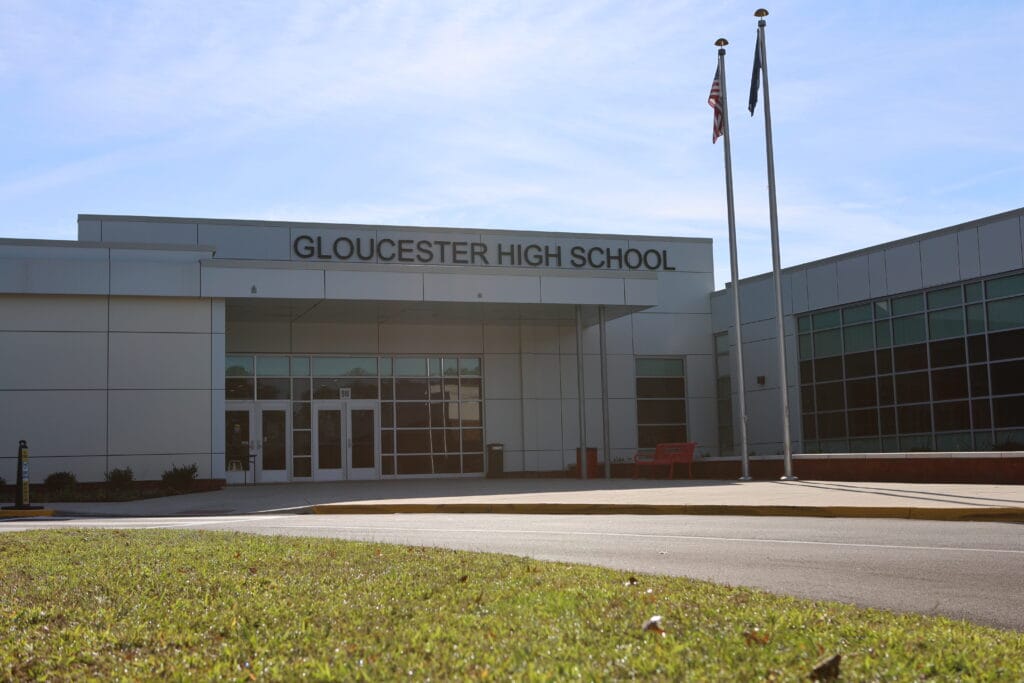
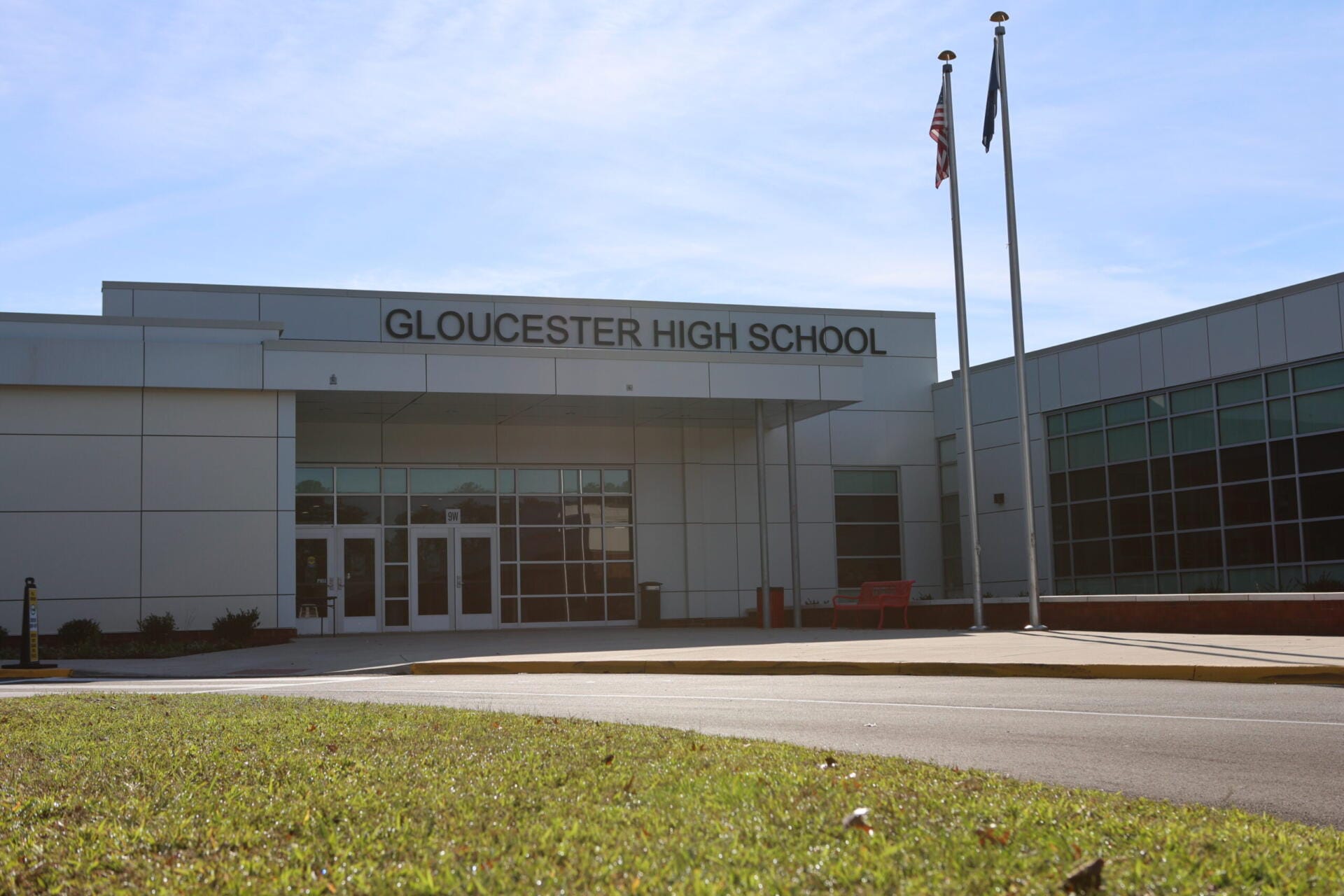
A view from the front entrance of the renovated Gloucester County High School, which opened in September 2025. (Photo by Nathaniel Cline/Virginia Mercury)
Six years ago, the city of Danville in Virginia’s Southside region struggled to raise funds for school construction and modernization across 15 schools, with nearly a quarter of its population, around 42,000, living in poverty.
But since the state authorized the city to levy an additional sales and use tax of up to 1% for school rehabilitation and voters agreed to the measure seven years ago, the future has changed for students, staff and local leaders.
“It’s been great so far,” said Michael Adkins, Danville’s assistant city manager and chief financial officer.
“Based on the receipts we’re getting each month, we’re easily able to take care of the debt service on those 20-year bonds,” he added. “And we have a little leftover, so we were able to accumulate the excess 1% sales tax for specific projects or contingency funds for the school renovations and construction that have been going on here.”
Across the commonwealth, 47 localities hope for similar success, if not better, when voters decide next month whether to adopt the 1% tax and allow those revenues to support school construction and modernization costs.
Records obtained by The Mercury show mixed results in the nine localities including Danville that Virginia’s legislature authorized to impose the 1% tax beginning in 2019. Those areas have generated $119 million total, state tax records show.
Despite the monetary benefits for schools, support for the tool isn’t unanimous statewide.
Concern around increased taxes
In York County, where voters will consider approving the tax, some residents are urging voters to reject the measure, arguing that it’s unnecessary because some localities, including York and Chesterfield County, already pay a significant amount in sales and use taxes.
According to the Department of Taxation, York County pays 7%, along with Williamsburg and James City County, representing the highest rate in the commonwealth. The next highest rate is 6.3%, for localities such as the city of Danville, and the counties of Charlotte, Gloucester, Halifax, Henry, Northampton, Patrick and Pittsylvania.
Steve Kennedy, a volunteer with the VOTE NO referendum committee, said voters in York and elsewhere should “100%” oppose the measure.
“Beyond the overall tax burden, the sales tax is highly regressive and hits low-income households the hardest,” Kennedy said, arguing that those same people are already struggling in a “stagflationary economy created by politicians’ spending and Federal Reserve policy.”
Kennedy added that before York County asks taxpayers to approve a new 1% sales tax and potentially take on decades of debt, it should prove that the money is truly necessary, that existing revenues have been used responsibly and that the projected sales-tax revenue is realistic.

A “No More Taxes York County” sign is posted outside a home in York County. (Photo courtesy of No New Taxes York County Committee) Mecklenburg, one of the nine localities with state-approved authority, has not put the matter to voters after receiving authorization, largely because they were not in favor of raising taxes, according to the Board of Supervisors’ records in 2021.
In August 2021, the county considered researching state and federal money that could help pay for new school construction. At that time, Mecklenburg estimated it would need about $6 million per year in debt payments to move forward with new school construction.
However, interest died down because the board did not want to raise taxes to pay for the projects, plus the county had already invested in newer additions to the three elementary schools.
Officials were concerned that replacing the schools would mean losing that investment. The committee recommended waiting a year before asking voters to approve it.
No action has been taken in the ensuing five years since former state Sen. Frank Ruff successfully proposed the change in 2020
“We did not and will not need to impose the additional 1% sales tax authority bestowed upon us and our neighboring localities thanks to the generosity of Senator
Ruff,” Alex Gottschalk, administrator for Mecklenburg County, said in a statement to the Mercury. “Therefore, we generate zero dollars of revenue and have made zero dollars of expenditures related to this tax and revenue streams derived from such tax authority.”
Danville’s success
In the shortest time span among the authorized localities, the city of Danville has collected more revenue than the others, with $30,739,149 in tax revenue for school construction costs through fiscal year 2025, after starting the tax in fiscal year 2023.
One takeaway from the city’s success is that it already established a significant sales-tax base of about $11 million per year, according to Adkins. In addition, the city has also attracted tourists, nonresidents and regional shoppers.
The city has also seen increased economic activity associated with the casino, although gaming taxes are separate from the sales tax. That’s helped attract tourists, nonresidents and regional shoppers.
“If you’re not a retail hub, it’s just going to take time,” Adkins said. “That 1% will add up. … It helps to offset your debt service if you decide to issue bonds to do some school construction … (but) certainly they’ll make a difference.”
The city invested $88 million to overhaul the 370,000-square-foot George Washington High School, which features a new gym, cafeteria, a renovated auditorium, expanded career and technical education classrooms, and remote central security systems.
Funds also went to renovating John M. Langston Campus into a modern learning facility that houses Galileo Magnet High School, RISE STEM Academy, and the administrative central offices.
The county also constructed a state-of-the-art elementary school, Arnett Hills, replacing the adjacent, aging G.L.H. Johnson Elementary School.
‘Significant impact’ in Gloucester
Gloucester County has used the 1% tax tool to generate $22,183,901 in revenue through fiscal year 2025, beginning in fiscal year 2022.
Like Danville, Gloucester is considered a retail hub in the Middle Peninsula region, and its sales tax benefits from residents’ and surrounding communities’ shopping there.
Gloucester has dedicated its revenues to projects focused on modernizing and improving school facilities, safety, accessibility and infrastructure, including the renovation of Gloucester High School.
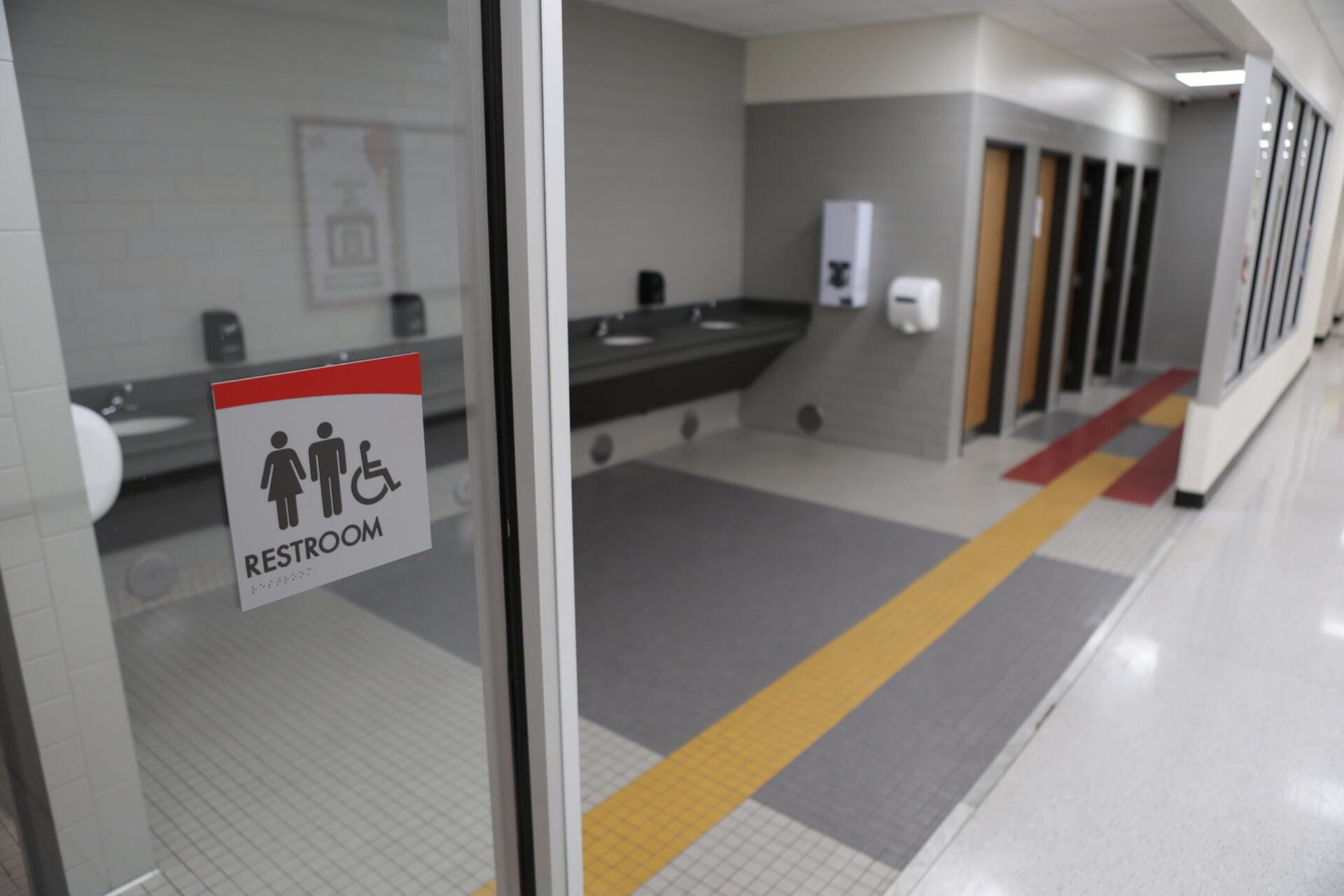
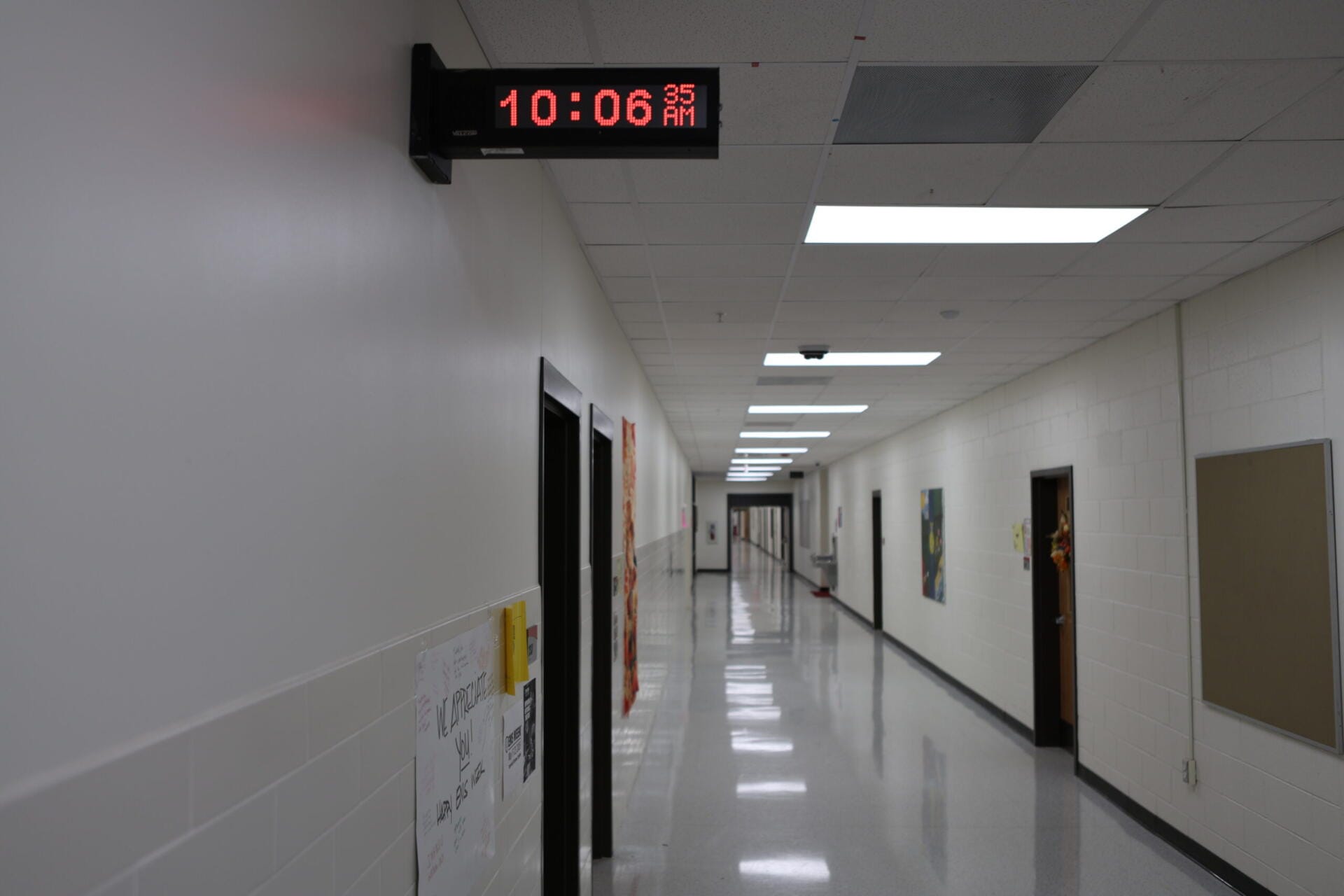
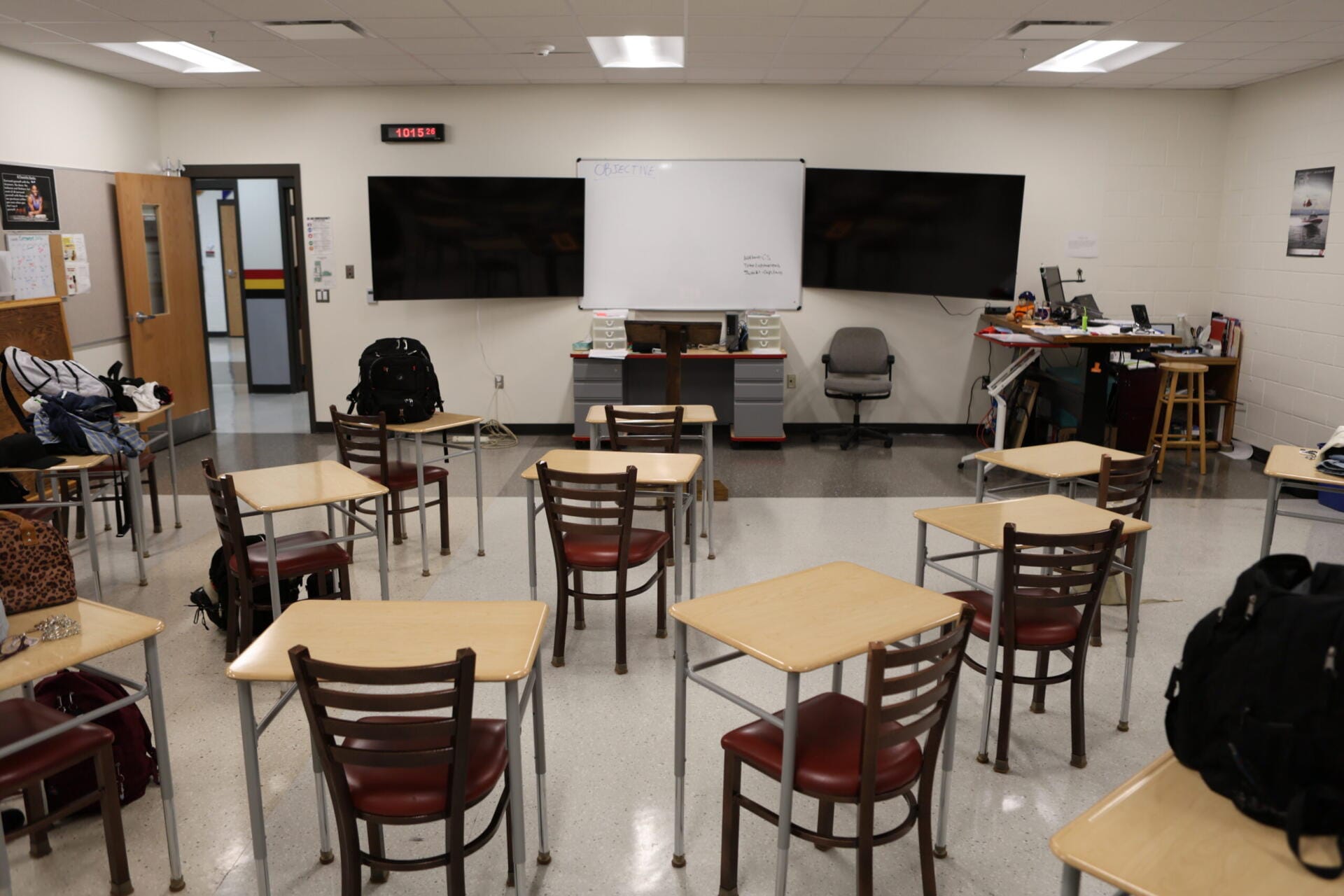
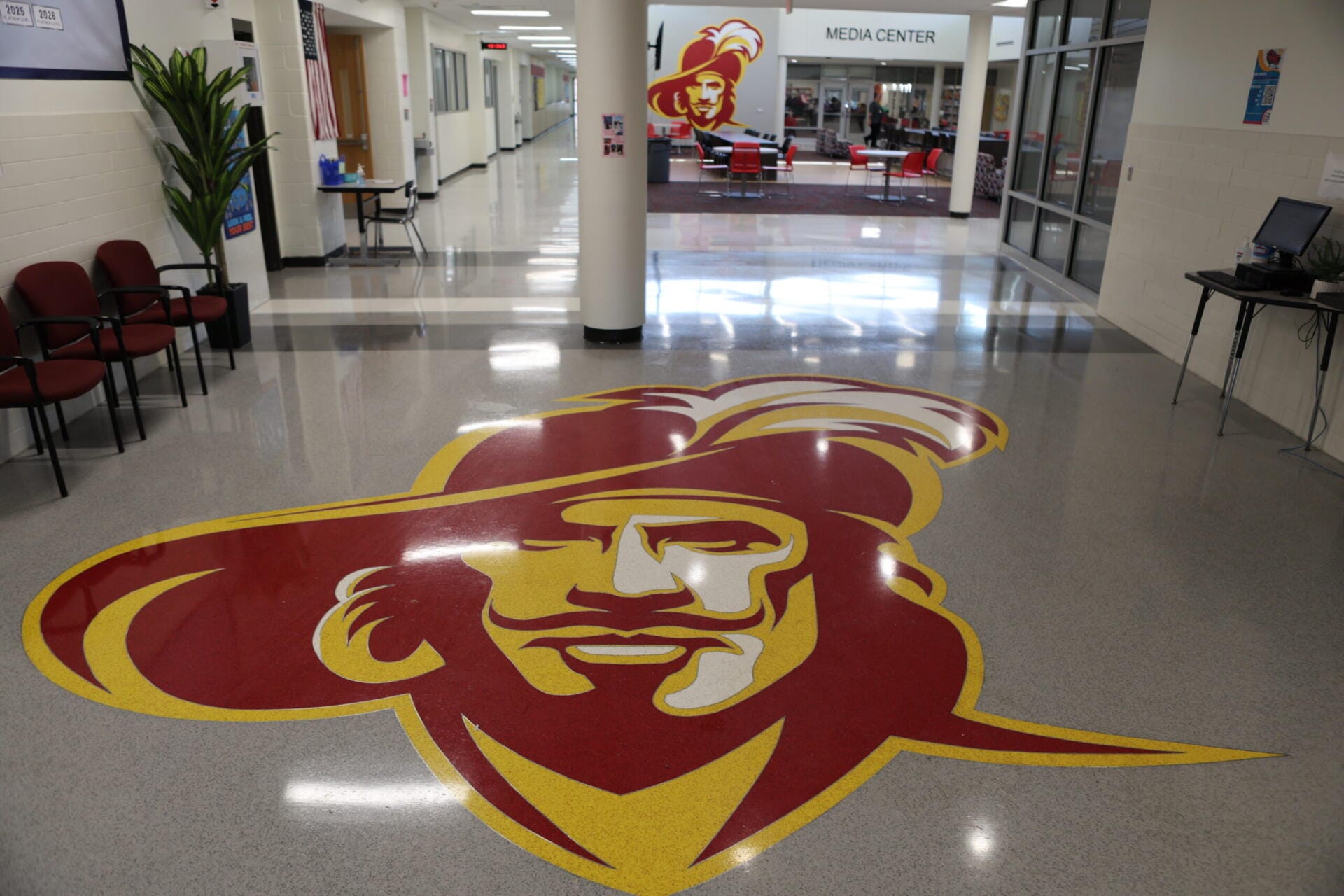
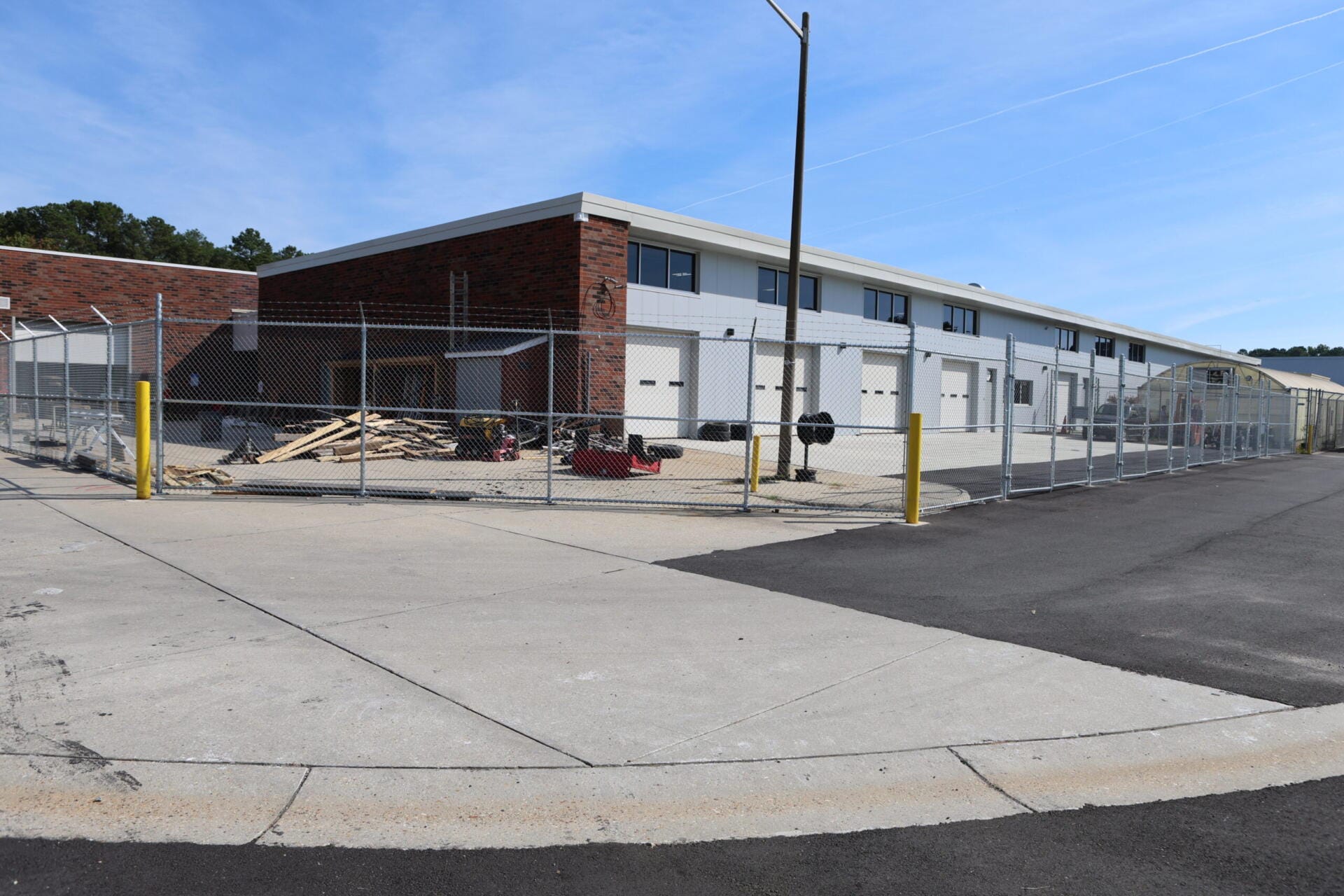
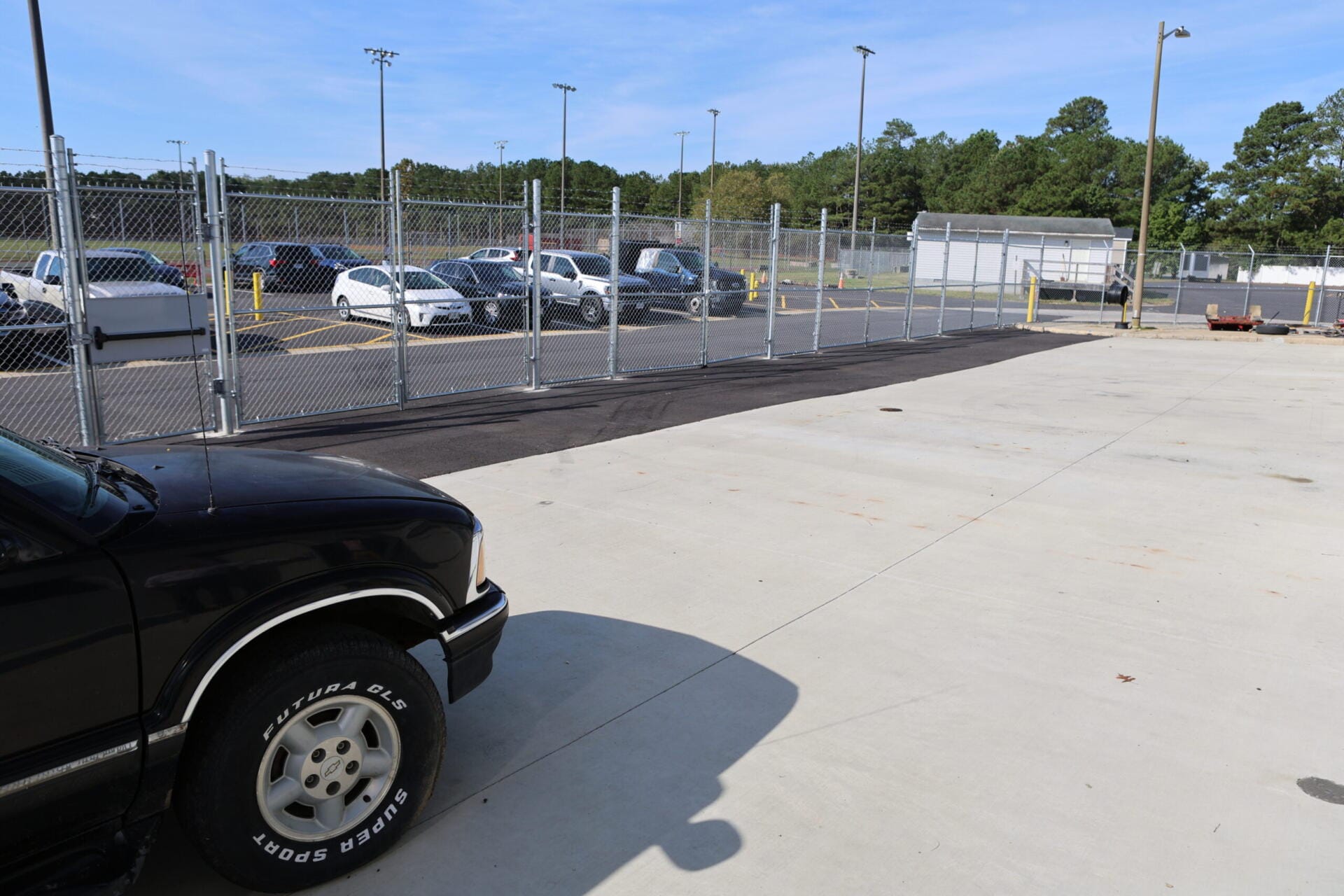
A view from the front entrance of the renovated Gloucester County High School, which opened in September 2025. (Photo by Nathaniel Cline/Virginia Mercury) A view from inside the newly renovated Gloucester County High School, which opened last September. (Photo by Nathaniel Cline/Virginia Mercury) A view from inside the newly renovated Gloucester County High School, which opened last September. (Photo by Nathaniel Cline/Virginia Mercury) A view from inside the newly renovated Gloucester County High School, which opened last September. Shelves that carry library books can be shuffled around to accommodate group sizes. (Photo by Nathaniel Cline/Virginia Mercury) A view from inside the newly renovated Gloucester County High School, which opened last September. (Photo by Nathaniel Cline/Virginia Mercury) A view from inside the newly renovated Gloucester County High School, which opened last September. (Photo by Nathaniel Cline/Virginia Mercury) A view from inside the newly renovated Gloucester County High School, which opened last September. (Photo by Nathaniel Cline/Virginia Mercury) A view from inside the newly renovated Gloucester County High School, which opened last September. (Photo by Nathaniel Cline/Virginia Mercury) A view from inside the newly renovated Gloucester County High School, which opened last September. (Photo by Nathaniel Cline/Virginia Mercury) A view from inside the newly renovated Gloucester County High School, which opened last September. (Photo by Nathaniel Cline/Virginia Mercury) A view from outside the newly renovated Gloucester County High School, which opened last September. The gate keeps students safe during their automotive and woodshop classes when the garage doors are open. (Photo by Nathaniel Cline/Virginia Mercury) A view from outside the newly renovated Gloucester County High School, which opened last September. The gate keeps students safe during their automotive and woodshop classes when the garage doors are open. (Photo by Nathaniel Cline/Virginia Mercury) A view from outside the newly renovated Gloucester County High School, which opened last September. (Photo by Nathaniel Cline/Virginia Mercury) A view from inside the newly renovated Gloucester County High School, which opened last September. (Photo by Nathaniel Cline/Virginia Mercury) George Bains, interim administrator for Gloucester County, said the investment has already made a noticeable mark on the school system.
“The 1% school sales tax has already made a significant impact here in Gloucester by supporting major renovations to our high school,” Bains said. “Not only did the renovations address basic functions of the building — they allow our students to take pride in our flagship school.”
Bains said other renovation projects supported by the sales tax revenue are in the works and will “ensure all Gloucester County students have classrooms and facilities that are modern, secure, and provide optimal learning environments.”
The county has also used the funds to replace an aging HVAC and air quality systems, repave high-traffic areas and lots, replace outdated and unsafe playgrounds, upgrade athletic fields and redesign school traffic loops.
A ‘very fortunate’ Halifax
Halifax County, the first to receive state authorization, has collected $20,857,413 in tax revenue since implementing the tax in fiscal year 2021.
Former Republican Del. James Edmunds II pushed for the authorization as the county faced “very little opportunities to generate tax revenue,” he said to a House finance subcommittee in 2019.
After the county raised the property tax rate to remodel the elementary schools and middle school, Edmunds said constructing a new high school would have been too much for the county’s tax rate to cover.
Ultimately, lawmakers endorsed the measure.

A view of the walking track and wall pad installation at Halifax County High School. (Courtesy of Halifax County Public Schools) 
A view of the auditorium at Halifax County High School. (Courtesy of Halifax County Public Schools) 
A view of the auditorium at Halifax County High School. (Courtesy of Halifax County Public Schools) “Halifax is very fortunate to have been the first to initiate the 1% sales tax and our goal is to use it in the most fiscally responsible way possible to maximize the impact for all of our schools,” Halifax Schools Superintendent Amy Huskin said
Halifax opened its new high school last year and is developing a new athletic complex. The county’s 1% sales tax, along with county funds, is being used to repay a portion of the high school’s debt service. The county has not yet drawn from the sales-tax account, but it is expected to begin doing so soon.
The school board also has other projects lined up in its Capital Improvement Plan. A full assessment of school assets is underway to determine priority needs and the best use of available funding.
Other successes, what’s next
In Charlotte, Henry, Northampton, Patrick and Pittsylvania counties, the 1% sales tax tool has also proved successful.
Henry County, one of the first areas to get approval, raised $22,212,783 in tax money for school construction through fiscal year 2025. Collections began in fiscal year 2021. Since then, Henry County has paid for improvements to sports facilities, heating and cooling systems, roofs, accessibility, and electrical systems throughout the district generating about $5.5 million annually in local capital revenue.
Between fiscal years 2022 and 2025, Northampton County collected $7,888,115 in tax money for school construction. The county set aside $91 million to expand and update its middle and high schools, to be finished next year, and $20 million to replace heating and cooling systems at its two elementary schools.
Patrick County collected $5,926,293 in tax money for school construction through fiscal year 2025. Collections started in fiscal year 2022. The biggest project was a $1.2 million update to its high school.
Through fiscal year 2025, Pittsylvania County raised $6,753,163, which varies slightly from the state’s record by about $5,000 in tax money for new school capital infrastructure. Collections began in fiscal year 2024. The biggest project was improving security and safety systems at 15 elementary and middle schools across the area, costing around $6 million.
In Charlotte County, from fiscal year 2022 through fiscal year 2025, the county collected $3,125,311 in tax money to pay for school construction.
Most of it went to new building work, including early planning and design for Randolph Henry High School, worth nearly $1 million.
According to a 2022 report to the state, a review of the high school found accessibility issues, uneven and cracked sidewalks and other items requiring remediation. Records show the school has been open since 1939, with improvements and a significant addition in 1968 — nearly 60 years ago.
The remaining funds were used to fix the shared bathroom at Phenix Elementary School, install tile floors in the high school’s cafeteria and hallway, and remove asbestos around the school.
Early voting runs through Oct. 31 and Election Day is Nov. 3, when residents in all Virginia localities will decide whether to adopt the 1% sales tax for school construction and modernization needs.
This post was originally published on Virginia Mercury.
Perriello seeks another 5th District upset as McGuire leans on Trump
Democrats are looking to an old winner for a new opening in Virginia’s 5th Congressional District, where former U.S. Rep. Tom Perriello is trying to repeat the upset that briefly put the Republican-leaning seat in his party’s hands 18 years ago.
Perriello, who defeated longtime Republican incumbent Virgil Goode in 2008, faces first-term U.S. Rep. John McGuire, R-Goochland, in the Nov. 3 election. Independent Cooke Costa Harvey is also on the ballot.
Perriello served one term before losing to Republican Robert Hurt in 2010. Republicans have held the seat ever since, although the district’s boundaries have changed considerably since Perriello last represented it.
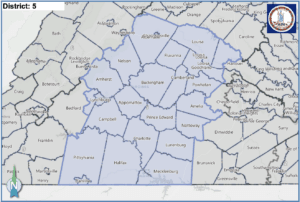
Today, the 5th District stretches from Charlottesville and Albemarle County through Lynchburg and Danville to the North Carolina border, while reaching east toward the Richmond suburbs. It takes in university-centered communities, parts of rural Southside and heavily Republican suburbs and exurbs.
Recent elections show the challenge Perriello faces in his contest to oust McGuire.
President Donald Trump carried the district by about 12% in 2024. That year, McGuire defeated Democrat Gloria Witt 57.3% to 42.3%. Even during Democrats’ strong statewide showing last year, Gov. Abigail Spanberger received 46.3% of the vote in the district, according to election data by the Virginia Public Access Project.
A new Washington Post-Schar School poll suggests a closer contest this fall. Conducted Sept. 23-28, the survey found McGuire leading Perriello 51% to 45% among likely voters. The margin of error for likely voters in the district was 4.6%.
David Richards, a professor and chair of the political science department at the University of Lynchburg, said the district’s Republican lean still gives McGuire an advantage, but turnout could matter more than large numbers of voters changing sides.
“The numbers are still on McGuire’s side, and Perriello has a huge climb still, but the final vote may be uncomfortably close,” Richards said.
For McGuire, Richards added, the danger would be Republican voters staying home. Perriello needs strong Democratic participation while also reaching voters in the middle.
McGuire ties his record to Trump
McGuire, a former U.S. Navy SEAL, came to Congress after several years in Virginia politics.
In a 2024 interview, McGuire described a childhood spent partly in foster care around Central Virginia before his grandparents took him and his sister in. After leaving the Navy, McGuire returned to Virginia in 1998 and founded SEAL Team PT, a fitness business. He and his wife, Tracy, live in Goochland County.
He later served in the House of Delegates and briefly in the state Senate, before challenging then-U.S. Rep. Bob Good in the 2024 Republican primary.
That contest became a fight over loyalty to Trump after Good had endorsed Florida Gov. Ron DeSantis for president. Trump backed McGuire, who ultimately defeated Good by 370 votes after a recount.
McGuire’s campaign did not respond to a request for an interview for this story.
During a September telephone rally with Trump, McGuire drew on his military background while making the case for his first term in Congress.
“As a Navy SEAL veteran, there are many ways to serve. We work as a team to get things done, and we do that in the General Assembly and now in Congress,” he said.
McGuire credited his team and the Trump administration with helping negotiate roughly $20 billion in investment in the district and about 7,000 new jobs. He also said his office had returned more than $10 million owed to constituents by the federal government.
He has defended Republicans’ 2025 tax-and-spending law, pointing to deductions for tips, overtime and seniors as well as a $50 billion rural health program. Virginia’s share of the funding totaled $189 million.
The five-year Rural Health Transformation Fund was created alongside Medicaid reductions that health policy researchers have warned could put additional pressure on rural providers.
“If Democrats win, like the president said, they will undo all of that,” McGuire said.
Trump, in turn, praised McGuire as a reliable supporter of his agenda.
“John McGuire has been a rock solid vote for strong borders, low taxes, low regulations, strong military, and supporting our vets,” Trump said.
The president also attacked Perriello as a “left-wing radical lunatic who spent years working for George Soros.” Perriello previously led the U.S. operation of Open Society Foundations, the philanthropic network founded by Soros.
McGuire has gone further himself, calling Perriello a “communist” while arguing that his policies would increase taxes, government spending and energy costs.
Energy has become another dividing line in the race.
McGuire supported legislation passed by the House aimed at shielding residential customers from some electricity costs associated with data centers. He also said local communities should decide where the facilities are built.
Perriello campaigns on affordability and independence
Perriello grew up in Albemarle County and graduated from Yale College and Yale Law School.
After leaving Congress in 2011, he held several diplomatic and foreign policy posts under Democratic administrations, including serving as a special envoy for the Great Lakes region of Africa and the Democratic Republic of Congo.
He ran unsuccessfully for the Democratic nomination for Virginia governor in 2017.
In an interview with The Mercury in Richmond last week, Perriello pointed to the new Washington Post-Schar School poll as evidence that his reach exceeds the Democratic base in his district.
“We’re really building a broad coalition of common sense, and you can feel it at the door, and you can see it in the early vote numbers,” he said.
His campaign has put affordability near the center of its argument against McGuire.
Perriello said some of his first priorities in Congress would be ending the war in Iran, reclaiming congressional authority over tariffs and reversing federal healthcare changes that he says are pushing costs higher.
“We’ve got to get to universal affordable care, whether that’s through Medicare for all or another plan,” he said. “But I don’t think that’s going to happen in the next two years.”
More immediately, he wants Congress to restore enhanced Affordable Care Act premium subsidies and protect Medicaid. The enhanced subsidies expired at the end of 2025, while Republicans’ tax-and-spending law made separate changes to Medicaid eligibility and financing that Virginia health leaders say could force 600,000 Virginians off the program.
Perriello also referred to his first stint in Congress when talking about politically difficult votes.
He supported the Affordable Care Act in 2010, a vote that became a major issue in his unsuccessful reelection bid later that year.
His argument now is that members of Congress should be willing to take those risks rather than simply follow their party of president.
“A member of Congress does not work for the president. A member of Congress works for the people in the district,” Perriello said.
Data centers give the candidates another issue on which to make that case.
Perriello criticized tax provisions in Republicans’ 2025 law that allow businesses to deduct certain investments more quickly, arguing that they benefit data center developers while Washington does too little to protect workers from automation. The provisions are available more broadly to businesses and are not limited to data centers.
He also said local communities should decide whether to welcome the facilities and negotiate protections for residents.
Perriello opposes the Valley Link transmission line, which would run across Central Virginia toward Northern Virginia as utilities respond to rising electric demand, much of it associated with data center growth.
Asked about McGuire’s ideological attacks, Perriello returned to the pocketbook issues he has emphasized throughout his campaign.
“This doesn’t bring down diesel costs. It doesn’t bring down gas prices,” he said.
Harvey rejects two-party system
Independent Harvey, a Delaware native who has lived in Amherst County since 2012, says voters deserve an alternative to both major parties.
Harvey has worked in engineering, surveying and wilderness therapy with at-risk youth. He has never held political office and says he would serve only one term and accept no monetary donations.
In a phone interview with The Mercury Friday, Harvey blamed partisan division for congressional failures on immigration reform, war and government funding.
“I am for a unified America, I am for the collaboration of ideas,” he said.
Harvey said he supports eliminating tax incentives for data centers and backing communities that oppose them, citing residents’ concerns about water and electricity costs.
“If they don’t want a data center in their community, I would support them,” he said.
Early voting is underway through Oct. 31. Election Day is Nov. 3. Read The Mercury’s voter guide to learn more about the candidates and stakes of the congressional races.

Virginia’s 5th Congressional District stretches across Central and Southside Virginia, including Charlottesville, Lynchburg and Danville, and reaches east into communities near Richmond. (Map courtesy of Supreme Court of Virginia) This post was originally published on Virginia Mercury.
NextEra faces Thursday deadline in Dominion review
(The Center Square) – NextEra Energy must provide records about accusations of political misconduct in Florida by Thursday as Virginia regulators review its proposed acquisition of Dominion Energy.
The State Corporation Commission’s chief hearing examiner also ordered a clearer answer about whether generation costs incurred to serve large-load customers could shift to customers who remain with Dominion for their electricity supply.
U.S. Rep. Eugene Vindman, D-Va., announced Monday that he had joined a congressional letter urging federal regulators to more closely examine the merger’s potential effects on competition and electricity costs.
Chief Hearing Examiner D. Mathias Roussy Jr.’s Friday ruling gives the companies four business days to supplement responses to Clean Virginia’s information requests. He granted some requests and rejected others.
Roussy found that NextEra’s handling of allegations involving its Florida Power & Light subsidiary could help regulators evaluate NextEra’s management. The ruling does not establish wrongdoing or decide whether to approve the merger.
Dominion and NextEra argued that historical political activity outside Virginia falls beyond the proceeding’s scope. The companies said an internal investigation found no evidence of illegality or wrongdoing by Florida Power & Light or its employees.
Required disclosures include a memorandum allegedly sent to then-NextEra Chairman James Robo concerning potentially unlawful conduct by Florida Power & Light officers through consultants and vendors, if it exists and is within the companies’ possession or control.
NextEra also must provide records of an internal investigation Robo discussed on a January 2022 earnings call; contracts, payments and work product involving Matrix LLC, Canopy Partners and specified related entities; and records supplied to Jacksonville’s special committee investigating the proposed sale of its public utility, JEA.
On customer costs, the companies said Dominion’s rates and service terms provide substantial protections against shifting generation costs. Their attorney acknowledged during oral argument that the risk is never zero, according to the ruling. Roussy ordered a more specific response.
The companies have offered an alternative that would double the proposed residential bill credit period from two years to four, subject to commission approval. Their Sept. 14 announcement described $10 monthly credits funded by shareholders and a commitment to keep merger costs off customers’ bills.
Vindman, U.S. Rep. Suhas Subramanyam, D-Va., U.S. Sen. Elizabeth Warren, D-Mass., and other lawmakers urged federal scrutiny of the merger in a Sept. 29 letter.
Public hearings are scheduled Wednesday in Newport News and Friday in Fairfax County. Written comments are due Nov. 9, and the evidentiary hearing begins Nov. 17.
This post was originally published on The Center Square.
Identical twin brothers return to Va. hometown to co-run an ER, more state headlines
• “First bill of 2027 aims to protect people with autism, other disabilities.” — Richmond Times-Dispatch
• “Virginia Beach schools violated Title IX for years, feds find. It may be more complicated.” — The Virginian-Pilot
• “Winchester area still fastest-growing in Virginia.” — The Northern Virginia Daily
• “Out of the Darkness Walk raises suicide awareness and mental health support in Virginia.” — WSET
• “Identical twin brothers, who grew up in poverty, returned to their (Virginia) hometown to co-run an ER together.” — People.com
This post was originally published on Virginia Mercury.
Physicians urge rejection of Virginia abortion amendment
(The Center Square) – Physicians urged Virginia voters Friday to reject a proposed reproductive freedom amendment, arguing it could weaken medical oversight and parental consent requirements.
Virginia Medical Professionals for Women’s Safety held the Richmond press conference to oppose Question 1 on the Nov. 3 ballot.
Dr. Christina Francis, an OB-GYN and CEO of the American Association of Pro-Life Obstetricians and Gynecologists, said the amendment could allow abortions by unlicensed providers in unlicensed facilities. She urged voters to consider the proposal as a patient safety issue.
Dr. Timothy Boley, a maternal-fetal medicine specialist, questioned who would set and enforce medical standards under the amendment.
The proposal would add a right to reproductive freedom to the Virginia Constitution, which does not currently explicitly provide that right.
The ballot question asks:
“Should the Constitution of Virginia be amended to (i) protect the freedom to make personal decisions about prenatal care, childbirth, postpartum care, birth control, abortion, miscarriage management, and fertility care; (ii) protect doctors, nurses, and patients from being punished for these decisions; and (iii) allow for restrictions on access to abortion during the third trimester of pregnancy except when the patient’s health is at risk or the pregnancy cannot survive?”
Abortion is already legal in the commonwealth during the first and second trimesters, with additional restrictions afterward. Rejecting the amendment would not itself ban abortion.
Current law already includes an exception for mental or physical health after the second trimester. It generally requires hospital care and agreement from three physicians that continuing the pregnancy would likely cause death or substantially and irremediably impair the patient’s mental or physical health. A separate exception applies when an abortion is necessary to save the patient’s life.
The amendment would allow third-trimester restrictions but prohibit a ban when a physician judges an abortion medically indicated to protect the patient’s life or physical or mental health, or when the fetus is not viable.
Boley also argued that the amendment’s protection for patients’ decision-making could take precedence over restrictions on third-trimester abortions.
More broadly, restrictions on reproductive care would have to maintain or improve the patient’s health and follow accepted medical standards and evidence. They would also have to use the least restrictive approach and respect the patient’s right to make their own decisions.
Victoria Cobb, president of the Family Foundation of Virginia, argued the amendment would invalidate parental consent requirements.
Current law generally requires consent from a parent or another authorized adult for an unemancipated minor’s abortion. A minor can seek a judge’s permission instead. The law also includes exceptions involving suspected abuse or neglect and medical emergencies.
Virginians for Reproductive Freedom, the coalition campaigning for passage, launched a six-figure digital ad campaign.
“From the Shenandoah Valley to the Eastern Shore, we know Virginians don’t agree on everything,” the ad says.
“But when it comes to our healthcare decisions, we can all agree: a politician is never more qualified to make medical decisions than you, your family, and your doctor,” it continues.
“This November, it’ll be up to us, not extreme politicians in Richmond.”
Early in-person voting began Sept. 18 and continues through Oct. 31. Election Day is Nov. 3.
This post was originally published on The Center Square.
Federal scholarship rules outline Virginia’s next steps
(The Center Square) – Virginia families could receive scholarships for tuition, tutoring and other education expenses through a new federal tax credit program in 2027, provided the commonwealth completes the participation requirements.
The Treasury Department and IRS released proposed regulations and companion temporary regulations Thursday outlining how the program would operate.
The IRS lists Virginia among states that have made an advance election to participate in the Federal Scholarship Tax Credit for 2027. Participation also requires submitting a list of qualifying scholarship organizations.
The governor’s office told The Center Square Thursday that the administration is reviewing the new federal regulations.
“As the parent of three school-aged daughters, Governor Spanberger remains committed first and foremost to protecting and supporting Virginia public school students, teachers, and parents, and setting kids up for life-long success,” a statement from her office said.
The response did not specify whether Virginia has submitted its list of qualifying scholarship organizations or provide a timetable for doing so.
Beginning Jan. 1, individual donors could receive an annual federal tax credit of up to $1,700 for qualifying contributions. Married couples filing jointly could claim up to $3,400, with each spouse making their own qualifying contributions.
For 2027, participating states must submit their lists of scholarship organizations and required certifications by Feb. 15.
Leslie Hiner, senior adviser for legal policy at EdChoice, a school choice advocacy organization, told The Center Square that multiple Virginia scholarship organizations have been preparing for the program for almost a year.
“This is a huge advantage, and those SGOs should be praised for this work,” Hiner said.
She said Virginia’s next step would be submitting its list of scholarship granting organizations through the federal portal.
National surveys conducted by Morning Consult for EdChoice in June, July and August found 64% of adults and 77% of school parents supported their state participating after receiving a description of the federal tax credit. Forty percent of adults said they had heard nothing about the program.
Scholarship granting organizations are qualifying charities that collect donations and award education scholarships. Federal law requires them to spend at least 90% of their income on scholarships and serve at least 10 students who do not all attend the same school.
They must also verify applicants’ household income and family size. Contributions cannot be earmarked for a particular student.
Students must be eligible to enroll in a public elementary or secondary school and have prior-year household income no higher than 300% of area median gross income, adjusted for family size.
Qualified expenses include private school tuition, tutoring for public school students, special education services, books and supplies. Eligibility does not guarantee an award. Scholarships depend on available funding and the organizations’ decisions.
Virginia already operates a separate Education Improvement Scholarships Tax Credits program. It provides state tax credits equal to 65% of qualifying donations to approved scholarship foundations, with a $25 million annual cap on credits.
Under the new federal program, state tax credits for the same qualifying contributions reduce the amount eligible for the federal credit.
The federal credit is nonrefundable, meaning it can reduce income tax owed to zero but does not pay out any excess as a refund. Unused credit may be carried forward for up to five years.
This post was originally published on The Center Square.
The simple affordability fix Virginia just can’t seem to make
Across the political spectrum, people who do the math come up with the same answer: the cheapest kilowatt-hour is the one you don’t need to use. A well-insulated building outfitted with LED lighting and energy-efficient appliances saves money for occupants over time even when upfront costs are higher.
It’s astounding, then, that Virginia’s residential building code treats these elements as optional luxuries rather than as basic standards that all home buyers and renters should expect, even – or perhaps especially – in an entry-level home.
Key efficiency provisions of Virginia’s housing code have not been strengthened in a decade and a half, lagging far behind national model standards that many states regularly adopt each time the model standards are improved.
Even more astounding, Virginia’s Board of Housing and Community Development (BHCD), which updates Virginia’s code every three years, is set to propose an “updated” building code with efficiency standards that lag even the 2012 edition of the national standards.
The national model code is called the International Energy Conservation Code, or IECC. Its globalist name notwithstanding, it is overwhelmingly a U.S. standard and serves as the basis for the efficiency provisions of most state and local building codes.
Every three years the International Code Council updates the IECC, almost always ratcheting up standards in line with improved technologies and capabilities.
If you buy a new house in Maryland, which regularly adopts the latest IECC, you can be assured of a weather-tight home built to a solid efficiency baseline. Across the Potomac in Virginia, your new house is likely to be built to lower standards, even by the same builder.
The builder may have saved a little money building the Virginia house, but whether you will save anything on the purchase price is questionable. As every buyer knows, supply and demand matter much more than a builder’s cost in determining how much you pay for your home.
What is absolutely clear (and demonstrated by research in case the point isn’t sufficiently intuitive) is that you will spend more money over time to heat and cool and power a less efficient home. By the time you’ve paid off your mortgage, Virginia’s lax standards are likely to have cost you tens of thousands of dollars.
Sure, once you’ve bought that Virginia home you can then spend more money to upgrade lighting and appliances and possibly do some extra weatherizing, assuming you are even aware that better performance is possible. But you’re pretty much stuck with whatever insulation the builder put into the walls. That’s why the time to maximize energy efficiency is when the home is being built, not later.
What’s especially irritating is that Virginia’s failure to adopt higher standards comes in spite of the General Assembly’s efforts to raise the bar. Legislators are hesitant to wade into the minutia of building codes, but twice in the last ten years they have passed laws nudging the Board towards stronger energy conservation standards.
Virginia law now calls for the Board to adopt a code that permits buildings to be “constructed, rehabilitated and maintained at the least possible cost consistent with recognized standards of health, safety, energy conservation and water conservation.”
It instructs the Board to have “due regard” for the “generally accepted standards” recommended by the International Code Council and the National Fire Protection Association. (The fire standards have done very well as a result; the efficiency standards, not so much.)
More pointedly, a 2021 act added a requirement that when the International Code Council issues an updated version of the IECC, the Board must consider adopting amendments to the Virginia building code that are “at least as stringent as” the provisions of the latest IECC.
In doing so, the Board must assess “the public health, safety, and welfare benefits of adopting standards that are at least as stringent as those contained in the IECC, including potential energy savings and air quality benefits over time compared to the cost of initial construction.”
I’m sure the Board would say that it does consider these things, right before dismissing them. We should take that with a grain of salt; the BHCD has long been dominated by builder interests.
And according to Bill Penniman, an activist and attorney who participates in the BHCD process, the board operates according to a rule it made up that says there must be “consensus” among the members of the various working groups that review the code before a more stringent provision makes the final cut.
But, according to Penniman, the board defines “consensus,” to mean unanimity, and thus consensus is never reached in favor of strengthening energy conservation provisions because, again, builders and their allies dominate the process. (Interestingly, he notes, non-unanimous proposals to weaken the code don’t suffer a similar fate.)
And so, in spite of the law, Virginia’s wall insulation and air-leakage standards remain weaker than IECC standards from 2012, 2015, 2018, 2021 and 2024.
Now, according to Penniman, the BHCD plans to submit to the governor proposed code amendments that once again fall short of even the 2012 IECC. At a July 13 meeting, the board rejected even an amendment offered by Penniman and other efficiency advocates that would have brought wall insulation requirements up to the IECC standard in effect from 2012 to 2018.
Penniman says there will be a final vote in December before BHCD publishes the proposed rule for “updates” that will take effect in 2028.
Having written on this topic before, I’ve heard from home builders who say that increasing the efficiency of new homes makes them too expensive for entry-level buyers. The choice, they say, is not between building homes to lower standards or higher standards, but between building them to lower standards or not at all.
Houses can be built to use much less energy. Why aren’t they?
If you really want to add to the housing stock, they urge, you need to make homes as cheap to build as possible, including skimping on energy-saving measures. And since it wouldn’t be fair to have higher standards for well-off buyers than for poorer folks, everyone alike must suffer from below-standard housing.
Well, okay, they don’t put it in quite the same words I use, but so far they have won the argument at the Board.
What is interesting here, however, is that while most homebuilders focus on maximizing profit by building as cheaply as possible, companies like Habitat for Humanity and Viridiant, which regularly serve low-income communities, consistently choose EarthCraft or Energy Star standards – which both exceed code. They know a home isn’t affordable if the occupants can’t afford to pay for heat and electricity.
Clearly it is time for the governor to weigh in. Her just-released Energy Plan has a lot of welcome language on energy efficiency as well as other technologies that save money while lowering carbon emissions. (I’ll unpack it in more detail in a future column.)
The plan leans in on the importance of home efficiency and touts state programs that provide support for retrofits of existing homes. But while it also notes that adopting the latest model building codes could yield billions of dollars in energy cost savings over the life of new homes, it does not actually call for Virginia to take that path.
Residential heating and cooling is a significant expense for most households. An energy affordability agenda that leaves out home efficiency is one with a gaping hole in it.
This post was originally published on Virginia Mercury.
Feds provide guidance on new federal K-12 scholarship tax credit program
The U.S. Department of the Treasury released new guidance Thursday for participating states, scholarship-granting organizations and taxpayers as the federal scholarship tax credit program prepares to take effect in January.
Created through President Donald Trump’s massive tax and spending law in 2025, the Education Freedom Tax Credit program allows individuals to claim a dollar-for-dollar federal tax credit of up to $1,700 for donations to certain scholarship-granting organizations (known as SGOs) and taxpayers can contribute to an eligible organization regardless of where that taxpayer lives.
The $1,700 limit applies to the donor credit, not the scholarship amount, and married couples filing jointly can claim a combined $3,400 credit.
These contributions are meant to fund K-12 scholarships, primarily at private schools, though the scholarships can cover tutoring, books, supplies, extended-day programs and disability services for students who remain in public schools, and tutoring can take place during or after school.
So far, 30 states have agreed to join the program, according to the Internal Revenue Service. Officials also confirmed a deadline for states to opt in by Jan. 1 and to submit their SGO lists by Feb. 15. On a press call with reporters Wednesday, a Treasury official said that if an organization meets the federal statutory requirements, the state must include it on the list submitted to the IRS; states cannot pick and choose the SGOs they like.
States opting in so far include: Alabama, Alaska, Arkansas, Colorado, Florida, Georgia, Idaho, Indiana, Iowa, Kansas, Kentucky, Louisiana, Mississippi, Missouri, Montana, Nebraska, Nevada, New Hampshire, North Carolina, North Dakota, Ohio, Oklahoma, South Carolina, South Dakota, Tennessee, Texas, Utah, Virginia, West Virginia and Wyoming.
New York Democratic Gov. Kathy Hochul, has said that she plans to have her state participate, but wants to first review the federal rules before making a final decision.
Several Democratic governors, including those in Hawaii, Minnesota, New Mexico and Oregon, have said their states won’t participate.
In some states, Republican lawmakers and Democratic governors have had some disputes over the decision to opt in. Democratic governors in North Carolina and Kansas vetoed legislation requiring their states to opt in, but GOP-controlled legislatures overrode both vetoes.
The Democratic governors of Arizona and Wisconsin successfully vetoed GOP legislation that would have opted their states into the program.
Under the program, scholarships may be given to students whose household income is up to 300% of an area’s median income. During the press call, Treasury officials said approximately 95% of American children live in households meeting that threshold, while Department of Education officials said about 28 million children in the 30 participating states would be eligible.
States have limited authority on the rules they can impose on scholarship-granting organizations within their borders; federal rules don’t allow them to supersede limits by the federal government.
Under the federal rules, the organizations would be required to undergo annual financial and program audits and provide those reports to participating states. States could use the audits to identify problem organizations and remove groups that fail to meet federal requirements or to prevent fraud, including duplicate scholarship payments for the same student expense.
SGOs are required to be 501(c)(3) nonprofits that are not private foundations, and they must keep qualified contributions in separate accounts.
Under the law, SGOs must spend no less than 90% of their income on scholarships. Additionally, each scholarship-granting organization must serve at least 10 students who do not all attend the same school. They cannot earmark donations for a particular student and must verify household income and family size.
Federal statute also requires SGOs to prioritize students who received a scholarship the previous school year, then siblings of the recipients. Students who would otherwise be public school students could qualify for these scholarships.
The rules stipulate that homeschools will be treated as they are defined and categorized according to each state’s law.
According to new estimates provided by the Treasury, by 2030, there could be somewhere between 600 and 700 SGOs with contributions from more than 11 million taxpayers, nearly $26 billion in qualified contributions annually and as many as 2.2 million scholarships annually.
Stateline reporter Robbie Sequeira can be reached at [email protected].
This story was originally produced by Stateline, which is part of States Newsroom, a nonprofit news network which includes Virginia Mercury, and is supported by grants and a coalition of donors as a 501c(3) public charity.
This post was originally published on Virginia Mercury.
FOIA Friday: Virginia faces scrutiny over public records transparency
One of the less noticed features of the Virginia Way is the long-running tendency of the commonwealth’s leaders to conduct their decision-making behind closed doors. While the Virginia Freedom of Information Act presumes all government business is by default public and requires officials to justify why exceptions should be made, too many Virginia leaders in practice take the opposite stance, acting as if records are by default private and the public must prove they should be handled otherwise.
In this feature, we aim to highlight the frequency with which officials around Virginia are resisting public access to records on issues large and small — and note instances when the release of information under FOIA gave the public insight into how government bodies are operating.
Richmond faces scrutiny over Flock contract records
Richmond said it had no records. Then, after requests were reworded, it produced them — at least three times over nine months, according to The Richmonder, raising questions about the city’s effort to improve transparency.
One request focused on the city’s contract with license plate reader company Flock, which has faced privacy criticism across the commonwealth. Some localities have publicly supported using the cameras to help solve crimes.
The Richmonder said Chesterfield and Henrico sent copies of their contracts. Richmond Police said it found “no relevant documents,” and the city’s procurement office said the same, each directing The Richmonder to the other’s office.
“Why did the city say two departments doing two searches for the contract had turned up nothing?” The Richmonder wrote.
In a third attempt, the outlet changed its request from “Flock Safety Inc.” to the contractor’s name, “Insight Public Sector,” to search for the contract for nearly 100 cameras in the city.
The city also rejected two other requests. One involved the Richmond Flying Squirrels, which operates under the legal business name Navigators Baseball LP. Another sought a water-funding spreadsheet, but the city rejected it because the request contained a typo.
Mayor Danny Avula vowed to improve the city’s responsiveness. After multiple records requests for the Flock contract, he told The Richmonder that he believes employees made an honest effort to find it and that the procurement office’s search process wasn’t comprehensive enough.
“Our FOIA officers work really hard to identify responsive records the requester is asking for, and we definitely encourage FOIA officers to ask clarifying questions to help scope the request, but there are undoubtedly times where they just do a search for the words that were asked for,” Avula said.
The Richmonder said Avula’s administration didn’t directly answer who decided to say there was no Flock contract.
Mold forces temporary closure of Obama Elementary
Mold that shut down Richmond’s Barack Obama Elementary School at the start of the school year has prompted recommendations to remove and replace building materials, according to a contractor’s report obtained by WTVR.
The contractor said the school’s HVAC and moist pipes caused the mold. The assessment identified a broader pattern of moisture intrusion, leaks, water-damaged materials and areas where moisture could remain hidden.
WTVR’s records request included the contractor’s room-by-room assessment, prior work orders, information about leaks and the HVAC system, and remediation recommendations. Priority repair areas included areas affected by active plumbing leaks and roof leaks.
Students returned to school after nine days.
WTVR questioned Richmond Public Schools about the work-order descriptions and whether repairs had been completed. RPS said many of the underlying issues have since been addressed and that it is adding ongoing monitoring.
The city of Richmond is one of 47 localities seeking voter approval in November to collect a 1% sales tax for school construction and modernization to address aging facilities. Obama Elementary, formerly J.E.B. Stuart, opened in 1922.
Court sides with parent in Spotsylvania FOIA delay case
A parent seeking records about her children’s education plans won a partial victory in the Virginia Court of Appeals, which sent part of her FOIA case against the Spotsylvania County School Board back to the trial court.
Tamara Quick, the parent of two students, sought documents related to their individualized education programs, customized learning plans for students with disabilities.
The Virginia Coalition for Open Government, a nonprofit alliance promoting open government, published a copy of the Aug. 4 opinion, drawing attention to questions about the school division’s compliance with Virginia’s FOIA response deadline. Quick alleged that the division had failed to respond within five business days, instead taking more than a month.
Quick lost in the trial court after arguing that the school division had not responded properly or quickly enough under Virginia FOIA. She appealed.
The appeals court upheld the lower court’s finding that Quick’s April 18, May 6, and May 23 inquiries were not FOIA requests.
However, her Oct. 4 request was a valid FOIA request because it explicitly referenced FOIA and was sent to the school superintendent and FOIA officer.
The appeals court sent the issue back to the lower court after the school division produced records more than a month later, on Nov. 8.
The trial court must examine whether the division produced the specific records requested Oct. 4 and whether it violated FOIA’s five-working-day requirements.
The appeals court rejected Quick’s two other FOIA requests on procedural grounds. Her Nov. 5 request was not in the record, so she could not establish what she sent or to whom. Her Jan. 13 request was sent to the school system’s private attorneys rather than the school system itself.
Residents use FOIA to uncover data center projects
Residents in Franklin and Roanoke counties used public records requests to uncover details about proposed data centers as scrutiny of the projects grows, WVTF reported.
In Franklin County, resident Laura Carter told WVTF that her FOIA request about the county’s zoning ordinance and process uncovered references to “Project Flash.” The project was later identified as a proposed data center development at Summit View Business Park, just north of Rocky Mount.
As details emerged, residents opposed the project, and the county announced in mid-August that it was not moving forward.
In a separate case, the Southwest Virginia Data Center Transparency Alliance used records requests to piece together a potential agreement involving a data center at Wood Haven Technology Park in Roanoke County.
That project ultimately fell through.
“It’s a helpful illustration of how some of these deals can come together, but it is also a case where we got lucky this time,” Ben Verschoor, alliance organizer, told WVTF. “We should be taking measure to ensure it doesn’t happen.”
This post was originally published on Virginia Mercury.
Trump cuts end Virginia Medicaid access for thousands of legal immigrants and more headlines
• “Trump cuts end Virginia Medicaid access for thousands of legal immigrants.” — VPM
• “Democrat has edge in Virginia House race considered national bellwether, poll finds.” — The Washington Post
• “Cline and Macy appear aligned on one issue in the 6th District race: the need for a data center moratorium.” — Cardinal News
• “Virginia’s fall foliage show is just weeks away.” — Axios
• “Virginia’s 9th District race: Griffith faces challenger Powers in November.” — WSLS
This post was originally published on Virginia Mercury.
Cost of living tops concerns in two Virginia House races
(The Center Square) – Household costs are the leading voting concern in two Virginia congressional districts where Republican incumbents face Democratic challengers.
A Washington Post-Schar School poll released Thursday found 42% of likely voters in the 1st Congressional District and 49% in the 5th named cost of living as their most important issue when voting for Congress.
Immigration followed at 15% in the 1st District and 11% in the 5th. Healthcare drew 9% and 8%, respectively, while taxes were the top issue for 9% and 7%.
More voters in both districts said their finances had worsened than improved since January 2025, when President Donald Trump took office for a second time.
In the 1st District, 42% said they were not as well off financially, compared with 24% who said they were better off. Another 33% said their finances were about the same.
In the 5th District, 39% said they were not as well off, 25% said they were better off and 35% said their finances were about the same.
Democrat Shannon Taylor received 50% support in the 1st District, compared with Republican Rep. Rob Wittman’s 46%.
Republican Rep. John McGuire received 51% support in the 5th District, compared with Democrat Tom Perriello’s 45%.
The results include voters leaning toward a candidate and those who had already cast ballots.
The survey was conducted Sept. 23-28 among 609 registered voters in the 1st District and 600 in the 5th. Responses were weighted to produce likely-voter results.
The Post and George Mason University’s Schar School of Policy and Government jointly sponsored and funded the poll. The margin of error was +/- 4.5% in the 1st District and 4.6% in the 5th.
Campaign finance reports filed with the Federal Election Commission show Wittman’s campaign reported about $4.3 million in cash on hand as of July 15, compared with about $1 million for Taylor’s campaign.
Perriello’s campaign reported about $1.5 million in cash on hand, compared with about $524,000 for McGuire’s campaign as of the same date.
Through Wednesday, voters had cast 37,990 early ballots in the 1st District and 32,671 in the 5th, according to the Virginia Public Access Project’s tracker, which uses Virginia Department of Elections data.
In-person early voting began Sept. 18 and continues through Oct. 31. Election Day is Nov. 3.
The Center Square was unsuccessful prior to publication getting comments from the campaigns of Taylor, Wittman, McGuire and Perriello.
This post was originally published on The Center Square.
Virginia energy plan targets utility costs, data center growth
(The Center Square) – Virginia’s new energy plan proposes requiring utilities to share fuel costs that exceed approved forecasts and making data centers pay the electricity infrastructure costs they create.
Gov. Abigail Spanberger released the plan Thursday as the commonwealth prepares for rising power demand. The proposals target how utilities recover costs from customers, finance investments and acquire new generation.
The plan does not set electric rates or approve projects. Implementation would move through legislative, regulatory and local processes, according to the governor’s office.
One recommendation would authorize the State Corporation Commission to require utilities to absorb a portion of fuel and purchased-power costs exceeding approved forecasts. The framework could use escalating cost-sharing tiers rather than placing the full burden on customers.
It also calls for reviewing whether utilities could use more debt and less shareholder equity to finance investments, potentially reducing costs recovered through electric bills.
For data centers, the plan recommends assigning the additional generation, transmission and distribution costs they create to those customers. For large data centers seeking new grid connections, it proposes requiring them to demonstrate that they can reduce demand during grid emergencies.
Chief Energy Officer Josephus Allmond described one approach being seen in other states: Data center developers could help finance batteries in nearby homes and contract with those batteries to reduce demand on the grid during peak hours.
Another recommendation would explore a state-led renewable energy procurement process comparing utility-owned and third-party projects on cost and risk.
“This is about competition,” Spanberger said when asked how the administration would carry out the plan while working with utilities.
The Virginia Department of Energy’s modeling estimates about $422 billion in electricity system costs from 2026 through 2050 under current policies and a moderate-demand forecast.
Another modeled scenario expanding distributed energy resources, adding data center demand flexibility and allowing certain non-combustion gas resources estimates about $385 billion.
The roughly $37 billion difference is not a guaranteed household bill reduction. The estimates exclude added utility return on equity, available federal tax credits and the full transmission costs needed to serve new demand and deliver generation. Virginia Energy cautions that modeled system costs should not be interpreted as costs borne by existing customers.
House Republican Leader Terry Kilgore, R-Scott, said the plan’s modeling makes the case for repealing the Virginia Clean Economy Act and withdrawing from the Regional Greenhouse Gas Initiative.
Kilgore wrote, “Today’s energy plan is the strongest argument we’ve seen yet for repealing the Virginia Clean Economy Act and getting Virginia out of RGGI. By their own math, meeting Virginia’s power needs will be more than $100 billion cheaper if we took that common sense step. The governor’s plan only becomes the ‘affordable’ option when it includes ‘social costs,’ something that doesn’t show up on power bills.”
Under the same moderate-demand forecast, the plan estimates $295 billion in direct system costs without those policy requirements, compared with $422 billion under current policies. Including modeled climate and health damages brings those totals to $725 billion and $510 billion, respectively.
Spanberger said she favors the three modeled pathways incorporating demand flexibility while retaining options as technology and supply chains change.
She said the administration has begun developing legislative proposals based on the plan’s research.
This post was originally published on The Center Square.
CEO Editorial: Planning Responsibly for a Changing Energy Landscape

John Hewa is President and CEO of Rappahannock Electric Cooperative. Courtesy photo. By John Hewa, President & CEO, Rappahannock Electric Cooperative
Across the REC service territory, few issues are generating more questions, or more concern, than the rapid growth of data centers and the amount of electricity they require. Since January of this year, REC has energized 900 megawatts of new data center substation capacity. The amount of electricity requested to serve data centers planning to locate in our area is unprecedented for our Cooperative and much of the electric utility industry.
REC members are right to ask what this growth could mean for electric rates, reliability and the infrastructure required to serve these facilities. Members also deserve a clear explanation of REC’s role and the actions we have taken.
As a regulated electric cooperative in Virginia, REC is required to provide service to all members, whether residential or business, within our territory. Our responsibility is to carefully plan for and provide that service while maintaining the safety, reliability and financial strength of the Cooperative. When a data center requests electric service, we determine what infrastructure, system improvements, power supply arrangements and financial commitments are required to serve that request safely and reliably.
Data centers can bring investment and revenue to communities that choose to permit them. They also raise legitimate questions about their potential impacts and costs. Each community decides what development or growth it wants. Our role is to explain what powering that growth will require and then manage our responsibilities as the electric service provider carefully and transparently.
Members should stay informed of proposed developments and opportunities for public input by following their county’s planning commission and board of supervisors proceedings. When a project, whether a data center or something else, such as a manufacturing facility, residential subdivision or distribution center, requires rezoning, permits or other local approvals, information about the process is generally made available by the locality. Certain electric infrastructure and rate matters may also require or invite public input by state regulatory agencies, including the Virginia State Corporation Commission (SCC).
Members have also asked why confidentiality agreements are used during the early stages of some projects. Nondisclosure agreements are common when businesses are evaluating potential locations and have not made a final decision about their plans. These agreements protect commercially sensitive information such as a company’s identity, proposed location, development timeline and projected energy needs. They do not allow REC to approve a data center, bypass a locality’s public process or conceal information that must be disclosed through a regulatory proceeding.
When information can legally and appropriately be shared, REC is committed to providing members with that information about the potential impacts on our electric system.
REC has spent several years preparing for this growth and establishing appropriate requirements for members with very large energy needs. Our approach addresses the infrastructure required to serve them, how their electricity is purchased, the rates they pay and the financial commitments they must make.
Data center members pay upfront for the REC distribution infrastructure constructed specifically to serve them. This may include dedicated substations, electric lines and other system improvements. Existing members are not financing facilities built solely because of a data center’s demand.
Their wholesale power supply is also kept separate. REC purchases electricity for the homes, farms and businesses traditionally served by the Cooperative through Old Dominion Electric Cooperative (ODEC), a generation and transmission cooperative owned by REC and 10 other electric cooperatives. To serve data centers, REC created Hyperscale Energy Services (HES), which separately procures the significant amounts of electricity they require through the PJM Interconnection, LLC (PJM) wholesale energy market. Data center members pay for all the electricity that is purchased to meet their needs, including absorbing fluctuations in market prices.
These large-power members must also provide financial assurances for their commitments. Those protections may include upfront infrastructure payments, collateral and obligations established through their service agreements. The rates they pay are set by a specialized Large Power–Dedicated Facilities rate schedule approved by the SCC. Under that rate schedule, data center members must make ongoing payments based on the infrastructure installed to serve them, regardless of their actual energy consumption. This is another important safeguard REC has put in place to protect the Cooperative and its members from future financial risk.
Taken together, these safeguards establish a comprehensive structure for serving data centers. They are designed to prevent homes, farms and other businesses from subsidizing the direct costs and financial risks associated with serving data centers. They cannot, however, insulate members from every change in the broader regional energy market.
Reliability presents a broader challenge. REC and the utilities it relies on for transmission service carefully study every large-power request and determine what infrastructure is required to serve it safely and reliably. But Virginia’s electric system is part of the larger PJM grid, which serves all or portions of 13 states and the District of Columbia.
PJM has acknowledged that demand is growing faster than new generation and transmission resources are being added. Power-plant retirements, transmission constraints and increasing energy needs in recent years have all contributed to this supply-demand mismatch. As a result, PJM is taking several steps aimed at ensuring the reliability of the grid.
Members have asked whether data center growth will lead to blackouts. PJM is responsible for balancing electricity supply and demand across the regional grid and PJM is the body that would direct rolling blackouts as a last resort. PJM is proposing changes to its emergency procedures that would require data centers to be curtailed first. Data centers typically have back up generators they can lean on in times of grid stress.
REC’s role in grid emergencies is to comply with regional and/or state requirements, and to communicate clearly with members when emergency conditions arise.
We want to be clear about what REC can and cannot do. We can establish strong electric requirements for data centers, carefully plan the electric system we operate and adapt as conditions change. We cannot control every condition affecting the regional grid, and no utility can guarantee that broader energy costs will not change.
Virginia’s energy landscape is changing quickly. REC will continue carefully evaluating every large-power request and keeping our members informed. Our responsibility is to provide safe, reliable service while protecting the financial strength of the Cooperative our members built and own. That responsibility will continue to guide every decision we make.
We will continue to address different aspects of this complex and evolving topic in future columns, including the many ways REC is working to provide service while protecting the Cooperative and its members.
Learn More
Learn more about REC’s approach to data centers and protecting reliability and affordability for all members at: myrec.coop/planning-responsibly-growing-energy-needs
About Rappahannock Electric Cooperative
Serving more than 185,000 connections across portions of 22 Virginia counties, REC is a pillar in its communities, with over 18,000 miles of power lines extending from the Blue Ridge Mountains to the Chesapeake Bay. For more information about REC, please visit www.myrec.coop. Follow REC on Facebook, X, Instagram, LinkedIn and YouTube.
US Senate leaves nation’s capital in advance of midterms with much still undone
WASHINGTON — U.S. senators departed Capitol Hill on Wednesday night for their campaign break, leaving numerous policy disputes unresolved.
The chamber won’t return until Nov. 9 for the five-week lame-duck session, when party leaders will have to decide which bills they want to negotiate during what could be the final days of unified Republican control.
Democrats have become increasingly optimistic they will be able to flip the House and possibly the Senate from red to blue amid rising frustration with the cost of living, the war in Iran and unrestrained development of artificial intelligence.
The bills that hang in the balance aren’t small by any measure:
- Congress has yet to reach final agreement on the dozen annual government funding bills that total about $1.8 trillion.
- Lawmakers haven’t brokered a compromise on the massive annual defense policy bill known as the National Defense Authorization Act.
- The years-delayed farm bill has yet to see enough momentum to make it to the president’s desk.
Agriculture Committee Chairman John Boozman, R-Ark., said this week during a brief interview he hopes a final bipartisan version of that farm aid and nutrition assistance bill will be worked out later this year.
The Arkansas Republican also criticized Democrats for not cooperating more with Republicans on major initiatives ahead of the elections.
“I think a lot of these things will be easier once the election’s over and they don’t feel like they’re giving the president a win on legislation,” he said.
Boozman, who isn’t up for reelection this cycle and won’t need to campaign during the break, said he doesn’t have plans to begin serious negotiations with the House Agriculture chairman or the top Democrats on the committee during the October recess, though he said they may text each other.
Spending bills
In addition to working out a compromise on the farm bill, Boozman is one of the relatively few lawmakers tasked with shepherding a government funding bill through Congress.
Lawmakers were supposed to enact all 12 of those measures before the start of the fiscal year on Oct. 1, but instead leaned on a short-term stopgap measure to avoid a shutdown until mid-December.
When senators and their House counterparts, who left for their campaign break earlier this month, return after the election they’ll have to decide whether to come to an agreement or pass on another temporary funding bill to keep federal departments up and running.
Senate Minority Leader Chuck Schumer, of New York, declined to directly answer a question in mid-September about whether Democrats would negotiate those appropriations bills with Republicans during the lame duck, if Democrats win the majority and would take over come January.
“Look, the bottom line is first I think we have a damn good chance of winning the Senate,” he said. “And we will have to sit down with our Republican colleagues and work out the best bill possible in terms of approps. That’s one area where Dems and Republicans have worked pretty well together.”
Holding over final decisions on major legislation until next year would still require Congress to garner President Donald Trump’s support.
While funding levels and policy might not change substantially if those bills are negotiated during the lame duck or next year, leadership on the powerful Appropriations Committee could.
Senate Appropriations Chairwoman Susan Collins is in an especially close reelection bid in her home state of Maine.
Regardless of whether Collins secures reelection or loses, she will still be in charge of negotiating those government funding bills with Democrats this year. But if voters do elect her Democratic opponent instead, Alaska Sen. Lisa Murkowski would likely become the top Republican on the committee next year.
Lawmakers will also likely want to make some progress on defense policy this year, having approved the annual National Defense Authorization Act every year for more than six decades.
The massive package gives Congress its best opportunity, other than the Defense appropriations bill, to place guardrails on the Pentagon and shape the military’s future.
Permitting reform
One bill that will very likely be on the Senate floor during the lame-duck session is a long-sought overhaul of how the federal government conducts environmental reviews and permits infrastructure projects.
The bipartisan agreement was announced shortly before the Senate left for the break by West Virginia Republican Sen. Shelley Moore Capito, chairwoman of the Environment and Public Works Committee; Rhode Island Democratic Sen. Sheldon Whitehouse, ranking member on that committee; Utah Republican Sen. Mike Lee, chairman of the Energy and Natural Resources Committee; and New Mexico Democratic Sen. Martin Heinrich, ranking member on that committee.
Capito said during a press conference the “historic” agreement would make it “faster and more efficient and easier to build infrastructure projects” without eroding “strong protections for our environment.”
“In my state, whether it’s too long to build roads or energy infrastructure and other investment, it costs us jobs, it costs us the strengthening of our local economies,” she said. “So when these projects are not built, what happens? Those costs are shifted onto our families, who pay more for energy, housing and other items.”
The goal, Capito said, is for the package to be the first vote when the Senate returns in mid-November, to start the sometimes long and complicated floor process.
Whitehouse said negotiators had to go down several “dead-end avenues” before they were able to reach the final agreement they unveiled Wednesday, though that’s not the end of the process.
“This is a hugely important milestone but there are two big pieces of work in front of us,” he said, noting that their Senate colleagues now get to review the bill and offer amendments.
The second hurdle, Whitehouse said, will be “returning to regular order for wind and solar projects in the Trump administration,” which remains unresolved.
“But we have had what I consider to be a very reasonable opening proposal from the Trump administration. We need more clarity on that,” he said. “And when we have more clarity on that they’ll be back-and-forth to try to resolve those issues. That will happen in parallel with the amendment work.”
Whitehouse said if the legislation becomes law it should “lower electricity costs measurably for Americans,” increase “clean” power, add construction jobs throughout the country and raise the overall economy.
This post was originally published on Virginia Mercury.
Here’s how incumbents in Virginia’s 1st, 2nd and 5th Congressional Districts have voted on abortion
Abortion is on the ballot this fall, with Virginia voters slated to select their next slate of congressional representatives after federal protections for the procedure ended in 2022.
Voters will also decide on Election Day whether a reproductive rights amendment should be cemented into the state’s constitution, reflecting the weight abortion and reproductive healthcare access are levying in both state and federal elections this year.
A Pew Research Center survey conducted earlier this year found that 60% of Americans believe abortion should be legal in all or most cases.
More than 12% of Virginia respondents in The Mercury’s ongoing reader survey name shrinking healthcare access — including reproductive healthcare — as a top motivator for them to cast their ballot for any candidate.
Republican incumbents in three of Virginia’s congressional districts that could help determine partisan control of the U.S. House of Representatives — the 1st, 2nd and 5th — have all voted for abortion bans or restrictions.
1st Congressional District’s Wittman supported a six-week limit
U.S. Rep. Rob Wittman, R-Westmoreland, is facing Democratic challenger Shannon Taylor in the 1st District. With a large voter population centered in Henrico, Chesterfield, Hanover and James City counties, the district stretches from Westmoreland to Newport News and wraps around Richmond’s west side.
Historically a safe GOP seat, the district has grown more politically purple in recent years. In late September, veteran analyst Larry Sabato’s nonpartisan political analysis newsletter changed the district’s rating from “leans Republican” to “toss up.”
In 2017, Wittman co-sponsored the Heartbeat Protection Act.
Reproductive rights advocates have said the bill and similar ones from other members of Congress effectively propose a six-week abortion ban, as some embryonic cardiac activity can be detected as early as six weeks into a pregnancy.
When Texas enacted a state-level version of the law in 2021, physicians called it “misleading” to refer to activity detected in ultrasounds during that phase of pregnancy as a heartbeat, because fetuses have not yet developed heart chambers.
“What pregnant people may hear is the ultrasound machine translating electronic impulses that signify fetal cardiac activity into the sound that we recognize as a heartbeat,” an American College of Obstetricians and Gynecologists online guide stated.
More recently Wittman has voted against the Women’s Health Protection Act. That bill would have codified federal abortion protections and has been reintroduced numerous times since the Supreme Court overturned Roe v. Wade.
H.R. 1, the reconciliation bill Congress passed last summer which is slated to put 300,000 Virginians at risk of losing Medicaid, also excluded Planned Parenthood from Medicaid reimbursement for one year.
The organization provides reproductive healthcare, including abortions.
If Va.’s reproductive rights amendment passes, challengers say they’ll fight to overturn it in court
Wittman’s campaign team didn’t reply to The Mercury’s interview requests.
Meanwhile, Taylor has no track record of reproductive votes because she has not served as a lawmaker.
On the anniversary of the Supreme Court overturning federal protections in June, Taylor vowed to work to restore them if she joins the nation’s legislature and to ensure patients and doctors are not criminalized for the procedure.
Emily’s List, a national organization that backs pro-reproductive rights candidates, has endorsed her.
Jen Kiggans voted to block veterans’ abortions
Kiggans is seeking reelection in Virginia’s 2nd Congressional District, one of the most contested political battlegrounds in the country.
The district, which has oscillated between partisan control over the years, stretches from the Eastern Shore through Virginia Beach and down to Chesapeake and Suffolk. It also includes the state’s highest concentration of military constituents.
During 2023’s annual defense spending appropriations, Kiggans voted for a provision to block military personnel from being able to receive abortions, regardless of where they are stationed.
She also voted to block abortions at Veterans Administration medical centers and to block the Defense Department from paying for expenses related to abortions.
“Taxpayers should not be funding elective procedures,” Kiggans told WAVY, a Hampton Roads NBC affiliate, in 2023. “If I wanted to get a Hollywood nose job in California, I do not expect the Navy to pay for my travel expenses to get there.”
Kiggans’ challenger, Democrat Elaine Luria, also previously represented the district for two terms before Kiggans ousted her in 2022.
Luria’s reproductive voting record includes supporting the Ensuring Women’s Reproductive Right to Freedom Act and the Women’s Health Protection Act. Both bills cleared the House but did not advance further.
Though Kiggans didn’t clarify if she would have voted for a national 15-week limit, which former South Carolina Rep. Lindsey Graham proposed in a failed 2022 bill, she called the idea “common sense.”
Kiggans’ campaign did not respond to interview requests for this story.
Virginia’s reproductive rights amendment reflects years of similar debates between state legislators’ over gestational limits for abortions.
In 2023, as Republicans lost their majority in Virginia’s House of Delegates, many GOP candidates coalesced under a 15-week proposal that lacked exceptions for severe fetal anomalies — which are often not diagnosed until around or after 15 weeks.
John McGuire carried a life-at-conception bill
In the 5th District, U.S. Rep. John McGuire, R-Goochland, is seeking a second term against Democrat Tom Perriello, who previously represented the district for one term from 2009 to 2011.
The 5th is the state’s largest district, sprawling from just north of Charlottesville down to Danville at the North Carolina border.
It has long been a stronghold for Republicans, but Perriello represents a formidable challenger for McGuire, as the lone Democrat to hold the seat in the past 20 years. The Cook Political Report shifted the district’s rating from “Solid R” to “Likely R” in late September.
Republicans nationwide are also fending off criticism over inflation, the Iran war, and healthcare affordability concerns.
More than abortion: What Va. patients and providers want you to know about reproductive health laws
McGuire, a military veteran and former state lawmaker, co-sponsored a “life at conception” bill in 2025.
The bill would have confirmed that “the right to life guaranteed by the Constitution is vested in each human being at all stages of life, including the moment of fertilization, cloning, or other moment at which an individual comes into being.”
The measure didn’t include exceptions for rape, incest or danger to the life of a pregnant person. It did include a disclaimer noting the bill didn’t “authorize the prosecution of any woman for the death of her unborn child.”
On social media McGuire called abortion “American genocide” and while still a state lawmaker, he carried a bill to block public funding for abortions. His campaign did not respond to requests for comment on this story.
Democrat Perriello once voted in favor of a ban
In contrast to Perriello’s current campaign pillars that include protecting reproductive rights, he once voted for an abortion restriction during his term in Congress.
In 2009, as Congress was creating the Affordable Care Act — a health insurance marketplace for people without employer-provided healthcare — an unsuccessful provision emerged to block federal funding from covering abortions except for rape, incest or to save the life of the pregnant person.
Though the bipartisan amendment ultimately didn’t make it into the ACA’s final version, Perriello was among Democrats to vote with Republicans to advance the amendment.
Perriello did not answer directly when asked to explain his reasoning for the vote at that time, but his spokesperson Brytan Mendes said that Perriello would try to recodify federal abortion protections, if he is elected.
“Tom would join efforts to codify access to contraception, abortion, and fertility care nationwide, so no family’s rights depend on their ZIP code,” Mendes wrote in an email, adding that Perriello also supports all three of Virginia’s constitutional amendments.
Early voting in Virginia began on Sep. 18 and runs through Oct. 31. Election Day is Nov. 3. Visit The Mercury’s Voter Guide to learn more.
This post was originally published on Virginia Mercury.
Spanberger’s energy plan keys in on clean energy to meet growing demand and VCEA goals
Gov. Abigail Spanberger released the commonwealth’s latest energy plan on Thursday, marking the first long-range blueprint of her term for how Virginia can meet its growing energy demands and achieve the Virginia Clean Economy Act’s decarbonization and energy goals.
As she announced the plan in Richmond Thursday morning, Spanberger said it “models four primary pathways to explore the costs, benefits, and realities of each potential energy mix,” citing a mix of power sources that all keep the state on the path of net-zero carbon emissions by 2050.
State law requires the governor and energy leaders to develop a plan every four years that outlines a 10-year roadmap on how to achieve a net-zero carbon economy.
In a shift away from the last plan released in 2022 under former Gov. Glenn Youngkin, Spanberger’s plan acknowledges that the state’s growing power demands require a mixed portfolio of energy sources, including natural gas, but prioritizes cleaner energy sources like community solar and battery storage.
It also suggests demand flexibility strategies for data centers, “whose rapidly growing electricity consumption far exceeds new consumption from the electrification of homes and vehicles,” the plan states.

Chart showing costs for different policy scenarios under a moderate energy load forecast. (Virginia Energy Plan) The administration created the plan compiling public comments and feedback from stakeholder meetings that were held across the commonwealth.
Many of the ideas in the varying paths laid out in the plan will need legislative approvals and the cooperation of the utilities and the State Corporation Commission, which oversees many sectors of energy regulation.
A key point of focus in the document is how to get electrons on the grid in small ways now to ease big strains later. The plan also explores new technologies to bridge the gap of phasing out carbon-emitting generation.
“Understanding the complexity of this moment, we knew that this year’s Energy Plan needed to do more than present a prescriptive path forward, it needed to analyze the options before us,” Spanberger said.
PJM, the regional grid operator for most of the East Coast including Virginia, projects that the load forecast for Dominion Energy and Appalachian Power Company could reach up to 68.8 gigawatts in peak demand.
Dominion has reported a connection queue of projects requiring 25 gigawatts worth of power that have an electrification date, and noted an additional 75 gigawatts are in the line without a set power up date.

(Chart courtesy Virginia Energy, the Office of the Chief Energy Officer, and the Secretariat of Commerce & Trade) That will require a massive amount of energy to be generated for use in Virginia, and the administration’s plan four models lay out a roadmap of how to make it possible.
One of the modeled options laid out in the plan puts an emphasis on distributed energy resources (DER), such as community and rooftop solar. The state will need to ramp up its deployment of solar energy and battery storage to meet the VCEA goals and bring enough power on the grid to sustain the retirement of fossil fuel power sources.
The state needs about 1.8 gigawatts of solar and roughly 1 gigawatt of battery storage annually over the next two decades to meet demand, according to calculations for all the scenarios that take VCEA benchmarks into account.
The administration suggests the state focus on more adding solar to brownfields, former minds, parking lots, and rooftops to bring power onto the grid and reform siting and other policies to help localities make decisions on larger solar projects.
Under this version of the plan, the state would implement a demand flexibility for data centers.
This means that utilities would deploy on-site clean energy, local battery storage and other methods to offset power flow to data centers on the hottest and coldest days of the year.
This would also eliminate the need to build peaker plants that are designed to fire up when the grid requires temporary extra power, the plan suggests.
As part of the governor’s data center framework announced earlier this month, the administration wants to move away from data centers using fossil fuels as their own behind-the-meter power or as a backup power source.
“Instead of having the data center need to have on-site generation, they can contract with this fleet of batteries that they’ll help to finance to have basically the battery fleet doing that same thing on site during those peak hours,” Spanberger said
Additionally, this route recognizes that some gas power generation must serve as a “bridge” between current power generation methods and cleaner energy strategies, to fulfil the VCEA’s mandate that utilities decarbonize by 2045.
On that front, Spanberger’s plan recommends fuel cell generation and linear generators – gas power sources that release fewer toxic particulates into the air but don’t eliminate carbon emissions.
Fuel cells and linear generators also have a shorter lifespan, putting their retirement much closer to the deadlines of the VCEA compared to traditional combustion gas plants, which usually have multi-decade lifespans.
“So fuel cells have like a five year lifespan, linear generators have a 20 year lifespan. So even if we’re building them in the next 5 years, by 2030, they’ll basically be reaching the end of their useful life,” Chief Energy Officer Josephus Allmond said.
While these methods are more expensive, Allmond said it would be an example of putting the cost of some energy infrastructure onto the industries that are driving the demand, such as data centers.
It’s important for Virginia to be a leader in pushing for new technologies, the governor added.
“Virginia is a place where we want this type of in a nation and we want these newer growing technologies, that is part of making them more widely available” Spanberger said.
The governor’s plan not only calculates the cost to build the infrastructure, but also the social and health costs that could be attributed to combustion gas power sources. The SCC typically looks at other factors when determining if a project is in the public’s best interests.
“I think it is the responsibility of Virginia leadership… to look at the holistic impact because it does have a cost for Virginia. Even if that might not be the central lens (of the) SCC… we’re going to continue to advocate for a holistic view of the cost to Virginia, when we’re talking about balancing impacts and benefits to ratepayers, companies and Virginia citizens,” the governor said.
Another version of the plan calculated how the state would meet power demands if less solar and battery storage were implemented in the coming years. It explores the impact of more offshore wind, nuclear investments, and less-polluting gas technologies.
This showed that even if solar infrastructure can’t be built to the extent the administration modeled, the state’s energy demands can be met with cleaner energies.
The plan modeled what the state’s energy profile would look like if the VCEA was repealed and if the state left the Regional Greenhouse Gas Initiative.
That path would result in a heavy reliance on gas power and although it’s one of the cheaper options, building enough gas plants to meet the current load forecast would stretch into the next decade, leading to potential grid unreliability, according to Allmond.
“Across all net zero aligned modeled scenarios, Virginia will need to more than double its existing generation capacity to meet its projected growth and clean energy goals,” the plan states.
Lawmakers, energy and environmental advocacy organizations and utilities began responding to the Spanberger administration’s plan by Thursday afternoon. The Mercury will provide continuing coverage of those views and the energy plan in the coming days.
This post was originally published on Virginia Mercury.
States OK solar panels for balconies. Safety guidelines haven’t caught up.
Over the past year and a half, a dozen states have embraced a new vision for solar power: small, cheap panels that can be hung from a balcony or porch, be plugged into a standard wall outlet and take a dent out of residents’ utility bills.
These systems, known as balcony solar or plug-in solar, are attractive because they can be installed without permits, contractors or large investments. They can allow renters to tap into clean electricity.
Lawmakers say the systems can help at a time when residents’ power bills are skyrocketing and utilities are struggling to keep pace with demand. They also can be paired with a battery, which can provide backup power during area outages.
Backers see a future in which solar panels deployed across millions of balconies, porches and yards could ease strain on the electrical grid and save residents hundreds of dollars each year on their power bills.
Twelve states — Republican and Democratic alike — have recently passed bills authorizing residents to install such systems. Nine have been signed into law, while three are awaiting signatures from a governor.
But for most Americans, even some in states that have passed laws, the systems still sit in a legal gray area. That’s because the “plug and play” simplicity that creates balcony solar’s appeal might not yet work safely with most household electrical systems, experts and utilities say. Work is underway to develop industry standards for such products, and advocates agree that such guidelines are necessary to draw manufacturers to the U.S. market.
Backers say that plug-in solar systems have a long track record of operating safely in Germany and other countries, and argue that it’s imperative for the standards to allow for products that do not require a permit, home upgrades or a certified electrician to install.
Meanwhile, power utilities haven’t strongly opposed the bills, though some have expressed concerns that unregistered systems could affect power flows or endanger line workers.
For all the legislative action to boost balcony solar, advocates say the market won’t take off until safety groups give the all-clear for systems that don’t require red tape or electrical upgrades.
Solar bills
The recent burst of balcony solar bills kicked off in Utah. Republican state Rep. Ray Ward read an article about the balcony solar boom in Germany, where the devices have surged in popularity and are widely available in stores such as IKEA.
In Germany, more than 1 million balcony solar systems have been installed across the country, providing more than 2 gigawatts of power — the equivalent of a large power plant.
“I thought, ‘How come I cannot do that in Utah and in the U.S.?’” Ward said.
In Utah, as in many states, putting any amount of power onto the grid requires a contract with a utility, an impossible barrier for the average homeowner. Ward’s bill removes that requirement for solar panels up to 1,200 watts, roughly the amount of power used by a hair dryer.
The bill passed unanimously through both houses of the Utah legislature last year, and Ward has balcony solar at his home. But the law also requires systems to meet National Electrical Code and Underwriters Laboratories certification standards, guidelines that are still in development.
“The safety standards don’t exist, even though the products are plainly safe,” Ward said. “There is a way to make it safe, as Germany has shown, and we’ve just got to get safety standards in place here.”
Since Utah’s bill became law, state lawmakers across the country have drafted similar bills.
Many of the bills also prevent landlords and homeowners associations from restricting balcony solar. And many also seek to establish safety guidelines for the technology.
“These things are just easy, simple, affordable, permitless ways to generate your own electricity — in whatever your living arrangement is — that enables everyone to contribute to reducing energy consumption in our country,” said Virginia state Sen. Scott Surovell, a Democrat.
His bill drew bipartisan support and was signed into law in April.
In New York, a bill passed in May awaits action by Democratic Gov. Kathy Hochul.
“These solar panels could help you save 10% of your electricity bill each month, which is significant considering how much costs are going up,” said New York state Sen. Liz Krueger, a Democrat who sponsored the balcony solar bill. “In New York city, a huge percentage of us are renters, and up until now there’s been no way for us to participate in green energy or energy lowering projects.”
Krueger said Hochul may ask for some small technical changes, which lawmakers are prepared to adopt.
Colorado enacted a new law in May.
“With power prices going up, people are wanting to find a way to be able to participate and have some control over their own energy,” said Colorado state Sen. Cathy Kipp, a Democrat who sponsored the measure. “As more states adopt it, it will drive down costs, which will further increase adoption.”
Connecticut, Maine, Maryland, New Hampshire, New Jersey and Vermont have also enacted balcony solar laws since 2025. Bills in California and Massachusetts have passed and sit on the governor’s desk.
The state measures have been supported by Bright Saver, a nonprofit advocacy group that envisions 60 million balcony solar panels deployed across the country by 2035. Cora Stryker, the group’s co-founder, said several lawmakers told her they’d never seen a measure go from an idea to a law so quickly.
But the success of those new laws, she said, hinges on the development of safety standards that allow balcony solar systems to be simple “plug and play” devices.
“The widespread adoption we’re talking about will only happen when we get out of this legal gray area and every American can feel confident that they can plug it in without contacting their utility,” she said.
Bright Saver sells balcony solar systems at cost, offering 180-watt panels for $285 and 360-watt panels for $414. But it cannot sell to customers in some states that have passed solar legislation, because products don’t yet exist that can meet their safety certifications.
Other companies sell kits online, but experts say it’s hard for customers to know if those devices meet safety thresholds. While backers do not have estimates for nationwide adoption totals, they say the numbers will remain low until balcony solar systems are widely available at popular retailers.
Safety standards
Underwriters Laboratories, a global safety science company, recently issued certification standards that would require residents to modify circuits before plugging in devices — a hurdle that advocates fear could slow the adoption of balcony solar.
The main concern, experts say, is that power outlets in U.S. homes are not designed to carry power in two directions. Sending electricity back into the system could bypass circuit protection devices, overloading wires and creating fire or shock hazards.
“Some of these (bills and laws) are a little ahead of their time,” said Nadav Enbar, program manager at the nonprofit Electric Power Research Institute. “There isn’t yet a product that can meet the letter of the law.”
Some of the state laws call for products to achieve certification from Underwriters Laboratories. The company issued its certification program, known as an outline of investigation, in January.
While those guidelines are still working through a committee process — which could take a year or more — to be finalized as a permanent standard, the company says they still count as official certification for manufacturers seeking to comply with state laws.
The current certification requires residents to modify circuits in their home to safely receive electricity. Electrical experts said it’s possible that manufacturers will eventually be able to develop balcony solar systems that address the circuit overload concerns with onboard technology.
“Could there in the future be another way to address these problems? Sure,” said Joe Bablo, principal engineering manager with UL Solutions, one of the three organizations that makes up Underwriters Laboratories. “Will the standard adapt to that? Of course.”
The certification also requires the use of a proprietary connector that ensures the blades will not continue carrying electricity after being unplugged from the wall.
The National Electric Code offers another possibility for a widely accepted standard that manufacturers could follow, but new revisions to the code will not be issued until 2029.
Some utilities have also raised concerns about large-scale adoption affecting local power flows, or solar systems feeding power into the grid during blackouts and putting line workers at risk. Utility leaders have called for a program that requires balcony solar users to register or notify utilities when installing their devices.
“We just need people to let us know what they’re plugging in, so we can track anything that feeds back into the grid and can be a danger to line workers,” said David Eisenhauer, spokesperson for the California power utility Southern California Edison.
The utility initially opposed the California bill, but adopted a neutral position after language was added to allow utilities to require registration of balcony solar units.
Stateline reporter Alex Brown can be reached at [email protected].
This story was originally produced by Stateline, which is part of States Newsroom, a nonprofit news network which includes Virginia Mercury, and is supported by grants and a coalition of donors as a 501c(3) public charity.
This post was originally published on Virginia Mercury.
BLACK FRIDAY MEMBERSHIP SPECIAL: Two Websites. One Price.
Join WarrenCountyVA.com and we’ll also feature your membership listing and any banner advertising on Route11DJ.com at no additional charge through May 2027.