University students weigh in on potential Virginia congressional district redraw

A stack of redistricting advertisements. VCU CNS photo courtesy of Ryan Jackson. By Kacy Lee | VCU Capital News Service
RICHMOND, Va. — A constitutional amendment allowing the General Assembly to redraw Virginia’s congressional districts is on the ballot this month, prompting mixed responses from university students across the state.
Both state legislative chambers agreed in January to bring House Joint Resolution 4 to a referendum, and the measure is currently on the ballot in a special election.
The amendment, if passed, would allow the General Assembly to modify Virginia’s congressional districts until Oct. 31, 2030. While the proposed district map has already been approved by lawmakers, it would only go into effect if the amendment is approved by voters, according to the Virginia Department of Elections.
The redrawn map would give Virginia Democrats a 10-1 lead in the U.S. House, according to the Center for Politics at the University of Virginia. This could give Virginia Democrats four more seats in Congress.
This amendment follows similar amendments passed by six states, including Texas, Missouri and California, to redraw their own congressional districts, according to the National Conference of State Legislatures. Several other states also introduced legislation to authorize new maps.
Gov. Abigail Spanberger expressed support for the redistricting amendment ahead of early voting, saying it “preserves Virginia’s bipartisan redistricting process for the future,” according to a press release. Spanberger also visited the polls and said she voted in favor of the measure.
Student Views Around Virginia
Ryan Jackson, a Virginia Commonwealth University senior and the VCU Votes assistant director for outreach, said many VCU students intend to approve the amendment, but those living in rural areas may feel differently.
“When I’ve traveled to rural areas over the past few months, you definitely see a lot more ‘vote no’ signs coming up,” Jackson said.
In addition to VCU Votes’ efforts to educate students about the vote and how to find their polling locations, off-campus groups like Virginians for Fair Maps and Virginians for Fair Elections are often spotted on campus asking students about their voting plans in a more partisan manner, according to Jackson.
The redrawn districts would benefit the Democratic Northern Virginia region, into the Republican-leaning rural areas, according to Jackson.
“A lot of the framing that I’ve seen from ads online, for example, is that if you vote yes, then you’re diluting rural votes and rural voters are losing power,” Jackson said.
With midterm elections later this year, Jackson said the results of the vote could shape legislative pathways on a national scale. With the influx of advertisements and pamphlets urging people to vote one way, Jackson stressed the importance of people doing their own research.
James Madison University student Erin Fitzgerald said there is not a lot of on campus information about the vote, but many of her peers intend to approve the amendment.
“We have [newspaper stands] for our student news publication, and there have been ads on those signs that say ‘vote yes’ or ‘vote no,’ but I don’t think those are paid for or sponsored by any JMU organization,” Fitzgerald said.
Many JMU students will likely vote on party lines, with conservatives voting no and liberals voting yes, according to Fitzgerald.
Virginia Tech student Thomas Fiedor said he and his friends plan to vote against the amendment, but he is not sure of the general consensus of the student body.
“It’s pretty much gerrymandering,” Fiedor said. “They’re redistricting the districts in order to put the power into one hand more than the other.”
While many of his peers from Northern Virginia may not be affected by the vote, Fiedor said representation is still important to those living or planning to live in southwestern Virginia, including himself.
Fiedor also noted a lack of on campus awareness surrounding the upcoming vote.
Confusing Messages
In that void, groups are spending tens of millions to persuade voters, and many of the messages can be confusing.
Voters have been targeted along a stretch of Interstate 64 in Richmond, with ads that flip political figures and voting stances. An image of President Donald Trump in one ad encourages people to stop the power grab and vote “yes”, while another ad shows Spanberger pushing a “no” vote on the measure. Virginians have also received mailers that connect redistricting to reduced Black representation, according to the Virginia Mercury.
Almost all of the over $79 million spent on both sides of the issue since February is from “dark money” groups that are not required to disclose their donors, according to a recent Cardinal News report.
Early voting for the amendment opened March 6 and ends Saturday, April 18. Voters can cast a ballot at their respective polling locations on Tuesday, April 21.
Capital News Service is a program of Virginia Commonwealth University’s Richard T. Robertson School of Communication. Students in the program provide state government coverage for a variety of media outlets in Virginia.
Redistricting vote nears as ballots top 1M

File photo By Shirleen Guerra | The Center Square
With six days until Virginia voters decide a proposed redistricting amendment, more than 1 million ballots have already been cast in early voting for the April 21 special election.
The ballot asks voters whether to amend the Virginia Constitution to allow the General Assembly to temporarily redraw congressional districts before the next census, then return to the every 10 years redistricting process after 2030.
As of Tuesday, 1,043,908 ballots had been submitted, according to data from the Virginia Public Access Project, pointing to strong early participation in a vote that could reshape congressional districts.
Virginia’s congressional delegation is split 6-5, with Democrats holding a narrow majority. Proposed maps tied to the amendment could shift that balance to 10-1 Democrats, provided it survives an ongoing litigation.
The vote comes about five months into Democratic Gov. Abigail Spanberger’s term following the 2025 election.
A recent State Navigate poll shows voters remain divided on the amendment, with 51% opposed and 45% in favor, and a small share undecided.
Campaign finance reports show a wide gap in spending between groups on both sides. Virginians for Fair Elections, which supports the amendment, reported raising more than $64 million during the filing period. Virginians for Fair Maps, which opposes the proposal, reported raising more than $19.8 million, with additional opposition groups reporting smaller totals.
The issue in Virginia comes as redistricting battles continue in other states.
In Maryland, a proposal backed by Democratic Gov. Wes Moore to redraw congressional districts mid-decade passed the House of Delegates but stalled in the state Senate. Senate President Bill Ferguson opposed moving it forward before the legislative session ended Monday.
States typically redraw congressional maps once every 10 years after the census.
New maps are in play for the 2026 elections in California, Missouri, North Carolina, Ohio and Texas. Litigation has also led to changes in Utah and remains ongoing in Georgia, Louisiana and New York.
In addition to Virginia next week, Florida on Wednesday begins a special session on the matter.
The debate follows a series of legal and legislative fights over redistricting in Virginia. Lawmakers approved the amendment in two sessions before placing it on the ballot, though court challenges briefly blocked it.
Virginia’s current congressional maps were drawn in 2021 after the bipartisan redistricting commission failed to reach agreement. The Virginia Supreme Court then stepped in and approved new district lines.
The vote will decide whether the state keeps its current system, created by voters in 2020, or gives lawmakers a more direct role before the end of the decade.
Mattress fee blocked in Spanberger veto round

File photo By Shirleen Guerra | The Center Square
A proposed mattress fee is off the table after Democratic Gov. Abigail Spanberger vetoed a slate of bills in her first year, including measures tied to criminal enforcement, vehicle sales and gaming regulation.
Spanberger has vetoed eight bills so far, fewer than recent governors. Former Republican Gov. Glenn Youngkin issued 33 vetoes in his first year, while former Democratic Gov. Ralph Northam issued 20.
The vetoes touch on a range of issues, from how criminal cases are handled to whether new costs are passed on to consumers.
One of those vetoes covered House Bill 86, which would have created a mattress recycling program funded through a new fee on purchases. In her veto message, Spanberger said the plan would require retailers to participate in a single system and could increase costs, calling the structure “unworkable for the commonwealth.”
Another veto targets House Bill 1288 and Senate Bill 17, which would have raised the threshold for selling a vehicle without a court order from $12,500 to $17,000. Spanberger said companies often take temporary possession of vehicles in routine situations and warned, “Virginians should not have to worry that the company with temporary possession of their vehicle can sell it.”
Other vetoes focused on criminal law and how cases are prosecuted.
House Bill 637 would have created a misdemeanor charge for possession of drug residue. Spanberger said the change could lead to unintended consequences, including making some offenders ineligible for drug court programs.
Senate Bill 764 would have expanded the use of deferred dispositions in criminal cases, including certain driving offenses. Spanberger said the bill removes key guardrails and raised concerns about accountability, particularly in DUI-related cases.
“Virginia’s criminal justice system must be fair, equitable, and focused on rehabilitation as well as accountability and public safety, and Senate Bill 764 undermines accountability and public safety,” she said.
Lawmakers also passed Senate Bill 23, which would have restricted plea agreements by limiting when defendants can waive certain constitutional rights. Spanberger said those waivers are already commonly used and that limiting them would reduce options for both defendants and prosecutors.
On the business side, Senate Bill 661 would have legalized and taxed electronic skill gaming machines.
“The rapid expansion of gaming in Virginia over the last decade has outpaced the Commonwealth’s ability to provide consistent enforcement, robust public safety oversight, and meaningful assessments of the potential impacts or harms of gaming in all its forms,” Spanberger said in her veto message.
Each of the bills now returns to the General Assembly, which is scheduled to reconvene Wednesday of next week, where lawmakers can attempt to override the vetoes with a two-thirds vote.
Spanberger has also proposed amendments to additional legislation, meaning more bills could still return to her desk for final action.
Before You Climb: Ladder Safety Starts on the Ground
For many REC members, warmer weather means it’s time to clean gutters, tackle repairs and take on long-postponed projects around the house. It’s also a good time to remember that ladder safety starts before your foot ever leaves the ground. The right ladder, a quick inspection and a safe setup all matter.
Ladder accidents are more common, and more serious, than many people realize. The American Ladder Institute says more than 100 people die in ladder-related accidents each year, and thousands more suffer disabling injuries. That’s a reminder to slow down and use the right ladder the right way.
A good place to start is choosing the right ladder for the job. The institute’s guidance says users should think about the work environment, the height they need to reach and the ladder’s duty rating before getting started. Using the wrong size or type of ladder is one of the most common mistakes people make.
Before climbing, take a moment to inspect the ladder and the area around it. The institute’s training stresses checking labels and markings, making sure the ladder is set on firm, level ground and watching for hazards in the work area. Small problems, such as unstable footing or a damaged ladder, can lead to serious falls.
Another important precaution is being aware of your surroundings when using a ladder. Look up to see if there are overhead lines anywhere near where you plan to work. REC encourages everyone to treat all lines as if they are powered and to not use a ladder anywhere that it could come in contact with power lines.
Once it’s time to climb, slow down and use proper form. Ladder safety guidance emphasizes maintaining three points of contact and avoiding overreaching. If you can’t easily reach the work area, climb down and move the ladder closer instead of stretching from the side.
Most ladder injuries don’t happen because of one dramatic mistake. They happen when routine jobs are rushed. Choosing the right ladder, inspecting it before use and climbing carefully can go a long way toward keeping a simple chore from becoming a serious injury. Learn more at the American Ladder Institute’s free Ladder Safety Training site: laddersafetytraining.org.
About Rappahannock Electric Cooperative
Serving nearly 185,000 connections across portions of 22 Virginia counties, REC is a pillar in its communities, with over 18,000 miles of power lines extending from the Blue Ridge Mountains to the Chesapeake Bay. For more information about REC, please visit www.myrec.coop. Follow REC on Facebook, X, Instagram, LinkedIn and YouTube.
Budget hits non-smokers with a mysterious $450 cleaning fee. Do they have to pay?

Illustration by Christopher Elliott By Christopher Elliott
When Mike Welden returned his Budget rental car after his Palm Springs vacation, he thought he was done with the car. The retired social worker had enjoyed a pleasant two-week trip through California without incident.
But Budget wasn’t done with him. Three weeks later, Welden’s credit card got dinged with a $450 cleaning fee. The company claimed their vehicle reeked of cigarette smoke.
There was just one problem: Neither Welden nor his husband had ever smoked. Not once. Not ever.
This case raises several important questions about rental car cleaning fees:
- How can you prove a car doesn’t smell like smoke?
- What documentation do rental companies need to justify cleaning charges?
- When should you dispute a cleaning fee with your credit card company?
First, let’s review a few details about this case.
“Nobody smoked in the car while we had possession of it”
Welden’s trouble started with Budget’s “evidence” — photos that supposedly documented the smoking violation. But the images told a different story. In one photo, someone had scrawled “sweet smell” on the car window.
Sweet smell? Since when does cigarette smoke smell sweet?
“Neither my husband nor I have ever smoked in our lives,” Welden told me. “Nobody smoked in the car while we had possession of it.”
A Budget customer service representative wasn’t buying it. In a form letter response, he explained that “cleaning charges are assessed when a vehicle is returned in such a condition that makes it not rentable” and insisted the company had provided ample documentation of the vehicle’s condition upon return.
But what kind of documentation proves an odor existed?
A photo with “sweet smell” written on glass hardly constitutes scientific evidence of tobacco use. It’s about as customer claiming their meal was cold because they wrote brrr on the receipt.
Welden tried reasoning with Budget, requesting detailed evidence to support the charge. The company’s response was swift and final: Pay up!
That’s when Welden contacted our team.
How can you prove a car doesn’t smell like smoke?
Here’s the rub with odor-based cleaning fees: They’re nearly impossible to verify after the fact.
Unlike visible damage such as stains, burns, or scratches, smells are subjective and temporary. What one person considers overwhelming smoke odor, another might dismiss as lingering cologne or a whiff of someone’s fast food lunch.
Budget’s own policy states that if it detects a smoky odor in a vehicle, “renters will be assessed a fee.” It will also take a photo “if possible.”
Notice that crucial caveat: “if possible.” Photos can show cigarette butts, ash, or burn marks — physical evidence of smoking. But they can’t capture a scent.
That’s where cleaning fee disputes get tricky. How do you prove the absence of something that may never have existed?
Savvy renters document their vehicle’s condition before and after use. They take photos of the interior from multiple angles when they pick up the car. You can also record a brief video walkthrough, mentioning any pre-existing odors. (But if you smell anything “funny”, you probably should. ask for a different car.)
When returning the vehicle, they repeat the process. They get the return agent to initial their rental agreement confirming the car’s acceptable condition. If there are any concerns, they address them immediately rather than discovering a surprise charge weeks later.
But Welden’s case exposes a darker possibility: What if the cleaning fee has nothing to do with the car’s actual condition? What if it’s simply a revenue stream disguised as customer accountability?
The rental industry has embraced what I call “gotcha fees” — charges that appear legitimate but often target customers who probably won’t fight back. Tourists, international visitors, or busy professionals rarely have time to fight a $450 charge, especially when the company claims to have documentation.
What documentation do rental companies need to justify cleaning charges?
The short answer? Less than you’d think.
Budget’s FAQ explains that if staff finds “evidence that the car has been smoked in and/or it smells of smoke,” customers might be assessed a cleaning fee of up to $450. Notice the wiggle room in that language. Phrases like “might be assessed,” and “evidence of smoking and/or smell” leave much room for discretion.
In Welden’s case, Budget provided photos showing nothing.
No cigarette butts. No ash. No burn marks. Just someone’s handwritten assessment of a “sweet smell” that doesn’t even match tobacco’s acrid odor profile.
This documentation failure isn’t uncommon. We’ve had numerous similar cases, including one reader who visited Niagara Falls and returned home to a $450 bill from Budget. And one renter had a $450 cleaning bill for dog hair. He doesn’t have a dog.
The pattern suggests a systematic problem. Companies assess fees first, then scramble to justify them when challenged. It’s guilty until proven innocent — with the burden of proof falling on customers who may not have been present during the inspection.
Legitimate cleaning fees require more than subjective assessments. The most effective documentation would include:
- Multiple clear photos showing specific damage or contamination.
- Written assessments from qualified inspectors.
- Timestamped evidence collected immediately upon return.
- Detailed estimates for actual cleaning costs.
Budget’s “sweet smell” note fails every test. It’s not objective, specific, or credible. Yet the company initially stood behind this flimsy evidence, hoping Welden would simply pay rather than fight.
When should you dispute a cleaning fee with your credit card company?
Credit card disputes aren’t just for obvious fraud. They’re designed to protect consumers from unfair charges — exactly what Welden faced.
The Fair Credit Billing Act gives you 60 days to dispute charges you believe are incorrect. For cleaning fees, he’ll want to gather evidence that the charge was inappropriate:
- His rental agreement and return documentation showing the vehicle was accepted in good condition.
- Photos he took of the car’s interior before and after his rental.
- Any correspondence with the rental company, especially weak “evidence” like Budget’s sweet smell notation.
Budget had a questionable case against Welden. Its documentation consists of a notation of a sweet smell. That would have been a slam-dunk for a credit-card dispute.
But it turns out a dispute would be unnecessary.
Is there a way of documenting a bad smell in a rental car beyond just writing the words?
After reviewing his case, I had one question for my contact at Avis Budget Group: “Is there a way of documenting a bad smell in a rental car beyond just writing the words?”
Apparently not.
My inquiry prompted a quick investigation that revealed what Welden suspected all along: The smoking charge was bogus.
Within 24 hours of my email, Budget reversed the fee completely. No negotiation. No compromise. Just a full refund that appeared on Welden’s credit card the next morning.
“Thanks so much for your assistance,” Welden wrote. “The refund showed up on my credit card this morning.”
That swift reversal tells you everything about Budget’s confidence in its “evidence.” Companies don’t immediately cave on legitimate charges. They fight tooth and nail to justify fees they can actually prove.
Budget’s quick capitulation raises uncomfortable questions about cleaning fee practices across the rental industry. How many customers receive similar bogus charges? How many simply pay without questioning the company’s “evidence”?
Car rental smoking fees are on the rise, with charges reaching as high as $450 per incident. Some of these fees undoubtedly target genuine smoking violations. But others, like Welden’s case, appear to be phantom charges designed to extract revenue from unsuspecting customers.
The “sweet smell” notation is particularly telling. Either Budget’s staff doesn’t know what cigarette smoke smells like, or they’re deliberately mischaracterizing odors to justify fees. Neither scenario inspires confidence in the company’s fee assessment process.
Budget expected Welden to quietly pay its bogus fee. It didn’t expect him to fight back — or to have help doing it.
The lesson? Never assume a cleaning fee is legitimate just because a company claims to have documentation. Demand to see their evidence. Question subjective assessments. And don’t be afraid to escalate when customer service fails.
In Welden’s case, persistence paid off to the tune of $450. The phantom smoke smell disappeared as quickly as it had materialized — along with Budget’s bogus fee.
Christopher Elliott is an author, consumer advocate, and journalist. He founded Elliott Advocacy, a nonprofit organization that helps solve consumer problems. He publishes Elliott Confidential, a travel newsletter, and the Elliott Report, a news site about customer service. If you need help with a consumer problem, you can reach him here or email him at [email protected].
Spanberger tackles gun bills at deadline
File photo of father and son hunting. By Shirleen Guerra | The Center Square
Gov. Abigail Spanberger took action Tuesday on a series of firearm-related bills, amending a proposed assault weapons ban while signing several other measures into law.
The most closely watched action involved House Bill 217 and Senate Bill 749, which she sent back to lawmakers with amendments rather than signing or vetoing them.
The legislation would ban the future sale, transfer and import of certain semi-automatic firearms, along with magazines capable of holding more than 15 rounds. The restrictions would not apply to firearms or magazines legally owned before July 1.
Spanberger said her amendments are intended to clarify how the law would be applied and enforced, including giving law enforcement clearer guidance on which firearms are covered and protecting the use of certain semi-automatic shotguns used for hunting.
“I grew up in a family where responsible gun ownership was expected, and I support the Second Amendment,” Spanberger said. “But gun violence is the leading cause of death for children and teenagers in America, and that should motivate all of us to act.
“These commonsense steps will help keep our families, our communities, and our law enforcement officers safe.”
Lawmakers will decide whether to accept or reject the governor’s amendments when they return to Richmond.
Sen. Saddam Azlan Salim, a sponsor of the legislation, said the goal is to restrict future access to certain firearms without affecting current owners.
“I thank Governor Spanberger for proposing amendments that are consistent with my goal when I wrote the bill: to end the sale of these weapons without criminalizing what people own today or infringing their Second Amendment rights,” Salim said in a statement.
The U.S. Department of Justice warned the governor last week that certain firearm restrictions could raise constitutional concerns and may prompt legal challenges.
Several other firearm-related bills were approved by the governor and will take effect July 1.
House Bill 1525 would restore background check requirements for private firearm sales, raise the minimum age to purchase certain firearms from 18 to 21, and direct Virginia State Police to resume oversight of those transactions. Spanberger proposed amendments to the bill, including an emergency clause that would allow the measure to take effect immediately if lawmakers adopt her changes.
House Bill 871 requires firearms in homes with minors present to be stored securely, such as in a locked container or with a safety device.
House Bill 702 clarifies that local governments may establish voluntary gun buyback programs, allowing residents to safely turn in firearms.
Another measure, Senate Bill 115, directs the Office of the Attorney General to review concealed handgun permit reciprocity agreements with other states and determine whether those standards align with Virginia law. The review could result in changes to which out-of-state permits are recognized in Virginia beginning in July 2027.
Separately, House Bill 19, which was approved by the governor and signed into law, expands restrictions on firearm possession for individuals convicted of assault and battery against a family or household member or intimate partner.
House Bill 110, also signed into law, creates a Class 4 misdemeanor for failing to properly secure a handgun in an unattended vehicle.
A fiscal impact statement tied to HB217 notes the policy could lead to “a net increase in periods of imprisonment or commitment,” pointing to potential costs for the state’s correctional system.
Gun rights groups criticized the actions and warned of potential lawsuits.
“These measures target commonly owned firearms and impose broad restrictions that raise serious constitutional concerns,” said John Commerford, executive director of the NRA Institute for Legislative Action. “Law-abiding Virginians should not face criminal penalties for exercising their rights, and if these policies are enacted, we are prepared to challenge them in court.”
The Center Square was unsuccessful prior to publication getting comment from Del. Dan Helmer.
Similar legislation was vetoed last year by former Republican Gov. Glenn Youngkin, setting up a renewed push under the current administration.
Catalytic converter theft investigation leads to two arrests
Warren County, VA — A nearly two-month investigation by the Warren County Sheriff’s Office into the theft of catalytic converters from Gooney Creek Salvage Yard has resulted in the arrest of two individuals.
Deputies initially responded on Feb. 17, 2026, after receiving a report that multiple catalytic converters had been stolen from the business. Due to the scope of the theft and the financial impact, the case was assigned to the Criminal Investigations Division.
Through evidence collection, witness interviews, and coordination with partner agencies, investigators identified Terry Heflin and James Roberts Jr. as the individuals allegedly responsible. Warrants were obtained, and both men were taken into custody. They are currently being held without bond at the Rappahannock Shenandoah Warren (RSW) Regional Jail.
Sheriff Crystal M. Cline said property crimes have a direct impact on local businesses and community safety, and credited investigators and partner agencies for bringing the case to a conclusion.
The sheriff’s office said it will continue to prioritize the investigation and prosecution of crimes that affect local businesses and residents.
Anyone with additional information is asked to contact Investigator T. Romer with the Criminal Investigations Division at (540) 635-7100 or [email protected].
Terry Heflin
Front Royal, VA
Charges:- § 18.2-146: Breaking, injuring, defacing, destroying, or preventing operation of a vehicle (15 counts)
- § 18.2-121: Entering property of another for the purpose of causing damage
- § 18.2-23 / § 18.2-146: Conspiracy to commit a felony
James Roberts Jr.
Front Royal, VA
Charges:- § 18.2-146: Breaking, injuring, defacing, destroying, or preventing operation of a vehicle (15 counts)
- § 18.2-121: Entering property of another for the purpose of causing damage
- § 18.2-23 / § 18.2-146: Conspiracy to commit a felony
Information from a release. Edited by Dan McDermott.
Lawmakers divided over billions in data center tax breaks
By Alexa Barnes | VCU Capital News Service
RICHMOND, Va. — State lawmakers will soon return to the Capitol after ending the General Assembly session without a budget, in part due to some debate whether to continue current tax breaks for data centers.
The Democratic-led Senate Finance and Appropriations Committee put forth a budget that would end the tax exemption for data centers by 2027, and free up approximately $1.6 billion in additional revenue. House leadership argued against the change, saying there is an obligation to honor the state’s existing commitments to data centers.
The tax break, called the Data Center Retail Sales and Use Tax Exemption, was originally approved in 2008 by the Democratic governor Tim Kaine to attract the industry to the region. Under the incentive, qualifying data centers are exempt from paying Virginia’s sales tax on computers and other equipment used in data centers. This includes servers, network gear and software.
Sen. Tim Kaine has since commented on the incentive as it stands now.
“Virginia has had some favorable tax provisions for data centers,” Kaine said. “Those tax provisions, along with some other factors, have made Virginia the data center capital of the United States and probably the world.”
Kaine acknowledged that these tax exemptions do have a cost, however.
“The offering of those incentives essentially takes money out of the state treasury that could be used for other important priorities, education, public safety, etc.,” Kaine said.
Kaine concluded that the solution doesn’t have to be all or nothing, and that it could be possible to keep some exemptions for data centers while eliminating others.
“I watch these things from afar and I always figure they’ll find an answer somewhere in the middle of the two positions,” Kaine said.
Megan Davis, a senior tax and budget policy analyst at The Commonwealth Institute, said the incentive has not only worked, but grown far beyond what was imagined when it was created 17 years ago. Davis said the original fiscal impact estimate of $2.2 million in 2009 has since ballooned to $1.9 billion in 2025.
“That’s a huge, huge increase,” Davis said.
Davis emphasized how the revenue gained by ending the exemption early could help to lower the cost of child care, make health care more affordable and improve public education resources.
“The revenues that we get from this are able to go towards struggling families and people who really need it,” Davis said. “The data center industry is booming, and we need to be making real investments for Virginia families right now.”
The data center industry is estimated to generate 74,000 jobs, $5.5 billion in labor income and over $9 billion in gross domestic product to Virginia’s economy annually, according to a 2024 report by the Joint Legislative Audit and Review Commission. The study credits the data center’s positive economic benefits in Virginia to substantial capital investment in the industry.
Opponents of ending the tax exemption say Virginia’s business reputation would be damaged by the move and make the state less attractive to potential investors in the industry. Gov. Abigail Spanberger voiced a desire to abide by the state’s contracts and commitments in a statement to reporters, according to VPM.
Christopher Miller, president of the Piedmont Environmental Council, said the argument there is a commitment to maintaining the tax break is a weak one.
“The contract that the people signed with the Virginia Economic Development Partnership … says the sales tax exemption is subject to change, and any change brought by the General Assembly is hereby incorporated,” Miller said. “The contract is very explicit that you shouldn’t count on a sales tax exemption and that’s subject to change from year to year.”
Miller said the focus should instead be on how much revenue is lost and what that loss prevents Virginia from supporting, and how this is part of the pattern of data centers not paying their fair share.
“People are deeply offended that private enterprise in the form of the five or six richest companies in the world are asking us to subsidize them for their global enterprise,” Miller said.
Data centers and related infrastructure have surged across Virginia. The state is home to nearly 150 of all known hyperscale data centers worldwide, according to the Virginia Economic Development Partnership. Those are massive data centers with huge workloads. There are an estimated 600 operational data centers in the state, with an additional 595 under construction or planned, according to a 2025 report by the American Edge Project—a pro-tech investment group.
Additionally, a 115-mile transmission line through Campbell to Culpeper counties has been planned by Valley Link Transmission. The $1 billion joint venture between Dominion Energy, Transource and FirstEnergy seeks to answer Virginia’s growing energy demands.
“The state has failed to analyze the aggregate and cumulative effects on land, air, water, on communities and what the implications of those are for citizens of the state but also ratepayers,” Miller said.
Senate Finance and Appropriations Chair Louise Lucas, D-Portsmouth, and House Appropriations Chair Luke Torian, D-Prince William, released a joint statement on March 13 regarding progress made on budget negotiations.
“We are pleased to report we are making meaningful progress toward a final agreement that reflects the priorities of Virginians across the Commonwealth,” the committee chairs stated.
According to the joint statement, Lucas and Torian are pleased with the progress made toward a final agreement that reflects the priorities of Virginians. The joint statement emphasizes the shared goal of balancing investment in local communities and maintaining Virginia’s business reputation and competitive advantage in the data center industry.
“We expect to resolve the remaining outstanding issues soon and look forward to presenting a final budget that Virginia families, businesses, and communities can be proud of,” the committee chairs stated.
Spanberger has called for a special session to finalize a biennial budget for the state before the fiscal year starts July 1.
“I remain in close contact with leaders in the General Assembly, and I look forward to calling lawmakers back to Richmond on April 23 to pass a budget that delivers on the responsible, pragmatic leadership Virginians voted for this past November,” Spanberger said.
Capital News Service is a program of Virginia Commonwealth University’s Richard T. Robertson School of Communication. Students in the program provide state government coverage for a variety of media outlets in Virginia.
Virginia Poultry Growers Cooperative to build largest feed mill on East Coast
File photo of hen eating feed. ROCKINGHAM COUNTY (146 jobs)–The Virginia Poultry Growers Cooperative will invest $113.9 million to expand its operations in Rockingham County, including construction of what will be the largest grain storage facility on the East Coast.
The multi-phase expansion will create 146 jobs and includes a nearly two-million-cubic-foot feed mill, a new rail spur at the cooperative’s Linville facility, and upgrades to the water treatment system at its Hinton facility. The cooperative will also increase turkey processing capacity and expand opportunities for family farms in the region.
Over the next three years, VPGC expects to process an additional 4.5 million turkeys and purchase an additional 2.4 million bushels of corn and wheat from Virginia farms.
Founded in 2004, the Virginia Poultry Growers Cooperative is owned entirely by its growers, meaning all profits return to the farmers. The cooperative has grown into one of the largest commercial turkey processors to offer antibiotic-free and organic products, supplying poultry to food processors and distributors worldwide.
Rockingham County is the top agricultural producing county in Virginia. Four of the top five agricultural-producing localities in the state are in the Shenandoah Valley region.
The state is supporting the project with a $1 million performance-based grant, a $500,000 agriculture and forestry industries development grant, and a $750,000 rail industrial access grant.
Information from a release. Edited by Dan McDermott.
REC Honors Lineworkers for Their Essential Role in Powering Growing Communities
Rappahannock Electric Cooperative (REC), along with cooperatives across the nation recognizes the dedication, skill and sacrifice of its lineworkers throughout the month of April each year. These critical team members’ work keeps power flowing safely and reliably for members across the Cooperative’s growing service territory.
From setting poles and stringing wire to installing transformers and protective equipment, REC lineworkers do the demanding, hands-on work required to build, maintain and restore the electric system. Their work is critical every day, and especially during storms and emergencies, when they respond in harsh and often dangerous conditions to restore service as quickly and safely as possible.
As REC continues to grow by about 4,000 new members each year, lineworkers remain central to keeping pace with demand and maintaining the Cooperative’s high standards for reliability and service.
“We’re experiencing unprecedented growth, but our lineworkers continue to meet the moment,” said Jason Satterwhite, REC’s chief grid operations officer. “They bring consistency, safety and pride to their work every day. We appreciate the sacrifices they make, the standards they hold themselves to and the example they set for our Cooperative.”
Linework is among the most challenging and essential jobs in the utility industry. In addition to routine maintenance and system upgrades, lineworkers often work long hours during emergency restoration efforts, facing extreme weather, physical demands and serious safety hazards.
“We ask so much of them, and they respond time and again,” said Darrell Potter, senior director – operations and construction for REC’s Blue Ridge District. “They work around the clock for multiple days, away from their families and in extreme cold and blistering heat. They prioritize public safety and critical infrastructure. After storms, lineworkers are often the first on the scene to repair downed power lines and broken poles.”
The lineworker profession traces its roots to the earliest utility and communications systems, when workers built and maintained telegraph and telephone lines long before rural electrification brought power to communities across the country in the 1930s. As electric systems expanded, linework evolved into a highly specialized trade that combines construction, troubleshooting and an unwavering commitment to safety.
Today’s lineworkers carry that legacy forward, maintaining an increasingly complex electric grid while standing ready to respond when severe weather, accidents or equipment failures threaten service.
REC is proud to recognize its lineworkers for the essential role they play in powering homes, businesses and communities, and for the professionalism and dedication they demonstrate every day.
About Rappahannock Electric Cooperative
Serving nearly 185,000 connections across portions of 22 Virginia counties, REC is a pillar in its communities, with over 18,000 miles of power lines extending from the Blue Ridge Mountains to the Chesapeake Bay. For more information about REC, please visit www.myrec.coop. Follow REC on Facebook, X, Instagram, LinkedIn and YouTube.
Information from a release. Posted by Dan McDermott.
Report: Millions in medical bills lead to demand for price transparency policies
File photo of medical billing statement By Emily Rodriguez | The Center Square
A new report shows hospitals in Virginia filed 1.15 million lawsuits against patients over unpaid medical bills between 2010 and 2024, collecting $1.4 billion.
PatientRightsAdvocate.org collaborated with George Washington University Law School and Stanford University’s Clinical Excellence Research Center to research Virginia court records, revealing what PatientRightsAdvocate.org described as a “coordinated medical debt ecosystem in which hospitals, law firms, and courts collectively extract billions from patients.”
The records revealed the medical bill lawsuits inflicted patients with $45.9 million in court costs while generating $87.1 million in attorneys’ fees.
“In their most vulnerable hour, patients faced undue challenges, such as unclear pricing, difficulty understanding their medical bills, and unexpected legal action for debts they could not afford,” said Cynthia Fisher, founder and chairman of PatientRightsAdvocate.org. “Without consistent price transparency, patients often had limited ability to anticipate or verify costs, leaving many families under significant financial strain.”
Interviewing patients for the report revealed how patients were routinely subjected to hidden and varying prices for hospital services, and that patients experienced significant financial and mental distress from not having access to prices or understanding their bill prices.
Nonprofit hospitals were responsible for more than half, 52.7%, of medical debt lawsuits, despite receiving tax exemptions tied to providing community benefits that only cost 5.9% of hospital operating expenses.
“The report illustrates just how widespread medical debt collection is: how much it accounts for all debt collections; how many hospitals, doctors, and lawyers they involve; and how they follow patients for years after requiring medical care,” said Barak Richman, George Washington University Law School professor. “We aptly describe it as an economic vortex and as an ecosystem of coercive collection.”
Just 20 law firms filed more than half of all cases, often obtaining default judgments that triggered garnishments. Courts issued 812,948 judgments, and patients faced interest rates as high as 18% annually.
“American workers’ paychecks and bank accounts too often fall prey to unethical medical bill collection practices,” said Arnold Milstein, Stanford physician and professor. “We hope our findings trigger much stronger protection by lawmakers, state bar associations and or employers ASAP.”
PatientRightsAdvocate.org wants Congress to pass the bipartisan Patient Deserve Price Tags Act, which they believe would “bring much-needed transparency and accountability to healthcare pricing and help protect patients from these harmful practices.”
“The widespread practice of suing patients underscores the importance of strengthening price transparency policies to ensure that patients are informed and hospitals are held accountable for unfair pricing tactics,” Fisher said.
Emily Rodriguez is an intern reporter based in Washington, DC, covering national news for The Center Square. Originally from Texas, she is a proud graduate of Our Lady of the Lake University, San Antonio, where she studied a variety of writing styles.
Area students earn academic honors, take part in global education programs
Several students from the Front Royal, Winchester and Shenandoah Valley area have recently earned academic recognition or taken part in international education programs.
Academic honors
Tiffany Galvin of Front Royal and Lexi Settle, also of Front Royal, have each been elected to membership in The Honor Society of Phi Kappa Phi — Galvin at James Madison University and Settle at Virginia Tech. Erin Attaway of Lake Frederick was similarly elected to the honor society at the University of Southern Mississippi. Phi Kappa Phi, founded in 1897, is the nation’s oldest all-discipline collegiate honor society. Membership is by invitation only and is limited to the top 10 percent of seniors and 7.5 percent of juniors.
Madison Hobson of Winchester was named to the dean’s list at Frostburg State University in Maryland for the fall 2025 semester, earning a 4.0 grade point average. Jake Dann, also of Winchester, made the dean’s list at the Georgia Institute of Technology for the same semester with a 3.0 or higher average.
Nicholas Figgins of Stephens City earned a Master of Science in Computer Science from Georgia Tech in December.
Ave Meteyer of Winchester, a women’s hockey player at Nazareth University in Rochester, N.Y., earned Empire 8 Second Team All-Conference recognition after recording 3 goals and 17 assists for 20 points in 26 games this season.
Global Citizenship Project
Shenandoah University in Winchester marked the 21st year of its Global Citizenship Project this spring, sending students, faculty and staff to five countries in March. Area students participated in four of the five trips.
Darian Angel of Winchester and Lucas Weber of Linden traveled to Kenya, where the group toured Nairobi landmarks, visited Amref International University, took a safari at Tsavo East National Park, and explored the Shimoni Slave Caves and Mombasa.
Matthias Rivera of Lake Frederick and Marissa Overbaugh and Lauren Mason, both of Winchester, traveled to Hong Kong. The group visited Hong Kong Baptist University, toured the Hong Kong Stock Exchange, and made a day trip to Shenzhen to meet with Shenandoah’s Global MBA students.
Erika Lopez of Winchester traveled to Ghana, where the group toured Cape Coast Castle, visited the University of Cape Coast, and toured the Manhiya Palace Museum in Kumasi before finishing with stops in Accra including a visit to the U.S. Embassy.
Aaruni Choudhary of Winchester traveled to Saint Lucia, where the group took lessons in Kweyol — a French-based creole language — toured Pigeon Island and Sulphur Springs, and participated in a masquerade workshop with local youth arts students.
Aidan Robbins of Winchester traveled to Slovakia, where the group toured Bratislava, visited Bratislava Castle, hiked the Janosikove Diery gorges and waterfalls in Terchova, and finished with a pottery lesson in Modra.
Since its founding in 2005, Shenandoah’s Global Citizenship Project has sent more than 1,400 participants to over 70 countries.
Information from a release. Posted by Dan McDermott.
Trump, Spanberger trade barbs online

Perhaps highlighting different approaches to social media, Governor Abigail Spanberger’s X profile image contrasts with the Truth Social profile used by President Donald J. Trump. Edited by Dan McDermott | WarrenCountyVa.com
President Donald Trump took to social media Saturday to criticize Gov. Abigail Spanberger’s economic record, claiming Virginia has lost its competitive edge under new taxes and rising costs. Spanberger fired back, calling the president’s claims lies and listing a series of bipartisan bills she says address housing, healthcare and energy costs.

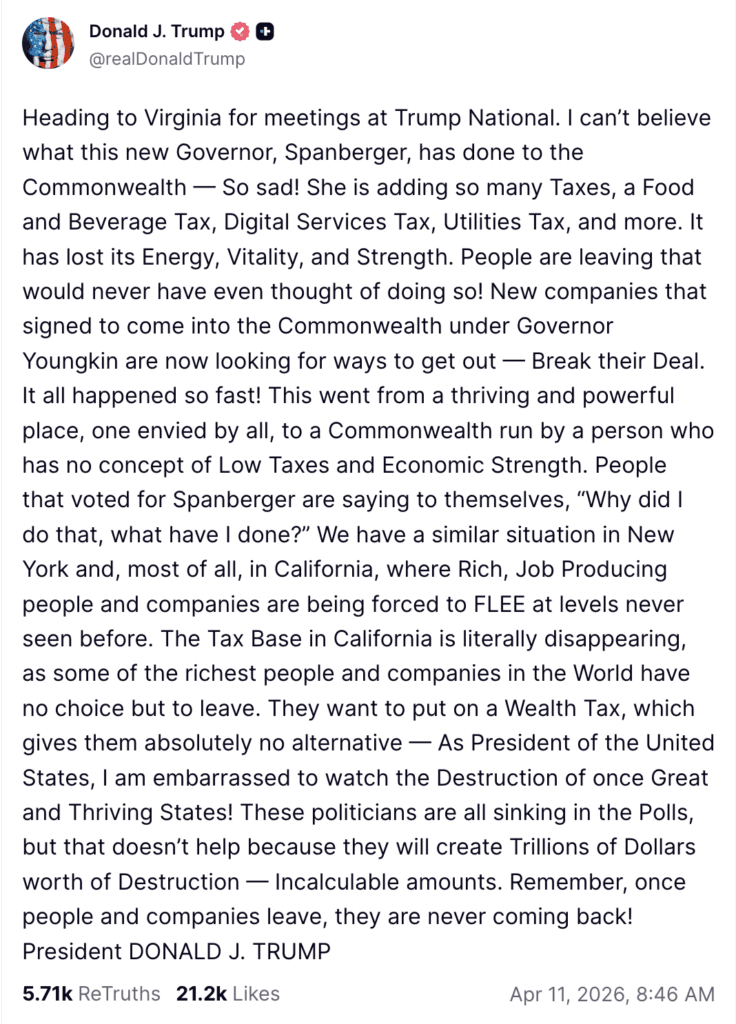
President Donald Trump criticized Virginia Gov. Abigail Spanberger in a Saturday social media post, claiming the commonwealth has lost economic strength under her administration. President Trump posted at 8:46am
Heading to Virginia for meetings at Trump National. I can’t believe what this new Governor, Spanberger, has done to the Commonwealth — So sad! She is adding so many Taxes, a Food and Beverage Tax, Digital Services Tax, Utilities Tax, and more. It has lost its Energy, Vitality, and Strength. People are leaving that would never have even thought of doing so! New companies that signed to come into the Commonwealth under Governor Youngkin are now looking for ways to get out — Break their Deal. It all happened so fast! This went from a thriving and powerful place, one envied by all, to a Commonwealth run by a person who has no concept of Low Taxes and Economic Strength. People that voted for Spanberger are saying to themselves, “Why did I do that, what have I done?” We have a similar situation in New York and, most of all, in California, where Rich, Job Producing people and companies are being forced to FLEE at levels never seen before. The Tax Base in California is literally disappearing, as some of the richest people and companies in the World have no choice but to leave. They want to put on a Wealth Tax, which gives them absolutely no alternative — As President of the United States, I am embarrassed to watch the Destruction of once Great and Thriving States! These politicians are all sinking in the Polls, but that doesn’t help because they will create Trillions of Dollars worth of Destruction — Incalculable amounts. Remember, once people and companies leave, they are never coming back! President DONALD J. TRUMP

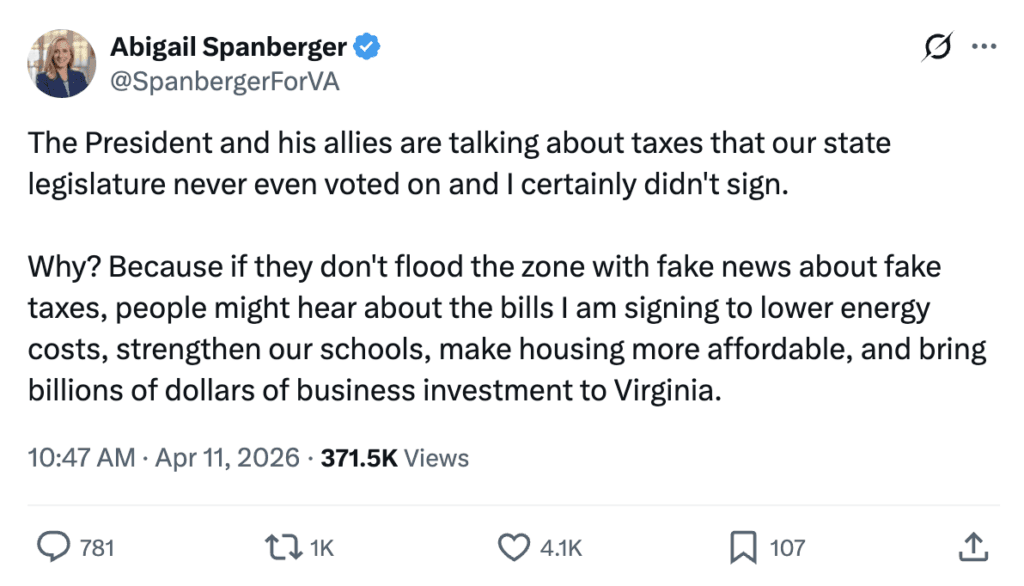
Gov. Abigail Spanberger responded Saturday to Trump’s criticism. Spanberger responded twice.
The President and his allies are talking about taxes that our state legislature never even voted on and I certainly didn’t sign. Why? Because if they don’t flood the zone with fake news about fake taxes, people might hear about the bills I am signing to lower energy costs, strengthen our schools, make housing more affordable, and bring billions of dollars of business investment to Virginia.

Gov. Abigail Spanberger responded Saturday to Trump’s criticism, calling his claims lies and listing legislative accomplishments — but did not specifically address the tax proposals he cited. Spanberger continued this afternoon.
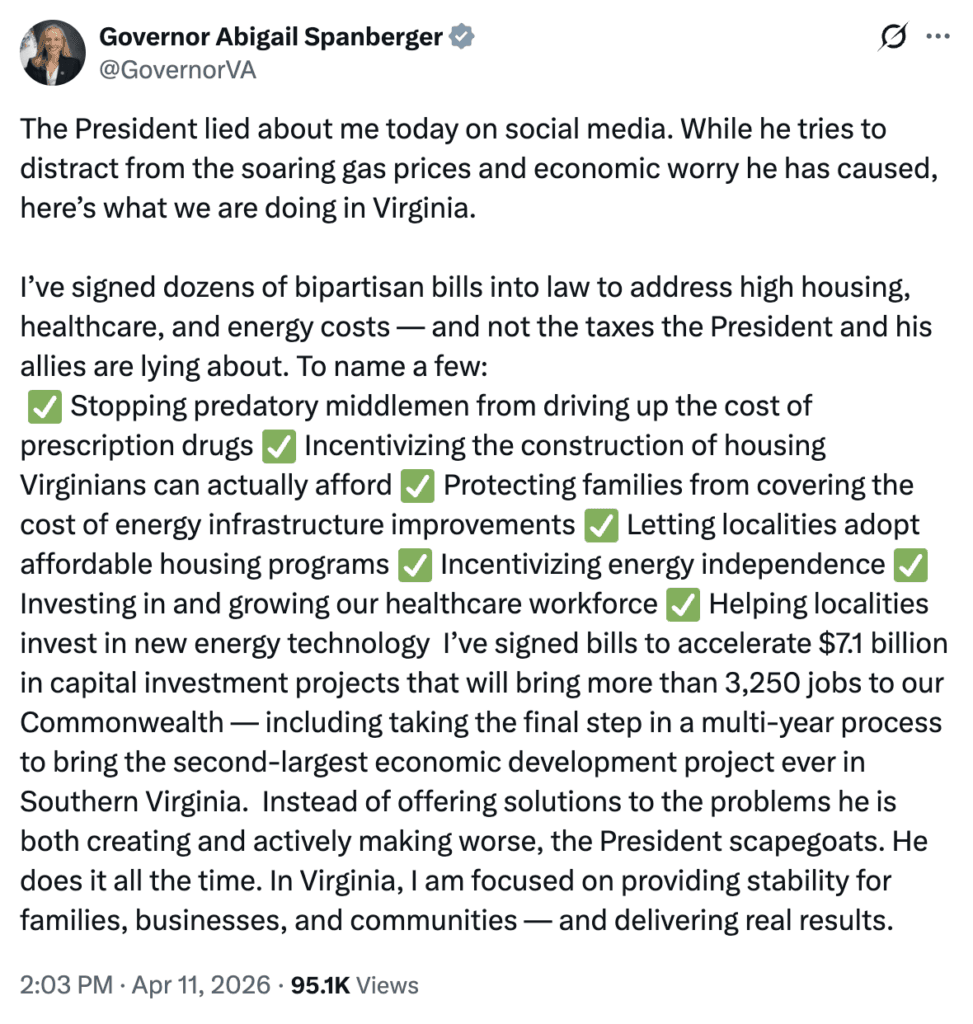
The President lied about me today on social media. While he tries to distract from the soaring gas prices and economic worry he has caused, here’s what we are doing in Virginia.
I’ve signed dozens of bipartisan bills into law to address high housing, healthcare, and energy costs — and not the taxes the President and his allies are lying about. To name a few:
✅ Stopping predatory middlemen from driving up the cost of prescription drugs ✅ Incentivizing the construction of housing Virginians can actually afford ✅ Protecting families from covering the cost of energy infrastructure improvements ✅ Letting localities adopt affordable housing programs ✅ Incentivizing energy independence ✅ Investing in and growing our healthcare workforce ✅ Helping localities invest in new energy technology I’ve signed bills to accelerate $7.1 billion in capital investment projects that will bring more than 3,250 jobs to our Commonwealth — including taking the final step in a multi-year process to bring the second-largest economic development project ever in Southern Virginia. Instead of offering solutions to the problems he is both creating and actively making worse, the President scapegoats. He does it all the time. In Virginia, I am focused on providing stability for families, businesses, and communities — and delivering real results.Saturday’s social media exchange comes as Spanberger faces headwinds on several fronts. A Washington Post-Schar School poll released last week showed her approval rating at 47 percent, with 46 percent disapproving — lower than the early-term average for any Virginia governor going back to 1993. Analysts have pointed to several factors in the slippage. Voters face an April 21 referendum on a Democratic plan to redraw the state’s congressional districts mid-decade, a map that would create 10 Democratic seats and one Republican seat. Spanberger also signed Virginia back into the Regional Greenhouse Gas Initiative through budget amendments, a cap-and-trade program that requires utilities to purchase carbon emission credits — critics say the costs will be passed to ratepayers, while supporters argue the program funds energy efficiency and flood mitigation programs. And on immigration, Spanberger signed an executive order repealing her predecessor’s requirement that local and state law enforcement cooperate with ICE, a decision that has drawn scrutiny amid reports that three of the four murder suspects in Fairfax County so far this year are illegal immigrants.
Spanberger, a former CIA officer who served three terms in Congress before winning the governorship in a 15-point landslide last November, ran as a centrist focused on affordability and touted her law enforcement background on the campaign trail.
Cannabis testing challenges persist as Virginia retail market nears
Products in a display counter at the Cannabis Outlet in Portsmouth advertise high THC concentrations. (Photo by Ned Oliver/Virginia Mercury) By Stef Anderson | VCU Capital News Service
RICHMOND, Va. –THC breathalyzers are often discussed as a way to detect drivers under the influence, especially as Virginia closes in on a retail cannabis market, but questions remain about their effectiveness.
There is no standardized, widely-approved THC breathalyzer test on the market. Researchers have been trying to develop an effective THC breathalyzer, including former Virginia Commonwealth University professor Emanuele Alves who received a grant from the National Institute of Justice to develop a prototype.
Alves’ research made a big splash in the headlines in 2023, but she has since left VCU and could not be reached for comment. Alves stated in a recent publication that they have filed a patent for a future prototype to aid in roadside cannabis testing.
Michelle Peace is a VCU forensic science professor with experience in toxicology issues. Although there have been developments with THC breathalyzers, the standard markers that help assess recent use and impairment from alcohol do not work for THC impairment.
“For alcohol, we have legislated that 0.08% blood alcohol concentration is the threshold that defines if someone is impaired to drive,” Peace said. “We cannot set a cutoff like that for THC. If we do, we don’t know what that number means for impairment.”
The number would not directly note when THC was consumed, according to Peace.
“Does that number mean that they were recently consumed, or that they consumed two hours ago?” Peace said. “We don’t know.”
Alcohol and THC metabolize in the body differently, which makes a test for THC intoxication more tricky, according to Peace.
Field sobriety tests and THC levels were also unreliable in determining marijuana intoxication levels, according to an article by researchers with the Research Triangle Institute International, an almost 70-year-old organization that began in North Carolina and is now global.
Toxicology tests could indicate the presence of cannabis, but not determine cognitive or psychomotor impairment, according to the RTI research.
Impaired driving cases often involve people taking more than one drug, according to Peace. A 2024 analysis of driving under the influence from the Virginia DMV found significant concurrent alcohol and cannabis usage. Thirty percent of individuals with a blood alcohol concentration of 0.08% or higher also tested positive for cannabis, according to DMV data.
The DMV also notes that legalization of recreational cannabis does not correlate to more individuals driving under the influence of cannabis. Legalization may encourage trends of monitoring cannabis-impaired driving or crashes.
Chelsea Higgs Wise, the executive director of Marijuana Justice, believes informed public health campaigns around cannabis will help with increased safety.
“I saw that they were having a no drug driving campaigns, but whether it’s drunk driving, sexual abstinence or any types of drugs, just telling people not to do something has never worked for public safety,” Higgs Wise said.
Adults need to stay informed about impaired driving, Higgs Wise said. She outlined strategies to prevent impaired driving, like ensuring adults don’t drive immediately after consuming, especially with edibles, which have longer onsets than smoking.
“We can be teaching people to not just lock up their drugs, but how to also check in and ask a friend, ‘can you drive me home?’” Higgs Wise said.
Higgs Wise noted concerns regarding the Drug Recognition Experts employed by law enforcement to detect if someone is under the influence of drugs during traffic stops.
DREs are certified by Virginia State Police, and there are currently 21 on the force, according to Matthew Demlein, VSP public relations coordinator. They undergo approximately 80 hours of training to be certified. When there is a question about a driver’s intoxication, a DRE is called to the scene and makes a determination and charges could possibly ensue.
“We are spending millions of dollars a year to certify police to do something not even a medical doctor can do,” Higgs Wise said. “They are claiming that they can look at someone, someone got pulled over for driving and they didn’t have a high alcohol blood content, but the officer thinks that they are on drugs.”
The Virginia General Assembly recently passed House Bill 642 and Senate Bill 542 to create a retail cannabis market in the state overseen by the Virginia Cannabis Control Authority. They will also oversee retail of specific regulated hemp products.
The Virginia Cannabis Control Authority recently launched a new safe driving campaign, one of several in recent years in which they work to raise awareness that cannabis and driving do not mix. The website also displays information on cannabis statistics and facts versus myths.
Virginians still believe cannabis makes them safer drivers, according to Jamie Patten, chief administrative officer of the CCA, but that is “simply not true.”
“Our ‘Bad Combinations’ campaign uses relatable examples to deliver a clear message,” Patten stated in an email. “Driving while high is dangerous and illegal. We want people to plan ahead, make safe choices, and help keep everyone on the road safe.”
Drivers can learn more about the risks and find resources at cca.virginia.gov/safedriving.
Capital News Service is a program of Virginia Commonwealth University’s Richard T. Robertson School of Communication. Students in the program provide state government coverage for a variety of media outlets in Virginia.
Youngkin returns to campaign trail, calls for court to strike redistricting vote
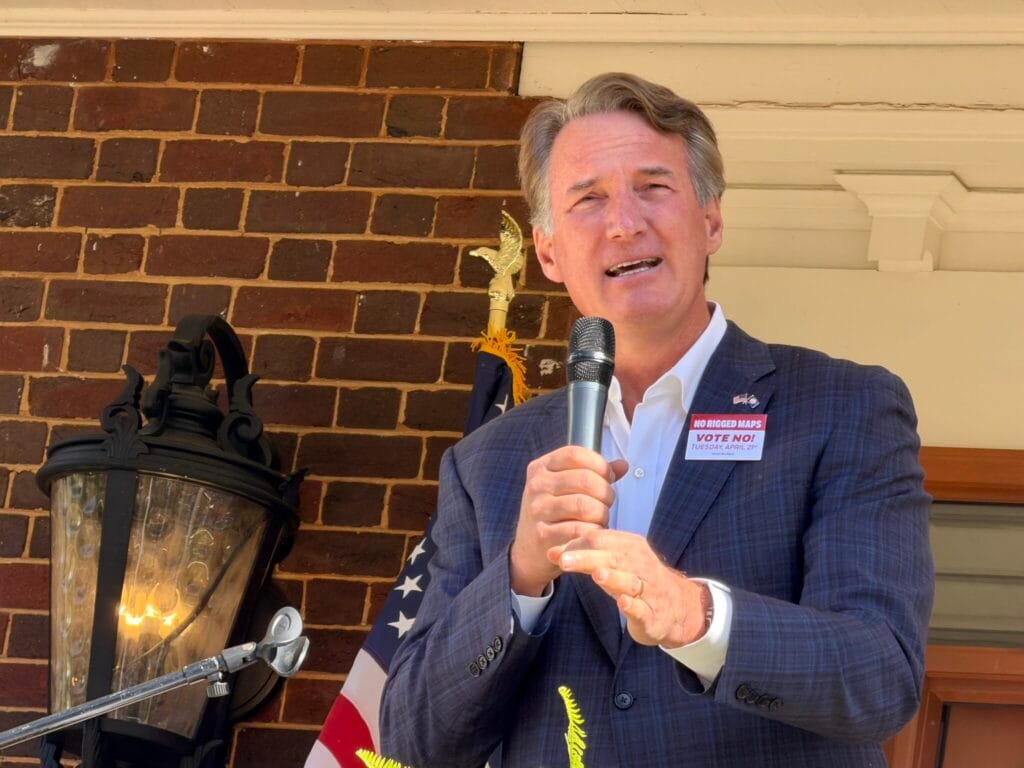
Former Gov. Glenn Youngkin speaks during a “Vote No” rally against Virginia’s redistricting referendum at the Bella Rose estate in Lynchburg on Saturday, urging the state Supreme Court to opine on the measure. (Photo by Markus Schmidt/Virginia Mercury) By Markus Schmidt | Virginia Mercury
With just 10 days remaining before Virginia voters decide a closely watched redistricting referendum, former Gov. Glenn Youngkin on Saturday called on the Supreme Court of Virginia to strike down the measure, arguing it stems from what he described as an unconstitutional process.
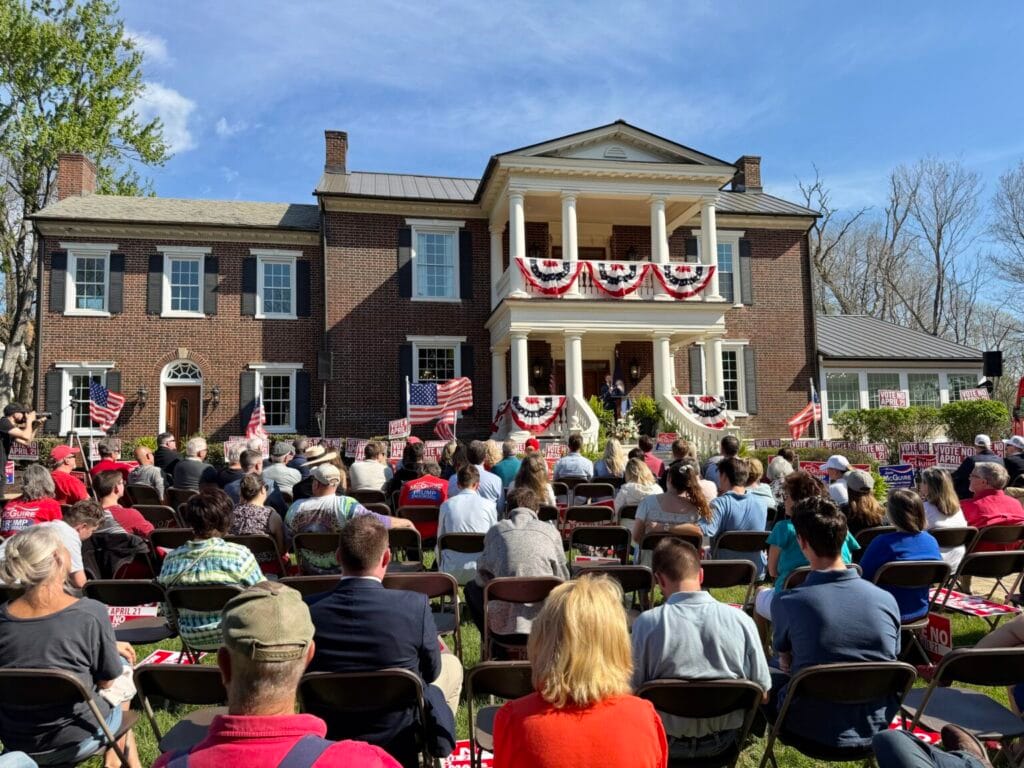
Speaking before a crowd of at least 150 people at a “Vote No Rally” held at the Bella Rose estate in Lynchburg, Youngkin returned to the campaign trail for the first time since leaving office in January, joining Republican lawmakers and officials in a coordinated push to defeat the April 21 ballot measure.
“They’ve proposed a map that is not only, in my view, the result of a process that’s unconstitutional and illegal,” Youngkin said, urging the state’s high court to intervene. “I call on our State Supreme Court to do its job and opine on it.”
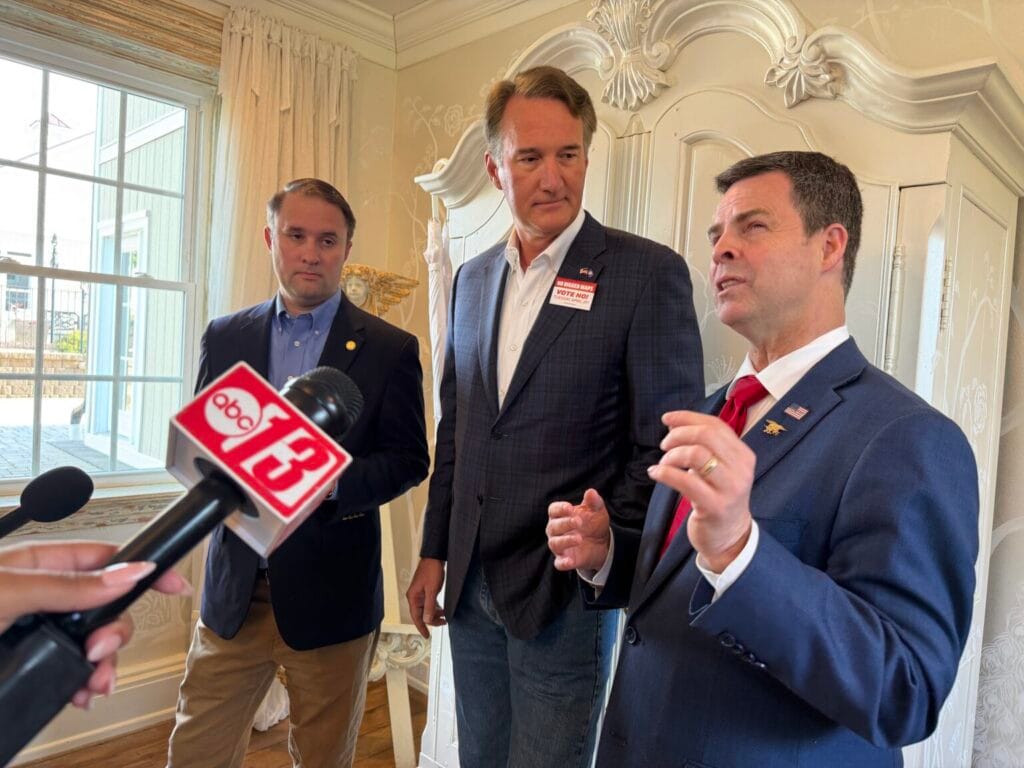
The rally, hosted by U.S. Rep. John McGuire, R-Goochland, featured a lineup of Republican figures, including former Attorney General Jason Miyares, U.S. Rep. Jen Kiggans, R-Virginia Beach, and several state lawmakers from the Lynchburg region.
Youngkin sharply criticized both the proposed congressional map and the process behind it, calling it “the most ridiculous usurping of the voice of the people that you could possibly imagine.”
He argued the ballot language itself is misleading and accused Democrats of violating constitutional and procedural requirements in advancing the amendment.
At the center of Republican messaging was Gov. Abigail Spanberger, whom speakers repeatedly cast as a key figure behind the redistricting effort. Youngkin labeled her “Governor Bait-and-Switch,” accusing her of reversing campaign positions.
“Virginia is under assault because we have leadership in Richmond that is trying to take away your vote,” Youngkin said, adding that Spanberger had promised not to pursue redistricting but signed legislation enabling the current proposal shortly after taking office.
President Donald Trump, who visited Charlottesville for a private fundraiser Friday, also took aim at the Virginia Democrat in a post on Truth Social on Saturday, accusing her of undermining Virginia’s economy through tax policy.
“I can’t believe what this new Governor, Spanberger, has done to the Commonwealth — So sad!” Trump wrote, going on to criticize what he described as a series of new taxes and claiming the state has “lost its Energy, Vitality, and Strength,” with businesses reconsidering investments made during the Youngkin administration.
Spanberger pushed back in a post on X, formerly Twitter, disputing Trump’s claims and accusing him and his allies of spreading misinformation about her record.
“The President and his allies are talking about taxes that our state legislature never even voted on and I certainly didn’t sign,” she wrote, adding that the criticism was meant to distract from legislation she said is aimed at lowering energy costs, strengthening schools, making housing more affordable and attracting business investment to Virginia.
Republican voters gather at the Bella Rose estate in Lynchburg on Saturday for a “Vote No” rally opposing Virginia’s redistricting referendum, as GOP leaders urged voters to reject the measure ahead of the April 21 election. (Photo by Markus Schmidt/Virginia Mercury) The redistricting referendum would temporarily allow Virginia to redraw its congressional districts mid-decade, a move Democrats have framed as a response to aggressive redistricting in Republican-led states.
Spanberger has publicly supported the measure while emphasizing that her focus remains on governing rather than campaigning.
Republicans, however, have argued the proposal would tilt the state’s current 6-5 congressional split heavily in Democrats’ favor, potentially creating a 10-1 map.
Miyares, who co-chairs the Virginians for Fair Maps PAC, echoed Youngkin’s criticisms, accusing Spanberger of going back on a key campaign pledge.
“By every definition, Abigail Spanberger has broken the promises she made to Virginia,” Miyares said, pointing to her earlier statement that she had “no plans” to redistrict Virginia.
He also criticized the design of the proposed districts, describing one as the “Lobster District” due to its unusual shape, and argued that the map was drawn without sufficient public input.
McGuire framed the referendum as a reversal of voter intent following a 2020 constitutional amendment that established an independent redistricting commission.
“Virginia has the fairest maps in the country,” McGuire said. “Now that (Democrats) have power, they’ve changed their mind, and they want to take away your voice.”
Kiggans similarly warned that the proposed changes would concentrate political power, saying the current maps more closely reflect statewide voting patterns.
“What they want to do to Virginia nowadays is make 92% of our commonwealth to be represented by one political party,” she said. “That is wrong, that is unconstitutional, that is illegal.”
GOP state lawmakers in attendance reinforced those arguments, focusing on both the process and the potential political consequences.
Sen. Luther Cifers, R-Prince Edward, called the effort “patently dishonest,” while Sen. Mark Peake, R-Lynchburg, urged voters to reject what he described as an attempt by Northern Virginia Democrats to dominate representation statewide.
“We have got to fight this unconstitutional gerrymandered state,” Peake said.
Del. Wendell Walker, R-Lynchburg, accused Democrats of breaking earlier commitments to maintain stable district maps through the decade.
Outside elected officials, attendees also voiced concerns about the broader implications of the referendum.
Jason Redman, a former Navy SEAL, framed the issue in no uncertain terms. “This is when freedom truly starts to erode,” Redman said.
Saturday’s rally came as early voting continues across the state. Voting began March 6 and runs through April 18, giving campaigns a limited window to influence turnout.
Also on Saturday, former U.S. Attorney General Eric Holder spoke at a “Vote Yes” rally in Arlington, offering a counterpoint to Republican opposition.
Holder, who has long advocated for independent redistricting, told The Mercury in an interview Friday that he now supports the measure as a necessary response to Republican-led redistricting efforts in other states, saying, “we have to do something.”
Initial data has shown stronger participation in Republican-leaning areas, potentially shaping campaign strategies in the final days before the vote. And a recent Washington Post-Schar School poll highlighted the tight divide among voters, with 52% of likely voters saying they’re in favor of the measure.
The referendum has also been the subject of legal challenges.
The Supreme Court of Virginia previously allowed the vote to proceed despite objections from Republicans, a decision welcomed by Democrats, including former President Barack Obama and Spanberger.
Youngkin’s call Saturday for the court to now strike down the measure signals a continued legal and political battle even as ballots are already being cast.
Chris Faraldi, a Republican member of the Lynchburg City Council, said opposition to the referendum extends beyond party lines.
“It’s not so much Democrats and Republicans,” Faraldi said. “It’s more like Virginia versus everybody else.”
Former Attorney General Jason Miyares, former Gov. Glenn Youngkin and U.S. Rep. John McGuire, R-Goochland, speaking with reporters in Lynchburg Saturday. (Photo by Markus Schmidt/Virginia Mercury) Spanberger vetoes skill games legalization bill
File photo of man playing slot or skill game. RICHMOND — Gov. Abigail Spanberger this week vetoed legislation that would have legalized electronic skill gaming devices in Virginia, citing the state’s lack of a centralized gaming regulatory authority and data showing the machines had clustered in lower-income and minority communities when they were previously allowed to operate.
The bill, Senate Bill 661, would have legalized skill gaming statewide. Skill games are electronic devices, often found in convenience stores, gas stations and restaurants, that offer cash payouts and are distinct from traditional slot machines in that they involve an element of player skill.
In her veto statement, Spanberger pointed to data collected by the Virginia Alcoholic Beverage Control Authority during the period between 2020 and 2021 when skill games were briefly legal in the state. That data showed devices were disproportionately placed in communities with higher poverty rates, lower educational attainment, and higher percentages of Black and Hispanic residents.
Spanberger also argued that Virginia’s gaming oversight structure is too fragmented to absorb further expansion at this time, noting the state lacks a single independent entity responsible for regulating all forms of legal gaming. She said legalizing the machines now would also effectively reward operators who continued running them illegally after the previous authorization expired.
“Legalizing these machines at this moment would also reward operators who knowingly disregarded state law for years and set a troubling precedent for how business is conducted in Virginia,” Spanberger said in a statement.
The veto comes one day after Spanberger also vetoed separate legislation that would have required Fairfax County to hold a referendum on a casino in Tysons Corner. In February, her administration expressed support for creating a unified gaming regulatory body during testimony before the legislature’s ABC and Gaming Subcommittee.
Skill games have been a contentious issue in Virginia for several years. The industry has lobbied aggressively for legalization, arguing the machines provide revenue for small businesses and that operators should have a legal path to operate. Opponents, including some anti-gambling advocates and law enforcement officials, have pushed back on the expansion of gaming more broadly.
Spanberger said she remains open to future discussions with the General Assembly on gaming expansion, provided any approach prioritizes consumer protection and community impacts.
Information from a release. Edited by Dan McDermott.
Browntown’s 23rd Annual Redbud Festival set for Saturday 4/18/26 with car show, duck race, live music and more
BROWNTOWN — “It’s the Mayberry of festivals.” That’s how Martha Buracker, president of the Browntown Community Center and chairman of the festival, describes the 23rd Annual Redbud Festival, returning Saturday, April 18, 2026 to the scenic village of Browntown, Va.
“It’s small town, lots of good fellowship with neighbors, but we get a lot of outside people that come in too,” Buracker said.
The festival runs from 9 a.m. to 3 p.m. at the Browntown Community Center — also known as the Old Browntown Schoolhouse — at 96 Browntown Rd. Admission and parking are both free. A free shuttle will run from the back parking lot to the Community Center via side-by-sides.
Buracker has been part of the festival for its entire 23-year run. Her family bought land in Browntown in 1962 as a weekend property, and her parents moved there full time in 1976. She finished high school in Browntown and has lived there ever since.
The festival takes its name from the redbud trees that bloom in brilliant pink and purple each spring across the Shenandoah Valley, though Buracker acknowledges that nailing the timing has proven elusive. “When we first started, we tried to hit that date, which technically would have been last weekend. It seems like for years it was either cold or rainy, so we decided to move it back.” This year’s blooms have already peaked, she noted — “kind of like the Apple Blossom Festival” — but she hasn’t given up. “We may move it earlier next year and try again. But it’s just hard to get people to sit out and listen to music when it’s chilly outside. If we’re doing an outdoor festival, we’re trying to make it as comfortable as possible.”
Dave McDermott Annual Antique Car Show
This year’s festival carries a special tribute. The antique car show has been renamed the Dave McDermott Annual Antique Car Show in memory of a man Buracker describes as an irreplaceable part of the event.
“One of the guys that always helped with the car show, at least for the last five years, and was a big volunteer at the community center — he passed away around Christmas from pancreatic cancer,” Buracker said. “So we have renamed our little car show in memory of Dave McDermott.”
Sponsored by Manor Line Ranch of Browntown, the car show runs from 9 a.m. to 1 p.m., with check-in between 8 and 9 a.m. in the grassy lot between the museum and the Community Center. Owners of antique and classic cars are invited to register and display their vehicles. The registration fee is $15, with checks payable to the Browntown Community Center Association. Space is limited and early registration is encouraged. Registration forms can be mailed to BCCA, 96 Browntown Rd., Browntown, VA 22610, or obtained by contacting Martha Buracker at 540-671-6349 or [email protected].
Trophy prizes will be awarded in four categories: People’s Choice, Participant’s Choice, Best Paint and Best Interior. Voting ends at 1 p.m., with prizes presented at 2 p.m. at the BCCA Stage. Attendees should bring their own chairs. No alcohol is permitted.
Gooney Creek Duck Race
The Gooney Creek Duck Race is one of this year’s featured attractions, with organizers making a push to raise its profile. “We’re trying to promote the duck race a little bit more. It’s popular, and we’ve actually got a sponsor for that this year — Revolution Mortgage sponsored the duck race. We’ve got a big banner hanging up in the middle of town,” Buracker said.
The race is set for 1 p.m., with cash prizes of $100 for first place, $50 for second and $25 for third. Winners need not be present to collect. Tickets are $5 each and are available now at OJ Rudacille General Store in Browntown (540-636-2149), through Martha Buracker-Weichert Realtors in Front Royal (540-671-6349), and at the Browntown Community Center on the day of the festival.
Live Music
The festival will feature live outdoor music throughout the day. “We’ve got Ryan Jewel for entertainment — he’s the main entertainment — and we’ve got a local band from the Browntown area called Caney Ridge. We’ve got music all day. It’s just gonna be a fun day,” Buracker said.
The Caney Ridge Band kicks things off from 9 to 11 a.m., followed by Nashville recording artist and Warren County native Ryan Jewel from 11 a.m. to 2:30 p.m. Attendees are encouraged to bring chairs. The music stage is sponsored by 84 Lumber.
Something for Everyone
Beyond the car show, duck race and music, the festival offers a wide range of activities. Redbud seedling trees will be available for sale, along with craft sales at two locations — the Browntown Community Center and Browntown Baptist Church Fellowship Hall. A silent auction runs through 2:30 p.m. There will also be a bake sale, a full kitchen menu, face painting and a barrel train for kids, and the Browntown Museum will be open for visitors.
For craft vendor entry forms or more information, contact Emma Bricker at [email protected]. For car show entry forms or silent auction donations, contact Martha Buracker at 540-671-6349 or [email protected]. For Browntown Baptist Fellowship Hall craft space inquiries, contact Jayne Guilford at 540-636-4231 or [email protected].
Attendees are asked to leave pets at home. No alcohol is permitted.
Browntown is located approximately 8 miles south of Front Royal. From Front Royal, take Route 340 South half a mile and turn left onto Browntown Road. Follow Browntown Road 8 miles to the village of Browntown.
Edited by Dan McDermott.

Flyer for 4/18/2026 Redbud Festival Redbud Festival is April 18th!! Mark your calendars for a festive Browntown day! 🌸 Crafters, Food, Live music, Antique car show, Face painting, Silent auction, Redbud seedlings for sale, and the legendary Duck Race!!! Flyer for 4/18/26 Gooney Creek Duck Race Spanberger signs package of public safety bills covering gun laws, cyber crimes and first responders
RICHMOND — Gov. Abigail Spanberger this week signed a broad package of public safety legislation into law, covering topics ranging from law enforcement support and cyberstalking to gun regulations and protections for crime victims.
Several bills passed unanimously or with bipartisan support in the General Assembly.
Law enforcement and first responders
Two bills expand protections for Virginia’s emergency response community. HB1313 extends workers’ compensation eligibility for law enforcement officers and firefighters to include post-traumatic stress disorder. SB100 protects volunteer emergency responders from being fired or otherwise penalized by their employers for missing work due to emergency response duties.
HB248 and SB317 permit professionals from multiple agencies to jointly respond to behavioral health crisis calls, a measure supporters say will improve coordination and outcomes. Passed unanimously.
HB1300 and SB86, also passed unanimously, allow the immediate survivor of any State Police officer killed in the line of duty to purchase the officer’s service handgun for $1.
Online safety and sex offender restrictions
SB673 strengthens Virginia’s cyberstalking laws to address unwanted sexual or violent contact online. HB629 creates two new criminal offenses related to sexual extortion and the non-consensual production of explicit images, with felony-level penalties when the victim is a minor. Both passed unanimously.
HB1387 requires automatic revocation of teaching licenses for convicted sex offenders. HB559 and SB399 bar convicted sex offenders from teaching driver education courses. HB250 and SB55 prohibit convicted sex offenders from visiting state parks for the purpose of contacting children. All passed unanimously.
SB778, also unanimous, makes it a felony for anyone 18 or older to display obscene material to a child under 13.
HB1352 expands school safety education to include the dangers of speeding and reckless driving. SB95 requires signage at interstate highway rest areas to raise awareness of human trafficking. SB87 requires localities to have working automated external defibrillators at sporting events and facilities.
HB1233 and SB329 establish a $500 fee assessed on certain sexual and domestic violence convictions to fund the Virginia Sexual and Domestic Violence Victim Fund.
Gun legislation
The package includes several gun-related measures that drew varying levels of support.
HB19 and SB160 close what supporters call the “intimate partner loophole,” prohibiting intimate partners convicted of misdemeanor domestic violence crimes from possessing a firearm. The bills passed with bipartisan support.
HB93 and SB38 specify that a person prohibited from possessing a firearm due to a protective order or domestic violence conviction may transfer their firearm to a person who is not prohibited, is 21 or older and does not share their residence.
HB40 and SB323 ban the manufacture, sale and possession of untraceable firearms without serial numbers, commonly known as ghost guns.
HB21 and SB27 allow firearm manufacturers and dealers to be held legally liable when negligent business practices are found to have contributed to gun violence.
The full list of legislation signed by Gov. Spanberger is available at governor.virginia.gov.
Information from a release. Edited by Dan McDermott.
Gov. Spanberger signs four bills targeting invasive plants in Virginia
RICHMOND — Gov. Abigail Spanberger this week signed four bills aimed at combating invasive plants across Virginia, addressing what supporters say is an underrecognized threat to the state’s farms, forests, waterways and wildlife.
The bipartisan legislation moves on several fronts. One bill prohibits invasive plants from being planted along state highways. Another allows regulators to add plants to the Noxious Weeds List based on scientific merit. A third empowers local jurisdictions to raise funds to treat and control invasive plants. The fourth gives state agencies flexibility to use volunteers to help control invasive plants on state lands.
The bills were carried by Del. Amy Laufer (HB88), Del. Holly Seibold (HB109), Del. Katrina Callsen (HB388), Sen. Saddam Salim (SB89) and Sen. Ryan McDougle (SB163). Three of the bills were developed with the involvement of Blue Ridge PRISM, a Shenandoah Valley-based invasive plant management nonprofit. The Virginia Invasive Plant Coalition supported all four measures.
Invasive plants are widely recognized by ecologists as a significant driver of habitat degradation, biodiversity loss and disruption of ecosystem function. They can also affect agricultural operations, public health and recreational areas.
Del. Seibold, who carried HB109, said the bill builds on earlier legislation she passed requiring invasive plant education at retail garden centers.
The new laws take effect in the coming months. More information on invasive plant management in Virginia is available at blueridgeprism.org.
Information from a release. Edited by Dan McDermott.
Virginia to raise minimum wage to $15 by 2028 under new law
Gov. Abigail Spanberger signs legislation Thursday raising Virginia’s minimum wage to $15 an hour by 2028, marking a key priority of the 2026 General Assembly session. (Photo courtesy of Virginia Governor’s Office) By Markus Schmidt | Virginia Mercury
Gov. Abigail Spanberger on Thursday signed legislation to gradually raise Virginia’s minimum wage to $15 an hour by 2028, delivering on a top Democratic priority and setting in motion a series of wage increases that will affect workers, businesses and the state budget for years to come.
“Today, we are putting more money in the pockets of Virginia workers,” Spanberger said in a statement. “If you work full time in Virginia, you should be able to afford to live in Virginia. You should be able to keep up with your rent or mortgage, fill your medications, and save for your kids’ futures.”
The measure, carried by Del. Jeion Ward, D-Hampton, and Sen. Louise Lucas, D-Portsmouth, codifies the state’s current minimum wage of $12.77 per hour, which took effect Jan. 1, and sets a path for future increases.
Under the law, the wage will rise to $13.75 per hour on Jan. 1, 2027, and then to $15 per hour on Jan. 1, 2028. Beginning in 2029, the wage will be adjusted annually to reflect changes in the consumer price index.
Spanberger said the legislation reflects a broader effort to support workers across industries, including agriculture, noting the administration worked with the Virginia Farm Bureau “to strike a balance to protect farm workers and our vital farming industry.”
The governor also signed related legislation requiring that farm workers be paid the state minimum wage, extending protections to a sector that has historically been treated differently under labor laws.
Democrats tout wage gains as Republicans warn of costs
House Democrats, who made the wage increase a centerpiece of their 2026 agenda, praised the move as a long-overdue step toward economic stability.
“Working Virginians have been long overdue for a raise,” said Speaker Don Scott, D-Portsmouth, adding that voters “elected us to make an Affordable Virginia.”
Majority Leader Charniele Herring, D-Alexandria, said rising costs have outpaced wages.
“The reality is that inflation and tariffs have driven up prices, and wages have fallen behind — this law is a key component of rectifying that divide,” she said.
Ward, the House patron of the bill, said the measure ensures that “no one who works full-time in Virginia struggles to afford to live in Virginia.”
Public opinion has largely aligned with that push. A January survey by Christopher Newport University’s Wason Center found that 78% of Virginians support or strongly support raising the minimum wage to $15 an hour by 2028.
Still, the policy carries a measurable fiscal impact for the state.
According to the Department of Planning and Budget, general fund spending tied to the increase is expected to rise modestly at first — about $546,761 in fiscal year 2027 — before climbing sharply to roughly $14 million in fiscal year 2028.
Costs are projected to continue growing, reaching about $33.8 million by fiscal year 2029 and more than $38 million by fiscal year 2031.
Non-general fund spending follows a similar trajectory, with total combined costs expected to exceed $70 million annually by the end of the forecast period. A significant portion of those long-term costs is tied to Medicaid, particularly higher wages for personal care attendants.
The Department of Medical Assistance Services estimates those costs alone could reach $23.7 million statewide in fiscal year 2028 and approach $60 million annually in subsequent years.
Additional expenses include higher payroll obligations for state and local positions and increased funding for labor law enforcement, including new staffing needs at the Department of Labor and Industry.
The fiscal impact statement also points to broader, harder-to-quantify effects, such as increased contract costs and potential pressure on wages in publicly funded sectors like education.
Republicans raised concerns about how those costs will be absorbed, particularly as lawmakers continue to negotiate a state budget.
Del. Mike Cherry, a former Colonial Heights city councilor, said local governments are being asked to prepare for higher wage obligations without clear guidance on future state funding levels.
“Here we are again, the governor is mandating that localities pay their employees more, and yet the government won’t tell them how much money they’re going to have to budget with,” Cherry said during a Zoom call with reporters.
He added that local officials are already in the midst of budget planning and need clearer signals from Richmond. “As long as I’ve been there, it’s been a point of frustration,” he said.
New laws target workforce growth, job training across industries
Beyond the wage legislation, Spanberger on Thursday approved a slate of workforce and economic development bills aimed at expanding job opportunities and strengthening key industries.
Among them is legislation designed to grow Virginia’s offshore wind workforce, a measure that drew bipartisan support and reflects the state’s continued investment in renewable energy.
Another bill will allow more high school students to begin apprenticeships in fields such as culinary arts and information technology, creating earlier pathways into skilled trades.
Lawmakers also advanced an effort to bolster the health care workforce by establishing a new program to help high school students train as certified nurse aides, a measure that passed unanimously.
Additional legislation gives localities flexibility to support furloughed federal workers during government shutdowns, including by extending deadlines for personal property tax payments, and seeks to connect federal employees affected by recent job cuts with opportunities in state government.
Other measures include the creation of a state internship coordinator to promote public service careers and expanded authority for local workforce development boards to invest in regional job training initiatives.
Combined, the package reflects what Spanberger described as a broader strategy to invest in Virginia’s workforce while ensuring that economic growth reaches more residents.
“Investing in our workforce is a win for families, a win for local communities, and importantly, a win for the businesses that call Virginia home,” she said.
SCC approves Loudoun transmission line, nixes undergrounding; final route to be determined
Transmission lines between Loudoun and Prince William counties. (Photo by Nathaniel Cline/Virginia Mercury) By Shannon Heckt | Virginia Mercury
After months of fierce debate and community rallies, the State Corporation Commission on Thursday approved the above-ground construction of the Golden-Mars high-voltage transmission line in Loudoun County.
There are two options for the final route of the line, and it will be up to the Loudoun County School Board to decide if it will reverse its previous decision to block the project from using land easements near two schools in Ashburn.
The Golden-Mars 500kV/250kV transmission line is part of Dominion Energy’s three-pronged “reliability loop” that connects multiple substations to funnel more power to the major cluster of data centers in Ashburn. Two parts of the loop are already in the process of approval and construction. The SCC ruled that the Golden-Mars line, the final piece of this puzzle, is within the public’s interest.
The commission chose ‘Route 4’ as their priority option for the lines out of the six options provided by Dominion. This route runs along the Broad Run Stream Valley Park and crosses near the two schools. The order states that there are no homes within 100 feet of the center line, and, compared to the other routes, has fewer homes within 250 to 500 feet of the center line.
“(The route) is located predominately within the Broad Run floodplain in areas where residential uses are prohibited and electrical infrastructure is more consistent with the types of uses and design characteristics of the surrounding area,” the order reads.
The Loudoun Valley Estates neighborhoods as well as the Loudoun County School Board have for months urged the SCC to bury the transmission lines to avoid potential impacts to homes and students at Rock Ridge High School and Rosa Lee Carter Elementary.
Hundreds of community members turned out to public hearings and offered testimony in the case, mainly opposing the transmission lines being built overhead.
The SCC stated that burying the lines, even partially, would not be practical for the project.
Dominion estimated that the cost of the transmission line when built overhead would be about $513 million. A witness for the county submitted a separate analysis of undergrounding the lines in a hybrid format, but the SCC noted some stark potential variation in the presented numbers. The high end of those figures could place the project’s cost at $1.5 billion – triple what Dominion is estimating.
The order also lays out other challenges for burying the lines. Commissioners say that method would delay the project’s completion for years but Dominion can’t afford to wait because the electric grid is already strained and without the transmission line to complete the reliability loop, existing infrastructure could be damaged.
If energy is not provided through this loop, Dominion has stated, regional grid operator PJM, could levy violations on the company.
The burial of lines would also be in conflict with existing transmission infrastructure, commissioners determined, and there are no sites available for a transition site where the lines would enter the earth. The geological makeup of the area would also make it hard to bury lines, the ruling stated.
“The project remains critical to maintaining regional grid reliability and supporting data centers under development in Northern Virginia and Loudoun County,” Dominion said in a statement after the SCC’s decision was published. “We understand that constructing a new transmission line will have impacts to the community and we do our best to minimize those impacts.”
In August of last year, dozens of Loudoun Valley Estates residents attended a school board hearing to urge them to join in testifying to the SCC for the case. The board previously voted against two of the routes that would require access to easements on school board property, unless the lines could be buried.
The school board has the ability to block one of the two remaining options, Route 4, from being selected because their property ownership trumps the SCC’s desire to have the lines built along this route, which borders the schools.
If the school board blocks Route 4, the SCC’s backup option is Route 3a, which the order states would be “regrettable” due to it having a much larger impact on the surrounding homes, being much longer in length, and because new rights-of-way would be needed – which would jack up the price of the project.
Loudoun Valley Estates resident Vicky Hu has been a vocal opponent of the lines being built overhead. In route 3a, her backyard would be the site of one of the 165 foot monopoles. Her and her neighbors fear that not only will their views be impacted with the need to remove trees but their home values could tank, too.
“I’m disappointed with the SCC ruling,” Hu said Friday. “The only feasible option should be underground to avoid the damage to homes, communities, and also the best choice to preserve the health of students and student’s families.” She added that she and her neighbors are reviewing the SCC ruling and weighing their options to move forward.
The General Assembly this year passed legislation born out of the concerns about the Golden-Mars case.
Democratic state Sen. Kannan Srinivasan and Del. JJ Singh, who represent the Ashburn area of Loudoun, passed Senate Bill 827 and House Bill 1487, which would set up a pilot program to allow the SCC to identify four qualifying transmission projects to be buried.
The bills would allow for the increased cost of burying 500kV transmission lines to be shared with the locality. While those bills await approval, rejection or amendment by Gov. Abigail Spanberger, the SCC said they wouldn’t apply it to the Golden-Mars case.
“The increased cost of underground transmission lines versus conducting an overhead solution is a significant issue, and these pieces of legislation suggest a potential path forward in appropriate cases,” the order stated. “The record evidence produced over the course of this case does not support a finding that undergrounding is technically feasible.”
The community is now taking a closer look at their options as pressure mounts for the school board to make a decision on whether Route 4 can proceed.
“My initial reaction is that this decision goes against the will of our residents and the will of the General Assembly, both of which stood together and said that residents should not be punished by the unchecked sprawl of data centers,” Singh said in a statement. “Two things can be true at once: I respect and value the SCC, while I am also bitterly disappointed by the result.”
As of April 10, the Loudoun school board does not have any hearings or votes planned regarding the route debate.
FTC wants to hear from renters about ‘unfair and deceptive housing fees’
By Charlotte Rene Woods | Virginia Mercury
The Federal Trade Commission is seeking public input until April 13 as it considers creating a new rule to crack down on “unfair and deceptive housing fee practices.”
Christine Marra, director of housing policy at the Virginia Poverty Law Center said Wednesday she’s seen the practices firsthand when working with clients on housing issues.
“We have looked at leases of the past several years that have stated a base rent on the first page, and then throughout the lease added or mentioned multiple fees that are mandatory,” she said, listing examples like trash collection and maintenance of common areas in apartment buildings.
It’s shocking for tenants who saw their apartment marketed at one price but were afterwards locked into a lease at another price, Marra said. For people on fixed or low incomes, the price tag sometimes stretches already thin budgets and places families closer to destitution.
Marra said she believes some landlords or rental companies are taking advantage of a “little caveat” in state code where “no additional security deposits or rent shall be charged” unless they are incorporated into rental agreements “by way of a separate addendum or after execution of this rental agreement.”
Where the hiccup happens, she said, is that prospective tenants don’t typically see and sign a lease until they are near their move-in date.
“By that point, you’ve paid your application fee and you have probably already paid a security deposit,” Marra said. “And these are not two-page leases, they can go on for 10 pages or more. We think it’s sneaky.”
Responses that people around the country have already submitted to the FTC called out landlords for mandating fees in their rent for routine maintenance that is inconsistent.
Others have said their property managers mandated cable or certain utilities costs be included in their rent, even if the tenant could get a better deal in their own name and pay for it outside of their lease.
Others lambast landlords for refusing to resolve maintenance requests and withholding deposits when renters move.
For instance, respondent Tamerra Grove described how her water bill spiked to $400 caused by a leak in her irrigation system. It took months, she claimed, for the underground pipes to her home to get fixed and her management company has allegedly refused to credit her for the additional costs.
On kept deposits, Marra said landlords have “become bolder” on the issue over the years, retaining them even when tenants don’t damage units and using the money to facilitate routine maintenance between occupants or replace carpet. It’s an anecdote she’s heard from clients more and more in recent years.
Addressing damage from tenants’ and pets is one thing, she said, but offsetting typical property management costs to past residents is another. Replacing floors every few years or repainting between tenants “are a landlord’s responsibility over time,” Marra added.
After the FTC’s public comment period winds down next week, the federal commission could draft a new rule to spur clearer communication between landlords and tenants and support consumer protections.
Ultimately, Marra said, “People can’t responsibly shop for rental housing if they’re being denied information about what the true cost is.”
Click here to submit a comment to FTC.
Spanberger vetoes Fairfax casino bill over local control

Slot machines are displayed inside the Horseshoe Bossier City casino. Photo: Emilee Calametti / The Center Square By Shirleen Guerra | The Center Square
Gov. Abigail Spanberger vetoed legislation that would have required Fairfax County to move forward with a casino referendum, saying the proposal would override local decision-making and depart from how gambling projects have been approved in Virginia.
Senate Bill 756 would have added Fairfax County to the state’s list of eligible casino locations and required the county to hold a voter referendum, despite opposition from the Fairfax County Board of Supervisors.
In her veto statement, Spanberger said casino development in Virginia has historically been led by local governments and not imposed by the state.
She wrote that local governing bodies “should lead on proposed casino development” and pointed to opposition from Fairfax County officials.
“In Fairfax County, the Board of Supervisors has explicitly opposed this legislation, and an overwhelming majority of the General Assembly members who represent Fairfax voted against it,” she wrote.
Spanberger said the bill would weaken local authority over major development decisions.
“This effectively precludes local input and eliminates local decisions. While this legislation specifically affects only Fairfax County, it would set a precedent to bring casino referendums to other localities where the local governing board may similarly oppose such an effort,” she said.
Under current law, once the General Assembly designates a locality for a casino, local officials must proceed with a referendum. Spanberger said that structure depends on local support and should not be used to force action in a county that has already declined to pursue a project.
She also raised concerns about oversight, writing that Virginia lacks a unified regulatory framework for gambling and that a consistent structure is needed to ensure transparency, accountability, safety and public confidence.
Senate Majority Leader Scott Surovell, the bill’s sponsor, said the veto blocks what he described as a major economic opportunity for Northern Virginia.
In a statement, Surovell said the legislation passed with bipartisan support in both chambers and was backed by regional labor unions and the Northern Virginia Chamber of Commerce.
He said the project could have generated thousands of good-paying, well-benefited construction jobs and additional long-term hospitality and entertainment positions tied to a casino development in Tysons.
Surovell also said Virginia residents currently spend “hundreds of millions of dollars every year” at casinos in neighboring states, including Maryland and West Virginia, generating tax revenue outside the commonwealth.
He pointed to what he described as an independent analysis by EY projecting a proposed venue could generate about $1.5 billion in annual economic activity and thousands of jobs in Maryland, adding, “we just handed them another win.”
A state fiscal analysis of the legislation previously found no anticipated impact unless a project proceeds following voter approval, reflecting that revenue and cost outcomes depend on whether a casino is ultimately built.
Fairfax County officials opposed the measure, citing concerns about traffic, infrastructure demands and whether the project aligns with long-term development plans in Tysons.
The veto blocks the proposal for now and prevents Fairfax County from being added as a casino-eligible locality unless lawmakers revisit the issue in a future session.
The veto underscores the divide between state-level economic development efforts and local government authority over land use decisions.
Purchase of Monroe’s old estate in Loudoun pushed to 2027

Landscape near Oak Hill Farm in Loudoun County, the former seat of President James Monroe, where legislators are trying to create a public park. (Photo by Alessandra Caceres Mendoza/VCU Capital News Service) By Alessandra Caceres Mendoza | VCU Capital News Service
RICHMOND, Va. — Legislation to purchase the former estate of the fifth Founding Father for use as a new state park in Loudoun County was continued until the 2027 session, but it could still be acquired pending approval of the final budget.
House Bill 500, sponsored by Del. John McAuliff, D-Fauquier, would enable the Department of Conservation and Recreation to receive a 1,240 acre parcel of land known as Oak Hill Farm from The Conservation Fund and establish it as an official state park.
The first attempt to acquire the land was introduced in the 2025 session.
The Oak Hill Farm estate belonged to former President James Monroe and also holds the stories of the enslaved and indigenous individuals who worked the land. The area sits between James Monroe Highway, Little River Turnpike, and Tail Race Road, just south of Leesburg in the town of Aldie, according to the bill.
The Department of Conservation and Recreation would accept the parcel with conditions that general funds could not be used and that a community foundation would manage the park endowment, generating over $1 million in annual revenue. The state budget has $5 million toward the acquisition and Loudoun County would provide most of the $52 million, with the rest coming from federal funds and philanthropic support, McAuliff’s office confirmed.
Another measure, House Bill 239, was incorporated into McAuliff’s bill. The Senate version of the bill that did not include the funding died in the Senate Finance and Appropriations committee in mid-February. That same committee moved to carry the bill over and continue to look at it in the state budget.
Erin Lehman, McAuliff’s chief of staff, stated in an email that the park funding is in the House budget. Lawmakers ended the session without a finalized status in the budget but will return in April to pass one.
Legacy and Impact
“[The estate] is … a 1,200-acre recreation and nature preserve that is set right between the heavily urbanized part of northern Virginia and the farmland that I love and ran to protect,” McAuliff said during the bill’s final Senate committee hearing.
The park would benefit northern Virginia’s environment and communities, McAuliff said during the bill’s hearing. It’s also within an hour’s drive of 30% of the state’s population.
Northern Virginia has the largest population of any region in the state, with a population of 2.6 million in 2024, according to the Northern Virginia Regional Commission.
Heather Richards, mid-Atlantic vice president of The Conservation Fund, said the organization negotiated with previous estate owners to buy the land for $20 million with the provision that public access was maintained and well preserved. Loudoun County provided grant money for the group.
Richards said northern Virginia, not just Loudoun, needs more state parks.
“Demand for outdoor recreation is huge, and this park is within a 30-minute drive of more than 3 million people,” Richards said.
The Conservation Fund has nearly 10,000 signatures on their online petition in support of building this nature preserve, according to Richards.
More Green Space ‘Always Good’
Oscar Ali, a Loudoun County resident since 1985, said he noticed the increase in area development over the years and would like to see more land preservation efforts.
“It’s always good for the families to enjoy it and creative activities for kids or adults and anybody else—you name it,” Ali said.
The Virginia Tourism Corp. currently lists five state parks in northern Virginia, out of 44 in the state.
Visitors would have many outdoor experiences at Oak Hill Farm, such as cabins, an 11-acre pond for fishing and boating, river views and miles of trails, according to McAuliff.
Capital News Service is a program of Virginia Commonwealth University’s Richard T. Robertson School of Communication. Students in the program provide state government coverage for a variety of media outlets in Virginia.
Valley Link power line draws local pushback

High-voltage transmission towers carry power lines at sunset. Photo: Matthew Henry / Burst By Shirleen Guerra | The Center Square
A proposed high-voltage transmission project in central Virginia is moving forward as local governments raise concerns about land use, costs and potential impacts on ratepayers.
The Valley Link transmission line, a roughly 115-mile project spanning nine counties from Campbell County to Culpeper County, is being developed by a joint venture involving Dominion Energy, American Electric Power and FirstEnergy. The project is estimated to cost about $1 billion, according to company representatives.
Developers say the line is needed as electricity demand grows across Virginia, driven in part by data center expansion and increased energy use.
In a call with The Center Square, Dominion Energy representatives said the region is seeing “the largest increase in demand since World War II.”
Dominion officials said average daily demand in its service area is about 20 gigawatts and is expected to double within the next 15 years. During a recent winter cold snap, demand increased from about 20 to 25 gigawatts overnight, a 25% jump.
At the same time, local governments along the proposed route are pushing back, raising concerns that regional benefits may come with local impacts.
Louisa County officials have passed a resolution opposing the project and filed concerns with the Federal Energy Regulatory Commission. County leaders have also contacted neighboring jurisdictions, including Orange, Goochland, Fluvanna, Buckingham, Appomattox, Spotsylvania and Culpeper, in an effort to coordinate a regional response.
Local officials say the project could affect agricultural and forest land, reduce property values and offer limited direct benefit to rural communities along the route.
In a joint discussion among counties, officials said the transmission line is expected to support electricity demand in Northern Virginia “with little to no benefit” for the areas it would cross.
A Louisa County official said the project would carry electricity through the county without serving local demand.
“This is a transmission line,” the official said. “They’re not dumping any electricity here. It’s passing through.”
Louisa County officials have also raised concerns about a federal proposal tied to PJM Interconnection that could speed up approvals for large energy and transmission projects. The timeline could shrink from several years to about 10 months.
County leaders said a shorter review process could limit how long-term impacts are evaluated, including how costs are shared among ratepayers.
The board also urged the State Corporation Commission to require utilities to evaluate alternative routes that reduce impacts on agricultural and forest land, including using existing infrastructure corridors or placing portions of the line underground.
In a resolution adopted March 16, the Louisa County Board of Supervisors said the proposed line could run about 20 miles through the county using steel structures up to 160 feet tall, roughly the height of a 14-story building, and pass within 500 feet of some homes.
Project developers say they are continuing to refine the route and meet with communities.
According to company representatives, the project has been reduced from an earlier proposal of about 155 miles across 16 counties to the current 115-mile plan across nine counties. Developers said they have contacted about 120,000 residents and held public meetings attended by more than 5,000 people.
They estimate between 600 and 700 property owners would be directly affected by the final route.
The transmission line would require a right-of-way about 200 feet wide. Landowners would retain ownership and could continue using the land for farming, grazing and other purposes, but permanent structures such as homes or buildings would not be allowed within that space.
Developers said they aim to route the line through commercial or industrial areas where possible while avoiding dense residential communities, schools and historically or environmentally sensitive sites.
Most land easements are expected to be negotiated directly with property owners, according to company representatives. If agreements cannot be reached, court proceedings may be used to determine compensation.
The State Corporation Commission will decide whether to approve the project and how much of the cost can be recovered from Virginia ratepayers. Project costs are expected to be shared across utilities based on usage.
A second round of public meetings is planned for late May and early June. Developers expect to submit a final route to the State Corporation Commission in September, with regulators expected to take about a year to review the proposal.
The State Corporation Commission did not respond to a request for comment.
Browntown Redbud Festival to feature antique car show 4/18/26 honoring late community volunteer
Redbud Festival is April 18th!! Mark your calendars for a festive Browntown day! 🌸 Crafters, Food, Live music, Antique car show, Face painting, Silent auction, Redbud seedlings for sale, and the legendary Duck Race!!! BROWNTOWN — The annual Browntown Redbud Festival will include an antique and classic car show Saturday, April 18, held in honor and memory of Dave McDermott, described by organizers as a friend and fellow volunteer.
The car show runs from 9 a.m. to 1 p.m., with check-in between 8 and 9 a.m. It will be held in the grassy lot between the museum and the Browntown Community Center. Space is limited and early registration is encouraged. The registration fee is $15, with checks made payable to the Browntown Community Center Association (BCCA), 96 Browntown Rd., Browntown, VA 22610. For more information, contact Martha Buracker at 540-671-6349 or [email protected].
Trophy prizes will be awarded in four categories: People’s Choice, Participant’s Choice, Best Paint and Best Interior. Voting ends at 1 p.m., with prizes presented at 2 p.m. at the BCCA Stage. Attendees should bring their own chairs. No alcohol is permitted.
The car show is sponsored by Manor Line Ranch of Browntown.
The broader Redbud Festival runs from 9 a.m. to 3 p.m. and features a full day of family-friendly activities including a redbud seedling tree sale, silent auction, craft sales at two locations, a bake sale, a full kitchen menu and the Gooney Creek Duck Race at 1 p.m. Live music will be provided by the Katie Ridge Band followed by Ryan Jewel.
The festival takes place in scenic Browntown in Warren County’s South Fork area.
Posted by Dan McDermott.
Engle’s Angle: Some Food, Some Gas and a Lottery Ticket
Engle’s Angle: Some Food, Some Gas and a Lottery Ticket 4/8/26 by Kevin S. Engle
I was working on taxes the other day.
Sounds like fun doesn’t it?
When I finished our federal return, we owed the IRS some money, plus eight bucks in penalties and interest.
What bothered me the most was the eight bucks.
Could I do anything about it?
Actually, yes.
After reading some instructions, I spent the next two hours shuffling papers and crunching numbers. When I was done, that $8 penalty was now only $2. I felt a little better.
But I’d just spent two hours of my life to save six bucks.
That’s like earning three dollars an hour.
Not much when you think of it that way.
Was it worth it?
Probably not.
The following day, when I completed our state return, we had an $85 penalty.
Yikes!
You know what that meant?
Pull out my calculator again.
Some of the calculations were already done from the day before, but I still needed to tweak a few things. In less than an hour, I was able to eliminate all $85.
Now we’re talkin’.
In total, I spent about three hours of my life on this little exercise and saved us 91 bucks.
My hourly rate has just gone up from $3 to a little more than $30.
That’s a nice increase.
And just what are we going to do with all that extra money we’ve saved?
Spend it on something else of course.
I was at the grocery store yesterday. My total order was about 60 bucks. I should’ve stopped at the gas station on the way home and put a few gallons in the tank too.
Life is good.
$$$$$$$$$$$$$$$$$$$$$$$$$$$$$$$$$$$$
The author is feeling lucky. Maybe he should buy some lottery tickets as well?

The Best of Engle’s Angle: A Humorous Slant on Life and our Wacky World (Book Cover) The Best of Engle’s Angle is available online or pick up a signed copy at a local bookstore.
VDOT seeks public input on Shenandoah Valley Rail with Trail study; meetings scheduled in Woodstock, Front Royal and Timberville
Simulated rail with trail file image. STAUNTON — The Virginia Department of Transportation has launched an online survey to gather public feedback on findings from phases two and three of the Shenandoah Valley Rail with Trail Assessment, and has scheduled three in-person public meetings along the corridor being studied.
The online survey is open now through Wednesday, May 13, and is available at publicinput.com/svrwt.
The public meetings will take place at three locations along the 49-mile rail corridor, with identical information presented at each event. Each meeting runs from 5 to 7 p.m. and will begin with a brief presentation before transitioning to an open-house format, with study team members available to answer questions about information display boards. A court reporter will be present at each meeting to record oral comments.
The meeting schedule is as follows:
Woodstock – Thursday, April 16, 5-7 p.m.
Peter Muhlenberg Middle School cafeteria
1251 Susan Ave., Woodstock, VA 22664Front Royal – Thursday, April 23, 5-7 p.m.
Warren County Government Center, Board of Supervisors room
220 N Commerce Ave., Front Royal, VA 22630Timberville – Tuesday, April 28, 5-7 p.m.
Plains District Community Center, large multi-purpose room
233 McCauley Ave., Timberville, VA 22853VDOT says public feedback is critical to understanding community perspectives on estimated costs and overall considerations for both “Rail with Trail” and “Rail to Trail” alternatives. Feedback submitted through the online survey carries equal weight to comments provided in person at the meetings. Residents may also contact VDOT directly with input.
The Shenandoah Rail with Trail Assessment is being conducted in three phases and will identify the most likely configuration and costs associated with restoring rail assets and rail bridges and constructing an adjacent trail along a Norfolk Southern-owned rail corridor stretching from the town of Broadway in Rockingham County to the town of Front Royal in Warren County.
More information is available at VDOT.Virginia.gov/ShenandoahRailWithTrail.
Information from a release. Edited by Dan McDermott.
Virginia wildlife officials urge residents to secure food sources as bears become more active this spring

File image of a black bear mother with two small cubs emerging from a wooded area at the edge of a suburban backyard in spring, with green budding trees, early morning light, and a residential fence or home visible in the background. RICHMOND — Black bears are emerging from their winter dens hungry and in search of an easy meal, and Virginia wildlife officials are reminding residents to secure potential food sources and reduce the chances of human-bear conflicts near their homes.
Natural foods can be scarce during early spring, leading bears to seek out easy alternatives such as garbage, compost piles, barbecue grills, birdseed and pet food stored outside. Keeping those items secured encourages bears to move along and continue foraging for natural foods.
Bears are naturally cautious of humans, but they can overcome that wariness if people — intentionally or not — reward them with food. Unsecured garbage, pet food or other food sources can condition bears to associate neighborhoods with meals, increasing the likelihood of conflict.
The Virginia Department of Wildlife Resources recommends the following steps to avoid attracting black bears:
Secure garbage in a locked shed or inside until collection day, or use a bear-resistant container. Take down bird feeders; tips on attracting birds without attracting bears are available on the BearWise website. Store pet and livestock feed in bear-resistant containers or locked sheds. Clean grills and remove any potential food sources from porches and decks, keeping in mind that a screened-in porch is not a secure storage area from a bear’s perspective. Never leave food, trash or pet and livestock feed inside a vehicle.
In 2025, the DWR Wildlife Conflict Helpline received nearly 2,300 bear conflict calls. Unsecured trash accounted for 41% of those calls, and bird feeders accounted for another 10%. As backyard chicken flocks have grown in popularity, conflicts related to chickens and chicken feed have also increased, making up nearly 7% of all conflict calls in 2025.
In addition to increased adult bear activity, spring is also when females with cubs begin emerging from their winter dens. Bear cubs can become separated from their mothers for short periods during this time, but in almost all cases no intervention is necessary. Cubs should be left alone.
When a female bear perceives a threat — from barking dogs, nearby people or other disturbances — she will often “tree” her cubs, sending them scrambling high into the treetops while she circles the area and waits for conditions to feel safe. Though cubs may weigh as little as 5 pounds or less, they are capable climbers. The female will periodically return to check the area and will call her cubs down, often at night, once she feels the threat has passed.
If you see cubs in a tree with no female visible nearby, leave the area immediately. Keeping the area free of disturbance — especially from humans and dogs — is critical to allowing the female to return and retrieve her cubs.
Residents should never attempt to handle or capture a black bear cub found on their property. If a cub has a visible injury, appears lethargic or has remained in the same location for more than 24 hours, contact the DWR Wildlife Conflict Helpline at 1-855-571-9003.
For more information on black bears in Virginia, visit the DWR website at dwr.virginia.gov. Residents can also call the Wildlife Conflict Helpline at 1-855-571-9003 to report concerns about bears or get additional advice on preventing and mitigating wildlife conflicts.
Information from a release. Edited by Dan McDermott.
Six Electrical Safety Tips for Smarter Home Improvement
For many REC members, warmer weather means it’s time to start checking off home improvement projects. That can mean painting, repairs, landscaping, deck work or outdoor upgrades. It can also mean electrical risk, even when the job doesn’t seem like electrical work at all. A ladder near a power line, a shovel hitting a buried utility, a damp extension cord or an overloaded older circuit can all turn an ordinary project into a dangerous one.
The good news is that most of those risks can be reduced with a few simple safety steps.
Watch overhead lines
Some of the most dangerous home improvement projects are the ones that happen outside. Cleaning gutters, repairing a roof, painting trim or trimming trees can all become deadly if a ladder, long-handled tool or branch gets too close to a power line. Before starting, look up and around. Know where the lines are, keep yourself and your equipment at least 10 feet away and leave any work near power lines to qualified professionals.Call before you dig
A lot of spring projects start with a shovel. Fences, decks, gardens, mailboxes and drainage work can all put you at risk of hitting an underground utility line. In Virginia, homeowners should contact Virginia 811 at least three working days before beginning any digging project. It’s free, and it can help prevent injuries, outages and expensive damage. Visit va811.com (link below) to submit a request.Shut off and test power first
Replacing a light fixture, switch or outlet may look simple, but it is still electrical work. Turn off the breaker at the main service panel, unplug any lamp or appliance you’re working on and test the wires with appropriate equipment before touching them. If you are not sure the power is off, or the project feels beyond your skill level, stop there and call a licensed electrician. You can hire a skilled electrical professional through REC’s Vividly Brighter Electrician Services (link below).Keep tools dry and use GFCIs
Electricity and water are a dangerous mix. If it’s raining, the ground is wet or you are standing in damp conditions, wait until things dry out before using electric tools. Safe Electricity also says outdoor outlets should have GFCI protection, and portable GFCIs can be used if they don’t. You can usually identify a GFCI by the “test” and “reset” buttons on the outlet.Check cords and tools before use
Damaged extension cords and worn power tools are easy to ignore, but they can cause shocks, burns and fires. Check cords, plugs and tools before you start. Replace anything worn or damaged. When working outside, use only cords marked for outdoor use, and remember that extension cords are meant for temporary use, not as a permanent fix.Make sure the house can handle the project
Not every electrical hazard comes from a cord or a tool. Sometimes the problem is the house itself. Safe Electricity warns that an older home may be inadequately wired for today’s electrical demands, especially if a project adds appliances, outlets or new living space. If a remodel is increasing the load on your home’s electrical system, that is the time to bring in a professional rather than assuming the existing wiring can handle it.Most home improvement injuries do not start with anything dramatic. They start with ordinary projects and rushed decisions. Looking up, calling 811, shutting off power, keeping tools dry, checking equipment and making sure your home’s wiring is up to the job can go a long way in keeping you safe this spring.
Helpful links
Before you dig: Virginia 811 Homeowners
Need a pro: REC Vividly Brighter Electrician Services
More home safety tips: REC Electrical Safety
DIY project safety guidance: Safe Electricity Home Improvement Safety TipsAbout Rappahannock Electric Cooperative
Serving nearly 185,000 connections across portions of 22 Virginia counties, REC is a pillar in its communities, with over 18,000 miles of power lines extending from the Blue Ridge Mountains to the Chesapeake Bay. For more information about REC, please visit www.myrec.coop. Follow REC on Facebook, X, Instagram, LinkedIn and YouTube.
Information from a release. Posted by Dan McDermott.