Virginia State Parks to hire more than 900 rangers

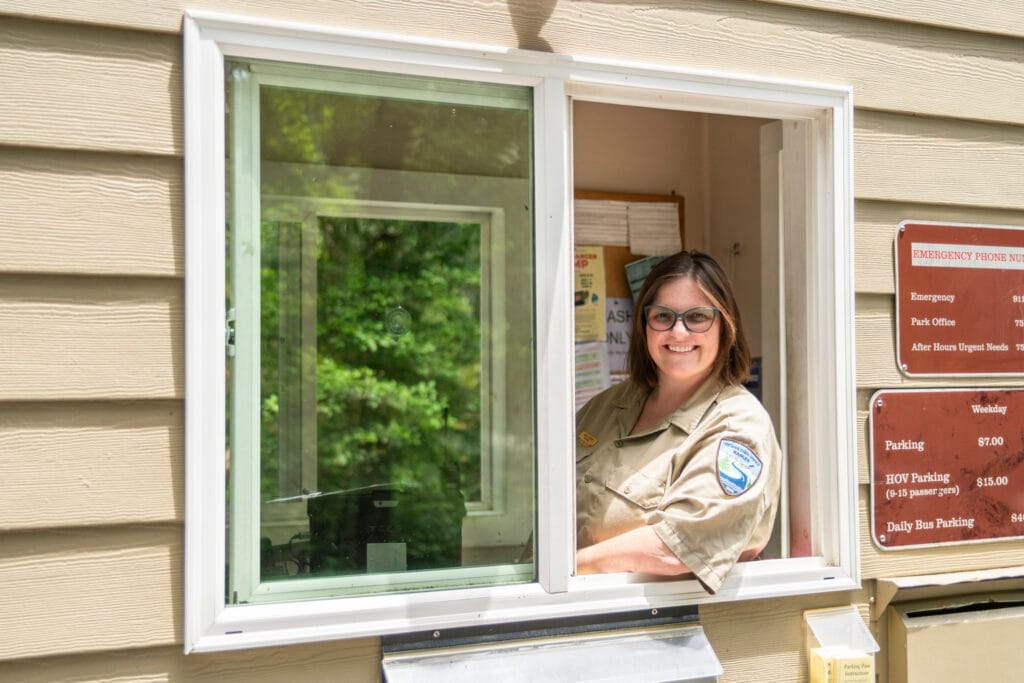
File photo of Va State Park Ranger. RICHMOND, Va. – Virginia State Parks invites job seekers interested in summer seasonal and hourly wage positions to explore the opportunities available at parks across the state.
Whether someone enjoys working outdoors, sharing their educational or historical expertise, or planning events and programs, Virginia State Parks offers a range of seasonal and wage positions that will allow job seekers to build new life skills, enjoy unique experiences and gain knowledge that is valuable inside and outside of the state park system.
Daily duties, pay rates and employment dates will vary depending on the position and park’s needs. Seasonal and wage positions can lead to full-time careers, so opportunities for advancement are possible. Jobs in demand include:
- Administrative assistant
- Contact ranger
- Education support specialist
- Food service ranger
- Groundskeeper
- Housekeeping ranger
- Lifeguard
- Maintenance ranger
- Office assistant
- Park interpreter
- Trades technician
For more information about seasonal, part-time and full-time opportunities and how to apply, please go to www.virginiastateparks.gov/jobs.
Information from a release. Posted by Dan McDermott.
Samuels Public Library Adult Programs — April 2026
SPECIAL FUNDRAISER
Taste for Books: Animal Kingdom — Saturday, April 25, 6 p.m. Take a walk on the wild side at Samuels Public Library’s annual fundraiser. Come in costume (optional) and enjoy food and drinks, a silent auction and games with prizes. Single tickets are $75; group rate is $300 for five tickets. Visit tasteforbooks.net for tickets and information. Note: The library will be closed during the day April 25 in preparation for the event.
ONE-TIME EVENTS
Seniors First Workshop: Prescription Drug Coverage — Thursday, April 9, 2–3 p.m. Learn how Medicare Part D works, including formularies, tiers and extra help options, plus tips for lowering drug costs. Following the workshop, one-on-one 20-minute counseling sessions are available starting at 3 p.m. Call VICAP at 540-635-7141 or visit seniorsfirst.info. To book a counseling session, contact the Adult Reference Department at 540-635-3153 ext. 105.
It’s Feud Time! — Thursday, April 9, 5–7:30 p.m. Brought to you by Warren Coalition, this Family Feud-style event challenges teams of two to five people to guess the top answers to survey questions covering popular topics as well as drugs and alcohol, mental health, smartphone usage and resilience. The winning team receives a $50 gift card per person (up to five people). A dinner of lasagna, salad, dessert and drinks will be provided. Free, but registration required. Intended for middle and high school students and their families. Register at bit.ly/feudtime.
Book Talk with Will Hackman — Monday, April 13, 6–7:30 p.m. Front Royal author Will Hackman discusses his new book “Radically Reframing Climate Change: A Guide to Saving Ourselves,” joined by guests Justin Proctor of the Smithsonian’s Conservation Biology Institute and Makario Sarsozo, a senior communications strategist for Homeworld Collective. The panel will discuss local and community climate actions and ways to get involved, followed by Q&A and a book signing.
Sewing 101 — Wednesday, April 15, 5–6:30 p.m. An introduction to sewing for beginners using a SINGER Heavy Duty 4411 machine. Participants will learn to thread, wind a bobbin and complete a simple take-home project. Registration required.
Spring Bird ID and Photography — Saturday, April 18, 9–10:30 a.m. Off-site at Shenandoah River State Park in Bentonville. Local photographer and educator Sharon Fisher leads a workshop on bird identification and photography. Meet outside the Visitor Center. Hikes of up to 2 miles on even terrain; sturdy footwear recommended. All camera types and experience levels welcome. Standard park parking fees apply; limited library park passes available. Registration required.
Sewing 101 — Wednesday, April 22, 5–6:30 p.m. Same beginner-friendly introduction as the April 15 session. Registration required.
RECURRING PROGRAMS
What the Tech! — Every Tuesday, 2–3:30 p.m. Drop in to Studio 330 for help with computers, phones, tablets, laptops or other devices.
Studio 330: Embroidery Club — Every Thursday, 10 a.m.–noon Bring your own hand embroidery or needlework project for a morning of crafting and socializing. No food in the studio; ages 13–17 must be accompanied by an adult.
Studio 330 Walk-in Hours — Every Thursday, noon–4 p.m. Open for tours or project work on a first-come, first-served basis. Note: Walk-in hours are canceled April 23 in preparation for Taste for Books and will resume April 30. Glowforge not available during walk-in hours.
Studio 330: String Theory Fiber Arts Club — Every Saturday, 2–4 p.m. Knitting, crochet, weaving and other fiber arts welcome. Open to experienced and first-time artists ages 13 and up. No food in the studio; ages 13–17 must be accompanied by an adult.
Love and Logic: Parenting with Empathy — Thursdays through April 23, 5–7 p.m. A six-week parenting series presented by Warren County Social Services and Samuels Public Library. Registration required. Contact Lillian Johns at [email protected] or 540-635-3430 ext. 3386.
BOOK CLUBS & CLUBS
Books & Beyond Book Club — Thursday, April 9, 6–7:45 p.m. Second Thursday of each month. April’s theme is “Space.”
Studio 330: Personal Archiving Series — Saturday, April 11, noon–1:30 p.m. Second Saturday of each month. April’s topic: Preserving Stories Through Artifacts — how to connect stories to keepsakes and memorabilia for future generations. Registration required.
Studio 330: Genealogy Club — Monday, April 13, 2–4 p.m. Second Monday of each month. April’s topic: Genealogy Meets Genetics, featuring author Colleen Snyder discussing how genetic genealogy has shaped her research for “In Search of Giants.”
Scary Words Horror Book Club — Saturday, April 18, 2:30–4:30 p.m. Third Saturday of each month. This month’s title: “My Best Friend’s Exorcism” by Grady Hendrix.
Walkabout Wednesday: Plant Medium — Wednesday, April 29, 10:30–11:30 a.m. Last Wednesday of each month. Extension Master Gardener Volunteers discuss the best potting medium for indoor plants and how to know when it’s time to replant.
COMMUNITY RESOURCE
Phoenix Project — Tuesday, April 21, 2–4 p.m. Advocates from Phoenix Project are available to members of the Front Royal/Warren County community who have experienced or are experiencing domestic violence or sexual assault. Services include crisis intervention, counseling, safety planning and more. Free, confidential and trauma-informed.
For more information, visit samuelslibrary.net or call 540-635-3153.
Information from a release. Posted by Dan McDermott.
Jury Convicts Springfield Man of Hatchet Assault in National Park
HARRISONBURG, Va. – A federal jury convicted a Springfield, Va., man March 19, 2026 for assaulting his then-girlfriend with a hatchet while camping in the Shenandoah National Park.
According to court documents and evidence presented at trial, on the night of August 24, 2025, Soufiane Bougria, 31, and his then-girlfriend (Victim 1) were camping at the Mathews Arm Campground in the Shenandoah National Park. Three different park visitors testified that they witnessed a heated and violent argument between Bougria and Victim 1 in the late-night hours of August 24.
These witnesses, from two different campsites, heard screaming, slamming, crying, choking, and what sounded to them like a gunshot. One of the witnesses saw the defendant physically grabbing Victim 1.
These witnesses described hearing a male voice say, “I don’t care, I’ll do the max sentence” and a female voice say, “I can’t believe you would threaten me with murder.”
All three witnesses independently called 911.
National Park Service Rangers responded to the area near Mathews Arm Campground. On their way to the campground, Park Rangers encountered two of the witnesses at a nearby overlook. While speaking with the witnesses, a car matching the description of the defendant’s vehicle drove past the overlook. Officers pursued the vehicle and initiated a traffic stop.
When officers approached the vehicle, they observed Bougria driving and visibly intoxicated. He was shirtless, barefoot, and smelled of alcohol. In addition, Victim 1 was sitting in the passenger seat crying and screaming. She was holding a piece of clothing around her right arm in an effort to stop the bleeding from a gaping laceration on her right arm and wrist. As officers looked around the car, they saw blood and fatty tissue. They also observed that the windshield of the car was shattered, and both the hood and windshield had large, dirty footprints on them.
When questioned by officers, the defendant told them Victim 1’s arm was accidentally cut with an axe.
Emergency medical personnel arrived at the overlook and transported Victim 1 to the nearest hospital. Treating physicians determined she needed a higher level of care based on the seriousness of her injuries and transported her to Winchester Medical Center where she underwent emergency surgery.
In the early morning hours of August 25, 2025, National Park Service Rangers returned to the Mathews Arm campsite where Bougria and Victim 1 were camping. They found a hatchet with blood spatter on the handle, blood throughout the campsite, pepper spray, shoes, and other personal belongings strewn around the campsite.
First Assistant United States Attorney Robert N. Tracci U.S. made the announcement.
The National Park Service is investigating the case.
Assistant U.S. Attorney Sally J. Sullivan and Special Assistant United States Attorney Chris Browne are prosecuting the case for the United States.
Information from a release.
Samuels Public Library Youth Events — April 2026
Children in library. File photo. More information about Samuels Library and the programs and services available can be found at www.samuelslibrary.net or by calling (540) 635-3153. Samuels Public Library has a full slate of youth programs lined up for April. More information is available at samuelslibrary.net or by calling 540-635-3153.
Thursday, April 9 10:30 a.m. — Grand Story Time (ages 0-6). A special grandparent guest shares favorite tales and classic nursery rhymes, followed by a craft activity.
Saturday, April 11 10 a.m., 10:20 a.m., 10:50 a.m. and 11:10 a.m. — Paws for Reading (ages 6-18). Children read aloud to trained therapy dogs in a relaxed, non-judgmental setting. Bring your own book or use one of theirs. Registration required.
Monday, April 13 10:15 a.m. — Music & Movement for Babies (ages 0-23 months). 11:15 a.m. — Music & Movement for Toddlers (ages 2-5). Music, movement and multisensory activities for little ones.
Tuesday, April 14 4 p.m. — 2.50 Million Acts of Science! (ages 6-11). Celebrate America’s 250th birthday by contributing to a goal of 2.5 million Acts of Science, including projects like White Squirrel Mapping and Nitrate Watch. Registration required.
Wednesday, April 15 10:15 a.m. — Toddler Story Time. 11 a.m. — Preschool Story Time. Planet Earth stories, sing-alongs, finger games and a craft.
Thursday, April 16 10:30 a.m. — Grand Story Time (ages 0-6). Grandparent guest reader, nursery rhymes and a craft.
Saturday, April 18 11 a.m. — Tales & Trails: Batty Bunch (ages 5-11). Explore the world of bats at Shenandoah River State Park with park rangers and librarians. Includes a bat-themed craft. Registration required.
Monday, April 20 10:15 a.m. — Music & Movement for Babies (ages 0-23 months). 11:15 a.m. — Music & Movement for Toddlers & Preschoolers (ages 2-5).
Tuesday, April 21 10:30 a.m. — Seeding Machine: Homeschool Hub (ages 6-11). Design and build a “seeding machine” in this hands-on workshop about technology in farming. Registration required.
Wednesday, April 22 10:15 a.m. — Toddler Story Time. 11 a.m. — Read with the Sheriff: Preschool Story Time. Plant Life stories, sing-alongs, finger games and a craft.
Thursday, April 23 10:30 a.m. — Grand Story Time (ages 0-6). Grandparent guest reader, nursery rhymes and a craft.
Saturday, April 25 The library will be closed for its annual Taste for Books fundraiser.
Monday, April 27 10:15 a.m. — Music & Movement for Babies (ages 0-23 months). 11:15 a.m. — Music & Movement for Toddlers (ages 2-5).
Tuesday, April 28 4 p.m. — Growing Worms (ages 6-11). Grow colorful paper worms using capillary action, plus worm-themed stories. Registration required.
Wednesday, April 29 10:15 a.m. — Toddler Story Time. 11 a.m. — Preschool Story Time. Vegetable stories, sing-alongs, finger games and a craft.
Thursday, April 30 10:30 a.m. — Grand Story Time (ages 0-6). Grandparent guest reader, nursery rhymes and a craft.
Information from a release. Posted by Dan McDermott.
‘From Lanterns to Liberty’ event April 18 kicks off Warren County’s America 250 celebration

Publicity image for From Lanterns to Liberty courtesy of Warren Heritage Society. FRONT ROYAL — Warren Heritage Society will host “From Lanterns to Liberty,” a free, family-friendly event Saturday, April 18, from 2 to 9 p.m. in downtown Front Royal, marking the kickoff of Warren County’s America 250 commemorations.
The event is held in partnership with the Town of Front Royal, Samuels Public Library and numerous local organizations and businesses, and is sponsored by Experience Warren County.
The afternoon portion will feature vendors, live blacksmithing, costumed interpreters, hands-on activities for children, music, storytelling and student performances, along with local food and shopping in the walkable downtown.
As evening falls, attendees can take part in the Paul Revere’s Midnight Glow Walk, carrying lanterns along Chester Street from the Warren Heritage Society to the Front Royal Gazebo. The night concludes with a recreation of the “one if by land, two if by sea” signal, followed by a musket display.
The Warren Heritage Society is located in downtown Front Royal.
Information from a release. Posted by Dan McDermott.
VDOT’s Staunton District plans nearly 600 miles of paving in 2026

File photo of crew working on side of interstate highway VDOT STAUNTON — The Virginia Department of Transportation has awarded 20 resurfacing contracts covering more than 580 miles in its Staunton District, which encompasses much of the Shenandoah Valley and Allegheny Highlands.
About $75 million worth of paving is scheduled across the district’s 11 counties. Contractors will also install 61 miles of rumble strips along primary roads to enhance safety.
The work breaks down across four treatment types. Traditional milling and paving will use about 287,000 tons of asphalt spread over 270 lane-miles. Latex and microsurfacing treatment, which extends pavement life and enhances vehicle traction, will be applied to 145 lane-miles. Surface treatment will cover about 70 lane-miles, and slurry seal — typically used in subdivisions and on low-speed roadways — will be applied to about 95 lane-miles.
On the safety front, VDOT will install 50 miles of center-line rumble strips and 11 miles of shoulder and edge-line rumble strips this year, primarily on roads with speed limits of 45 mph or greater. Rumble strips generate noise and vibration to alert drivers who drift from their lane and are especially effective at preventing crashes involving drowsy or distracted drivers.
Motorists should expect lane closures at dozens of locations throughout the district as the work gets underway. Flaggers and pilot trucks will sometimes be used to control traffic and protect work crews. Drivers are asked to slow down, remain alert, follow work-zone signs and respect flaggers.
All work is weather permitting. Detailed descriptions of VDOT’s resurfacing methods are available on the agency’s Pavement Treatment page at vdot.virginia.gov.
Information from a release. Edited by Dan McDermott.
Front Royal to flush fire hydrants through April 24

File cartoon image of fire hydrant being flushed. FRONT ROYAL — The town will flush fire hydrants throughout the community through April 24, with crews working daily between 7 a.m. and 3 p.m.
Hydrant flushing clears deposit buildup from water lines and allows crews to check the mechanical operation of hydrants. The town conducts the process twice a year to maintain water quality and fire protection. Daytime flushing allows crews to perform minor repairs to keep hydrants operational.
Residents may experience periods of low water pressure or discolored water during flushing. Those who notice discolored water should run their cold-water tap until it clears, postpone washing clothes and limit hot water use until the cold water runs clear.
Flushing also results in water on roadways. Motorists are asked to use caution in affected areas.
For more information, contact the Department of Public Works at 540-635-7819, Monday through Friday, 7 a.m. to 3:30 p.m.
Information from a release. Edited by Dan McDermott.
Front Royal to begin weekly yard waste, chipper collection Wednesday
File photo of yard waste in paper bags. FRONT ROYAL — The town will begin its weekly yard waste and chipper collection service Wednesday, April 8, running through Jan. 27, 2027.
Collection occurs every Wednesday except during weeks when town offices are closed for a holiday. Residents should have yard waste at the curb before 7 a.m. on collection days.
Grass clippings, weeds and leaves must be placed in reusable containers such as Rubbermaid-type bins or cardboard boxes, biodegradable bags or paper bags. All bags must be left untied. Town roll-out carts are not permitted for yard waste. Residents should not mix trash, dirt, rocks or other debris with yard waste.
The town will not collect root balls, stumps, firewood logs or bushes and hedges pulled out by their roots. Brush must be bundled with rope or heavy twine, cut to shorter than 5 feet in length and weigh less than 50 pounds.
The chipper service accepts limbs longer than 5 feet and up to 8 inches in diameter. Limbs should be stacked facing the same direction with cut ends toward the road. The chipper cannot process vines, weeping willow branches or bamboo.
Residents must schedule chipper service in advance by calling the Department of Public Works at 540-635-7819, Monday through Friday, 7 a.m. to 3:30 p.m.
The town does not collect contractor work. Contractors must purchase a dump ticket at the Finance Office, 102 E. Main St., to dispose of materials at the Manassas Avenue extended site, which is closed Wednesdays and Sundays.
Information from a release. Edited by Dan McDermott.
Va. Court of Appeals stops major data center development in Prince William County
A sign opposing the Prince William Digital Gateway Project in Prince William County. (Photo by Nathaniel Cline / Virginia Mercury) By Shannon Heckt | Virginia Mercury
A court ruling has once again halted a massive rezoning effort in Prince William County that would have allowed dozens of data centers to be built near Manassas National Battlefield Park. Now residents and conservation agencies are pushing the county Board of Supervisors to drop out of the lawsuit.
In a ruling last week, the Virginia Court of Appeals agreed with a lower court that the Prince William Board of Supervisors sped up the approval process to establish the technology district without giving the public a fair chance to weigh in.
The industrial rezoning, planned near the park where major Civil War battles took place and residential areas, has drawn criticism from conservation groups since it was proposed four years ago It is one of the most high profile land use battles in the state in recent years.
Six groups joined together to file an amicus curiae brief in support of one of the lawsuits against county leaders filed by the Oak Valley Homeowners Association, who were concerned about the potential impacts the siting of multiple data centers could have on noise pollution and other environmental impacts. The court responded to all the suits in one opinion.
“This 2,000+ acre project — one of the largest data center proposals in the world — planned for 37 data centers and 14 substations,” Chris Miller, president of the Piedmont Environmental Council, said in a statement following the ruling. “The failure to properly notice the public hearings on the proposed development is indicative over a rush to judgement and a failure to adequately assess the impacts on local, regional, state and national resources, ranging from historic and cultural sites to water quality.”
The move to rezone the land has been embroiled in controversy since 2022. Opponents warned that the project would impede the county’s rural character, require extensive water use and strain the power grid.
The plan’s supporters highlighted expected financial benefits, given the massive tax revenues that localities often reap from data center development. The initial proposal was pitched by property owners in Prince William County by way of an amendment to the county’s comprehensive plan, which county supervisors later expanded.
The National Parks Conservation Association, who were part of the brief filed in the case, said their chief concern was data centers sprouting up across the street from the battlefield. They’re now urging the developers involved in the case to use this ruling as a sign to reconsider the digital gateway project and find an alternative that would not harm the historical site.
“Constructing and operating this massive data center complex would have devastating consequences for this iconic piece of American history and set terrible precedent for heavy industrial development near our national parks,” said Kyle Hart, the association’s senior Mid-Atlantic program manager.
The Board of Supervisors and the developers involved in the case can still appeal the case up to the Virginia Supreme Court to make a final determination if the rezoning efforts violated Virginia’s public notice law.
“The county is in the process of reviewing the decision of the court,” Nicole Brown, the director of communications for the county, said in a statement Tuesday. “The County Attorney will then provide legal advice to the Board. Since the decision can be appealed within 30 days, and therefore not yet final, this is still active litigation.”
Prince William County has already approved $1.6 million in legal expenses related to the Digital Gateway lawsuit.
Drive for more housing sparks rare bipartisanship in statehouses, including in Virginia
New housing is under construction in Richmond, Va. State lawmakers around the country are working across the aisle to pass housing legislation. (Photo by Parker Michels-Boyce/Virginia Mercury) By Robbie Sequeira | Virginia Mercury
In contrast to highly partisan debates over many other issues, state lawmakers of all political stripes are joining forces to pass legislation to increase the supply of housing.
The policies attracting support range from requiring cities to allow manufactured homes in areas with single-family homes to easing regulations for accessory dwelling units to allowing housing on church-owned land and strip malls.
Housing has become a can’t-ignore issue for lawmakers across the political spectrum, said Henry Honorof, director of Welcoming Neighbors Network, which connects pro-housing advocacy organizations across 24 states.
“Almost every victory in the country for pro-housing policy has been bipartisan, and has actually required votes from the minority party. … It’s not moderates working together. It’s urban progressives and rural conservatives and libertarians working together,” said Honorof.
“There’s a huge amount of political pressure to do something about housing prices, but the average person doesn’t have a clear sense of what that ‘something’ is but they’re just saying, ‘Fix housing prices, for the love of God.’”
From July 2024 through June 2025, 124 pro-housing bills cleared state legislatures, up from 40 during the same period in 2022-2023, according to the Mercatus Center, a research institute at George Mason University.
This year, lawmakers in Florida, Idaho and Virginia have passed bills requiring municipalities to allow manufactured homes — houses that are built in a factory rather than on site and then transported to a permanent location — anywhere single-family or other housing is permitted. New Hampshire legislators are considering a similar bill.
Michigan lawmakers have also filed housing legislation — including measures to reduce minimum lot sizes, allow accessory dwelling units and set caps on minimum parking requirements — all of which have at least some Republican sponsors. None has passed yet.
Michigan Republican state Rep. Joe Aragona is working alongside Democratic colleagues on a package aimed at easing zoning restrictions.
Aragona is co-sponsoring a bipartisan bill that would dictate who gets a say in opposing new housing in a neighborhood. Instead of just a few nearby neighbors, anyone within 300 feet could be part of a protest petition, which would require at least 60% of those neighbors to sign the petition for it to impede any new development.
Aragona noted that in a March executive order, President Donald Trump outlined a few steps states could take to increase supply and reduce costs. Those included capping fees and reducing timelines associated with permitting, allowing by-right development and curtailing mandates that may increase costs, such as “green-energy building requirements” and reexamining restrictions on manufactured housing.
Everyone across all parties and all levels of government needs to come together over housing.
– Michigan Republican state Rep. Joe Aragona
“I think it’s a growing urgency and everyone across all parties and all levels of government needs to come together over housing,” Aragona said. “The price of housing has been going up significantly and that’s not an outlier, and that seems to be the norm right now.”
Some issues still are harder than others to solve, he added, such as how far states should go in overriding local zoning rules.
“Some of the harder issues to find agreement among all types of groups is zoning. How do you step in as the state and try to referee that?” he said.
Granny flats and strip malls
Indiana this year enacted a wide-ranging law with broad backing from both parties to limit local zoning rules, streamline approvals and expand the types of residential development that must be allowed without public hearings, unless a city or county opts out.
The Indiana law also promotes backyard accessory dwelling units, often known as granny flats or in-law suites. ADUs have increasingly gained momentum in statehouses as a way to fit more housing into existing lots.
Last year, Arizona, Arkansas, Iowa, Maryland and New Hampshire enacted bipartisan laws to ease regulations on ADUs.
A Virginia ADU bill passed overwhelmingly this year that would limit permitting fees to $500 and ease requirements compared with a “primary dwelling.” It’s now on Democratic Gov. Abigail Spanberger’s desk.
Utah has had mixed results on ADU legislation. Legislators this year enacted a bipartisan law requiring certain municipalities with populations of at least 5,000 to adopt a land use regulation to allow ADUs. But the legislature did not pass two bills last year that would have required urban cities to allow ADUs in residential zones.
Honorof, of the Welcoming Neighbors Network, said messaging has been important, with broad coalitions coming together over the left-leaning politics of affordability and equity and the right-leaning priorities of property rights and markets.
“The first major reforms almost every state passes are legalizing accessory dwelling units and allowing more housing near jobs, and that combo is the lowest-hanging fruit of the pro-housing push,” Honorof said. “The next tier is what to do with land zoned only for large single-family homes, and that’s where you start seeing fourplexes, townhomes and lot splits.”
Honorof and other pro-housing advocates have pointed to Washington state as a national test case for how far states can go to expand supply. Lawmakers enacted a law in 2025 capping parking minimums and a law this year forcing cities to allow residential development in commercial zones, opening the way for strip malls to become apartments.
On the parking minimums vote, 13 of 19 Senate Republicans and seven of 39 House Republicans voted for it, and the 2026 law received similar GOP support.
‘Yes in God’s Backyard’ bills
Virginia Democratic state Sen. Jeremy McPike was the lead sponsor on two pro-housing bills that both passed this session, including a “Yes In God’s Backyard” bill and a bill that would allow cities and counties to create affordable housing plans and amend zoning as they see fit.
McPike believes pro-housing bills that aim to reduce red tape in the building process can draw votes across the aisle.
“Some of the bipartisan support comes from reducing red tape and answering the question, how do you get to ‘yes’ when it comes to building more housing?” McPike told Stateline.
Yet division around policies requiring a certain percentage of units to remain affordable can stall some bills, he said.
McPike’s YIGBY bill passed mostly along party lines, with just one Senate Republican and two House Republicans voting for it.
The bill would allow churches and certain nonprofits to build housing on their land by right — bypassing lengthy rezoning and approval processes. Under the bill, at least 60% of the homes would have to be affordable and stay that way for 30 years, and once built, local governments could tax the housing like other property.
The Rev. Michael Sessoms, a senior pastor at Little Union Baptist Church in Dumfries, Virginia, who supports YIGBY legislation, said he talks to Democrats, Republicans, Independents and apoliticals who sit in church pews every week. He said many faith leaders in the housing space see themselves as connectors to groups who seem diametrically opposed on most issues.
Despite the floor votes for the YIGBY measure skewing heavily Democratic, Sessoms said that a coalition of Republicans and Democrats lobbied for the bill.
“This was, for the most part, nonpartisan and we got more pushback from Democrats than Republicans, and we had over 50 coalition partners involved, including conservative groups. So this is a win-win for everybody,” said Sessoms. “People on the left, people on the right, people in the center, and we all came together because this is a crisis.
“The No. 1 issue voters were concerned about in Virginia is housing. There’s not enough housing, and it affects everybody who calls this place home,” Sessoms said. “We have people … teachers, police officers … who can’t afford to live in the county in which they work. Elected officials don’t want to see people leaving their communities, and that’s happening.”
Sessoms said that despite the will from churches to build affordable housing, they simply can’t produce housing on their own without some level of support from the cities they are in.
“One church has been working for about five years to try to build affordable housing on their property, and because of zoning laws it just wasn’t happening,” said Sessoms. “That church ended up spending well over $300,000 without a shovel in the ground. They decided late last year that they would give up.”
Stateline reporter Robbie Sequeira can be reached at [email protected].
This story was originally produced by Stateline, which is part of States Newsroom, a nonprofit news network which includes Virginia Mercury, and is supported by grants and a coalition of donors as a 501c(3) public charity.
Poll: Spanberger policies make Virginia less affordable

A Washington Post-Schar School poll published Apr. 6, 2026 found that Virginia voters were highly polarized over Gov. Abigail Spanberger (D), who ran as a unifying centrist. By Shirleen Guerra | The Center Square
(The Center Square) – Virginia voters are closely divided on Democratic Gov. Abigail Spanberger’s job performance less than three months into her term, including a 10-point deficit saying her policies make the state less affordable.
A new poll points to affordability as a key concern shaping early views of her administration, a subject she and other Democrats campaigned on last fall.
The Washington Post-Schar School poll found 47% of registered voters approve of Spanberger’s performance, while 46% disapprove and 7% are undecided. The Center Square was unsuccessful prior to publication getting comment from the governor.
Spanberger’s approval falls below levels seen by many recent Virginia governors in the same polling series, where most topped 50%. Her disapproval rating is also higher than most of her predecessors in the survey.
More voters said Spanberger’s policies would make Virginia less affordable, at 41%, than said they would make the state more affordable, at 31%. Others said her policies would not make a difference.
That finding contrasts with Spanberger’s campaign and early governing agenda, which has focused on lowering costs for housing, healthcare and energy.
In recent weeks, the governor has signed legislation targeting prescription drug costs, housing supply and certain energy-related expenses. Her office has described those measures as part of a broader effort to ease financial pressure on Virginia families.
The poll offers a more detailed look at how voters view specific policies tied to affordability.
Several proposals drew more positive responses when evaluated individually. About 51% of voters said requiring electric utilities to help low-income customers improve home energy efficiency would make Virginia more affordable. Another 46% said raising the minimum wage to $15 an hour by 2028 would have the same effect, while 44% said reducing regulations on small solar panel systems would make the state more affordable.
Other measures, including expanding mixed-income housing and limiting certain health insurance requirements, also received more favorable responses than negative ones.
Some proposals drew more skepticism.
About 41% of voters said providing up to 12 weeks of paid family and medical leave funded by higher payroll taxes would make Virginia less affordable. Increasing renter protections also drew more responses indicating it would raise costs than lower them.
Individual policies generally received more favorable responses, even as more voters said overall affordability would worsen.
The poll also found that 45% of voters view Spanberger as too liberal, compared to 42% who say her positions are about right and a smaller share who see her as too conservative.
Spanberger took office in January following a decisive victory in the 2025 gubernatorial election, where she emphasized economic issues and positioned herself as a candidate focused on lowering costs.
The Washington Post-Schar School poll surveyed 1,101 registered Virginia voters from March 26-31 and has a margin of error of +/- 3.4%.
Spanberger signs cost-focused bills, but many impacts delayed

The Virginia State Capitol stands in Richmond. Photo: Ron Cogswell / Flickr / CC BY-SA 2.0 / Cropped from Original By Shirleen Guerra | The Center Square
By Shirleen Guerra | The Center Square
(The Center Square) – Democratic Gov. Abigail Spanberger has signed a wide set of bills aimed at lowering costs in health care, housing and energy, though many of the changes will take time before Virginians see a difference in their monthly budget.
The legislation, passed with broad bipartisan support, targets everything from prescription drug pricing to housing supply and electric rates. Much of it, however, focuses on studies, regulatory changes or long-term investments rather than immediate cost cuts.
Several bills take aim at health care costs, including Senate Bill 669, which targets middle men known as pharmacy benefit managers. The law requires regulators to review how drug prices are set, a step lawmakers say could lead to lower costs in the future but does not immediately reduce what patients pay at the counter.
Lawmakers also approved House Bill 220 and SB630, which eliminate certain health insurance surcharges tied to tobacco use, and HB60, which prevents insurers from charging more based on the use of HIV prevention medication.
Housing measures focus on increasing supply and preventing displacement, but their impact will likely take time. HB1227 and SB729 shift more state-backed funding toward affordable housing projects, while SB628 creates a statewide eviction prevention program that must still be implemented.
Another measure, HB655, requires local governments to allow manufactured homes in areas zoned for single-family housing, a change intended to expand lower-cost housing options, though local timelines will determine how quickly that happens.
Energy legislation addresses rising electricity demand and long-term costs, including pressure tied to large users such as data centers. SB505 directs regulators to study how utilities manage fuel costs, which directly affect monthly electric bills, but any changes would come later based on the findings.
Other measures, including HB1191 and SB377, allow large energy users to pay for new power infrastructure, a move designed to prevent those costs from being passed on to residential customers. HB1225 and SB407 also set up future rules for electric vehicle charging infrastructure, with decisions still pending from regulators.
Some of the newly signed laws provide more immediate, targeted savings. HB94 expands vehicle registration fee exemptions for disabled veterans, while HB1180 and SB591 create a free state income tax filing system, though it is not expected to be available until 2028.
Most of the legislation takes effect July 1, with additional studies, rulemaking and program rollouts scheduled over the next one to two years.
Former Gov. Allen seeks redistricting debate

File photo of podium with microphone and US flag. By Shirleen Guerra | The Center Square
(The Center Square) – A former Virginia governor is pressing for a public debate with the incumbent on a proposed redistricting amendment as Virginians are already casting ballots ahead of the April 21 special election.
Former Gov. George Allen, a Republican who served from 1994 to 1998 and later as a U.S. senator, is urging Gov. Abigail Spanberger to participate in a one-hour virtual debate. Allen is part of the group No Gerrymandering Virginia, which opposes the amendment.
“I don’t think it’s too much to ask for one honest virtual debate for the people,” Allen said told The Center Square in an interview Monday afternoon.
Allen said he previously requested multiple debates and recently renewed the invitation, calling for a public discussion where voters can hear both sides of the issue.
The language used has been criticized. According to the Department of Elections, the ballots say, “Question: Should the Constitution of Virginia be amended to allow the General Assembly to temporarily adopt new congressional districts to restore fairness in the upcoming elections, while ensuring Virginia’s standard redistricting process resumes for all future redistricting after the 2030 census?”
In saying “restore fairness,” the Republican National Committee said it’s a “misleading statement – if not an obvious falsehood.”
Today, Virginia’s delegation to the U.S. House of Representatives is 6-5 Democrats. If the map – still under litigation even as voters cast ballots – is adopted, all indications is Democrats will be 10-1.
The Virginia Institute for Public Policy, on March 2, wrote, “The hastily-cobbled-together, back-of-a-cigarette-packet April 21st referendum on redistricting (or “revenge gerrymandering” amendment as we like to call it) has more holes than a sponge, Swiss cheese, and a golf course combined. Is the process by which this referendum was called even legal? Is the blatantly unfair referendum question legal? These are questions which should be resolved before voting even starts.”
That didn’t happen. The state Supreme Court decided the referendum could continue with a deadline two days later for the case. The forecast is for the U.S. Supreme Court to eventually decline or take up the controversy.
Allen said the proposal would reverse the intent of the voter-approved system by allowing lawmakers to redraw maps outside the standard redistricting cycle of once every 10 years.
Allen said the timing of the amendment has limited public awareness, adding that some voters may not realize the referendum is taking place or understand how district lines could change.
“The voters of Virginia have had even less time to become aware that a vote is even taking place,” he said.
Hence why he believes public debate would help.
Virginia’s current congressional maps are drawn once every 10 years by a bipartisan redistricting commission, a system voters approved through a constitutional amendment in 2020 to limit direct control by lawmakers.
For April 21, and early voters before then, a “yes” vote would also put a proposed map approved by the General Assembly into effect for the 2026 elections, while a “no” vote would keep the current districts in place. The former system resumes with the 2030 census.
Spanberger has publicly supported the amendment and said she voted “yes” on the referendum, calling it a temporary measure that preserves Virginia’s bipartisan redistricting process.
Allen also said the proposed changes could shift political representation in parts of Virginia, including Hanover, New Kent, York County and Williamsburg, placing them in districts centered in Northern Virginia. He said that could reduce representation in regions including the Shenandoah Valley and parts of Tidewater.
Allen outlined the debate proposal in a letter and said the governor could choose the moderator, timing and format.
The Center Square on Monday was unsuccessful prior to publication getting comment on the proposal from Spanberger.
Early voting in Virginia began March 6 and will continue through April 18. More than 677,000 early ballots had been cast as of late Monday afternoon, according to data from the Virginia Public Access Project.
Virginia set to rejoin RGGI as utilities prepare to pass the cost back to ratepayers

File photo of natural gas power station. By JPxG – File:Gateway Generating Station.jpg, CC BY-SA 4.0, https://commons.wikimedia.org/w/index.php?curid=106642563 By Shannon Heckt | Virginia Mercury
Virginia is poised to reenter the Regional Greenhouse Gas Initiative this summer, a move that could again add a monthly charge to electricity customers’ bills as utilities resume buying carbon credits.
State officials expect the commonwealth to participate in the program’s September auction once regulations to reestablish the CO2 budget trading program are finalized. Dominion Energy plans to petition the State Corporation Commission in June to add the cost of those credit auctions back onto ratepayer’s bills.
The Department of Environmental Quality and the Secretary of Natural and Historic Resources are working to complete the regulations before the May 21 deadline laid out in the legislation passed by the General Assembly.
“Our intention is that we will formally be participating in the Regional Greenhouse Gas Initiative effective July 1 of this year,” DEQ Deputy Director Jonathan Rak said.
Virginia began participating in 2021 auctions that require utilities to purchase carbon emission credits when they exceed caps set by RGGI Inc., a program now involving 10 other states.
Former Gov. Glenn Youngkin removed Virginia from the agreement in 2023, calling it a hidden tax on ratepayers. The program costs an estimated $2 a month for residential customers in Dominion’s territory. When RGGI was officially paused, customers were paying about $4 due to the stop and start of the court process. A court later ruled that the removal was unlawful, and when he took office, Attorney General Jay Jones canceled the appeal of that ruling.
The cost of the credits has increased since the state last participated in RGGI, but it is not yet clear how that could financially impact ratepayers.
“I can certainly confirm that the prices have increased,” Rak said. “They’re obviously determined in the auction, but we don’t have a prediction at this point as to what the numbers will be.”
In 2027, the cap for carbon emissions under RGGI is also set to decline, as part of ongoing efforts to reduce greenhouse gas emissions. This could further increase costs for utilities working to meet mandates under the Virginia Clean Economy Act while still relying on fossil fuels to generate sufficient power.
Dominion said the cost of the “Rider RGGI” on bills will be detailed in its June filing to the SCC.
Virginia received over $800 million during the three years it participated in the program. Revenue from the fall auction allocated to Virginia will be returned to the fund and distributed as follows: 50% for low-income energy efficiency programs, 45% for the Community Flood Preparedness Fund, and the remainder for climate change planning and administrative costs.
Spanberger signs bipartisan school-safety, student support bills into law

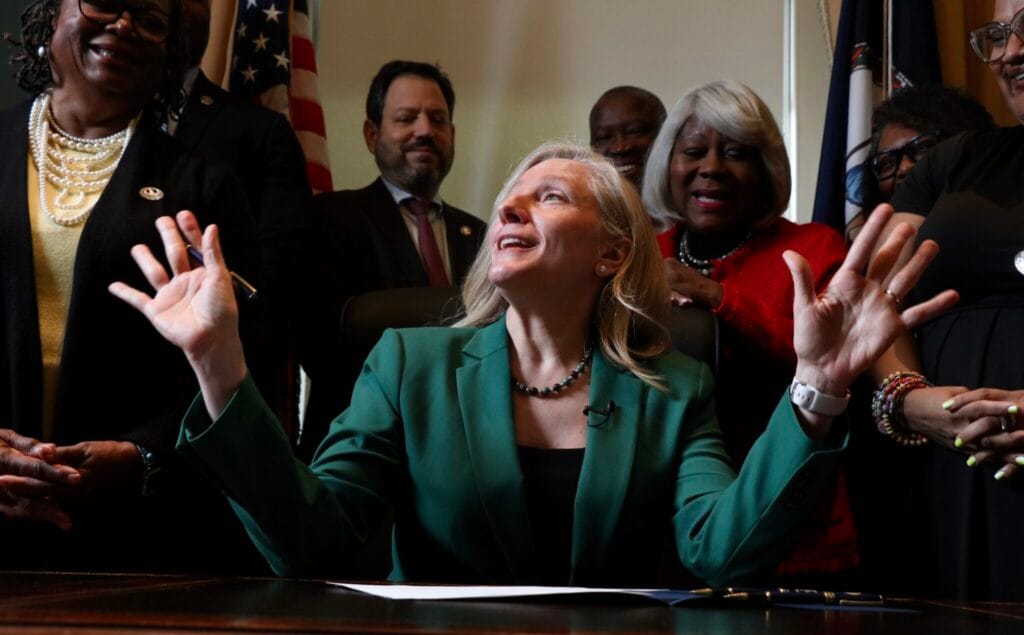
Gov. Abigail Spanberger signs legislation at the Capitol in Richmond in February, 2026. (Photo by Charlotte Rene Woods/ Virginia Mercury) By Markus Schmidt | Virginia Mercury
Gov. Abigail Spanberger on Thursday signed a new batch of legislation centered on school safety, student well-being and expanded support systems in Virginia’s public schools, alongside measures addressing public health protections and food insecurity among children.
The package of bills, all of which cleared the General Assembly with unanimous or bipartisan support during its 2026 session, reflects a broad push by lawmakers to strengthen emergency preparedness in schools, improve mental health resources, modernize student safety education and provide additional tools for educators working with at-risk youth.
With the governor’s signature, the measures will become law.
“As the parent of three daughters in Virginia public schools and a former federal law enforcement officer, nothing is more important to me than the safety of Virginia’s kids,” Spanberger said in a statement.
“Every Virginia parent deserves peace of mind knowing their kids are safe, supported, and set up for success — and that their school is prepared for any emergency.”
Spanberger added that the legislation is intended to give teachers and school staff the training and resources they need while reinforcing safety priorities shared by families across the commonwealth. She thanked both Democratic and Republican lawmakers for their support.
Lawmakers target threats, school readiness
At the center of the legislative package is an effort to strengthen how schools identify and respond to potential threats.
One measure, House Bill 1071, sponsored by Del. Amy Laufer, D-Albemarle, requires threat assessment teams in K-12 schools and public colleges and universities to receive additional training on emergency substantial risk orders, often referred to as “red flag” laws.
Those orders, already permitted under Virginia law, allow for the temporary removal of firearms when someone is deemed a danger to themselves or others.
The new requirement incorporates that training into existing annual instruction, aiming to ensure school-based teams are better prepared to recognize warning signs and coordinate with courts when intervention is needed.
Lawmakers also expanded how educators are trained to support students facing mental health challenges.
HB 38 by Del. Rozia Henson, D-Woodbridge, sets clearer standards for required mental health awareness training, directing school divisions to include evidence-based practices tailored to students considered at higher risk.
That includes youth affected by suicide, students with disabilities or chronic illnesses, those experiencing housing instability or foster care placement, and students who identify as LGBTQ+.
The law also makes explicit that the training cannot be used to justify discriminatory or biased treatment, while still allowing local divisions flexibility in how the instruction is delivered.
In response to the evolving digital landscape, legislators updated requirements for internet safety education.
Under HB 171, Del. Alex Askew, D-Virginia Beach, schools will incorporate expanded instruction on topics such as online privacy, responsible social media use and the risks associated with digital platforms.
The updated framework also emphasizes recognizing online exploitation and understanding the permanence of digital footprints, integrating those lessons into existing curricula rather than creating a separate course.
Another measure gives school divisions the option to equip staff with wearable panic alarm systems designed to alert emergency responders of a crisis.
HB 592, carried by Del. Shelly Simonds, D-Newport News, allows the devices to send signals directly to 911 and trigger schoolwide alerts when necessary.
The law also directs the Virginia Department of Education to establish a grant program — contingent on state funding — to help offset the cost for divisions that choose to adopt the technology, with priority given to those demonstrating need.
Beyond emergency preparedness, several of the newly signed laws focus on expanding support for students considered at risk of academic failure.
A separate bill, HB 195 by Del. Delores McQuinn, D-Richmond, broadens how school divisions can use state funding targeted at those students, allowing the money to cover physical and mental health services.
That includes hiring licensed practical nurses, registered nurses and advanced practice registered nurses to work in schools, reflecting a growing emphasis on the connection between student health and academic outcomes.
Sen. Barbara Favola, D-Arlington, sponsored the companion measure, Senate Bill 33.
Another proposal, HB 1153, sponsored by Del. Sam Rasoul, D-Roanoke, makes permanent a school-based initiative originally launched as a pilot program in Roanoke and Petersburg.
By removing the program’s expiration date and designating it as a statewide demonstration model, the law signals an intent to expand efforts aimed at improving school climate and reducing youth violence.
The initiative focuses on workforce development, exposure to career and technical education and building social and emotional skills, combining academic support with broader community-based services.
Sen. David Suetterlein, R-Salem, carried the companion SB 820.
Measures aim to improve safety standards and fight child hunger
In addition to education-focused legislation, Spanberger signed measures aimed at improving public health oversight and addressing child hunger.
One new proposal, HB 222, introduced by Del. Patrick Hope, D-Arlington, requires Virginia’s Board of Health to establish comprehensive regulations governing public swimming pools and other water recreational facilities.
The updated framework shifts away from narrower requirements and instead mandates broader health and safety standards for facilities, including those associated with hotels and health spas, with the goal of creating more consistent statewide oversight.
Another measure, HB 210 by Del. Cia Price, D-Newport News, requires school divisions to track and report unpaid student meal debt.
Each local school board will submit annual data to the Virginia Department of Education, which will then compile a statewide report for lawmakers.
The requirement is designed to provide a clearer picture of the scope of unpaid meal balances across Virginia while protecting student privacy by prohibiting the inclusion of personally identifiable information.
The effort stems from recommendations by the Virginia Commission to End Hunger and is intended to inform future policy decisions addressing food insecurity.
This latest round of bill signings comes just days after Spanberger approved an initial slate of legislation focused on lowering costs for Virginians, including measures targeting health care affordability, housing supply and energy prices.
Taken together, the legislation reflects a wide-ranging approach to student safety and well-being, combining immediate emergency response measures with longer-term investments in mental health, educational support and public health infrastructure.
With Spanberger’s signature, the measures will take effect as law by July 1.
Trump budget seeks 43% boost in defense spending, cuts in many domestic programs

An aerial view of the Pentagon on May 12, 2021. (Department of Defense Photo/Air Force Tech. Sgt. Brittany A. Chase) By Jennifer Shutt | Virginia Mercury
WASHINGTON — The Trump administration released its fiscal 2027 budget request Friday, asking Congress to increase spending on defense programs by 43% and decrease funding for non-defense accounts by 10%.
The proposal kicks off what will be a monthslong process on Capitol Hill as lawmakers write the dozen annual government funding bills ahead of the Oct. 1 deadline.
Congress rarely adheres to the president’s request entirely, and didn’t do so last year, rejecting many of the proposed cuts, including to health and education.
Last year’s process, the first of President Donald Trump’s second term, was considerably rocky, leading to a 43-day shutdown that began in October, a brief partial shutdown that ended in early February and an ongoing shutdown for the Department of Homeland Security.
This budget request proposes Republicans again use the complex budget reconciliation process they used last year to enact the “big, beautiful” law to further bolster spending on the Pentagon and DHS.
The Defense Department would have its budget raised to $1.5 trillion, a $445 billion increase over its current funding level. The administration proposes lawmakers put $1.1 trillion of that in the annual spending bill that would require bipartisan support to move through the Senate and place the other $350 billion in the partisan reconciliation bill.
“America has already begun to strengthen and reinvigorate the military by committing tens of billions of dollars to new and innovative programs such as the Golden Dome for America, and making critical investments in the defense industrial base,” the document states. “By continuing to provide the resources necessary to rebuild America’s military, the Budget re-establishes deterrence, revives the warrior ethos of America’s Armed Forces, and prioritizes investments against the most acute national security threats.”
Department-by-department requests
The budget asks that lawmakers also increase spending on:
- The Energy Department by $4.8 billion, or 10%, to $53.9 billion.
- The Justice Department by $4.7 billion, or 13%, to $40.8 billion.
- The Veterans’ Affairs Department by $11.5 billion, or 9%, to $144.9 billion in discretionary spending.
The proposal asks Congress to decrease spending on:
- The Agriculture Department by $4.9 billion, or 19%, to $20.8 billion.
- The Commerce Department by $1.3 billion, or 12.2%, to $9.2 billion.
- The Education Department by $2.3 billion, or 2.9%, to $76.5 billion.
- The Environmental Protection Agency by $4.6 billion, or 52%, to $4.2 billion.
- The Department of Health and Human Services by $15.8 billion, or 12.5%, to $111.1 billion.
- The Department of Housing and Urban Development by $10.7 billion, or 13%, to $73.5 billion.
- The Interior Department by $2.3 billion, or 12.9%, to $15.9 billion.
- The Labor Department by $3.5 billion, or 25.9%, to $9.9 billion.
- The Small Business Administration by $671 million, or 67%, to $329 million.
- The State Department and other international programs by $15.5 billion, or 30%, to $35.6 billion.
- The Transportation Department by $1.6 billion, or 6.2%, to $26.6 billion.
- The Treasury Department by $1.5 billion, or 12%, to $11.5 billion.
The budget proposes $63 billion in funding for the Department of Homeland Security, which doesn’t yet have its appropriations bill from the current year for comparison.
Senate Appropriations Committee Chairwoman Susan Collins, R-Maine, said in a statement there are issues with some of its proposals for both defense and domestic spending.
“While there are some improvements over last year’s domestic discretionary budget request, including full support for the Pell Grant program, the request has several shortcomings,” she said. “For example, the proposal includes unwarranted funding cuts in biomedical research. It would also terminate worthwhile programs like LIHEAP, which helps low-income families and seniors to pay their energy bills during the cold winter and hot summer months, and TRIO, which assists low-income, first-generation students in pursuing higher education.”
Collins indicated she may bolster defense spending for a certain type of ship that she views as essential to the country’s military.
“The request for just one DDG-51, the workhorse of the U.S. Navy, is insufficient to counter the ever-growing Chinese fleet, which now exceeds the size of the American Navy, as well as other global threats,” she said.
Privatizing TSA screening
The president’s request asks lawmakers to cut funding for the Federal Emergency Management Agency’s non-disaster grant program and to begin the process of offloading security screening at the nation’s airports.
“The Budget begins the privatization of TSA’s airport screeners by requiring small airports to enroll in the Screening Partnership Program, under which TSA pays for private screeners at designated airports,” it states. “The airports that already use this program have demonstrated savings compared to Federal screening operations. The move would yield cost savings compared to Federal screening and begin reform of a troubled Federal agency.”
The budget asks Congress to provide an increase of $1.7 billion to the Bureau of Prisons to improve working conditions and pay, with $152 million of that going to the first year costs to “rebuild Alcatraz as a state-of-the-art secure prison facility.” The Bureau of Prisons has been evaluating whether to restore the closed California facility.
The budget proposes increases in funding for Trump’s efforts to improve the District of Columbia, including a $10 billion Presidential Capital Stewardship Program run through the National Park Service and $403 million for a new Transportation Department program to upgrade security in the Metro system and other local projects.
The National Aeronautics and Space Administration, which launched the Artemis II mission this week to orbit the moon, would receive a $5.6 billion, or 23%, cut under Trump’s budget proposal to a total funding level of $18.8 billion.
It asks Congress to decrease funding for the International Space Station by $1.1 billion and “prioritizes the rapid development and deployment of commercial space stations, while also keeping the safe de-orbit of the ISS on track for 2030.”
Dems reject ‘bleak’ budget
Washington Democratic Sen. Patty Murray, ranking member on the Appropriations Committee, wrote in a statement that the budget request was “bleak and unacceptable.”
“President Trump wants to slash medical research to fund costly foreign wars,” she wrote. “It doesn’t get more backward than that, and the only responsible thing to do with a budget this morally bankrupt is to toss it in the trash.”
Murray added that she expects Congress to pursue bipartisan spending bills, just as lawmakers did during last year’s process, including investments in domestic issues.
“This week, President Trump said that our country cannot afford to help families with child care or health care—but his own budget proves what a ridiculous farce that is,” she said. “Imagine how many families we could help if, instead of giving the Pentagon more money than they can even figure out what to do with, we cut people’s heating bills in half and made child care affordable for every family in America.”
Senate Budget Committee ranking member Jeff Merkley, D-Ore., wrote in a statement the request lacks detail for programs that run outside of the annual budget and appropriations process, like Medicare, Medicaid and Social Security.
“Going back decades, presidents have sent to Congress detailed budgets with 10 years’ worth of detailed plans – outlining their approach to tax policy and our growing debt, as well as the solvency of our biggest programs like Medicare and Social Security,” he wrote. “This budget doesn’t do any of that. It’s just an out-of-touch plea for more money for guns and bombs, and less for the things people need, like housing, health care, education, roads, scientific research, and environmental protection.”
Minnesota Democratic Rep. Betty McCollum, ranking member on the Defense Appropriations Subcommittee, said the Pentagon doesn’t have an issue with how much in taxpayer money lawmakers allocate, but “a problem with efficiently spending the funding that Congress has provided them – and accounting for it.”
“The President’s request for $1.15 trillion in defense spending is outrageous and unacceptable, especially when President Trump and Congressional Republicans intend to make further cuts to critical services that Americans rely on at home,” she said. “Our nation cannot be secure without investments in our country’s critical health care, education, nutrition, and infrastructure.”
Trump makes history at Supreme Court amid landmark birthright citizenship challenge
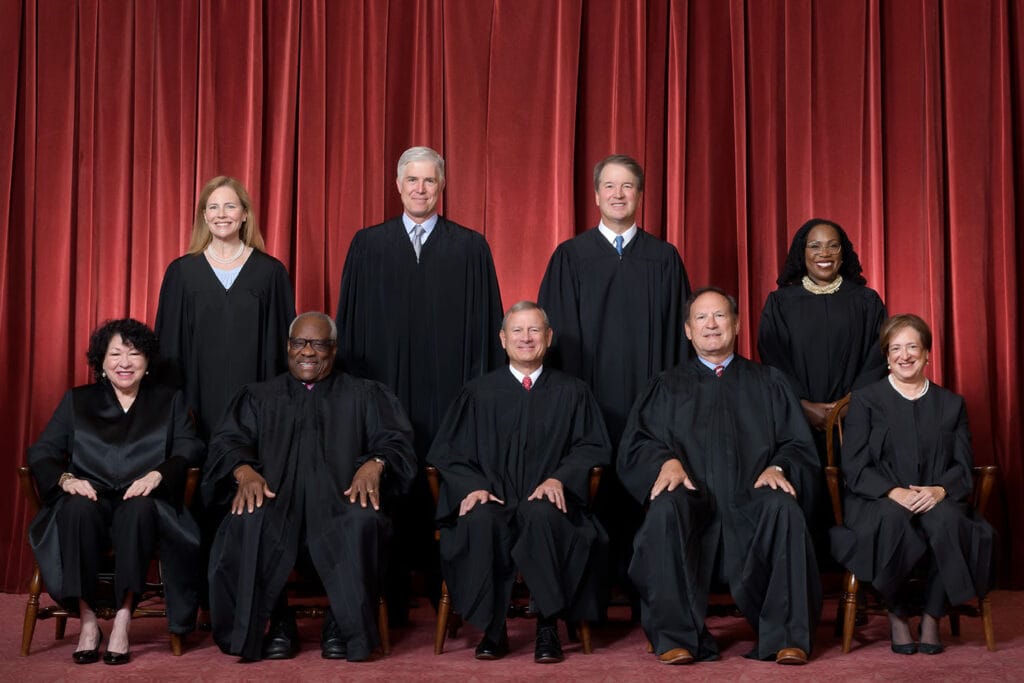
Formal group photograph of the Supreme Court as it was been comprised on June 30, 2022 after Justice Ketanji Brown Jackson joined the Court. The Justices are posed in front of red velvet drapes and arranged by seniority, with five seated and four standing. Seated from left are Justices Sonia Sotomayor, Clarence Thomas, Chief Justice John G. Roberts, Jr., and Justices Samuel A. Alito and Elena Kagan. Standing from left are Justices Amy Coney Barrett, Neil M. Gorsuch, Brett M. Kavanaugh, and Ketanji Brown Jackson.Credit: Fred Schilling, Collection of the Supreme Court of the United States By Emily Rodriguez and Brett Rowland | The Center Square
(The Center Square) – President Donald Trump made history Wednesday by attending oral arguments at the U.S. Supreme Court over his executive order seeking to end birthright citizenship, spotlighting a pivotal legal battle with far-reaching implications.
Trump has been urging the Supreme Court to rule in his favor on several key issues. After the court ruled against him on tariffs in February, the citizenship case moved to the forefront. During oral arguments, the president stayed for only part of the session, leaving the courtroom for the White House as an American Civil Liberties Union attorney presented the case against his order.
Trump, a second-term Republican, arrived in a secure convoy. Police blocked off access for non-Supreme Court personnel and redirected traffic, while photographers waited outside the area.
Around 9:40 a.m., police vehicles led Trump’s convoy to the Supreme Court, followed by several black vehicles, armored police vehicles, and an ambulance. Security was heightened as military personnel arrived and vehicles remained at the scene.
Trump left the court about 15 minutes after a lawyer for the American Civil Liberties Union presented the case against Trump’s executive order. On the drive back, tourists responded with gestures of support and opposition to the president. Trump arrived back at the White House at 11:30 a.m.
The birthright citizenship case, Trump v. Barbara, challenges Trump’s first-day executive order denying birthright citizenship to children born in the U.S. after Feb. 19, 2025, whose parents are either illegally in the country or are temporary residents. The central legal question is whether the president’s order violates or reinterprets the 14th Amendment’s guarantee of citizenship to those born in the United States.
The challenge centers on whether the executive order is consistent with the 14th Amendment, which conferred citizenship and voting rights to freed African Americans after the Civil War. Plaintiffs argue the order conflicts with whatr has been interpreted as a constitutional guarantee.
The 14th Amendment reads: “All persons born or naturalized in the United States, and subject to the jurisdiction thereof, are citizens of the United States and of the State wherein they reside.” The case could hinge on the meaning of five words: “subject to the jurisdiction thereof.”
This case directly challenges the president’s authority to alter citizenship policy by executive order, and its outcome could reshape immigration policy, citizenship definitions, and broader U.S. policy.
The Supreme Court is expected to decide the case before the end of its term this summer.
Emily Rodriguez is an intern reporter based in Washington, DC, covering national news for The Center Square. Originally from Texas, she is a proud graduate of Our Lady of the Lake University, San Antonio, where she studied a variety of writing styles.
US Supreme Court justices skeptical of Trump attempt to end birthright citizenship
By Ariana Figueroa | Virginia Mercury
WASHINGTON — The U.S. Supreme Court Wednesday seemed poised to reject the Trump administration’s attempt to redefine the constitutional right to birthright citizenship, and instead uphold the country’s long understanding of citizenship by birth on American soil.
If a majority of Supreme Court justices strikes down President Donald Trump’s executive order to end birthright citizenship for children born to parents without legal status or temporary immigration statuses like visas, it will be the second recent major blow to the president via the high court. Earlier this year, a majority of justices struck down his use of sweeping tariffs.
Trump, who signed the executive order aiming to end birthright citizenship as one of his first acts after his inauguration in 2025, came to the courtroom to hear the oral arguments, a first for a sitting president.
‘Quirky’ administration argument
A majority of the justices during Wednesday’s oral arguments were skeptical of Solicitor General D. John Sauer’s arguments that the citizenship clause of the Constitution’s 14th Amendment was only intended to grant citizenship to the children of newly freed African American slaves, not immigrants.
Chief Justice John Roberts called one of Sauer’s key arguments “quirky,” and questioned how it could be applied to an entire class of immigrants without legal status.
Sauer argued that the children born to parents without legal status or temporary visitors are not “subject to the jurisdiction of the United States” and are instead subject to the laws of their home country. He cited carve outs in birthright citizenship, such as the children born to foreign diplomats.
“You expand it to a whole class of illegal aliens,” Roberts said. “I’m not quite sure how you can get to that big group from such tiny and sort of idiosyncratic examples.”
Along with Roberts, the liberal wing of the court and conservative Justices Neil Gorsuch, Brett Kavanaugh and Amy Coney Barrett also did not seem swayed by Sauer’s argument.
Gorsuch asked Sauer if, under the Trump administration’s interpretation of the 14th Amendment, Native Americans would be considered birthright citizens “under your test.”
“Uh, I think so,” Sauer said.
Indigenous people were granted U.S. citizenship by Congress in 1924, but were not granted citizenship under the 14th Amendment because those children were born to parents who were citizens of tribal governments.
Sauer also contended the 1898 Supreme Court ruling that upheld citizenship based on birth on American soil, United States v. Wong Kim Ark, was wrongly decided.
He argued that the Wong Kim Ark case did not take into consideration “sojourn travelers,” who are temporary visitors in the U.S. and give birth.
Sauer also said the Trump administration was not looking for the justices to overturn that case.
ACLU arguments
Liberal justice Elena Kagan said that Sauer’s argument to the court was an effort to create a “revisionist history” of the Wong Kim Ark case.
“Everyone took Wong Kim Ark to say that, as a result of that, birthright citizenship was the rule,” she said. “And I think everybody has believed that for a long, long time.”
American Civil Liberties Union lead attorney Cecillia Wang said during oral arguments that when the federal government tried to strip Ark of his citizenship, “largely on the same grounds (the Trump administration) raised today,” the Supreme Court rejected those efforts.
“This Court held that the 14th Amendment embodies the English common law rule (that) virtually everyone born on U.S. soil is subject to its jurisdiction and is a citizen,” said Wang, who is the daughter of Taiwanese immigrants.
Her parents were in the U.S. on student visas when she was born in Oregon, meaning that if Trump’s executive order were in effect at that time, she would have been denied U.S. citizenship.
“Ask any American what our citizenship rule is and they’ll tell you, everyone born here is a citizen alike,” Wang said. “That rule was enshrined in the 14th Amendment to put it out of the reach of any government official to destroy.”
Birthright citizenship has been a longstanding core principle in the United States, where nearly any child — regardless of their parents’ immigration status — born on U.S. soil is automatically granted citizenship.
The text of the clause is: “All persons born or naturalized in the United States, and subject to the jurisdiction thereof, are citizens of the United States and of the State wherein they reside.”
Experts have warned that if the constitutional right to birthright citizenship were struck down, it would effectively create a class of millions of stateless people, leaving them without a country to call home.
If the high court determines that Trump violated the Constitution with his executive order, it would be a major block to the president’s goal in defining who is American, as Trump has aimed to reshape the country’s racial and ethnic makeup through limits to migration and an aggressive immigration campaign of mass deportations.
A decision from the high court on the case, Trump v. Barbara, is likely not going to come until the end of the court term, in late June or early July. If the court decides to uphold the executive order, it would go into effect 30 days after the ruling.
New world, old Constitution
Sauer argued that birthright citizenship should not be applied to children of temporary visitors, such as foreigners who partake in what opponents call “birth tourism.”
Roberts asked Sauer how much of an issue birth tourism is – the idea that foreign visitors specifically travel to the U.S. for the purpose of giving birth and obtaining citizenship for their soon-to-be born children.
“No one knows for sure,” Sauer said, citing media reports that many Chinese tourists travel to the U.S. and give birth.
However, China does not allow its citizens to have dual citizenship.
Roberts seemed skeptical that birth tourism should be considered in Sauer’s legal arguments for the purpose of restricting birthright citizenship. He told Sauer that birth tourism “wasn’t an issue in the 19th century.”
“We’re in a new world now,” Sauer said. “Where 8 billion people are one plane ride away from having a child as a U.S. citizen.”
But Roberts shot back, “Well, it’s a new world, it’s the same Constitution.”
Other countries
Sauer also argued that the U.S. should fall in line with the citizenship laws of other countries.
“Unrestricted birthright citizenship contradicts the practice of the overwhelming majority of modern nations,” he said. “It demeans the priceless and profound gift of American citizenship.”
Kavanaugh questioned why the U.S. should worry about the citizenship requirements of other countries.
“Obviously we try to interpret American law with American precedent based on American history,” Kavanaugh said. “I’m not seeing the relevance as a legal, constitutional interpretive matter necessarily, although I understand it’s a very good point.”
Shortly after oral arguments ended, Trump took to his social media site, Truth Social, where he falsely said the U.S. is the only country to have birthright citizenship. Argentina, Brazil, Canada and Mexico are among several countries that have birthright citizenship.
“We are the only Country in the World STUPID enough to allow ‘Birthright’ Citizenship!” he wrote.
Trump left Wednesday’s oral arguments after Sauer was finished presenting his argument to the justices, and about a few minutes into arguments from the ACLU’s Wang, according to White House pool reports. Oral arguments lasted for about two-and-a-half hours.
Earlier decision
This is the second time the Trump administration has brought a birthright citizenship case before the justices.
Last year, after federal judges in Maryland, Massachusetts, New Hampshire and Washington state struck down the president’s executive order, the Trump administration appealed to the Supreme Court, but asked the justices to consider the lower courts’ use of universal injunctions, rather than the merits of birthright citizenship.
The justices took up the case, and in a 6-3 vote divided along ideological lines, the use of universal injunctions was curtailed by the conservative wing of the high court.
After the ruling, immigration advocates and the ACLU filed class action suits, which were successful in blocking the birthright citizenship executive order. The suits argued that future children born in the United States without gaining citizenship constituted a nationwide class.
“If you credit the government’s theory, the citizenship of millions of Americans past, present and future could be called into question,” Wang said.
The Aircraft carrier USS Bush and its 4,000 sailors left Norfolk Tuesday

Families wait along the pier for the aircraft carrier USS George H.W. Bush to depart Norfolk. (Photo by Steve Walsh/WHRO) By Steve Walsh/WHRO | Virginia Mercury
The USS George HW Bush pulled out of Norfolk as the Trump administration continues to send mixed signals about its next steps for the war with Iran.
The head of the strike group, Rear Adm. Alexis Walker, would not say where the ship and its complement of three destroyers were headed.
“For operational security and as well as for flexibility, who knows what the next crisis will be or the next challenge will be around the world? ” So we’ll be ready to go wherever that is,” Walker said.
For the last several weeks, media reports have indicated USS Bush would replace USS Gerald R. Ford in the theater with Iran. The carrier is in Croatia undergoing repairs after being sidelined by a fire in a laundry room that displaced hundreds of sailors from their berthing areas. Navy officials have said USS Ford is not expected to return to Norfolk until sometime in May. The 11-month deployment could surpass the record deployment by carriers during the COVID pandemic.
On Tuesday, Secretary of Defense Pete Hegseth hinted that the U.S. could be winding down operations against Iran. During his first press briefing on the war in two weeks, Hegseth said the U.S. could leave it to allies to completely open the Strait of Hormuz. The choke point for the global oil market has been largely blocked since the beginning of the war by the threat of strikes from Iran.
President Trump made similar suggestions on social media after saying Monday that the U.S. could also widen the war by targeting civilian infrastructure, if negotiations break down with the current regime in Iran.
Technically, USS Bush has been available to deploy since completing the Composite Training Unit Exercise at the beginning of March. The training was the last step in certifying the readiness of the carrier, which has undergone a major maintenance cycle. The carrier waited for the crew to finish additional maintenance, Walker said.
“There was a lot of maintenance that we wanted to tie up and make sure that we had all of our redundancy in place so that when we head out into theater, we are fully combat capable and ready to go,” Walker said.
Long deployments have become more common. Leadership on the carrier is concerned about stressing the crew. Sailors typically go on leave just prior to a deployment, said USS Bush Capt. Robert Bilbeau.
“The workup cycle is very challenging for our sailors,” Bilbeau said. “I use the analogy of going to the gym. You have a heavy day at the gym, it helps to rest and recharge and spend some family time. So that’s absolutely important.”
Monday morning, LaKenya Ford waited on the dock with her family. Her twin daughters, 21-year-old Jaden and Jade Andrews, were deploying for the first time. They were born in April and they flew home for a combination of early Easter and early birthday.
“I told them to think positive. I told them at least you’re getting to see the world, getting to travel, so just make the best of the situation,” Ford said.
Spanberger signs first wave of bills targeting health care, housing and energy cost
Gov. Abigail Spanberger signing bills. (Photo by Charlotte Rene Woods/Virginia Mercury) By Charlotte Rene Woods and Shannon Heckt | Virginia Mercury
Gov. Abigail Spanberger has signed the first first batch of bills passed by state lawmakers before they adjourned in mid-March, advancing measures on health care, housing and energy affordability. With hundreds of bills cleared by the legislature, she has until April 13 to sign, seek amendments or veto remaining legislation.
In the meantime, Spanberger in a statement highlighted lawmakers’ focus on these three issues as a priority during the legislative session.
“No Virginian should ever have to choose between seeing their doctor, paying their rent or mortgage, or keeping their lights on,” she said. “I am signing this legislation to respond to the real, pressing concerns I have heard from Virginia families across the commonwealth about high costs — particularly at the pharmacy counter, in the housing market, and on their utility bills.”
While she signed some versions of bills, she noted cognates from the opposite chamber that have yet to be communicated but will be signed when they officially reach her desk.
Health care
Following through on a campaign promise, Spanberger signed a slate of bills aimed at addressing health care affordability and access, along with measures to boost housing supply and strengthen tenant protections.
After passing unanimously, Senate Bill 669 by Sen. Aaron Rouse, D-Virginia Beach, and House Bill 830 by Del. Katrina Callsen, D-Charlottesville, aim to prevent pharmacy benefit managers from inflating prescription drug costs.
Pharmacy benefit managers are the middlemen that negotiate drug prices between health plans, manufacturers and pharmacies. Critics have argued they operate with little transparency, making it hard to tell how much of their negotiated savings are passed on to consumers. Rouse and Callsen have been working on reforming PBMs in recent years.
Another unanimously supported measure was SB 405 by Sen. Louise Lucas, D-Portsmouth and HB 815 by Del. Mark Downey, D-Williamsburg. The legislation invests in Virginia’s health workforce by administering nursing scholarships.
HB 220 by Del. Patrick Hope, D-Arlington, and SB 630 by Sen. Jennifer Carroll Foy, D-Prince William will eliminate additional fees on health care premiums while HB 60 by Del. Jeion Ward, D-Hampton, seeks to prevent life and health insurance from being denied to people who have sought care for HIV or AIDS.
Housing
After a state-directed study confirmed a shortage of roughly 200,000 affordable housing units, lawmakers have spent several legislative sessions trying to address the gap. Housing affordability and increasing supply were also central to Spanberger’s campaign for governor.
HB 1227 by Del. Josh Thomas, D-Prince William, and SB 729 by Sen. Mike Jones, D-Richmond, leverage the state’s bonding authority to support the development of new affordable housing.
SB 628 by Sen. Mamie Locke, D-Hampton, and SB 527 by Del. Adele McClure, D-Alexandria, establish Virginia’s Eviction Reduction Program — a measure both women had planned to pursue through their work on the Virginia Housing Commission, where they learned the piloted diversion program was not being used as widely as intended.
SB 346 by Sen. Schuyler VanValkenburg, D-Henrico, and HB 655 by Del. Michelle Maldonado, D-Prince William, aim to boost housing supply by making it easier to construct manufactured homes, which can provide a more affordable housing option but are not always granted the same approvals as other single-family homes.
All of the housing bills Spanberger has so far signed so far, or indicated she plans to sign, cleared the legislature with bipartisan support.
Energy
With energy costs a top concern for Virginians, lawmakers passed several bills aimed at lowering monthly utility bills.
Spanberger signed HB 1191, by Del. Irene Shin, D-Fairfax, and SB 377, by Sen. Scott Surovell, D-Fairfax, that allows high load energy customers — such as data centers or manufacturers — to enter into agreements to invest in new substations that serve only them, shielding ratepayers from those costs.
Under these measures, customers that demand more than 20 megawatts of power and rely on transmission lines of 230 kV of power or more would pay 100% of the cost to construct the substation should they enter into an agreement with the utility and comply with local ordinances.
HB 369, sponsored by Del David Reid, D-Loudoun, addresses the process by which commercial and industrial customers of Phase I and Phase II utilities buy renewable energy certificates, or RECs, from within the regional grid operator PJM to help meet clean energy and capacity requirements.
The RECs help utilities comply with mandates under the Virginia Clean Economy Act. The legislation also provides that power purchased from nuclear and fusion energy sources would count toward meeting the law’s carbon-zero emissions requirements.
SB 505, by Sen. Creigh Deeds, D-Charlottesville, directs the State Corporation Commission to take a closer look at fuel and power purchase costs and how they affect risk for ratepayers. Fuel costs are a direct pass-through from utilities to customers, but the newly signed bill requires the SCC to ensure that the most efficient methods are being used and to consider fuel-cost sharing programs.
HB 562, also by Reid, allows electric cooperatives to establish virtual power plants to help ease potential strain on the grid during periods of extreme heat or cold. The measure enables customers with electric vehicle charging stations, smart thermostats, and battery storage to temporarily reduce demand on the grid during peak hours on a voluntary basis.
HB 889, by Shin, and SB 497, by Sen. Russet Perry, D-Loudoun, prioritizes existing transmission line corridors and state highways for new transmission siting. The Department of Transportation is also directed to make recommendations on how the state can speed up permitting for transmission lines in areas where infrastructure already exists and along highway rights-of-way.
Another Shin proposal, HB 1225, and SB 407, by Sen. Jennifer Boysko, D-Fairfax, allows Dominion Energy and Appalachian Power Company to petition the SCC to build utility-owned electric vehicle charging stations while establishing new location requirements. The bill also initiates a rulemaking proceeding by the SCC to determine appropriate distances between utility-owned fast-charging stations and privately-owned ones.
Spanberger order, RNC lawsuit highlight divide over Virginia voter roll maintenance

A Fairfax County voters receives a sticker on Election Day, Nov. 4, 2025. (Photo by Nathaniel Cline/Virginia Mercury) By Markus Schmidt | Virginia Mercury
With midterm elections approaching in Virginia, Republicans and Democrats are advancing competing strategies over how the state maintains its voter rolls, setting up an already familiar clash that is unfolding simultaneously in federal court and through executive action.
At the center of the divide is a lawsuit over the removal of suspected noncitizens from voter rolls — and a new executive order from Gov. Abigail Spanberger aimed at tightening election security procedures while rejoining a national data-sharing system used to keep registration lists up to date.
On one front, the Republican National Committee has moved to intervene in ongoing litigation, seeking to defend Virginia’s previous efforts to remove individuals identified as noncitizens from voter rolls.
On the other hand, Spanberger’s Executive Order 13 directs state agencies to strengthen election safeguards, improve list maintenance practices and reenter the Electronic Registration Information Center (ERIC), a multistate partnership designed to help states identify outdated or duplicate registrations.
Taken together, the moves reflect a growing clash over election integrity and voter access in the commonwealth, one that has sharpened in recent years and is now unfolding as another election cycle approaches.
Executive order outlines administrative approach
Spanberger signed her directive last Tuesday, framing it as an effort to reinforce trust in Virginia’s election system while ensuring eligible voters are not improperly removed.
“I know it feels like it is always election season in Virginia,” Spanberger said in a statement. “With even more days of voting on our calendar this year, I’m acting early to strengthen Virginia’s transparent, robust voting process and protect the rights of all eligible Virginia voters.”
The order directs the Virginia Department of Elections to certify annually that key security procedures are in place, including ballot handling protocols, testing and certification of voting machines and accuracy checks conducted after elections.
It also establishes clearer rules for maintaining voter rolls.
Under the directive, any systematic removal of ineligible voters — including individuals identified as noncitizens — must be completed at least 90 days before a federal primary or general election.
That provision aligns with federal restrictions under the National Voter Registration Act, which limits large-scale voter list maintenance close to an election to reduce the risk of errors that could prevent eligible voters from casting ballots.
The order further requires coordination between state agencies.
The Department of Motor Vehicles must certify that it shares daily updates with election officials, including information on new registrations, address changes and individuals deemed ineligible.
The Department of Elections, in turn, must confirm it is acting on that data in compliance with state and federal law.
A central component of the order is Virginia’s return to ERIC.
The nonprofit consortium allows member states to share voter registration and identification data to identify voters who have moved, died or registered in multiple states.
Virginia was a founding member of ERIC in 2012 but withdrew in 2023 under then-Gov. Glenn Youngkin, a move that election officials said made it more difficult to track certain changes in voter status.
Democratic Party Chair Lamont Bagby said in a statement that rejoining ERIC restores “proven tools that work to keep our voting systems fair and secure.”
Civil liberties advocates also backed the move.
Chris Kaiser, policy director for the American Civil Liberties Union of Virginia, said the order could help prevent eligible voters from being wrongly removed while strengthening overall election administration.
Lawsuit highlights legal dispute over removals
At the same time, a separate legal battle is unfolding over Virginia’s efforts to remove suspected noncitizens from voter rolls.
The Republican National Committee filed a motion last week seeking to intervene in a federal lawsuit brought by voting rights groups.
The plaintiffs are attempting to block state officials from conducting systematic removals within 90 days of an election, arguing the practice violates federal law and risks disenfranchising eligible voters.
The RNC contends that removing individuals who have identified themselves as noncitizens through government records is a lawful and necessary step to maintain accurate voter rolls.
“Democrats and left-wing groups are trying to block commonsense safeguards and keep self-identified noncitizens on voter rolls,” said Republican Party Chairman Joe Gruters in a statement. “The RNC is stepping in to protect the integrity of our elections so that only American citizens decide American elections.”
The case stems from a broader dispute dating back to 2024, when voting rights groups challenged actions taken by Youngkin to remove roughly 1,600 individuals flagged as noncitizens from voter rolls based on state records, including removals carried out within 90 days of the November election — a period when federal law generally restricts large-scale voter list maintenance.
The issue drew national attention and prompted legal action involving the U.S. Department of Justice and other parties.
Virginia collects citizenship information through driver’s license applications and had been using that data to identify individuals who may not be eligible to vote.
Critics argue that such data can be outdated or inaccurate, particularly for naturalized citizens whose records may not reflect their current status. But supporters of the policy say it is a straightforward way to prevent ineligible voting.
The RNC has already been involved in earlier stages of the case.
After the lawsuit was filed, the party submitted an amicus brief to the U.S. Supreme Court, which ultimately stayed a lower court order that would have halted the removals and left the flagged individuals on the voter rolls.
Now, the party is seeking a more direct role, citing concerns that Virginia’s new Democratic Attorney General Jay Jones may not fully defend the policy as the case proceeds.
Plaintiffs in the lawsuit argue that systematic removals close to an election violate federal protections and could sweep up eligible voters, particularly those who have recently become citizens.
Safeguards and broader context
Virginia officials have pointed to existing safeguards in state law, including same-day registration.
That process allows voters whose registrations may have been affected to register at the polls and cast a provisional ballot, ensuring they still have an opportunity to participate.
Still, the debate reflects a national divide over how states should balance election security with voter access.
Republicans, led by Donald Trump before he was elected to his second term as president, have repeatedly raised concerns about election security, often citing unfounded claims about widespread voter fraud in the 2020 election — assertions that have been rejected by courts, election officials and federal agencies, which found no evidence the outcome was affected.
More recently, RNC has pursued legal efforts in other states, such as Ohio and Wyoming, including legal challenges tied to documentary proof of citizenship requirements and actions aimed at preventing noncitizen voting.
Spanberger’s executive order attempts to navigate that tension by emphasizing both accuracy and timing, requiring voter roll updates to be completed well before elections while expanding the state’s ability to track changes through interstate data sharing.
Spanberger said the steps are intended to ensure “only Virginians who are eligible to vote are able to vote in our commonwealth — this year, and in every election into the future.”
TSA officers finally get paid amid ongoing Homeland Security shutdown

TSA officer carrying a bin of prohibited items that passengers have surrendered. TSA photo. By Jacob Fischler | Virginia Mercury
Most Transportation Security Administration officers received a paycheck Monday covering four weeks of back wages that were held up by the funding lapse at the Department of Homeland Security, a TSA spokesperson said.
The lack of pay had produced long wait lines for security checks at some of the nation’s busiest airports after TSA officers quit or called out sick.
The 45-day partial government shutdown of DHS remains ongoing — with each chamber of Congress, both led by Republicans, unable to reach a consensus on a solution. It is now the longest government shutdown in history, exceeding last year’s 43-day record.
But President Donald Trump on Friday ordered the department and the White House Office of Management and Budget to reprogram funds with a “logical nexus” to TSA in order to compensate the airport screeners who had remained on the job without pay.
That month of back pay went out Monday, DHS spokeswoman Lauren Bis wrote in an email.
“Most TSA employees received a retroactive paycheck today that included at least two full paychecks … today,” Bis wrote.
Some TSA workers “might see a slight delay,” which could be attributed to a variety of factors, such as processing by their banks, Bis added. She said the department was working with the U.S. Department of Agriculture’s National Finance Center to process the half-paycheck employees missed in February.
Because TSA workers are considered essential, they are required by law to stay on the job even when the government cannot fund their positions. Though they receive back pay once funding is available, long shutdowns cause major problems for workers.
More than 500 TSA workers have quit since the shutdown began and thousands more have missed shifts, Bis wrote.
Breakdown in Congress
The House and Senate passed competing measures Friday to end the shutdown. Because the chambers diverged in how to fund the department, it remains shuttered.
The shutdown began Feb. 14 after Democrats in Congress said they would only support a funding bill for the department if it contained changes in how the Trump administration carried out immigration enforcement following the fatal shootings of two U.S. citizens by immigration agents in Minneapolis.
Senators last week reached a deal to fund the department except for its immigration enforcement agencies, which received a massive influx from Republicans’ spending and tax cuts law last year.
The House bill would have extended 2025 funding levels for the entire department for two months. Lawmakers from both chambers left for a two-week recess after passing their respective bills.
White House wants full funding
At a Monday briefing, White House press secretary Karoline Leavitt urged Congress to pass full funding for the department.
“The president just can’t keep signing presidential memorandums and proclamations every time Congress fails to do its job and every time Democrats hold our country hostage, picking and choosing the programs and agencies they want to fund just because they don’t like this administration’s policies,” she said. “That’s not how it’s supposed to work.”
Jennifer Shutt contributed to this report.
Supreme Court skeptical of allowing states to count mail ballots that arrive after Election Day
File photo of election ballot. By Jonathan Shorman | Virginia Mercury
The U.S. Supreme Court’s conservative justices on Monday appeared skeptical of the validity of mail-in ballots that arrive after Election Day, in a case that could potentially affect hundreds of thousands of voters during the upcoming midterm elections.
The high court heard arguments on whether federal law overrides a Mississippi law that requires mail-in ballots that are postmarked on or before Election Day to be counted as long as they arrive within five business days of the election. Fourteen states have similar laws, which extend a “grace period” to ballots that arrive through the mail after polls close.
Several conservative justices raised concerns with allowing ballots to arrive after Election Day, including whether voters could recall ballots once they’ve shipped them but before they arrive at election offices. Justice Brett Kavanaugh questioned whether late-arriving ballots risk undermining election confidence.
“‘The longer after Election Day any significant changes in vote totals take place, the greater the risk that the losing side will cry the election has been stolen,’” Kavanaugh said, quoting from an analysis by a New York University law professor.
The case comes before the Supreme Court at a moment of broader attacks against mail-in voting. Four Republican-led states eliminated their ballot arrival grace periods last year. And Congress is mulling proposals that would restrict voting by mail amid a sprawling debate in the U.S. Senate over legislation demanded by President Donald Trump that would impose sweeping new voter restrictions nationwide. That legislation, known as the SAVE Act, is unlikely to pass because of the filibuster.
The Republican National Committee is challenging Mississippi’s grace period law. The party contends a longstanding federal law that sets the Tuesday after the first Monday in November as Election Day for federal offices preempts state laws that allow ballots cast by Election Day, but received later, to count.
Paul Clement, an attorney for the Republican National Committee, argued the prospect that the outcome of an election could change because of ballots arriving after Election Day would be unacceptable to losing candidates. After the 2020 election, President Donald Trump demanded election officials not count ballots that came in after Election Day. States kept counting ballots.
“If you have an election and the election is going to turn on late-arriving ballots in a way that means what everybody kind of thought was the result on Election Day ends up being the opposite a week later, 21 days later, the losers are not going to accept that result. Full stop,” Clement told the justices.
Mississippi Secretary of State Michael Watson, a Republican who is defending the state law, argues that federal law allows ballots cast by Election Day to be received later. In legal filings, attorneys for the secretary argue both legal and historical precedent support his position. States may decide that voters have made their final choices when ballots are submitted to state officials rather than when they’re received, according to Watson.
On Monday, the justices appeared divided along ideological lines, with conservative justices skeptical of the grace periods and liberal justices more sympathetic. Conservatives hold a 6-3 majority on the court.
“It seems to me that we have a very long history of states having a variety of different ballot receipt deadlines, to include after Election Day,” said Justice Ketanji Brown Jackson, one of the court’s liberal members.
Mississippi Solicitor General Scott Stewart told the court the dispute is over whether Congress in an 1845 law blocked states from counting ballots cast by Election Day but received later. “No one challenged it until now,” Stewart said.
It seems to me that we have a very long history of states having a variety of different ballot receipt deadlines, to include after Election Day.
– Justice Ketanji Brown JacksonAt least 725,000 ballots were postmarked by Election Day 2024 and arrived within a legally accepted post-election window, The New York Times has reported, citing election officials in 14 of 22 states and territories where late-arriving ballots were accepted that year.
About 30% of voters cast a mail ballot in 2024, according to data gathered by the U.S. Election Assistance Commission.
The 5th U.S. Circuit Court of Appeals ruled in October 2024 that federal law requires ballots to be received by Election Day. Trump likewise issued an executive order last year that attempted to require that mail ballots be received by the end of Election Day and to impose other election changes, but much of the order has been blocked by federal courts.

A voter marks her ballot at Fondren Church in Precinct 16 during primary voting on March 10, 2026, in Jackson, Miss. (Photo by Vickie D. King/Mississippi Today) Rick Hasen, a professor and director of the Safeguarding Democracy Project at the University of California-Los Angeles School of Law, wrote on his Election Law Blog that it was clear from Monday’s arguments that the Supreme Court will be closely divided, “and the case could come out either way.” A decision is expected later in the spring or early summer.
Caleb Hays, chief policy counsel at the Center for Election Confidence, a conservative-leaning legal advocacy group that opposes ballot grace periods, said his organization was pleased that the justices appeared to pick up on the need for a clear end to the voting period. He also welcomed the justices raising the issue of recalling ballots when they are delivered through the mail or by a third-party service like FedEx.
“That brings into question some of the arguments we saw from (Mississippi) on a ballot being final when it is cast and cast includes when it is deposited in a mailbox,” Hays said in an interview.
As the legal challenge made its way through the courts over the past two years, some Republican-led states moved to eliminate their grace periods. Kansas, North Dakota, Ohio and Utah last year moved to require all or nearly all ballots to be in the hands of election officials on Election Day to count.
The states that continue to extend grace periods for ballots arriving after Election Day are Alaska, California, Illinois, Maryland, Massachusetts, Mississippi, Nevada, New Jersey, New York, Oregon, Texas, Virginia, Washington and West Virginia, along with the District of Columbia.
Some local election officials have urged the Supreme Court to uphold ballot grace periods. A decision that strikes down state laws’ grace periods would increase the administrative burdens on many election officials, said a collection of election officials and local governments in California, Massachusetts and Washington in an amicus brief.
“(Grace periods) enable administrators in large and small jurisdictions to do their essential work in a timely and reasonable manner,” the brief says.
If the Supreme Court requires that ballots must arrive on or before Election Day, Clement suggested election officials would have enough time to prepare ahead of November. He said such a decision wouldn’t violate the Purcell principle, a Supreme Court doctrine holding that major changes to election policy and practice shouldn’t be made just before an election because voters could get confused.
The federal law at issue pertains to general elections, not primary elections, he noted — meaning the court’s decision would apply only to the November election.
“There’s plenty of time,” Clement said.
Stateline reporter Jonathan Shorman can be reached at [email protected].
This story was originally produced by Stateline, which is part of States Newsroom, a nonprofit news network which includes Virginia Mercury, and is supported by grants and a coalition of donors as a 501c(3) public charity.
After bills passed, NoVa lawmakers urge SCC to consider burying transmission lines
By Shannon Heckt | Virginia Mercury
Two legislators representing a sprawling county in the northern region of the commonwealth asked the State Corporation Commission last week to consider burying high-voltage transmission lines, after bills that would initiate a pilot program for the proposed lines passed the General Assembly.
Ashburn residents in Loudoun County are waiting for state regulators’ final decision on which route will be used for the 500 kilovolt transmission lines in the project, dubbed Golden to Mars.
Democratic state Sen. Kannan Srinivasan and Del. JJ Singh, who both represent Loudoun, submitted testimony in the original Golden to Mars SCC hearing. In their most recent letter, they acknowledged the lines are necessary for energy reliability, but said community health, safety and quality of life should be prioritized — a goal they think could be accomplished by burying the lines.
“The legislation passed by the General Assembly reflects the General Assembly’s recognition that innovative approaches—including hybrid solutions that incorporate underground transmission where feasible—should be seriously considered when evaluating projects of this magnitude,” the letter read.
Project background
The Golden to Mars project by Dominion Energy is the final piece of the “reliability loop” of energy sources in Ashburn, just outside a major cluster of data centers. The project is critical to bring energy to the power-hungry facilities, Dominion has said, and to complete the connection of multiple substations that is already two-thirds approved and under construction.
If the Golden to Mars portion of the loop is not completed, the utility has warned, existing infrastructure could be damaged and penalties for violations could be levied by the regional grid operator PJM.
There has been fierce community opposition to all of the proposed routes. The Loudoun County School Board has also rejected proposals for the transmission lines to be placed on school properties; some of the originally proposed routes would cross near Rock Ridge High School and Rosa Lee Carter Elementary School.
Homeowners in the nearby Loudoun Valley Estates neighborhoods are worried about diminishing property values, health risks, and potential loss of their land due to the proposed routes cutting close to their properties.
With these limitations posed by the county and school board, two routes are still viable in the plan, 1F and 3a according to Dominion. Community members have urged the SCC to order at least portions of the lines to be buried underground to mitigate many of their concerns.
A feasibility study by Dominion found that it would be much too expensive to bury the lines, the utility reported. But Loudoun officials had their own study conducted that concluded it could be feasible to bury parts of the lines, even with the financial challenges.
The SCC will ultimately determine whether it would be within the public’s interest and financially reasonable to move forward with the project and bury the lines.
Legislators take action
The General Assembly passed two bills from Srinivasan and Singh which, if signed into law by Gov. Abigail Spanberger, would set up a pilot program to allow the SCC to identify four qualifying transmission projects to be buried, which could include Golden to Mars.
The proposed pilot program allows for the additional cost that would come from undergrounding 500kV transmission lines — compared to what it would cost to keep them overhead — to be shared with the locality where the project is built.
The locality would have to pass a resolution that agrees with paying 50% of the cost, with caps on how much of an increase in energy taxes can be placed on residential customers. The allocation of the other portion of the cost would be subject to SCC review and recommendation.
A final order in this case is anticipated in the coming days or weeks. The passed legislation would not be available to the commission to implement if not signed by the governor.
ALEC: Virginia 14th in energy retail price
Electric station photo: Alan Wooten / The Center Square By Alan Wooten | The Center Square
(The Center Square) – Virginia is 14th in energy affordability in the Energy Affordability 2026 report from the American Legislative Exchange Council.
ALEC released its analysis on Wednesday. North Dakota and Louisiana were the leaders in the review of electricity prices and energy affordability indicators is measured for each of the 50 states.
Virginia was 23rd a year ago. The report uses the most recent information available for consistency; this means electricity price data is from 2024, and gasoline and diesel fuel prices are from 2025.
Additionally for context, the United States and Israel launched military strikes against Iran on Feb. 28, and the prices of fuel have climbed since. Global energy infrastructure has been impacted by the action and the blockade of the Strait of Hormuz.
ALEC says, “Virginia’s electricity generation is led by natural gas and nuclear power, with solar, wood, and coal contributing smaller shares. As the largest net importer, the state supplements substantial in-state generation with regional purchases to meet growing demand. In 2023, Virginia received 50 million MWH through interstate transmission.
“Virginia officials have indicated intent to rejoin the Regional Greenhouse Gas Initiative cap-and trade program, with the Legislature recently passing legislation to solidify this action. Mandate-driven energy requirements like the ones imposed by RGGI can place upward pressure on long-term electricity costs, even in states with diverse generation portfolios. One grid incident was reported in the most recent year, involving vandalism.”
ALEC suggests statutory guidance with priority on affordability, reliability and domestic production “could help ensure continued cost competitiveness while strengthening grid resilience.”
The report says the average retail price in cents per kilowatt-hour is 10.62. Total retail sales in megawatt-hours are 102.6 million.
Natural gas (59%), nuclear (28%), solar (7%), wood (3%) and coal (2%) represent the top generation sources.
Immigrant charged in 2nd Fairfax County stabbing in 35 days

Police emergency lights flash red and blue at night. Photo: Scott Rodgerson / Unsplash (The Center Square) – For the second time since Feb. 23, Fairfax County in Virginia is mourning the loss of life in a stabbing believed to have been caused by someone illegally in America.
Anibal Armando Chavarria Muy, 38, from Guatemala, is charged in Sunday’s incident in Bailey’s Crossroads. He’s charged with second-degree murder and being held without bond at the Fairfax County Adult Detention Center.
Published reports say he is believed to have come into the United States as a gotaway. That means he came across the border without documentation as required by law, was detected by border security, but not apprehended and did not turn back.
Abdul Jalloh, from Sierra Leone, is charged with second-degree murder in the stabbing death of Stephanie Minter on Feb. 23. She was killed at a bus stop in Hybla Valley.
Federal officials have said Jalloh was in the United States illegally and had more than 30 prior arrests. The Department of Homeland Security also said immigration authorities had previously lodged a detainer against him.
Immigration and cooperation with U.S. Immigration and Customs Enforcement has been hotly debated in Virginia. Democratic Gov. Abigail Spanberger, in one of her first acts, rescinded an order requiring the Virginia State Police and the Virginia Department of Corrections to enter into 287(g) agreements with ICE.
The order also encouraged local law enforcement agencies to participate in the federal immigration enforcement program.
Spanberger has said the policy change is intended to refocus state and local law enforcement resources on core public safety responsibilities. In a television interview, she criticized federal immigration enforcement tactics, saying they undermine trust between law enforcement and communities.
House Bill 1441 would place limits on cooperation between state and local law enforcement and federal immigration authorities, while allowing coordination in certain cases, including when a valid judicial warrant or detainer is issued, according to bill language.
Offshore wind project begins generating power
Offshore wind turbines in the ocean. Photo: Jesse De Meulenaere / Unsplash – https://unsplash.com/photos/a-group-of-wind-turbines-in-the-ocean–IaTiYqRTL8 By Shirleen Guerra | The Center Square
(The Center Square) – Dominion Energy’s Coastal Virginia Offshore Wind project has begun delivering electricity to the grid, marking a key milestone as construction continues off Virginia’s coast.
A Dominion spokesperson told The Center Square the project delivered its first power on Monday, March 23, meeting the company’s original schedule.
One turbine is currently generating about 14.7 megawatts of electricity. As additional turbines are installed, output will increase toward the project’s full capacity of 2.6 gigawatts, which Dominion says is enough to power about 660,000 homes.
The project is now more than 70% complete, according to Dominion.
Construction progress includes the installation of 160 of 176 transition pieces, which connect turbine towers to their foundations, signaling that a major phase of offshore work is nearing completion.
Dominion said the project remains on track, with most construction expected to wrap up by the end of 2026 and final work continuing into early 2027.
The milestone follows a temporary federal pause earlier this year tied to national security concerns involving offshore wind development. A federal judge later allowed construction to resume while legal challenges continue.
Dominion said the project remains on schedule despite the delay.
Project costs have increased as construction has progressed.
Dominion confirmed to The Center Square the total cost is now estimated at about $11.5 billion, up from the project’s original $9.8 billion estimate.
Under the project’s cost recovery structure, customers are already paying for the project through rates approved by the Virginia State Corporation Commission. Dominion said the average residential customer is currently paying about $11 per month for the offshore wind project.
In a separate company statement, Dominion said updated cost estimates would increase the average lifetime bill impact by about 43 cents per month.
The company has said cost increases are largely tied to higher network upgrade costs assigned by PJM, which manages the regional power grid, as well as onshore electrical system work needed to connect the project to the grid.
The offshore wind project is part of a broader effort to meet rising electricity demand in Virginia, including growth tied to data centers, population increases and military operations.
Dominion said additional turbines will come online in phases, increasing the amount of electricity delivered to the grid as construction continues.
Fairfax casino bill advances, others stall
Slot machines are displayed inside the Horseshoe Bossier City casino. Photo: Emilee Calametti / The Center Square By Shirleen Guerra | The Center Square
(The Center Square) – Virginia lawmakers wrapped up the session with mixed results on gambling legislation, advancing a Fairfax casino proposal while other measures stalled.
Senate Bill 756, introduced by Sen. Scott Surovell, cleared both chambers in conference, according to the Virginia Legislative Information System. The measure would add Fairfax County to the list of localities eligible to host a casino, reopening debate over expanding gambling in Northern Virginia.
The proposal requires any casino development to be part of a mixed-use project totaling at least 1.5 million square feet and mandates voter approval through a local referendum before any casino could move forward. The bill now heads to the governor for consideration.
A state fiscal analysis found no anticipated impact unless a project proceeds following voter approval.
Another measure, Senate Bill 661, also cleared both chambers and establishes a framework to regulate electronic skill game machines under state oversight. The bill now heads to the governor for consideration.
A fiscal impact statement notes the potential costs tied to regulating skill game machines are largely undetermined, though the proposal could increase enforcement and correctional system demands.
Efforts to legalize online casino gaming, however, did not move forward.
House Bill 161 and Senate Bill 118, which would have allowed internet-based casino games under Virginia Lottery oversight, both failed in conference and saw no further action, according to LIS records.
A separate proposal addressing sweepstakes-style gaming, Senate Bill 579, was continued to 2027, delaying further consideration of how the commonwealth may regulate that type of gaming.
The debate comes as problem gambling calls in Virginia rose 39% in 2025, according to the Virginia Council on Problem Gambling, reflecting growing demand for support as gambling options expand.
The results leave Virginia’s approach to gambling uneven, with some proposals advancing while others remain unresolved.
Virginia order sets new election rules, rejoins ERIC
A woman leans over a table to complete voter registration paperwork at a polling location, with a small American flag in the foreground. Photo: freepik By Shirleen Guerra | The Center Square
(The Center Square) – In the latest election-related move in Virginia, Democratic Gov. Abigail Spanberger signed an executive order Tuesday to rejoin a multi-state voter data system and set new rules for how voter rolls are reviewed and maintained.
Executive Order 13 begins the process of bringing Virginia back into the Electronic Registration Information Center, or ERIC. The system is used by states to share voter registration and motor vehicle data to identify outdated or duplicate records.
ERIC helps states flag voters who may have moved, died or be registered in more than one state, allowing election officials to update voter rolls and contact voters when needed.
Membership in ERIC is unstable. Today, there are 25 states plus the District of Columbia – the latter a member consecutively since 2015. In 2025 and 2024, there were 21 states, down from 28 in 2023 and 31 in 2022. There were 28 in 2021, 23 in 2020, 22 in 2019, 19 in 2018, 18 in 2017 and 12 in 2016.
Virginia withdrew from ERIC in 2023 under former Republican Gov. Glenn Youngkin.
At the time, state officials cited concerns about rising costs, data privacy and participation gaps among neighboring states, according to a 2023 letter from the Virginia Department of Elections announcing the withdrawal. The letter also pointed to uncertainty around how the system was being managed as several states exited.
The decision drew political criticism at the time, with Democrats saying the move could weaken voter list accuracy, while state officials said they would pursue other data-sharing efforts.
The new order directs election officials to begin the process of rejoining within 30 days.
“I’m acting early to strengthen Virginia’s transparent, robust voting process and protect the rights of all eligible Virginia voters,” Spanberger said in a statement.
“The actions Virginia is taking today are not only critical to allowing all eligible Virginia voters to register and cast their ballot, but to making sure that only Virginians who are eligible to vote are able to vote in our commonwealth, this year and in every election into the future.”
Beyond rejoining ERIC, the order lays out changes across several areas, including ballot security, equipment testing, election result verification and voter list maintenance.
Under the order, the Department of Elections has to confirm each year that ballot security procedures are being followed. That includes tracking ballots through each step of the process, matching ballots to voter check-ins during early voting and Election Day, and verifying required information on absentee ballots before they are counted.
The order also reinforces existing rules for voting equipment. Virginia uses paper ballots, and counting machines are not connected to the internet. All equipment must be tested before each election and certified to state and federal standards.
To make sure results are accurate, the order lays out a step-by-step review process. Election officers check results at the precinct level on election night. Local electoral boards then review those results during the post-election canvass, including confirming that ballots received match ballots distributed. After that, the Department of Elections conducts a final state-level review before results are certified.
Election officials are also directed to review potential cases of ineligible voting identified through interstate data systems after elections.
In addition, the order sets requirements for maintaining voter lists, including that any systematic effort to remove ineligible voters must be completed at least 90 days before a federal election.
The Department of Motor Vehicles is also directed to share information daily with election officials, including new registrations, address changes and eligibility data, to help keep voter rolls current.
The order further requires election officials to provide information to voters about election-related offenses under Virginia law, including penalties tied to illegal voting, intimidation and interference with the voting process.
The order takes effect immediately and replaces earlier executive actions related to election procedures.
Requests for additional comment were sent to the governor’s office and the Virginia Department of Elections.
Airport chaos: TSA agents skip work, security lines expand, Trump sends in ICE to assist
Federal immigration officers were at the Hartsfield-Jackson Atlanta International Airport on Monday, March 23, 2026, to help with airport security as the partial shutdown continues. The airport was telling travelers to prepare for at least four-hour wait times to get through security Monday. (Photo by Ross Williams/Georgia Recorder) By Jacob Fischler | Virginia Mercury
Airport security workers missed work Monday at the highest rate since a partial government shutdown began in mid-February, the Department of Homeland Security said, and the Trump administration sent immigration officials to some airports in an attempt to keep lines moving.
Travelers reported hourslong security lines at major airports in Atlanta and Houston, while waits of 30 minutes or more were reported at several other hubs Monday.
Nearly 3,500 Transportation Security Administration agents, roughly 11.8% of the scheduled nationwide workforce, called out from work Monday. TSA officers have been working without pay since the department that oversees TSA began a funding lapse Feb. 14 due to a dispute in Congress over immigration enforcement.
Call out rates were over 20% at a handful of major airports, according to DHS. They were:
- 42.3% in New Orleans
- 41.5% in Atlanta
- 39.1% in Houston
- 38.1% in Baltimore
- 37.4% at New York’s John F. Kennedy International Airport
- 24.7% in Pittsburgh
- 24.2% in Philadelphia
- 21.7% at New York’s Laguardia Airport
- 20.3% in Phoenix
ICE to airports
More than 400 TSA workers have quit since the “pointless, reckless shutdown” began, DHS spokeswoman Lauren Bis said in an emailed statement.
Bis blamed the shutdown and related problems with air security staffing on Democrats in Congress, and confirmed DHS would send officers from Immigration and Customs Enforcement, another DHS agency, to assist TSA at airports.
TSA officers “are not able to afford gas, childcare, food, or rent,” she said.
“While the Democrats continue to put the safety, dependability, and ease of our air travel at risk, President Trump is taking action to deploy hundreds of ICE officers, that are currently funded by Congress, to airports being adversely impacted. This will help bolster TSA efforts to keep our skies safe and minimize air travel disruptions.”
President Donald Trump praised ICE in comments to reporters Monday morning and suggested he could also call upon National Guard troops to help at airports.

Federal immigration officers at the Hartsfield-Jackson Atlanta International Airport on Monday, March 23, 2026. (Photo by Ross Williams/Georgia Recorder) “They stepped in so, so strongly,” he said of ICE officers. “They’ll do great. And if that’s not enough, I’ll bring in the National Guard.”
Tom Homan, the White House border czar who coordinates much of Trump’s immigration enforcement agenda, said in a Sunday interview on CNN’s “State of the Union” that ICE officers would primarily handle duties that did not require extensive training, such as making sure no one entered secure areas through exits.
“We’re simply there to help TSA do their job in areas that don’t need their specialized expertise,” he said, rather than screening through the X-ray machines, he told CNN’s Dana Bash. “But there are roles we can play to release TSA officers from the non-significant role, such as guarding an exit, so they can get back to the scanning machines and move people quicker.”
DHS declined to provide a list of airports to which ICE would deploy, citing “operational security” concerns.
ICE officers were spotted at Hartsfield-Jackson Atlanta International Airport, the nation’s busiest, where waits of four hours in security lines were reported on Monday.
Shutdown persists
Federal law requires TSA officers to work, even during a shutdown, though they will not be paid until funding is restored.
Despite being at the center of the shutdown debate, ICE has not been affected by the DHS funding lapse because Republicans provided the agency massive funding in the tax cuts and spending bill they passed along party lines last year.
Democrats have refused to fund a fiscal 2026 appropriations bill for the department without major changes to the administration’s immigration enforcement, which reached a tipping point following the deaths of two U.S. citizens in Minneapolis in January.
“Because of the Democrat shutdown, President Trump is using every tool available to help American travelers who are facing hours long lines at airports across the country—especially during this spring break and holiday season that is very important for many American families,” Bis said.
In a rare weekend session, the U.S. Senate again failed to advance a funding measure for DHS on Saturday.
Deadly LaGuardia crash
The pilot and co-pilot of an Air Canada plane died, and more than 40 people were injured, after the jet collided with a fire truck at LaGuardia airport late Sunday.
The incident was unrelated to problems with TSA, which is not responsible for safety on runways or elsewhere outside of airport terminals, but it further delayed and complicated travel in the New York City area.
Ashley Murray contributed to this report.