A new look at blue crab cannibalism in the Chesapeake Bay

Blue crabs from the Lynnhaven River in Virginia Beach in May 2025. (Photo by Katherine Hafner/WHRO) By Katherine Hafner/WHRO | Virginia Mercury
Each summer for nearly four decades, scientists at the Smithsonian Environmental Research Center have tethered some baby blue crabs along a Chesapeake Bay tributary.
Then they watched, hoping to learn more about which marine creatures prey on crabs. Turns out, their biggest predators were their own kind.
Adult crabs accounted for about 97% of juvenile crab deaths at the study site in Maryland’s Rhode River, just east of Washington, D.C.
Scientists have long known that blue crabs are cannibals. But the new findings shed light on the extent of cannibalism and help identify which areas of the bay serve as refuge for young crabs.
“It’s understanding the complexities of what’s regulating a population of one of the most iconic species of the bay, and one of the greatest fisheries,” said Tuck Hines, emeritus director and research scientist at the Smithsonian Environmental Research Center.
“Everybody appreciates blue crabs as important food but also they’re really important as major predators in the system themselves, so they’re helping to regulate the ecology and the food web of the bay.”
Hines has helped lead the research since it started in 1989. Blue crabs, which are migratory, are complicated to manage as a fishery and somewhat difficult to understand ecologically, he said.
Larvae ride currents offshore into the Atlantic Ocean, then migrate back into the bay and settle into southern seagrasses to grow. Once they reach about an inch in size, many baby crabs move again into the northern reaches of the bay, which are less salty.
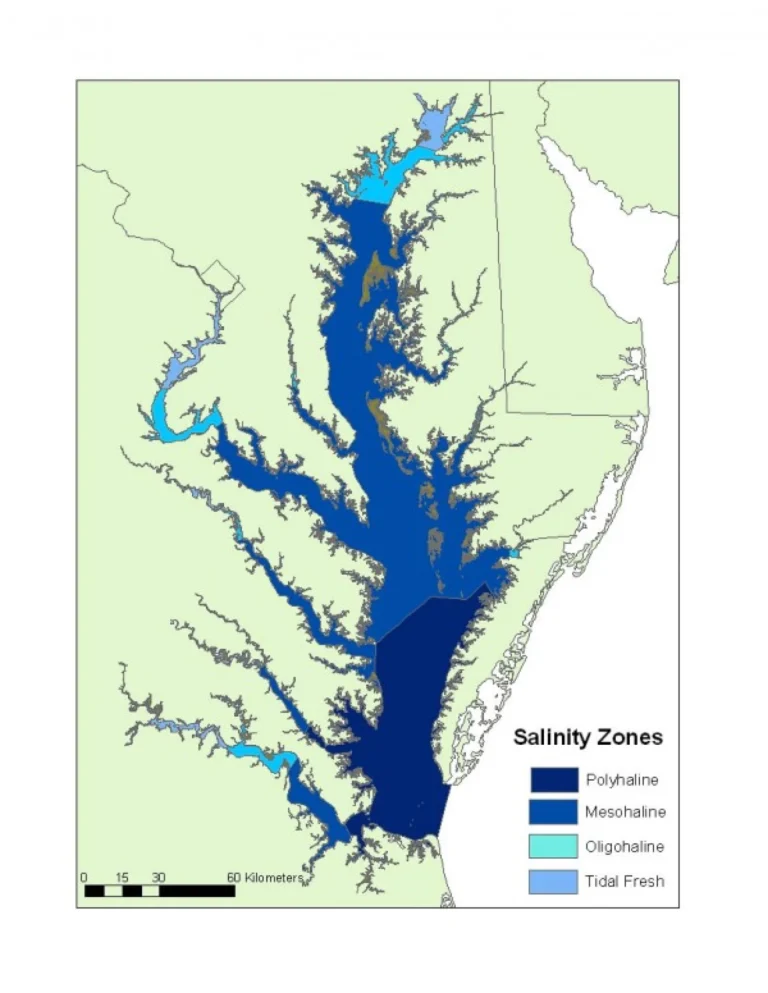
“What this says is that these juvenile crabs are using the mid-salinity zone as a very important refuge habitat from fish predation in the lower bay,” Hines said.

An image shows the equipment used to tether juvenile blue crabs for the study, including an attached harness, tether line, metal spike to be inserted into bottom sediment and marker float. (Photo by Smithsonian Environmental Research Center) The Smithsonian researchers ran an initial experiment by attaching a fishing leader with a small harness to the back of a crab and staking it out in the water to see how long the crab survives.
The tethering technique turned out to be successful, Hines said. Based on lab experiments, researchers could tell which critters were eating the crabs by the marks left on the tether.
More than half of the tethered crabs over the 37-year period survived and were released back into the bay. Of those that were eaten, adult crabs were always the culprit and the smallest crabs usually the victim.
“We expected that we would see a mix of fish and cannibalistic blue crabs as the sources of mortality for these crabs,” Hines said. “We were surprised that we found no instances of fish predation.”
That’s a stark difference from saltier parts of the bay, such as Hampton Roads, where blue crabs are often consumed by fish such as red drum and striped bass.
In the Rhode River study, baby crabs fared much better in shallower waters. That indicates those areas are a refuge from adult crabs, within the larger mid-salinity zone that protects them from other predators.
Hines said the information can help conservationists and fishery managers understand which spots to prioritize as critical habitat.
The bay ecosystem is changing quickly, such as from shifting climate conditions.
During the wintertime, blue crabs burrow into sediment and wait for temperatures to rise, which prolongs their life cycle compared to natives of the warmer Gulf Coast, for instance, Hines said.
Warmer waters with shorter winters could be changing the species’ population dynamics.

A map shows the distribution of salinity, or saltiness, in the Chesapeake Bay. Darker colors, such as in Hampton Roads, are areas with higher salinity. The Smithsonian study site in Maryland is in the mid-salinity zone, just east of Washington, D.C. (Map courtesy William & Mary Center For Conservation Biology) Invasive blue catfish are another threat – especially as they spread to mid-salinity and freshwater areas of the bay.
Protecting shallow water habitat for baby crabs will also mean changing how we manage shorelines, Hines said.
Communities facing sea level rise and erosion often reinforce shorelines with rip rap or seawalls, which shrink the marine habitat. Living shorelines, which mimic natural ecosystems to protect the shore, are a good alternative when possible.
The new research comes as scientists are working on updating the way officials estimate the health and population of blue crabs in the bay.
Population numbers are highly variable because of weather conditions and the creatures’ short life cycle, Hines said.
But they appear to be on the decline. The Virginia Institute of Marine Science’s annual winter dredge survey last year counted the second-lowest number of crabs since it began in 1990.
The Smithsonian center will continue its annual tethering research. But Hines said it was a good time to publish their findings so far.
“With these data, it’s a remarkably clear story.”
Virginia contract bill draws scrutiny over set-asides
By Shirleen Guerra | The Center Square
A Virginia bill that would expand how the state awards contracts is drawing attention as it heads to first-term Democratic Gov. Abigail Spanberger for a decision.
House Bill 61 sets a statewide goal for agencies to direct 42% of certain discretionary spending to certified Small, Women-owned and Minority-owned, or SWaM, businesses, according to bill language and a fiscal impact statement from the Department of Planning and Budget.
It also changes how smaller contracts are handled. Purchases between $10,000 and $200,000 would be set aside for certified SWaM businesses, while those under $10,000 would be reserved for microbusinesses.
The bill goes further for construction work. On capital outlay projects, contractors that are not SWaM-certified would be expected to subcontract 50% of the work to certified businesses.
The proposal has picked up attention online, with some posts claiming it would prioritize contracts based on race or gender.
The bill itself does not bar any group from bidding. Instead, it sets participation goals and steers certain types of spending toward businesses that qualify for SWaM certification, which is based on ownership and size requirements under state rules.
If adopted, the measure would require agencies to steadily increase their SWaM utilization rates. It also establishes a procurement enhancement function within the Department of Small Business and Supplier Diversity to help oversee the changes.
The bill would also result in new state costs. A fiscal impact statement projects new state costs starting in fiscal year 2027, including about $325,000 from the general fund and more than $1 million in non-general funds for system updates, staffing and reporting. The bill also calls for a disparity study, estimated at up to $1 million every five years, to evaluate participation gaps among eligible businesses.
There are guardrails in place. Bids from certified businesses cannot exceed competing offers by more than 5%, and the legislation states that public bodies may not discriminate against bidders based on race, sex or other protected characteristics under state law.
The Center Square was unsuccessful prior to publication getting comment from the bill’s patron.
Derrick Max, president of the Thomas Jefferson Institute for Public Policy, said the approach could shift how contracts are awarded and questioned whether it delivers results.
“Set asides substitute political allocation for market allocation, resulting in increased costs and often lower quality,” Max said.
He added that such policies can “often hurt true struggling minority businesses,” arguing that firms that are better positioned or more familiar with the system may be more likely to qualify.
Max also raised concerns about how certification works in practice, saying some businesses may “find ways to qualify, despite the fact that they are not truly qualified.”
He questioned whether the programs address underlying barriers to success, saying they are often tied to claims about disparities in opportunity.
The bill is now with the governor. She can sign it, veto it or recommend changes. If no action is taken by the deadline, it would become law without her signature.
Virginia session moves bills but shows divide
By Shirleen Guerra | The Center Square
More than half of the roughly 2,400 bills introduced during Virginia’s 2026 General Assembly session did not pass, even as lawmakers moved hundreds of others forward.
Data from the Virginia Public Access Project shows lawmakers passed about 47% of the bills they introduced in the House of Delegates. Democratic delegates passed about 55% of their bills, while Republican delegates passed about 22%, highlighting how legislation moved through a chamber with majority of Democrats.
A similar pattern played out in the state Senate. Senators passed about 53% of the bills they introduced overall. Democratic senators passed about 64% of their bills, compared with about 35% for Republican senators.
Together, the numbers show a consistent gap between the parties in both chambers as legislation moved through the process.
Voting patterns also showed differences in how lawmakers aligned on close votes. In the House, Democrats voted together about 81% of the time in closely contested votes, compared with about 70% for Republicans, according to VPAP. In the Senate, Democrats showed higher voting unity, at about 92%, while Republicans were closer to about 62%.
Lawmakers approved a range of high-profile proposals during the session, including a measure to gradually raise the state’s minimum wage to $15 per hour by 2028 and legislation establishing a right to obtain contraception.
Other proposals stalled earlier in the process. A bill that would have changed the state income tax standard deduction did not advance out of committee, while a proposal dealing with felony prosecution timelines was carried over to the 2027 session.
Many proposals never made it to a full vote. In Virginia’s legislative process, bills must clear committee before reaching the floor, and a large share are defeated or left in committee each year. That step often determines which proposals advance and which do not, regardless of party control.
Lawmakers also ended the session without finalizing a state budget, which will require a special session.
Virginia roads rank No. 1, congestion lags
By Shirleen Guerra | The Center Square
Virginia has the top-ranked highway system in the country, but that doesn’t mean drivers are getting an easy ride.
A new report from the Reason Foundation finds the state delivers strong road conditions while spending less than comparable states, even as congestion and some safety issues continue to frustrate commuters across the commonwealth.
Virginia moved from fourth to first overall in this year’s Annual Highway Report, driven by improvements in pavement conditions, safety and spending efficiency.
Compared to the previous year, the state improved in urban interstate pavement, urban arterial pavement and urban fatality rate, where it climbed 17 spots. It also improved its rankings in maintenance, administrative and other spending categories.
The report’s lead author, Baruch Feigenbaum, told The Center Square those gains helped push Virginia to the top.
“Compared to the previous report, Virginia improved in three road and safety categories and also improved its rankings in three spending categories,” he said.
The report evaluates states across 13 categories, including pavement quality, traffic fatalities, congestion, bridge conditions and spending. Spending accounts for about 31% of the total score.
That cost-effectiveness is a major factor behind Virginia’s ranking.
“The state spends less than comparable states while delivering things like good pavement conditions and relatively low percentages of structurally deficient bridges,” Feigenbaum told The Center Square.
But the report also highlights a gap between overall performance and what drivers experience day to day.
Virginia ranks 38th in urban traffic congestion, with drivers spending about 33 hours a year stuck in delays. Congestion affects multiple regions, not just Northern Virginia.
“Traffic jams aren’t just a problem in Northern Virginia but also in Richmond, Hampton Roads and many communities along I-81,” Feigenbaum said, adding that residents “should not be satisfied” with the state’s approach to congestion.
He said the state could improve by directing more funding to high-traffic corridors where congestion can be reduced.
The report also points to uneven safety outcomes.
Virginia ranks sixth in urban fatality rates but 29th in rural fatality rates, suggesting higher risks on less populated roadways.
“Given Virginia’s geography, the traffic fatality and safety metrics are acceptable, but the rural fatality rate could really be improved,” Feigenbaum told The Center Square.
Even with the top overall ranking, the report emphasizes that Virginia is not leading in every category.
The state does not rank in the bottom 10 in any major category, which helps boost its overall score. At the same time, it lacks many top-ranked finishes, reflecting a system that performs consistently well but still has room to improve.
“Just because the state ranks first overall doesn’t mean there isn’t plenty of room for improvement,” Feigenbaum said.
The report also credits Virginia’s use of public-private partnerships with helping control costs, including major highway projects that came in below initial estimates.
The Center Square was unsuccessful prior to publication getting comment from the Virginia Department of Transportation.
For drivers, the takeaway is mixed.
While Virginia’s highway system ranks among the most efficient in the country, congestion and rural safety still shape what drivers deal with every day.
Virginia lawmakers cast solo votes on key bills
By Shirleen Guerra | The Center Square
Several Virginia lawmakers voted alone against the rest of their chamber multiple times during the 2026 General Assembly session, opposing bills tied to energy policy, artificial intelligence, government transparency and state regulation.
Data from the Virginia Public Access Project identified a group of lawmakers who cast at least two solo votes on floor legislation this session, a category VPAP refers to as its “Contrarian Caucus.” The designation excludes procedural votes and focuses on final floor decisions where one lawmaker voted differently from all other members present.
Among them was Del. Eric Zehr, a Republican who voted against multiple measures that ultimately passed.
Zehr opposed House Bill 323, which directs the Department of Energy to study the reuse of waste heat from data centers. He also voted against House Bill 346, which deals with Freedom of Information Act provisions related to public utility account numbers, and House Bill 218, a measure tied to casino permitting.
Additional votes included House Bill 395, related to solar and local regulation.
Other lawmakers from both parties also cast solo votes on a range of policy issues.
Sen. Danica Roem, a Democrat, voted against House Bill 1186, which addresses the use of artificial intelligence in student instruction.
Roem told The Center Square her vote was tied to broader concerns about how artificial intelligence is being used and how it connects to increased data center development in parts of Virginia.
“In western Prince William County, the proliferation of data center sprawl can be linked back to the force-feeding of artificial intelligence on the public,” Roem said, adding that the technology is often used to support industry demand rather than public need.
She said she opposed expanding the use of artificial intelligence in classrooms, arguing it reinforces a cycle that drives further data center growth tied to those technologies.
Roem also pointed to her broader voting record, noting she frequently votes against legislation that expands exemptions to the state’s Freedom of Information Act.
“FOIA now has more than 150 exemptions to it, which works to the detriment of the public and their ability to hold their government accountable,” Roem said. “As a news reporter-turned-legislator, I know FOIA is the single most important public integrity tool of the citizenry beyond the ballot box, and legislators need to stop treating it like a giant block of Swiss cheese.”
Sen. Dave Suetterlein, a Republican, opposed House Bill 1491, a bill related to electric utility transmission line construction.
Sen. Bryce Reeves, a Republican, voted against Senate Bill 332, which allows the administration of medical marijuana for terminally ill patients.
The votes involved policies that affect residents and taxpayers, including energy infrastructure, public records access and how artificial intelligence is introduced in schools.
While solo votes are relatively uncommon, the data shows they occurred across both parties during the session, reflecting individual lawmakers’ decisions on specific pieces of legislation rather than broader caucus-level divisions.
The Center Square was unsuccessful prior to publication getting comment from other lawmakers.
Retail marijuana moves closer to reality in Virginia

File photo of marijuana leaves and cigarettes. By Shirleen Guerra | The Center Square
Retail marijuana sales are one step closer to becoming a reality in Virginia after lawmakers approved a plan to create a state-regulated market, sending the proposal to the governor for a final decision.
The final version passed both chambers through a conference report, with the Senate voting 21–18 and the House 64–32 largely along party lines.
A 6% state cannabis tax would apply on top of the existing sales tax, and local governments could add an additional tax of between 1% and 3.5%.
State fiscal analysts project the market could generate about $10 million in its first year, growing to more than $100 million annually within several years, depending on how quickly the system is implemented and how many businesses enter the market.
House Bill 642 and Senate Bill 542 lay out how marijuana would be grown, processed, transported and sold across the commonwealth.
Rather than opening the market broadly, the plan limits how many businesses can operate and gives the state a central role in deciding who gets a license. If more people apply than there are available spots, the state could use a lottery or tiered selection process depending on demand and eligibility requirements.
The proposal also requires marijuana to be tracked from production to sale and sets rules for how it moves through the system. Deliveries would have to follow strict security and tracking requirements, and violations could lead to licenses being suspended or revoked.
Before products reach store shelves, they would need to be tested for contaminants like pesticides and heavy metals and approved by regulators. Packaging must be child-resistant and cannot be designed in a way that appeals to minors.
Sales would be limited to adults 21 and older, with restrictions on how products are sold, including bans on vending machines and certain delivery locations. The proposal would also increase the legal possession limit for adults from one ounce to 2.5 ounces.
In a statement, Sen. Lashrecse Aird’s office told The Center Square that revenue and implementation will depend on factors such as how quickly the market launches, how many businesses participate and overall demand, adding that parts of the rollout are still being developed.
A fiscal impact statement from the Virginia Criminal Sentencing Commission said the full cost of enforcement and incarceration tied to the legislation cannot be determined. Under state requirements, the proposal is assigned a minimum fiscal impact of $50,000, though that figure is a placeholder because the full cost is unknown.
Most Democrats supported the measure, while Republicans largely opposed it.
The bill also includes a Cannabis Equity Business Loan Fund aimed at helping certain businesses enter the market, particularly those who may face barriers to entry.
Even if signed, the changes will not happen immediately. State agencies would need time to build out the regulatory system, issue licenses and establish oversight before retail sales begin.
The projection is 2027.
The governor can sign, amend or veto the legislation.
Opinion: Spanberger’s moment of decision on the 2nd Amendment
John Commerford | National Rifle Association Institute for Legislative Action
Abigail Spanberger has been governor of Virginia for only a few months, yet she already faces a political crossroads. The 75th governor of Virginia campaigned on a promise to govern as a moderate, one who would work with both political parties and be tough on crime. She was a law enforcement agent after all, and a CIA operative. She’s all in on America’s security.
On her own website she pledged to, “…focus on bringing Virginians together, lowering costs for Virginia families, keeping our communities safe,” among other promises.
So far, Gov. Spanberger’s actions haven’t meshed with her campaign rhetoric. She is enthusiastically embracing a far-left activist agenda of the Democrat Party. One must ask if this is a smart political strategy for Spanberger as her continued drift to the left could damage her national political aspirations, just as it has for other Democrats who ran moderate but governed progressive.
For the present, Spanberger is signaling that she will support new gun control measures, which we have long argued will do little, if anything, to reduce violent crime. Instead, they’ll make it harder for law-abiding gun owners to protect themselves and their families.
Some of the worst anti-gun bills on the governor’s desk include Senate Bill 749 which bans the most common semi-automatic firearms in Virginia and arbitrarily limits magazine capacities. Senate Bill 727 outlaws carrying and transporting many types of firearms on public property. This includes many semi-automatic rifles and pistols.
Senate Bill 27 & House Bill 21 targets the firearms industry by imposing vague, subjective standards of “responsible conduct” for manufacturers and opens the door to lawsuits and regulations that are clearly designed to drive the firearms industry out of Virginia. This legislation is not only focused on firearm manufacturers, it even includes your local gun shop. House Bill 40 would end the centuries old practice of individuals building firearms for personal use without government interference.
And while the fate of these bills that will limit Virginians’ ability to defend themselves still hangs in the balance, Gov. Spanberger has made other moves that make the Commonwealth less safe.
Immediately upon taking office, she rescinded Republican Gov. Glenn Youngkin’s order allowing Virginia’s law officers to support federal immigration enforcement. Gov. Spanberger called lawful immigration enforcement “…fear-based policing, enforcement theater,” and actions that create,”…barriers to people seeking assistance in their time of need.”
And when an illegal immigrant and serial criminal, Abdul Jalloh, stabbed 41-year-old Stephanie Minter to death at a Northern Virginia bus stop, Spanberger’s office and Fairfax DA Steve Descano refused to turn him over to immigration authorities. Instead, Spanberger set a new standard for ICE interactions with Virginia law enforcement, telling them to get a judicial warrant, knowing full well that such a step was unnecessary, unprecedented, and unlikely to succeed. She did this despite Jalloh’s thirty prior arrests, including for violent crimes like assault and malicious wounding.
Is this the moderate, former law enforcement governance she talked about on the campaign trail?
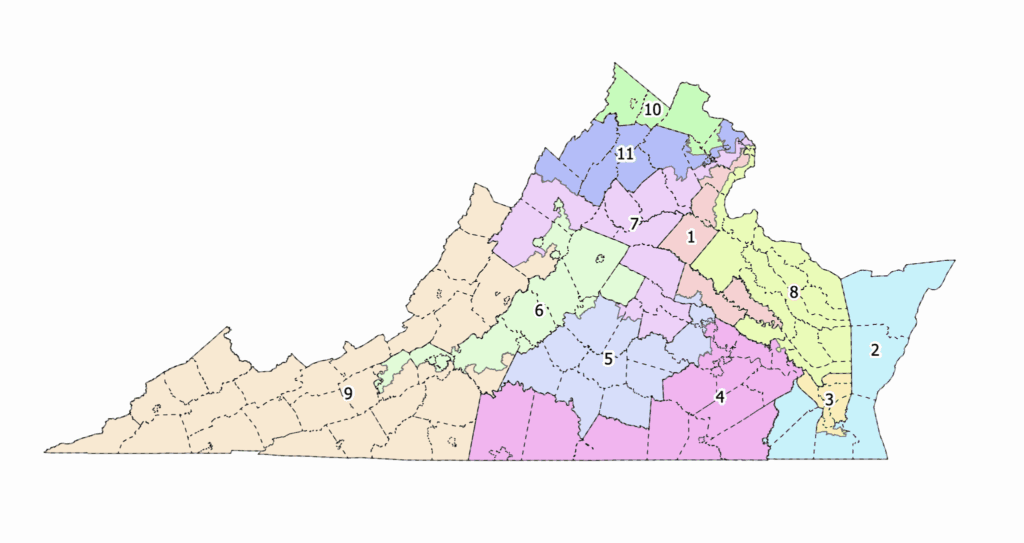
Virginians should also be dismayed by her quick reversal on gerrymandering. Though she had spoken forcefully against it as far back as 2024, she changed her tune quickly when Virginia Democrats offered her the chance to revamp the Commonwealth’s electoral map from a 6 to 5 split to 10 Democrat and a single Republican district.
When Spanberger won in November, she was hailed as a party up and comer – a young, pragmatic former civil servant, with real law enforcement and security credentials who could appeal to independents. Her potential for even higher office was reinforced when the party chose her to deliver the Democrat response to President Trump’s State of the Union Address.
But potential is one thing, and a governing record is another.
Whether Gov. Spanberger will stay true to her professed centrist roots and sustain her long-term electability options or cave to the more partisan leanings of her colleagues in Richmond, is an open question. The answer to that question will begin to be revealed in the coming days as she weighs whether to sign off on the slew of anti-gun bills rammed through the legislature.
If the governor chooses to exercise her power and sign these unconstitutional infringements into law, The National Rifle Association and our team of constitutional appellate attorneys stand ready to meet her in both state and federal court.
John Commerford is executive director of National Rifle Association Institute for Legislative Action
Despite community opposition, Fluvanna supervisors approve gas plant permit

File photo of natural gas power station. By JPxG – File:Gateway Generating Station.jpg, CC BY-SA 4.0, https://commons.wikimedia.org/w/index.php?curid=106642563 By Shannon Heckt | Virginia Mercury
In a 4-1 vote, the Fluvanna County Board of Supervisors on Wednesday approved a conditional use permit for Nebraska-based company Tenaska to build its second natural gas plant in the community. Hundreds of members of the community voiced and wrote their opposition to the project over the multi-month process for the permit application, which concluded at a meeting that went into the early hours of the morning Thursday.
The project is dubbed the Expedition Generating Station and will be able to produce 1540 megawatts of power – enough to power 1.5 million homes. It will be located directly across the street from the existing plant that has been housed in Scottsville.
The plant will be housed on 50 acres of a 450-acre parcel. The company has also promised to place 350 acres of nearby land into a permanent conservation easement.
The board’s move is a reversal of the Fluvanna Planning Commission’s 3-1 vote that the project was not in accord with the comprehensive plan of the county. But some supervisors said that when they considered how much power can be generated at the plant — as well as millions of dollars in tax revenue — those factors pushed their decision to approve it.
“Is the proposed project in my opinion a perfect fit? No. But nothing really is when you’re trying to balance two things that seemingly conflict all the time,” Supervisor Mike Goad said. “For me when you consider the footprint of the proposed project when compared to others that I’ve seen – I tend to err on the side of substantial accord.”
Grassroots community advocacy group Fluvanna Horizons Alliance represents some of the strongest voices opposing the project. Members of the group said at Wednesday’s meeting their core concerns are potential health risks from the gas plant’s emissions and sound pollution disturbing homes near the planned plant.
“This is all much bigger than Tenaska and bigger than Fluvanna and I hope you keep this big picture in your hearts and minds when you cast your votes tonight,” Angus Murdoch with the Rivanna Conservation Alliance told the board during the hearing.
Over 1,300 people signed a petition against the gas plant urging supervisors to deny the permit.
“Tenaska seeks a special-use permit to construct a second gas plant adjacent to its existing methane power plant in Fluvanna,” the Action Network petition reads. “The new plant would more than double its environmental impact on our air, water, and health, and Fluvanna will bear the health and environmental costs, while Tenaska reaps the profits.”
The project still has to get approval from the State Corporation Commission, the Department of Environmental Quality, and other permits before construction can begin.
VDOT Seeks Public Input on Shenandoah Valley Rail With Trail Study

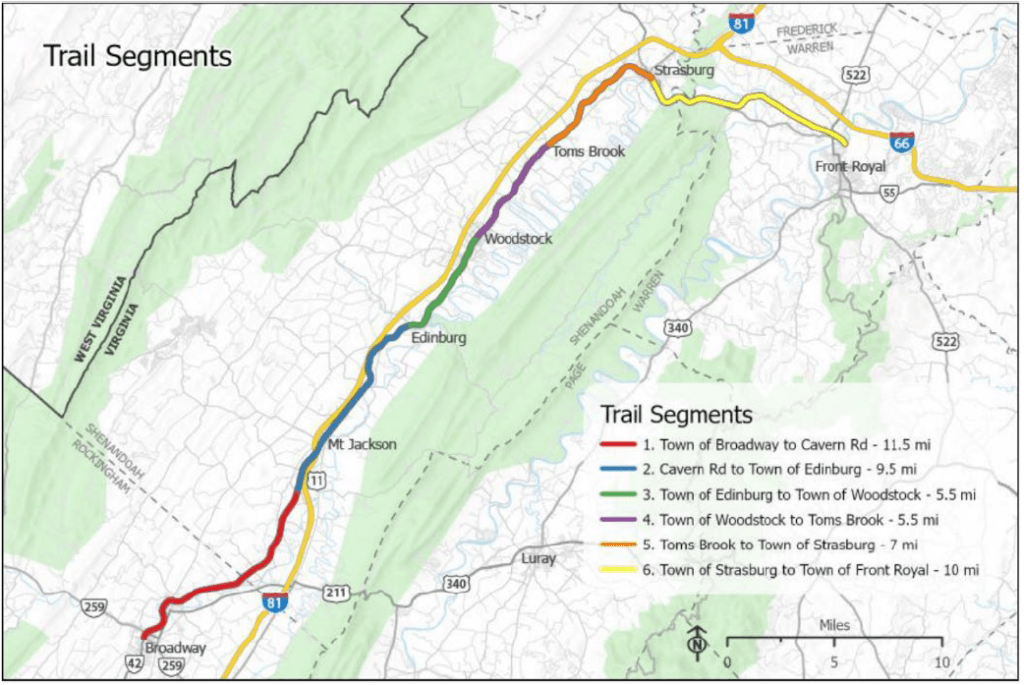
The study area covers the rail corridor and its immediate environs in the northern end of Rockingham County, Shenandoah County, and the central part of Warren County. Between Broadway and Front Royal, the inactive rail line passes through the towns of Broadway, Timberville, Mount Jackson, Edinburg, Woodstock, Toms Brook, Strasburg, and Front Royal. The study area is 49 miles in length. VDOT. STAUNTON – The Virginia Department of Transportation (VDOT) will hold three public engagement meetings to gather feedback on findings from Phases 2 and 3 of the Shenandoah Valley Rail with Trail Assessment.
The public meetings will take place at three locations along the 49-mile rail corridor being studied, with identical information provided at each event. The meetings will run from 5 p.m. to 7 p.m., beginning with a brief presentation followed by an open-house format with the study team available to answer questions about the information display boards.
Woodstock – Thursday, April 16, 5-7 p.m.
Peter Muhlenberg Middle School cafeteria
1251 Susan Ave., Woodstock, VA 22664
Front Royal – Thursday, April 23, 5-7 p.m.
Warren County Government Center, Board of Supervisors room
220 N Commerce Ave., Front Royal, VA 22630
Timberville – Tuesday, April 28, 5-7 p.m.
Plains District Community Center, large multi-purpose room
233 McCauley Ave., Timberville, VA 22853
Public feedback is critical in understanding the public’s perspective on estimated costs and overall considerations for ‘Rail with Trail’ and ‘Rail to Trail’ alternatives. Feedback can be provided in many ways including in-person at the meetings, through a brief online survey that will be released in early April, or by contacting VDOT directly. A court reporter will be present at the meetings for oral comments. Submitted feedback has equal value whether shared at a meeting or through the online survey.
The Shenandoah Rail with Trail Assessment is being conducted in three phases and will identify the most likely configuration and costs associated with rail asset/rail bridge restoration and constructing an adjacent trail on the Norfolk Southern-owned rail corridor between the Town of Broadway in Rockingham County and the Town of Front Royal in Warren County.
More information is available at VDOT.Virginia.gov/ShenandoahRailWithTrail.
The VDOT Customer Service Center operates 24/7 to help roadway users report potential hazards, make service requests or get information related to Virginia’s transportation network. Use its mobile friendly website or call 800-367-7623.
Find the VDOT Staunton District on Facebook and X and follow VDOT statewide social media accounts. News releases, travel tips and project updates are on the VDOT website.
The VDOT Staunton District serves Frederick, Shenandoah, Clarke, Warren, Page, Rockingham, Augusta, Highland, Rockbridge, Alleghany and Bath counties.
Information from a release. Posted by Dan McDermott.
Data center bills dominated this year’s General Assembly. Here’s what passed.
By Shannon Heckt | Virginia Mercury
The rapid growth of Virginia’s data center industry was a key point of focus during the 2026 legislative session, as lawmakers sought to balance the sector’s benefits — including over $80 billion in state investments and thousands of jobs — against its enormous electricity and water needs, which are a growing concern for communities statewide.
Legislators filed dozens of bills directly aimed at regulating the industry but only a handful passed, with some significant changes.
Distribution Costs
Senate Bill 253, by Sen. L. Louise Lucas, D-Portsmouth, caused a stir in the middle of the session. The bill extends Dominion Energy and Appalachian Power’s weatherization programs, which help low-income households save on their monthly bills by making their homes more weather proof.
The bill also allows the State Corporation Commission to decide if they will approve shifting more costs onto data centers and large manufacturing facilities for the electricity Dominion Energy generates and distributes to them.
The bill that now heads to the governor’s desk puts energy auction costs onto the data centers, with SCC approval. When Dominion needs more power on the grid beyond what they are producing, they may buy more power at an auction run by the regional grid operator PJM to help meet demand.
The financing costs for distribution lines and substations that mainly bring power to data centers could also be levied onto data centers and other companies in their rate class, with SCC approval.
Lucas advocated repeatedly during the session for data centers to “pay their fair share,” as residents’ energy costs climb. The Joint Legislative Audit and Review Commission found in their 2024 report that data centers are paying the appropriate cost of operating, but as power demand grows, driven by data centers, costs will continue to climb for everyone.
The average Dominion Energy residential customer “could experience generation- and transmission-related costs increasing by an estimated $14 to $37 monthly … by 2040 (independent of inflation),” the report found.
Water use
Sen. Kannan Srinivasan, D-Loudoun, set out to reveal how much water data centers are using from local utilities.
Data center operators are often able to shield their water usage needs from the public as industry secrets, which leaves communities in the dark about how much of their local water resources are being used.
SB 553 directs water utilities to report monthly or quarterly, within their ability without raising rates, an aggregate estimate of how much water is going to data centers. The measure cleared both chambers and is under consideration by Gov. Abigail Spanberger.
“You’ll be able to compare data centers versus industrial versus commercial,” Srinivasan said.
The senator explained that he lives in Loudoun County’s Data Center Alley, containing the world’s densest concentration of data centers, and he’s seen how the evolution of data center technology, including closed-loop hyperscale data centers that require less water.
“They have done a lot of innovation. This will clearly be the fair way to bring the data set out,” Srinivasan said.
Some water utilities have already begun reporting the data center usage separately but the legislation aims to get more operators on board to boost transparency for the public.
Siting
SB 94 and companion HB 153 require applicants asking localities to rezone for “high load users” like data centers that would use over 100 megawatts of power to submit a site assessment report.
This report will examine the project’s potential impact on agricultural resources, parks, historical sites, and forestland, and confirm alignment with the locality’s sound and zoning ordinances.
Sen. Danica Roem, D-Manassas, the Senate bill’s sponsor, said it’s the first step towards stronger regulations about where data centers can be located and how much of an impact on the surrounding communities should be permissible.
Roem acknowledged that the measure could have been more stringent, saying “we should strengthen this” on the chamber floor Friday. But the current version of the legislation is what could garner enough votes to pass, Roem said, calling it “ the bare minimum.”
Diesel generators
The data centers housed in the commonwealth host over 9,000 backup generators. Some of those generators run on diesel fuel and emit toxic emissions when they are running. There are already limitations on when the generators are allowed to run, which is regulated by the Department of Environmental Quality.
But residents living in neighborhoods close to data centers have flagged concerns about breathing in the diesel fumes from the Tier II generators, which are most commonly run during monthly testing and during power outages. There is a push to get the industry to switch to the more energy efficient and cleaner Tier IV generators.
House Bill 507, by Del. John McAuliff, D-Fauquier, mandates that the Department of Environmental Quality deny any air permit submitted for a data center generator after July 2026 unless they are equipped with a Tier IV generator or the environmental equivalent. The measure passed the legislature and is waiting for Spanberger’s signature, amendment or veto.
“I will note it’s probably not the final step toward making sure that we have the best possible tech out there and being used, and those generators are being used in the right way for our communities, but it is a very good first step,” McAuliff said in a Feb. 11 committee meeting.
Data center waste heat
The server equipment that fills data centers’ warehouse-style facilities generates a lot of heat. Millions of gallons of water are used to cool them but there is a growing interest in finding ways to use heat that would otherwise be wasted.
A university in Dublin exemplifies one solution, where the heat of an Amazon Web Services data center is piped into a number of buildings on campus, according to CNBC.
House Bill 323, by Del. Rip Sullivan, D-Fairfax, tasks the Department of Energy with accelerating efforts to use data centers’ waste heat here in the commonwealth. The department must make a workgroup to study how waste heat can be transferred between buildings that are already close by or plan to be built near data centers.
If the governor signs the bill, a report will be due to the General Assembly by September of this year to help shape future legislation to regulate the use of waste heat.
Taxes
The question of whether or not the state should continue allowing data centers to opt out of the 5.3% sales and use tax on their server equipment and software was a surprise debate this session that hampered budget negotiations and forced lawmakers to leave the Capitol without finalizing a budget.
Lucas, who led the Senate version of the budget proposal that axes the exemption, said it causes the state to lose out on about $1.6 billion annually.
The House version of the budget kept the exemption in place – albeit with some new environmental and energy requirements for data centers must meet in order to qualify for the exemption. House Speaker Don Scott, D-Portsmouth, House Appropriations Committee Chair Del. Luke Torian, D-Prince William, and Spanberger said keeping the exemption would honor existing business contracts with data centers and preserve the industry’s presence in the state.
“I don’t think it does anything to the industry. A lot of folks are saying they are going to be leaving and going to other places. I don’t believe that’s going to happen. I think they will continue to build in Virginia but I think they understand it will be a different playing field now,” Lucas said in February following the passage of the Senate budget.
The industry has hit back on the idea of cutting the exemption and said the provision paved the way for data centers’ billions of dollars in investments in Virginia. Industry leaders have also joined forces with the state’s largest electrical workers union, who build the data center facilities, to urge lawmakers to keep the incentive for the industry.
The issue does not fall on traditional party lines, with a bipartisan mix of lawmakers from various regions of the state voicing support and opposition to the proposal.
The pitch to remove the exemption threw a wrench into lawmakers’ budget negotiations. Spanberger has called a special session on April 23 for the legislature to cement the state’s spending plan.
Virginia launches online registration system for charitable organizations
Charitable organizations that solicit donations in Virginia can now file their required registration documents online through a new state platform.
The Virginia Department of Agriculture and Consumer Services launched the digital system, called Evoke, this month through its Office of Charitable and Regulatory Programs, which oversees charitable solicitations statewide.
Any organization that intends to solicit contributions in Virginia — or have funds solicited on its behalf — is required to register with the office unless exempt under state law. More than 13,000 charities, professional solicitors and fundraising counsels are currently registered in the Commonwealth. Previously, registration required paper filing and records could only be obtained by contacting VDACS directly.
With Evoke, organizations can file electronically and the public can search and access charity records through the online database — making it easier for donors to research an organization before contributing. The system is also expected to reduce processing times, help charities track their registration status and cut down on overpayments and incomplete applications.
“VDACS continues to modernize its technology and procedures to better serve residents of the Commonwealth,” said VDACS Commissioner Charles Green. “This online platform will be put to use across a range of VDACS programs in the future, making services more efficient and easier to use.”
Each charity will receive direct communication from the office about how to use Evoke before its next renewal date. For more information, visit vdacs.virginia.gov/food-charitable-solicitation.shtml.
Information from a release. Edited by Dan McDermott.
Front Royal Rotary Club marks 100 years with centennial gala
The Rotary Club of Front Royal is celebrating a century of community service with a Centennial Gala Fundraiser on Saturday, April 18 at 6 p.m. at Shenandoah Valley Golf Club, 134 Golf Club Circle, Front Royal.
The evening will include dinner, a centennial toast and live swing music. Guests are invited to dress in formal or cocktail attire inspired by any decade from the 1920s to today.
Founded in 1926, the club has contributed more than $1.5 million to local initiatives over the years through volunteer service, scholarships and charitable projects. Rotary International has more than 1.2 million members worldwide.
“This milestone is about celebrating the people who have served our community for the past century and investing in the work still ahead,” said Elizabeth Lewis, club president. “Rotary has always been about neighbors helping neighbors, and we’re proud to continue that tradition in Front Royal.”
Tickets and sponsorship opportunities are available at givebutter.com/FRRotary100. Proceeds support ongoing Rotary projects and local charitable programs.
For more information, visit frontroyalrotary.org or email [email protected].
Information from a release. Edited by Dan McDermott.
Warren County Unplugs for Mental Health
FRONT ROYAL, VA— To help raise awareness of the dangers of excessive social media use, Warren Coalition created “Warren County Unplugged,” a community effort to encourage individuals of all ages to get off of their phones (or at least social media) for a day (or so). This 24-hour event is held in conjunction with the Global Day of Unplugging the first weekend in March, which was March 6-7 this year. During Warren County Unplugged, people of all ages are encouraged to sign up to unplug and were entered into a prize drawing for doing so. The first year, a total of 55 people signed up; the following year, that number was 108. This year, 132 signed up.
“We coordinate events all over the County, and the point of those events is to make it easier for folks stay off of their phones,” said organizer Celeste Brooks, Deputy Director of the Warren Coalition. “Our ultimate goal is to raise awareness about how social media impacts mental health, especially for our youth, and to get people to make a plan to stay off of their phones, or at least off of social media, for a little while.”
Since 2012, smartphone use by teens has increased, and anxiety, depression, and loneliness have skyrocketed. Social media companies deliberately designed their algorithms to be addictive, which could potentially prime the teen brain for substance use disorders (addiction) later in life. In fact, studies have already shown that teens who regularly use social media are more likely to buy cigarettes, drink alcohol, and/or use marijuana.
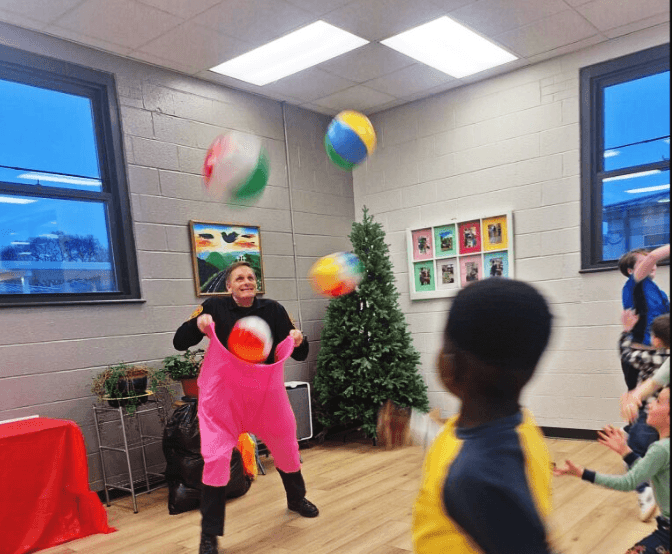
As part of this year’s Warren County Unplugged activities, children of all grade levels (and parents as well) enjoyed a variety of activities at Friday night’s Youth Unplugged Party, hosted by the Coalition, Warren County Parks & Recreation, Warren County Young Life, and Scouting America. Those activities included tossing beach balls into “granny pants” worn by Dave Goss and Ed Daley, The Quiet Game, arts and crafts, archery, bingo, 9-square in the air, Volley Bound, basketball, and an inflatable gaga pit.
“Warren Coalition hosted the elementary school student activities, and it was heart-warming to see the families enjoying time together without a phone in sight,” said Brooks.
Additional Friday evening activities included karaoke hosted by Reaching Out Now at Santmyers Student Union, a Scottish Cèilidh at Samuels Public Library, and a Hyper Party at the Royal Family Bowling Center. Brooks estimated that there were well over 350 people at the various events held on Friday evening.
Saturday brought a push of attention to local retail stores and the downtown area, with kid-friendly stores like Play Favorites and Main Street Geek offering discounts and free activities. Habitat for Humanity of Warren County hosted Backyard Games at the Gazebo with an inflatable obstacle course and entertainment by the talented students from the School of Rock in Haymarket. On Cue Sports Bar hosted a casino-style fundraiser, and Ruby Yoga offered a discount on several classes throughout the day.
Altogether, 37 businesses and organizations came together to provide some sort of phone-free experience for the Warren County community. An additional 15 restaurants allowed the Coalition to place “table tents” of information on their tables in the weeks leading up to the event, helping to promote awareness of the risks of excessive social media use and awareness of Warren County Unplugged.
“We are deeply thankful that so many organizations recognize the importance of this event and the issue it addresses,” said Brooks. “This day helps us all become a little more aware of what the concerns are, for both ourselves and our kids.”
Those who signed up online are eligible for an upcoming prize drawing. A survey has been sent out to them, and those who complete it will receive an extra two entries into the drawing, which will be held on March 20th.
Warren Coalition is a nonprofit agency established in 1994 to help fill the gaps in health care and substance abuse awareness to the community. The Coalition began under the guidance of Warren Memorial Hospital as an outreach project, but it has since grown and was incorporated in 2001. The office is currently located in the Warren County Community Center. Their mission is to make Warren County a safe, healthy, and drug free community through many programs and in collaboration with 15+ member agencies.
Information from a release. Posted by Dan McDermott.

Wearing “granny” pants, Dave Goss of the Warren County Sheriff’s Office tries to catch the balls the students are tossing at him. 
A team in the Youth Unplugged Party’s “volley bound” tournament celebrates a point scored. 
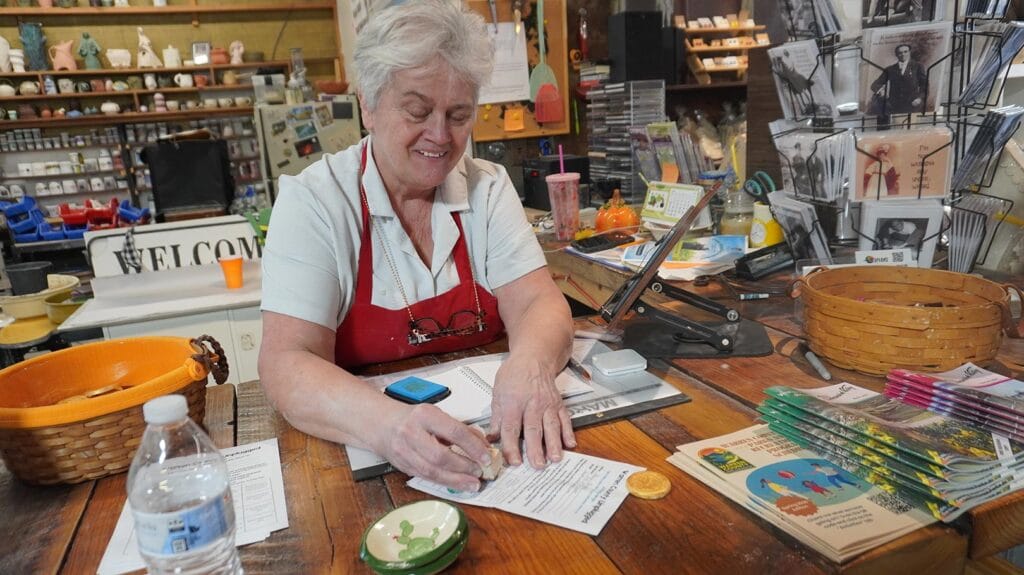
Arline Link of Explore Art & Clay stamps a “bingo” card that listed Warren County Unplugged events and participating stores. Individuals who visited six or more locations were entered into a prize drawing. Valley Health Foundation Donates Medication Take Back Box for Year-Round Use

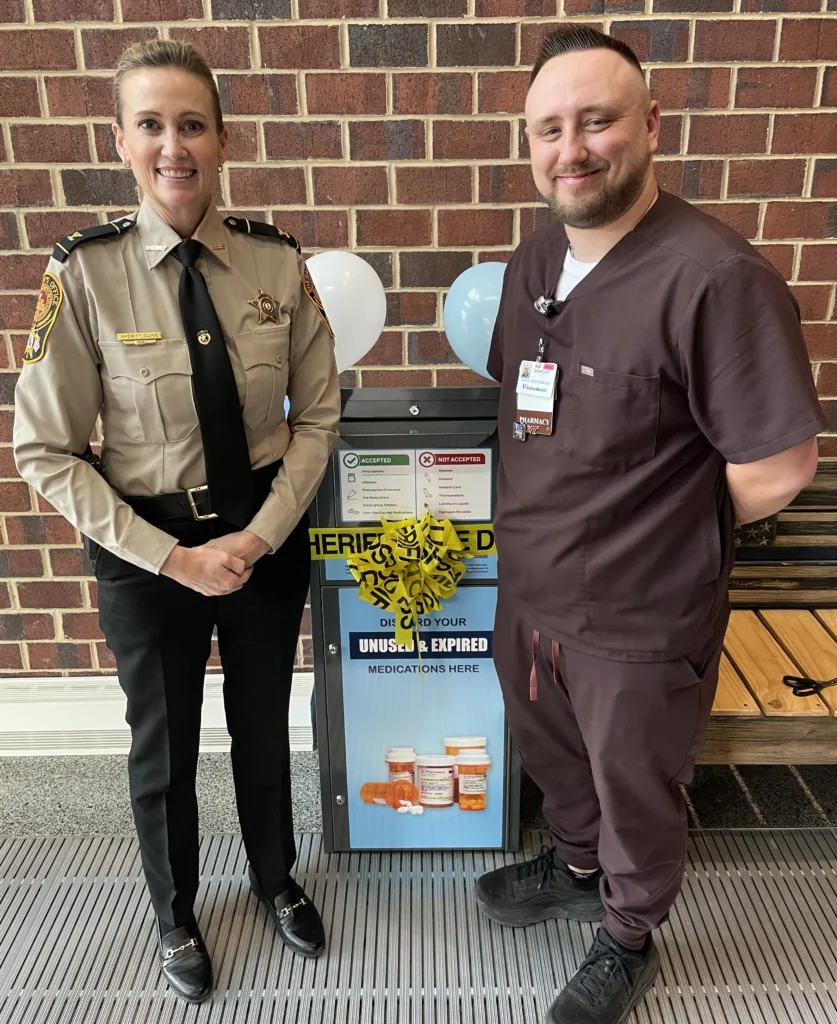
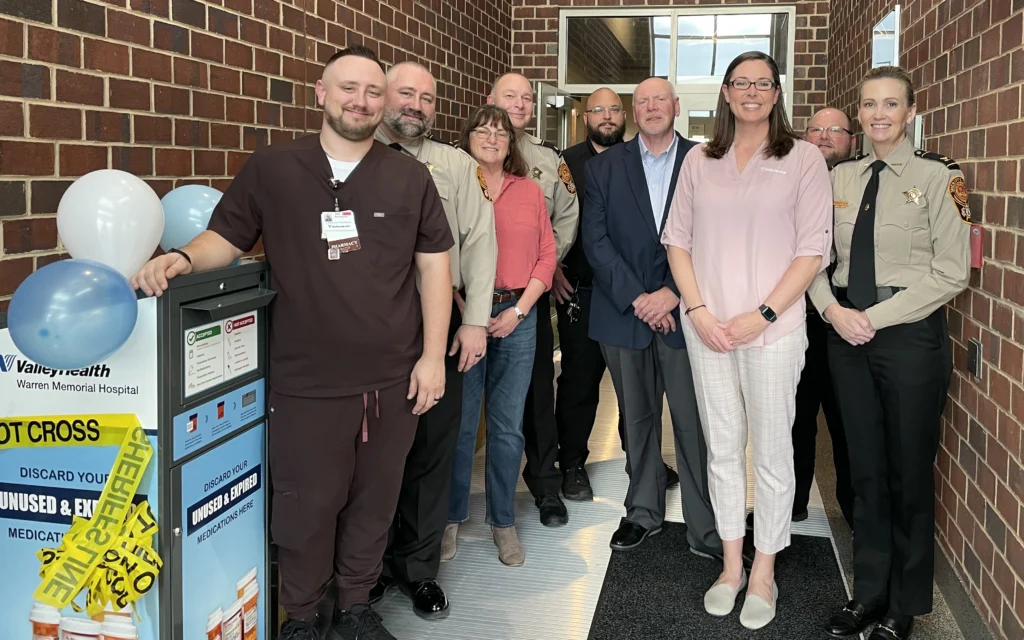
Warren County Sheriff Crystal Cline and Valley Health pharmacist Brandon pose next to a Take Back Box at the Sheriff’s Office. The Warren Memorial Hospital Foundation is partnering with the Warren County Sheriff’s Office by donating a Medication Take Back Box to provide the community with a safe place to dispose of any expired, unused, or no-longer-needed prescriptions or over-the-counter medications.
The Medication Take Back Box will be located at the Warren County Sheriff’s Office, 200 Skyline Vista Drive, Front Royal, just inside the front entrance.
While most boxes are temporary, this take back box will be available 24 hours a day, year-round, filling an ongoing need in the Warren County community for safe medication disposal.
Accepted items include prescription and over-the-counter tablets and capsules (including controlled substances). Residents may also dispose of prescription patches, as well as expired or unwanted pet medications. Community members are encouraged to remove or black out any patient-identifying information on prescription labels before dropping off medications.
Liquids, lotions, syringes or other sharps, inhalers, and aerosol products are not permitted in the box. Any accepted items must be placed in accordance with the posted instructions on the collection unit.
“We are excited to collaborate with the Warren County Sheriff’s Office to offer residents the option to safely dispose of their medications at any time,” says Emily Burner, Senior Director of Development for Valley Health Foundations. “We remain committed to helping keep our community safe and healthy.”
Sheriff Crystal M. Cline said, “This medication take back box is an important public safety resource for Warren County. Too often, unused or expired medications remain in homes where they can be misused, stolen, or accidentally accessed by children and others. By providing a secure, year-round disposal location, we are helping reduce opportunities for prescription drug abuse, protecting families, and giving our community a safe and responsible way to remove these medications from circulation.”
About Valley Health
Valley Health is a nationally recognized not-for-profit health system serving a population of more than 500,000 in the Northern Shenandoah Valley of Virginia and the Eastern Panhandle of West Virginia. As a healthcare provider, employer, and community partner, Valley Health is committed to improving the health of the region. The system includes six hospitals, more than 75 medical practices and Urgent Care centers, outpatient rehabilitation, medical transport, long-term care, and home health. www.valleyhealthlink.com.
Information from a release. Posted by Dan McDermott.

A Take Back Box is set up at the Warren County Sheriff’s Office by Valley Health staff and the Warren Memorial Hospital Foundation. Well Testing Clinics Offered Across Shenandoah Valley
By Amanda Johnson
Virginia Cooperative Extension Family and Consumer Sciences AgentThousands of households across the Northern Shenandoah Valley rely on private wells for drinking water, yet many homeowners have never tested their water for contaminants. Because private wells are not regulated like public water systems, homeowners are responsible for monitoring their water quality and maintaining their well system.
To help residents better understand and protect their drinking water, Virginia Cooperative Extension’s Virginia Household Water Quality Program is offering a series of well water testing clinics across the Northern Shenandoah Valley this spring. Residents can choose from five clinic locations in Page, Frederick, Shenandoah, Warren, and Clarke counties.
These clinics provide an affordable and convenient opportunity for homeowners to test their water and learn how to protect their private water systems.
Why Well Water Testing Matters
Water from a private well may look, smell, and taste normal but still contain contaminants that can only be detected through laboratory testing. Groundwater moves slowly through layers of soil and rock, which means contaminants from surface activities—such as agriculture, septic systems, or runoff—can eventually reach wells.
Testing can identify potential concerns including:
• Bacteria, including E. coli
• Nitrate, which may come from fertilizers or septic systems
• Metals, such as iron, manganese, copper, or lead
• Hardness, which can cause mineral buildup in plumbing and appliances
• pH and other indicators that affect corrosion and water treatment systems
Testing helps identify both potential health concerns and common household water problems, such as staining, odors, corrosion, or scale buildup.
Experts recommend that private well owners test their water at least once a year for bacteria and nitrate and conduct more comprehensive testing every three to five years.
How the Program Works
Participants collect their own water sample using a testing kit provided by Virginia Cooperative Extension. Samples are analyzed in a certified laboratory for 28 water quality parameters.
The cost is $70 per sample.
Participants will receive:
• A confidential report explaining their water test results
• Educational materials on well maintenance and water quality
• Guidance on possible treatment options if concerns are identified
• Access to a results interpretation meeting or recorded presentation explaining the findings
All individual water test results are kept strictly confidential.
Regular testing is the only way to know what’s in your well water,” said Amanda Johnson, Family and Consumer Sciences Agent with Virginia Cooperative Extension serving the Northern Shenandoah Valley. “These clinics help homeowners understand their results and learn practical steps they can take to maintain a safe and reliable water supply.”
Clinic Dates Across the Region
Residents may choose the clinic location that best fits their schedule.
Shenandoah, Warren, and Clarke Counties
• Kick-Off Meeting (Virtual or In-Person): April 27, 6:30 PM
• Sample Kit Pick-Up: April 27, 3:00–6:00 PM
• Sample Drop-Off: April 29, 7:00–10:00 AM
• Results Meetings: June 8 or June 9
Page and Frederick Counties
• Kick-Off Meeting (Virtual or In-Person): May 11, 6:30 PM
• Sample Kit Pick-Up: May 11, 3:00–6:00 PM
• Sample Drop-Off: May 13, 7:00–10:00 AM
• Results Meeting: June 23
Registration deadlines vary by location and space is limited.
To view the full schedule and register for the clinic that works best for you, visit:
https://warren.ext.vt.edu/news/NSV-Water-Clinics.html
Protect Your Household Water
More than one million Virginians rely on private wells for their drinking water. Regular testing helps homeowners detect potential problems early and make informed decisions about water treatment and system maintenance.
For additional information about private wells and water system care, visit the Virginia Household Water Quality Program website at:
For questions about the clinics, residents may contact their local Virginia Cooperative Extension office or Amanda Johnson at [email protected]
Mark Warner Officially Files for Re-election to the U.S. Senate

Campaign file photo of Sen. Mark Warner RICHMOND — After officially kicking off his campaign for re-election and holding five days of public events with voters across the Commonwealth, U.S. Senator Mark Warner today filed the paperwork and petitions required to secure a place on the ballot for the 2026 U.S. Senate election.
“After five days on the road across the Commonwealth, I’ve heard the same message from Virginians everywhere: lower costs, get things done, and make sure our economy is ready for the changes ahead,” said Warner. “My focus has always been on delivering real results for Virginia – lowering costs, creating good-paying jobs, and making sure our workers and businesses are ready to lead as technologies like artificial intelligence transform the economy. That’s the work I’ve been focused on in the Senate, and it’s the work I’ll keep fighting to deliver.”
Under Virginia law, candidates for U.S. Senate must submit at least 10,000 signatures from qualified voters – including at least 400 from each congressional district – to the Virginia Department of Elections in Richmond. Warner today submitted 18,036 signatures from registered Virginia voters.
Information from a release. Posted by Dan McDermott.
Gun bill carveout for lawmakers dropped before session ended
Youth hunting file photo. By Shirleen Guerra | The Center Square
(The Center Square) – As Virginia lawmakers wrapped up work on firearm legislation before adjournment, they considered and ultimately rejected substitute language in House Bill 110 that Republicans said would give General Assembly members different treatment in a bill dealing with handguns left in unattended vehicles.
House Bill 110 would prohibit a person from leaving visible a handgun in an unattended motor vehicle and impose a civil penalty of up to $500 if signed into law. A conference report substitute included language Republicans objected to, but that language was not included in the final version approved by both chambers.
The Center Square was unsuccessful prior to publication getting comment from Laufer.
Sen. Richard Stuart, R-King George, said lawmakers should not vote for a bill that gives them “a special privilege over any other citizen.” Stuart said the General Assembly is a citizen legislature and “we are no better than anybody else.”
The final action on HB110 came as lawmakers wrapped up work on a broader package of firearm-related bills sent to first-term Democratic Gov. Abigail Spanberger.
Del. Wren Williams, R-Patrick, told The Center Square the package represents “the most sweeping restructuring of Virginia firearms law in the commonwealth’s history.”
Williams said the package includes measures on assault firearms and magazine bans, firearm industry civil liability, ghost gun serialization, a carry ban on public property, safe storage where minors or prohibited persons are present, and the domestic violence firearm removal process.
On Senate Bill 749, Williams said, “After July 1, you cannot buy, sell, or transfer a semiautomatic rifle or pistol with a detachable magazine and a single cosmetic feature, a pistol grip, a thumbhole stock, a threaded barrel. You cannot sell it to your neighbor. You cannot give it to your brother-in-law. Your son can inherit the rifle, but the magazines that feed it have no inheritance exception. They become contraband the moment they change hands. One generation from now, those magazines are gone.”
Williams also criticized Senate Bill 727, saying, “This bill strips the carry rights of concealed handgun permit holders in parks, on public sidewalks, and in public spaces, including streets and roads, across Virginia, for firearms that are already legally owned and legally carried. Your permit now means nothing.”
On House Bill 40, Williams said, “Building a firearm at home, something Virginians have done lawfully since before the founding, is now a Class 5 felony. Up to 10 years in prison. The same session where Democrats created an open season of lawsuits on the firearms manufacturing industry, they have also just criminalized building your own firearms.”
On Senate Bill 27 and House Bill 21, Williams said, “This bill creates a Virginia cause of action against firearms manufacturers and dealers that deliberately guts the federal liability protections Congress enacted in 2005. It is designed to do through litigation what the Legislature cannot do directly, bankrupt the firearms industry and drive them out of Virginia.”
He also criticized House Bill 871, saying, “If a minor or prohibited person lives in your home, your firearms must be locked at all times. The state will now dictate how you store your own property in your own home, and a violation is a criminal offense.”
Williams further argued the package would not have prevented the recent shooting at Old Dominion University.
“Not one of these bills would have stopped what happened at Old Dominion University,” he said. “Every law needed to stop him already existed. Every single one failed. All seven of these bills make criminals out of Virginians who follow the laws, the hunter, the collector, the mother who keeps a firearm in her home for protection. That is not public safety. That is political virtue signaling at the expense of the law-abiding.”
Spanberger can sign the bills, veto them or return them to the General Assembly with amendments.
Virginia firearm bills head to governor for decision

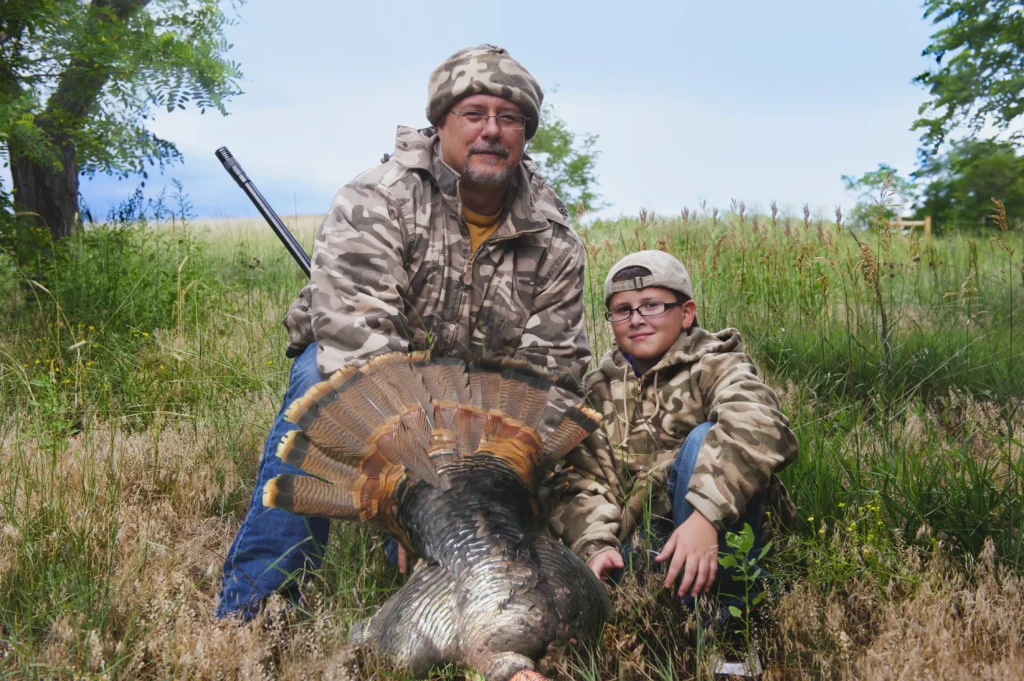
Father and son hunting file photo. By Shirleen Guerra | The Center Square
(The Center Square) – Several firearm-related bills passed by the Virginia General Assembly this session are awaiting action from first-term Democratic Gov. Abigail Spanberger.
The list includes measures addressing public carrying of certain firearms, liability standards for the firearm industry and restrictions on unserialized firearms.
Legislative records show several of the proposals have passed both chambers, been signed by the House speaker and Senate president, and enrolled before being sent to the governor for consideration.
One of the measures, Senate Bill 727, would prohibit carrying certain loaded firearms defined in the bill as “assault firearms” in public areas such as streets, roads, alleys, sidewalks and other public rights-of-way. Violations would be treated as a Class 1 misdemeanor.
Supporters say the proposal is intended to reduce the presence of certain firearms in crowded public places.
Another measure, Senate Bill 27 and its House companion, House Bill 21, would establish standards of responsible conduct for firearm industry members including manufacturers, distributors and retailers.
The legislation requires firearm industry members to establish reasonable controls designed to prevent unlawful firearm sales, straw purchasing and firearm trafficking. It also allows civil action by the attorney general or local governments against companies that fail to follow those standards.
Josh Horwitz, co-director of the Johns Hopkins Center for Gun Violence Solutions, said the legislation represents what supporters describe as a public safety approach to firearm policy.
“Virginia’s General Assembly has taken meaningful steps to protect public safety,” Horwitz said in a statement. “These bills represent a serious, evidence-based public health approach to reducing gun violence in Virginia.”
Gun-rights advocates say the measures could create confusion for lawful firearm owners attempting to comply with new rules.
“My concern is you’re going to get good people caught up in these laws and end up criminalizing them,” said Philip Van Cleave, president of the Virginia Citizens Defense League.
“Somebody that meant no harm and has a perfect record suddenly gets caught up because they have the wrong features on the gun or they’re carrying it in the wrong place.”
Van Cleave said restrictions tied to firearm features or where firearms may be carried could leave some gun owners unsure whether they are complying with the law.
He also criticized other firearm proposals debated during the legislative session that would restrict the future sale of certain rifles.
“You can keep the guns you’ve got, but forget your children,” Van Cleave said. “They’ll never get to own what you have.”
Another proposal, House Bill 40, would restrict the manufacture, import, sale or possession of certain unserialized firearms and unfinished frames or receivers used to assemble them.
The bill also addresses plastic firearms that may not be detectable by common security screening devices.
Gun-rights organizations including the National Rifle Association have criticized several firearm proposals moving through the Legislature this year, saying they place additional restrictions on lawful gun ownership.
“It is no secret that Abigail Spanberger’s aspirations for higher office rival Gavin Newsom,” said John Commerford, executive director of the National Rifle Association’s Institute for Legislative Action, in a statement to The Center Square.
“As a bevy of bad bills that undermine the rights of law-abiding Virginians hit her desk, Spanberger will need to make a political calculus.”
Supporters of the bills say the proposals are intended to address illegal firearm trafficking, untraceable firearms and gaps in current firearm regulations.
Spanberger can sign the legislation into law, veto it or return it to the General Assembly with amendments.
Virginia lawmakers leave without budget deal
By Shirleen Guerra | The Center Square
(The Center Square) – Virginia lawmakers adjourned the 2026 General Assembly session without adopting a final state budget, leaving one of the state government’s core responsibilities unfinished despite Democrats controlling the House of Delegates, Senate, governor’s office, lieutenant governor’s office and attorney general’s office.
The impasse sets up a likely return to Richmond later this spring and prompted criticism from Republicans, who said Democratic leadership failed to produce a finalized spending plan before adjournment.
“As of the end of the 2026 legislative session, Virginia still does not have a state budget,” Del. Wendell Walker, R-Lynchburg, wrote in a newsletter to constituents after lawmakers left Richmond.
Walker said House leadership informed members Thursday that negotiations had stalled and no completed budget agreement had been reached before adjournment.
Walker said the unfinished budget leaves schools, local governments, law enforcement agencies and community organizations waiting to learn what funding levels they will receive for the next biennium.
First-term Democratic Gov. Abigail Spanberger, in a statement released Saturday, pointed instead to the legislation advanced during session and said she remained focused on lowering costs for Virginia families.
“I am reviewing the legislation on my desk as we continue to focus on lowering costs for families, growing Virginia’s economy, and making sure every Virginia student is set up for success,” Spanberger said.
She added that she looked forward to calling lawmakers back to Richmond on April 23 “to pass a budget that delivers on the responsible, pragmatic leadership Virginians voted for this past November.”
Spanberger also highlighted parts of what her office called its “Affordable Virginia Agenda,” including House Bill 2 and Senate Bill 72, which her office said would reduce heating and energy costs for Virginians who need it most. Her office also pointed to HB15 and SB48, aimed at improving protections for Virginia renters, and HB220 and SB630, which it said would eliminate additional fees on health care premiums.
The governor’s office also highlighted HB830 and SB669, which it said would stop predatory middlemen from hiking the cost of prescription drugs, and HB1227 and SB729, aimed at leveraging the commonwealth’s bonding authority to support affordable housing.
But while the governor emphasized legislation tied to housing, health care and energy costs, the session still ended without a final budget agreement in place.
Public comments from Senate President Pro Tempore Louise Lucas showed a dispute over Virginia’s data center tax policy had become a visible point of tension in the final days of session. In posts on social media, Lucas said there would not be a budget with former Republican Gov. Glenn Youngkin’s data center tax breaks in it and said large companies should pay their “fair share of taxes.”
The Center Square was unsuccessful prior to publication getting comment from House Speaker Don Scott and Lucas.
The unfinished budget leaves unresolved major spending decisions for the next two years and prolongs uncertainty for localities and agencies that rely on state funding.
Is it time for Virginia to cut back on studies and commissions? Lawmakers are weighing it.
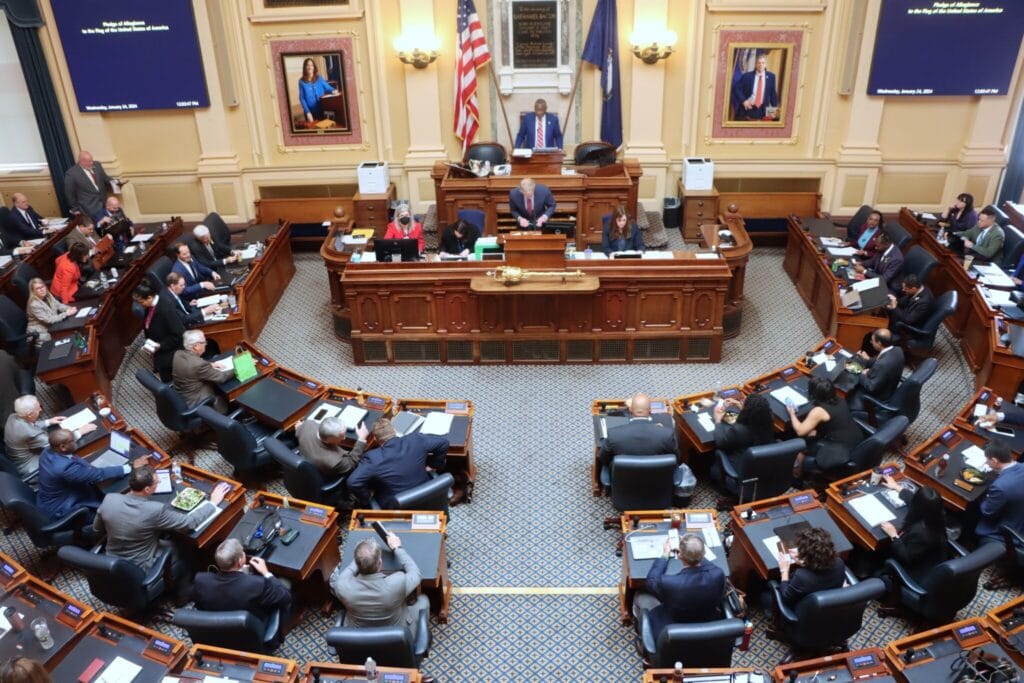
A view of the Virginia House of Delegates Chamber in Richmond, January 2026. (Photo by Nathaniel Cline/Virginia Mercury) By Nathaniel Cline | Virginia Mercury
The Virginia government is sponsoring around 200 interim studies and commissions created through various actions by the state legislature and governor’s office, and that number is expected to grow with pending legislation. But several lawmakers are now saying there are too many of these initiatives.
Shortly before the session ended last Saturday, state leaders, including Senate Democratic Caucus Chair Sen. Mamie Locke, D-Hampton, told the Mercury that the number of studies and commissions has become “ridiculous.”
“People need to stop turning legislation into studies, and that’s what’s been happening,” Locke said. “These pieces of legislation get into a committee and get turned into a study, and that’s why you get the proliferation of the studies. Just kill the bill.”
Senate Pro Tempore Louise Lucas, D-Portsmouth, recently criticized members of her own party and committee chairs for failing to reject unpopular bills, which often morph into studies. Legislators should “grow a backbone and kill bills that they don’t feel worthy of passage instead of sending them all to me to kill for them,” Lucas posted on X, formerly Twitter.
House Speaker Don Scott, D-Portsmouth, along with Locke, said they want to continue pushing for time limits and caps on new study panels, conduct a review of older ones to prevent staff from being overwhelmed, and ensure studies lead to real policy.
Studies and Commissions: What do they do?
The state already utilizes the Joint Legislative Audit and Review Commission (JLARC) to conduct new and ongoing studies raised by state lawmakers.
But because the legislature meets just three months a year and faces a huge swell of bills, they lack the time for in-depth policy study. Instead, they often rely on interim studies and commissions tasked with analyzing complex issues and generating policy recommendations to fill the gap.
“In a part-time legislature, commissions can actually serve a function in the way that standing committees often do in full-time legislatures,” said Richard Meagher, a professor and chair of the political science department at Randolph-Macon College, in a phone interview.
Meagher said commissions and studies enable oversight by examining issues, create forums for discussing complex topics, and unite advocates and legislators outside of session.
However, Meagher also pointed out that creating a commission is often a way to “make it look like you’re doing something about an issue without actually having to do something about it.”
He also noted a related but separate concern: bureaucratic clientelism.
Even when a board or commission is actually accomplishing something, the creation of such bodies can produce a network of clients — such as advocacy groups and affected communities — who depend on its continued existence. Once a board or commission is established, it becomes very difficult to dismantle, which can entrench both the bureaucracy and its associated interests.
Unless a commission has a set end date, it usually persists, he said.
Last year, states such as Indiana and Nevada faced similar issues and worked to reduce or consolidate state boards and commissions to streamline government, reduce bureaucracy, centralize oversight and cut regulatory barriers.
Those discussions focused on concerns that the moves would increase political influence over regulation.
House Minority Leader Terry Kilgore, R-Scott, said the caucus would be open to similar measures for Virginia. House Republicans identified over 400 studies that were proposed this session.
“These cost money, time and resources,” Kilgore said. “Whether it’s a legislative commission or a study or an administration study, it still takes away from folks who could be helping their constituents in other ways.”
House Caucus Chair Scott Wyatt, R-Mechanicsville, criticized the number of studies as “poor legislation that affects citizens,” and called it a reflection of the lack of unity in the Democratic party, which controls both chambers and the executive branch.
“We need to get back on track and be an appropriate, straight business state, (and) continue to grow the economy so folks increase salaries to really compete with the states further to the south,” Wyatt said.
“We don’t want to emulate what has happened in the state of Maryland or California, where I see the direction with this General Assembly session, is the direction they want to take Virginia.”
Meagher said some Virginia studies and commissions are crucial, including JLARC, the Freedom of Information Act Council, and the Chesapeake Bay Commission. Others fizzle out because they are obscure, inactive, have served their purpose, or could be important far in the future, like the autonomous driving work group.
Despite the number of existing studies and commissions, Scott said there are some benefits to creating interim studies and commissions through legislation by the General Assembly.
The speaker pointed to initiatives including studying how the forage fish menhaden are faring in the Chesapeake Bay, and reviewing the impact of data centers, which were at the center of legislative and budget discussions this year.
“These studies are important because they inform the legislation, and you can’t make good legislation if you don’t understand it,” Scott said.
Still, Scott said the growing number has warranted a review, which consequently falls to the staff. He said setting limits on the number of studies and commissions created each session helps lawmakers and staff.
“It’s helpful for the lawmakers and it’s helpful for the staff, so they can have some predictability about what needs to be done because the staff does a lot of work,” Scott said. “DLS staff, the clerks that support us, this is their full-time job, and so it can be overwhelming if they don’t know when these things have been called and when they will end.”
Locke and Scott said they have started meeting before each session to set limits on the number of studies and commissions the legislature will adopt. No other measure was provided beyond their practice.
Long security lines start popping up at airports as TSA officers go without pay

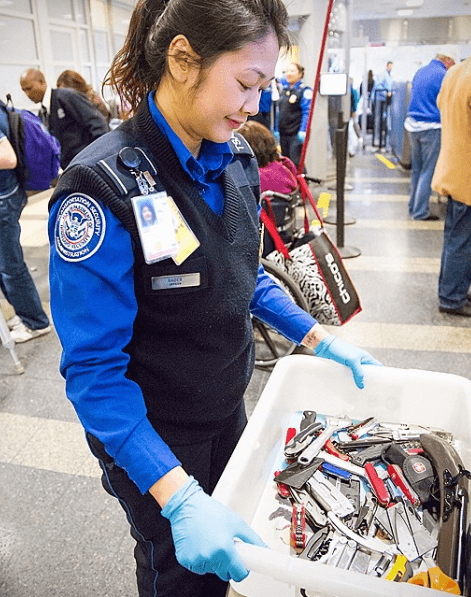
TSA officer carrying a bin of prohibited items that passengers have surrendered. TSA photo. By Jacob Fischler | Virginia Mercury
Passengers at a handful of airports this week waited in hours-long security lines as the government shutdown of the Department of Homeland Security dragged on.
Though Transportation Security Administration officers are required by law to work during a lapse in funding, more than usual have been absent after receiving only a partial paycheck during the most recent pay period. TSA officers will miss an entire paycheck this weekend if the shutdown is still in effect then.
No end to the shutdown appeared imminent Wednesday, as the U.S. Senate rejected a bill that would have funded TSA and other agencies in DHS that are not related to immigration enforcement.
In the meantime, TSA officers are not being paid.
Most live paycheck-to-paycheck, said Johnny Jones, the secretary-treasurer of the American Federation of Government Employees Council 100, which represents TSA agents.
The lack of pay has contributed to absenteeism, Jones added. The union does not condone coordinated “sick-outs,” which are illegal.
But individual officers miss work for one of three reasons during a shutdown, he said: pre-planned time off, legitimate illness or personal emergencies, and those calling in sick but seeking other work to pay bills.
“If you’re normally receiving a paycheck, you wouldn’t have that third group,” he said.
Some of those who are working are going without lunch or making other sacrifices, Jones added. And he said two colleagues were evicted during the most recent shutdown last fall, which lasted for 43 days.
The U.S. war against Iran, which has an estimated price in the billions of dollars in just its first two weeks, has also driven resentment among TSA workers, Jones said.
“One of the things that I’ve heard from the colleagues is that, man, we got plenty of money to go fight wars and bomb Iran, but we can’t pay our own employees,” he said.
Long lines
No exceptionally long wait times were reported Wednesday, but the previous few days saw several examples of snarled security lines.
Security lines topped three hours at Houston’s William P. Hobby International Airport on Monday and Tuesday.
Lines at Louis Armstrong New Orleans International Airport were up to two hours Monday and the airport’s social media drew a direct line to the shutdown.
“Due to impacts from the federal government’s partial shutdown, there continues to be a shortage of TSA workers at the security checkpoint … which is causing longer-than-average lines,” the airport’s X account posted.
Atlanta’s Hartsfield-Jackson International Airport also urged passengers to leave extra time to account for factors including “TSA staffing constraints.”
CBS News reported Wednesday that more than 300 TSA agents have left their jobs since the shutdown began. TSA officials did not respond to messages seeking confirmation of that figure.
Senate gridlock
The top Democrat on the U.S. Senate Appropriations Committee, Washington’s Patty Murray, sought unanimous consent Wednesday for the Senate to approve a bill that would fund all of DHS other than Immigration and Customs Enforcement, Customs and Border Protection, and the secretary’s office.
Sen. Katie Britt, an Alabama Republican who chairs the subcommittee on Homeland Security funding, objected.
Murray’s bill “would effectively defund our law enforcement officers that are charged with keeping Americans safe,” Britt said.
Each party blamed the other for the impasse, which has been unbreachable since the department’s funding lapsed Feb. 14.
Following the January fatal shootings of two U.S. citizens by immigration officers in Minneapolis, Democrats are demanding changes to immigration agencies’ conduct as a condition of funding the department.
Republicans have said they are willing to negotiate the issue, but the parties disagree on what to do for the department, which also includes the Coast Guard and the Federal Emergency Management Agency, in the meantime.
Republican leaders sought to pass a short-term continuing resolution to fund the entire department, but Democrats rejected it, saying it would allow the operation of immigration agencies without adding accountability measures.
“Right now, TSA agents are going without pay because Republicans and the White House have decided they would rather shut down all of DHS than pass some very basic reforms to rein in ICE and Border Patrol,” Murray said. “We also want TSA and FEMA funded, but we are not going to be blackmailed into cutting a blank check for ICE to get it done.”
Politics cited
Senate Majority Leader John Thune, of South Dakota, said Democrats have stopped negotiating on DHS funding in a bid to keep the issue alive for the November midterm elections.
“The American people are tired,” he said. “Lines get longer at the airports because TSA isn’t funded. The American people want us to do our jobs. Republicans are at the table. We’re ready to work toward a solution. Democrats have walked away.”
Jones, the AFGE member and TSA officer, declined to say which approach to short-term funding was preferable, but said it was Congress’ job to fund the federal government.
“We all swear the same oath to the same Constitution,” he said. “Now my job function is a little different than theirs, so they need to do theirs so I can do mine.”
Early voting begins on Virginia redistricting referendum

Virginia Democrats’ proposed 10-D, 1-R congressional districts map preserves the broad outlines of some existing districts but redistributes how the population is grouped across much of the state. (Photo courtesy Virginia Legislative Information System) Edited by Dan McDermott
Warren County voters can start casting ballots today on a referendum that would allow Virginia’s Democratic-controlled General Assembly to redraw all eleven of the state’s congressional districts before this fall’s midterm elections.
Matthew Reisinger, Warren County’s Director of Elections and General Registrar, said early voting opened Friday, March 6 at his office at 465 W. 15th St., Suite 800 in Front Royal. The special statewide election is April 21.
What’s on the ballot
The proposed constitutional amendment would give the General Assembly a temporary window to redraw congressional maps before the normally scheduled 2031 redistricting — but only because other states have already redrawn their own maps mid-decade without court orders to do so.
A “yes” vote puts a new map, already passed by the General Assembly and signed by Gov. Abigail Spanberger, into effect for the November 2026 elections. A “no” vote keeps the current lines in place. Either way, the bipartisan Virginia Redistricting Commission resumes control after the 2030 Census.
What it means locally
Warren County is part of the 6th Congressional District, represented since 2019 by Rep. Ben Cline, R-Botetourt County. The proposed map could cost Cline and several other Virginia Republicans their seats.
Cline has launched a group called Stop the Gerrymander, seeding it with his own campaign funds to run a voter turnout operation against the amendment. The pro-redistricting group Virginians for Fair Elections has raised more than $21 million; the main opposition group had raised around $295,000 as of early March. Former President Obama has recorded a video endorsement urging a “yes” vote.
Republicans argue the amendment is an unconstitutional power grab that bypasses the bipartisan commission Virginia voters created. Democrats say it’s a necessary response to Republican-controlled states doing the same thing nationally.
The Virginia Supreme Court cleared the vote to proceed on March 4 while legal challenges continue.
How to vote in Warren County
Reisinger said early voting runs weekdays 9 a.m.–5 p.m. at the registrar’s office, with Saturday hours on April 11 and April 18. Absentee ballot requests must be submitted by April 10 at 5 p.m. — either in person at the registrar’s office or online at elections.virginia.gov/VoterInformation. Election Day polls are open 6 a.m.–7 p.m.
Note: this year’s primary has been moved to August 4 regardless of how this vote turns out.
Reisinger is also looking for county residents to serve as Officers of Elections — the poll workers who staff voting locations and help make sure every eligible voter can cast a ballot. Anyone interested can learn more at warrencountyva.gov/594/Get-Involved.
Questions? Call the registrar’s office at 540-635-4327.
The Ballot Question
Should the Constitution of Virginia be amended to allow the General Assembly to temporarily adopt new congressional districts to restore fairness in the upcoming elections, while ensuring Virginia’s standard redistricting process resumes for all future redistricting after the 2030 census?
Present Law: Virginia’s eleven congressional districts are drawn once every ten years by the Virginia Redistricting Commission, made up of eight legislators and eight citizens, with an equal number of Republicans and Democrats. The districts were last redrawn in 2021 and will next be redrawn in 2031.
Proposed Law: The amendment would give the General Assembly authority to redraw districts before 2031 if another state does so mid-decade without a court order. That authority would expire October 31, 2030, after which the Redistricting Commission resumes control.
A “yes” vote puts a new map into effect for the November 2026 elections.
A “no” vote keeps the current districts in place.

Warren County, Va. Sample Ballot for April 21, 2026 referendum on redistricting Bluebell Festival returns to Shenandoah River State Park April 4
Courtesy photo of Bluebell Festival Virginia bluebells will blanket the trails along the Shenandoah River next month when Raymond R. “Andy” Guest, Jr. Shenandoah River State Park hosts its annual Bluebell Festival on April 4.
The festival runs from 10 a.m. to 4 p.m. and is free with the park’s standard $10-per-vehicle parking fee.
Attendees can join guided nature walks and ranger-led programs, browse local artisan vendors and grab food from on-site trucks. Live music will also be part of the day. Visitors are advised to bring cash, as not all vendors accept cards.
Activities will be centered around the park’s picnic area and Bluebell Trail, a one-mile natural surface path through the park’s riverfront landscape.
Park Manager Dustin Haymaker said the spring bloom makes early April one of the most scenic times to visit.
“The Bluebell Festival is an excellent opportunity for visitors to experience the park at one of the most picturesque times of the year,” Haymaker said.
The park is located in Bentonville. For vendor information or other details, visit virginiastateparks.gov/shenandoahriver-events or call 540-622-2262.
Courtesy photo of Bluebell Festival Courtesy photo of Bluebell Festival Information from a release. Edited by Dan McDermott.
General Assembly nixes bills that required data centers to get SCC certificate
By Shannon Heckt
For most of the industry’s existence in Virginia, approvals for data centers were largely seen as a local issue – with the state and federal governments giving the thumbs up on certain permits.
But as the industry balloons across the commonwealth, those local decisions are triggering statewide implications concerning energy capacity and residents’ rising utility bills.
Two bills in the General Assembly sought to give the State Corporation Commission the authority to review how proposed high-load users — mainly data centers and manufacturing facilities — would impact the environment, energy reliability, and gauge if there is sufficient infrastructure in place to support the power needs.
But House Bill 155, carried by Del. Josh Thomas, D-Prince William, and Senate Bill 619, by Sen. Kannan Srinivasan, D-Loudoun, met with fierce opposition and were both tabled for the year.
Both of the bills directed the SCC to review if a proposed project that would need over 25 megawatts of power would have a material impact on rates, impacts on grid reliability, or hinder the utility’s ability to follow environmental regulation laws like the Virginia Clean Economy Act.
The bills would have also allowed the SCC to examine the environmental and health impacts a project could have on the surrounding communities. Both Thomas and Srinivasan said the bills would not have removed the local review and permitting actions, but rather added a state backup check.
“Localities get to decide what they want to do with the land. The state, since the invention of electrical power, and the creation of a statewide monopoly has an obligation to make sure that we regulate it,” Thomas said in an interview at the state Capitol on Thursday. “But what’s happening now is localities are deciding to use their land for data centers, which require an immense amount of power and the state cannot keep up.”
The measures would have allowed proposed projects to receive quicker consideration from the state if they were compliant with clean energy investments, sending notice to the public, participating in demand response programs and other measures.
The data center industry has been a boon for localities, with some counties reaping millions of dollars for major projects. Loudoun County, the seat of the so-called Data Center Alley, benefits from about $800 million in tax revenue from the data center industry, according to the county’s budget proposal for this year.
Srinivasan said he has watched the industry grow before his eyes and encourages its continuance with a more balanced approach.
“I think everybody understands in Virginia that this industry has been a pivotal thing for the commonwealth. Absolutely no doubt about it. But how do we go forward?” Srinivasan asked. ”How do we go forward with a more mature and a more balanced growth strategy? Because we don’t want to be five years from now and ask “why didn’t we do this?”
In a hearing for HB 155 on Feb.10, Nicole Riley with the Data Center Coalition spoke against the bill, stating that it would set up more roadblocks for the industry that already has to go through multiple permitting processes.
“We are concerned that this bill unnecessarily extends time to market for data centers, which collectively invested $80 billion in Virginia over the last two years, along with a number of other large capital intensive industries. It would create tremendous regulatory uncertainty,” Riley said.
Dominion Energy, the state’s largest utility, also spoke against the bill. The company has a mandate to serve customers that request power. But with the explosion of the high-powered users requesting to come on the grid, a long queue has developed as Dominion determines when it can power them up.
Thomas said that his bill’s review process would have helped provide certainty of when power would be made available. But the utility said it would have breached choices that should be up to localities.
“We would submit this bill muddies the water on the role of the State Corporation Commission and local governments, and that it improperly inserts the SCC into local siting decisions,” Dominion representative Christine Noonan said. “The Commission already has the authority to govern the large load interconnection queue process.”
Srinivasan’s bill was able to pass out of the Senate with a bipartisan vote but was laid on the table in a House subcommittee on Tuesday, where HB155 met the same fate earlier in the session. The committee agreed to send a letter to the SCC requesting they investigate how a review program like the one laid out in the bills could be implemented.
Srinivasan said that showed him there is interest for the state to take steps to further regulate the exploding industry. Thomas said their legislation sought to address specific aspects of data center development in the state.
“These are the only bills that sought to address the load side. I mean, there are bills that try to address efficiency, and there’s bills that try to talk about generation,” Thomas said.
“Do we have the political will to tell an industry that has been undeniably doing a lot for locality taxes and may potentially here, really soon do a lot for state taxes, ‘you might need to slow down because of the immense amount of stress that it’s putting on our electrical grid’?”
Both lawmakers hope to revive the measures in the next legislative session once they get a response from the SCC on how to implement a review program.
Shenandoah River State Park announces new Nights in Nature Series

Glowing Millipede. Courtesy photo. Bentonville, Va. – Shenandoah River State Park invites visitors to experience the park like never before with its new Nights in Nature Series, a collection of evening programs designed to showcase the sights, sounds and creatures of the park after dark.
Beginning this March, the Nights in Nature Series will feature a variety of guided activities, including:
- March 7: Nighttime Vernal Pool Expedition
- March 28: Nighttime Vernal Pool Expedition
- April 22: Sounds of Spring: Woodland Amphibian Walk
- May 31: Blue Moon Hike
- June 20: Firefly Hike
- July 4: Red, Wagon and Blue Glow-in-the-Dark Wagon Ride
- Aug. 8: Black Light Exploring
- Aug. 12: Perseids Meteor Shower Watch Party
- Sept. 26: Harvest Moon Hike
- Oct. 31: Ghosts of Virginia State Parks Campfire
- Nov. 11: Embers of Honor: Campfire and Lantern Walk
Registration is required for all programs, which are family-friendly and suitable for all ages. Visitors 16 years old and younger must be accompanied by an adult at all times.
The Nights in Nature Series is free to attend; however, the standard $10 parking fee applies. To learn more, please go to www.virginiastateparks.gov/shenandoahriver-events or call 540-622-2262.
Night exploration. Shenandoah River State Park courtesy photo. Samuels Public Library Youth Events – March, 2026
These are the events being presented by the Youth Services Department at Samuels Public Library during the month of March 2026. More information about Samuels Library and the programs and services available can be found at www.samuelslibrary.net or by calling (540) 635-3153.
Monday, March 2
10:15 AM – Music & Movement for Babies (ages 0-23 months).
11:15 AM – Music & Movement for Toddlers (ages 2-5). Join our fun and joyful time with your little ones as we listen to music while learning some basic movements and multisensory activities designed to delight your baby or toddler.Tuesday, March 3
4:00 PM – Create a 250 Quilt. For ages 6-11. Hear a story about quilt making, talk about why they did it often 250 years ago, and then design your own square to add to a “community quilt” that we will hang in the library. Sponsored by FRUMC. Registration is required.Wednesday, March 4
10:15AM – Toddler Story Time.
11:00AM – Preschool Story Time. Come in for an enjoyable hour filled with Nursery Rhymes , exciting sing-alongs, finger plays, and a craft.
Thursday, March 5
10:30 AM – Grand Story Time. For ages 0-6. Come hear a grandparent read a few stories, say some nursery rhymes, and do a craft.Friday, March 6
3:00 PM – Children’s Ceilidh. Dance the jig and reel, play percussion instruments, and learn about Scottish dance, music, and culture with Sean Heely Celtic Band. Fun for the whole family!Saturday, March 7
11:00 AM – Global Day: Tales & Trails. For ages 5-11. Join the Shenandoah River State Park rangers and us as we go on a scavenger hunt in the library garden, collect things, make sun catchers, and learn about “Leave No Trace” and recycling. Registration is required.Monday, March 9
10:15 AM – Music & Movement for Babies (ages 0-23 months).
11:15 AM – Music & Movement for Toddlers (ages 2-5). Join our fun and joyful time with your little ones as we listen to music while learning some basic movements and multisensory activities designed to delight your baby or toddler.Tuesday, March 10
10:30 AM – Pi- Fractions: Homeschool Hub. For ages 6-11. Children will learn about Pi (3.14) and create a pie to play with fractions. Registration is required.Wednesday March 11
10:15AM – Toddler Story Time.
11:00AM – Preschool Story Time. Come in for an enjoyable hour filled with Kite stories, exciting sing-alongs, finger plays, and a craft.Thursday, March 12
10:30 AM – Grand Story Time. For ages 0-6. Come hear a grandparent read a few stories, say some nursery rhymes, and do a craft.Saturday, March 14
Paws for Reading. For ages 6-18. Paw for Reading is a program where people read aloud to trained therapy dogs, which helps improve their reading skills, confidence, and attitudes toward reading. This program provides a non-judgmental and stress-free environment, as the dogs are calm, attentive listeners who don’t correct mistakes, making it less intimidating for children. Bring your own book or use one of ours! Registration is required.2:30 PM – Press Play. For ages 12-18. Come spend an afternoon playing games on the Nintendo Switch. Registration is required.
Saturday, March 21
11:00 AM – Digital Art Chillout: Teens Connect. For Ages 12-18. Do you enjoy drawing, painting, and channeling your inner Rembrandt on a computer or tablet? We will provide laptops with GIMP installed so you can create whatever you like! You can show off what you make at the event, or something you have made in the past. Registration is required.2:30 PM – Wings & Wonders. For ages 6-14. Join people from the Smithsonian Conservation Center as read a bird story, make a suet feeder, and get creative painting windows to keep the birds from flying into them. Registration is required.
Monday, March 23
10:15 AM – Music & Movement for Babies (ages 0-23 months).
11:15 AM – Music & Movement for Toddlers & Preschoolers (ages 2-5). Join our fun and joyful time with your little ones as we listen to music while learning some basic movements and multisensory activities designed to delight your baby or toddler.Tuesday, March 24
10:30 AM – Water Cycle: Homeschool Hub. For ages 6-11. Come learn about water as it travels through the cycle in our world. Registration is required.
Wednesday, March 25
10:15AM – Toddler Story Time.
11:00AM – Read with the Sheriff: Preschool Story Time – Come in for an enjoyable hour filled with Kitchen stories, exciting sing-alongs, finger plays, and a craft.Thursday, March 26
10:30 AM – Grand Story Time. For ages 0-6. Come hear a grandparent read a few stories, nursery rhymes, and do a craft.Saturday, March 28
9:00 AM – Easter Egg Hunt. Family event. In partnership with Warren County Parks & Rec, there will be a story time, craft, egg hunt, and visit from the Easter Bunny at 465 W 15th St., Front Royal, VA (Old Middle School).2:00 PM – Forest Lanterns. For ages 8-14. Hear stories about the forest and then create your own forest scene in a lantern, using alcohol and ink. Registration is required.
Monday, March 30
10:15 AM – Music & Movement for Babies (ages 0-23 months).
11:15 AM – Music & Movement for Toddlers (ages 2-5). Join our fun and joyful time with your little ones as we listen to music while learning some basic movements and multisensory activities designed to delight your baby or toddler.Tuesday, March 31
4:00 PM – Life of a Frog. For ages 6-11. Hear some silly frog stories and learn about the different stages they go through in life. Registration is required.Information from a release. Posted by Dan McDermott.
Department of Conservation and Recreation recognizes Flood Awareness Week
file photo of flooded neighborhood The Department of Conservation and Recreation is recognizing March 8-14 as Virginia Flood Awareness Week to encourage Virginians to learn about flood risks in their communities and take steps to protect their families, homes and businesses from the commonwealth’s most frequent and costly natural hazard.
Flooding can occur anywhere in Virginia, along rivers and streams, in coastal areas and in neighborhoods far from mapped floodplains. During Flood Awareness Week, the Virginia Department of Conservation and Recreation is sharing resources, tools and information to help residents understand their risk, prepare before flooding occurs and reduce long-term impacts through smart planning and mitigation.
“Flooding affects every region of the commonwealth and can happen with little warning,” said Nikki Rovner, Director of the Virginia Department of Conservation and Recreation. “Flood Awareness Week is an opportunity to remind Virginians that preparation saves lives, reduces damage and strengthens communities. Understanding your risk today can make all the difference tomorrow.”
DCR’s Flood Awareness webpage offers factsheets and a risk assessment tool designed to help Virginians determine their flood risk and assist with planning for future flood events.
Virginians can learn about a property’s flood risk by entering an address into the Virginia Flood Risk Information System (VFRIS).
Despite the risks, only 3% of Virginians carry flood insurance, according to the National Flood Insurance Program.
“Flood awareness starts with knowing your risk and having a plan,” said Angela Davis, director of DCR’s Floodplain Management Division. “Whether it’s signing up for local alerts, purchasing flood insurance or supporting local mitigation projects, small actions can significantly reduce the impacts of flooding.”
There are additional ways renters, homeowners and business owners can reduce potential flood damage to some, but not necessarily all, of their property. These include:
- Storing important documents in waterproof containers, on an upper floor
- Caulking windows, doors and gaps where pipes and wires enter a building
- Anchoring propane tanks and labeling with the owner’s name and address
- Choosing tile or other waterproof flooring over carpeting on lower floors
- Elevate mechanical equipment such as hot water heaters above the flood level
Through its Floodplain Management Division and Office of Resilience Planning, DCR works closely with local governments, planning district commissions and federal partners to support flood risk mapping, hazard mitigation, flood resilience, and serves as the statewide coordinator of the National Flood Insurance Program. These efforts increase the commonwealth’s capacity to combat changing environmental conditions while protecting natural floodplains that store floodwaters and improve water quality.
As of Dec. 3, 2025, all applicable state agencies must comply with the Virginia Floodplain Management Standards or the local floodplain management regulations when planning or conducting development in floodplain areas designated on state-owned land. These Virginia Floodplain Management standards have been finalized and are now available for download.
Visit dcr.virginia.gov/floodawarenessweek/ for more information on your flood risk and additional flood mitigation tips.
Information from a release. Posted by Dan McDermott.
Pediatric Associates of Winchester joins Valley Health
Valley Health announces that Pediatric Associates of Winchester, at 1002-C Amherst St., has joined Valley Health, effective March 2, 2026. Going forward, the practice will be known as Valley Health Pediatrics. While the name is new, families can expect the same trusted care they know and value. The practice will remain in its current location, and the dedicated team of caregivers will continue to serve patients, providing the compassionate, high‑quality pediatric care the community has relied on for years.
“We are excited to welcome this experienced team of pediatricians, nurse practitioner and staff to the Valley Health family, and we are dedicated to continuing the exceptional care the practice has provided to children in our community for decades,” says Kevin Volkema, DO, MBA, Regional Medical Director, Valley Health Primary Care. “We believe this transition will provide more seamless care between the practice and primary care, specialty, diagnostic, and hospital inpatient and outpatient services within the health system, ultimately improving the patient experience.”
The practice’s legacy of care in the Winchester community dates back to 1972. Since its inception, the practice has been staffed by board certified pediatricians and has maintained a steady focus on excellence in pediatric care. Today, the practice consists of a team of highly skilled and caring professionals, dedicated to providing the best quality health care in a responsive and comfortable environment. Clinicians include Jennifer Currie, DO, Mounira A. Dahimene, MD, Susan J. Gawalt, MD, Bryan A. Kornreich, MD, Colette M. Sabbagh, MD, and Laura E. Grove, PNP, BC.
“The team here has always prided itself in providing the best care possible to our patients and their families,” says pediatrician Bryan Kornreich, MD. “As we join Valley Health, we are excited to continue keeping the children of our area healthy and happy and to enhance the overall quality of care for our families.”
This transition reflects Valley Health’s continued commitment to expanding access to exceptional pediatric care while preserving the strong relationships between caregivers, patients, and families. We look forward to continuing to care for our community’s children—today and for generations to come.
About Valley Health
Valley Health is a nationally recognized not-for-profit health system serving a population of more than 500,000 in the Northern Shenandoah Valley of Virginia and the Eastern Panhandle of West Virginia. As a healthcare provider, employer, and community partner, Valley Health is committed to improving the health of the region. The system includes six hospitals, more than 75 medical practices and Urgent Care centers, outpatient rehabilitation, medical transport, long-term care, and home health. www.valleyhealthlink.com.
Information from a release. Posted by Dan McDermott.
Samuels Public Library Adult Programming-March, 2026
Community Resource Fair — Wednesday, March 4, 1:00–3:00 p.m. (In person). See what resources are available in your community and talk directly with representatives about how they can help. Bring your questions, pick up free items and explore the services available to you.
Sewing 201: St. Patrick’s Quilted Wall Hanging (Two-Part Program) — Wednesday, March 4 and March 11, 5:00–6:30 p.m. (In person, registration required). This two-part class will demonstrate techniques for creating a St. Patrick’s Day themed quilted wall hanging. Registration enrolls participants in both sessions. Participants must have completed Sewing 101 or have a basic working knowledge of using a sewing machine. All supplies and materials are provided.
Studio 330 Craft Swap — Saturday, March 7, 10:00 a.m.–2:00 p.m. (In person). Refresh your craft stash during the library’s second annual Craft Swap. Early access from 10 a.m.–12 p.m. is available for those who donated craft supplies during February. The event opens to the public from 12–2 p.m. to browse and pick up free craft materials while supplies last. Visitors can also explore Studio 330 equipment and find inspiration for their next project.
Seniors First Workshop: Medicare and Other Coverage — How They Work Together — Thursday, March 12, 2:00–3:00 p.m. (In person). Learn about special enrollment periods, avoiding coverage gaps and penalties and how Medicare coordinates with employer coverage, retirement plans, TRICARE, VA benefits and COBRA. For questions call VICAP at 540-635-7141 or visit seniorsfirst.info. One-on-one counseling sessions can be scheduled beginning at 3:00 p.m. by contacting Samuels Public Library staff at 540-635-3135 ext. 105.
Seniors First Counseling — Thursday, March 12, 3:00–4:00 p.m. (20-minute sessions, in person). Meet individually with Seniors First for assistance navigating Medicare, reviewing coverage options and identifying programs that may help lower healthcare costs. Contact the Adult Reference Department at 540-635-3153 ext. 105 to reserve an available counseling timeslot.
Writing Workshop: Improve Communication Skills — Thursday, March 19, 6:00–7:30 p.m. (In person, registration required). Join award-winning writer, editor and professor Dr. Dan Trigoboff for a workshop focused on improving communication skills. Dr. Trigoboff has more than 50 years of experience in media and academia, beginning his career while earning a bachelor’s degree at Boston University and later teaching at Methodist University and North Carolina State University, where he earned his Ph.D. in Communication, Rhetoric and Digital Media. He retired as professor emeritus at St. Augustine’s University in 2024.
Sewing 201: Hemming — Wednesday, March 25, 5:00–6:30 p.m. (In person, registration required). Participants who have basic sewing experience will learn hemming techniques using a sewing machine. Bring a project such as pants, skirts or other items that need hemming. Participants must have completed Sewing 101 or have equivalent sewing machine knowledge.
Sublimation 101 — Thursday, March 26, 5:00–7:00 p.m. (In person, registration required). Learn the basics of sublimation printing and create a custom item to take home. This hands-on class explains how sublimation works, what materials are compatible and how to prepare and heat-press a design. Bring a photo or image on a removable flash drive or use one of the library’s pre-formatted designs. Beginners are welcome and all supplies are provided. No food is allowed in the studio and patrons ages 13–17 must be accompanied by an adult.
Short Film Screenings: “Building for Birds” and “Grass Roots” — Thursday, March 26, 6:00–7:30 p.m. (In person). Join the library for two short films about migratory birds and biodiversity conservation on working land in the Shenandoah Valley. Director Sam LeGrys, research ecologist Brian Evens and Virginia Grassland Bird Initiative coordinator Justin Proctor will participate in a panel discussion following the screenings. “Building for Birds” examines the problem of bird collisions with glass windows, which kill an estimated one billion birds each year in the United States, while “Grass Roots” highlights research conducted by Smithsonian’s Virginia Working Landscapes program and partner farms.
Basic Machine Embroidery — Friday, March 27, 12:00–2:00 p.m. (In person, registration required). Learn the fundamentals of machine embroidery using the library’s Brother PE900 embroidery machine and create a simple monogram or one-color image on sample fabric. No food is allowed in the studio and patrons ages 13–17 must be accompanied by an adult.
Bluebells, Wildflowers and Wildlife Walk & Photography — Saturday, March 28, 9:00–10:30 a.m. (Off-site program, registration required). Join local photographer and educator Sharon Fisher for a photography workshop at Raymond R. “Andy” Guest Jr. Shenandoah River State Park in Bentonville. Participants will meet outside the visitor center for tips on photographing spring flowers and wildlife before exploring selected areas of the park. All cameras, from smartphones to professional equipment, are welcome and the program may include hikes of up to two miles on even terrain. The park’s standard parking fees apply and the library has a limited number of park passes available.
Freedom 250 Mobile Museum Truck Coming to Middletown March 27-28, 2026

Freedom 250 courtesy photos Middletown, VA – As communities across the nation prepare to commemorate America’s 250th Anniversary, Middletown will proudly welcome the Freedom 250 Mobile Museum Truck, a traveling national exhibit that is crisscrossing the country to celebrate this historic milestone.
The Freedom 250 Truck will be parked at the historic Wayside Inn, the oldest continuously operating inn in America, offering residents and visitors a unique opportunity to experience this immersive exhibit right here in the Shenandoah Valley.
Open Hours:
March 27–28
10:00 a.m. – 5:00 p.m.The mobile museum is arriving in Middletown following appearances in South Carolina and will continue its nationwide journey as part of the official America 250 commemorations.
“Freedom 250 is grateful for the opportunity to showcase the mobile museum with the community of historic Middletown and the surrounding area,” said Katie Childress Miller, Project Manager for Freedom 250. “The museum, which is part of an initiative to celebrate America’s 250th birthday, is traveling across the country throughout 2026, encouraging all ages to gain a deeper appreciation of our great nation’s incredible history.”
“I was very excited when Katie Childress Miller brought this project to me; to have a national, traveling historical exhibit spend time in our community creates something special all citizens can enjoy as we all take part in celebrating America 250. Middletown’s historical nature lends itself perfectly for Freedom and History 250,” said Mike Guevremont, Member of the County Board of Supervisors.
Mayor Charles Harbaugh IV, an avid Revolutionary War reenactor who portrays Young George Washington, expressed his enthusiasm for hosting the exhibit in such a historic setting:
“As someone who has dedicated much of my life to preserving and portraying our history, I can say how incredibly excited and blessed we are to welcome the Freedom 250 Mobile Museum to Middletown. To have this national exhibit stationed at the historic Wayside Inn, a place that has witnessed centuries of American history, is truly special. We are most grateful to Katie Miller, Supervisor Mike Guevremont, and Wayside Inn owners John and Bob Hotaling for working with us to bring Freedom 250 to Middletown.”
The Freedom 250 Mobile Museum is part of Middletown’s broader slate of America 250 events, culminating in the town’s annual July 4th Celebration, home to the area’s only Independence Day parade within an hour’s distance. The celebration continues to grow each year, drawing thousands of visitors from across the region to experience Middletown’s deep historical roots and vibrant patriotic spirit. The July 4th Celebration was recently awarded a Virginia tourism grant to promote the event from a regional standpoint.
Residents and visitors are encouraged to stop by the Wayside Inn and Clem’s Kitchen on March 27–28 to experience this one-of-a-kind traveling exhibit, dine at the historic inn, and join Middletown in celebrating 250 years of American freedom.
For more information about the Freedom 250 Mobile Museum, visit:
https://freedom250.org/Information from a release. Cross-posted from route11news.com by Dan McDermott.