Edited by Dan McDermott
RICHMOND, Va. (WarrenCountyVa.com) — The Virginia Supreme Court ruled Friday that the General Assembly violated the state constitution when it advanced a proposed amendment that would have authorized partisan gerrymandering of congressional districts, nullifying a statewide referendum in which voters approved the measure — a vote the court ruled has no legal effect.
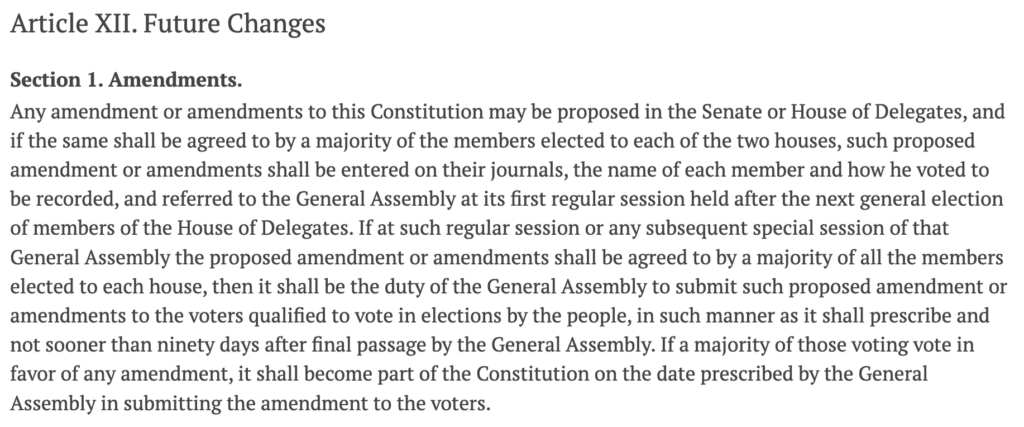
The 4-3 decision, written by Justice D. Arthur Kelsey and handed down May 8, found that the General Assembly’s first vote on the proposed amendment — taken Oct. 31, 2025 — came after early voting in the 2025 House of Delegates general election had already begun, violating the intervening-election requirement in Article XII, Section 1 of the Virginia Constitution.
The ruling leaves in place the nonpartisan congressional district maps drawn by the Supreme Court of Virginia in 2021.
The vote and the amendment
The Virginia Department of Elections reported that 1,604,276 voters cast “yes” votes and 1,499,393 cast “no” votes in the April 21 special election on the proposed amendment. Voting ran from March 6 through April 21, with approximately 45% of ballots cast during the early voting period and 55% on Election Day.
The ballot question asked voters whether they wanted to “restore fairness” in upcoming congressional elections.
The proposed amendment would have temporarily suspended Article II, Section 6-A — the provision that created Virginia’s bipartisan Redistricting Commission — and authorized the General Assembly to redraw congressional districts outside of the regular decennial-census redistricting cycle in response to other states doing the same. A new congressional map had already been enacted contingent on the amendment’s approval.
The court noted that the existing map produces a 6-5 split in Virginia’s congressional delegation between the two major parties. The contingent replacement map, the majority wrote, would have been expected to produce a 10-1 split.
The constitutional violation
Article XII, Section 1 requires that a proposed constitutional amendment pass the General Assembly twice — with an intervening general election of House of Delegates members between the two votes. The purpose, the court wrote, is to give voters an indirect voice by allowing them to support or defeat candidates based on their position on the amendment before the second legislative vote occurs.
The General Assembly first approved the proposed amendment on Oct. 31, 2025 — four days before Election Day on Nov. 4, 2025. But early voting in the House of Delegates election had begun Sept. 19, 2025, and more than 1.3 million ballots had already been cast by Oct. 31.
The Commonwealth argued that “general election” in Article XII, Section 1 referred only to Election Day itself — Nov. 4 — meaning the four-day window was sufficient to satisfy the intervening-election requirement.
The court rejected that argument, holding that an election encompasses the combined actions of voters casting ballots and election officials receiving them and closing the polls, beginning with the first day of early voting and ending on Election Day.
“The plain and ordinary meaning of the expression matches the historical definition embraced by the courts and legal scholars,” the majority wrote.
The court also noted that of the 63 proposed amendments Virginia has advanced since the 1971 constitution was adopted, the Commonwealth could not identify a single prior instance in which the General Assembly passed a proposed amendment after voting in a general election had already begun.
The litigation timeline
The Commonwealth had successfully argued before the referendum that courts could not intervene to block the election while the constitutional amendment process was ongoing, citing the 1912 Virginia Supreme Court decision Scott v. James. The Claimants — the parties challenging the amendment — had urged the court to rule before the vote was held.
The court addressed that history directly, noting that if pre-election challenges were barred and post-election challenges were also barred by the force of voter approval, judicial review of unconstitutional amendment procedures would effectively cease to exist in Virginia. The Commonwealth’s counsel acknowledged at oral argument that the fact of a “yes” vote did not affect the court’s jurisdiction to review procedural compliance.
Dissent
Chief Justice Powell, joined by Justices Mann and Fulton, dissented, arguing that the majority’s interpretation conflicts with how both Virginia and federal law define an election.
The dissent pointed to Code § 24.2-101, which defines a general election as “an election held in the Commonwealth on the Tuesday after the first Monday in November,” and argued the General Assembly’s express constitutional authority to regulate the time and manner of elections supports limiting the term to a single day.
The dissenters also raised practical concerns, arguing the majority’s multi-day definition of “election” could hamper court operations for more than 90 days per year under Article II, Section 9’s prohibition on compelling voters to attend court during the “time of holding any election,” and could conflict with federal law requiring congressional elections to be held on a single day.
The majority addressed each of those objections, concluding none undermined its interpretation of Article XII, Section 1.
Effect of the ruling
With the referendum nullified, the 2021 congressional maps — which the Princeton Gerrymandering Project graded an “A” and described as providing no partisan advantage — remain the governing maps for Virginia’s 2026 congressional elections.
The court said its holding made it unnecessary to resolve two additional procedural questions that had been raised: whether the 2024 special session in which the amendment was first passed violated its own procedural resolutions, and whether the General Assembly’s failure to comply with a statutory posting requirement for proposed amendments also independently invalidated the process.