
Edited by Dan McDermott | WarrenCountyVa.com
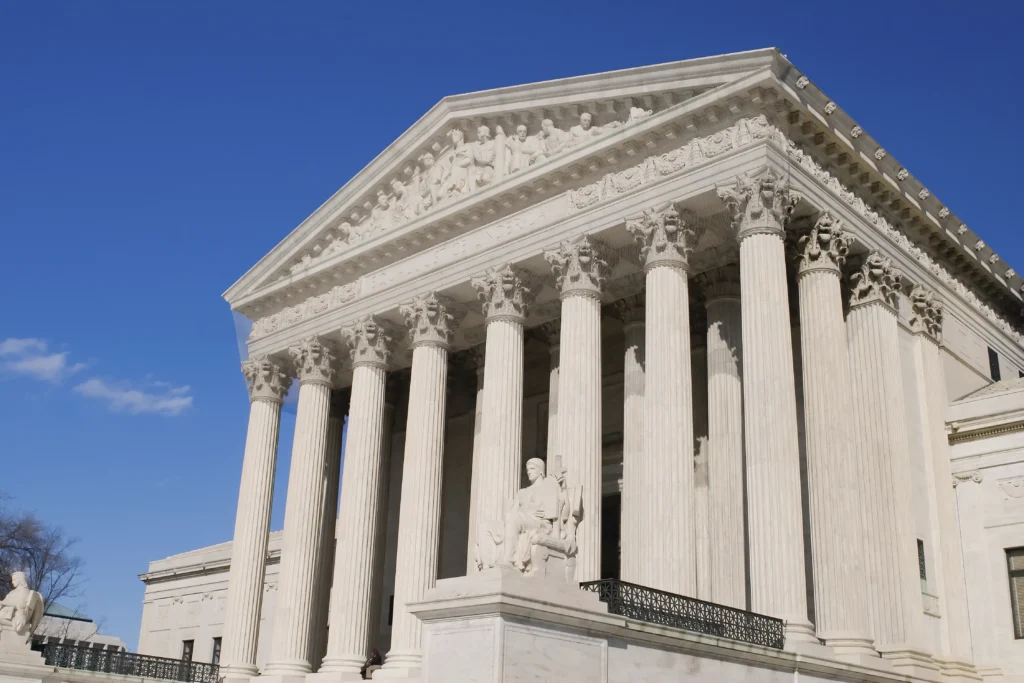
The U.S. Supreme Court on Friday denied an emergency request to stay a Virginia Supreme Court ruling that blocked a recently approved constitutional amendment allowing mid-decade congressional redistricting.
The order was brief. The Court’s docket says the application was presented to Chief Justice John Roberts, referred by him to the full Court, and denied. No justice publicly dissented, and the Court gave no explanation. The docket does not disclose the vote.
The case, Don Scott, in his official capacity as Speaker of the Virginia House of Delegates, et al. v. Ryan T. McDougle, et al., came to the U.S. Supreme Court after the Supreme Court of Virginia ruled May 8 that the General Assembly had not followed the state constitution’s required amendment process. The Virginia court divided 4-3.
At issue was whether lawmakers validly advanced a constitutional amendment that would have allowed the General Assembly to redraw congressional districts in response to mid-decade redistricting in other states. According to the emergency application, the General Assembly first approved the proposal on Oct. 31, 2025, approved it a second time on Jan. 16, 2026, and voters approved it in an April 21, 2026 referendum.
Opponents argued the amendment failed because the Virginia Constitution requires a proposed amendment to pass the General Assembly, then be referred to the next General Assembly session after the “next general election” for the House of Delegates, and then pass again before going to voters. The Virginia Supreme Court agreed that the timing requirement had not been satisfied because early voting in the 2025 House election had already begun before the first legislative approval.
The applicants — including House Speaker Don Scott, Senate Majority Leader Scott Surovell, Senate President Pro Tempore L. Louise Lucas and the Commonwealth — argued to the U.S. Supreme Court that the Virginia Supreme Court had misread both Virginia and federal election law. Their filing said the Virginia ruling wrongly treated the word “election” as including the entire early-voting period rather than Election Day itself, and that the state court’s reasoning was intertwined with federal law governing congressional elections.
They also argued that without a stay, Virginia would be forced to conduct the 2026 congressional elections under districts that the voters had rejected through the referendum process. The application asked the Court to stay the Virginia Supreme Court’s decision while the applicants prepared a petition for full Supreme Court review.
The McDougle respondents urged the Court to deny relief, arguing that the request came too late, that emergency intervention would disrupt upcoming elections, and that the Virginia Supreme Court decision rested on state-law grounds outside the U.S. Supreme Court’s ordinary review. They also argued that a separate state case, Koski, created additional obstacles because that injunction rested on other state-law grounds, including allegedly misleading ballot language.
The legislative clerks named in the case filed a short response supporting the stay application, saying they had not joined the application because their legislative-immunity defense had been sustained below, but that they supported the applicants’ request.
Amicus briefs split along similar lines. The Virginia NAACP supported the stay, arguing that the state Supreme Court’s ruling nullified the votes of more than 3.1 million Virginians and relied on an unprecedented interpretation of “election.” The NAACP brief also argued that the referendum had strong support from Black voters and other minority voters.
The American Center for Law and Justice opposed a stay, arguing that the Virginia Supreme Court was enforcing state constitutional limits and that other state-law defects — including the referendum’s timing and ballot language — independently supported blocking the amendment.
West Virginia also filed an amicus brief opposing intervention, arguing that the case asked the U.S. Supreme Court to do what it usually avoids: review a state supreme court’s interpretation of its own constitution in a state-law matter.
In their reply, the applicants disputed the timing and jurisdiction arguments, saying May 12 was an operational deadline, not a legal bar to relief, and that the federal issues arose from the Virginia Supreme Court’s own ruling. They argued that the state court had displaced authority assigned to Virginia’s lawmaking process in a federal-election case.
Friday’s order leaves the Virginia Supreme Court ruling in place. It does not necessarily end the case, because the applicants could still seek full review through a petition for certiorari. But without a stay, the immediate practical effect is that Virginia’s 2026 congressional elections proceed without the new redistricting amendment taking effect.