
The Virginia Department of Wildlife Resources (DWR) reports the results of chronic wasting disease (CWD) surveillance from the Department’s four CWD Disease Management Areas (DMAs) as well as results from across the Commonwealth. In total, more than 7,800 deer were tested resulting in 126 positive CWD detections.
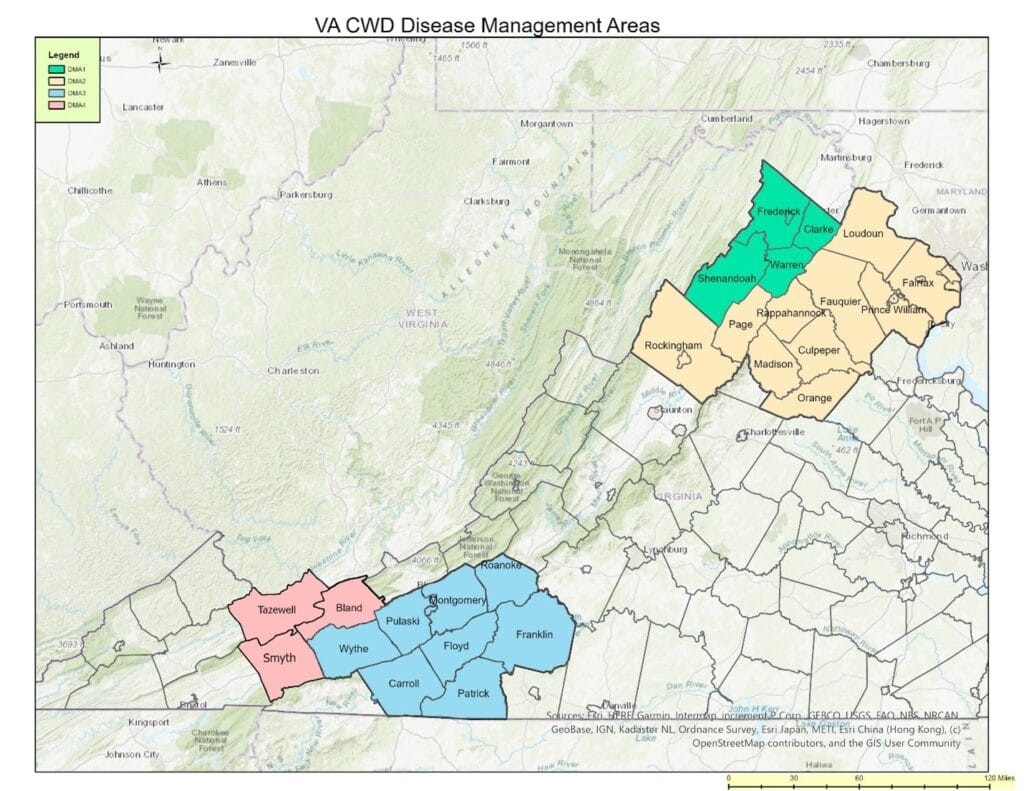
For the 2025 – 2026 hunting season, DMA1 included Clarke, Frederick, Shenandoah, and Warren counties. Of 562 white-tailed deer within DMA1 that were sampled for CWD since July 2025, 83 were confirmed to be infected with CWD. There were 60 CWD-positive deer confirmed from Frederick County, 10 from Clarke County, nine from Shenandoah County, and four from Warren County.
- is currently comprised of Arlington, Culpeper, Fairfax, Fauquier, Loudoun, Madison, Orange, Page, Prince William, Rappahannock, and Rockingham counties. A total of 2,883 white-tailed deer from DMA2 were sampled for CWD over the past year, with 32 confirmed to be infected with CWD. There were 11 CWD-positive deer confirmed in Loudoun County, seven in Fauquier County, four each in Madison and Rappahannock counties, three in Culpeper County, two in Fairfax County, and a single CWD-positive deer was confirmed in Page County. The detection in Page County is the first in the county and was found due to a report of an adult female deer exhibiting symptoms consistent with late-stage illness with CWD.
For the 2025 – 2026 deer hunting season, DMA3 encompassed Carroll, Floyd, Franklin, Montgomery, Patrick, Pulaski, Roanoke, and Wythe counties. DWR sampled 2,158 deer for CWD throughout the year in DMA3, yielding 11 positive detections including seven in Floyd County, two in Montgomery County, and one each in Pulaski and Roanoke counties.
- currently encompasses Bland, Smyth, and Tazewell counties. DWR tested 231 deer for CWD throughout the year in these counties. There were no new CWD detections.
At this time, no changes to any DMA boundaries are expected for the 2026 – 2027 deer hunting season.
Statewide Surveillance outside of DMAs
Throughout the remainder of the Commonwealth, 2,001 deer were tested for CWD. No additional positive detections were able to be confirmed as a result of these efforts.
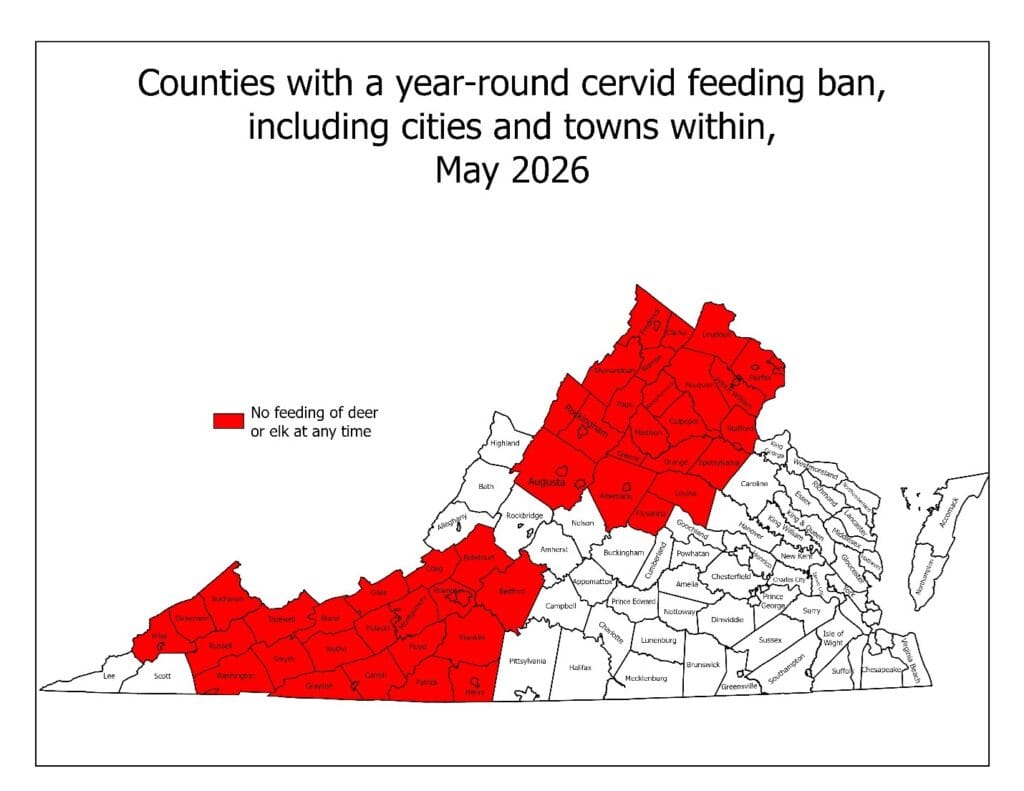
Administrative code section 4VAC15-40-285 prohibits feeding of cervids (deer and elk) year-round within twenty-five miles of a CWD detection. The map below highlights all the counties that have a year-round cervid feeding ban because of CWD detections or due to inclusion in the Elk Management Zone. No additional counties are being added in 2026.
The Department sincerely appreciates the assistance of deer hunters in these areas for their willingness to have their deer tested for CWD. Additionally, DWR is grateful for the help of commercial deer processors and taxidermists across the Commonwealth who assisted with the Department’s CWD surveillance efforts. These partnerships proved effective in acquiring over 5,000 samples this past season.
CWD has been detected in 37 U.S. states and four Canadian provinces. In Virginia, a total of 488 deer from 18 counties have tested positive since 2009. This incurable disease, found in deer, elk, and moose in North America, is a slow and progressive neurologic disease that ultimately results in death of the animal. The disease-causing agent, a prion, is spread through the urine, feces, and saliva of infected animals.
Noticeable symptoms of CWD, though they may not appear in animals for 16 months to two years, include staggering, abnormal posture, lowered head, drooling, confusion, and marked weight loss. These symptoms are rarely seen until the disease is well-established in an area. In Virginia, deer exhibiting these clinical symptoms have been detected in Clarke, Culpeper, Fauquier, Floyd, Frederick, Montgomery, Page, Rappahannock, Roanoke, Shenandoah, and Warren counties. There is currently no evidence that CWD can be transmitted naturally to humans, pets, or livestock, but the Centers for Disease Control and Prevention advise hunters to test all deer harvested from known CWD-positive areas and to not consume any animals that test positive for the disease.
Additional surveillance data, descriptions of regulations pertaining to CWD, maps of DMAs, and more information about CWD can be found on the DWR website.
Information from a release. Edited by Dan McDermott.