New law lets Virginia schools start earlier
(The Center Square) – Virginia students can head back to class earlier under a change to state law giving local school boards more flexibility over when the school year begins.
The change comes as students across the Richmond area return to classrooms this week.
The law, which took effect July 1, allows school divisions to schedule the first day of class as early as 14 days before Sept. 1. For the 2026-27 school year, that meant schools could open as early as Tuesday of last week.
Before the change, Virginia law generally set the earliest start date at 14 days before Labor Day.
The General Assembly approved the change this year through House Bill 1455, which amended Virginia’s school calendar law. The new law replaces Labor Day with Sept. 1 as the date used to determine how early classes may begin.
School divisions are not required to open earlier. Local school boards still decide when classes begin within the window allowed by state law.
Some divisions took advantage of the earlier window this year. Goochland County Public Schools brought prekindergarten, kindergarten, sixth- and ninth-grade students back Aug. 17, followed by all students a day later.
Amelia County Public Schools also listed Aug. 18 as its first day of school.
Richmond Public Schools began its staggered return Monday, with preschool through fifth grade and students in sixth and ninth grades returning. Students in seventh and eighth grades and grades 10 through 12 return Tuesday.
Virginia’s rules on school start dates have changed several times in recent years.
Before 2019, most school divisions generally could not begin classes before Labor Day without a waiver. Lawmakers later gave divisions more flexibility to start earlier.
This year’s change moves the earliest allowable start date again, this time tying it to Sept. 1 instead of Labor Day.
Schools that begin classes before Labor Day are still generally required to close from the Friday immediately before Labor Day through the holiday. The Virginia Board of Education can waive that requirement for qualifying year-round instructional programs.
The change gives local officials more room when building calendars around instructional days, testing, holidays and school breaks.
For families, the new law does not mean every Virginia school will begin in mid-August. It gives local school boards a wider window to decide when students return each fall.
This post was originally published on The Center Square.
Postal Service moves ahead with mail ballot rule amid court battle
WASHINGTON — With just over two months until the November midterms, a federal district judge in Massachusetts is chastising the Trump administration for sowing confusion and “creating” an emergency by noticing a rule Friday that the U.S. Postal Service will eventually require federally regulated mail-in ballot voting envelopes and state data.
A 95-page notice alerting that the final rule would appear in the Federal Register on Aug. 26 outlined justifications for federal requirements on states to redesign ballot envelopes and provide a list of recipient names and addresses to USPS. The final rule became effective Friday, according to the document.
The final rule runs contrary to U.S. District Judge Indira Talwani’s Aug. 11 preliminary injunction barring the federal government from changing states’ mail-in voting rules prior to the Nov. 3 midterm elections, the judge wrote in a brief order on the docket Sunday.
“Defendants did not file an appeal and did not seek, let alone obtain, a stay of the preliminary injunction,” Talwani wrote. “Nonetheless, on August 21, 2026, USPS issued its Final Rule, with an anticipated publication date in the Federal Register of August 26, 2026.”
Talwani was appointed to the bench by President Barack Obama in 2013 and unanimously confirmed by the Senate the following year.
Effective date delayed
The rule includes a provision that it will not be in effect for this year’s midterm elections if Talwani’s injunction is still in place, but the judge said it would still create significant confusion for voters.
The Trump administration asserted the rule would “have no effect on the rules themselves while the injunctions are in place, while ignoring the confusion that the publication will engender,” Talwani wrote.
It’s unclear what effect the final rule will have on the active litigation on the issue.
The federal government had appealed Talwani’s injunction because, it argued, Trump’s order could not be challenged until an agency published a final rule.
Groups want quick order
The voting rights advocacy groups, led by the League of Women Voters of Massachusetts, who sued President Donald Trump and administration officials over a March executive order overhauling mail-in voting procedures swiftly filed an emergency motion Saturday.
They urged Talwani to quickly enforce her injunction, and to order expedited responses from the administration, citing “immediate, ongoing, irreparable harm caused by Defendants’ violation of the preliminary injunction, and in light of these fast-approaching dates.”
“There are now only 73 days before the November 2026 election, and far fewer before mail ballots begin to go out,” they wrote.
The Trump administration appealed to the U.S. Supreme Court in late July a similar district court ruling against its mail-in voting restrictions order in a case brought by nearly two dozen Democrat-led states.
The states argued that the federal government has no constitutional role in election administration, that the executive order unfairly limited vote-by-mail, which some states use exclusively, and that an overhaul of ballot requirements this close to an election was unworkable.
High court appeal
In a supplemental brief filed to the Supreme Court justices Monday, U.S. Solicitor General D. John Sauer said the USPS’s rule issuance “underscores the need for relief from the district court’s improper, unripe injunction.”
“The Postal Service’s final rule imposes only modest requirements for preparation and envelope design for federal ballot mail — requirements that fall well within its traditional authorities to impose mailing standards for particularly sensitive types of mail,” wrote Sauer, who formerly worked as Trump’s personal defense attorney.
Democratic officials in 23 states — California, Massachusetts, Nevada, Washington, Arizona, Colorado, Connecticut, Delaware, Illinois, Maine, Maryland, Michigan, Minnesota, New Jersey, New Mexico, New York, North Carolina, Oregon, Rhode Island, Vermont, Virginia, Wisconsin and Pennsylvania — and the District of Columbia brought the suit challenging the executive order.
Twelve states with Republican attorneys general — Alabama, Missouri, Florida, Indiana, Kansas, Louisiana, Montana, Nebraska, Oklahoma, South Carolina, South Dakota and Texas — joined the appeal to the Supreme Court on the federal government’s side.
This post was originally published on Virginia Mercury.
Last Virginia gun ban case put on hold
(The Center Square) – The last pending state court challenge to Virginia’s new assault weapons restrictions has been put on hold as courts await guidance from the U.S. Supreme Court.
A Lancaster County judge Friday granted a stay in John Crump, et al. v. Jeffrey S. Katz, a challenge to Virginia’s restrictions on certain semiautomatic firearms and large-capacity magazines.
The decision means the Lancaster County case now joins three other state court challenges and a federal case that have been paused while the Supreme Court considers challenges to similar firearm restrictions.
Attorney General Jay Jones said the decision puts Virginia’s cases on a consistent legal path.
“With the United States Supreme Court now reviewing major challenges to assault weapons bans, this stay ensures Virginia’s cases move forward on solid, consistent footing,” Jones said in a statement.
The stay does not determine whether Virginia’s law is constitutional and does not lift the statewide injunction currently blocking enforcement of the challenged restrictions.
Senate Bill 749 and House Bill 217 were scheduled to take effect July 1. The laws would restrict the future manufacture, import, sale, purchase and transfer of certain semiautomatic firearms and magazines capable of holding more than 15 rounds. Virginians who legally possessed affected firearms and magazines before the restrictions were set to take effect may continue possessing them.
The Lancaster County lawsuit is one of four challenges filed in Virginia circuit courts. A three-judge panel appointed by the Supreme Court of Virginia previously denied the state’s request to consolidate the cases, allowing them to continue separately.
In a separate Washington County case, Circuit Judge Jeffrey L. Campbell expanded a preliminary injunction statewide before later staying that litigation while the Supreme Court considers challenges to similar restrictions.
A separate federal lawsuit has also been stayed.
The Supreme Court agreed June 30 to hear Viramontes v. Cook County and Grant v. Higgins. The rulings could shape how lower courts evaluate Virginia’s law and similar firearm restrictions.
This post was originally published on The Center Square.
What Virginia’s assault weapons ban pause means for gun owners and more headlines
• “What Virginia’s assault weapons ban pause means for gun owners and retailers.” — WSET
• “Virginia SUN Bucks food program has an approaching deadline for families.” — WRIC
• “Virginia Black Expo draws thousands to Main Street Station: ‘A rising tide raises all ships.’” — WTVR
• “Virginia Beach looks to turn its surf culture into a year-round economic driver.” — 13newsnow
• “Virginia man charged with impersonating a police officer at a police station.” — WTOP
This post was originally published on Virginia Mercury.
Legislators didn’t allow local bans of gas-powered leaf blowers. Va. localities are doing it anyway.
Three years in a row of losing in the legislature might persuade some people to give up trying to get what they want. For members of the group Quiet Clean Virginia, their losing record simply challenged them to seek another path to victory.
Quiet Clean Virginia and its affiliate groups in Northern Virginia advocate for local bans on gas-powered leaf blowers, machines that are either essential to modern suburban living or the scourge of it, depending on your point of view.
Their pollution-spewing, two-stroke engines are linked to asthma, heart attacks and even global warming, and their headache-inducing roar is the bane of the work-from-home set, parents of napping children and night-shift workers who must sleep during the day.
But on the plus side, they are really good at blowing detritus off people’s lawns.
These days electric leaf blowers can also move leaves around, with no pollution and less noise. So advocates believe the gas version should no longer have a place in dense, urban environments where clean air and tranquility are already scarce.
Prohibitions have been in place elsewhere in the country for years, including in the District of Columbia since 2022, and in Maryland jurisdictions including Montgomery County since 2025.
Many residents of Northern Virginia would like their region to be next. A survey conducted by Arlington County showed almost three-quarters of residents support a total ban.
The problem is that even Democrats in the General Assembly have balked at giving local jurisdictions the express authority to regulate or ban gas-powered leaf blowers.
In a Dillon-Rule state like Virginia, localities have only the powers expressly delegated to them by the state. And the General Assembly has never said anything about what local governments can do about lawn care equipment.
Bills to grant localities this power have failed repeatedly in the House and Senate, and the votes weren’t even close. According to Quiet Clean board member Margaret McKelvey, lawn-care companies and leaf blower manufacturers lobbied hard against the measure, asserting it would cause economic ruin.
Still, the failure of the initiative wasn’t the end of the story.
Legislation would have been nice, but was it actually necessary? The Virginia Code gives localities the power to adopt “such measures as it deems expedient” to secure the “health, safety and general welfare” of their residents, including through enforcement of noise ordinances. That seems like enough authority.
Indeed, Alexandria attorney Jamie Conrad, a supporter of the legislation, told me in a phone call that several legislators he spoke with felt localities already have sufficient authority to enact a ban under the police powers delegated to them in the Virginia Code, and this was why they voted against the bill.
Proceeding cautiously, the City of Alexandria asked their then-local delegate (and former vice mayor), Elizabeth Bennett-Parker, to request an opinion on the topic from then-Attorney General Jason Miyares.
On August 12, 2024, Miyares replied with a letter confirming the city’s authority to ban gas leaf blowers simply by amending its noise ordinance.
Miyares, a Republican, acknowledged that the General Assembly had voted down legislation giving local governments express authority to regulate leaf blowers, but cited case law in rejecting any inference of legislative intent from those outcomes as speculative. Alexandria, he concluded, was clearly within its rights to ban the equipment.
Alexandria used that green light to amend its noise ordinance in May of 2025 and begin an 18-month phaseout of gas leaf blowers. A full prohibition is set to take effect on November 17, 2026.
Miyares’ opinion had leaned heavily on the authority in Alexandria’s city charter, though the power of counties to enforce noise ordinances under the Virginia Code is similar. Nonetheless, Arlington chose to move more slowly, holding extensive outreach sessions and soliciting feedback, including through a survey.
The county collected more than 3,500 written comments, the great majority of which favored a ban. Reading through the comments linked from the survey, noise is clearly the driving factor behind support for the ban, with pollution and health impacts as secondary concerns.
Most opponents cite the financial impact to homeowners and lawn care companies from having to buy new equipment. Complaints about government overreach make up a small (but often colorful!) part of the negative feedback.
Not surprisingly, Arlington’s survey also showed most lawncare companies oppose a ban, saying it would impose an economic hardship. More surprisingly, though, nearly one-third of companies said they were “very comfortable” with a total ban, suggesting that the electrification of leaf blowers is already underway.
With that support, last month the Arlington County board amended its noise ordinance to ban gas-powered leaf blowers effective January 1, 2029. The 30-month lag time is intended as a transition period giving owners of gas equipment time to change their equipment as it wears out, a frequent suggestion in the comments. The county transitioned all of its own landscaping equipment to electric in 2025.
McKelvey says other jurisdictions have been watching, but so far none have followed Alexandria and Arlington.
The path to do so is straightforward; most localities already have noise ordinances, and many already apply time restrictions and decibel limits to the use of loud machines. Fairfax County, for example, already bans the use of all lawn equipment between 9 p.m. and 7 a.m.
Lawn care isn’t alone; other loud activities also have time restrictions. Even dog parks have to close at night, and indeed the quiet hours for dogs are longer than those for lawn equipment. (Clearly, the dogs didn’t hire the right lobbyists.)
Still, localities will have no interest in banning gas leaf blowers as long as their residents don’t demand it. The idea likely won’t even be discussed in rural counties, unless as an occasion to ridicule Democrats. With technology on the side of batteries, the market will eliminate the two-stroke engine long before most governments do.
That’s cold comfort to the exhausted parent whose colicky baby has just been jolted awake. When that happens, even an avowed libertarian may waver on the sanctity of lawn equipment choice. Politics crumble when the baby is screaming.
As for whether Alexandria and Arlington have set off on a slippery slope to banning everything having to do with fossil fuels, McKelvey thinks not. For one thing, the price differential between gas-powered lawn mowers and electric is too great to make a similar restriction reasonable; for another, as I can attest, gas leaf blowers are just uniquely irritating.
I asked Del. Rip Sullivan, D-Fairfax, the House patron of the leaf blower ban legislation, whether he would put the bill in again next year, now that the localities that wanted it had gone ahead with their bans.
He told me he hadn’t decided, but added, “I’m glad to see Arlington taking this step, and I hope it sets an example for other localities that want it.”
This post was originally published on Virginia Mercury.
Chesapeake Regional may avoid criminal trial, but former OB-GYN Perwaiz’s patients are still suing
By Yiqing Wang/WHRO
Federal prosecutors said this week they have reached a tentative deferred prosecution agreement with Chesapeake Regional Medical Center for charges related to disgraced former OB-GYN Javaid Perwaiz.
The deal would require the hospital to admit certain facts, accept an independent monitor, repay health care programs and create a $12.8 million fund for Perwaiz’s former patients. If finalized, the deal would let the hospital avoid a criminal trial.
Legal experts previously told WHRO a federal conviction could cut Chesapeake Regional off from Medicare, Medicaid and other federal health care payments — a punishment that they said could put a hospital out of business.
Perwaiz was convicted in 2020 of health care fraud and false statements after prosecutors said he performed unnecessary surgeries and sterilizations.
Between 2010 and 2019, the hospital received $18.5 million from public and private benefit providers for procedures Perwaiz performed, including some prosecutors allege he misclassified.
Federal prosecutors have then charged Chesapeake Regional with conspiracy to defraud the United States and health care fraud, alleging officials at the hospital were aware of Perwaiz’s conduct and did nothing to stop him.
Court filings describe the civil litigation as involving more than 1,040 plaintiffs and care Perwaiz provided between 1984 and 2019, and the former patients allege Chesapeake Regional was negligent in hiring, retaining and granting privileges to Perwaiz.
The hospital pleaded not guilty to the charges in January 2025. This week, Chesapeake Regional confirmed to WHRO that a deal has been reached, but said it cannot comment further because the agreement is not finalized.
The U.S. Attorney’s Office said the proposed $12.8 million patient fund would be available to people whose medical records show they had procedures performed by Perwaiz at Chesapeake Regional.
But the fund would only cover losses allowed under the Mandatory Victims Restitution Act, such as the cost of medical procedures or therapy. It would not cover emotional distress or similar damages.
A class-action lawsuit against the hospital including more than 1,000 former patients is still ongoing.
A court order entered this week has shown multiple civil cases have been consolidated into one and several plaintiffs have dropped claims against the hospital and three former executives: James Reese Jackson, Peter Francis Bastone and Wynn Lawton Dixon Jr.
Claims remain pending against two former Chesapeake Regional CEOs: Donald S. Buckley, who quietly left the post in May, and Christopher Mosley, who the Virginian-Pilot reported in 2010 “resigned abruptly” after 5 years leading the hospital.
Chesapeake Regional has argued that the civil claims are barred by Virginia’s statute of limitations because the procedures happened years ago.
Plaintiffs said the legal deadline should not block their claims because of the hospital’s alleged conduct and the related criminal case.
A spokesperson for Victoria Wickman, who is representing the plaintiffs, told WHRO the former patients will next seek evidence from the defendants and ask the court for permission to update their complaint.
This post was originally published on Virginia Mercury.
Virginia considers calls for mandatory school nurses as healthcare gaps persist
As schools reopen across Virginia, just under 10% will operate without a nurse, leaving critical gaps in student healthcare, advocates say. School nurses are responsible for managing complex student medical conditions and helping to reduce absenteeism.
Most school divisions in the commonwealth employ nurses, but current laws permit, rather than require, their presence.
Legislators and experts are exploring updating the state’s Standards of Quality, the school funding baseline requirements for the state and local governments, to include mandatory full-time licensed nurse positions. A report is expected to be presented to the state’s School Health Services Committee next month.
“It is time that we establish a standard of quality that really does require a nurse in every school,” said Senate Education and Health Committee Chair Barbara Favola, D-Arlington, who also chairs the state’s school health services committee.
Favola, advocates and education leaders in Virginia are pushing for mandatory full-time licensed nurses in every public school. Advocates argue it’s imperative to have a nurse in all schools, especially as lawmakers require more health protocols in learning environments.
“It sets a dangerous public policy precedent to continue passing legislation that requires schools to maintain medications, emergency medical equipment, and specialized health protocols without also requiring a qualified healthcare professional to oversee their implementation,” Betsy Looney, former president of the Virginia Association of School Nurses, said.
Earlier efforts have been largely unsuccessful because localities must match the costs, especially in jurisdictions with high local composite indexes, which determine how much localities can pay for their schools.
Last year, the Virginia School Health Services Committee discussed the goal of stationing registered nurses in all of Virginia’s schools and there have been multiple efforts to pass legislation.
In 2020, then- state Sen. Jen Kiggans and former Del. Dawn Adams carried legislation requiring a registered nurse in every Virginia school building. The proposal did not advance because lawmakers sought additional data.
Could COVID-19 make a school nurse requirement in Virginia a reality?
About 90.1% of Virginia’s public schools had a licensed nurse, according to data available from the Virginia Department of Health from the 2024-2025 school year. Of these, 69.9% are registered nurses, 20.1% are licensed practical nurses and around 10% are neither.
Both types of nurses are medical professionals, but RNs have more training and receive higher pay.
The data equates to roughly one full-time nurse per 619 students statewide.
Dr. Dana Ramirez, a pediatrician representing the Virginia Chapter of the American Academy of Pediatrics, said the organization wants state law to be amended to require a licensed nurse in every public school building in the commonwealth.
The American Academy of Pediatrics first recommended a minimum of one full-time registered nurse in every school in 2016. The National Association of School Nurses subsequently supported and has continued to advocate for this standard.
“A school nurse provides students access to comprehensive health services and timely recognition and treatment of physical and mental health needs,” Ramirez said in a statement. “This optimizes school attendance, classroom time, and student success, allowing students with acute and chronic medical conditions to remain in school.”
How nurses serve students
Nurses provide the clinical expertise to help students manage complex and chronic health conditions, advocates said. Some of them provide individualized healthcare plans and monitor students for medication side effects, including those related to mental health diagnoses.
Looney said teachers, principals, and administrators should not be expected to function as the school’s healthcare professional.
“While school personnel play an essential role in supporting students, they should not bear the responsibility of managing clinical programs for which they have neither the education nor the professional licensure,” she added.
Nurses are also qualified to oversee and implement life-saving protocols required by law, including the use of stock epinephrine and naloxone for opioid overdose response and the use of automated external defibrillators, or AEDs, commonly used in an emergency to help a heart return to a normal rhythm.
Advocates have also said that having nurses in schools will not only provide relief for nurses floating between schools within a single division, but also support families by helping minimize disruptions to parents’ and caregivers’ work schedules and costly emergency room visits.
Keith Perrigan, superintendent of Washington County Public Schools and president of the Coalition of Small and Rural Schools, said such efforts are important in rural communities.
“Investing in a licensed nurse in every school building is an investment in student health, academic achievement, family stability, and the overall well-being of our communities,” Perrigan wrote in an Aug. 7 letter.
He added, “Requiring a licensed school nurse in every Virginia school is not simply a healthcare issue – it is an educational, public health, and student safety imperative.”
What’s next
Advocates say the first step to putting more nurses in schools is updating the state’s SOQ to include mandatory, full-time licensed nurses among the specialized student support positions that each school board is allowed to provide, thereby making the requirement a formal policy.
The minimum number of specialized student support positions per 1,000 students is three, according to state law.
The list includes school social workers, school psychologists, school nurses, licensed behavior analysts, licensed assistant behavior analysts and other licensed health and behavioral positions, which may either be employed by the school board or provided through contracted services.
Such action would require legislative approval by the General Assembly and the governor.
The Virginia School Health Services Committee will receive a report on the initiative Sept. 23 at 2 p.m.
This post was originally published on Virginia Mercury.
Virginia, Maryland have mixed financial picture
(The Center Square) – Virginia avoided all eight financial warning signs in a new study, though several local governments and school systems did not.
Maryland received one state-level warning, while some of its counties, cities and school systems showed more financial pressure.
The Reason Foundation study looked at audited financial reports and measured governments in eight areas, including debt, available cash, spending compared with revenue and liabilities per resident or student.
A government received a red flag each time it crossed one of the study’s thresholds. Researchers said one red flag does not necessarily mean a government is in financial trouble.
Virginia was one of 23 states with no red flags.
The results were more mixed at the local level. Fairfax County received two red flags. Richmond and Norfolk received one each, while Chesapeake and Virginia Beach received none.
Several of Virginia’s largest school systems had more.
Chesterfield County Public Schools and Fairfax County Public Schools each received three red flags. Henrico and Loudoun County schools received two each. Prince William County and Virginia Beach schools received one each.
Chesterfield schools reported about $680 million in liabilities compared with about $254 million in assets, according to the study.
Fairfax schools reported nearly $4.1 billion in liabilities compared with about $3.9 billion in assets. That worked out to about $22,777 in liabilities per student, above the study’s $20,000 warning threshold.
Maryland received one state-level red flag, tied to its unrestricted net position, a measure of what remains after accounting for certain financial obligations and restrictions.
Some Maryland local governments received considerably more.
Baltimore County and Prince George’s County each received four red flags. Montgomery and Anne Arundel counties received one each.
Baltimore received five of the eight possible flags. The city reported about $9.7 billion in liabilities, or more than $16,000 per resident. It also received a warning because its liabilities were more than twice its annual revenue.
Maryland’s school systems varied widely.
Prince George’s County Public Schools received four red flags. Howard County Public School System and the Board of Education of Montgomery County received three each, the Board of Education of Baltimore County received two, and the Board of Education of Anne Arundel County received one.
Baltimore City Public Schools stood out in the other direction.
The school system received no red flags and was one of only two of the nation’s 100 largest school districts examined to avoid all eight.
The report relies largely on fiscal 2023 financial data, so the findings are not a current snapshot of government finances.
Reason Foundation said the study used financial reports from a database covering more than 20,000 state and local government entities.
Researchers said the measurements are intended to identify areas that may deserve closer attention rather than determine whether a government is in financial crisis.
This post was originally published on The Center Square.
Eastern Shore leaders, residents dubious of mineral mining pitch. They have good reason to be.

Two whimbrels, migratory birds that stop over on the Eastern Shore of Virginia, walk along an intertidal flat in the Volgenau Virginia Coast Reserve in November 2020. (Sarah Vogelsong/Virginia Mercury)
The initial public comment period for an unprecedented proposal to mine minerals from the Atlantic Ocean off Virginia’s Eastern Shore ends on Saturday, Aug. 22. Over 1,300 comments have been filed, the vast majority opposing offshore mineral leases.
But thanks to the arcane U.S. regulatory approval process, the door to public input will close with most Eastern Shore residents lacking enough information to judge the risks to their livelihoods and shorelines.
The stakes are enormous. A Fortune Business Insights report projected that the global marine mining market will grow from $6.18 billion in 2026 to $65.56 billion by 2034. North America would produce 41% of that growth, the analysts projected.
Federal government scouts for interest in mineral mining off Virginia shores
Earlier this year, Florida-based Odyssey Marine Exploration and Michigan-based Great Lakes Dredge & Dock Company filed an unsolicited request for a lease to mine sites within a 2,700 square mile area off the Virginia’ coast.
In their proposal, the companies focused on the need for the U.S. to find domestic sources of critical minerals, including rare earth minerals like those used in cell phones and military equipment.
This pitch plays well with the Trump administration’s desire to stop buying these materials from foreign countries, especially China.
Ironically, Virginia’s 1st Congressional District U.S. Rob Wittman, a Republican who represents many Chesapeake Bay watermen, authored recent legislation which expands mineral mining. 2nd Congressional District U.S. Rep. Jen Kiggans, who represents the Eastern Shore, voted for that bill.
Odyssey promises “to fully understand the local environment—how the seafloor, water, and wildlife interact—before any dredging activity is proposed.” The company will use “measures to avoid, minimize, and monitor potential impacts” and involve “regulators, scientists, stakeholders, and the public in a transparent and collaborative way.”
Communities with the most to lose would welcome more information.
Accomack County borders the Atlantic Ocean. County Supervisor Jeffrey Parks told me he first heard of Odyssey’s proposal when the media reported on a Bureau of Ocean Energy Management (BOEM) announcement about leasing, back in June.
Since then, information about risks has been so sparse that Parks and other Accomack supervisors told the BOEM they opposed sea mining leases.
“Nobody likes to be surprised,” Parks said. “If (mining) is a way to add jobs, I’d be all over it. But I don’t know enough to know whether (Odyssey) will be exploiting resources. I feel they missed an opportunity by not coming to the local government first.”
The board’s official comment to the BOEM reflected that frustration.
“Any large-scale seabed mining or dredging activity has the potential to alter marine habitats, affect water quality, disrupt fisheries, and negatively impact recreational opportunities that attract thousands of visitors to our region each year,” the supervisors’ comment reads.
The board also worried that offshore mining would interfere with the Mid-Atlantic Regional Spaceport, NASA’s Wallops Flight Facility and Navy testing and training areas.
A dearth of information about mining risks continues to bedevil Eastern Shore communities, individuals, and groups.
“We really don’t know about the mining process,” said Susan Bates, director of the Virginia Coast Reserve Program for The Nature Conservancy in Virginia.
“We don’t know about the risks. There are 133,000 acres of conserved lands on the Eastern Shore. Water quality allows for sea grasses. The clam industry here is one of the largest in the nation, and it is on the ocean side.”
The Virginia Waterman’s Association told the feds it has “grave concerns regarding the environmental impacts that could affect commercial fishing.”
The group laid out specific requests:
- “A detailed analysis of commercial fishing in the proposed area to understand the full impacts” of mineral mining.
- “A detailed sediment transport and plume modeling to evaluate both short-term and long-term movement of disturbed sediments under varying seasonal and storm conditions.”
- An evaluation of “cumulative impacts of mineral extraction in combination with other stressors affecting Virginia’s marine ecosystem and existing fisheries.”
- “A fisheries mitigation and compensation program to address any demonstrated economic losses to commercial fishermen, seafood businesses, processors, and supporting industries resulting from project activities.”
Northampton County Supervisors told the BOEM it would oppose commercial sea mining leases “until comprehensive scientific, environmental, and economic analyses demonstrate that such activities pose no unacceptable risk to Northampton County, its residents, its economy, or its natural resources.”
An Odyssey statement sent to me emphasized that the mining lease request is in early days, with a long regulatory journey ahead. The statement outlined environmental and wildlife protections, including whale habitats.
A company spokesperson also stressed that there is no deep-sea mining proposed. The project will use shallow-water mining with dredges.
Deep-sea mining has been linked to plumes of sediment that can smother species and alter marine habitats by changing water quality and washing ashore.
The University of Helsinki in Finland studies sea mineral mining. Environmental impacts of shallow-water mining with dredges may take less time to abate than deep-sea mining, a university report said, but shallow sea mineral mining remains a serious risk to marine life and ecosystems.
“Claims of reduced environmental impacts of shallow-water mining are not backed by credible evaluations, but by hopes and assumptions that support a pro-mining narrative,” the report noted.
Shallow-water mining is also less regulated than deep-sea mining, offering a “regulatory grey area (that) may be seen as an opportunity to circumvent stringent rules.”
There are plenty of details to come, but all of them lead to a single conclusion: If you are a Virginian opposed to mineral mining off your coast, you better pay very close attention to a very confusing process.
Public comments on the proposal for marine mining leases off the Eastern Shore are being accepted here until 11:59 p.m. on Saturday, Aug. 22.
This post was originally published on Virginia Mercury.
Congressional Democrats launch probe into ICE enforcement in NoVa, more headlines
• “Congressional Democrats launch probe into ICE enforcement in Northern Virginia.” — WTOP News
• “Virginia hospitals keep closing labor-and-delivery units, stranding rural mothers.” — WSLS
• “Texas has now surpassed Virginia for data center construction.” — KXAN
• “Even with upcoming raises, Virginia teacher salaries still lag the national average.” — WVTF
• “Pharrell’s Adidas Virginia Adistar Jellyfish returns this weekend.” — Sports Illustrated
This post was originally published on Virginia Mercury.
After eastern groundwater report detailed aquifer concerns, Va. lawmakers consider policy shifts
After the Virginia Department of Environmental Quality released a 117-page report indicating that available groundwater east of Interstate-95 is “declining (in) availability in the near future,” the agency pitched recommendations on how to tackle the issue to lawmakers Thursday in Richmond.
The report detailed the groundwater needs for the Eastern Groundwater Management Area, and showed that the region would not be able to handle any new major water withdrawal permits for industry use without risking water availability.
It also outlined potential impacts from ground subsidence and saltwater intrusion into the aquifers in the management area.
The report triggered a bipartisan set of senators to request that Gov. Abigail Spanberger call a special session to address potential policy changes and solutions. Spanberger has not publicly responded to that request.
Virginia senators request special session to act on ’deeply alarming’ groundwater report
DEQ Director Mike Rolband told legislators Thursday that the state’s Groundwater Management Act of 1992 has had mixed results. While water withdrawals have significantly reduced, the issues laid out in the report are still present and could present major challenges if left unaddressed.
One potential solution is the SWIFT water injection project that is currently under construction. It will conduct regular injections of highly treated wastewater back into the aquifer to help raise the water levels.
The Hampton Roads-based project has already done a test run of injecting one billion gallons of water. One of the locations, set to start daily operations of about 10 million gallons a day off the James River, will begin in October. Another location is anticipated to begin injections in 2029.
It is an experimental project that has never been performed in Virginia before, and is one of the largest projects of its kind in the nation, according to DEQ representatives. Still, DEQ’s water availability concerns remain, especially since it will take time for the water injections to spread through the aquifer.
“It would be a good idea to, you know, take the bull by the arms and try to solve those problems. So we don’t have to worry about the future,” Rolband said.
Lawmakers also considered whether the state and localities should invest in more treated water injection projects farther north in the groundwater management area, which would help send more water to areas in need.
The agency proposed several policy recommendations that would have to be enacted by the General Assembly.
DEQ suggested the legislature allow the department more discretion in being able to deny water withdrawal permits. The agency is also seeking more autonomy to direct permit applications towards alternate water sources such as wastewater reuse or reducing leaks in existing infrastructure.
The department also asked for increased funding to hire more staff to study the groundwater issues and manage permit reviews.
The biennial budget lawmakers passed and Spanberger signed in late June includes funding to allow the department to locate potential sites for a SWIFT-like project in Northern Virginia.
DEQ representatives also suggested that the price of groundwater withdrawal fees could be increased to pay for more projects like the SWIFT injections.
The Chesapeake Bay Foundation weighed in at the meeting with a suggestion for lawmakers to scrutinize the existing Groundwater Management Act to find the weak points allowing a projected decline in water availability, even though the aquifer is stable for the time being.
“Because we have been here before. And so, I know we have sort of conflicting opinions on the efficacy, but we are once again projected to decline, despite having the Groundwater Act in place,” said Jay Ford with CBF.
Ford said the closure of a paper mill in Franklin that has since partially reopened at a reduced rate was part of the reason the aquifer was able to stabilize after years of decline.
Mission H2O, a group representing industrial, municipal and agricultural industries, stated in a presentation that the aquifer is stabilized and that the 1992 law has been successful in reducing permitted water withdrawals.
They said SWIFT is revolutionary in terms of improving groundwater levels but acknowledged the need for further discussions on how to manage unpermitted withdrawals from the groundwater management area, which reportedly take up a third of the water use.
“The aquifer is better understood, continues to be monitored, and is stable,” said Andrea Wortzel, a representative of Mission H20 Virginia. “Existing protections and regulatory authority are working and will continue to work. SWIFT is a game changer that will further improve the situation.”
Despite the industry representatives’ testimony, Rolband and Ford agreed that policy shifts are necessary to make human consumption the top priority when maintaining groundwater in the eastern region of the commonwealth.
“The biggest concern, if you do nothing, is if SWIFT is not as good as we hope this is gonna be, we’re gonna have a problem,” Rolband said. “We think that things are relatively balanced right at this moment, but a slight damage trend. SWIFT could show us a slight upward trend. But we’re, you know, it’s just kicking the can down the road. It’s been a problem for over 30 years.”
This post was originally published on Virginia Mercury.
Trump’s court workarounds push limits but are within legal bounds, experts say
WASHINGTON — President Donald Trump has not slowed his pursuit of central policy goals and personal passions, even after major setbacks at the U.S. Supreme Court and other federal courts.
The high court in its 2026 term delivered blows to Trump’s core campaign promises to upend a constitutional provision governing who becomes a U.S. citizen at birth and to swiftly address the growing national debt with “trillions of dollars” raised by taxing imports.
The justices also ruled the president cannot fire, without cause, Fed Board Gov. Lisa Cook and deny her a chance to plead her case. And a lower court blocked Trump from installing his name on the John F. Kennedy Center for the Performing Arts.
But even after the Supreme Court ruled against him, Trump is forging ahead and using what some legal observers describe as “creative lawyering” to find alternative routes to push his agenda, even as public support fades.
He ordered new blanket tariffs in late July on at least 60 trading partners. He signed a new round of birthright citizenship orders Aug. 6. Reports also revealed that Cook received a letter Aug. 5 from administration officials that Trump is again “considering” firing her.
The moves test the power dynamic between the executive and judicial branches, but are not illegal or even unconventional in modern times, experts said.
“They look at it and they say, ‘We want to advance a particular policy agenda. Here’s the whole array of legal arguments that we might be able to use that give us authority,’’’ said Scott Anderson, senior fellow at the centrist Brookings Institution and senior counsel and editor of the publication Lawfare.
Trump is not alone in this pursuit. After all, President Joe Biden found another route to student loan debt relief after a loss at the Supreme Court. A federal appeals court effectively axed the Biden-era relief program in March.
“It does happen, and (administrations) will sometimes run the risk of legal reversal, but it’s a rarer move,” Anderson said. “For this administration, it’s become the standard move.”
‘Spirit of the law’
While Anderson said Trump’s responses to the rulings are “not surprising” given the legal strategy of his second term, one could argue the “legal brinksmanship … often clearly runs contrary to some of the spirit of the law, and it capitalizes on a lot of institutional inefficiencies.”
Thomas Berry, a legal scholar with the libertarian Cato Institute, said while Trump has often used rhetoric to “delegitimize the court,” his recent actions are not out of legal bounds.
“What he’s doing is distinct from outright disobedience or ignoring a Supreme Court’s decision, and it’s important to stress that that line has not been crossed,” said Berry, who directs the institute’s Robert A. Levy Center for Constitutional Studies.
A White House spokesperson said the administration has “always followed court orders.”
“The Supreme Court’s ruling on the Cook case required notice and an opportunity for a hearing in considering whether the President should take certain adverse employment actions. The President’s notice sent to Fed. Governor Cook offers exactly that within the precise structure enunciated by the Court,” said Lauren Bis in a brief written response from the White House.
A Department of Justice spokesperson, who did not provide a name, wrote in a statement, “Investigative and prosecutorial decisions are made based on the law and the facts. To date, DOJ has prevailed in 24 emergency applications before the Supreme Court, winning over 80 percent, an unprecedented win rate that speaks for itself, and has also won dozens of merits cases at the Court.”
The spokesperson highlighted the department’s Supreme Court win in June that allows the administration to follow through with plans to deport between about 350,000 Haitians and 6,000 Syrians who were living in the U.S. under Temporary Protected Status.

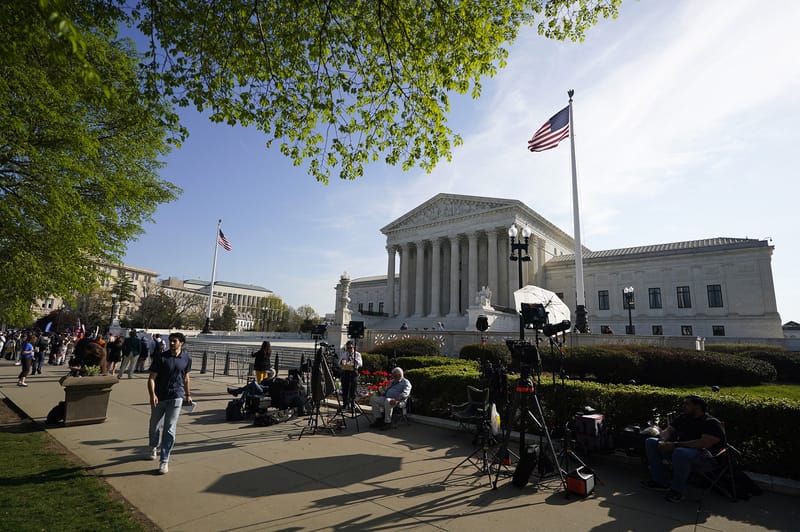
Members of the media set up outside the U.S. Supreme Court ahead of Trump’s arrival on April 1, 2026. The Supreme Court heard oral arguments in Trump v. Barbara to determine if Trump’s executive order ending birthright citizenship is constitutional. According to historians and the Court, it was the first time a sitting president has attended oral arguments at the nation’s highest court. (Photo by Al Drago/Getty Images) Birthright citizenship
On the final day of its 2026 term, the Supreme Court rejected Trump’s sweeping attempt to deny citizenship to children born to parents who either do not have legal status or hold temporary legal visas.
Chief Justice John Roberts led the 6-3 opinion on June 30, writing that children born in the U.S. to parents who are unlawfully or temporarily present “are ‘subject to the jurisdiction’ of the United States and are citizens at birth under the Fourteenth Amendment’s Citizenship Clause.”
Today’s exceptions for those who are not subject to U.S. jurisdiction include foreign diplomats and their families, members of invading armies and in most cases foreign public ships passing in nearby waters.
On Aug. 6, Trump signed two executive orders again aimed at curtailing birthright citizenship. The first targets children born to the staff working for foreign diplomats; to children born in American Samoa, where Congress has yet to pass a citizenship law; and to the children born to parents who belong to what the U.S. defines as a “Foreign Terrorist Organization.”
“So what Trump is trying to do with these executive orders is he’s trying to say, ‘OK fine, those are the categories you’ve given us. We’re going to try to push those to the maximal extent possible,’” Berry said.
“And he interprets them broadly,” Berry continued. “Do people have diplomatic immunity or not? That’s kind of a factual question. Literally the ambassador and the ambassador’s spouse, they get diplomatic immunity. But does everyone from the foreign country working in the embassy similarly get immunity from U.S. law? That wasn’t my impression.”
Trump is also seeking to limit birthright citizenship by taking what Berry described as a “maximalist view” of what an invading army is.
“It’s not obvious that that analogy extends to people who are part of designated terrorist groups because they’re not literally rampaging and pillaging,” he said. “This is more people who are living here but have been, you know, labeled as part of a group that’s at odds with the United States.”
Anderson said the administration “clearly is intending to just take advantage of every hint and every limitation the Supreme Court decision left open.”
The American Civil Liberties Union on Aug. 12 began the process of asking the federal judiciary to reaffirm the Supreme Court ruling.
Tariffs
Trump’s trade policy provides another example of the administration finding a new legal reasoning after the Supreme Court struck down the initial basis for a major administration goal.
In the midst of refunding roughly $166 billion to businesses that paid taxes on imports under Trump’s emergency tariffs, the president has hopscotched across multiple trade statutes to continually impose at least 10% duties on most global goods since his Supreme Court loss in February.
In a 6-3 opinion, the high court struck down Trump’s unprecedented claim of tariff authority under the 1977 International Emergency Economic Powers Act. Congress retained tariff authority in most circumstances, Roberts wrote for the majority, and Trump could not use the statute to impose duties after declaring emergencies on trade imbalances and illegal drug smuggling.
Trump lost the case to a handful of small business owners and Democratic state officials. Tariffs are taxes paid by the importers, meaning American businesses were shouldering the additional costs.
Trump immediately turned to another statute, Section 122 of the Trade Act of 1974, which authorizes the president to unilaterally set up to 10% in tariffs for 150 days.
The order set off another round of legal challenges, including from Democratic-led states, in the U.S. Court of International Trade.
Less than a month after the Supreme Court loss, the U.S. Office of the Trade Representative also opened broad trade investigations under Section 301 of the 1974 law into the practices of nearly all U.S. trading partners.
As the clock ran out on Trump’s 10% blanket tariff under Section 122 on July 24, U.S. Trade Representative Jamieson Greer announced his office had found forced labor practices by roughly 60 of America’s trading partners, including Canada, the European Union, Japan, Mexico, South Korea, Taiwan and the United Kingdom, among dozens more. The findings triggered a 10% to 12.5% duty on most goods from those countries.
Days earlier, Trump announced he would use a Depression-era provision that had never been enforced — Section 338 of the Tariff Act of 1930 — to slap a 50% duty on most Canadian imports. The U.S., for now, has delayed the start of the high tariffs as talks with Canada continue, according to reports.
Trump’s strategy on pushing tariffs is “not really surprising at all,” Anderson said, adding “it’s not even inappropriate.”
“The Supreme Court never said, ‘You can’t do tariffs.’ In fact, it said basically you can. It just said ‘You can’t do it this way.’ And that automatically points to these other ways, which everyone said is probably a more sound way to do this if the president really wants to do this,” Anderson said.
“It doesn’t mean it’s good policy,” he added. “It doesn’t mean it’s a good idea, but there’s at least a very colorable case the president can do this all legally. ”

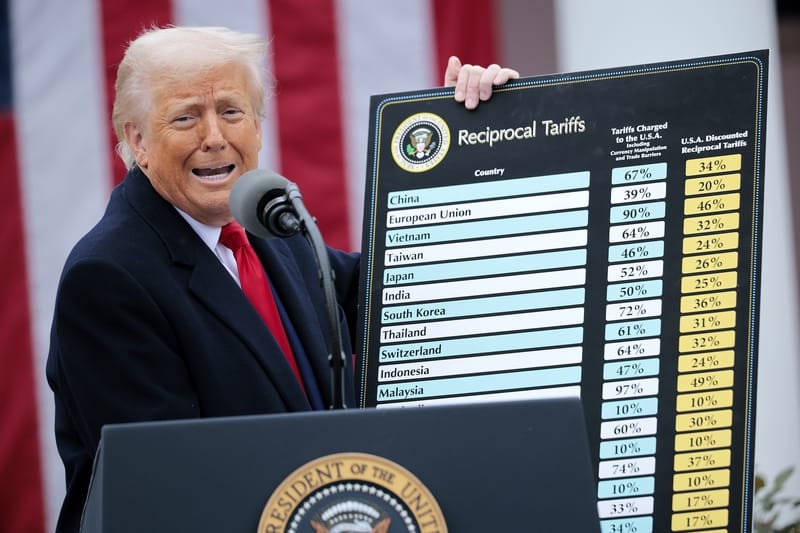
Trump holds a chart while speaking during an event in the Rose Garden at the White House on April 2, 2025. Touting the event as “Liberation Day,” Trump announced sweeping tariffs on imported goods. (Photo by Chip Somodevilla/Getty Images) 2025 deportation flights
Trump’s “aggressive” legal strategy has set him apart from other presidents, and, despite specific recent examples that haven’t crossed a legal line, the administration likely violated court orders in relation to immigration, according to observers.
“I think there are some cases that push the envelope, might be unlawful, particularly around, like, some of those early deportations,” Anderson said. “But the majority of the time, the executive branch has been responding and complying with court orders. It’s capitalizing on the fact that those orders are often very narrow.”
Berry also highlighted the March 2025 deportation flights that took off with hundreds of immigrants on board despite a court order as a potential example of cases “where these agencies have outright violated court orders.”
Overall, the courts have been a check on the administration’s view of expansive power, both experts said.
“It is worth taking a moment to realize, like, just how vastly smaller the scope of this (most recent) birthright executive order is after the Supreme Court,” Berry said. “The decision did cut off the vast majority of options the administration has. I mean, you think about the scope of millions of people that the original order would have affected, and compare that to this. It’s just night and day.”
Electorate another check
Voters are also a check on power, observers say.
With crucial midterm elections approaching, Trump’s net approval rating is -26, meaning the percentage of voters who approve of him is 26 points below those who disapprove, according to The Economist/YouGov poll figures published Aug. 18. A Reuters/Ipsos found Trump’s approval rating at a record low of 33%, according to data published Aug. 17.
A recent Fox New poll last month showed most voters disapproved of Trump’s handling of the economy. And 55% told Reuters/Ipsos just days before the Supreme Court ruling that they disapproved of Trump’s attempt to end birthright citizenship.
Trump surrounded himself in his second term with people who “openly denigrated” a lot of norms of the executive office and are “acting accordingly” to what they saw their voter base wanted, Anderson said.
“I think they probably overreacted to this idea that simply by winning the last election, that voters have a high tolerance for this,” Anderson said. “And Republicans in Congress and potentially in 2028 are going to pay a price for that.”
Anderson added if voters and lawmakers don’t like the loopholes Trump’s legal strategy is employing, then maybe it’s time for Congress to close them.
“If we don’t think our laws align with what we think is right ethically and good policy, then maybe they do need to be adjusted,” he said.
“Maybe if we want a robust separation of powers, we need to take actions that will empower the courts and Congress to push back on executive aggrandizement more effectively, as opposed to the trajectory over the most of the 20th century, which was implicitly, sometimes expressly, more or less empowering the executive branch on the assumption that the executive branch was going to self-constrain itself.”

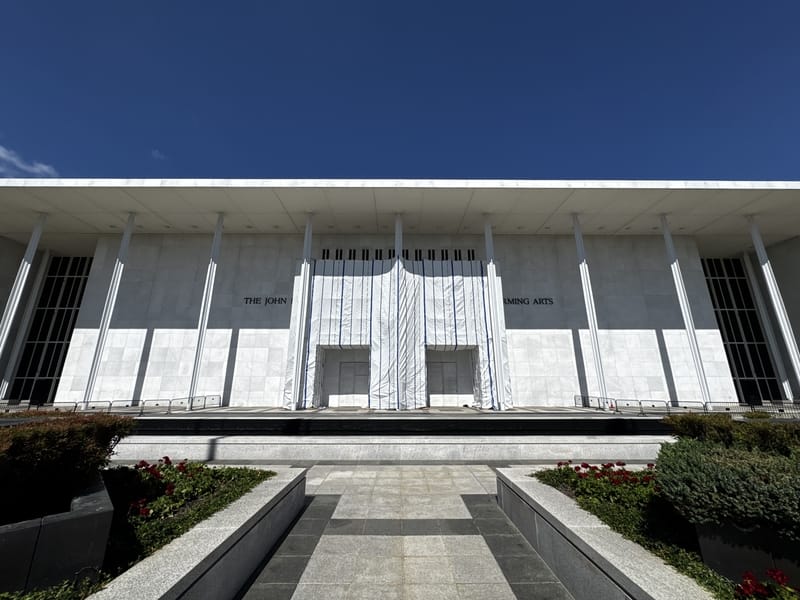
A tarp covers the facade of the John F. Kennedy Center for the Performing Arts in Washington, D.C., on June 15, 2026, after a federal judge ruled Trump’s name must be removed from the center. (Photo by Sam Gauntt/States Newsroom) ‘Everything people don’t like’
As for the Kennedy Center: Despite a judge’s order that led to the yanking of Trump’s name from the facade of the revered performing arts venue in mid-June, Trump’s hand-picked board voted Aug. 13 to again affix his name to the building.
This time, instead of above John F. Kennedy’s name, the board voted to add an inscription underneath to read “The John F. Kennedy Center for the Performing Arts Restored and Renovated By President Donald J. Trump,” according to court records.
A federal judge had found that Trump’s name, which had already been added, could not officially remain there without authorization from Congress.
“It’s sort of everything people don’t like about lawyers at its extreme. … This is kind of again looking for a loophole — they’re going to argue ‘We are not naming the center. We are adding this appendage,’” Berry said.
“So long as it’s just like naming the renovation, you know, kind of like a sponsorship deal at the end of the name of a stadium or something like that, that’s acceptable because it’s not renaming the center,” he continued. “So we’re likely to have litigation about that too, and it’s going to be a pretty lawyerly and probably annoying debate.”
This post was originally published on Virginia Mercury.
Va. health dept. improves nursing home inspection backlog, reforms sanction criteria for facilities
Stories of neglect in care or unsanitary living situations have plagued several of Virginia’s nursing home facilities in recent years and data backs up a lapse in oversight by state agencies.
With reform efforts underway, the Virginia Department of Health officials said they aim to adopt sanction criteria by the end of the year to rein in bad actors and get troubled facilities back on track.
As of July, 58% of Virginia’s nursing homes were overdue for inspections and 68 of Virginia’s 289 nursing homes were found to have serious deficiencies, according to ProPublica. Several of the state’s flagged facilities with numerous deficiencies also had high staffing turnover rates.
The issue has been salient among various healthcare spaces, including VDH.
In recent years, the state health department has grappled with staffing turnover — some of which stemmed from COVID-19-era retirements and burnout — along with management and financial issues that the agency has worked to overcome.
But problems within VDH also meant problems within nursing homes have not always received swift remedies or reprimand.
How the Virginia Department of Health is healing internal issues amid federal funding cuts
A series of WTVR investigations over the past year revealed deficiencies in nursing homes ranging from failure to report violence between residents, lack of attention to residents’ health conditions like incontinence, or misuse of medications.
Office of Licensure and Certification Director April Dovel, who stepped into her role late last year, has spent the bulk of this year making adjustments to get nursing home oversight operating smoothly.
To start, VDH has worked on hiring more inspectors and getting them trained for the job.
Industry representatives like the Virginia Health Care Association have supported state laws to boost oversight efforts and adjust once-stagnant licensing fees.
“They agreed to an increase in licensing fees so that we can increase our staffing,” Dovel said. “They want us to come out and complete these surveys.”
Bulked up staffing doesn’t translate to the agency immediately dispatching inspectors around the state in droves, Dovel said.
The federally-required training has typically taken a year to complete but Dovel’s team has pared the training process down to six months by providing trainees on-the-job experience in team outings for re-certification processes.
Seasoned staff handle investigations into filed complaints.
To date, she said, all new staff that have taken their certification tests within six months have passed.
In addressing backlogged inspections, she said her team has triaged the situation by focusing investigators on facilities that racked up multiple allegations.
More recently, VDH is fielding public comment on a proposed sanction mechanism Dovel said she hopes will be in effect by the end of the year.
Key provisions include that if a facility has had the same or similar violation on two consecutive inspections, the same violation three times within 18 months and repeated failures in correcting deficiencies, that entity could lose its license.
Sanctions would fall into three levels. The first step would be restriction on new admissions. Level two would entail a prohibition on new admissions and reaching level three would revoke or suspend a facility’s license.
If a nursing home is marked for closure, Dovel explained that her team regularly meets with officials in the Department of Medical Assistance Services and the Department of Aging and Rehabilitative Services to brainstorm how residents may be relocated to other nursing homes.
Public comment runs on the state’s regulatory town hall website until Sep. 9. People are already chiming in.
“Thank you for tightening (regulations), decreasing backlogs and increasing inspectors,” wrote an anonymous commenter who said they lived in a rural area of the state.
The person described nursing homes with broken heating or air conditioning, residents with unchanged bandages and the presence of pests and cleanliness issues in facilities.
Rural areas leave families little choice of where to house their aging loved ones, the commenter wrote, adding that meaningful enforcement can help ensure facilities fix issues.
“Please don’t give up, just push harder and keep asking for more help,” the person wrote. “Those are people living in these places, and they don’t deserve what they are getting.”
This post was originally published on Virginia Mercury.
Feds’ proposal to alter Head Start could ‘dismantle’ program in Virginia, parents and advocates say
Amanda Daugherty, a mother from Nottoway County, valued the Head Start program in Virginia because it closely reflected her values and experience before she was hired by the program in October 2021.
Less than six months later, the program came to her aid after her husband died, stepping in to help stabilize her family and give her children a strong developmental and educational start during a time of uncertainty.
“Our local agency … wrapped their arms around me. I had no family here, nothing,” Daugherty said, adding that Head Start helped her keep working to support her family.
Now, four years later, the program Daugherty called “very special” is facing an overhaul.
Earlier this month, the U.S. Department of Health and Human Services (HHS) Administration for Children and Families proposed significant changes to the program, framing them as measures to reduce federal regulatory burden, restore local flexibility and give greater authority to states, programs, and parents.
The administration’s proposal also seeks to remove unnecessary, overlapping requirements and refocus Head Start on children’s health, nutrition, physical activity and school readiness.
HHS Secretary Robert Kennedy Jr., appointed by President Donald Trump, said, “We are removing unnecessary bureaucracy, strengthening nutrition and physical health, trusting parents and local communities, and opening Head Start to hundreds of thousands more children.”
He added, “That’s how we renew the promise of Head Start for the next generation.”
Daugherty and advocates from the Virginia Head Start Association (VAHSA), which supports Head Start professionals through training and advocacy to improve the lives of young children and families, said the proposal risks the program’s future.
Their concerns focus on child safety, quality, and inclusion, family input and program capacity, and access and equity for underserved communities, all of which would be reduced or eliminated under the new plan, they said.
Virginia has nearly 11,000 funded Head Start and Early Head Start spaces for children under age five that support their educational and social development.
In 1965, HHS launched Head Start to provide health, nutrition and education services to children, including those whose families fall below the federal poverty line, which is currently around $30,000 for a family of four.
VAHSA Executive Director Dawn Ault said in a statement that staff see daily how the program changes children’s lives, helping them gain the skills they need to succeed in school. It helps parents find trusted partners and families connect to services that support their health and well-being.
“This proposal would strip away the standards that make those outcomes possible,” Ault said. “We urge HHS to withdraw this proposal and preserve the standards that have made Head Start work for children and families for more than 60 years.”
Advocates believe the proposal will weaken protections and quality standards for children because the administration plans to eliminate classroom ratios and group-size limits. The proposal would also reduce requirements for serving children with disabilities and multilingual learners.
“The idea in this notice of proposed rulemaking is that they will turn the ratios to the state ratios, which means you’re serving more children,” said Tamie Rittenhouse, Head Start director at the Children’s Center in Western Tidewater. “When you get up into those higher ratios, you’re not educating children. You’re warehousing them.”
The proposal would make parent committees optional and eliminate several federal requirements governing their structure, which the association argues will stifle parents’ perspectives and input.
The association is also concerned that the proposal would reduce program capacity by restricting how programs can use federal funds for day-to-day operations. The federal agency has proposed reducing the amount of Head Start grant funding that can be spent on administrative costs from the current 15% ceiling to 5%.
Limiting allowable administrative spending could constrain programs’ ability to fund operations, potentially leading to staff cuts, workforce retention challenges, or service reductions, opponents said.
HHS said the proposed rule could create up to 236,000 new spaces for children while strengthening focus on health and nutrition.
But this change will reduce access, leading to fewer children being able to participate in the program and reducing equity for vulnerable families, VAHSA said. This could compound challenges for rural, underserved and low-income communities, the association added.
“I feel like this notice of proposed rulemaking is basically a backdoor approach to dismantle the program from within, and … Head Start will cease to be what Head Start truly is,” Rittenhouse said
Public comments about the proposed shifts are open until Oct. 6, 2026. Search “ACF-2026-0595” or email [email protected]. Include the docket number ACF-2026-0595 and/or RIN number 0970-AD30 in the subject line of the message. HHS will then review the comments and decide whether to revise, finalize and adopt the proposed changes.
This post was originally published on Virginia Mercury.
Judge affirms ruling in favor of former felons in voting rights lawsuit
Despite winning a lawsuit earlier this year that found that certain Virginians with felony convictions should not have lost their voting rights, some Virginians missed their chance to vote in congressional primary elections earlier this month.
But a new ruling from U.S. District Court Judge John Gibney means that they will be able to vote in this November’s general elections and weigh in on a state constitutional amendment that would enshrine restored voting rights for people with felony convictions, so long as their prison sentences are complete.
The voting access issue stems from a series of 1870 laws called the Readmission Acts, which banned former Confederate states from constitutionally disenfranchising people other than those convicted of crimes considered “common law” at the time.
Virginians with felony records lose the right to vote unless they successfully petition the governor for restorationor are pardoned. The processes are subjective and have not always had clear guidelines.
Virginia’s chapter of the American Civil Liberties Union argued that Virginians with a variety of felony convictions should have never lost their voting rights in the first place. A judge ruled in their favor this past January and ordered the state to comply by May.
Attorney General Jay Jones then successfully sought an extension to June 1 so that the state could compile guidance for registrars and ascertain which modern-day felonies might still block someone from registering to vote.
Some former felons, eligible to vote this summer, are in registration limbo
For instance, illegally using tear gas was included on a list of such crimes from Jones’ office, “even though tear gas was not invented in 1870,” ACLU attorney Eden Heilman said in an interview, earlier this summer.
But as early voting began for congressional primaries in June, some would-be voters found themselves in a registration limbo.
“It is shocking that instead of taking this opportunity to rid itself of a Jim Crow-era scheme that has disproportionately impacted Black voters for more than a century, the attorney general’s office instead created a process that erected new barriers to registration and robbed many newly eligible voters of the opportunity to participate in the August primary elections,” Heilman said in a statement Thursday.
Earlier in the summer, documents obtained by The Mercury showed that registrars had been instructed to not fully process new voter registrations of people with felony convictions.
Additionally, some spplicants who qualified for the exception granted by the January ruling were unsure whether they should check a box on a question about if they had been convicted of a felony because it is a crime to lie on applications in the state.
Around that time, the ACLU filed their motion for a judge to speed up registrations and force the state’s compliance.
In his latest ruling, Gibney denied the plaintiff’s request for rewrites of election forms to adjust the felony question box, but affirmed his earlier ruling on the Readmission Acts.
Civil rights group files motion to speed up Va.’s reform of voter registration process for ex-felons
“The Commonwealth lagged — sometimes egregiously so — in implementation,” he wrote. “They failed to register the named plaintiffs, left misinformation on their webpages, and prevented class members from registering online. But the parties agree the Commonwealth fixed these failures.”
Just before the Aug. 4 primaries, Gov. Abigail Spanberger restored voting rights to 66,000 people, but it’s unclear how many of those Virginians would have been eligible due to the Readmission Act ruling.
While Jones’ office had considered 284 statutory felonies as applicable for continued disenfranchisement, Gibney’s order reiterates that “only” the 11 common law felonies from 1870 will apply.
Those are: arson, burglary, escape or rescue from jail, larceny, manslaughter, mayhem, murder, rape, robbery, sodomy or suicide.
Gibney gave the example of how a Virginia statute outlaws the use of tear gas to injure someone else.
“Perhaps a court could find someone guilty of common-law mayhem for using noxious gases to harm another, but a person found guilty of (that crime) is not a person found guilty of common-law mayhem,” Gibney wrote. “That person can vote.”
Gibney’s ruling affirmed the purpose of the Readmission Acts in preventing states from finding new reasons to disenfranchise people.
“This case is simple,” he wrote. “The Virginia Readmission Act gives a straightforward rule, and this Court’s injunction reflects that rule.”
This post was originally published on Virginia Mercury.
Virginia revenues finish $939M above forecast
(The Center Square) – Virginia closed fiscal 2026 nearly $939 million above its general fund revenue forecast, even as employment fell and Gov. Abigail Spanberger cautioned lawmakers against assuming the gains will continue.
State finance officials presented the year-end numbers Wednesday to the General Assembly’s Joint Money Committees.
Virginia ended the fiscal year with 43,600 fewer jobs. Federal government employment and professional and business services each lost about 20,000 jobs, according to the presentation.
Despite the job losses, average wages grew about 3.3% during the fiscal year, helping support income tax withholding.
Nonwithholding income tax collections provided another boost, growing by more than $500 million and coming in $347 million above forecast. Sales tax collections grew 6.5% during fiscal 2026.
Spanberger told lawmakers the stronger revenue numbers should not be treated as a guarantee of what comes next.
“But a good year isn’t necessarily a guarantee of the next one,” Spanberger said in prepared remarks.
She tied that caution in part to expected federal changes affecting Medicaid and SNAP, saying they could shift additional costs to Virginia’s budget in coming years. Spanberger said more than 300,000 Virginians on Medicaid risk losing coverage as provisions of the federal law take effect.
The final revenue figure also came in above what state officials expected earlier this summer. A June revenue reforecast projected Virginia would finish fiscal 2026 about $585.5 million above the official forecast.
The administration said in July that higher nonwithholding income tax payments and fewer individual income tax refund liabilities accounted for about two-thirds of the preliminary year-end surplus, two sources officials described as highly volatile.
The economic outlook presented Wednesday showed slower growth ahead. U.S. real gross domestic product is projected to grow 2% in fiscal 2027 and 1.9% in fiscal 2028.
Virginia’s current budget assumes general fund revenue growth of 4.1% in fiscal 2027. That includes $600 million from the state’s data center consumption tax. Without that revenue, other general fund sources would need to grow about 2.3%, according to the presentation.
The new fiscal year has started ahead of forecast. July general fund revenues were $78.2 million, or 3.3%, above projections.
The preliminary year-end balance sheet includes $585.5 million for fiscal 2027 beginning balances as lawmakers continue to monitor revenues and the economic outlook.
This post was originally published on The Center Square.
Virginia Beach pauses new data center permits
(The Center Square) – Virginia Beach has temporarily stopped issuing permits for new data centers while city officials work on rules for where and how the facilities can be built.
City Council unanimously approved the moratorium Tuesday. It will last up to 12 months or end sooner if council adopts a data center ordinance.
Data centers do not have their own category in the city’s zoning rules. Instead, they are treated as “wholesaling, warehousing, storage, or distribution establishments” and are allowed by right in industrial districts, according to city documents.
The issue has been building for months.
The Planning Commission received a briefing in April and raised concerns about infrastructure, utility use, land use and noise. Commissioners later asked City Council to consider changes to the zoning ordinance.
Council received its own briefing June 2 from the departments of Information Technology and Planning and Community Development. Afterward, council directed staff to work on an amendment aimed at banning large data centers.
During that briefing, staff laid out several options, including larger setbacks from homes, limits on facility size, sound studies, restrictions on generator testing, screening requirements and conditional-use permits.
City documents say one of the biggest challenges is deciding where to draw the line between facilities that would still be allowed and those that would be banned.
Staff also said there are no established industry standards for defining different types of data centers or setting rules for setbacks, buffering and noise.
Data centers are not required to publicly report their energy or water use, according to the city’s agenda materials. Information about cooling systems is also often proprietary, and staff said research on long-term environmental and infrastructure impacts remains limited.
The moratorium gives the city more time to study those issues and work on an ordinance.
Virginia Beach has also drawn distinctions among different types of data center infrastructure.
In its June presentation, the city separated subsea cable landing sites, colocation facilities, traditional data centers and hyperscale facilities. The city identified Globalinx and Telxius as existing colocation and cable landing facilities at Corporate Landing Business Park.
Virginia Beach is not alone in reworking its rules.
Chesapeake paused new applications in July, then adopted a new ordinance Tuesday requiring data centers to go through a conditional-use process instead of being allowed by right in industrial districts. The ordinance also requires more review for facilities expected to use at least 100 megawatts of electricity and bars private groundwater systems for data centers.
Suffolk is considering an even broader restriction. City Council voted 7-0 on June 17 to direct the Planning Commission to draft a zoning amendment that would prohibit data centers in all zoning districts.
This post was originally published on The Center Square.
Prosecutors say ‘no dispute’ the 86 47 seashells could be Comey threat to Trump
(The Center Square) – “No serious dispute” is possible against an arrangement of seashells spelling out 86 47 on a North Carolina beach as a potential threat against President Donald Trump, says the U.S. Department of Justice.
Former FBI Director James Comey posted a photograph from the Outer Banks on social media in May of last year. While his counsel has sought to dismiss the case, the government’s Tuesday filings in the U.S. District Court for the Eastern District of North Carolina defended against such a move.
Comey is facing two federal counts of threats against the president.
Comey said he discovered the arrangement while walking the beach. He took down the social media post soon after putting it up, with an explanation that he didn’t know the numbers could be taken as a promotion of violence.
Prosecutors say two minutes before his post, Comey’s wife texted him a screenshot of the definition of 86 – to get rid of or refuse service.
The filing from prosecutors says, “There is no serious dispute that an objective viewer of Comey’s post could read it to mean ‘Kill President Trump.’”
The arrangement was 4 miles down from beachfront property where Comey stayed. Prosecutors say text messages between Comey and his agent after the social media post included the former FBI director’s assertion he didn’t mean for a viral post, yet said, “I’ll be OK if it sells books.”
Comey’s Instagram account had an estimated 200,000 followers at the time, prosecutors say, and the reach to secondary users would be in the millions.
Judge Louise Flanagan has set arraignment for Sept. 30 in New Bern and a trial to begin Oct. 21.
This post was originally published on The Center Square.
Virginia Beach pauses new hyperscale data centers for one year, more headlines
• “Virginia Beach pauses new hyperscale data centers for one year.” — 13 News Now
• “Spanberger administration revokes Virginia youth psych facility’s license, calls system ‘broken.’” — WTVR
• “Assistant state medical examiner fired over false certification letter; murder cases she testified in being questioned.” — The Virginian-Pilot
• “Federal judge rejects Virginia mask ban for law enforcement.” — NBC 4
• “Funding for Virginia’s fire service is insufficient, studies show. There are ideas for how to change that.” — Cardinal News
This post was originally published on Virginia Mercury.
Violent crime in US fell at record pace in 2025
Violent crime in the United States fell by an estimated 9.3% in 2025, marking the largest year-to-year decline in the national violent crime rate since the FBI began estimating crime in 1936, according to new national data.
The estimated murder and nonnegligent manslaughter rate also fell 18.1%, to 4.1 killings per 100,000 people — tying the lowest rate recorded since national estimates began. The rate matches those recorded in 1955 and 1956, according to the FBI.
The decline across major crime categories was broad. The estimated robbery rate fell 18.5%, aggravated assault fell 7.2% and rape fell 7.6%. Property crime also dropped sharply, declining 12.4% from 2024. Motor vehicle theft fell 22.7%, while burglary declined 15.8%.
The FBI’s figures are based on reports of crimes submitted by law enforcement agencies, meaning they do not capture offenses that aren’t reported to police. Participation in the FBI’s Uniform Crime Reporting program is voluntary, and agencies submit their data either through state programs or directly to the FBI.
In 2025, 17,075 law enforcement agencies submitted data, covering 96.2% of the U.S. population. Every city agency with populations over a million submitted a full year of data.
Crime statistics can be affected by changes in reporting practices and public willingness to report crimes, particularly as trust in law enforcement and government institutions varies.
An estimated 1.12 million violent crimes occurred nationwide in 2025, with the violent crime rate falling from 362.9 offenses per 100,000 people in 2024, to 327.6 per 100,000 in 2025.
The findings largely align with other recent estimates. The nonpartisan Council on Criminal Justice, which analyzed crime trends in 40 large U.S. cities, found that 11 of 13 offenses it tracked, including homicide, declined in 2025.
The sharp drop in homicides has persisted in 2026. Data analyzed by the council shows killings continued to decline through June across the cities it tracks, putting the nation on pace for another historic low.
“The homicide drop is historic and crystal clear. But right now, what’s driving it is about as clear as a glass of milk,” Adam Gelb, the council’s president and CEO, said in a statement.
“Rates are falling in cities with very different public safety strategies, economic conditions, and political leadership,” Gelb said. “The consistency across the map should make us cautious about handing credit to any one leader, party, policy, or program before the evidence catches up.”
Experts say it is difficult to pinpoint exactly what is driving the declines. Researchers have pointed to a range of possible factors, including the normalization of social activity after the pandemic, changes in policing and violence-prevention strategies, demographic shifts and the unwinding of the factors that contributed to the pandemic-era crime surge.
The declines also began before President Donald Trump returned to office in January 2025, making it difficult to attribute the national trend to policies implemented by his administration.
Cities with populations between 500,000 and 999,999 recorded the largest drop in violent crime, at 15.3%, according to the FBI. Smaller cities also saw double digit declines in overall violent crime.
Nonmetropolitan counties saw violent crime decline 6%, the smallest decrease among the population groups analyzed. No population group recorded an overall increase in violent crime.
Cities with populations over 1 million saw a 1.2% increase in rape between 2024 and 2025, the only increase in a specific violent crime among the population groups.
The data shows continued declines in several crimes that had surged in recent years. The estimated motor vehicle theft rate fell to 197 per 100,000 people in 2025, a 23% decrease from 2024 and a 38.8% decline from its 2023 peak. The robbery rate, at 49.4 per 100,000, was the lowest estimated rate in 20 years. Burglary and larceny-theft rates also reached 20-year lows.
The FBI reported declines in arrests of juveniles as well. The number of people under 18 arrested for violent crimes fell 5% in 2025, from 39,117 to 37,156, while juvenile arrests for property crimes fell 12.2%, from 77,779 to 68,281.
By comparison, adult violent-crime arrests fell 1.7%, and adult property-crime arrests fell 3.8%.
Despite the decline in reported crime, law enforcement cleared less than half of reported violent crimes in 2025. Agencies cleared 47.4% of reported violent crimes through an arrest or exceptional means, while just 17.4% of reported property crimes were cleared.
Some crime rates also remain higher than before the pandemic. The 2025 aggravated assault rate of 238 offenses per 100,000 people, for example, was lower than recent years but remained higher than every year from 2013 through 2015.
The FBI said preliminary data indicate crime continued to decline during the first half of 2026. Compared with the same period in 2025, violent crime was down 10.6%, while murder and nonnegligent manslaughter fell 23%, rape fell 18.6%, robbery fell 19.6% and aggravated assault fell 7.2%.
The latest national figures provide the most comprehensive accounting yet of the sharp decline in crime that followed the pandemic-era surge. The FBI’s 2025 murder rate of 4.1 per 100,000 compares with a recent high of 6.6 in both 2020 and 2022.
Stateline reporter Amanda Watford can be reached at [email protected].
This story was originally produced by Stateline, which is part of States Newsroom, a nonprofit news network which includes Virginia Mercury, and is supported by grants and a coalition of donors as a 501c(3) public charity.
This post was originally published on Virginia Mercury.
Commentary: November glut of school referendums signals necessity of taxing option in Virginia
If you wondered whether localities across Virginia desperately need another way to raise money to build new schools, take a look at the dozens of communities that will hold voter referendums in November.
Cardinal News recently reported that more than 40 localities plan referendums this fall seeking a 1% sales tax increase for school construction and major renovations. Many of those school divisions are small and rural. Some are urban like Norfolk, Portsmouth and Newport News.
This is a Dillon Rule state, and some local taxes can’t be increased without the General Assembly’s blessing. Former Gov. Glenn Youngkin repeatedly vetoed similar sales tax legislation that reached his desk – his eyes more focused on his political future than fixing the state’s crumbling school buildings.
When current Gov. Abigail Spanberger signed the state budget this year, the tax increase clause – including a voter referendum – was part of the deal. The rest of the state will now enjoy an option that only nine localities previously had access to.
State lawmakers and education officials knew for years that school infrastructure statewide needed help. In 2021, the General Assembly’s own Commission on School Construction and Modernization placed the tab for new construction and major repairs at $25 billion for public K-12 buildings at least a half-century old. More than 1,000 Virginia public schools fit that category.
Recent news stories have noted the dire conditions and desired overhauls: HVAC and boiler upgrades in Franklin County. A layout design that isn’t as safe as it should be and an expensive roof replacement in Pulaski County. Broken pipes and busted air conditioning units in Newport News.
Money from the sales tax increase would put a dent in the bills for repairs and school-building.
In Norfolk, for example, “The City is estimating the additional annual revenue to be $40 million,” Kelly Straub, a city spokesperson, told me by email. The tax in Norfolk would expire in 2046.
It shouldn’t have taken so many years to give all localities this taxing tool. It would be no surprise if voters in many communities passed their referendums on Nov. 3.
This post was originally published on Virginia Mercury.
USDA advances Roadless Rule repeal; advocates, lawmakers say it puts 400,000 acres in Va. at risk
The United States Department of Agriculture is nearing a full repeal of the 2001 Roadless Area Conservation Rule that protects millions of acres of virgin forestland nationwide. In Virginia, if the rule is repealed it would open up an estimated 400,000 acres of forest, largely across the Shenandoah Valley region, to development.
The Trump Administration has touted the move as a way to expand wildfire management and economic development to public lands.
“We filed a proposal to restore authority to local forest managers who know the land best, removing the barriers that have kept them from doing the work the land demands,” Agriculture Secretary Brooke Rollins said in a statement on Tuesday.
The rule was created decades ago as a way to protect the least-developed portions of the National Forest System and aid in preserving wildlife, clean drinking water, recreation and old-growth forests.
While wildfire management is necessary, groups like the Southern Environmental Law Center said there are already fire mitigation rules under the Roadless Rule that provide that guidance.
Kristin Gendzier with the SELC also said that federal budget cuts to the U.S. Forest Service and reorganization of the agency contradict the administration’s stated goal of bolstering wildfire fighting capabilities.
“They’re ignoring the reality that more roads lead to more fires. Their own reports show that. They are glossing over their ability to put out fires and also to address fire risks that they already have under the roadless rule,” Gendzier said.
Groups like the SELC are concerned that increased development in these will lead to degradation of the natural environment and impact the watersheds that millions of people rely on for clean drinking water.
Sen. Tim Kaine, D-Virginia, has been a staunch supporter of the rule. He has sponsored legislation in the past attempting to codify the Roadless Rule protection into law, but the measures failed.
“I strongly oppose the Trump-Vance Administration’s rollback of this rule, which would open the door to more development and increased logging in our national forests,” Kaine said in a statement Wednesday. “I’ll keep working to protect our roadless areas, which support outdoor recreation, tourism, and local economic growth in communities across the country.”
Hundreds of thousands of comments flooded in during the first public comment period for the proposed rule change last fall. Citizens now have a final chance to weigh in with their support or opposition of the repeal of the 25-year-old rule, with the current public comment period ending Sept. 21.
Once the period ends, the USDA will have the authority to repeal the rule.
This post was originally published on Virginia Mercury.
ICE still blocked from churches of Cooperative Baptists, Quakers, Sikhs
(The Center Square) – Agents with U.S. Immigration and Customs Enforcement are blocked from entering churches of Cooperative Baptists, Quakers and Sikhs to carry out enforcement operations unless they have a warrant, or in certain specified circumstances, the 4th U.S. Circuit Court of Appeals ruled.
Upholding last year’s preliminary injunction, the appellate court’s unanimous decision from a three-judge panel also applies to other agents in the U.S. Department of Homeland Security. The injunction restored part of a sensitive location policy that had been revoked by Homeland Security.
Many churches within CBF since have posted signage letting everyone, including immigrants to America who broke the law when entering the country, know that their location is protected by the injunction. To enter America from another country, if not a U.S. citizen, a visa or some other travel authorization is required to be presented at a port of entry.
In a statement, Cooperative Baptist Fellowship Executive Coordinator Paul Baxley said in part, “We remain steadfast in our commitment to religious liberty, local church autonomy and the clear separation of church and state. For decades, our congregations have faithfully engaged in ministry among immigrants and refugees, offering a bold and courageous witness to the remarkable and relentless love of Christ. We give thanks that the court has preserved these protections while the case moves forward, allowing our congregations to worship and minister freely.”
Prior guidelines from 2021 in the Biden administration are to be followed. Requests for comment by the government from multiple outlets were declined or not answered.
The panel of judges included Barbara Keenan, Steven Agee and Pamela Harris. They were nominated by, respectively, Presidents Barack Obama, George W. Bush and Obama.
The Cooperative Baptist Fellowship was born in Atlanta in 1991, bringing together moderate and progressive Baptists. While first stating it was not to rival the more entrenched Southern Baptist Convention, CBF did begin as a response to fundamentalism and conservative surges in the SBC. Issues prompting divide included inerrancy in Scripture, the role of women, and a route for global missions and ministry in line with moderate values.
Many churches have, or had, dual alignment with both organizations for years. Headquartered in Decatur, Ga., there are more than 1,800 member and partner churches and approximately 750,000 members of CBF.
The Cooperative Baptist Fellowship has organizations mostly in the South and mid-Atlantic, including Alabama, Florida, Georgia, Arkansas, Missouri, Kentucky, North Carolina, South Carolina, Tennessee, Virginia, Oklahoma and Texas.
The Catholic Church, at roughly 61.8 million members, is the largest faith-based group or denomination in America. Southern Baptists are the largest protestant denomination at 17.6 million.
There are an estimated 500,000 or more Sikhs. Quakers number about 100,000 or less nationwide
This post was originally published on The Center Square.
Virginia lawmakers question utility merger review clock
(The Center Square) – Virginia regulators could reject the pending merger application of NextEra and Dominion, requiring the companies to refile and restart the state’s six-month review clock, a state senator suggested Tuesday.
Sen. Creigh Deeds raised the possibility during an Energy Commission of Virginia meeting examining whether the commonwealth’s utility merger law gives regulators enough time and authority to review the roughly $67 billion transaction.
Deeds asked Energy Commission Executive Director Carrie Hearne whether the State Corporation Commission could reach the end of its review, determine Virginia’s legal standard had not been met, dismiss the case without prejudice and require Dominion Energy and NextEra Energy to file again.
“That is my understanding as well,” Hearne said.
Deeds later reiterated that a new filing would restart the six-month statutory review period.
The exchange came during several hours of testimony on Virginia’s Utility Transfers Act, which Deeds said dates to 1940 and was last amended in 1942.
Under the law, the State Corporation Commission determines whether adequate service to the public at just and reasonable rates would be “impaired or jeopardized” by a utility transfer and may impose conditions on an approval.
The adequacy of that review period was already being questioned before Tuesday’s meeting.
In an Aug. 12 letter to commission Chairwoman Kelsey Bagot, Sen. Scott Surovell asked whether the existing statutory timeframe gives the commission enough time to complete a meaningful review given the size of the transaction, number of parties and intervenors, likely length of hearings and need to develop a full record.
The commission responded Monday that commissioners would not comment outside the case record on issues affecting the merits of the pending application.
Joshua Macey, a Yale Law School professor with a focus on electricity markets and utility regulation, urged Virginia to consider replacing its current standard with one requiring companies to demonstrate measurable benefits for customers.
He also recommended a longer review period and tighter protections involving transactions between regulated utilities and affiliated companies.
Some of lawmakers’ questioning centered on Virginia’s growing electricity demand from data centers.
Surovell asked whether that growth could be part of what makes Dominion attractive to NextEra.
Macey said growth creates opportunities for significant investment but said the central question is who ultimately pays for it.
Dominion pushed back on calls for additional time.
Bill Murray, speaking for Dominion Energy during public comment, defended the State Corporation Commission as a professional and well-resourced regulator.
“I will challenge anybody who says more time is needed,” Murray said.
NextEra and Dominion have proposed about $1.78 billion in bill credits for Virginia customers over 24 months, or roughly $10 per month for a residential customer using 1,000 kilowatt-hours.
The meeting also addressed Bagot’s decision not to recuse herself from the merger proceeding because of previous work involving NextEra. Bagot was a senior attorney at NextEra Energy, Inc. Previously she served as legal advisor to Commissioner Mark C. Christie at the Federal Energy Regulatory Commission.
A public commenter questioned Bagot’s participation, but commission members Meade Browder and Angela Navarro, a former commission commissioner, defended her decision.
Browder said prior employment does not itself create a conflict and said Bagot has a duty to participate where no conflict exists. Del. Irene Shin said having a full commission available to review the case was important.
Most public commenters who addressed the merger opposed it or raised concerns about affordability, data-center growth and regulatory oversight.
For lawmakers, the broader question remains whether Virginia’s current merger law gives the commission enough time and authority to fully evaluate a transaction of this size before a decision is made.
This post was originally published on The Center Square.
Balancing optimism and caution, Spanberger says Va.’s revenues grew $2.1 billion in fiscal year 2026
Gov. Abigail Spanberger on Wednesday highlighted Virginia’s financial wins in the fiscal year that ended in July, touting a general revenue fund that increased by $2.1 billion, record investments in public services and a new energy consumption tax lawmakers levied on data centers that is projected to add $600 million to the commonwealth’s coffers in the next year.
The state also saw significant impacts from federal shifts, the governor said, most notably a loss of 43,600 jobs, primarily in the federal government and professional and business services sectors.
“In the wake of (the Department of Government Efficiency’s) slashing of our federal workforce, Virginia continued to lose jobs in FY26,” Spanberger said. “Normally that would mean weak withholdings. It didn’t, for two reasons: One, wages grew for the jobs we held, and two, many of the job losses were early, forced retirements — which softens the impact because retirees continue to pay income tax.”
Deep federal healthcare cuts have put 300,000 Virginians at risk of losing Medicaid coverage, Spanberger said, echoing the concerns of experts who have warned for months that this will strain hospitals and free clinics and make healthcare less accessible to people who need it most.
“Behind that number is someone seeking treatment for cancer. A fellow Virginian simply looking to fill a prescription. A family one hard month away from an empty dinner table,” Spanberger told lawmakers. “While (the One Big Beautiful Bill) passed Congress along partisan lines, the hurt it will cause to hardworking Virginians, young families, rural health clinics, safety net hospitals and ultimately, Virginia’s economy knows no party.”
Virginia hospitals, clinics brace for federal health care changes
Spanberger thanked legislators for helping her administration achieve key goals since she took office, including raising the minimum wage to $15 per hour, limiting out-of-pocket insulin costs to $35, providing a Regional Greenhouse Gas Initiative credit to Virginia ratepayers and small businesses, strengthening renter protections and easing homeownership access for teachers and first responders.
Secretary of Finance Mark Sickles gave a presentation to lawmakers after Spanberger’s speech that further detailed how the state fared in Fiscal Year 2026.
Virginia started the period with $938.8 million more than projected from the previous fiscal year, which Sickles said was mostly driven by income tax withholding revenue that rose “modestly.” He also pointed out the commonwealth saw a 3.3% year-over-year wage and salary growth.
“Despite the overall decline in overall employment, unemployment claims were quite stable over FY26 … hanging around 19,000 a week,” Sickes added.
Virginia’s labor force participation rate is 63%, while the nationwide rate is 61%, Sickles reported.
Consumption and sales tax grew 6.5% in the 2026 fiscal year, with personal consumption accounting for about 4.4% of that growth and sales and tax use refunds making up 0.8%
“Some of this consumption is likely being fueled by people spending or decreasing their savings, going into their savings to keep their same standard or living and not saving what they used to save,” Sickles said, adding that the national saving rate declined by 3% overall in the same period.
“That’s not a good sign going into the future,” Sickles said, “We all know how hard it is for people to … deal with the inflation we’ve seen in the economy.”
Home sales in the state were a bright spot in the report, Sickles noted, with about $1 billion in increased home sales year over year.
Virginia legislators advance $205 billion budget including new tax on data centers
The biggest source of variance in the budget are nonwithholding and refunds. Both Sickles and Spanberger reiterated that in the state budget passed in late June, lawmakers hedged against the expected decrease in federal funding for the Supplemental Nutrition Assistance Program, Medicaid and other social service programs.
“We have smart people back here who figured out we had to put $110 million dollars into the rainy day fund,” he said.
The General Assembly aims to amass budget reserves of 15% of the average revenue over the next two years, totaling $4.3 billion in reserves in 2027 and $4.5 billion in 2028, Sickles reported.
Legislators will meet with state economists this fall to review revenue estimates for the biennium, and Spanberger is expected to reveal her budget priorities in December before lawmakers convene for next year’s legislative session in January.
This post was originally published on Virginia Mercury.
SCC commissioner, former NextEra attorney declines to recuse herself from merger case
On Tuesday, Virginia lawmakers heard from utility regulation experts on the potential impact of the proposed merger between Dominion Energy and NextEra Energy. If approved, the merger would create the largest electric utility in the country.
In the days preceding this week’s Commission on Electric Utility Regulation meeting, legislators asked State Corporation Commission Chair Kelsey Bagot, a former attorney for NextEra Energy, to clarify if she planned to recuse herself from presiding over the $67 billion merger between Dominion and her former employer.
On Monday, Bagot replied that she saw no reason to do so.
Commission won’t step back from merger case
Bagot resigned from her position as a senior attorney for NextEra following her appointment to the SCC, where she took office in April 2024. She had worked for the Florida utility for two years prior.
In an Aug. 12 letter, Sen. Scott Surovell, D-Fairfax, stated “several members of the General Assembly and other third parties that have raised questions about your continued participation as a commissioner in this matter due to your prior employment by NextEra Energy especially in light of your prior recusal in a prior NextEra Energy case.”
In a response letter dated Aug. 17, Bagot wrote that her previous NextEra-related recusal during her SCC tenure concerned a high-voltage transmission line that would stretch from Leesburg to Winchester as the state’s segment of the Mid-Atlantic Resiliency Link.
Bagot had provided legal counsel for the project in 2023, she wrote, which prompted her to notify the commission at the outset that she would recuse herself from that specific case.
Bagot explained that she consulted independent counsel concerning the NextEra-Dominion merger and whether her previous employment would violate the Canons of Judicial Conduct. Following those conversations, she said, she did not feel a recusal would be necessary.
“As has been demonstrated by long-standing historical Commissioner practice, mere work history with a regulated entity has not served as a categorical basis requiring recusal,” Bagot wrote.
Experts testify about potential merger’s risks while residents rally
At Tuesday’s meeting, a slate of energy regulation policy experts shed light on possible impacts of the deal, which Dominion has said is necessary for the companies to purchase energy infrastructure equipment in bulk, bringing down the price and benefitting their credit ratings.
The combined companies would be responsible for 10 million customers and 110 gigawatts of power – with 130 GW of power demand in the pipeline waiting to be connected to the grid.
Part of the merger deal includes a $2.25 billion shareholder-funded bill credit for customers that will be distributed across Dominion’s coverage states. This would equate to about $10 a month for the average Virginia residential customer.
“If approved, our Virginia customers will benefit from $1.78 billion in NextEra Energy shareholder-funded bill credits,” a Dominion representative said in a statement Tuesday. “Over the longer-term our projects will be more efficient to finance, purchase, and build due to the stronger credit and buying power of the combined company.”
The experts told the Commission on Electric Utility Regulation members there’s no guarantee that rates will not increase once the bill credit runs out.
Lawmakers also heard from experts about NextEra’s past attempts to acquire utilities in other states.
In Hawaii, NextEra attempted to acquire Hawaiian Electric Companies but regulators determined the merger wouldn’t be in the public interest.
In Texas, NextEra also considered merging with the utility Oncor but regulators said it did not have tangible benefits for ratepayers and it would put them at substantial risk of taking on NextEra’s debt, which currently totals over $110 billion.
Surovell asked Yale Law School Professor Joshua Macey, who presented to the board about potential risks posed by the merger, if NextEra considers Dominion a strategic acquisition because of the data center expansion in the commonwealth that is driving energy demand.
Macey responded by explaining a capital bias by utilities called “gold plating,” where companies with a high return on investment percentage approved by regulators would have incentive to potentially overbuild.
“You want the utility’s return on equity to equal its cost of capital,” Macey said. “This might provide evidence that rates in Virginia are too high.”
About 50 Dominion customers and community advocates rallied outside the Virginia General Assembly building before the CEUR meeting began.
Speakers including Melissa Thomas said they believe the merger is driven by the proliferation of data centers in Dominion’s coverage area – the company currently serves over 400 – which are driving the companies’ quest to build more energy infrastructure.
“We do not need any more data centers in Virginia. And what is next —– more gas plants next to the data centers,” Thomas told the crowd. “Do we need more polluting gas plants here? We need clean energy, affordable energy.”
Legislators request special session, Spanberger to intervene in case
A bipartisan group of lawmakers has asked Spanberger to call a special legislative session to pass a measure allowing the SCC review process of the merger to be extended. Commissions have less than six months to approve or reject the project.
So far, the governor has not responded to that request. Lawmakers have also not convened a special session on their own, which each chambers’ leadership is legally permitted to do.
Gov. Abigail Spanberger and Chief Energy Officer Josephus Allmond officially filed notice to intervene in the SCC case for the merger on Monday.
Becoming an official intervenor, an unusual step by a sitting governor, will allow Spanberger to cross examine witnesses in the case and have access to confidential information about the possible merger.
“As Governor, I remain skeptical of the benefits this merger would deliver to Virginia — particularly if those benefits come at the expense of affordability, existing jobs, or meeting our homegrown clean energy goals,” Spanberger said in a statement on Monday.
The public testimony portion of the merger case will begin Nov. 5 and continue on the 9th and 10th. The evidentiary portion of the hearing will be Nov. 17. A decision must be made by Jan 11.
For the merger to succeed, North Carolina and South Carolina’s utility regulatory boards will have to approve it, in addition to Virginia regulators, as well as the Federal Energy Regulatory Commission, the Nuclear Regulatory Commission, the U.S. Department of Justice and the Federal Trade Commission.
This post was originally published on Virginia Mercury.
DOJ reviews College of William & Mary for Title VI violations
(The Center Square) – The U.S. Department of Justice has launched a compliance review of the College of William & Mary in Williamsburg, Va., over its scholarship and student benefits racial criteria and whether it violates Title VI under the Civil Rights Act of 1964.
Title VI prohibits discrimination on the basis of race, color, and national origin. The DOJ noted that the Constitution is colorblind and that colleges and universities should base no scholarship or benefits on any student’s race or national origin.
“Awarding scholarships or offering coveted opportunities to students based on the color of their skin is illegal and offends the guarantees of our color-blind Constitution,” said Assistant Attorney General Harmeet Dhillon, who oversees the DOJ’s Civil Rights Division, in a statement.
The Center Square reached out to the DOJ about the next steps if the review finds a violation, but did not receive a response.
The DOJ sent a letter to the College of William & Mary on Monday, putting the Virginia university on notice.
The Center Square reached out to the College of William & Mary for a comment, but was directed to its website, where the school said in a statement that it is “committed to nondiscriminatory learning environments across our campus and complying with all state and federal laws.”
The College of William & Mary said it’s reviewing the DOJ’s letter and does not comment on pending legal matters.
The university holds an overall acceptance rate of 34%, and total direct costs for out-of-state undergraduate students for the 2026-27 school year are $71,895. For in-state tuition, direct costs are $44,881.
There are three scholarship programs that the DOJ is reviewing.
One is the W&M Scholars for first-year undergraduate students, which can cover up to the cost of in-state tuition and fees. The DOJ notes that the program considers applicants with an “interest in diverse people and perspectives.”
W&M School of Education offers the need-based Martha L. Muguira Fellowship to graduate students, which the DOJ says gives “preference” to Hispanic or Latino women.
“Preference is given to Hispanic or Latino women who have financial need. If there are no qualifying students in the School of Education, the fellowship should be given to a student in the College of Arts & Sciences, with a preference given to Hispanic or Latino women with financial need,” the fellowship application states. It includes a box to select whether the applicant is Hispanic or Latino.
The College of William & Mary Law School offers the Lemon Legal Scholars Program, which is for graduates of historically Black colleges and universities who are accepted into W&M Law’s doctor of jurisprudence classes. The program offers up to five full-ride scholarships. HBCU graduates will be automatically considered for the Lemon Program and will be exclusively granted the scholarship.
This post was originally published on The Center Square.
Trump’s ballroom ‘illegal’ without congressional approval, high court told
WASHINGTON — Historic preservationists asked the U.S. Supreme Court Tuesday to deny President Donald Trump’s appeal to continue construction on his $400 million White House ballroom on the grounds of the demolished East Wing.
In response to Trump’s application to the high court, the National Trust for Historic Preservation argued irreparable harm would result if construction continued, and that the project is “illegal” without authorization from Congress.
The Trust lawyers highlighted that the Trump administration has argued in court the ballroom will be “virtually impossible to deconstruct” because it will be constructed out of nuclear power plant-grade concrete.
“That is the essence of irreparable harm,” the Trust argued in the 48-page filing.
“Petitioners make no secret of the fact that if the Court permits construction to continue, they will declare the case over,” according to the Trust, a private nonprofit chartered by Congress in 1949 to encourage the protection of historic sites.
By contrast, the organization argued, the president and his administration would not be harmed if the Supreme Court left intact a lower court order halting above-ground construction.
Security complex
Court filings from the administration have publicly revealed that a security complex under the ballroom will descend five stories, and is well on its way to completion.
The concrete-and-steel “superstructure,” reaching five stories deep and 70 feet high, already encompassing about 50,000 square feet, is 65% finished, according to the administration.
Plans include a 1,000-seat ballroom incorporated into a “highly integrated military complex” with drone-proof ceilings, bomb shelters, sniper nests, “military-grade venting,” and “state-of-the-art hospital and medical facilities.”
The U.S. Court of Appeals for the D.C. Circuit panel on Aug. 7 upheld, 2-1, the lower court order blocking all but underground construction while litigation continued.
The Trust further argued Tuesday that any above-ground construction happening is already illegal because Congress didn’t authorize it, which means the administration would not likely win the case should the Supreme Court take it up.
“The question is simply who decides whether a ballroom can be built on federal property. Our constitutional system and federal law commits that choice to Congress,” the Trust argued.
“If Petitioners believe there is a pressing need for a ballroom, nothing prevents them from asking Congress for one — today, tomorrow, or any time in the future,” the brief reads. “But Petitioners’ efforts to foil judicial review and arrogate Congress’s exclusive powers should not be rewarded with a stay that allows Petitioners to complete a ballroom they lacked any authority to commence in the first place.”
Democrats back preservationists
More than 30 Democratic U.S. senators, U.S. House Democratic leaders and committee ranking members from both chambers filed a brief Tuesday in support of the Trust.
Lawmakers who signed the brief are from California, Colorado, Connecticut, Hawaii, Illinois, Maryland, Massachusetts, Michigan, Minnesota, Mississippi, New Hampshire, New Mexico, New York, Oregon, Rhode Island, Virginia and Washington.
“The White House is, indisputably, federal property. It was built only after Congress authorized its construction and appropriated funds to cover that expense,” the lawmakers wrote. “And for over two centuries since, the White House has been renovated and maintained pursuant to congressional authorizations and appropriations.”
But Congress “neither authorized the demolition of the White House’s East Wing and construction of a ballroom nor appropriated funds to carry out that project,” they continued.
Trump maintains the ballroom project is being funded entirely by private donations.
U.S. Solicitor General D. John Sauer, who was Trump’s personal attorney before joining the government, told the Supreme Court in the administration’s application last week that $200 million has already been spent or committed to the project.
Sauer argued that a statute governing the Department of the Interior allows private donations to cover projects on land administered by the National Park Service. The service, an agency within the Interior Department, manages the White House and President’s Park.
The Democratic senators who signed onto the amicus brief were Sens. Sheldon Whitehouse and Jack Reed of Rhode Island, Dick Durbin of Illinois, Angela Alsobrooks and Chris Van Hollen of Maryland, Richard Blumenthal of Connecticut, Martin Heinrich and Ben Ray Luján of New Mexico, John Hickenlooper of Colorado, Mazie Hirono of Hawaii, Amy Klobuchar of Minnesota, Ed Markey of Massachusetts, Gary Peters of Michigan, Adam Schiff of California, Jeanne Shaheen of New Hampshire and Ron Wyden of Oregon
The Democratic House leaders who joined the brief were Minority Leader Hakeem Jeffries, of New York, Minority Whip Katherine Clark of Massachusetts and Caucus Chair Pete Aguilar of California.
The other representatives who signed on were Robert Garcia, Jared Huffman, Ro Khanna, Mark Takano, Maxine Waters and Zoe Lofgren of California; Jim Hines of Connecticut; Rick Larsen and Adam Smith of Washington state; Jamie Raskin of Maryland; Bobby Scott of Virginia; Bennie Thompson of Mississippi; and Gregory Meeks and Joe Morelle of New York.
Republican AGs want ballroom
A brief led by the Republican Attorneys General Raúl Labrador of Idaho and Todd Rokita of Indiana argued the Supreme Court should side with Trump because the National Trust allegedly built its case on the “associational standing” of one of its board members who would not suffer harm.
“This case is about more than a ballroom. It is about whether a passerby’s aesthetic objection to a government construction project furnishes not just the passerby standing, but an uninjured association standing to air its grievances in court,” the attorneys general wrote.
The argument echoed Trump’s many public statements that the case against his ballroom rests on the objection of one person who sometimes walks by the White House.
That risk is “of significant interest to States across the Nation,” they wrote. “Amici States have extensive experience litigating against organizations that invoke associational standing as their ticket into court.”
The attorneys general concluded: “The Court should not allow groups whose members claim offense to sue over virtually anything and everything.”
A federal district judge in December had already denied the Trust’s initial request for a temporary restraining order based on the lack of irreparable harm for an initial plaintiff.
The most recent lower court decision is based on an amended complaint filed by the Trust in early March.
In addition to Idaho and Indiana, the Republican attorneys general who signed the brief are from Alabama, Arkansas, Florida, Georgia, Iowa, Kansas, Kentucky, Louisiana, Mississippi, Missouri, Montana, Nebraska, North Dakota, Oklahoma, South Carolina, Tennessee and Texas. Two members of the Arizona state legislature also signed it.
This post was originally published on Virginia Mercury.
Who has the money in three high-profile Virginia congressional races and more headlines
• “Who has the money in three high-profile Virginia congressional races.” — WVTF
• “Alexandria’s Flock page now lists the 161 Virginia agencies that can search its cameras.” — The Alexandria Brief
• “Measles outbreak in central Virginia declared over.” — 13 News Now
• “8-foot python named Nanner blamed by officials for Virginia school fire; teacher says snake is innocent.” — NBC News
• “Man hits $1M jackpot with Royal Flush at Caesars Virginia in Danville.” — WSLS
This post was originally published on Virginia Mercury.
Spanberger signs executive order to boost Virginia’s emergency preparedness
Gov. Abigail Spanberger announced Executive Order 19 Tuesday afternoon, which is designed to strengthen Virginia’s preparedness for natural disasters and other emergencies and streamline the state’s response to crises.
The announcement comes ahead of hurricane season for states along the country’s southeastern coast. But the order extended beyond natural catastrophes, with the governor saying Virginia “faces an increasingly dynamic and complex threat environment that demands a modern, integrated approach to preparedness.”
She named “public health emergencies, cyber incidents, threats to critical infrastructure, supply chain disruptions, acts of violence, emerging technologies, and other complex hazards” that the order addresses by creating a “unified readiness framework,” Spanberger wrote.
The measure is meant to strengthen emergency communications, operations and planning, bolster retention and training for emergency response workers, promote community partnerships and enhance digital security.
This means that executive branch agencies with responsibilities related to emergency management, public safety and public health will designate a Unified Readiness Coordinator, participate in implementing the framework, share requested data and participate in statewide assessments and planning.
Private-sector entities, local first responders and nonprofit organizations will also be involved in the endeavor.
The coordination “breaks down operational silos and builds a stronger, more resilient Commonwealth,” Spanberger said in a press release announcing the order.
“By bringing together our first responders, state agencies, businesses, and community partners, we are ensuring Virginia is fully equipped to anticipate, respond to, and recover from any threat,” she added.
This post was originally published on Virginia Mercury.